Introduction
Convolvulus pluricaulis Choisy is a perennial herb of the family Convolvulaceae, currently treated by the principal modern taxonomic backbone as a synonym of Convolvulus prostratus Forssk. The accepted species is a subshrub occurring naturally from Cape Verde through northern Africa and the Arabian region to northwestern India, primarily in desert and dry-shrubland environments. The name C. pluricaulis remains prominent in Indian medicinal literature. The common names Shankhpushpi and Prostrate Bindweed are documented for the plant.
Within its native range, the species is associated with dry, often sandy or rocky habitats and a prostrate or spreading growth habit. Its occurrence in xeric environments is a defining ecological feature, although detailed species-specific evidence for its functional role within those ecosystems is comparatively limited.
The plant has a long history of use in Indian traditional medicine, particularly Ayurveda, where C. pluricaulis is documented under the name Shankhpushpi and associated with medicinal preparations. The available literature emphasizes medicinal and cultural significance rather than a clearly documented history of systematic cultivation. Its conservation context requires caution because an authoritative species-level conservation category was not established during this profile stage. The profile therefore distinguishes the established medicinal record from unresolved questions concerning taxonomy, cytogenetics and conservation.
Quick Plant Information
| Field | Value |
|---|---|
| Accepted name | Convolvulus prostratus Forssk. |
| Family | Convolvulaceae |
| Common names | Shankhpushpi; Prostrate Bindweed |
| Life form | Perennial herb / subshrub |
| Native range | Cape Verde to northwestern India |
| Conservation status | Not documented in available literature. |
| Uses category | Traditional medicinal plant |
Classification and Taxonomy
| Rank | Taxon |
|---|---|
| Kingdom | Plantae |
| Phylum | Streptophyta |
| Class | Equisetopsida |
| Subclass | Magnoliidae |
| Order | Solanales |
| Family | Convolvulaceae |
| Genus | Convolvulus |
| Species | Convolvulus prostratus Forssk. |
No formally recognised infraspecific rank is included for the accepted species in the current taxonomic treatment.
Related Species of Significance
| Species | Relationship | Distinguishing Note |
|---|---|---|
| Convolvulus arvensis L. | Congeneric species and potential nomenclatural source of confusion | It is a separate accepted species; the name Convolvulus prostratus F.W.Schmidt is instead treated as a synonym of C. arvensis, and should not be confused with C. prostratus Forssk. |
Taxonomic Context
The principal taxonomic issue is the continued use of Convolvulus pluricaulis for a plant that the current Kew taxonomic backbone treats under Convolvulus prostratus Forssk. The synonymisation is not merely a recent nomenclatural adjustment: C. pluricaulis has been accepted in several historical floristic treatments, while other authoritative treatments have used C. prostratus or other names for the same taxonomic concept. Researchers consulting older Indian, African, or medicinal-plant literature therefore need to retain the synonym when tracing historical records.
Cytogenetics
| Parameter | Value | Evidence status |
|---|---|---|
| Chromosome number | 2n = 18; historical species-attributed reports also include 2n = 36 and 2n = 40 | Documented |
| Ploidy level | Diploid material reported; tetraploid material also documented | Documented |
C. pluricaulis has a documented cytological history spanning multiple reported chromosome numbers. Historical cytological studies attributed diploid and tetraploid material to the species, while later work reported 2n = 18 for material treated under the accepted name C. prostratus. Historical literature also contains reports of 2n = 36 and 2n = 40. These records demonstrate that more than one chromosome number has been reported for material assigned to the species, but the geographic, taxonomic, and population-level basis of the differences is not sufficiently resolved to establish a single species-wide chromosome number or to determine whether all reported cytotypes represent a single coherent cytological series.
Accordingly, the most defensible interpretation is that multiple chromosome counts have been reported in species-attributed material, with diploid and tetraploid conditions documented in the historical literature. The available evidence is insufficient to determine the distribution, stability, or evolutionary significance of these cytotypes across the species’ range.
Scientific Stability and Nomenclature
The currently accepted name is Convolvulus prostratus Forssk. The name Convolvulus pluricaulis Choisy is maintained as a synonym in the current Kew treatment. This treatment follows a series of later taxonomic authorities that synonymised C. pluricaulis, whereas earlier authorities, including treatments of the Flora of British India and Flora of Tropical Africa, accepted C. pluricaulis as the species name.
For researchers using older pharmacognostic, ethnobotanical or cytological literature, this synonym relationship is consequential because substantial literature continues to identify the medicinal plant as C. pluricaulis. The older name should therefore remain searchable even though it is not the currently accepted species name.
Growth Habit and Architecture
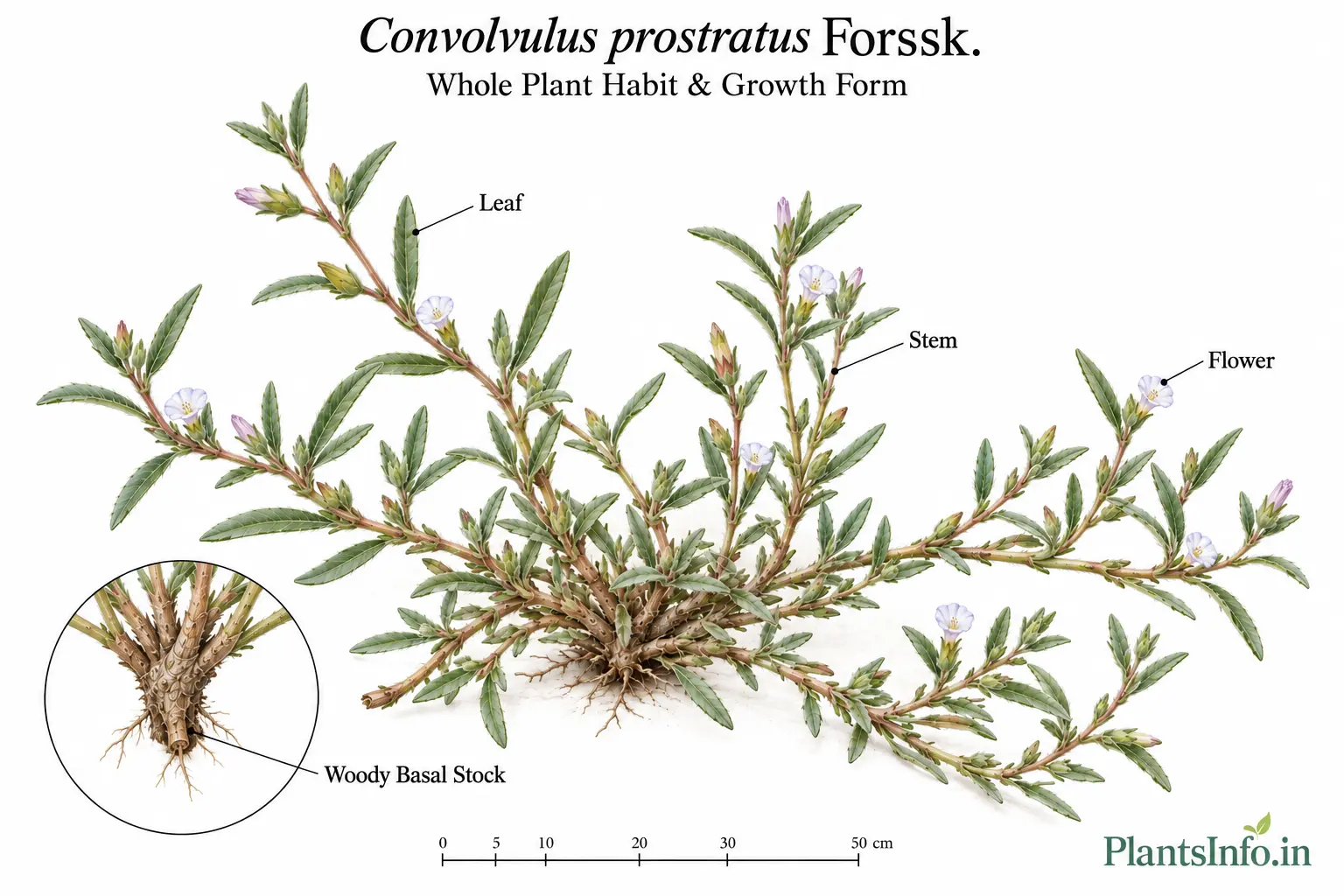
Convolvulus pluricaulis Choisy, treated taxonomically as Convolvulus prostratus Forssk., is a small perennial herb with a woody basal stock and a predominantly prostrate to ascending architecture. Its low, spreading habit and dense indumentum are conspicuous field characters, particularly in dry open habitats. The combination of a woody base, basally branched stems, and hairy surfaces gives the plant a compact, ground-associated appearance rather than the twining architecture characteristic of many other Convolvulus species.
| Field | Value |
|---|---|
| Life form | Perennial herb with a woody base |
| Mature height / stem length | Approximately 10–50 cm |
| Stem type | Prostrate to ascending, basally branched |
| Surface texture | Rufous to fulvous, appressed to spreading pubescent or tomentose |
| Branching pattern | Branching from the woody basal portion |
| Distinguishing architectural feature | Low prostrate-to-ascending habit arising from a woody stock |
Stem
The stems are slender and conspicuously hairy, with the indumentum varying from relatively sparse to dense. Their prostrate or decumbent orientation, combined with ascending terminal portions, contributes substantially to field recognition. The woody basal portion provides a persistent structural base from which the more slender annual-looking branches arise.
| Field | Value |
|---|---|
| Stem type | Slender, prostrate, decumbent to ascending |
| Cross-section shape | Not documented in available literature. |
| Surface texture | Rufous-fulvous, pubescent to tomentose |
| Young/mature colour | Green to rusty/rufous according to available descriptions |
| Thorn/spine/wing status | Not documented in available literature. |
| Internal structure | Not documented in available literature. |
Recommended Products
Disclosure: As an Amazon Associate, PlantsInfo may earn from qualifying purchases.
🌱 Plant Care Essentials
The following tools can help with pruning, plant health, soil management, and fruit garden maintenance.

Neem Oil for Plant Care
Natural plant protection against aphids, whiteflies, mites, and other common garden pests.

Fungicide for Root Care
Helps suppress soil-borne fungal diseases and supports healthier root systems.

Spray Bottle for Plants
Ideal for applying foliar sprays, neem oil solutions, and liquid plant treatments.

Rubber Hand Gloves
Protects hands during pruning, planting, soil preparation, and garden maintenance.
Leaves

The leaves are sessile or nearly sessile and characteristically narrow. Their linear, oblong, oblanceolate or lanceolate forms and conspicuous hair covering distinguish the foliage from the broader, often more variable leaves encountered in several other Convolvulus species. A prominent mid-vein may be visible on the lower surface.
| Field | Value |
|---|---|
| Presence | Present |
| Leaf type | Simple |
| Arrangement | Alternate |
| Attachment | Sessile or subsessile |
| Shape | Linear to oblong, oblanceolate or lanceolate |
| Size | Approximately 6–30 × 1.5–6 mm |
| Colour | Green |
| Surface | Villous to appressed-pubescent |
| Special features | Prominent mid-vein on lower surface; apex subacute to obtuse |
Flowers
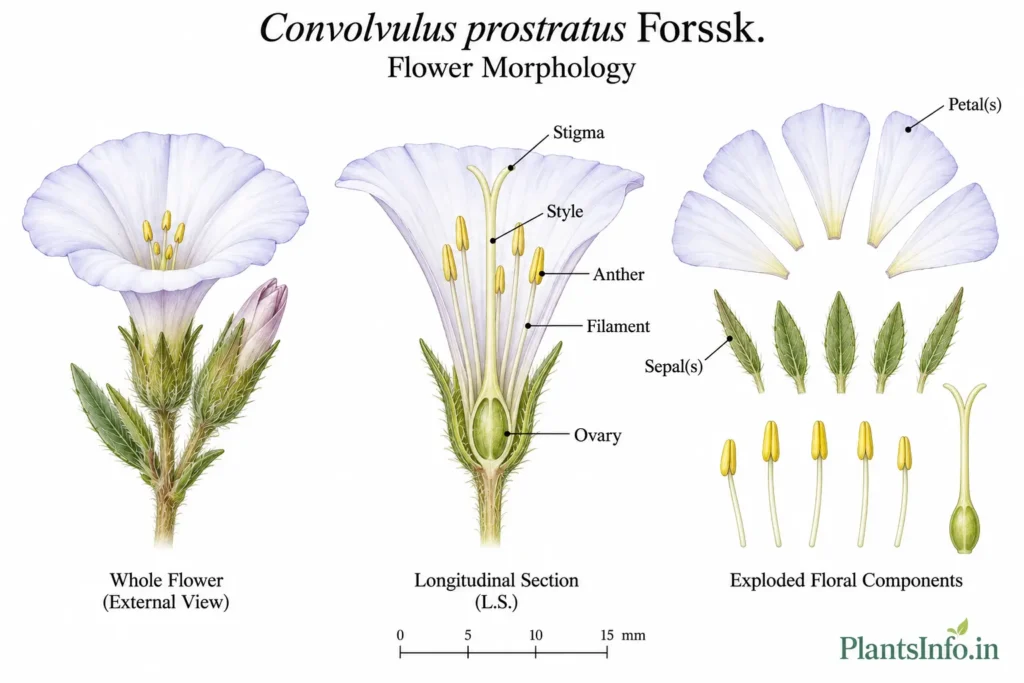
The flowers occur in small axillary groups, commonly as sessile or subsessile heads of a few flowers. The pale corolla contrasts with the hairy calyx and foliage. The funnel-shaped corolla and linear, bifid stigma are useful diagnostic characters within the genus.
| Field | Value |
|---|---|
| Inflorescence | Axillary 1–3(-5)-flowered head or short cyme |
| Corolla length | Approximately 10–13 mm |
| Sepals | Five, unequal, ovate-lanceolate to lanceolate, acuminate and hairy |
| Petals / corolla | Five-lobed, funnel-shaped, white to pale blue or pale pinkish |
| Stamens | Five, inserted in the corolla tube; unequal in documented material |
| Pistil | Single superior ovary with slender style and two linear stigma lobes |
| Fragrance | Not documented in available literature. |
| Anthesis | Not documented in available literature. |
| Primary pollinator identity | Not documented in available literature. |
Fruit

The fruit is a small, dry capsule. Species-specific descriptions agree on a subglobose to ovoid, glabrous capsule with a small number of seeds, although dimensions and dehiscence descriptions vary somewhat among regional floristic treatments.
| Field | Value |
|---|---|
| Fruit type | Capsule |
| Shape | Subglobose to ovoid |
| Diameter | Approximately 3–4 mm |
| Surface | Glabrous |
| Seed count | 2–4 |
| Dehiscence | Four-valved in the Flora of Oman treatment |
Seeds
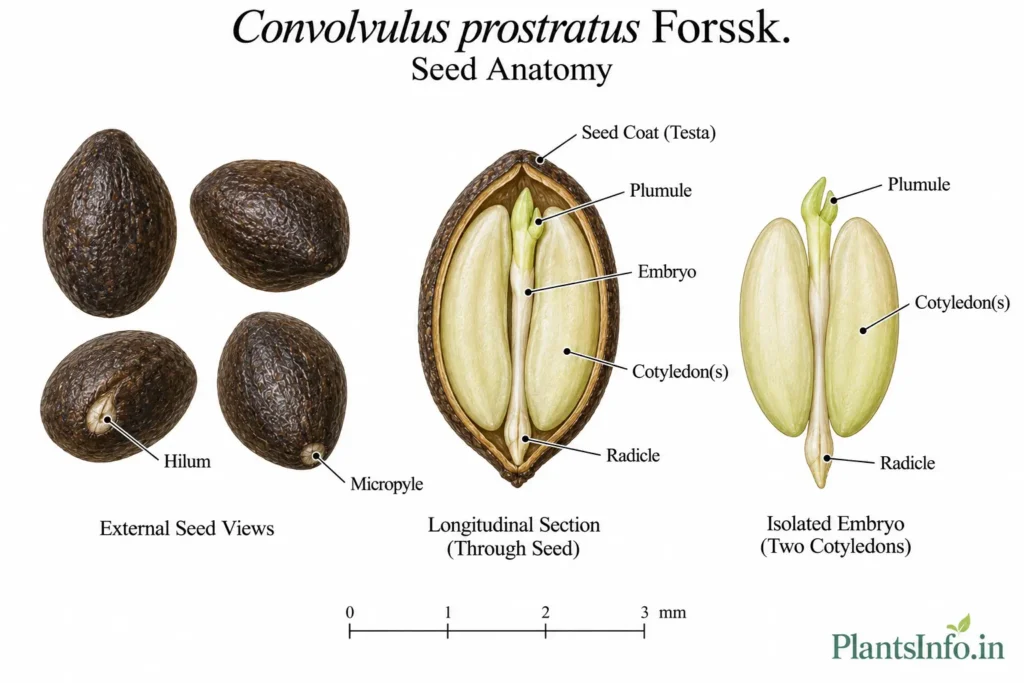
The seeds are small and dark, with a variable degree of surface pubescence reported in regional descriptions. The available evidence does not justify assigning a single uniform seed-surface condition across the entire species.
| Field | Value |
|---|---|
| Size | Approximately 2–2.5 mm long |
| Shape | Not documented consistently at species level. |
| Colour | Brown to dark brown/black |
| Seed coat | Sparsely to densely white-pubescent, or glabrous in some regional descriptions |
Root System
The species develops from a woody basal stock, which is a conspicuous structural feature of the plant. Available floristic descriptions establish the woody basal/rootstock condition but do not provide sufficient species-specific measurements for rooting depth or lateral root spread. The woody base also provides a useful field character when identifying mature plants.
| Field | Value |
|---|---|
| Root architecture | Woody basal stock/rootstock |
| Rooting depth | Not documented in available literature. |
| Lateral spread | Not documented in available literature. |
| Field-observable feature | Persistent woody base with multiple slender stems |
Field Identification
In the field, the combination of a small prostrate-to-ascending perennial herb, woody basal stock, narrow sessile hairy leaves, and small pale funnel-shaped flowers provides the strongest overall recognition pattern. The conspicuous rufous or fulvous indumentum on stems and foliage is particularly useful.
A genuinely relevant comparison is Convolvulus arvensis, which can also have prostrate stems and pale funnel-shaped flowers but generally has a different leaf form and a substantially larger overall flowering architecture. The two species should not be conflated merely because both may occur as low-growing bindweeds.
Single best distinguishing feature: the combination of a woody basal stock with densely hairy, narrow sessile leaves and small axillary pale flowers.
Normal vs. Concerning Observations
| Observation | Status | Notes |
|---|---|---|
| Prostrate or decumbent stems with ascending tips | Normal | Characteristic growth architecture |
| Dense hairs on stems and leaves | Normal | Documented species morphology |
| Woody basal portion | Normal | Characteristic structural feature |
| Small pale flowers in axillary groups | Normal | Consistent with regional floristic descriptions |
| Considerable variation in stem and leaf size | Monitor | Regional floras document morphological variation within the species |
| Unusually different leaf or floral morphology | Investigate | Identification should be reassessed where diagnostic characters fall outside documented variation |
Cultivar Summary
No documented cultivars or named selections identified.
Functional Traits
Species-specific physiological evidence for Convolvulus pluricaulis (currently treated as Convolvulus prostratus) is substantially less developed than its phytochemical literature. The available evidence supports a chemically active perennial adapted to dry environments, but it does not establish a complete species-specific model of photosynthetic pathway, water-use efficiency, nutrient acquisition, or drought physiology. Those traits therefore remain unassigned rather than being inferred from habitat or morphology.
| Trait | Mechanism Description | Ecological Context |
|---|---|---|
| Chemical defence / secondary metabolism | Production and accumulation of structurally diverse secondary metabolites, including alkaloids, phenolics, coumarin derivatives and sterol-related compounds, provides a documented chemical phenotype. | Consistent with a chemically defended perennial occurring in relatively dry open environments, although the ecological defensive function of individual compounds has not been demonstrated directly in this species. |
| Developmentally regulated secondary metabolism | Scopoletin biosynthesis varies with developmental stage and is associated with expression of enzymes in the phenylpropanoid pathway, including feruloyl-CoA 6′-hydroxylase. | Demonstrates that secondary-metabolite production is developmentally regulated rather than chemically static. |
Physiological Integration
The evidence does not currently establish experimentally demonstrated interactions among water-use, nutrient acquisition, photosynthesis, and secondary metabolism in C. pluricaulis. The strongest species-specific physiological finding is instead developmental regulation of scopoletin accumulation: expression of pathway-associated genes and tissue concentrations vary with plant age. This supports regulated metabolic allocation, but does not justify extending the finding into an unverified claim about drought adaptation, resource limitation or whole-plant stress physiology.
Phytochemistry
The phytochemical record is considerably stronger than the broader physiological record. Documented chemistry includes tropane-type alkaloids, coumarins, flavonoids, phenolic compounds, sterols and long-chain aliphatic compounds. Among repeatedly reported constituents are shankhapushpine, convolamine, scopoletin, β-sitosterol and kaempferol. The literature is heterogeneous, however: older phytochemical surveys often compile compounds from extracts or historical reports, whereas more recent analytical studies provide more direct compound-level characterization.
| Compound Class | Representative Compounds | Primary Location | Ecological or Biological Function |
|---|---|---|---|
| Alkaloids | Shankhapushpine; convolamine; convoline; convolidine; convolvine; confoline; convosine | Whole plant; individual compound distribution is incompletely resolved | Biological activity is documented, but species-specific ecological function of individual alkaloids is not established. |
| Coumarins / phenylpropanoids | Scopoletin; scopolin; ayapanin | Whole plant; quantitative tissue distribution demonstrated for scopoletin | Scopoletin biosynthesis is linked to the phenylpropanoid pathway; direct ecological function in C. prostratus remains unconfirmed. |
| Flavonoids | Kaempferol; quercetin | Plant extracts; precise native-organ distribution is incompletely resolved | Antioxidant activity is demonstrated in extracts, but ecological function of individual flavonoids is not species-confirmed. |
| Sterols | β-Sitosterol; phytosterols | Whole-plant extracts | Structural/metabolic sterol functions are established generally, but a species-specific ecological role has not been demonstrated. |
| Long-chain aliphatic compounds | Ceryl alcohol; 20-oxodotriacontanol; tetratriacontanoic acid | Whole plant / non-polar fractions | Species-specific ecological function is not documented. |
The recent whole-plant chemical-characterization literature also identifies additional constituents, including lupeol, campesterol, trans-phytol, and related terpenoid/sterol compounds. These findings expand the known chemical profile but also demonstrate that characterization remains incomplete rather than chemically exhaustive.
Phytochemical Organ Distribution
Direct organ-level quantitative evidence is available, particularly for scopoletin.
| Organ | Compound Class | Representative Compounds | Concentration | Source |
|---|---|---|---|---|
| Root | Coumarin | Scopoletin | Not documented in available literature. | Rafaliya et al., 2021 |
| Stem | Coumarin | Scopoletin | 732 μg/g dry weight at 90 days after sowing | Rafaliya et al., 2021 |
| Leaf | Coumarin | Scopoletin | 650 μg/g dry weight at 90 days after sowing | Rafaliya et al., 2021 |
| Stem | Coumarin | Scopoletin | 110 μg/g dry weight at 45 days after sowing | Rafaliya et al., 2021 |
| Leaf | Coumarin | Scopoletin | 90 μg/g dry weight at 45 days after sowing | Rafaliya et al., 2021 |
The study demonstrates strong developmental and tissue-level variation in scopoletin accumulation. At 90 days, stem and leaf concentrations were substantially higher than at 45 days, with the stem showing the highest measured concentration among the reported tissues.
For the broader phytochemical classes, published literature frequently analyzes whole-plant or aerial-part extracts rather than providing a systematic organ-by-organ chemical map. Consequently, distribution of most individual alkaloids, flavonoids and sterols among root, stem, leaf and reproductive tissues remains incompletely resolved.
Phytochemical Significance
The principal research concentration is on alkaloids, coumarins/phenylpropanoids, flavonoids and sterols, with particular attention to shankhapushpine, scopoletin, kaempferol and β-sitosterol. Scopoletin is the best-characterized compound from the standpoint of developmental and tissue-specific quantification, whereas the broader literature contains a substantially larger catalogue of reported compounds without equivalent quantitative validation.
Characterization is therefore moderately advanced but incomplete. Older studies provide much of the compound inventory, while newer analytical work has expanded the profile using GC-MS, LC-MS and related techniques. Whole-plant extracts remain disproportionately represented, and the chemical literature is heavily concentrated on material identified as C. pluricaulis from South Asian medicinal research. Comparative organ-specific chemistry and geographically replicated metabolomic studies remain limited.
The evidence does not establish experimentally demonstrated synergistic or antagonistic interactions among the principal compounds in the intact plant. Claims that combinations of these constituents act synergistically should therefore be treated as hypotheses rather than established species-level chemistry.
The phytochemical record is also affected by the nomenclatural history of the species: literature indexed under C. pluricaulis and newer literature using C. prostratus may concern the same taxonomic entity. This makes synonym-aware literature retrieval important when assessing the completeness of the chemical record.
Evidence Hierarchy for Medicinal Use
Convolvulus pluricaulis is a medicinal species in the Ayurvedic pharmacopoeial tradition, and the contemporary literature includes preclinical and human clinical research. The evidence should nevertheless be separated by level because traditional recognition and experimental activity do not establish clinical efficacy by themselves.
| Evidence Layer | Status | Notes |
|---|---|---|
| Traditional Use | Documented | The whole plant is documented as Shankhpushpi in Ayurvedic materia medica and the Ayurvedic Pharmacopoeia of India. |
| Nutritional Evidence | Absent | No documented studies at this evidence level. |
| In Vitro Studies | Documented | Cell-based studies report antioxidant and neuroprotective effects of extracts, including effects on oxidative stress and apoptosis-related markers. |
| Animal Studies | Documented | Rodent studies have investigated cognitive, neuroprotective, behavioural and other pharmacological effects. |
| Human Clinical Studies | Partial | Human clinical research exists, including a 2026 randomized controlled pilot trial, but the clinical evidence base remains small. |
| Regulatory Recognition | Documented | The plant is included as Shankhapuspi in the Ayurvedic Pharmacopoeia of India; this is pharmacopoeial recognition within the Indian traditional-medicine system, not equivalent to approval of a modern indication. |
| Unsupported Commercial Claims | Disputed | Commercial and promotional claims extend beyond the strength of the clinical evidence; claims should not be treated as established efficacy without product-specific and indication-specific clinical support. |
Evidence Assessment
The strongest evidence categories are traditional/pharmacopoeial recognition and experimental research, rather than clinical efficacy. In vitro and animal studies provide evidence that extracts or preparations can produce measurable biological effects, but these findings cannot by themselves establish therapeutic benefit in humans.
Human evidence has recently expanded. A 2026 randomized controlled pilot trial enrolled 30 women with posthysterectomy menopausal syndrome, with 15 receiving C. pluricaulis powder and 15 receiving Asparagus racemosus. Both groups showed improvements in several symptom and quality-of-life measures over 45 days, while the difference in serum-estrogen response between groups was not statistically significant. The small sample, short intervention period, and specific clinical population limit generalization.
Accordingly, the existence of human clinical evidence should not be conflated with establishment of efficacy for the numerous neurological, metabolic, cardiovascular, or other indications promoted for Shankhpushpi. Product composition, plant identity, extraction method, and formulation also vary across studies and commercial preparations.
Nutritional Composition
Not applicable as a dedicated food-composition section. Convolvulus pluricaulis is documented principally as a medicinal herb rather than a conventional food species, and the available evidence does not provide a sufficiently standardized species-specific food-composition dataset.
Nutritional Significance
No evidence base was identified that supports treating C. pluricaulis as a nutritionally characterized food crop. Published proximate or physicochemical measurements associated with medicinal-drug authentication should not be converted into a conventional nutritional profile.
Soil Ecology and Mycorrhizal Associations
Species-specific soil-biology evidence is limited. The plant is documented from sandy or rocky, relatively dry habitats, but habitat occurrence does not establish particular microbial associations.
No verified species-specific evidence was identified during the current audit for:
- mycorrhizal type or obligate mycorrhizal dependence;
- particular arbuscular-mycorrhizal fungal genera;
- rhizosphere bacterial communities;
- species-specific bacterial functional roles;
- allelopathic effects attributable to C. pluricaulis;
- a demonstrated phytochemical mechanism of allelopathy.
The evidence therefore supports only a low-resolution soil-ecology characterization. Soil-microbiome and mycorrhizal conclusions should not be extrapolated from other Convolvulaceae species.
Toxicity and Safety
| Subject | Toxic Compounds | Clinical Effects | Source |
|---|---|---|---|
| Humans | No specific toxic compound established as responsible for clinical toxicity | Human safety evidence remains limited; the 2026 pilot clinical study reported no adverse events during its 45-day intervention | Budihal et al., 2026 |
| Cats | No verified species-specific toxicity data identified | No verified toxicity data identified during current audit | No authoritative species-specific source identified |
| Dogs | No verified species-specific toxicity data identified | No verified toxicity data identified during current audit | No authoritative species-specific source identified |
| Livestock | No verified species-specific toxicity data identified | No verified toxicity data identified during current audit | No authoritative species-specific source identified |
Acute oral toxicity studies of C. pluricaulis extracts have been conducted in rodents. Published reviews report no observed toxicity or behavioural changes in Wistar rats at the tested acute oral dose of 5,000 mg/kg for aqueous and ethanolic leaf extracts. These findings are useful as animal safety observations but should not be interpreted as establishing human safety at an equivalent dose.
A separate study involving C. pluricaulis-associated iron-oxide nanoparticles reported a maximum tolerated dose of 2,000 mg/kg in mice without observed clinical toxicity. Because that preparation contains nanoparticles rather than being a conventional whole-plant preparation, it should not be used as direct evidence for the safety of ordinary C. pluricaulis preparations.
Toxicity Context
The available toxicity evidence is preclinical and preparation-specific. Rodent acute-toxicity observations provide some evidence against overt acute toxicity under the tested experimental conditions, but they do not establish chronic safety, reproductive safety, or safety across all preparations.
Human safety evidence is comparatively sparse. The 2026 pilot trial reported no adverse events among its 15 participants receiving C. pluricaulis powder for 45 days, but this sample is too small and the exposure too short to characterize uncommon or long-term adverse effects.
No adequately established species-specific evidence was identified during this audit for:
- dose-dependent human toxicity across different preparations;
- pregnancy or lactation safety;
- clinically established drug interactions;
- safety in renal impairment;
- safety in hepatic impairment;
- safety in cats, dogs or livestock.
The presence of pharmacologically active alkaloids and other secondary metabolites also means that absence of demonstrated toxicity should not be interpreted as proof of universal safety.
This profile does not constitute medical or veterinary advice.
Biogeographic Context
Convolvulus pluricaulis Choisy is treated by current Kew nomenclature as Convolvulus prostratus Forssk. Its documented native range extends from Cape Verde across northern and northeastern Africa, the Arabian Peninsula and western Asia to the Indian subcontinent, including northwestern India. Regional floras associate the species primarily with dry and xeric environments, including sandy and stony ground, desert margins and other open habitats.
The documented distribution therefore spans a broad belt of seasonally dry to arid environments extending across the Saharo-Arabian and Indo-Iranian regions. However, the available literature does not provide a sufficiently resolved species-specific model separating the contributions of temperature, rainfall, substrate, elevation and disturbance to the limits of the native range.
Nomenclatural history is also relevant to interpretation of the evidence base. A substantial body of South Asian medicinal literature uses the name C. pluricaulis, whereas current taxonomic databases treat that name as a synonym of C. prostratus. Historical floras have differed in their treatment of the name. Consequently, records under the two names should be considered together when assessing the available species-level literature, while retaining the taxonomic identity used by each source.
| Region | Countries or sub-regions | Notes |
|---|---|---|
| Macaronesia / Atlantic Africa | Cape Verde | Documented native range |
| North Africa | Algeria, Egypt, Libya, Morocco, Mauritania, Niger, Senegal | Dry and desert-region distribution |
| West and northeastern Africa | Burkina Faso, Chad, Djibouti, Somalia, Sudan and South Sudan | Documented native-range records |
| Arabian Peninsula | Gulf States, Oman, Saudi Arabia, Yemen | Broad Arabian distribution in dry habitats |
| Western Asia | Afghanistan, Iran, Iraq, Sinai | Documented native-range records |
| Indian subcontinent | India, Pakistan, West Himalaya | Eastern portion of the documented native range |
The precise boundaries of the native range vary among regional databases, but the principal modern taxonomic treatment places the species from Cape Verde to northwestern India.
Global Cultivation and Naturalisation
The species is cultivated as a medicinal plant in India. Available evidence is concentrated on South Asia and does not support a reliable global cultivation or production map. In Rajasthan, medicinal-plant studies document both wild collection and farmer cultivation within the Shankhpushpi value chain.
| Region | Country or area | Cultivation status | Notes |
|---|---|---|---|
| South Asia | India | Documented | Medicinal cultivation and wild collection are documented, with evidence particularly concentrated in Rajasthan and other Indian production areas. |
Evidence for systematic cultivation outside India is insufficient in the available material to establish a comparable cultivation industry or production geography.
Cultivation Range Note: The available evidence is strongly concentrated on India, particularly medicinal-plant production and collection. The evidence base for cultivation outside South Asia is substantially thinner.
Natural Habitat
The species occurs primarily in desert, dry-shrubland and other xeric open habitats. Regional descriptions record it from dry sandy and stony ground, desert margins and other open sites. In Oman, documented occurrences extend across approximately 50–700 m elevation, while other records include lowland and foothill environments.
Documented substrates include sandy and stony ground. Indian observations also record the species in black-soil environments, indicating that its recorded habitat is not restricted to a single substrate type.
The available evidence therefore indicates a species associated broadly with dry, open environments across a range of recorded substrates rather than one restricted to a single substrate class. Evidence remains insufficient to define a species-specific disturbance response or to establish the relative importance of individual environmental factors in determining habitat occupancy.
Ecological Role
Species-specific ecosystem-level studies are limited. The strongest evidence concerns occurrence and interactions associated with flowering rather than quantified ecosystem function.
| Role Type | Species or Agent Involved | Notes |
|---|---|---|
| Floral resource | Butterflies | Field observations from Rajasthan record butterflies using the small ground-level flowers of C. prostratus in post-rainfall conditions. The observations do not establish a complete pollination network. |
| Ground-layer flowering resource | Unresolved insect assemblage | The species flowers within dry open vegetation and is observed among other post-rainfall ground flowers, but the identities and importance of individual floral visitors are not sufficiently resolved. |
Invasive Status
No documented naturalisation outside the established native range was identified during the current audit. No invasive-status assessment can therefore be made beyond the absence of a verified naturalisation record.
Optimal Climate Parameters
| Parameter | Optimal Range | Tolerance Range | Notes |
|---|---|---|---|
| Mean Annual Temperature | Not documented in the available literature | Not documented in the available literature | Species-specific cultivation sources report growing-season temperatures rather than a verified mean annual optimum. |
| Annual Rainfall | 850–1,300 mm (33.5–51.2 in) | Not documented in the available literature | Reported as suitable for cultivation; this value should not be interpreted as the full native climatic range or as a species-wide rainfall requirement. |
| Day Temperature | 30–35 °C (86–95 °F) | Not documented in the available literature | Reported cultivation range; the source does not constitute an experimental species-wide temperature-tolerance study. |
| Night Temperature | Not documented in the available literature | Not documented in the available literature | No sufficiently authoritative species-specific night-temperature optimum or tolerance range was identified. |
The documented natural range extends into substantially drier environments than the reported 850–1,300 mm cultivation envelope, including desert and arid regions. Accordingly, the cultivation rainfall figure should be interpreted as a reported cultivation condition, not as a minimum rainfall requirement or a representation of the species’ native climatic range.
Climate Interpretation
The strongest biogeographic signal is association with dry environments, rather than a precisely defined temperature or precipitation optimum. The species occurs from desert margins and dry shrublands through somewhat wetter Indian environments, indicating a broader realized climatic envelope than the limited cultivation figures suggest.
The principal evidence gap is quantitative: a validated global climate envelope separating optimum conditions from survival limits has not been established. Consequently, precise thermal or rainfall thresholds should not be inferred from occurrence records.
Stress Tolerance Profile
Species-specific experimental stress physiology remains limited. Evidence from habitat occurrence supports drought-associated persistence, while landscape and horticultural sources provide additional but lower-resolution evidence for desiccation and salinity tolerance.
| Stress Type | Tolerance Level | Physiological Response | Notes |
|---|---|---|---|
| Water deficit / desiccation | Supported | A specific physiological mechanism is not sufficiently documented; persistence in arid and desert environments provides ecological support for tolerance. | Species occurs naturally in dry sandy and stony habitats and desert margins. |
| Salinity | Conditional | Not sufficiently documented at physiological-mechanism level. | Horticultural literature reports high salinity tolerance, but an experimentally validated species-specific physiological response was not established during this audit. |
| Waterlogging | Conditional | Not sufficiently documented. | Horticultural sources describe vulnerability to stagnant water, but the physiological mechanism is not established. |
Compound Stress Assessment
No species-specific experimental study was identified that adequately characterizes combined stresses such as drought plus heat, drought plus salinity, or heat plus nutrient limitation.
The occurrence of C. prostratus in hot, dry environments demonstrates ecological persistence under naturally combined climatic pressures, but this should not be converted into a mechanistic claim about combined-stress tolerance. The interaction between individual stress responses remains a knowledge gap.
Structural and Physiological Adaptations
The available species-specific evidence does not establish enough detail to designate particular morphological characters as demonstrated evolutionary adaptations rather than functional traits. The woody basal stock and dense pubescence are associated with a plant occurring in dry habitats, but a direct experimental demonstration of their adaptive contribution to water conservation or thermal buffering was not identified. They therefore remain structural characters rather than being promoted here to verified adaptations.
Climate Change Vulnerability
A species-specific climate-vulnerability model or quantitative projection was not identified. The assessment below is therefore qualitative and based on documented habitat, broad geographic distribution, and known climatic associations rather than a scored vulnerability model.
| Factor | Assessment | Notes |
|---|---|---|
| Primary Climate Sensitivity Factors | Qualitative: precipitation regime and temperature extremes | The species is associated with desert and dry-shrubland environments, but species-specific climatic thresholds are not established. |
| Key Threatening Climate Processes | Qualitative: altered rainfall seasonality and increased climatic extremes | These processes could affect phenology and reproductive timing, but a species-specific impact model was not identified. |
| Resilience Factors | Qualitative: broad geographic and habitat distribution | The documented range extends from Cape Verde to northwestern India and includes multiple dry-habitat settings. This suggests geographic breadth, but does not establish future climate resilience. |
| Confidence Level | Low to moderate | Based primarily on distributional and phenological observations; no verified species-specific climate-vulnerability model was identified. |
Phenological Calendar
Phenology varies geographically. Regional sources report flowering and fruiting from September–November in Oman, October–December in an Indian agricultural bulletin, November–March in Maharashtra, and March–May in the United Arab Emirates. These differences should not be collapsed into a single universal flowering season.
| Event | Native Range Timing | Cultivated Range Timing | Environmental Triggers |
|---|---|---|---|
| Vegetative Growth Onset | Not documented consistently at species level. | Not documented in available literature. | No specific temperature, photoperiod or rainfall threshold documented. |
| Flower Bud Initiation | Not documented separately from flowering. | Not documented separately from flowering. | No specific trigger documented. |
| Anthesis or Peak Flowering | Regionally variable: September–November in Oman; November–March in Maharashtra; March–May in UAE; October–December in an Indian production source. | October is reported for cultivated medicinal material in an Indian government medicinal-plant source. | A specific environmental threshold is not documented. |
| Fruit Development | Regionally overlaps the flowering period; precise developmental interval is not established. | Seeds are reported to develop by December in one Indian cultivation account. | No specific trigger documented. |
| Fruit Maturation | Not documented as a separately measured phenological phase. | December is reported for seed development in one Indian cultivation account. | No specific trigger documented. |
| Seed Dispersal | Not documented in sufficient species-specific detail. | Not documented in available literature. | No specific trigger documented. |
| Dormancy or Rest Period | Not documented as a defined physiological phase. | Not documented in available literature. | No specific trigger documented. |
Phenological Notes
The available evidence demonstrates substantial geographic variation in the apparent flowering window. This may reflect climatic differences, regional phenological plasticity, taxonomic recording differences, or differences in observation period. The evidence is insufficient to assign a single rainfall or temperature trigger.
Pollination Ecology
The flowers are bisexual and have a funnel-shaped corolla with five epipetalous stamens and a bifid/filiform stigma. These characters establish the floral architecture but do not, by themselves, establish a particular pollination syndrome or pollinator. No species-specific pollinator study adequate for identifying a primary pollinator was identified during this turn.
| Parameter | Value | Notes |
|---|---|---|
| Primary Pollinators | Not documented in available literature. | No species-level pollinator identity verified. |
| Secondary Pollinators | Not documented in available literature. | No species-level secondary pollinator identity verified. |
| Pollination Syndrome | Not established at species level. | Floral morphology alone is insufficient to assign a verified syndrome. |
| Floral Mechanism | Funnel-shaped corolla with epipetalous stamens and a bifid/filiform stigma | The physical consequences for pollen transfer have not been experimentally established. |
| Reproductive System | Bisexual flowers; breeding system not established | Presence of both androecium and gynoecium is documented; self-compatibility/outcrossing status remains unresolved. |
| Seed Dispersal Agent | Not documented in available literature. | No verified animal or abiotic dispersal agent identified. |
| Reproductive Evidence Status | Conditional | Floral and fruit morphology are well documented, but pollinator identity and breeding-system experiments are lacking. |
| Human Intervention | Not documented for pollination | No species-specific evidence establishing assisted-pollination biology was identified. |
Pollination Context
Self-compatibility, obligate outcrossing, and autonomous self-pollination have not been sufficiently established for the species. Consequently, pollinator-decline effects cannot be quantified. Biological feasibility of assisted pollination also remains untested in the evidence reviewed here.
Seed Biology and Germination
The species produces small dark seeds in dry capsules. The strongest available germination evidence is operational rather than physiological: an Indian medicinal-plant production source reports seedling emergence within approximately 30 days. This establishes a documented emergence period under that production context but does not establish an optimal germination temperature or a universal germination rate.
| Parameter | Value | Notes |
|---|---|---|
| Seed Type | Verified — sexually produced seed | Seeds develop within a dry capsule; approximately 2–4 seeds are reported per capsule. |
| Dormancy Class | Not documented in available literature. | No verified physiological dormancy classification identified. |
| Dormancy-Breaking Requirement | Not documented in available literature. | No species-specific requirement verified. |
| Optimal Germination Temperature | Not documented in available literature. | No experimentally established optimum identified. |
| Germination Rate | Not documented in available literature. | No sufficiently verified species-specific percentage identified. |
| Germination Period | Supported — seedlings reported within approximately 30 days | Reported in an Indian medicinal-plant production account; this is not a controlled species-wide germination study. |
| Storage Behaviour | Not documented in available literature. | No verified orthodox/intermediate/recalcitrant classification identified. |
| Seed Longevity | Not documented in available literature. | No verified longevity study identified. |
Germination Notes
The available evidence is insufficient to distinguish physiological dormancy from simply variable germination under different environmental conditions. Wild-versus-cultivated differences in germination performance have likewise not been adequately quantified. The approximately 30-day emergence observation should therefore remain context-specific rather than being treated as a universal germination period.
Vegetative Reproduction
Laboratory tissue-culture studies demonstrate that C. pluricaulis can regenerate shoots from cultured explants and can produce somatic embryos. These findings establish in vitro regenerative capacity, but they do not demonstrate that vegetative reproduction is an important natural regeneration mechanism in wild populations.
| Parameter | Value | Notes |
|---|---|---|
| Vegetative Regeneration Capacity | Verified in vitro | Shoot regeneration and somatic embryogenesis have been demonstrated from cultured explants. |
| Primary Regeneration Mechanism | Conditional — tissue-culture regeneration documented | Leaf and nodal/cotyledonary explants have produced regenerated shoots under experimental culture conditions; natural field dominance of this mechanism is not established. |
| Minimum Propagule Size | Not documented in available literature. | No minimum naturally viable propagule size identified. |
| Ecological or Invasive Significance | Not established | In vitro regeneration demonstrates experimental regenerative capacity but does not establish invasive potential or a significant natural clonal strategy. |
Economic Importance
Convolvulus pluricaulis is documented primarily as a medicinal plant associated with the Ayurvedic drug Śaṅkhapuṣpī (Shankhpushpi). The Ayurvedic Pharmacopoeia of India identifies the whole plant as the botanical source of Śaṅkhapuṣpī, while current botanical nomenclature treats Convolvulus prostratus Forssk. as the accepted name corresponding to the historical literature using C. pluricaulis.
| Use Category | Description | Economic significance |
|---|---|---|
| Ayurvedic medicinal raw material | The whole plant is documented as the botanical source of Śaṅkhapuṣpī in the Ayurvedic Pharmacopoeia. | Documented medicinal raw-material value; the species enters herbal and pharmaceutical supply chains. |
| Wild-collected medicinal material | A value-chain study from Barmer, Rajasthan, documented collection of naturally occurring material by local households, followed by sale through local traders to larger traders and pharmaceutical companies. | Documented local livelihood and commercial value within the studied regional supply chain. |
| Cultivated medicinal crop | Cultivation is documented in parts of western Rajasthan, while wild collection remains important in the documented Barmer system. | Regional cultivation value documented; the available evidence does not establish national production scale. |
| Commercial pharmaceutical supply | The Barmer value-chain study documents onward movement of material from larger traders to pharmaceutical companies and reports export in some cases. | A documented commercial pathway, but species-specific national export volume and monetary value were not identified. |
| Market authentication and adulteration | The Shankhpushpi trade involves substitution concerns because the vernacular drug name has historically been applied to more than one botanical species. Authentication studies distinguish C. pluricaulis from substitute taxa. | Quality-control and supply-chain significance; authentication is relevant to the identity and reliability of commercial raw material. |
Economic Assessment
Medicinal use is the principal documented economic role of C. pluricaulis. Commercial evidence is strongest at the regional level, particularly for Indian medicinal-plant supply chains and the documented Rajasthan value chain. National production, total trade volume, and species-specific market value remain insufficiently quantified in the available evidence.
The Indian Ministry of AYUSH’s e-Charak database also lists C. pluricaulis aerial parts among medicinal-plant commodities, providing evidence that the species is represented within a formal medicinal-raw-material market.
Traditional Uses
| Use Category | Knowledge system | Region or cultural group | Practice summary | Documentation level |
|---|---|---|---|---|
| Medhya Rasayana / cognitive and nervous-system use | Ayurveda | Indian Ayurvedic tradition | Śaṅkhapuṣpī is documented as an Ayurvedic medicinal plant associated with intellect, memory and nervous-system applications. | Documented |
| Neurological and mental-health applications | Ayurveda | Indian Ayurvedic tradition | Traditional indications include epilepsy, anxiety, sleeplessness and related nervous-system disorders. | Documented |
| Respiratory use | Ayurveda | Indian Ayurvedic tradition | Traditional formulations include use for chronic cough and bronchial complaints. | Documented |
| Liver-related use | Ayurveda and other Indian indigenous medical traditions | Indian subcontinent | Historical literature records use in liver-related disorders. | Supported |
| Digestive and other systemic applications | Ayurveda | Indian Ayurvedic tradition | Historical sources describe additional applications, including dysentery and appetite-related uses. | Supported |
| Shankhpushpi under an ambiguous vernacular identity | South Asian traditional medical practice | Indian subcontinent | The name Shankhpushpi has historically been applied to several botanically distinct taxa, including C. pluricaulis, Evolvulus alsinoides, Clitoria ternatea and Canscora decussata. | Documented ambiguity |
Taxonomic Qualification of Traditional-Use Evidence
Traditional-use records involving the name Shankhpushpi cannot automatically be interpreted as species-specific evidence for C. pluricaulis. The vernacular drug name has historically been applied to several botanically distinct taxa. Consequently, traditional indications should be treated as species-specific only where the underlying source explicitly identifies C. pluricaulis or its accepted synonym C. prostratus as the botanical material.
This qualification is particularly important when interpreting historical medicinal literature, pharmacological studies, and commercial material labelled as Shankhpushpi. Botanical authentication is therefore a necessary part of assessing the evidence attributable specifically to C. pluricaulis.
Traditional Use Summary
The principal documented knowledge system is Ayurveda, in which C. pluricaulis is identified as a botanical source of Śaṅkhapuṣpī. The strongest geographic documentation is from the Indian subcontinent, particularly within Ayurvedic medicinal practice and Indian medicinal-plant supply chains.
The traditional-use evidence should nevertheless be interpreted with taxonomic caution. Historical use of the vernacular name Śaṅkhapuṣpī encompasses several species, so records lacking explicit botanical identification cannot be assigned to C. pluricaulis with certainty. This taxonomic ambiguity also contributes to documented substitution and authentication concerns in the medicinal raw-material supply chain.
Regional Ethnobotanical Context
The plant occupies a distinctive position at the intersection of traditional botanical nomenclature and modern pharmaceutical standardization. Historical Ayurvedic terminology predates modern botanical nomenclature, and the name Śaṅkhapuṣpī has subsequently been associated with several species. Comparative pharmacognostic work specifically identified this ambiguity as a problem in interpreting historical drug descriptions and in authenticating commercial material.
In western Rajasthan, the ethnobotanical relationship is also linked to landscape availability: the Barmer value-chain study documented the plant as naturally occurring and locally collected, with households entering the medicinal-plant market through local traders. Cultivation subsequently became part of the regional production system.
Traditional Ecological Knowledge
No sufficiently documented species-specific traditional ecological knowledge concerning agroforestry, living fences, ecological indicators or formal landscape-management practices was identified.
Ethical Considerations
The principal documented ethical and supply-chain concerns are knowledge attribution, botanical authentication, and resource pressure associated with medicinal demand. A peer-reviewed population study reported over-exploitation associated with demand for Shankhpushpi and documented the sale of unrelated plants under the same commercial name.
The evidence also supports a benefit-sharing consideration where commercial use derives from longstanding Ayurvedic knowledge, although a species-specific documented biopiracy or intellectual-property dispute was not identified in the reviewed literature.
Cultural Significance
Shankhpushpi has documented cultural significance within Ayurveda beyond its status as a raw medicinal commodity. The Sanskrit name refers to the conch-like form of the flowers, and Shankhpushpi is described within the Ayurvedic tradition as a Medhya Rasayana. The term therefore carries both botanical and traditional-medical meaning.
Cultivation Summary
C. pluricaulis is biologically amenable to cultivation and has been cultivated commercially in western Rajasthan. It can also occur naturally on relatively dry and otherwise marginal land. A documented Rajasthan value-chain study describes both wild collection and farmer cultivation, with organized procurement involving traders and pharmaceutical companies.
Cultivation is not restricted to a single production system: recent Indian agricultural research has also obtained seed material from Rajasthan for controlled cultivation experiments.
The available evidence supports cultivation feasibility, but does not justify treating one cultivation regime as universally optimal. Detailed propagation, planting density, irrigation, fertilization, and harvest procedures are outside this section.
Pest, Disease and Physiological Burden Summary
Species-specific evidence for major pests and diseases is limited. The Barmer value-chain literature identifies grazing by sheep and goats as a practical biological burden in the local production context; local farmers reportedly cited grazing as one reason for not cultivating the plant traditionally.
No sufficiently robust species-specific dataset was identified establishing a ranked set of major pathogens, insect pests, or physiological disorders. Accordingly, generic pest and disease records for other Convolvulus species are not transferred to this profile.
Failure Points and Commercial Risks
The documented commercial vulnerabilities are principally supply-chain organization, raw-material authentication, and dependence on naturally occurring populations.
The Barmer value-chain study identified an initially unorganized market, limited farmer-level aggregation, high seed costs, and weak backward linkages as production-stage constraints. It also documented movement of material through local and district-level traders before reaching pharmaceutical companies.
A second major vulnerability is identity substitution. Molecular studies found that commercial samples sold as Shankhpushpi can represent different botanical species, making authentication a substantive quality-control issue rather than merely a nomenclatural concern.
Conservation Analysis
Convolvulus pluricaulis Choisy is currently treated by Kew as a synonym of the accepted name Convolvulus prostratus Forssk. The documented native range extends from Cape Verde to northwestern India, with the species occurring principally in desert, dry-shrubland and other dry open habitats.
The available evidence does not establish that the species is globally rare or geographically restricted. Conversely, the presence of cultivated or commercially traded material cannot be taken as evidence that wild populations are secure. The evidence assembled for this profile is insufficient to quantify total wild-population size, population trajectory, range-wide harvesting intensity, genetic erosion or habitat-specific population decline.
The principal unresolved conservation question is therefore whether geographically distinct wild populations are being maintained with adequate demographic and genetic representation. This question is particularly relevant because medicinal research and commercial documentation have historically concentrated on Indian material, whereas the accepted species concept encompasses populations across Africa, Arabia and western Asia.
Conservation Status
| Parameter | Value | Notes |
|---|---|---|
| IUCN Red List category | No species-level assessment located | A species-specific IUCN assessment for C. prostratus was not located during the current audit. This absence should not be interpreted as an IUCN category assignment. |
| Population trend | Not documented | No sufficiently broad species-level population-monitoring dataset was identified. |
| Primary conservation concern | Wild-harvest and habitat-pressure risk insufficiently quantified | Medicinal collection and commercial demand are documented, but their range-wide effects on wild populations have not been quantified. |
| Major conservation approach | Population monitoring and authenticated germplasm conservation | No species-specific conservation programme or formal recovery plan was identified. The available evidence supports improved population-level information and preservation of authenticated material, rather than a defined recovery prescription. |
| IUCN source | Assessment status not established at species level | The IUCN Red List was consulted during the audit, but no species-specific assessment was located. |
| Access date | 2026-09-22 | Current audit date. |
Kew currently accepts C. prostratus and lists C. pluricaulis among its synonyms. World Flora Online likewise retains the historical C. pluricaulis name in its taxonomic record. These taxonomic records establish the nomenclatural relationship but do not establish a species-level conservation category. No species-level IUCN conservation category was identified during the current audit.
Conservation Risk Factors
| Risk Factor | Evidence status | Assessment |
|---|---|---|
| Wild medicinal harvesting | Documented concern | Commercial medicinal collection and reported over-exploitation have been documented for Indian material; the extent and population-level consequences across the full range remain unresolved. |
| Habitat disturbance | Unquantified | The species occupies dry open habitats, but range-wide effects of habitat loss or alteration have not been quantified. |
| Commercial demand | Documented concern | Medicinal demand is established, while its effect on long-term wild-population viability remains unresolved. |
| Taxonomic and raw-material substitution | Documented quality-control concern | Multiple taxa have historically been traded under the Shankhpushpi name, complicating identification of the biological material entering commerce. |
| Population-level genetic information | Unquantified concern | Genetic information is available for selected material, but range-wide population structure and the distinctiveness of potential conservation units remain insufficiently resolved. |
Conservation Assessment
The available evidence supports a data-limited conservation assessment, rather than a demonstrated secure or threatened status. This wording describes the evidence base and does not constitute an IUCN Red List category.
The broad documented distribution provides no basis for treating the species as inherently range-restricted. At the same time, documented medicinal collection demonstrates that wild populations can experience direct human pressure at least in parts of the range.
The principal evidence gap is population-level information. It is currently insufficient to determine whether collection pressure is sustainable across different regions, whether particular populations are declining, or whether geographically separated populations contain distinctive genetic variation that would warrant separate conservation attention.
Cultivation provides an additional source of plant material but should not be interpreted as a substitute for assessment of wild populations. Germplasm conservation is also complicated by the historical application of the Shankhpushpi name to multiple botanical species.
Research Coverage and Knowledge Gaps
| Research Topic | Coverage Level | Key Gaps | Priority |
|---|---|---|---|
| Taxonomy and nomenclature | Strong | Resolution of historical synonym usage in applied literature | Medium |
| Morphology | Strong | Population-level morphological variation | Medium |
| Cytogenetics | Partial | Geographic distribution of reported cytotypes and modern comparative cytogenetics | High |
| Phytochemistry | Strong but geographically concentrated | Range-wide metabolomic variation and authenticated population comparisons | High |
| Pharmacology | Strong preclinical coverage | Mechanistic validation and standardized preparations | High |
| Human clinical research | Limited | Larger controlled studies and longer follow-up | High |
| Ecology | Partial | Population ecology and species interactions | High |
| Phenology | Partial | Geographic phenological datasets and environmental triggers | Medium |
| Pollination and reproductive biology | Weak | Pollinator identity, breeding system and reproductive success | High |
| Seed biology | Weak | Dormancy, storage behaviour, longevity and controlled germination studies | High |
| Vegetative regeneration | Partial | Natural clonal or regenerative contribution versus demonstrated in vitro capacity | Medium |
| Ethnobotany | Strong in South Asia | Cross-range ethnobotanical comparison and historical taxonomic reconciliation | Medium |
| Conservation biology | Weak | Population size, population trend, harvest impact and formal threat assessment | Very high |
| Cultivation biology | Partial | Genotype × environment response and authenticated planting material | High |
Research Landscape
Research on C. pluricaulis is substantially concentrated on its medicinal, phytochemical and pharmacological dimensions, particularly in India. Reviews describe a comparatively extensive preclinical literature but continue to identify deficiencies in detailed clinical investigation and mechanistic studies.
The geographic concentration has an important reliability implication: conclusions about phytochemistry, ethnobotany, cultivation and medicinal activity are disproportionately informed by South Asian material. By contrast, the accepted species occupies a much wider African–Arabian–South Asian range.
Research outside the medicinal domain is comparatively sparse. Population monitoring, pollination ecology, seed ecology, reproductive biology and conservation genetics are not represented by evidence of comparable depth. The literature therefore gives a much more detailed picture of what the plant has been investigated for than of its ecological functioning or population dynamics.
Priority Knowledge Gaps
- Range-wide population assessment using authenticated C. prostratus material.
- Population genetics across the native range, including comparison of geographically separated populations.
- Harvest-impact studies linking collection intensity with population regeneration.
- Formal conservation assessment based on population and distribution data.
- Species-specific pollinator identification and breeding-system experiments.
- Seed dormancy, storage, and longevity studies using authenticated seed lots.
- Modern cytogenetic comparison of the reported chromosome-number variation.
- Cross-regional metabolomic studies separating geographic variation from taxonomic substitution.
- Climate-response studies linking phenology and reproductive output to environmental variables.
- Taxonomically authenticated clinical research using chemically characterized material.
Interesting Facts
- The name Convolvulus pluricaulis remains highly prominent in medicinal literature even though Kew currently accepts Convolvulus prostratus Forssk. as the species name.
- C. pluricaulis is therefore simultaneously a historical botanical name, a major medicinal-literature name, and a synonym under the current Kew taxonomic treatment.
- The species has an unusually broad documented native range for a plant whose modern applied literature is heavily concentrated in South Asia.
- Historical Shankhpushpi usage encompasses more than one botanical species, creating a recurring authentication problem in ethnobotanical and pharmacological literature.
- Cytogenetic literature has reported more than one chromosome number for material assigned to this species, making geographic and taxonomic interpretation of cytotypes an unresolved research issue.
- The species combines a dry-habitat distribution with a substantial body of research devoted to medicinal chemistry and neuropharmacology.
Frequently Asked Questions
What is the accepted scientific name?
The current Kew treatment accepts Convolvulus prostratus Forssk. and treats Convolvulus pluricaulis Choisy as a synonym. The latter name remains widely used in medicinal literature.
Is Convolvulus pluricaulis formally listed as threatened?
No species-level IUCN Red List assessment was located during this audit. That absence should not be interpreted as evidence that the species is secure.
Where is the species native?
Its documented native range extends from Cape Verde through parts of Africa, the Arabian Peninsula and western Asia to northwestern India.
What is the main human use?
Its principal documented human use is as the Ayurvedic medicinal plant known as Śaṅkhapuṣpī or Shankhpushpi.
Is the Shankhpushpi name botanically unambiguous?
No. Historical and commercial usage has applied the name to several different plant species, making botanical authentication important.
Are its medicinal effects clinically established?
The profile contains substantial preclinical research but substantially less controlled human evidence. Reviews specifically identify the need for more detailed clinical and mechanistic studies.
Are its pollinators known?
No sufficiently strong species-specific evidence was identified establishing a primary pollinator.
Is its conservation status known?
A formal species-level IUCN assessment was not located, and population trends are insufficiently documented.
Conclusion
Convolvulus pluricaulis is a medicinally important South Asian plant whose current accepted taxonomic identity is Convolvulus prostratus Forssk. Its broad native distribution, dry-habitat ecology, distinctive medicinal history and extensive phytochemical and pharmacological literature make it scientifically well represented in some domains, while reproductive ecology, population biology and conservation remain comparatively poorly resolved.
The strongest evidence base concerns taxonomy, morphology, phytochemistry, traditional medicinal use and preclinical pharmacology. The principal uncertainties concern wild-population status, geographic genetic structure, reproductive biology, pollination, seed ecology and the relationship between commercial demand and wild-population persistence.
Taken as a whole, the profile therefore supports a species with substantial documented medicinal and scientific importance but an uneven evidence base. The remaining research agenda is weighted toward authenticated population-level ecology and conservation biology, while continued taxonomic discipline is necessary because the historical C. pluricaulis name and the vernacular Shankhpushpi identity occur across a literature that does not always distinguish botanical entities consistently.
Consolidated References
A. Primary Taxonomic Sources
- Choisy, J.D. (1833 [published 1834]). Convolvulus pluricaulis Choisy. Mémoires de la Société de Physique et d’Histoire Naturelle de Genève 6: 477.
- Forsskål, P. (1775). Convolvulus prostratus Forssk. Flora Aegyptiaco-Arabica: 203.
- Wood, J.R.I., Williams, B.R.M., Mitchell, T.C., Carine, M.A., Harris, D.J. & Scotland, R.W. (2015). A foundation monograph of Convolvulus (Convolvulaceae). PhytoKeys 51: 1–282. DOI: 10.3897/phytokeys.51.7104.
B. Peer-Reviewed Literature
- Balkrishna, A., Thakur, P. & Varshney, A.V. (2020). Phytochemical profile, pharmacological attributes and medicinal properties of Convolvulus prostratus – a cognitive enhancer herb for the management of neurodegenerative etiologies. Frontiers in Pharmacology 11: 171. DOI: 10.3389/fphar.2020.00171.
- Gupta, J.K., Verma, J., Khandelwal, G., Singh, K. & Singh, K. (2023). The pharmacological significance of Convolvulus prostratus: modern perspectives of an ancient herb. Current Indian Science 1: e2210299X264928. DOI: 10.2174/012210299X264928231020123247.
- Ganie, S.H., Ali, Z., Das, S., Srivastava, P.S. & Sharma, M.P. (2015). Genetic diversity and chemical profiling of different populations of Convolvulus pluricaulis (Convolvulaceae): an important herb of Ayurvedic medicine. 3 Biotech 5: 295–302. DOI: 10.1007/s13205-014-0227-8.
- Sethiya, N.K., Trivedi, A., Patel, M.B. & Mishra, S.H. (2010). Comparative pharmacognostic investigation of four ethnobotanicals traditionally used as Shankhpushpi in India. Journal of Advanced Pharmaceutical Technology & Research 1(4): 388–395. DOI: 10.4103/0110-5558.76437.
- Rachitha, P., Krupashree, K., Jayashree, G.V., Kandikattu, H.K., Amruta, N., Gopalan, N., Rao, M.K. & Khanum, F. (2018). Chemical composition, antioxidant potential, macromolecule damage and neuroprotective activity of Convolvulus pluricaulis. Journal of Traditional and Complementary Medicine 8(4): 483–496. DOI: 10.1016/j.jtcme.2017.11.002.
- Budihal, D.S., Hiremath, K.V., Ingale, O.D. & Uppin, S. (2026). Efficacy of Shankhapushpi (Convolvulus pluricaulis) in posthysterectomy menopausal syndrome – a randomized controlled pilot clinical trial. Journal of Mid-life Health 17(1): 146–153. DOI: 10.4103/jmh.jmh_37_25.
- Rafaliya, R.V., Sakure, A.A., Parekh, M.J., Sushil, K., Singh, A., Desai, P.J., Patil, G.B., Mistri, J.G. & Subhash, N. (2021). Study of dynamics of genes involved in biosynthesis and accumulation of scopoletin at different growth stages of Convolvulus prostratus Forssk. Phytochemistry 186: 112594. DOI: 10.1016/j.phytochem.2020.112594.
- Chandel, U. & Kharoliwal, S. (2017). An effective method for high-frequency multiple-shoot regeneration and callus induction of Convolvulus pluricaulis Choisy: an important medicinal plant. International Journal of Pharma and Bio Sciences 8(4): 98–102. DOI: 10.22376/ijpbs.2017.8.4.b98-102.
- Singh, S.K., Rathod, Z. & Saxena, O.P. (2012). Plantlet regeneration from leaf explant of Convolvulus pluricaulis via somatic embryogenesis. The Journal of Indian Botanical Society 91(4): 404–406.
- Malik, C.P. & Tandon, S.L. (1959). Morphological and cytological studies of a natural polyploid complex in Convolvulus pluricaulis Chois. Cytologia 24(4): 523–531. DOI: 10.1508/cytologia.24.523.
- Vij, S.P. & Singh, S. (1976). Cytomorphological studies in Convolvulaceae. I. Convolvulus L. Cytologia 41(2): 299–305. DOI: 10.1508/cytologia.41.299.
- Ramanpreet & Gupta, R.C. (2018). Meiotic studies of the Convolvulaceae Juss. from Indian Hot Desert. Chromosome Botany 12(4): 77–85. DOI: 10.3199/iscb.12.77.
- Agarwal, P., Sharma, B., Fatima, A. & Jain, S.K. (2014). An update on the Ayurvedic herb Convolvulus pluricaulis Choisy. Asian Pacific Journal of Tropical Biomedicine 4(3): 245–252. DOI: 10.1016/S2221-1691(14)60240-9.
C. Monographs, Books and Technical Reports
- Government of India, Ministry of Health and Family Welfare. The Ayurvedic Pharmacopoeia of India. Part I, Volume II. New Delhi: Government of India.
- Ghazanfar, S.A. (2015). Flora of the Sultanate of Oman. Volume 3: Loganiaceae–Asteraceae. Meise: National Botanic Garden of Belgium. 386 pp.
- Thulin, M. (ed.) (2006; updated 2008). Flora of Somalia. Volume 3: Angiospermae (cont.). Richmond: Royal Botanic Gardens, Kew. Convolvulaceae treatment, pp. 221–258.
- Pagaria, P. & Jain, L.K. (2020). Value chain study of medicinal plant Shankhpushpi (Convolvulus pluricaulis) in Barmer district of Rajasthan. Journal of Medicinal and Aromatic Plant Sciences 42(3–4): 250–256. DOI: 10.62029/jmaps.v42i4.Pagaria.
- Task Force on Conservation and Sustainable Use of Medicinal Plants, Government of India, Planning Commission. (2000). Report of the Task Force on Conservation and Sustainable Use of Medicinal Plants. New Delhi: Planning Commission, Government of India.
D. Databases and Online Resources
- Royal Botanic Gardens, Kew. Plants of the World Online: Convolvulus prostratus Forssk. Accessed 2026-09-22.
- World Flora Online. Convolvulus pluricaulis Choisy. Accessed 2026-09-22.
- International Plant Names Index. Convolvulus pluricaulis Choisy. Accessed 2026-09-22.
- Ministry of AYUSH, Government of India. e-Charak: Medicinal Plant Market Database. Accessed 2026-09-22.
- IUCN. The IUCN Red List of Threatened Species. Accessed 2026-09-22. No species-specific assessment for Convolvulus prostratus was located during the current audit; the resource was consulted for assessment-status verification and not treated as evidence of an assigned species-level category.
E. Institutional and Grey Literature
- ICAR–Directorate of Weed Research. (2017). Major Creeper and Climber Weeds in India. Technical Bulletin No. 13. Jabalpur: ICAR–Directorate of Weed Research. 50 pp.
- Banerjee, L.K., Rao, T.A., Sastry, A.R.K. & Ghosh, D. (2002). Diversity of Coastal Plant Communities in India. Kolkata: ENVIS & EMCBTAP, Botanical Survey of India, Ministry of Environment & Forests.
- India Biodiversity Portal. Convolvulus prostratus occurrence records. Accessed 2026-09-22.