Introduction
Vitex negundo L., commonly known as five-leaved chaste tree or Nirgundi, is a flowering shrub or small tree belonging to the family Lamiaceae. It is characterized by palmately arranged compound leaves, typically bearing five leaflets, although leaflet number may vary. The species is native to tropical and subtropical Asia, with its broader distribution requiring regional qualification.
Classification
- Plant Type
- Shrub
- Lifecycle
- Perennial
- Leaf Habit
- Deciduous, Semi-evergreen
- Native Region
- East Africa, East Asia, South Asia, Southeast Asia, Southern Africa
- Plant Family
- Lamiaceae
Within its native range, Vitex negundo occurs in a variety of terrestrial environments, including open woodland, scrub, forest margins, and disturbed habitats. Its occurrence in both relatively natural and human-modified landscapes reflects a broad ecological distribution, although habitat-specific preferences and environmental tolerances require separate treatment.
The species has a long history of cultivation and traditional use in South Asia, particularly in regional medicinal practices. It is also cultivated as an ornamental and useful shrub. Its botanical identity, accepted classification, and historical nomenclature provide the foundation for interpreting the ecological, pharmacological, and ethnobotanical literature associated with the species.
A Least Concern conservation assessment has been reported for V. negundo. However, the assessment date, geographic scope, and underlying record require confirmation before the designation is presented as a fully verified current status.
Quick Plant Information
| Field | Value |
|---|---|
| Accepted Scientific Name | Vitex negundo L. |
| Family | Lamiaceae |
| Order | Lamiales |
| Common Names | Five-leaved chaste tree, Nirgundi, Chinese chaste tree |
| Life Form | Shrub or small tree |
| Leaf Type | Opposite, palmately compound leaves, typically with five leaflets |
| Native Range | Tropical and subtropical Asia; regional limits and occurrence status vary geographically |
| Conservation Status | Least Concern has been reported; the assessment authority, date, and geographic scope require confirmation |
| Principal Use Categories | Traditional medicinal use, ornamental cultivation, and other practical applications |
Classification and Taxonomy
| Rank | Taxon |
|---|---|
| Kingdom | Plantae |
| Division | Tracheophyta |
| Clade | Angiosperms |
| Clade | Eudicots |
| Clade | Asterids |
| Order | Lamiales |
| Family | Lamiaceae |
| Subfamily | Viticoideae |
| Genus | Vitex |
| Species | Vitex negundo L. |
Accepted taxonomic name: Vitex negundo L.
Vitex negundo is an accepted species of the genus Vitex in the family Lamiaceae. The classification presented here follows the taxonomic framework adopted for this species. Subfamily placement and rank conventions should be interpreted according to the selected taxonomic authority.
Infraspecific Taxa
The cited Kew taxonomic treatment recognizes the following infraspecific taxa:
- Vitex negundo var. negundo
- Vitex negundo var. thyrsoides
These names are treated at varietal rank within V. negundo and are not presented as separate species.
The name Vitex negundo var. incisa is treated as a synonym of var. negundo under the cited classification. This synonymy reflects that particular taxonomic treatment and should not be assumed to represent every historical or regional classification.
Related Species of Significance
| Species | Relationship | Distinguishing Context |
|---|---|---|
| Vitex trifolia L. | Congeneric species | A related species commonly described as having three leaflets, although leaf morphology may vary. |
| Vitex agnus-castus L. | Congeneric species | Native to the Mediterranean region and western Asia and also cultivated as an ornamental shrub. |
These species provide comparative taxonomic context. Neither is treated as a synonym of V. negundo.
Taxonomic Context and Nomenclatural Stability
The accepted name Vitex negundo L. is established in modern taxonomic databases. The nomenclatural authority is Linnaeus, and the name was published in 1753.
Historical botanical, pharmacological, and ethnobotanical literature may use alternative infraspecific names or taxonomic circumscriptions. Such differences are relevant when comparing older publications, herbarium records, and studies involving medicinal plant material.
The treatment of V. negundo var. incisa illustrates the importance of distinguishing historical nomenclatural usage from the accepted synonymy adopted by a particular taxonomic authority.
For literature synthesis, the name reported in the original publication should be retained in the source record. Its relationship to the accepted taxonomic identity should be documented separately, particularly when the study concerns specimens, extracts, or regional medicinal preparations.
Cytogenetics
Species-specific chromosome and genome parameters are not presented as established numerical characteristics here. The available information does not provide sufficiently verified documentation to support definitive values.
Cytogenetic Evidence
Cytogenetic findings should be interpreted in relation to the material and methods used in the original study. Any future inclusion of chromosome counts, ploidy estimates, or genome-size measurements should identify the studied taxon, population or accession, analytical method, and primary research source.
Values obtained from a particular accession should not automatically be generalized to the entire species. Differences in taxonomic identification, sampling, and methodology should be considered when comparing published results.
Growth Habit and Architecture
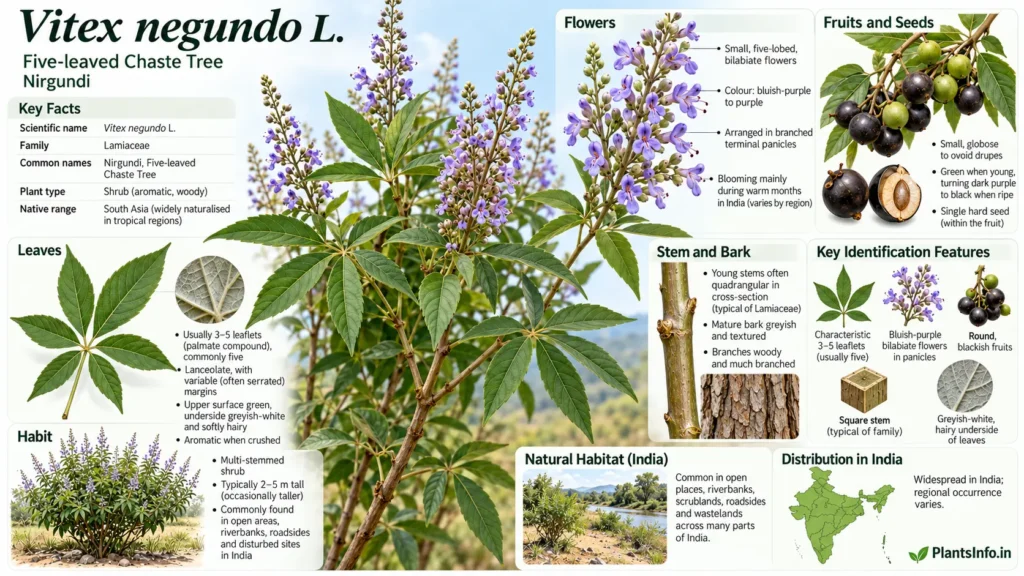
Vitex negundo is a woody, branched shrub or small tree characterized by opposite, palmately compound leaves and terminal inflorescences. Its growth form consists of a persistent woody framework supporting vegetative shoots and reproductive structures.
The combination of leaf arrangement, leaflet number, young-branchlet indumentum, and terminal flower clusters provides a useful basis for field recognition. Leaflet number, pubescence, and leaflet-margin characteristics may vary among botanical descriptions and taxonomic treatments. Identification should therefore rely on a combination of morphological characters rather than a single feature.
Growth Habit and Architecture: Key Characteristics
| Characteristic | Description |
|---|---|
| Life Form | Shrub or small tree |
| Mature Height | Approximately 1–5 m in the descriptions reviewed; reported dimensions vary among sources |
| Stem Type | Woody and branched |
| Young Branchlets | Densely grey-tomentose |
| Branching Pattern | Erect, branched growth |
| Root Morphology | Woody root system; detailed architecture is not characterised here |
| Distinguishing Architectural Features | Opposite, palmately compound leaves combined with terminal flower clusters |
The reported height range is descriptive and should not be interpreted as a universal maximum for the species. Plant stature may differ with habitat, growing conditions, age, and regional variation. Measurements from individual floristic accounts should be interpreted within their original geographic and observational context.
Stem
The stem provides structural support for the branching crown and reproductive structures of Vitex negundo. Young branchlets are particularly useful for identification because they are densely covered with greyish hairs, forming a characteristic tomentose surface.
This indumentum, considered together with the opposite leaf arrangement and palmately compound foliage, helps distinguish V. negundo from shrubs with superficially similar leaves. Stem colour and surface appearance may vary with branchlet age and condition and should therefore be interpreted alongside other morphological characters.
Stem Characteristics
| Characteristic | Description |
|---|---|
| Stem Type | Woody |
| Surface Texture | Young branchlets densely grey-tomentose |
| Young Stem Appearance | Greyish, associated with dense indumentum |
| Branching Pattern | Erect and branched |
Leaves
The leaves are among the principal diagnostic features of Vitex negundo. They are opposite and palmately compound, generally bearing three to five leaflets, although some botanical descriptions report up to seven.
The central leaflet is generally larger than the lateral leaflets and is distinctly petiolulate. The lower leaflet surface is often paler or greyish because of its covering of hairs, producing a visible contrast with the upper surface.
Leaflet margins are described as entire, dentate, or serrate in different botanical treatments. These differences should be interpreted in relation to the taxonomic treatment and specimens described rather than assumed to occur uniformly throughout the species.
The foliage is aromatic when crushed. This is a macroscopic observational characteristic; the chemical composition and identity of volatile constituents are addressed separately in the phytochemistry section.
Leaf Characteristics
| Characteristic | Description |
|---|---|
| Leaf Presence | Present |
| Leaf Type | Palmately compound |
| Arrangement | Opposite |
| Leaflet Number | Usually 3–5; some descriptions report 3–7 |
| Leaflet Shape | Lanceolate to elliptic or oblong-elliptic, as described in the reviewed material |
| Central Leaflet | Generally larger than lateral leaflets and distinctly petiolulate |
| Leaflet Margin | Entire to dentate or serrate in different descriptions |
| Upper Surface | Green, generally less densely hairy |
| Lower Surface | Pale to greyish, often pubescent or tomentose |
| Distinguishing Features | Aromatic foliage, palmately arranged leaflets, and variable indumentum |
Flowers
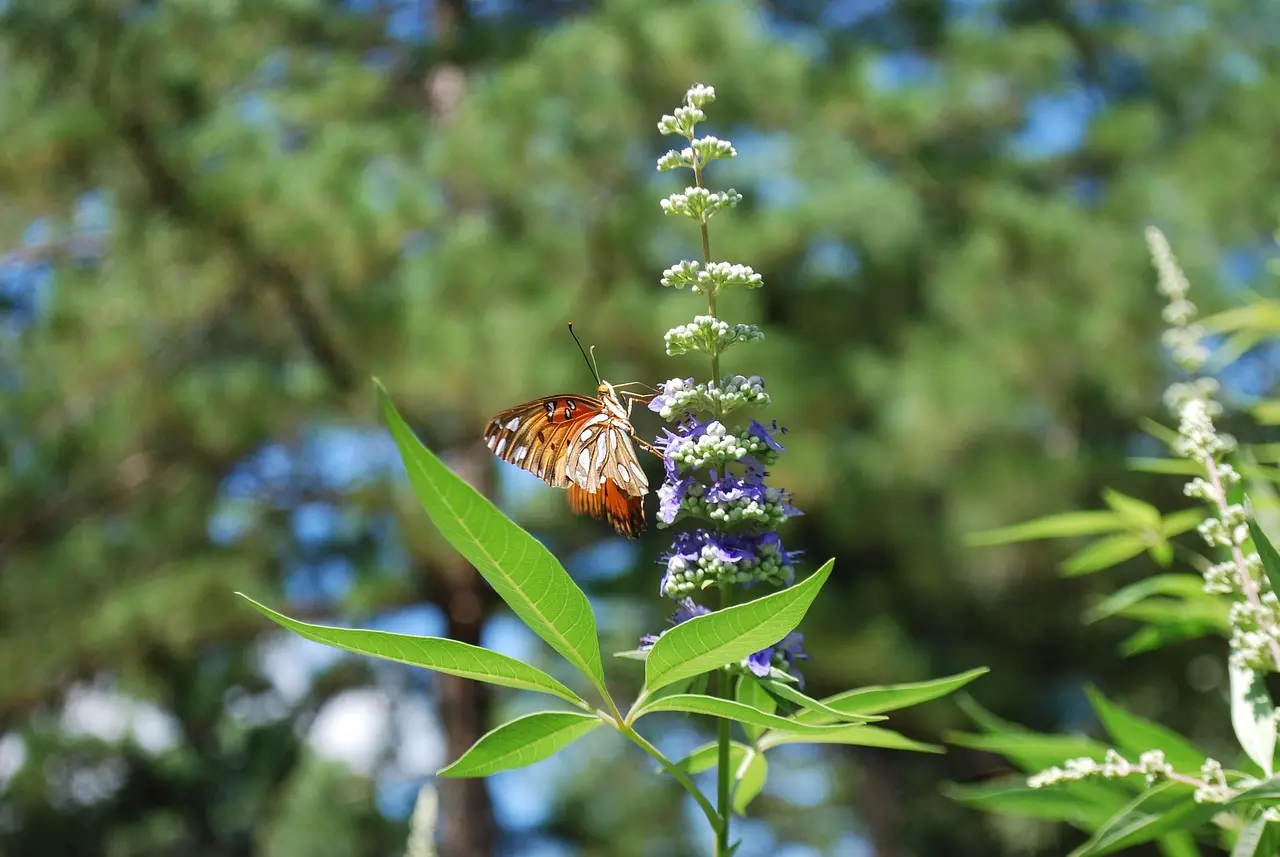
The flowers of Vitex negundo are arranged in terminal, branched inflorescences. Although individual flowers are relatively small, their grouping at the ends of branches produces conspicuous floral clusters.
The corolla is five-lobed and described as bilabiate, or two-lipped. Reported flower colours include white, purple, blue, and violet shades. The androecium comprises four stamens, commonly described as exserted, while the ovary is superior.
Flower colour should not be treated as an invariant diagnostic character because different botanical descriptions report variation in floral appearance.
Floral Characteristics
| Characteristic | Description |
|---|---|
| Inflorescence Position | Terminal |
| Inflorescence Type | Panicle or thyrse, depending on the botanical description |
| Inflorescence Length | Approximately 10–25 cm in the cited morphological material |
| Flower Colour | White, purple, blue, or violet shades |
| Corolla | Five-lobed and bilabiate |
| Calyx | Five-lobed or five-toothed, often tomentose |
| Stamens | Four, commonly described as exserted |
| Gynoecium | Superior ovary, with style and stigma |
This section describes floral structure and morphology. Pollination mechanisms, reproductive strategy, flowering phenology, and ecological relationships are considered separately.
Fruit
The fruit of Vitex negundo is a small drupe, generally described as globose to ellipsoid. At maturity, it becomes dark to black.
Some floristic descriptions provide measurements for dried fruit. These dimensions should be distinguished from measurements of fresh, fully mature fruit because drying and specimen preparation may affect the observed size.
Fruit Characteristics
| Characteristic | Description |
|---|---|
| Fruit Type | Drupe |
| Shape | Globose to ellipsoid |
| Dried Fruit Length | Approximately 2.5–4 mm in the cited floristic description |
| Dried Fruit Diameter | Approximately 1.8–2 mm in the cited floristic description |
| Mature Colour | Dark to black |
| Surface | Described as smooth in the cited dried-fruit account |
The reported dimensions describe the material covered by the cited account and should not be treated as universal species-wide measurements. The original measurement basis and source should be retained in the reference registry.
Seeds
The available morphological information does not establish a sufficiently consistent species-specific dataset for seed dimensions, seed-coat characteristics, oil content, viability period, or germination rate.
These characteristics are therefore not assigned numerical or categorical values in this profile. Their omission reflects the scope of the evidence incorporated here and does not establish that corresponding observations are absent from the wider scientific literature.
Seed dormancy, germination requirements, storage behaviour, and viability are addressed separately under reproductive biology.
Recommended Products
Disclosure: As an Amazon Associate, PlantsInfo may earn from qualifying purchases.
🌱 Plant Care Essentials
The following tools can help with pruning, plant health, soil management, and fruit garden maintenance.

Neem Oil for Plant Care
Natural plant protection against aphids, whiteflies, mites, and other common garden pests.

Fungicide for Root Care
Helps suppress soil-borne fungal diseases and supports healthier root systems.

Spray Bottle for Plants
Ideal for applying foliar sprays, neem oil solutions, and liquid plant treatments.

Rubber Hand Gloves
Protects hands during pruning, planting, soil preparation, and garden maintenance.
Root System
Vitex negundo possesses a woody root system associated with its shrub or small-tree growth form. However, the available morphological descriptions do not establish a reliable general range for rooting depth or lateral root spread.
A detailed account of root architecture would require species-specific anatomical or field evidence. Rooting depth, spatial distribution, and structural adaptations are therefore not generalised in this profile.
Field Identification
Vitex negundo is a woody shrub or small tree identifiable by the combination of opposite, palmately compound leaves, greyish lower leaflet surfaces, densely grey-tomentose young branchlets, and terminal clusters of small flowers.
The leaves typically bear three to five leaflets, with the central leaflet generally larger than the lateral leaflets. The lower leaflet surfaces are often pale or greyish because of their indumentum. Mature fruits are small drupes that become dark to black.
Identification should be based on a combination of vegetative and reproductive characters rather than a single feature. Leaflet number and shape are particularly useful when distinguishing V. negundo from related species.
Principal Identification Characters
| Character | Diagnostic Description |
|---|---|
| Growth Form | Woody, erect shrub or small tree |
| Leaf Arrangement | Opposite |
| Leaf Type | Palmately compound |
| Leaflet Number | Usually 3–5; broader descriptions include up to 7 |
| Leaflet Surface | Lower surface pale or greyish, often pubescent |
| Young Branchlets | Densely grey-tomentose |
| Inflorescence | Terminal clusters of small flowers |
| Corolla | Five-lobed |
| Mature Fruit | Small, dark to black drupe |
Principal identification feature: The combination of opposite, palmately compound leaves and pale to greyish, often hairy leaflet undersides.
Vitex trifolia may be confused with V. negundo in some settings because both belong to the same genus and possess compound foliage. Leaflet number and shape should be considered together with indumentum and other structural characters rather than used independently.
Morphological Variation and Observational Context
Morphological descriptions of Vitex negundo include variation in leaflet number, leaflet margins, and the degree of visible indumentum. Such differences should be interpreted within the context of the botanical treatment, specimen, and observation conditions.
The presence of variation does not necessarily indicate a separate taxonomic entity. Identification and comparative descriptions should consider multiple characters, particularly leaf arrangement, leaflet configuration, branchlet indumentum, inflorescence position, and fruit morphology.
Documented Morphological Observations
| Observation | Interpretation | Notes |
|---|---|---|
| Leaves with three or five leaflets | Commonly described foliage configurations | Leaflet number is a useful identification character but should not be used alone. |
| Higher leaflet counts | Reported morphological variation | Broader floristic descriptions include up to seven leaflets. |
| Greyish or pale lower leaflet surface | Characteristic morphology | Associated with leaf indumentum. |
| Grey-tomentose young branchlets | Characteristic morphology | Provides a useful structural identification feature. |
| Leaflet margins ranging from entire to toothed | Reported variation | Interpretation should follow the relevant botanical treatment. |
| Flowers borne in terminal clusters | Characteristic morphology | Consistent with the described terminal inflorescence arrangement. |
| Dark or black mature fruits | Characteristic morphology | Describes the reported mature fruit colour. |
| Extensive foliage loss outside an established seasonal pattern | Requires contextual assessment | No species-specific threshold is established here. |
Morphological observations should be distinguished from symptoms of environmental stress, damage, or disease. Unusual foliage loss cannot be assigned a specific cause from appearance alone.
Cultivar Summary
No documented cultivars or named horticultural selections are established in the source material reviewed for this profile.
This statement reflects the available evidence and does not establish that horticultural selections are absent from cultivation or specialist nursery records. A dedicated horticultural selection assessment would be required before the cultivar inventory could be considered comprehensive.
Functional Traits
Vitex negundo is an aromatic woody perennial characterized by a diverse secondary-metabolite profile. Its documented functional characteristics include its persistent woody growth form and the production of several classes of specialized plant compounds.
The available literature provides more information about its phytochemical composition than about its whole-plant physiological performance. Reported chemical classes include volatile constituents, flavonoids, iridoid glycosides, lignans, phenolic acids, and terpenoids.
The presence of these compounds establishes chemical characteristics but does not independently demonstrate their ecological functions. Defensive activity, signalling roles, or contributions to stress tolerance require evidence from appropriate biological or ecological investigations.
Species-specific quantitative information concerning photosynthetic pathway, water-use efficiency, nutrient acquisition, carbon allocation, and physiological stress thresholds is not established in the material reviewed for this profile. These characteristics are therefore not assigned numerical values or unverified mechanisms.
Functional Traits and Their Evidential Context
| Functional Trait | Documented Characteristic | Interpretation and Evidence Boundary |
|---|---|---|
| Aromatic Secondary Chemistry | Volatile constituents have been reported in essential-oil preparations and contribute to the characteristic aromatic profile. | Establishes a chemical trait. Ecological functions of individual volatile compounds require separate experimental evidence. |
| Specialized Metabolite Production | Flavonoids, iridoid glycosides, lignans, phenolic acids, and terpenoid compounds have been reported or characterized. | Demonstrates chemical diversity. Specific defensive, signalling, or stress-related functions should not be presumed. |
| Woody Perennial Growth | The species is described as a shrub or small tree with persistent woody tissues and continued vegetative growth. | Supports a broad woody-perennial growth description. Quantitative evidence concerning resource allocation and physiological performance remains limited. |
Physiological Integration
The available evidence establishes the coexistence of a woody growth strategy and a chemically diverse secondary-metabolite system in Vitex negundo. However, the reviewed literature does not sufficiently quantify how carbon allocation, water relations, nutrient acquisition, and metabolite production interact under natural conditions.
A possible relationship between vegetative growth and secondary metabolism represents a relevant research question, but it should not be presented as a demonstrated species-specific trade-off without direct experimental evidence.
Similarly, the presence of volatile compounds and phenolic metabolites does not independently establish a coordinated physiological stress-response mechanism.
The current evidence therefore supports a descriptive account of functional characteristics rather than a quantitative model of physiological integration.
Phytochemistry
The phytochemistry of Vitex negundo has been investigated through compound isolation, extract profiling, and analytical characterization. Published investigations describe a diverse range of specialized metabolites, including flavonoids, iridoid glycosides, lignans, phenolic acids, terpenoids, and essential-oil constituents.
Among the named compounds, vitexin, isovitexin, negundoside, and agnuside are recurring subjects of phytochemical investigation. Other reported constituents include chlorogenic acid, ferulic acid, vitedoin A, vitedoin B, ursolic acid, and oleanolic acid.
The literature provides more developed evidence for compound identification than for quantitative comparability across samples. Extraction procedures, plant material, geographical origin, analytical methods, and study designs differ among investigations.
Consequently, the identification of a compound in one sample does not establish that it occurs at a constant concentration across populations, growing conditions, or plant organs.
Major Phytochemical Classes
| Phytochemical Class | Representative Compounds | Reported Material or Occurrence | Evidence Interpretation |
|---|---|---|---|
| Flavonoids | Vitexin, isovitexin, casticin, luteolin derivatives | Reported from leaves and other investigated plant materials; distribution varies among studies. | Chemical identities have been reported, but individual ecological functions are not uniformly established for the species. |
| Iridoid Glycosides | Negundoside, agnuside | Reported from investigated plant extracts; organ-specific distribution requires confirmation from the relevant studies. | Represents a documented class of specialized glycosidic metabolites. Ecological roles remain incompletely characterized. |
| Phenolic Acids | Chlorogenic acid, ferulic acid | Reported in phytochemical investigations of plant material. | Chemical occurrence is documented; species-specific ecological functions require further investigation. |
| Lignans | Vitedoin A, vitedoin B | Isolated from investigated plant material; precise organ assignment requires confirmation from the original studies. | Chemical identities have been reported, but ecological functions are not established here. |
| Triterpenoids | Ursolic acid, oleanolic acid | Reported in phytochemical investigations of extracts. | Represents documented terpenoid constituents; specific ecological roles remain unresolved. |
| Essential-Oil Constituents | Sabinene, β-caryophyllene, linalool, and other reported volatile compounds | Identified in volatile-oil preparations from investigated material, including leaves and aerial parts. | Contributes to the documented volatile chemical profile. Individual ecological effects require direct evidence. |
Phytochemical Organ Distribution
The available literature establishes chemical diversity in the plant materials investigated. However, the evidence incorporated into this profile does not provide a sufficiently consistent and quantitatively comparable compound-by-organ dataset.
A formal organ-distribution table is therefore not presented with inferred associations.
A compound reported from a whole-plant extract or an unspecified aerial-part preparation cannot automatically be assigned to leaves, roots, flowers, fruits, or seeds individually. Such assignments require direct support from the relevant investigation.
Phytochemical Significance
Chemical Characterization
The chemical significance of Vitex negundo lies in the breadth of its characterized secondary metabolites and the repeated investigation of particular flavonoids and iridoid glycosides.
Vitexin, isovitexin, negundoside, and agnuside are relevant chemical reference points because they recur in the phytochemical literature. Their repeated investigation does not, by itself, establish them as universal quantitative markers.
The use of any compound as a quantitative marker would require standardized analytical validation, including appropriate reference standards and reproducible measurement procedures.
The reported presence of lignans, phenolic acids, terpenoids, and volatile constituents further demonstrates that the chemical profile of the species is not restricted to a single metabolite class.
Characterization Methods and Evidence Strength
Phytochemical investigations of V. negundo include compound isolation, structural characterization, and chromatographic profiling. Analytical approaches reported for investigations of the species include:
- Thin-layer chromatography (TLC)
- High-performance thin-layer chromatography (HPTLC)
- High-performance liquid chromatography (HPLC)
- Gas chromatography–mass spectrometry (GC–MS)
- Liquid chromatography–tandem mass spectrometry (LC–MS/MS)
- Nuclear magnetic resonance (NMR) spectroscopy
These techniques provide different forms and levels of chemical evidence. Compound isolation followed by structural elucidation can provide stronger identity support than an unconfirmed chromatographic peak assignment.
Quantitative comparison remains complicated by differences in extraction procedures, analytical standards, plant material, and study design. Reported concentrations should therefore not be treated as directly comparable unless the underlying methods and measurement bases are sufficiently aligned.
Research Coverage and Its Limitations
The reviewed literature includes substantial research conducted in India and other Asian research settings. Leaves and aerial-part preparations also receive considerable attention in phytochemical and pharmacological investigations.
However, the available material does not establish reliable numerical proportions of studies by geographical origin or plant organ. These observations should therefore be interpreted as research-coverage tendencies within the literature reviewed, rather than quantified characteristics of the entire research record.
Chemical characterization of fruits, seeds, and roots is less clearly consolidated in the evidence examined. This represents a limitation of the present evidence assessment and does not establish that these organs lack chemical diversity, biological activity, or research significance.
Relationships Among Chemical Constituents
Multiple phytochemical classes have been reported in Vitex negundo, but their co-occurrence does not independently establish synergistic or antagonistic interactions.
Demonstrating such relationships requires experimental designs capable of distinguishing the effects of individual constituents from those of mixtures, including the contribution of interactions between compounds.
No specific synergistic or antagonistic relationship is established in this profile.
Overall Phytochemical Significance
The principal research significance of Vitex negundo phytochemistry lies in its diverse and increasingly characterized secondary-metabolite profile. The strongest descriptive evidence concerns compound identification and analytical detection.
Important areas requiring more standardized investigation include:
- Quantitative distribution of compounds among plant organs.
- Comparability of phytochemical measurements across geographical populations and experimental conditions.
- Ecological functions of individual metabolites.
- Relationships between secondary metabolism and whole-plant physiological processes.
- Potential interactions among compounds in complex extracts.
The current evidence supports a description of chemical diversity and research activity, but not a comprehensive quantitative model of phytochemical distribution or function.
Medicinal Evidence and Research Status
Vitex negundo L. has a documented history of traditional medicinal use in South Asian and other Asian medicinal traditions. Its pharmacological literature includes laboratory experiments, animal investigations, and reports of clinical or regulatory evaluation.
These evidence categories represent different forms of support and should not be treated as interchangeable. Traditional use establishes historical and cultural documentation, while laboratory and animal studies provide experimental observations under defined conditions.
Neither traditional use nor preclinical activity independently establishes clinical efficacy, an appropriate therapeutic dose, or safety in humans.
Evidence Hierarchy
| Evidence Category | Status | Evidence Assessment |
|---|---|---|
| Traditional Medicinal Use | Documented | Traditional applications are described in Indian and other Asian medicinal literature. Historical use does not independently establish clinical efficacy or safety. |
| Nutritional Evidence | Not established | The reviewed material does not identify a verified, standardized food-composition or nutritional-efficacy dataset sufficient to support routine dietary recommendations. |
| In Vitro Studies | Documented | Experimental investigations report antioxidant, anti-inflammatory, antimicrobial, and other biological activities in extracts or isolated compounds. These findings are limited to the experimental systems examined. |
| Animal Studies | Documented | Preclinical investigations include pharmacological and toxicological evaluations. Results require cautious interpretation when considering human applications. |
| Human Clinical Studies | Partial | Human clinical evidence remains limited and does not establish broad therapeutic efficacy across traditionally reported uses. |
| Regulatory Recognition | Partial | A Philippine regulatory recognition has been reported for an herbal preparation associated with cough and asthma. The exact product, approved conditions, regulatory basis, and current authorization require independent verification. |
| Broad Therapeutic or Safety Claims | Not substantiated | The evidence assessed for this profile does not support claims of established cures, universal safety, or clinically proven efficacy across the species’ traditionally reported applications. |
Evidence Assessment
The available evidence is weighted toward traditional documentation and preclinical research.
Laboratory investigations indicate that particular extracts and isolated constituents can influence biological processes under specified experimental conditions. Animal studies provide additional information about pharmacological activity and selected toxicological endpoints.
These findings do not establish equivalent therapeutic benefits in humans. Differences in extract composition, experimental models, dose, administration route, and study design limit the direct translation of preclinical observations into clinical conclusions.
The 2026 review by Phate and Patil identifies limited pharmacokinetic evidence, inconsistencies in experimental design, and the need for better-standardized clinical investigations.
The reported Philippine regulatory recognition is jurisdiction-specific. It should not be interpreted as general approval of all V. negundo preparations, formulations, therapeutic indications, or commercial products. The precise regulatory status should be established from the relevant authority and product documentation before publication of a definitive regulatory statement.
Overall Medicinal Evidence Interpretation
Traditional medicinal use is documented, and experimental pharmacological activity has been reported across multiple research areas. However, clinical validation remains incomplete.
The current evidence therefore supports a distinction between documented traditional applications, experimentally observed biological activity, and established human therapeutic efficacy. These categories should remain separate in the interpretation of medicinal research concerning Vitex negundo.
Nutritional Composition
Vitex negundo is primarily documented as a medicinal and aromatic plant rather than an established food crop.
The reviewed literature does not provide a sufficiently verified and standardized nutritional composition dataset to support quantitative reporting of its energy, macronutrient, vitamin, or mineral content.
Its documented phytochemicals should not be interpreted as evidence of nutritional value or dietary suitability.
Nutritional classification: No established routine dietary or nutritional role is assigned within this profile.
Soil Ecology and Mycorrhizal Associations
The evidence reviewed does not establish a sufficiently detailed, species-specific account of the soil biological relationships of Vitex negundo.
Its occurrence across different Asian environments provides ecological context, but habitat occurrence alone cannot demonstrate a particular mycorrhizal association, rhizosphere bacterial community, or soil-mediated physiological mechanism.
Soil Ecology Evidence Assessment
| Domain | Evidence status | Assessment |
|---|---|---|
| Mycorrhizal type | Unverified | No sufficiently verified species-specific association established in this assessment. |
| Fungal genera | Unverified | No directly supported fungal-genus inventory established. |
| Rhizosphere bacteria | Unverified | No reliable species-specific community profile established. |
| Bacterial functional roles | Unverified | Nitrogen fixation, nutrient mobilization, and other functions cannot be assigned without direct evidence. |
| Allelopathy | Partial | Biological activity reported for plant extracts does not independently establish ecologically significant allelopathy under natural conditions. |
| Phytochemical basis of allelopathy | Unverified | No validated field-level compound-to-effect relationship established in this assessment. |
| Agronomic implications | Partial | Potential applications have been discussed in research, but field-scale soil effects, reproducibility, and practical significance require verification. |
| Conservation implications | Unverified | No specific soil-biological conservation mechanism established. |
Interpretation
The current evidence supports a concise, conservative soil ecology account rather than a detailed microbial profile.
The available assessment does not establish species-specific identification of fungal or bacterial partners. No particular fungal genus, bacterial taxon, or functional association is asserted.
Reported potential agronomic applications should be treated as research propositions rather than established field-scale outcomes.
Toxicity and Safety
Toxicological findings for Vitex negundo vary according to experimental preparation, exposure route, dose, duration, and biological model.
Some animal investigations and experimental reviews report no significant adverse effects under the conditions tested. Other research describes potentially adverse biological effects associated with particular extracts or experimental exposures.
A brine shrimp lethality study classified the tested ethanolic extract as mildly toxic within that assay’s comparative classification. This is an experimental screening result, not a direct estimate of human or veterinary toxicity.
Toxicity Evidence Assessment
| Subject | Evidence status | Documented findings or limitation | Source status |
|---|---|---|---|
| Humans | Partial | Human adverse-effect incidence and dose–response relationships are insufficiently characterized. No universal safety threshold is established for all preparations. | General review evidence identified; direct clinical safety characterization remains incomplete. |
| Cats | Unverified | No verified species-specific toxicity profile identified in the current source assessment. | Direct veterinary toxicology evidence not verified. |
| Dogs | Unverified | No verified species-specific toxicity profile identified in the current source assessment. | Direct veterinary toxicology evidence not verified. |
| Livestock | Partial | Experimental and proposed feed applications require preparation-specific evaluation. Long-term safety cannot be established from the reviewed evidence alone. | Livestock review identified; direct evidence and applicable exposure conditions require further source-level verification. |
The absence of verified toxicity data for cats or dogs must not be interpreted as evidence of safety.
Dose and Exposure Dependency
Toxicological interpretation must distinguish among crude plant material, aqueous extracts, alcoholic extracts, essential oils, and isolated compounds.
A result obtained using one preparation cannot automatically be transferred to another. Similarly, an experimental dose administered to an animal cannot be converted directly into a safe human dose.
The available research does not establish a universal safety threshold applicable to every plant preparation, formulation, route, or exposure duration.
Whole-Plant and Isolated-Compound Effects
Vitex negundo contains multiple classes of secondary metabolites. Experimental findings associated with an isolated constituent do not necessarily predict the biological effects of the whole plant or a commercial preparation.
Interpretation therefore requires attention to preparation identity, chemical characterization, dose, exposure conditions, and experimental design.
Vulnerable Populations
Pregnancy, lactation, childhood, and other potentially vulnerable conditions require specific safety evidence.
The current assessment does not establish adequate species-specific human safety data for these populations. No general safety assurance should be inferred from the absence of reported adverse findings in unrelated experimental models.
Drug Interactions
Reliable clinical interaction data for Vitex negundo preparations remain insufficiently established.
Experimental biological activity does not, by itself, prove a clinically significant drug interaction. However, the absence of comprehensive interaction studies also prevents a general assurance of compatibility with medicines or other preparations.
Renal and Hepatic Considerations
Some animal studies have investigated organ-level toxicological endpoints. These findings do not establish a universal human renal or hepatic safety profile.
Preparation-specific exposure, study duration, experimental model, and study design must be considered when interpreting such results. Any specific organ-toxicity claim requires direct support from the relevant study.
Overall Safety Interpretation
The available evidence supports continued pharmacological and toxicological investigation but does not justify an unrestricted safety claim.
This profile does not constitute medical or veterinary advice.
Biogeographic Context
Vitex negundo has a broad reported distribution across South Asia, East Asia, Southeast Asia, and parts of eastern and southern Africa. Its distribution also includes island regions in the western Indian Ocean and western Pacific.
The geographical treatment follows the distribution framework identified in Kew Plants of the World Online and World Flora Online. Regional occurrence and native status should be interpreted according to the applicable botanical records.
Reported Native Distribution
| Region | Countries or Sub-regions | Distribution Context |
|---|---|---|
| Indian Subcontinent | India, Bangladesh, Nepal, Pakistan, Afghanistan, Sri Lanka | Includes mainland and Himalayan distributions, with documented Indian island occurrences. |
| East Asia | China, Japan, Korea, Taiwan | Reported native distribution across multiple temperate and subtropical sub-regions. |
| Southeast Asia | Myanmar, Thailand, Cambodia, Vietnam | Part of the broader reported native Asian range. |
| Eastern and Southern Africa | Somalia, Tanzania, Mozambique | Documented native distribution in African regions. |
| Western Indian Ocean | Madagascar, Mauritius, Maldives | Includes island populations within the reported native distribution. |
| Western Pacific | Mariana Islands | Included within the native distribution by major botanical databases. |
Global Cultivation and Naturalisation
Vitex negundo is cultivated outside its accepted native range, including as an ornamental and useful shrub. Botanical distribution records also document introduced occurrences in several regions.
Introduced status, cultivation, naturalisation, and invasive behaviour represent distinct categories. An introduced occurrence does not independently establish persistent self-sustaining populations or ecological impact.
Reported Introduced Distribution
| Region | Countries or Areas | Reported Status | Interpretation |
|---|---|---|---|
| North America | Alabama, Arkansas, Florida, Texas | Introduced; cultivation documented | Regional establishment requires separate verification. |
| Caribbean | Cuba, Haiti, Leeward Islands, Trinidad and Tobago, Windward Islands | Introduced | Recorded outside the accepted native range. |
| Southeast Asia | Java, Sumatra, Philippines | Introduced; cultivation documented | Historical botanical treatments identify human-mediated introduction in parts of the Malesian region. |
| Southeastern Europe | Bulgaria | Introduced | Establishment and ecological impact require regional assessment. |
Cultivation Range
The documented introduced range includes tropical, subtropical, and some warmer temperate settings.
Available distribution records do not establish comparable commercial production volumes, cultivated acreage, or production rankings across these regions. The literature identified for this profile is geographically concentrated in South Asian and other Asian botanical and applied research.
A quantitative assessment of global cultivation intensity is therefore not available.
Natural Habitat
Vitex negundo occurs across a range of natural and semi-natural environments, including seasonally dry tropical vegetation, secondary forest, disturbed landscapes, and locally moist habitats.
Its occurrence in human-modified environments indicates that the species is not restricted to undisturbed vegetation. However, habitat records alone do not establish a specific ecological mechanism or quantify its tolerance to disturbance, moisture variation, or soil conditions.
Habitat Characteristics
| Habitat Parameter | Documented Characteristics | Interpretation |
|---|---|---|
| Broad Biome | Seasonally dry tropical biome | Recognised as a principal biome association in the cited distribution treatment. |
| Forest Association | Secondary forest; occasionally primary forest | Occurrence is documented across different degrees of vegetation disturbance. |
| Open Habitats | Wastelands, roadsides, and village margins | Demonstrates occurrence in human-modified landscapes. |
| Water-associated Habitats | Stream margins and moist localities | Regional floristic records document occurrence near watercourses. |
| Elevation | Approximately 0–1,981 m (0–6,500 ft), according to a secondary horticultural account | Represents a reported occurrence interval, not a verified physiological optimum or tolerance limit. |
| Soil Specialization | No exclusive soil type established | Available habitat records do not demonstrate strict soil specialization. |
| Moisture Regime | Seasonally dry environments and locally moist habitats | Occurrence spans more than one moisture setting. |
| Disturbance Association | Secondary vegetation and disturbed sites | Supports a habitat association, but not a quantified disturbance-response mechanism. |
The broad elevation interval is attributed to the North Carolina State University Plant Toolbox habitat account. It should not be interpreted as a species-wide physiological limit.
Ecological Role
The available evidence supports a primarily descriptive assessment of the ecological role of Vitex negundo. Distribution and habitat records are more complete than direct experimental evidence of ecosystem-level interactions.
Documented Ecological Relationships
| Ecological role | Organism or setting | Evidence interpretation |
|---|---|---|
| Potential floral resource | Insect visitors | Floral accessibility is documented, but a comprehensive species-level pollinator network has not been established in the reviewed material. |
| Reproductive dispersal | Specific disperser unresolved | Fleshy fruit morphology is documented; a verified disperser inventory remains unavailable. |
| Secondary vegetation component | Mixed secondary vegetation | Occurrence in secondary forests and disturbed sites is documented. |
| Human-modified habitat component | Roadsides and wasteland vegetation | Regional botanical accounts record the species in these settings. |
| Ecological indicator status | Not established | No validated indicator-species classification is assigned. |
| Keystone status | Not established | Available evidence does not support designation as a keystone species. |
Ecological Interpretation
The species is a documented component of secondary and disturbed vegetation across portions of its range. Its flowers and fruits provide potential points of interaction with other organisms, but particular pollinator or disperser species should not be assigned without direct records.
No ecosystem-wide keystone function or validated ecological indicator role is asserted.
Invasive Status
Vitex negundo is recorded as introduced in several regions outside its accepted native range. However, the material reviewed does not establish a sufficiently verified, species-specific invasive-impact assessment across those regions.
Introduced status must not be treated as synonymous with naturalisation or invasiveness.
A regional invasive classification would require evidence of establishment, spread, ecological effects, and the relevant assessment authority.
Climate Envelope
Vitex negundo is associated with seasonally dry tropical environments, although its reported geographical distribution extends across multiple climatic and elevation settings.
A standardized global dataset establishing species-specific temperature, rainfall, humidity, or solar-radiation optima and physiological tolerance limits is not available in the reviewed material. Numerical climate thresholds are therefore not assigned.
Climate Evidence
| Climate Aspect | Evidence Status |
|---|---|
| Seasonality | Association with seasonally dry tropical environments is documented. |
| Temperature | Species-specific quantitative optima and tolerance limits are not established. |
| Rainfall | Broad climatic association is documented, but a validated rainfall optimum and tolerance interval are unavailable. |
| Humidity | Numerical humidity thresholds are not established. |
| Geographical Variation | The reported distribution spans different geographical, climatic, and elevation settings. |
| Cultivation Range | Introduced occurrences demonstrate establishment or cultivation beyond parts of the native range, but do not define universal climatic limits. |
Climate Evidence Interpretation
Climatic occurrence and physiological tolerance are distinct concepts. The presence of V. negundo in a particular climatic region does not independently establish a physiological optimum or tolerance threshold for the corresponding environmental conditions.
Similarly, geographical elevation records cannot be directly converted into temperature-tolerance limits without appropriate climatic and geographical data.
Climate classification: Seasonally dry tropical association documented; quantitative physiological optima and tolerance limits not established.
Stress Tolerance Profile
Vitex negundo occurs in seasonally dry environments, but the reviewed evidence does not establish a sufficiently reliable species-specific physiological profile for assigning quantitative stress-tolerance limits.
Habitat occurrence should not be treated as direct evidence of physiological tolerance. In particular, occurrence in seasonally dry regions does not independently demonstrate a specific drought-resistance mechanism or threshold.
Stress Evidence Assessment
| Stress Factor | Evidence Status | Assessment |
|---|---|---|
| Seasonal Moisture Limitation | Habitat association documented; physiological tolerance unverified | Occurrence in seasonally dry tropical environments is documented, but specific response mechanisms and thresholds remain unestablished. |
| Temperature Extremes | Unverified | No sufficiently established species-specific heat or cold response profile is available. |
| Salinity | Unverified | No verified physiological mechanism or quantitative tolerance threshold established. |
| Waterlogging | Unverified | Occurrence near streams does not independently demonstrate waterlogging tolerance. |
| Combined Drought and Heat | Unverified | No directly supported species-specific combined-stress response profile established. |
Compound Stress Assessment
The reviewed evidence does not establish a sufficiently detailed model of combined environmental stress responses in V. negundo.
Interactions involving drought, high temperature, soil moisture, and salinity remain research questions rather than established physiological conclusions. No speculative synergistic or antagonistic stress mechanism is assigned.
Structural Traits and Ecological Functions
Vitex negundo is a woody perennial characterized by persistent stems, pubescent leaf surfaces, aromatic volatile chemistry, and terminal inflorescences.
These features can be described in relation to their potential ecological relevance. However, a plausible function should not be interpreted as a demonstrated adaptation or measurable fitness advantage without supporting evidence.
Structural Traits
| Structural Trait | Description | Potential Ecological Relevance |
|---|---|---|
| Persistent Woody Framework | Lignified stems provide a perennial structural framework supporting continued vegetative and reproductive development. | Relevant to persistence in shrubland, secondary vegetation, and seasonally variable environments. |
| Pubescent Leaf Surfaces | Leaf hairs modify the physical environment at the leaf surface and may influence radiation exposure, airflow, and water loss. | Potential relevance to exposed and seasonally dry habitats; species-specific effects remain unquantified. |
| Aromatic Volatile Chemistry | Volatile compounds contribute to the characteristic aromatic profile of plant tissues. | May participate in ecological interactions, although specific defensive or signalling functions are not established here. |
| Terminal Inflorescences | Flowers are arranged in branched clusters at shoot ends. | Provides floral presentation accessible to visiting insects; pollinator effectiveness and reproductive consequences require separate evidence. |
| Woody Perennial Growth | Persistent tissues provide a structural basis for continued growth across seasonal changes. | Potential relevance to persistence in disturbed habitats; species-specific regeneration and resprouting mechanisms require further verification. |
The presence of these characteristics does not establish that each trait provides a measurable fitness advantage under all environmental conditions.
Climate Change Vulnerability
A species-specific quantitative climate vulnerability model has not been established in the material reviewed for this profile. The assessment is therefore qualitative and should not be interpreted as a scored vulnerability index.
The broad geographical distribution of Vitex negundo provides relevant biogeographic context, but distribution alone cannot establish population-level resilience to future climatic change.
Climate Change Vulnerability Assessment
| Factor | Assessment | Evidence Interpretation |
|---|---|---|
| Potential Climate Sensitivity | Possible sensitivity to changes in seasonal rainfall, prolonged moisture limitation, and temperature extremes | Qualitative consideration based on habitat association; physiological thresholds and population responses remain unverified. |
| Potential Threatening Processes | Changes in rainfall seasonality, prolonged drought, heat extremes, and shifts in seasonal timing | Plausible exposure pathways, not demonstrated species-specific population impacts. |
| Potential Resilience Factors | Broad geographical distribution and occurrence across multiple habitat settings | These characteristics do not independently establish adaptive capacity, genetic resilience, or stable population trends. |
| Confidence Level | Low; qualitative only | No species-specific vulnerability score, population projection, or validated climate-response model is established. |
Climate Vulnerability Interpretation
The broad geographical distribution of Vitex negundo is relevant to its potential exposure to climate change, but it does not establish uniform vulnerability across populations.
Regional populations may experience different combinations of temperature, rainfall seasonality, habitat modification, and disturbance. A single global vulnerability classification would therefore require evidence beyond the distribution records currently available.
Climate vulnerability classification: Not quantitatively assessed; species-specific vulnerability remains unresolved.
Phenological Calendar
Phenological timing in Vitex negundo varies geographically and may differ between wild populations and cultivated plants.
The available information supports a broad seasonal description of reproductive development, but not a universal month-by-month calendar applicable across the native and introduced ranges.
Phenological Overview
| Phenological Event | Documented Timing | Evidence Status |
|---|---|---|
| Vegetative Growth | Seasonal vegetative development occurs under favourable growing conditions. | A universal onset month or minimum soil-temperature threshold is not established. |
| Flower-Bud Initiation | Seasonal development precedes flowering. | Precise initiation timing and environmental triggers remain insufficiently resolved. |
| Flowering | Flowering is reported during warm-season periods in parts of the range. | Timing varies regionally; a universal flowering window is not established. |
| Fruit Development | Follows successful flowering and fertilisation. | Regional calendar dates and developmental thresholds are not sufficiently standardized. |
| Fruit Maturation | Mature fruits are described as dark or black. | A universal maturation period or environmental trigger is not established. |
| Seed Dispersal | Species-specific dispersal timing and principal disperser identities remain incompletely verified. | No universal dispersal calendar is established. |
| Dormancy or Rest Period | Seasonal growth reduction may occur under locally unfavourable conditions. | A universal obligatory dormancy period or species-specific dormancy threshold is not established. |
Phenological Notes
The available evidence supports seasonal variation rather than a fixed annual schedule.
In India, flowering and fruiting records should be interpreted regionally because climatic seasonality differs across the subcontinent. A calendar derived from one locality should not be generalized to the entire native range.
The relationships between rainfall onset, temperature, photoperiod, and reproductive timing remain insufficiently quantified for a species-wide environmental trigger model.
Cultivated populations may experience different seasonal conditions from wild populations, but the reviewed evidence does not establish standardized differences in flowering duration or reproductive output between these settings.
No orchard-management or flowering-induction recommendation is assigned.
Pollination Ecology
The floral architecture of Vitex negundo is compatible with insect-mediated pollen transfer. Its terminal inflorescences and two-lipped flowers provide a floral arrangement accessible to visiting insects.
However, floral visitation alone does not establish pollination effectiveness. The identity, behaviour, and reproductive contribution of visiting organisms require separate evidence.
A complete species-level pollination network, including verified primary pollinators and quantitative reproductive outcomes, is not established in the current assessment.
Pollination Characteristics
| Parameter | Assessment | Evidence Status |
|---|---|---|
| Primary Pollinators | Insect-associated pollination is reported. | Primary pollinator species or genera are not established in this assessment. |
| Secondary Pollinators | Unresolved | Additional effective pollinator taxa have not been sufficiently characterized. |
| Pollination Syndrome | Insect-associated floral presentation | Formal syndrome classification remains conditional because floral morphology alone is insufficient. |
| Floral Mechanism | Two-lipped corolla with reproductive structures positioned within the floral opening. | Provides a structural context for pollen contact during visitation; pollinator-specific contact mechanics remain unresolved. |
| Reproductive System | Sexual reproduction through flowers and fruits is documented. | Self-compatibility, autonomous self-pollination, and breeding-system status remain unverified. |
| Seed Dispersal | Principal dispersal agent unresolved. | Fruit morphology is documented, but a primary disperser is not established here. |
| Reproductive Evidence | Partial | Floral and fruit structures are documented; controlled breeding-system and pollinator-effectiveness evidence remains incomplete. |
| Assisted Pollination | Unresolved | No verified evidence establishes whether artificial pollen transfer is necessary or improves reproductive success. |
Pollination Context
The floral structure is compatible with insect-mediated pollen transfer, but this does not establish dependence on a single pollinator group.
Self-compatibility, autonomous self-pollination, and the relative contribution of outcrossing require controlled reproductive studies. These characteristics should not be inferred from floral morphology alone.
A reduction in effective pollinator populations could theoretically affect reproductive opportunities. However, the magnitude of this potential effect on V. negundo has not been quantified.
The biological feasibility and reproductive benefit of assisted pollination remain unresolved. No manual pollination procedure or management recommendation is provided.
Phenological Calendar
Phenological timing in Vitex negundo varies geographically and may differ between wild populations and cultivated plants.
The available information supports a broad seasonal description of reproductive development, but not a universal month-by-month calendar applicable across the native and introduced ranges.
Phenological Overview
| Phenological Event | Documented Timing | Evidence Status |
|---|---|---|
| Vegetative Growth | Seasonal vegetative development occurs under favourable growing conditions. | A universal onset month or minimum soil-temperature threshold is not established. |
| Flower-Bud Initiation | Seasonal development precedes flowering. | Precise initiation timing and environmental triggers remain insufficiently resolved. |
| Flowering | Flowering is reported during warm-season periods in parts of the range. | Timing varies regionally; a universal flowering window is not established. |
| Fruit Development | Follows successful flowering and fertilisation. | Regional calendar dates and developmental thresholds are not sufficiently standardized. |
| Fruit Maturation | Mature fruits are described as dark or black. | A universal maturation period or environmental trigger is not established. |
| Seed Dispersal | Species-specific dispersal timing and principal disperser identities remain incompletely verified. | No universal dispersal calendar is established. |
| Dormancy or Rest Period | Seasonal growth reduction may occur under locally unfavourable conditions. | A universal obligatory dormancy period or species-specific dormancy threshold is not established. |
Phenological Notes
The available evidence supports seasonal variation rather than a fixed annual schedule.
In India, flowering and fruiting records should be interpreted regionally because climatic seasonality differs across the subcontinent. A calendar derived from one locality should not be generalized to the entire native range.
The relationships between rainfall onset, temperature, photoperiod, and reproductive timing remain insufficiently quantified for a species-wide environmental trigger model.
Cultivated populations may experience different seasonal conditions from wild populations, but the reviewed evidence does not establish standardized differences in flowering duration or reproductive output between these settings.
No orchard-management or flowering-induction recommendation is assigned.
Pollination Ecology
The floral architecture of Vitex negundo is compatible with insect-mediated pollen transfer. Its terminal inflorescences and two-lipped flowers provide a floral arrangement accessible to visiting insects.
However, floral visitation alone does not establish pollination effectiveness. The identity, behaviour, and reproductive contribution of visiting organisms require separate evidence.
A complete species-level pollination network, including verified primary pollinators and quantitative reproductive outcomes, is not established in the current assessment.
Pollination Characteristics
| Parameter | Assessment | Evidence Status |
|---|---|---|
| Primary Pollinators | Insect-associated pollination is reported. | Primary pollinator species or genera are not established in this assessment. |
| Secondary Pollinators | Unresolved | Additional effective pollinator taxa have not been sufficiently characterized. |
| Pollination Syndrome | Insect-associated floral presentation | Formal syndrome classification remains conditional because floral morphology alone is insufficient. |
| Floral Mechanism | Two-lipped corolla with reproductive structures positioned within the floral opening. | Provides a structural context for pollen contact during visitation; pollinator-specific contact mechanics remain unresolved. |
| Reproductive System | Sexual reproduction through flowers and fruits is documented. | Self-compatibility, autonomous self-pollination, and breeding-system status remain unverified. |
| Seed Dispersal | Principal dispersal agent unresolved. | Fruit morphology is documented, but a primary disperser is not established here. |
| Reproductive Evidence | Partial | Floral and fruit structures are documented; controlled breeding-system and pollinator-effectiveness evidence remains incomplete. |
| Assisted Pollination | Unresolved | No verified evidence establishes whether artificial pollen transfer is necessary or improves reproductive success. |
Pollination Context
The floral structure is compatible with insect-mediated pollen transfer, but this does not establish dependence on a single pollinator group.
Self-compatibility, autonomous self-pollination, and the relative contribution of outcrossing require controlled reproductive studies. These characteristics should not be inferred from floral morphology alone.
A reduction in effective pollinator populations could theoretically affect reproductive opportunities. However, the magnitude of this potential effect on V. negundo has not been quantified.
The biological feasibility and reproductive benefit of assisted pollination remain unresolved. No manual pollination procedure or management recommendation is provided.
Climate Change Vulnerability
A species-specific quantitative climate vulnerability assessment for Vitex negundo is not established in the evidence reviewed. Its broad geographical distribution provides ecological context but does not independently demonstrate resilience to future climatic change.
Potential climate-related exposure pathways include changes in rainfall seasonality, prolonged moisture limitation, and temperature extremes. These factors should be distinguished from demonstrated population-level impacts, which remain insufficiently characterised.
Climate Change Vulnerability Assessment
| Assessment factor | Current interpretation | Evidence limitation |
|---|---|---|
| Primary climate sensitivities | Potential sensitivity to altered seasonal rainfall, prolonged drought, and temperature extremes. | Physiological thresholds and population responses have not been established. |
| Relevant climate processes | Changes in rainfall seasonality, drought duration, heat extremes, and seasonal timing. | These represent plausible exposure pathways rather than demonstrated species-specific impacts. |
| Potential resilience context | Broad geographical distribution and occurrence across multiple habitat settings. | Distribution does not establish genetic resilience, adaptive capacity, or stable population trends. |
| Confidence level | Low; qualitative assessment only. | No validated species-specific vulnerability score, population projection, or climate-response model is available in this assessment. |
Climate Vulnerability Interpretation
Climate exposure is unlikely to be uniform across the geographical range of V. negundo. Regional populations may experience different combinations of temperature, rainfall seasonality, habitat modification, and disturbance.
Its occurrence across multiple environments should not be interpreted as proof of uniform climatic tolerance. A defensible vulnerability classification would require population-level observations, physiological response data, and geographically resolved climate assessments.
Assessment status: Qualitative only; quantitative climate vulnerability remains unresolved.
Phenological Calendar
Phenological timing in Vitex negundo varies geographically and may differ between wild populations and cultivated plants. The available information supports a broad description of reproductive development, but not a universal month-by-month calendar applicable across its native and introduced range.
Phenological Calendar
| Phenological event | Documented seasonal context | Regional or cultivated variation | Evidence limitation |
|---|---|---|---|
| Vegetative growth onset | Vegetative development is associated with favourable growing conditions. | Timing varies with local climate and cultivation environment. | No species-wide minimum soil temperature or photoperiod threshold is established. |
| Flower-bud initiation | Bud development precedes flowering. | May differ among geographical regions and local seasonal conditions. | Precise initiation timing and environmental thresholds remain unresolved. |
| Anthesis and flowering | Flowering is reported under differing regional seasonal conditions. | No universal flowering window is established for wild or cultivated populations. | A validated species-wide flowering threshold is unavailable. |
| Fruit development | Follows successful flowering and fertilisation. | Timing varies with flowering period and local environmental conditions. | Regional developmental intervals are not sufficiently standardised. |
| Fruit maturation | Mature fruits are described as dark or black. | Maturation timing varies geographically and with reproductive development. | No universal maturation period or environmental trigger is established. |
| Seed dispersal | Species-specific dispersal timing remains incompletely resolved. | No standardised cultivated-range dispersal calendar is available. | Principal disperser identities and dispersal triggers require verification. |
| Dormancy or seasonal rest | Seasonal growth reduction may occur under locally unfavourable conditions. | Depends on regional environmental conditions. | An obligatory dormancy period or species-specific photoperiod requirement is not established. |
Phenological Interpretation
The available evidence supports seasonal variation rather than a fixed annual schedule. In India, flowering and fruiting records should be interpreted regionally because climatic seasonality differs across the subcontinent. Observations from one locality should not be generalised to the entire native range.
The relationship between rainfall onset, temperature, photoperiod, and reproductive timing remains insufficiently quantified for a species-wide phenological model.
Cultivated plants may experience different seasonal conditions from wild populations, but a standardised difference in flowering duration or reproductive output has not been established.
No universal flowering-induction schedule or orchard-management recommendation is assigned.
Pollination Ecology
The floral architecture of Vitex negundo provides a morphological context for insect-mediated pollen transfer. Its terminal inflorescences and two-lipped flowers present reproductive structures in a configuration accessible to floral visitors.
However, floral morphology, visitor observation, and demonstrated pollination effectiveness represent different levels of evidence. Floral accessibility alone does not establish that a particular organism transfers pollen effectively or contributes substantially to reproductive success.
A complete species-level pollination network, including verified principal pollinators and quantitative reproductive outcomes, remains insufficiently established in the evidence reviewed.
Pollination Ecology Assessment
| Parameter | Current assessment | Evidence limitation |
|---|---|---|
| Primary pollinators | Insect-associated pollination is reported. | No primary pollinator species or genus is assigned in this assessment. |
| Secondary pollinators | Unresolved. | Additional effective pollinator taxa have not been sufficiently characterised. |
| Pollination syndrome | Floral presentation is compatible with insect visitation. | A formal syndrome classification is not treated as experimentally established. |
| Floral mechanism | Two-lipped corolla with reproductive structures positioned within the floral opening. | Pollinator-specific contact mechanics and pollen-transfer effectiveness remain unresolved. |
| Reproductive system | Sexual reproduction through flowers and fruits is documented. | Self-compatibility, autonomous self-pollination, and outcrossing rate remain unverified. |
| Seed dispersal agent | Unresolved at species level. | Fruit morphology is documented, but a principal disperser is not established here. |
| Reproductive evidence status | Partial. | Floral and fruit structures are described, while controlled breeding-system and pollinator-effectiveness evidence remains incomplete. |
| Assisted pollination | Biological feasibility and necessity are unresolved. | No verified evidence establishes whether artificial pollen transfer is necessary or improves reproductive success. |
Pollination Context
The floral structure is compatible with insect-mediated pollen transfer, but it does not establish dependence on a single pollinator group.
Self-compatibility, autonomous self-pollination, and the relative contribution of outcrossing require controlled reproductive studies. These characteristics should not be inferred from floral morphology alone.
Pollinator decline could theoretically affect reproductive opportunities if effective pollinators become less available. However, the magnitude of this potential effect on V. negundo has not been quantified.
No manual pollination procedure or pollination-management recommendation is provided.
Seed Biology and Germination
The fruit of Vitex negundo is a drupe containing the seed-bearing structure. Although fruit morphology is documented, a standardised species-specific dataset for seed dormancy, germination performance, storage behaviour, and longevity is not established in the evidence reviewed.
Seed Biology Parameters
| Parameter | Assessment | Evidence limitation |
|---|---|---|
| Seed-bearing structure | Seed enclosed within a drupe-derived fruit structure. | Fruit morphology is documented; detailed embryo and seed anatomy require further verification. |
| Dormancy class | Unverified. | No definitive species-specific physiological, morphological, or combined dormancy classification is established. |
| Dormancy-breaking requirement | Unverified. | No universal dormancy-breaking requirement can be assigned from the evidence reviewed. |
| Optimal germination temperature | Not established. | No verified species-specific optimum in °C is assigned. |
| Germination rate | Not established. | No standardised germination percentage suitable for general publication has been verified. |
| Germination period | Not established. | A reliable species-wide interval in days is unavailable. |
| Storage behaviour | Unverified. | Classification as orthodox, intermediate, or recalcitrant has not been conclusively established. |
| Seed longevity | Not established. | No reliable species-specific longevity period under defined storage conditions is available. |
Germination Notes
Seed biology should be distinguished from fruit morphology. The presence of a drupe does not establish a particular dormancy class, germination requirement, or storage behaviour.
Differences between wild and cultivated material may occur, but the evidence reviewed does not support a quantified comparison of germination percentage, storage sensitivity, or seed longevity.
No species-wide germination protocol, pretreatment instruction, or propagation recommendation is assigned.
Vegetative Reproduction
Vitex negundo is a woody perennial, but its growth form alone does not establish the frequency or mechanisms of natural vegetative regeneration.
Vegetative reproduction must also be distinguished from horticultural propagation. A method demonstrated under controlled cultivation does not necessarily establish its importance in natural populations.
Vegetative Reproduction Assessment
| Parameter | Assessment | Evidence limitation |
|---|---|---|
| Vegetative regeneration capacity | Unresolved; woody perennial habit is documented. | Natural regeneration frequency, recovery rates, and the contribution of vegetative reproduction require direct species-specific evidence. |
| Primary regeneration mechanism | Unresolved. | The relative contribution of basal resprouting, root-derived shoots, or other vegetative mechanisms is not sufficiently established. |
| Minimum propagule size | Not established. | No verified minimum viable propagule dimension or biomass is available. |
| Ecological or invasive significance | Partially documented. | Introduced occurrence is reported in some regions, but the contribution of vegetative regeneration to establishment or spread has not been quantified. |
Vegetative Regeneration Interpretation
The woody perennial habit provides a structural basis for continued growth but does not independently demonstrate strong resprouting capacity or identify a principal regeneration mechanism.
Natural vegetative regeneration should be distinguished from human-assisted propagation. Introduced distribution records likewise do not establish vegetative reproduction as the principal mechanism of establishment or spread.
No minimum viable propagule size or general regeneration rate is assigned without direct evidence.
Economic Importance
The economic importance of Vitex negundo is associated primarily with traditional medicinal use, ornamental cultivation, and scientific investigation. However, reliable global statistics on production, trade, market size, and profitability are not established in the evidence reviewed.
Traditional use, experimental biological activity, and commercial performance represent distinct forms of evidence and should not be treated as equivalent.
Documented Uses and Economic Context
| Use category | Knowledge system or sector | Region or context | Documented practice or significance | Documentation level |
|---|---|---|---|---|
| Traditional medicinal use | Ayurveda | India | Plant materials are documented in Ayurvedic literature and traditional formulations. | Historical and ethnopharmacological use documented; clinical efficacy is a separate question. |
| Traditional medicinal use | Siddha | Tamil Nadu and broader South Indian context | The species is included in secondary literature concerning traditional medicinal-plant use. | Broad regional documentation; formulation-level attribution requires further verification. |
| Traditional medicinal use | Unani | South Asian medicinal tradition | Reported in medicinal-use literature associated with the Unani tradition. | Historical use reported; precise textual and formulation attribution remains incompletely verified. |
| Regional medicinal use | Ethnobotanical knowledge | India and neighbouring regions | Appears in regional medicinal-plant surveys and ethnobotanical literature. | Regional-use documentation; community-specific attribution varies by source. |
| Ornamental cultivation | Horticulture | Parts of the native and introduced range | Cultivated as a shrub or small tree. | Cultivation documented; production scale and economic value are not quantified. |
| Scientific research | Phytochemistry and pharmacology | International research literature | Investigated for chemical constituents and experimental biological activities. | Research activity documented; research attention does not establish commercial success. |
The available source material does not provide sufficiently specific primary ethnobotanical records to assign every reported preparation, plant part, or practice to an identifiable community with confidence. Unverified formulation details are therefore not expanded into additional entries.
Traditional Medicinal and Ethnobotanical Importance
The traditional medicinal use of Vitex negundo is documented broadly within South Asian knowledge systems, including Ayurvedic and regional medicinal-plant literature. Its inclusion in ethnobotanical surveys and subsequent phytochemical and pharmacological investigations provides a historical and scientific context for continued research.
Historical applications and contemporary experimental findings should remain separate evidence categories. Experimental biological activity does not establish clinical efficacy for every traditional application.
The exact transmission history of individual formulations and practices, including continuity among particular communities, remains incompletely resolved.
Traditional Ecological Knowledge
The available source material does not establish sufficiently specific traditional ecological knowledge concerning Vitex negundo in agroforestry systems, living fences, ecological indicator practices, or documented community-based resource management.
No community-specific ecological management practice is assigned in this assessment.
Ethical Considerations
The traditional medicinal importance of Vitex negundo makes accurate knowledge attribution and transparent documentation relevant to scientific research and commercial development.
Knowledge Attribution
Traditional knowledge should be attributed to identifiable knowledge systems or documented communities where the available source permits. Generalised descriptions should not be presented as the exclusive knowledge of a particular cultural group without supporting evidence.
Benefit Sharing
No specific biopiracy dispute, intellectual-property conflict, or benefit-sharing case involving Vitex negundo is established in the evidence reviewed.
Commercial development based on community-derived knowledge nevertheless raises general considerations of attribution, transparency, and equitable benefit sharing. These considerations should not be interpreted as evidence that a documented dispute has occurred.
Resource Pressure
No verified species-specific dataset establishes whether commercial harvesting is causing population-level depletion. The relative contributions of wild harvesting and cultivation to commercial supply also remain unresolved.
Consequently, a quantified assessment of harvesting pressure or resource depletion cannot be assigned.
Ethical Assessment
The available evidence does not establish a specific documented biopiracy or intellectual-property dispute involving the species. Attribution, transparency, equitable benefit sharing, and responsible resource use remain relevant considerations for future research and commercial development.
Cultural Significance
The cultural significance of Vitex negundo is documented primarily through its medicinal associations in South Asian knowledge systems.
The evidence reviewed does not establish a sufficiently specific independent religious, ceremonial, or symbolic role beyond its documented practical and medicinal associations.
No additional cultural symbolism is assigned without supporting historical or ethnographic evidence.
Cultivation Summary
Vitex negundo is a woody perennial shrub or small tree cultivated in parts of its native and introduced range. Its occurrence across tropical and subtropical environments, including seasonally dry regions, provides broad ecological context for cultivation.
The species is grown for ornamental and medicinal-plant purposes, although its production scale and commercial value are not quantified in the evidence reviewed.
Sexual reproduction through flowers and fruits is documented. The extent and relative importance of natural vegetative regeneration remain incompletely established.
Biological Cultivation Orientation
| Parameter | Documented biological context | Evidence boundary |
|---|---|---|
| Growth form | Woody shrub or small tree. | General botanical characteristic. |
| Climatic association | Tropical and subtropical environments, including seasonally dry regions. | Habitat association, not a quantified cultivation tolerance range. |
| Light environment | Occurs in open and secondary vegetation. | Quantitative light requirements are not established. |
| Soil relationship | Recorded across varied habitat settings. | No exclusive soil requirement is established. |
| Sexual reproduction | Reproduction through flowers and fruits is documented. | Does not establish commercial seed-production performance. |
| Vegetative reproduction | Potential vegetative persistence is consistent with its woody perennial habit. | Natural regeneration mechanisms and frequency require further verification. |
| Cultivation purpose | Medicinal and ornamental cultivation. | Commercial production scale and comparative performance are not quantified. |
This summary provides biological orientation only. It does not establish cultivation schedules, propagation procedures, input recommendations, or production protocols.
Pest, Disease and Physiological Burden Summary
The available evidence does not establish a comprehensive species-specific ranking of major pests and diseases affecting Vitex negundo across its geographical range.
Phytochemical and pharmacological investigations should not be interpreted as evidence of field-level resistance to particular pests or pathogens.
Burden Assessment
| Category | Evidence status | General significance |
|---|---|---|
| Insect pests | Partial | Species-specific pest records require further consolidation; no global pest ranking is assigned. |
| Fungal diseases | Partial | A comprehensive verified disease inventory is unavailable. |
| Viral diseases | Unverified | A sufficiently supported species-specific viral disease profile is not established in this assessment. |
| Root and soil-related disorders | Unverified | No standardised species-wide burden assessment is available. |
| Physiological stress | Partial | Environmental stress is relevant to the species’ habitat context, but quantified field-level disorder incidence is not established. |
The available evidence does not support a numerical estimate of pest- or disease-related losses.
Failure Points and Commercial Risks
The medicinal, ornamental, and research-related applications of Vitex negundo are documented, but its commercial value chain is not sufficiently quantified to establish a reliable global production-risk profile.
The following assessment distinguishes potential commercial considerations from demonstrated species-specific production failures.
Commercial Risk Factors and Evidence Status
| Risk factor | Potential vulnerability | Evidence status |
|---|---|---|
| Raw-material consistency | Chemical composition may vary among plant materials, populations, and extraction methods. | Phytochemical research supports variation among studied materials and methods; commercial batch-level variation is not quantified. |
| Product standardisation | Differences in botanical identity and extract composition can complicate product comparison. | General botanical-product quality consideration; species-specific commercial failure rates are unavailable. |
| Supply-chain structure | The relative dependence on wild harvesting versus cultivated supply is unknown. | No verified global supply-chain breakdown is established. |
| Market concentration | Major producing and exporting countries have not been reliably identified. | No verified market-concentration dataset is available. |
| Regulatory variability | Product recognition and permitted claims may differ between jurisdictions. | General botanical-product consideration; current species-specific regulatory status requires jurisdiction-level verification. |
| Climate-related production | Regional environmental variation may affect cultivated performance. | Plausible vulnerability; no validated species-specific commercial loss model is established. |
| Adulteration or substitution | Botanical identity and raw-material authentication are relevant quality concerns. | General botanical quality-control consideration; species-specific prevalence and documented commercial incidence remain unverified. |
Commercial Interpretation
The principal limitation in assessing the commercial position of Vitex negundo is the absence of standardised global economic data.
Commercial development involves considerations beyond traditional use and laboratory biological activity. Supply consistency, botanical authentication, regulatory requirements, and demonstrated market demand represent separate dimensions of commercial assessment.
No global profitability, market-growth, export-ranking, or commercial-loss estimate is assigned.
Biological Cultivation Orientation
| Parameter | Documented biological context | Evidence boundary |
|---|---|---|
| Growth form | Woody shrub or small tree. | General botanical characteristic. |
| Climatic association | Tropical and subtropical environments, including seasonally dry regions. | Habitat association, not a quantified cultivation tolerance range. |
| Light environment | Occurs in open and secondary vegetation. | Quantitative light requirements are not established. |
| Soil relationship | Recorded across varied habitat settings. | No exclusive soil requirement is established. |
| Sexual reproduction | Reproduction through flowers and fruits is documented. | Does not establish commercial seed-production performance. |
| Vegetative reproduction | Potential vegetative persistence is consistent with its woody perennial habit. | Natural regeneration mechanisms and frequency require further verification. |
| Cultivation purpose | Medicinal and ornamental cultivation. | Commercial production scale and comparative performance are not quantified. |
This summary provides biological orientation only. It does not establish cultivation schedules, propagation procedures, input recommendations, or production protocols.
Pest, Disease and Physiological Burden Summary
The available evidence does not establish a comprehensive species-specific ranking of major pests and diseases affecting Vitex negundo across its geographical range.
Phytochemical and pharmacological investigations should not be interpreted as evidence of field-level resistance to particular pests or pathogens.
Burden Assessment
| Category | Evidence status | General significance |
|---|---|---|
| Insect pests | Partial | Species-specific pest records require further consolidation; no global pest ranking is assigned. |
| Fungal diseases | Partial | A comprehensive verified disease inventory is unavailable. |
| Viral diseases | Unverified | A sufficiently supported species-specific viral disease profile is not established in this assessment. |
| Root and soil-related disorders | Unverified | No standardised species-wide burden assessment is available. |
| Physiological stress | Partial | Environmental stress is relevant to the species’ habitat context, but quantified field-level disorder incidence is not established. |
The available evidence does not support a numerical estimate of pest- or disease-related losses.
Failure Points and Commercial Risks
The medicinal, ornamental, and research-related applications of Vitex negundo are documented, but its commercial value chain is not sufficiently quantified to establish a reliable global production-risk profile.
The following assessment distinguishes potential commercial considerations from demonstrated species-specific production failures.
Commercial Risk Factors and Evidence Status
| Risk factor | Potential vulnerability | Evidence status |
|---|---|---|
| Raw-material consistency | Chemical composition may vary among plant materials, populations, and extraction methods. | Phytochemical research supports variation among studied materials and methods; commercial batch-level variation is not quantified. |
| Product standardisation | Differences in botanical identity and extract composition can complicate product comparison. | General botanical-product quality consideration; species-specific commercial failure rates are unavailable. |
| Supply-chain structure | The relative dependence on wild harvesting versus cultivated supply is unknown. | No verified global supply-chain breakdown is established. |
| Market concentration | Major producing and exporting countries have not been reliably identified. | No verified market-concentration dataset is available. |
| Regulatory variability | Product recognition and permitted claims may differ between jurisdictions. | General botanical-product consideration; current species-specific regulatory status requires jurisdiction-level verification. |
| Climate-related production | Regional environmental variation may affect cultivated performance. | Plausible vulnerability; no validated species-specific commercial loss model is established. |
| Adulteration or substitution | Botanical identity and raw-material authentication are relevant quality concerns. | General botanical quality-control consideration; species-specific prevalence and documented commercial incidence remain unverified. |
Commercial Interpretation
The principal limitation in assessing the commercial position of Vitex negundo is the absence of standardised global economic data.
Commercial development involves considerations beyond traditional use and laboratory biological activity. Supply consistency, botanical authentication, regulatory requirements, and demonstrated market demand represent separate dimensions of commercial assessment.
No global profitability, market-growth, export-ranking, or commercial-loss estimate is assigned.
Integrated Scientific Synthesis
Vitex negundo is a widely distributed woody perennial with documented medicinal, ornamental, and research significance. Its occurrence across tropical and subtropical Asia, including seasonally dry environments, provides a broad geographical and ecological context for understanding the species.
Its botanical identity is established at species level, although certain infraspecific treatments require careful reconciliation across taxonomic authorities. The phytochemical literature documents diverse classes of specialized metabolites, including flavonoids, iridoid glycosides, lignans, phenolic acids, and terpenoid constituents. This chemical diversity has supported extensive pharmacological investigation; however, traditional use and laboratory activity must remain distinct from demonstrated clinical efficacy.
Ecological and reproductive knowledge is comparatively less uniform. Broad habitat associations and reproductive structures are documented, but quantitative physiological thresholds, effective pollinator identities, seed biology, and population-level responses remain important areas of uncertainty. These limitations constrain precise interpretation of the species’ ecological performance, reproductive dynamics and environmental responses.
The economic significance of V. negundo is established primarily through documented medicinal and ornamental uses rather than quantified commercial performance. Global production, trade volumes, supply-chain composition and market value remain insufficiently verified, limiting conclusions about its economic scale and resource dependence.
Conservation interpretation likewise requires a distinction between geographical breadth and population security. The reported global Least Concern category provides a conservation reference point, but its underlying assessment requires verification. Regional habitat conditions, population trends, and potential harvesting pressures remain relevant to localized assessment and monitoring.
Overall, the available evidence supports a descriptive scientific understanding of Vitex negundo across botanical, phytochemical, ecological, and applied domains. Nevertheless, important physiological, reproductive, clinical, economic, and conservation questions remain unresolved. Further standardized research and evidence consolidation are necessary to improve the precision of species-level interpretation.
References
A. Primary Taxonomic Sources
- Plants of the World Online (POWO) – Vitex negundo L. Royal Botanic Gardens, Kew. Accessed 2026-10-02.
- World Checklist of Vascular Plants. Royal Botanic Gardens, Kew. Taxonomic and nomenclatural reference.
- World Flora Online – Vitex negundo L. World Flora Online Consortium. Accessed 2026-10-02.
B. Peer-Reviewed Literature
- de Kok, R. (2008). The genus Vitex (Labiatae) in the Flora Malesiana region, excluding New Guinea. Kew Bulletin, 63, 17–40. https://doi.org/10.1007/s12225-007-9013-7.
- Rani, A., et al. (2013). The genus Vitex: A review. Pharmacognosy Reviews.
- Phytochemical and Pharmacological Profile of Vitex negundo (2015). PubMed PMID: 25641408.
- Traditional Medicinal Uses, Phytochemistry, Biological Properties, and Health Applications of Vitex (2022). Peer-reviewed review article.
- Phate, P. V., & Patil, A. S. (2026). Vitex negundo Linn.: A decade of advances in phytochemistry, pharmacological activities, and biotechnological interventions (2015–2025)—A comprehensive review. Phytomedicine, 153, 157895. https://doi.org/10.1016/j.phymed.2026.157895.
- Comparative toxicity, phytochemistry, and use of 53 Philippine medicinal plants (2022). Toxicology Reports, 9, 22–35. https://doi.org/10.1016/j.toxrep.2021.12.002.
C. Monographs, Books and Technical Reports
No additional monograph or technical report was identified in the supplied reference set.
D. Databases and Online Resources
- Plants of the World Online (POWO). Royal Botanic Gardens, Kew. Accessed 2026-10-02.
- World Flora Online. World Flora Online Consortium. Accessed 2026-10-02.
- PubMed. National Library of Medicine, National Institutes of Health. PMID: 25641408. Accessed 2026-10-02.
E. Technical and Institutional Publications
- North Carolina State University Extension – Vitex negundo, Plant Toolbox. North Carolina State University. Accessed 2026-10-02.