
Your ultimate destination for everything plants!
PlantsInfo was created with a simple goal: to make plant information more accessible, organized, and useful for everyone.
The name PlantsInfo reflects our broader mission—to provide plant-related information in as many meaningful forms as possible. Plants are studied, cultivated, conserved, researched, and appreciated by people with very different interests and levels of expertise. PlantsInfo aims to serve all of these audiences through two complementary content areas.
Plant Database
The Plants Database serves as a structured botanical reference library. These profiles are designed to provide comprehensive information on plant taxonomy, morphology, ecology, distribution, conservation, cultivation, ethnobotany, and related subjects.
The database is intended to be useful for:
• Students and educators
• Researchers and academic users
• Horticulturists and nursery professionals
• Conservation practitioners
• Serious plant enthusiasts
Plant Guides
Plant Guides focus on practical, experience-oriented information that helps readers understand, grow, maintain, and troubleshoot plants in real-world conditions.
These guides are intended to help:
• Home gardeners
• Hobby growers
• Urban gardeners
• Farmers and growers
• Plant lovers seeking practical advice
Topics may include cultivation methods, seasonal care, pest management, propagation techniques, plant selection, and region-specific growing recommendations.
Bridging Science and Practical Knowledge
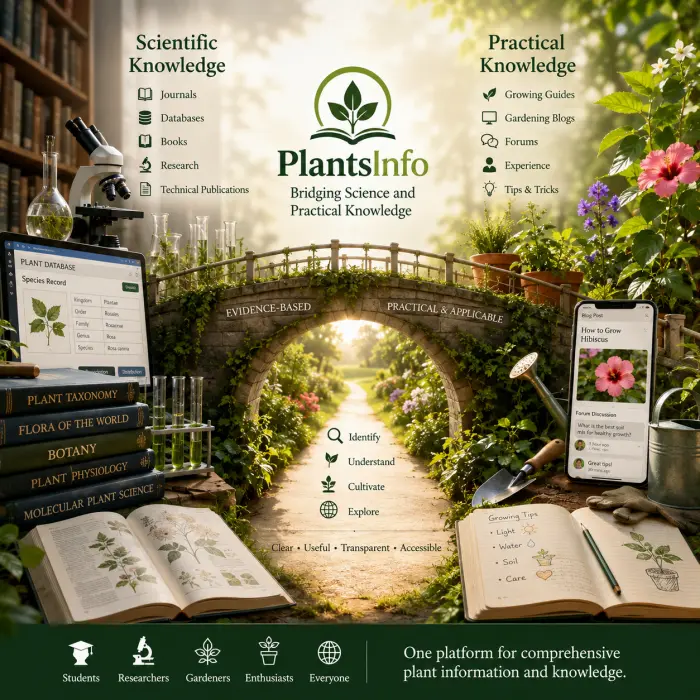
Scientific plant information is often scattered across journals, databases, books, and technical publications. Practical growing knowledge is frequently dispersed across forums, blogs, and personal experiences.
PlantsInfo seeks to bridge these worlds by bringing together evidence-based botanical information and practical plant knowledge within a single platform.
Whether a visitor is researching the taxonomy of a species, identifying a plant, learning how to cultivate it, or simply exploring plant diversity, our goal is to provide information that is clear, useful, transparent, and accessible.
Transparency and Editorial Approach
PlantsInfo is an independent botanical knowledge platform managed by Avijit Sarkar.
The project combines information from scientific publications, taxonomic databases, horticultural references, conservation resources, and other educational sources. Modern digital tools, including artificial intelligence systems, may be used to assist with information organization, data synthesis, drafting, formatting, and editorial workflows.
Artificial intelligence is used as a research and publishing tool, not as a substitute for editorial oversight. Published content is reviewed before publication to improve clarity, consistency, and accuracy.
PlantsInfo does not claim to replace primary scientific literature. Taxonomy, conservation assessments, and botanical knowledge continue to evolve, and readers conducting academic, scientific, medical, legal, or commercial work should consult sources whenever possible.
Our goal is to make plant knowledge more accessible while remaining transparent about the methods and tools used to build and maintain this resource.
PlantsInfo is a living project. As the database grows, our methodologies, editorial standards, and technologies may evolve. Significant changes to editorial practices will be documented whenever practical.
Acknowledgements
PlantsInfo benefits from the collective work of botanists, taxonomists, horticulturists, conservation scientists, educators, researchers, software developers, photographers, open-data initiatives, and knowledge-sharing communities around the world.
We also acknowledge the contribution of modern artificial intelligence systems, including large language models, as well as digital research and publishing tools that assist with information organization, content development, editorial workflows, and knowledge synthesis.
Without the contributions of these individuals, institutions, databases, publications, and technologies, a project of this scope would not be possible.