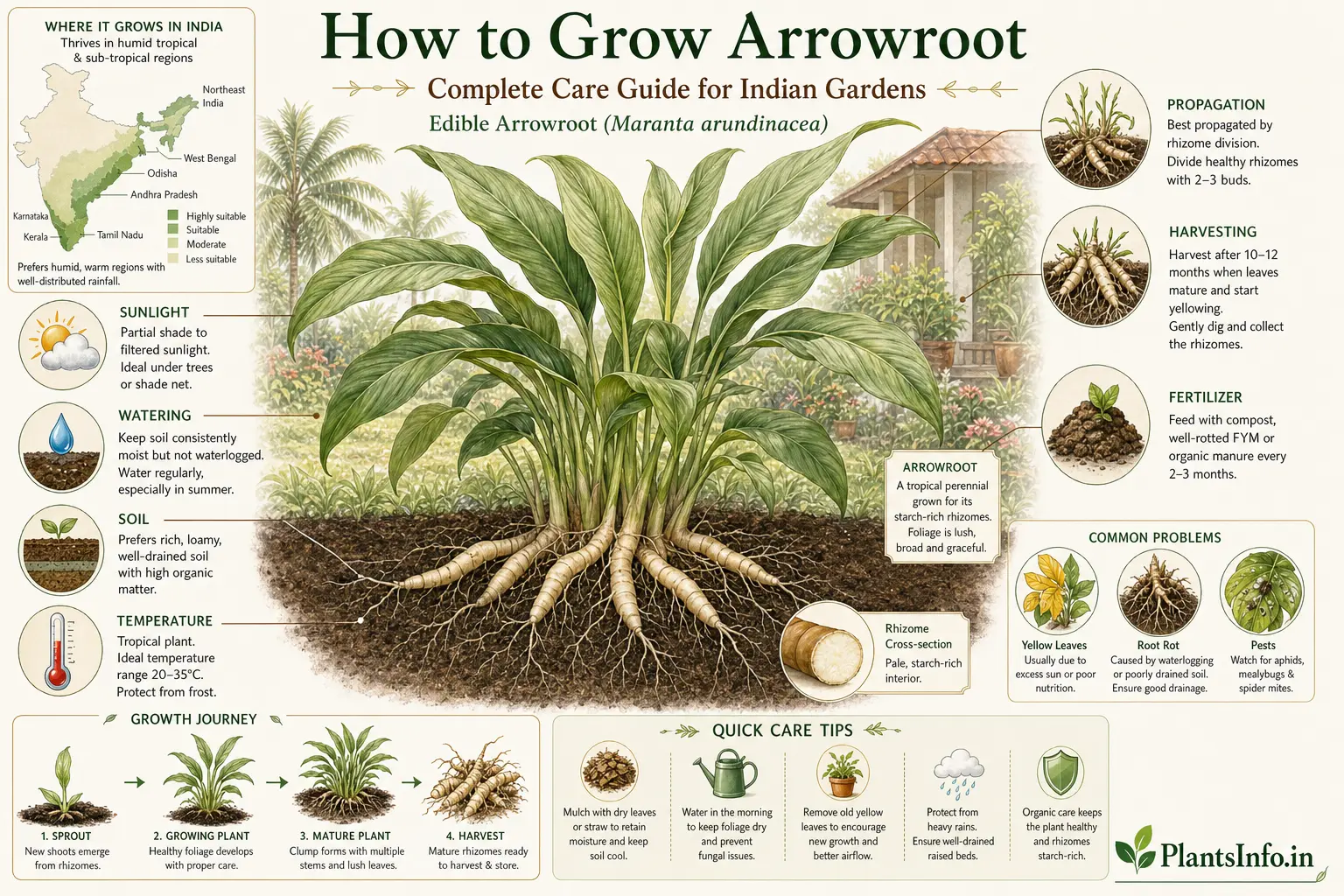
How to Grow Arrowroot: Complete Care Guide for Indian Gardens
Quick Answer: Arrowroot is a low-maintenance tropical rhizome plant that grows easily in warm, humid Indian conditions with partial shade and moist, well-drained soil. Plant rhizome pieces at the start of the monsoon, harvest after 10–11 months, and the plant will regrow from the root for another cycle.
See also: Arrowroot plant profile, common problems, its flowering season, its benefits, and its varieties.
There is something quietly satisfying about a plant that gives you both edible starch and ornamental foliage from the same root — and asks almost nothing in return. Arrowroot (Maranta arundinacea) has been cultivated across tropical India for centuries without ever becoming a headline crop. Which means most gardeners who grow it do so because someone handed them a rhizome and told them to plant it.
Recommended Products
Disclosure: As an Amazon Associate, PlantsInfo may earn from qualifying purchases.
🌱 Growing Essentials
The following products can help with container gardening, potting, root development, soil management, and healthy plant growth.
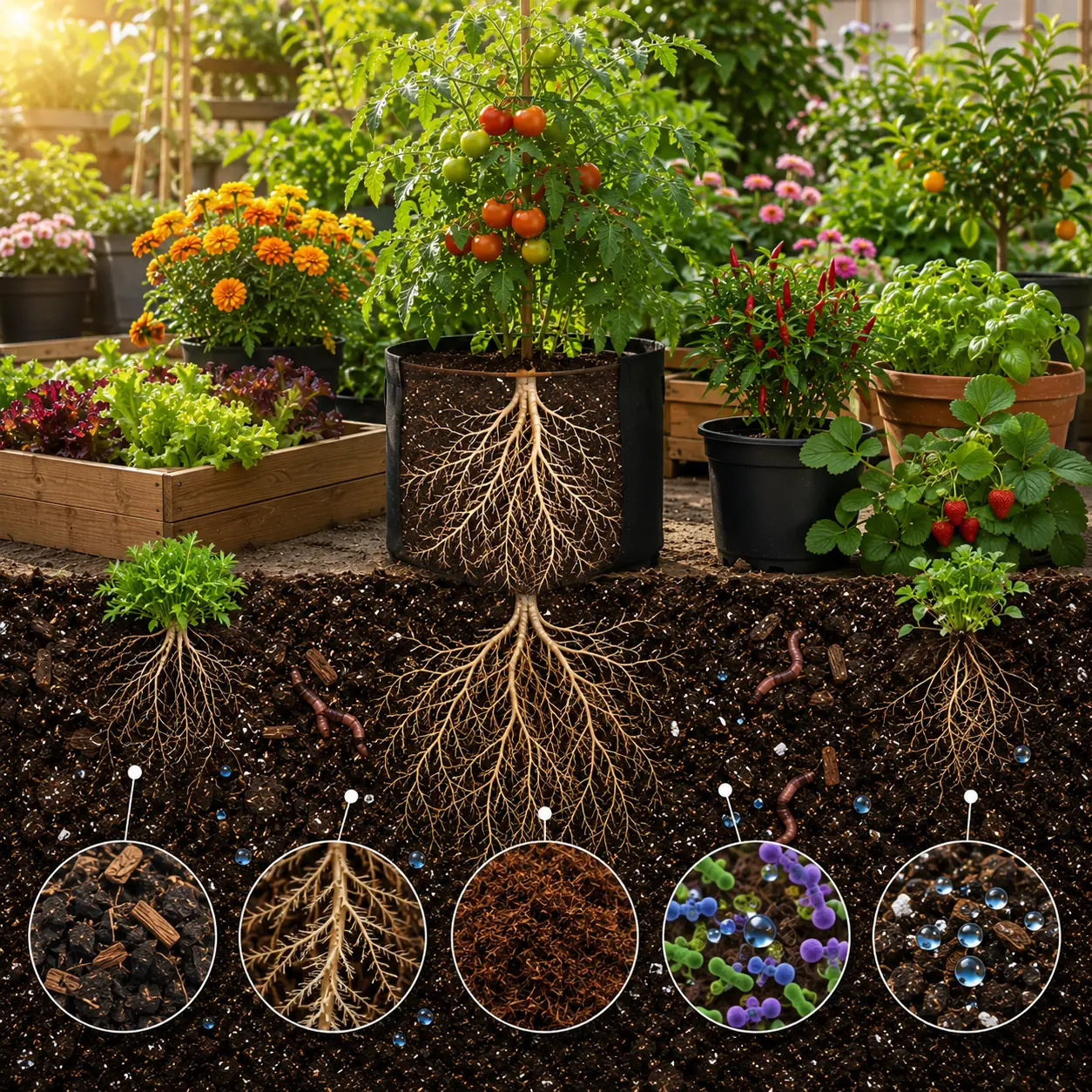
Organic Potting Soil Mix
Provides nutrients, structure, and healthy growing conditions for container plants.
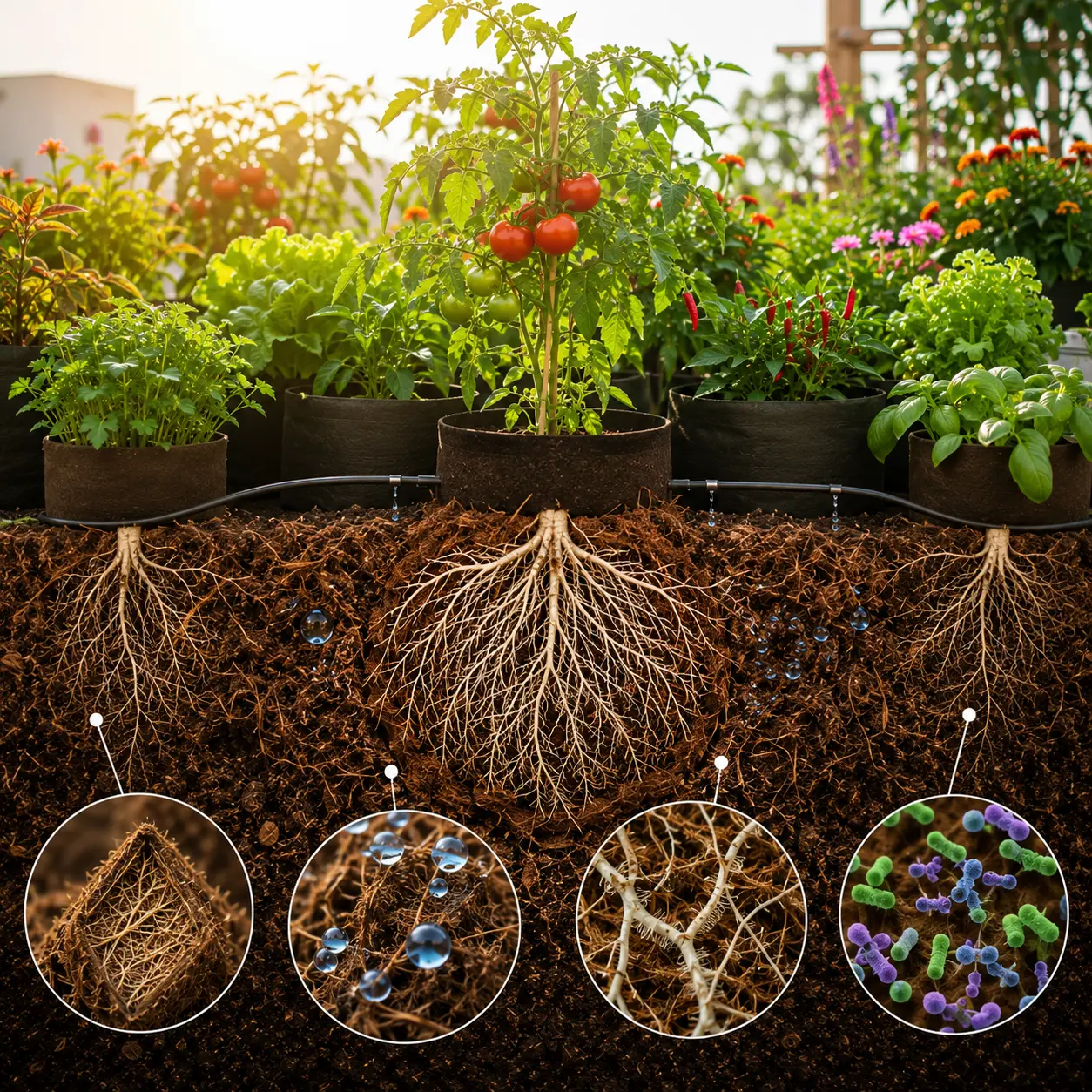
Coco Peat Growing Medium
Enhances moisture retention while maintaining excellent root-zone aeration.

Grow Bags for Plants
Improve drainage, root aeration, and vegetable production in limited spaces.

Plastic Pots for Plants
Ideal containers for seedlings, ornamentals, herbs, and balcony gardens.
That informal tradition is actually the best argument for growing it: this is a plant that has survived and spread through Indian home gardens entirely on its own merits. Difficulty level: Easy.
Quick Facts
| Attribute | Detail |
|---|---|
| Common names | Arrowroot, Ararot, Koova, Tikur, Tavaksiri |
| Scientific name | Maranta arundinacea |
| Varieties | No formally named cultivars widely available in India; local landrace rhizomes most common. See Varieties Guide for full comparison. |
| Plant type | Perennial rhizomatous herb |
| Mature size | 60–120 cm tall, clump-forming |
| Sunlight | Partial shade preferred; tolerates filtered sun |
| Water needs | Moderate to high; consistent moisture during growing season |
| Best season to plant | Monsoon onset (June–July) |
| Suitable states | Kerala, Tamil Nadu, Karnataka, Andhra Pradesh, West Bengal, Assam, Northeast India; also grows in humid parts of Maharashtra and Odisha |
Choosing the Right Spot
Arrowroot is one of the few food plants that actively prefer shade. In its natural habitat, it grows as an understorey plant beneath taller vegetation, and the same logic applies in the garden — a spot with morning sun and afternoon shade, or the dappled light under a fruit tree canopy, produces the best growth. Direct afternoon sun in Indian summers (April–June) causes leaf scorch and stresses the plant into early dormancy.
In coastal and northeastern India, where humidity is high year-round, arrowroot tolerates slightly more sun exposure. In drier inland gardens, err firmly toward shade. Container growing works well in this species — a large pot in a shaded corner of a terrace or balcony is a genuinely productive setup. The plant’s relatively compact size (rarely exceeding 1.2 metres) and clump-forming habit make it one of the more manageable rhizome crops for urban Indian gardeners.
Soil and Potting Mix
Arrowroot performs best in deep, well-drained, moisture-retentive loamy soil with a pH of 6.0–7.0. The rhizomes need loose, friable soil to expand freely — compacted or stony ground produces poor yields and misshapen rhizomes. Sandy-loam enriched with organic matter is close to ideal.
If using regular garden soil, incorporate generous quantities of vermicompost or well-decomposed cow dung (roughly 3–4 kg per square metre of planting area) and ensure the bed drains freely. In the Kerala and Tamil Nadu tradition, arrowroot is grown in raised beds or mounds specifically to ensure drainage during monsoon while retaining moisture through dry spells.
The most common soil mistake Indian gardeners make is using heavy, unimproved clay soil without amendment. Rhizomes in clay soil develop poorly, are prone to fungal rot, and are difficult to harvest cleanly — the starch extraction process is also more labour-intensive from misshapen rhizomes.
Planting — Season and Method
Monsoon onset (June–July) is the ideal planting window across most arrowroot-growing regions of India. In Kerala and the northeast, where the monsoon arrives earlier, May planting is common and effective. The consistent soil moisture at monsoon onset gives rhizome pieces the best rooting conditions.
Rhizome pieces are the standard planting material. Select healthy, firm rhizomes with visible buds (eyes), and cut them into 5–8 cm sections, each with at least one bud. Allow cut surfaces to dry for a few hours to reduce fungal risk, then plant at a depth of 5–8 cm with the bud facing upward.
Space plants 30–40 cm apart within rows and 45–60 cm between rows. The first shoots emerge within 2–3 weeks in warm, moist conditions. Seeds exist but are rarely used in home cultivation — rhizome planting is faster and more reliable.
Water thoroughly once after planting, then allow the monsoon to do the work.
Watering
In the first four weeks, water every two to three days if rainfall is insufficient. Once active shoot growth is visible above the soil surface, the plant is establishing well and can rely largely on rainfall during the monsoon season.
During the post-monsoon dry period (November–February in most growing regions), water two to three times per week to maintain consistent soil moisture — arrowroot does not tolerate extended drying out during its active growth phase.
A specific overwatering sign to watch: if the lowest leaf sheaths begin to yellow and the soil surface is perpetually wet, reduce watering and check that drainage is functioning. This is distinct from the natural yellowing that signals the start of dormancy in February–March.
During monsoon, ensure the planting site does not pool water — arrowroot needs moisture, not inundation.
Fertiliser
Arrowroot responds well to organic feeding. At planting, incorporate vermicompost or well-decomposed cow dung into the planting holes. Apply a top-dressing of the same material in September, when the plant is in active growth and rhizome development is beginning. A third application of neem cake or mustard cake in November supports the final phase of rhizome bulking before the harvest period.
Avoid high-nitrogen synthetic fertilisers after July — they push leafy top-growth at the expense of rhizome development, which is the opposite of what is wanted in the second half of the growing season. A balanced organic approach (vermicompost for baseline nutrition, mustard cake for mid-season potassium and phosphorus support) produces well-formed rhizomes with good starch content.
Common Problems and Fixes
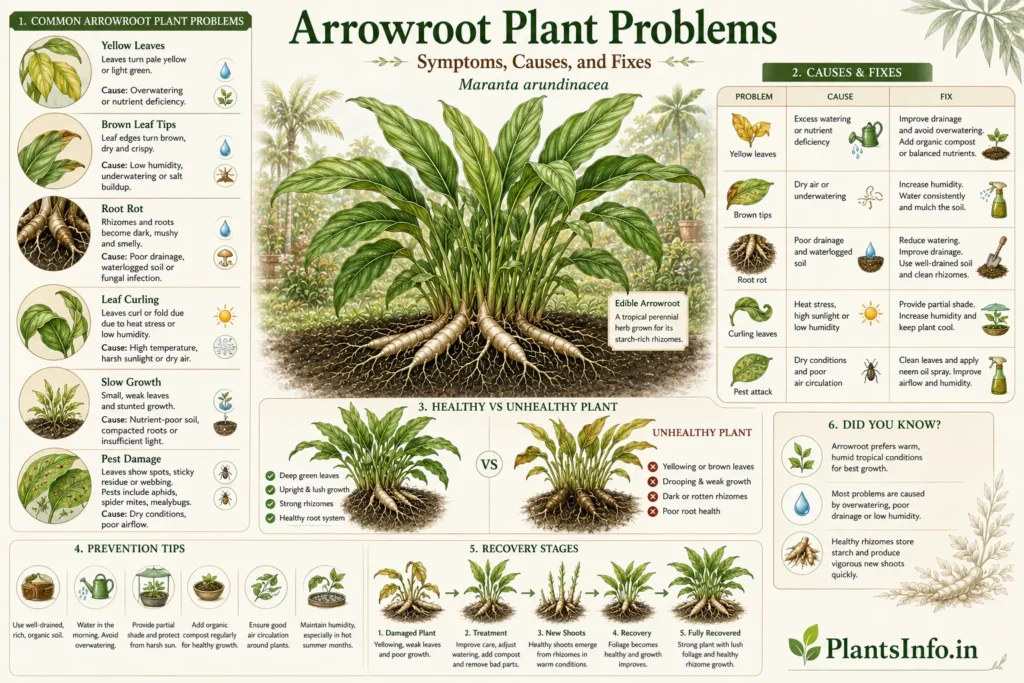
The three most common problems with arrowroot in Indian gardens are rhizome rot from waterlogged soil, leaf scorch from excess sun exposure, and slug or snail damage to young shoots at monsoon planting time. For full diagnosis and treatment, see the Arrowroot Problems Guide.
When Will You See Results?
Shoots emerge within 2–3 weeks of planting in warm monsoon conditions. The plant reaches its full foliage height (60–120 cm) by August–September. Rhizomes are ready for harvest approximately 10–11 months after planting — typically April–May of the following year, when the leaves begin to yellow and die back naturally.
First-year rhizome yields are modest by commercial standards but entirely adequate for household starch production. The plant improves in the second and third cycles as the root system becomes more established. One square metre of well-managed arrowroot planting typically yields 2–4 kg of fresh rhizomes — enough to produce a meaningful quantity of home-extracted starch.
Propagation
Rhizome division is the standard and most practical propagation method. At harvest time, retain the youngest, firmest rhizome pieces with visible buds for replanting. These are planted immediately (if the monsoon is approaching) or stored in slightly moist sand in a cool, shaded location until the next planting window.
Success rates with healthy rhizome pieces are very high — above 90% in warm, moist monsoon conditions. Air layering and seed propagation are not practised in home cultivation. Dividing established clumps in February–March, just before dormancy breaks, is a reliable way to multiply planting stock before the monsoon season.
Container Growing
Arrowroot is well-suited to container cultivation. Use a container of at least 30–40 cm depth and width — the rhizomes extend horizontally and need horizontal space as much as depth. A grow bag of 15–20 litres is a practical and affordable option.
Use a soil mix of 50% good loamy garden soil, 30% vermicompost, and 20% coarse sand or perlite. Place the container in a position with morning sun and afternoon shade. Water more frequently than ground-planted specimens — containers dry out faster, and arrowroot in containers is particularly sensitive to moisture stress. Repot or refresh the soil after each harvest cycle, as repeated growth depletes organic matter quickly.
Harvesting
Harvest arrowroot when the aerial leaves begin to yellow and die back naturally — in most Indian growing regions, this is April–May, approximately 10–11 months after a June–July planting. This natural die-back is the clearest signal that the rhizomes have reached maximum starch content.
Lift the entire clump carefully with a fork or spade, working outward from the plant base to avoid slicing rhizomes. The rhizomes are white to pale cream, finger-shaped, and can range from 10 to 30 cm in length in well-grown plants. Handle them gently — bruised rhizomes discolour quickly.
For home starch extraction: wash rhizomes thoroughly, peel, grate finely, and suspend the grating in cold water. Allow the starch to settle to the bottom, pour off the water, and repeat until the water runs clear. Spread the wet starch on a clean cloth in a shaded, airy spot to dry — direct sun can discolour it. Dried arrowroot starch stores well in an airtight container for 12–18 months.
Store unprocessed rhizomes in cool, dry, well-ventilated conditions for up to two to three weeks before processing. Do not refrigerate fresh rhizomes — cold temperatures damage the starch structure.
Seasonal Protection
In North Indian gardens, arrowroot is not reliably cold-hardy and should be treated as a warm-season annual unless rhizomes are lifted and stored through winter. In South India and the northeast, the plant is essentially perennial — it dies back in the dry season and regrows from rhizomes in the next monsoon.
During the April–May heat peak in inland gardens, the plants will naturally die back earlier than in coastal or humid regions. This is normal behaviour, not a problem, and coincides with the harvest period. Do not attempt to extend the growing season through heavy watering during this period — the plant is completing its cycle.
Key Takeaways
- Plant rhizome pieces at monsoon onset (June–July) in loose, organic-rich, well-drained soil for best rhizome development.
- Partial shade is not a compromise — it is the optimal condition for arrowroot in India, not a workaround.
- The entire harvest cycle takes 10–11 months; expect modest first-year yields that improve significantly in subsequent cycles.
- Avoid high-nitrogen fertiliser after July — it pushes leaves at the cost of rhizome bulk.
- Harvest when leaves naturally turn yellow, not on a fixed calendar date — the plant tells you when it is ready.
Conclusion: Give arrowroot shade, loose soil, and consistent moisture, and it will reward you with a genuinely useful harvest from one of the most undemanding food plants in the Indian home garden.