Introduction
Adenium obesum (Forssk.) Roem. & Schult., commonly known as desert rose, is an accepted species of Apocynaceae. It is a semisucculent shrub native to western tropical Africa through the Arabian Peninsula to Tanzania, occurring primarily in desert and dry-shrubland biomes.
Classification
- Plant Type
- Shrub
- Lifecycle
- Perennial
- Leaf Habit
- Deciduous, Semi-evergreen
- Native Region
- East Africa, Middle East, North Africa
- Plant Family
- Apocynaceae
Ecologically, A. obesum is associated with semi-arid environments and succulent growth forms. Species-specific documentation reviewed here establishes its occurrence in dry shrubland and desert settings, but does not establish a sufficiently specific functional role for the species within those native ecosystems to justify a stronger ecological claim.
The species has substantial ornamental importance and has been developed as a potted flowering plant, while a recent ethnobotanical review documents ornamental, medicinal, religious-ceremonial, and other traditional uses. Its conservation status is currently Least Concern under the IUCN assessment recorded by Kew. The profile series therefore treats A. obesum as a taxonomically accepted species while preserving distinctions between established evidence, historical nomenclature, and areas requiring further verification.
Quick Plant Information
| Field | Value |
|---|---|
| Accepted name | Adenium obesum (Forssk.) Roem. & Schult. |
| Family | Apocynaceae |
| Common names | Desert rose; Impala lily |
| Life form | Succulent shrub or small tree |
| Native range | Western tropical Africa to the Arabian Peninsula and Tanzania |
| Conservation status | Least Concern (LC) |
| Uses category | Ornamental; traditional and ethnobotanical uses documented |
Kew recognizes the accepted name, family, life form, and native range; the IUCN status is recorded as Least Concern in the current Kew taxon record. Kew’s medicinal-plant resource and the ethnobotanical literature document vernacular usage and medicinal/traditional applications.
Identity
Classification and Taxonomy
| Rank | Taxon |
|---|---|
| Kingdom | Plantae |
| Phylum | Streptophyta |
| Class | Equisetopsida |
| Subclass | Magnoliidae |
| Order | Gentianales |
| Family | Apocynaceae |
| Genus | Adenium |
| Species | Adenium obesum (Forssk.) Roem. & Schult. |
The hierarchy and accepted species treatment follow the current Kew Plants of the World Online / World Checklist of Vascular Plants backbone.
Related Species of Significance
| Species | Relationship | Distinguishing Note |
|---|---|---|
| Adenium multiflorum Klotzsch | Accepted congener | Accepted separately by Kew; native to southern tropical and southern Africa. The name A. obesum subsp. multiflorum is treated as a synonym of A. multiflorum. |
| Adenium swazicum Stapf | Accepted congener | Accepted separately by Kew; native from southern Mozambique to South Africa. A. obesum subsp. swazicum is treated as its synonym. |
| Adenium oleifolium Stapf | Accepted congener | Accepted separately by Kew; a semisucculent subshrub native to southern Africa. A. obesum subsp. oleifolium is treated as its synonym. |
Taxonomic Context
The principal nomenclatural issue is the historical treatment of several geographically differentiated Adenium names. Kew currently accepts A. obesum while treating names including Adenium arabicum, A. somalense, A. socotranum and others as synonyms. This has direct implications for researchers searching older literature or specimen records: records under those names may refer to material currently placed under A. obesum.
A particularly relevant contemporary issue is A. arabicum. Kew treats A. arabicum Balf.f. as a synonym of A. obesum, whereas recent cytogenetic research has reported distinct diploid and tetraploid groups associated with the names A. obesum and A. arabicum, respectively. This difference between nomenclatural treatment and cytogenetic interpretation should remain explicit rather than being silently reconciled.
Cytogenetics
| Parameter | Value | Source |
|---|---|---|
| Chromosome number | 2n = 22 in diploid A. obesum material | Rosa et al. (2025) |
| Genome size | 2C = 1.98 pg in diploid samples; 2C = 2.92 pg in tetraploid samples | Rosa et al. (2025) |
Species-specific cytogenetic work now establishes chromosome counts for A. obesum material, including diploid samples with 2n = 22 and tetraploid samples with 2n = 44. The 2025 study also reports substantial genome-size differences between the diploid and tetraploid groups.
The cytogenetic evidence is therefore no longer appropriately classified as wholly unverified. However, interpretation of the tetraploid material is taxonomically consequential because the study discusses material historically associated with A. arabicum, while Kew currently treats A. arabicum as a synonym of A. obesum. The chromosome data should consequently be reported with the taxonomic context of the source rather than used to resolve the nomenclatural issue implicitly.
Scientific Stability and Nomenclature
The current accepted name is Adenium obesum (Forssk.) Roem. & Schult., with the combination published in 1819; its basionym is Nerium obesum Forssk., published in 1775. IPNI confirms the nomenclatural authorship and basionym, while Kew currently accepts A. obesum as the species name.
A specific reclassification relevant to current researchers is Kew’s treatment of Adenium arabicum Balf.f. as a synonym of A. obesum. Older literature and horticultural material may therefore use A. arabicum independently, and those records should not be discarded when tracing historical evidence. Recent cytogenetic literature has reopened questions concerning the biological distinctness of such forms, but this does not alter the current Kew accepted-name treatment used here.
Growth Habit and Architecture
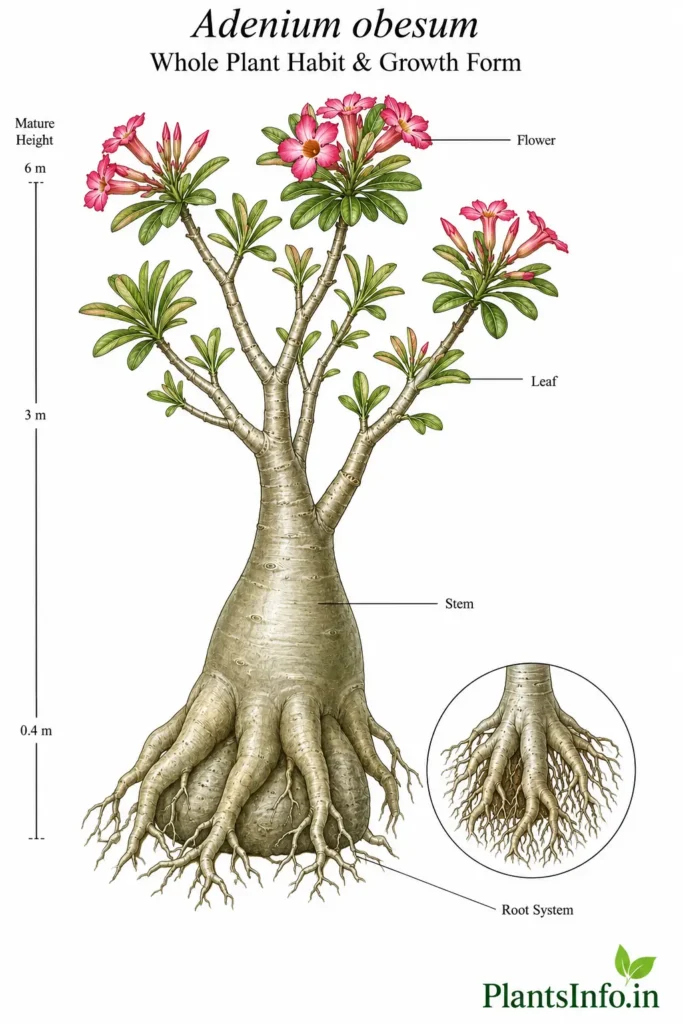
Adenium obesum is a conspicuously pachycaulous, semisucculent shrub whose swollen basal stem gives the plant its characteristic caudiciform architecture. The thickened stem functions as a major structural and storage organ, while branches arise above the swollen base and carry foliage toward their distal portions. This combination of a sculptural trunk, relatively sparse branching in some wild populations, and terminal foliage makes the species readily recognizable even when leafless.
| Field | Value |
|---|---|
| Life form | Succulent shrub or small tree |
| Mature height | 0.4–6 m, depending on population and growth form |
| Canopy spread | Not documented in the available species-specific sources reviewed |
| Stem type | Succulent, swollen basal stem; caudiciform/pachycaulous |
| Bark / surface texture | Grey, generally smooth |
| Branching pattern | Sparsely to multiply branched; branches ascending |
| Root morphology overview | Swollen primary roots associated with caudiciform growth |
| Growth rate | Not documented in the available species-specific sources reviewed |
| Longevity | Not documented in the available species-specific sources reviewed |
| Distinguishing architectural feature | Prominently swollen basal stem (caudex) |
The unusually enlarged stem and associated root system are among the principal architectural features separating A. obesum from many ordinary shrub forms.
Stem
The stem is both structurally distinctive and diagnostically important. Its swollen basal region can become extremely prominent, while the relatively smooth grey surface and ascending branches contribute to the characteristic sculptural appearance. The succulent stem architecture is also consistent with the genus-level caudiciform condition, but the specific dimensions and form vary substantially among plants.
| Field | Value |
|---|---|
| Stem type | Succulent, pachycaulous stem |
| Cross-section shape | Rounded |
| Surface texture | Smooth |
| Young / mature colour | Grey at maturity |
| Thorn / spine / wing status | Not documented as a spiny or winged stem |
| Water-storage structure | Swollen basal stem / caudex |
| Internal structure | Succulent tissue associated with water storage |
Leaves

Leaves are concentrated toward the ends of branches, giving the species a characteristic tufted appearance. Their simple, entire blades range from obovate to linear across the documented geographic material, with variation in pubescence and shape; this variation is useful when interpreting specimens from different parts of the broad native range.
| Field | Value |
|---|---|
| Presence | Present; deciduous under seasonal conditions |
| Leaf type | Simple |
| Size | Approximately 3–17 cm long; width variable by population |
| Colour | Green above; sometimes pale green or reddish beneath |
| Arrangement | Alternate, concentrated near branch tips |
| Special features | Sessile to shortly petiolate; obovate to linear; apex rounded to acute, emarginate or mucronate; margins entire |
Flowers

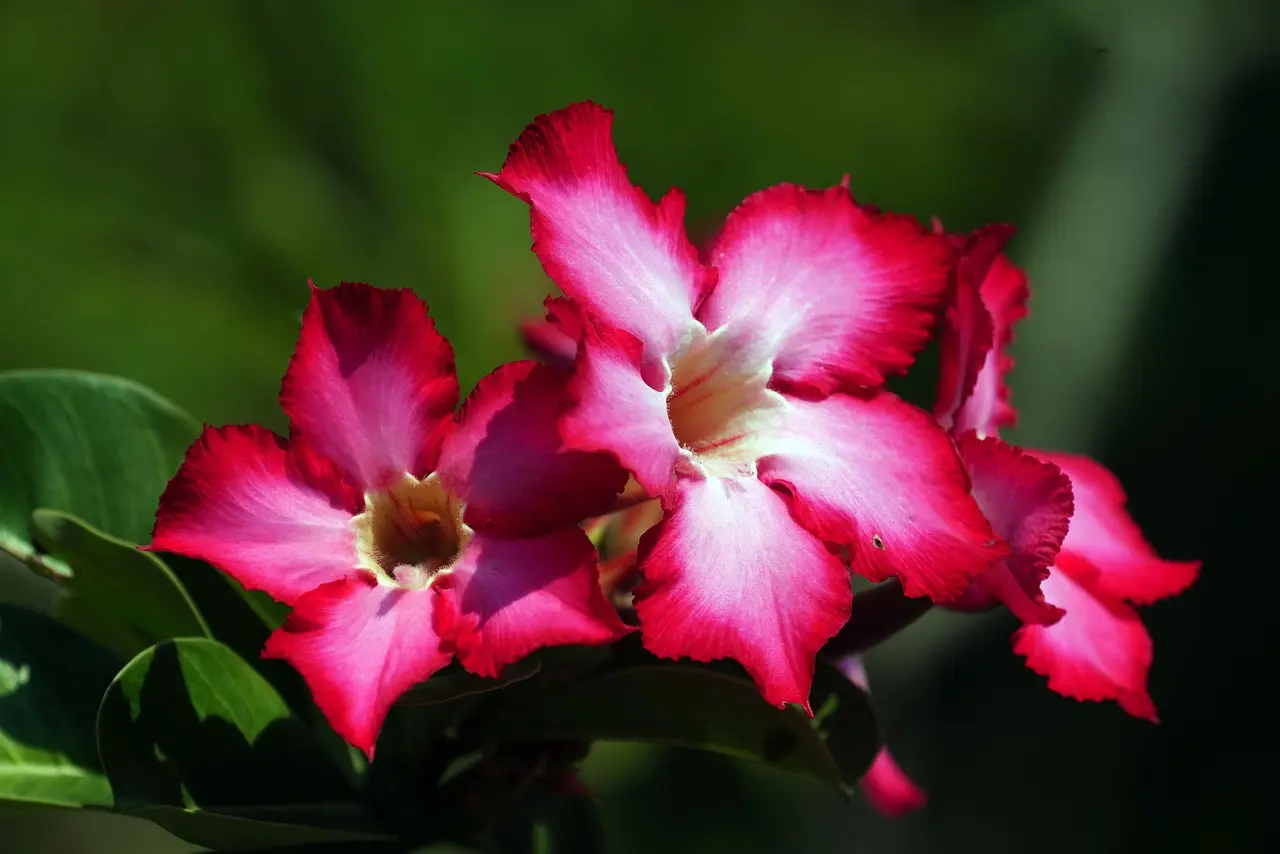
The flowers are conspicuous, terminal and typically pink to reddish-pink, although substantial cultivated variation exists. The funnel-shaped corolla and enclosed-to-exserted stamens are characteristic of Adenium floral morphology. The species-specific morphology is therefore more diagnostic than flower colour alone, since colour and form have been extensively modified through ornamental selection.
| Field | Value |
|---|---|
| Inflorescence type | Few-flowered to dense terminal cymes |
| Flower diameter / length | Corolla tube approximately 2–5 cm long |
| Sepals | Five, connate at base; approximately 0.5–1.1 cm in documented material |
| Petals | Five, fused into a funnel-shaped corolla; pink to red, often with contrasting throat |
| Stamens | Five; inserted near the upper corolla tube, included to exserted |
| Pistil | Two carpels; ovary united at the base |
| Fragrance | Variable among cultivated material; not a stable species-level diagnostic character |
| Anthesis | Flowers produced at branch tips; timing varies geographically and with seasonal conditions |
Pollination boundary: a species-specific pollinator identity is not sufficiently established in the sources reviewed here and is therefore not assigned.
Fruit

The fruit consists of a paired follicle structure that develops from the two carpels. The follicles are elongated, joined at the base, and open longitudinally when mature, exposing the numerous hairy seeds.
| Field | Value |
|---|---|
| Fruit type | Paired follicles |
| Shape | Elongated, tapering follicles |
| Length | Approximately 11–22 cm in East African material; cultivated biometric studies report approximately 15.1–25.1 cm |
| Surface features | Smooth to pubescent externally depending on source and geographic material |
| Seed count | Variable; published cultivated material reports approximately 28–118 seeds per follicle |
Seeds

The seeds are elongated and adapted for wind dispersal by conspicuous hair tufts at both ends. Published biometric work places individual seeds broadly around 1 cm in length, although measurements vary between seed lots.
| Field | Value |
|---|---|
| Size | Approximately 9–12 mm long in documented seed lots |
| Shape | Cylindrical to oblong |
| Colour | Brown |
| Seed coat | Brown integument |
| Germination rate | High germination potential has been documented under tested conditions |
Root System
The root system contributes to the species’ characteristic caudiciform architecture, with enlarged primary roots associated with the swollen basal portion of seed-grown plants. This organization provides a conspicuous below-ground component to the plant’s overall storage architecture.
Field-observable roots are therefore best recognized by their thickened primary-root development rather than by a specialized fine-root morphology. Species-specific evidence reviewed here does not justify assigning a precise rooting depth or lateral spread.
Field Identification
In the field, the strongest combination of characters is the swollen succulent basal stem, smooth grey mature surface, branch-tip clusters of simple entire leaves, and conspicuous pink-to-red funnel-shaped flowers. The paired elongated follicles and hairy seeds provide additional confirmation when reproductive material is present.
Single best distinguishing feature: the prominently swollen basal caudex combined with a succulent shrub architecture.
A specific confusable species is not assigned here because the strongest identification characters are structural and should be assessed together rather than reduced to a single superficial comparison.
Normal vs. Concerning Observations
| Observation | Status | Notes |
|---|---|---|
| Swollen basal caudex | Normal | Characteristic architecture of the species. |
| Seasonal leaf loss | Normal | Deciduous behaviour occurs under seasonal dry or cool conditions. |
| Latex exudation from damaged tissue | Normal | Clear or white latex is documented for the species. |
| Terminal clusters of pink-to-red flowers | Normal | Characteristic reproductive presentation. |
| Paired elongated follicles | Normal | Normal fruiting structure following successful reproduction. |
| Soft or blackened stem tissue | Investigate | Not characteristic of healthy succulent stem tissue; may indicate structural deterioration rather than normal caudex development. |
Cultivar Summary
Documented ornamental selections of A. obesum exist, including named selections developed or maintained in cultivation. PROTA records selections such as ‘Singapore’, ‘Red Everbloomer’, ‘Mombasa’, ‘Fritz Dederer’ and ‘Tom Grumbleys’; more recent breeding literature likewise demonstrates substantial deliberate selection for flower and caudex characters.
| Cultivar | Key Characteristic | Commercial Status | Origin |
|---|---|---|---|
| ‘Singapore’ | Deep-pink flowers | Historically documented | Probably Yemen |
| ‘Red Everbloomer’ | Selected for prolific flowering | Historically documented | Not documented in the cited source |
| ‘Mombasa’ | Much-branched dwarf form | Historically documented | Not documented in the cited source |
| ‘Fritz Dederer’ | Thick, corky white bark | Historically documented | Not documented in the cited source |
| ‘Tom Grumbleys’ | Purely white flowers | Historically documented | Not documented in the cited source |
Physiology and Phytochemistry
Functional Traits
Adenium obesum combines succulent water storage with physiological responses that reduce water loss during moisture limitation. Experimental work on the species shows that reduced substrate water availability alters stomatal conductance and gas exchange, while plants subjected to prolonged water restriction retained substantial physiological function and recovered after rewatering. The evidence therefore supports a drought-response strategy, but the available experiments do not justify assigning a particular photosynthetic pathway without direct species-specific evidence.
| Trait | Mechanism Description | Ecological Context |
|---|---|---|
| Water-storage strategy | Water and associated resources are stored in succulent stem tissues, providing a reserve during periods of restricted water availability. | Consistent with occupation of seasonally dry environments. |
| Stomatal regulation under water limitation | Water restriction reduces stomatal conductance and modifies gas exchange, limiting transpirational water loss while maintaining physiological activity. | Documented experimentally under controlled water-deficit conditions. |
| Seasonal dormancy / leaf loss | Under unfavourable seasonal conditions, plants can enter a period of reduced activity accompanied by leaf loss. | Documented for plants experiencing drought- or cold-associated seasonal conditions. |
| Chemical defence | Cardiac glycosides and other secondary metabolites occur in species tissues, providing a chemically defended tissue profile. | Particularly relevant to tissues exposed to herbivory, although a direct species-specific ecological defence experiment was not identified. |
Physiological Integration
The strongest species-specific evidence supports an integrated drought-response phenotype rather than a single isolated mechanism. Water storage provides a reserve, while stomatal regulation modifies gas exchange during water limitation, and seasonal dormancy can reduce the physiological costs of maintaining a full photosynthetic surface under unfavourable conditions. Experimental evidence also indicates that A. obesum can recover physiological and growth parameters after an extended irrigation interruption.
The available literature does not establish the relative contribution of each mechanism under natural field conditions, nor does it demonstrate a quantitatively defined trade-off among storage, stomatal regulation and dormancy. Such relationships should therefore not be inferred beyond the experimental evidence.
Phytochemistry
The phytochemical profile of A. obesum is particularly well documented for cardiac glycosides and pregnanes, with additional evidence for flavonoids and other phenolic compounds. Early species-specific isolation work identified numerous cardiac glycosides from roots and stems, including glycosides associated with oleandrigenin and digitoxigenin; oleandrigenin β-gentiobiosyl-β-thevetoside was reported as a principal glycoside in the investigated material. Pregnanes including neridienone A and 16,17-dihydroneridienone A were also isolated.
Later investigations broadened the documented chemistry to include flavonoids and terpenoid-related constituents. A stem-bark study isolated rosmarinic acid, while work on A. obesum grown in Oman characterized two additional flavonoids: 5,7,3′,4′-tetrahydroxyflavone and 3,5,7,3′,4′,5′-hexahydroxyflavone.
| Compound Class | Representative Compounds | Primary Location | Ecological or Biological Function |
|---|---|---|---|
| Cardiac glycosides | Oleandrigenin β-gentiobiosyl-β-thevetoside; obeside; obebioside; obetrioside; honghelin; somalin | Roots and stems; stem-bark material also investigated | Biologically active secondary metabolites; their potent bioactivity is consistent with a chemical-defence role, although direct ecological defence experiments are limited. |
| Pregnanes | Neridienone A; 16,17-dihydroneridienone A | Roots and stems | Secondary metabolites of documented species chemistry; ecological function remains insufficiently established. |
| Flavonoids | 5,7,3′,4′-Tetrahydroxyflavone; 3,5,7,3′,4′,5′-hexahydroxyflavone; 3-O-methylkaempferol | Stem / stem-derived extracts | Secondary metabolites with demonstrated biological activity in experimental assays; direct ecological function remains unresolved. |
| Phenolic compounds | Rosmarinic acid | Stem bark | Secondary metabolite with antioxidant and antimicrobial activity demonstrated in extract/compound assays; ecological function in the intact plant is not established. |
| Terpenoids | Dihydroifflaionic acid and other reported terpenoid constituents | Species extracts; organ assignment varies among studies | Secondary metabolites; species-specific ecological function is insufficiently characterized. |
Phytochemical Organ Distribution
Direct organ-specific evidence is available principally for roots, stems and stem bark. The classic isolation studies explicitly investigated roots and stems, while later work focused on stem bark. Quantitative concentration comparisons across organs were not established by these sources.
| Organ | Compound Class | Representative Compounds | Concentration | Source |
|---|---|---|---|---|
| Roots | Cardiac glycosides | Oleandrigenin glycosides; obeside; obebioside; obetrioside | Not documented in available literature. | Yamauchi & Abe (1990) |
| Roots | Pregnanes | Neridienone A; 16,17-dihydroneridienone A | Not documented in available literature. | Yamauchi & Abe (1990) |
| Stems | Cardiac glycosides | Oleandrigenin and digitoxigenin glycosides; D-cymarosides; D-thevetosides; D-digitalosides | Not documented in available literature. | Yamauchi & Abe (1990) |
| Stems | Pregnanes | Neridienone A; 16,17-dihydroneridienone A | Not documented in available literature. | Yamauchi & Abe (1990) |
| Stem bark | Phenolic compounds | Rosmarinic acid | Not documented in available literature. | Akhtar et al. (2017) |
| Stem | Flavonoids | 5,7,3′,4′-Tetrahydroxyflavone; 3,5,7,3′,4′,5′-hexahydroxyflavone | Not documented in available literature. | Al-Rawahi et al. (2017) |
Phytochemical Significance
The most distinctive chemical group is the cardiac glycoside fraction, which has received disproportionate attention because multiple structurally characterized glycosides occur in roots and stems. This work includes several named glycosides and chemically defined aglycone–sugar combinations rather than merely qualitative screening.
Characterization is therefore relatively mature for cardiac glycosides and selected pregnanes, but substantially less complete for quantitative organ distribution and whole-plant metabolite allocation. Flavonoid research has also expanded the known chemical profile, particularly through investigations of Omani stem material.
The dominant research organs are roots and stems/stem bark. The available literature is correspondingly biased toward extracts and isolated constituents from these organs, whereas comparable quantitative characterization of leaves, flowers, fruits, and seeds is much less evident in the sources reviewed here. This creates an important research-concentration bias: A. obesum chemistry is better characterized for below-ground and woody tissues than for the complete plant.
No species-specific study identified here establishes synergistic or antagonistic interactions among the documented cardiac glycosides, pregnanes, flavonoids, and phenolic compounds in intact A. obesum. Experimental biological activity of individual compounds or extracts should therefore not be converted into claims of chemical synergy.
Evidence, Nutrition, Soil Ecology, and Safety
Evidence Hierarchy for Medicinal Use
Adenium obesum qualifies for this section because traditional medicinal use is documented, while contemporary literature contains substantial in-vitro and experimental pharmacological work. The evidence base does not establish clinical efficacy in humans.
| Evidence Layer | Status | Notes |
|---|---|---|
| Traditional Use | Documented | Ethnobotanical literature records medicinal use for several conditions and traditional use of different plant parts. (ResearchGate) |
| Nutritional Evidence | Absent | No documented studies at this evidence level. |
| In Vitro Studies | Documented | Extracts and isolated constituents have been investigated for antimicrobial, antioxidant, cytotoxic and other biological activities. (RJMS) |
| Animal Studies | Documented | Experimental and toxicological animal evidence exists, including documented cardiac-glycoside toxicosis. |
| Human Clinical Studies | Absent | No documented clinical efficacy trials establishing therapeutic benefit were identified during the current audit. |
| Regulatory Recognition | Absent | No documented medicinal regulatory approval or recognized therapeutic indication was identified during the current audit. |
| Unsupported Commercial Claims | Disputed | Pharmacological activity is frequently presented as therapeutic potential in reviews, but the available evidence does not establish equivalent clinical efficacy in humans. (RJMS) |
Evidence Assessment
The medicinal evidence is strongly asymmetric. Traditional use and laboratory pharmacology are documented, but the evidence does not progress to demonstrated human clinical efficacy. The strongest experimental categories are therefore in-vitro biological activity and chemical characterization, whereas the weakest are human clinical evidence and regulatory recognition.
This distinction is important because reviews sometimes describe antioxidant, antimicrobial, anticancer, antiviral, or anti-inflammatory activities as validating traditional uses. Those claims primarily derive from experimental studies and should not be interpreted as established treatments in humans.
Nutritional Composition
Not applicable — Adenium obesum is not established here as a food-use species, and no validated nutritional-composition dataset suitable for a food-composition table was identified.
Nutritional Significance
No evidence was identified that supports treating A. obesum as a nutritionally significant food plant. Nutritional claims should therefore not be extrapolated from its documented phytochemical composition.
Soil Ecology and Mycorrhizal Associations
Evidence is moderate but concentrated in a single rhizosphere-microbiome investigation. Khan et al. (2020) used sequencing to characterize the rhizosphere of A. obesum growing in the Arabian Peninsula. The study detected substantial fungal and bacterial diversity, including 121 fungal and 3,662 bacterial operational taxonomic units. Ascomycota and Basidiomycota were abundant, while Mucoromycota was detected in the A. obesum and Aloe dhufarensis rhizospheres but not in the Cleome austroarabica comparison.
The bacterial community was dominated at the phylum level by Actinobacteria, Proteobacteria, Bacteroidetes, Planctomycetes, Acidobacteria, and Verrucomicrobia. The study demonstrates a diverse species-associated rhizosphere microbiome, but it does not by itself establish a specific obligate mycorrhizal association, a particular fungal symbiosis, or a defined nutrient-transfer mechanism.
Accordingly:
- Mycorrhizal type: Not established in the species-specific evidence reviewed.
- Fungal associations: Documented at broad taxonomic resolution; Ascomycota, Basidiomycota, and Mucoromycota were detected.
- Rhizosphere bacteria: Documented at community/phylum level.
- Bacterial functional roles: Not sufficiently resolved for species-specific assignment.
- Allelopathy: No species-specific evidence establishing allelopathy was identified.
- Agronomic/conservation implications: The documented rhizosphere diversity indicates that A. obesum participates in a complex soil microbial environment, but experimental evidence is insufficient to assign a specific microbial management or conservation function.
Toxicity and Safety
| Subject | Toxic Compounds | Clinical Effects | Source |
|---|---|---|---|
| Humans | Cardiac glycosides, including obebioside B | Human poisoning is poorly documented; the expected toxicological mechanism involves inhibition of myocardial Na⁺/K⁺-ATPase and potential cardiac arrhythmia. | Hong Kong Hospital Authority, Atlas of Poisonous Plants in Hong Kong |
| Cats | Digitalis-like cardiac glycosides | Vomiting, diarrhea, anorexia, depression, irregular heartbeat and potentially death after ingestion. | ASPCA Poison Control (ASPCA) |
| Dogs | Digitalis-like cardiac glycosides | Vomiting, diarrhea, anorexia, depression, irregular heartbeat and potentially death after ingestion. | ASPCA Poison Control (ASPCA) |
| Livestock | Cardiac glycosides | No verified livestock-specific clinical dataset was identified during the current audit. | No species-specific livestock study identified during current audit. |
The plant is considered toxic as a whole, with particular concern for its sap. Cardiac glycosides such as obebioside B inhibit myocardial Na⁺/K⁺-ATPase, producing the physiological basis for digitalis-like cardiac toxicity.
Independent veterinary guidance identifies A. obesum as toxic to dogs and cats and lists horses among susceptible animals. A 2026 case report provides additional species-specific evidence in a blue-and-gold macaw: ingestion of a desert-rose flower resulted in severe clinical toxicosis including bradycardia, shock, cyanosis, gastrointestinal bleeding and hyperkalemia.
Toxicity Context
The toxicological evidence is principally consistent with cardiac-glycoside poisoning rather than a nonspecific irritant effect. The documented mechanism involves inhibition of myocardial Na⁺/K⁺-ATPase, with consequent changes in intracellular sodium and calcium handling and potential development of arrhythmias.
Whole-plant toxicity and isolated-compound activity should not be treated as interchangeable measurements. Species-specific chemical studies establish numerous cardiac glycosides, while clinical toxicology sources identify the whole plant, particularly its sap, as poisonous.
Human poisoning evidence remains particularly limited. The Hong Kong Hospital Authority states that poisoning is not well documented in humans, although a poison-center case involving an eight-month-old child who had a flower in her mouth has been reported; the child was asymptomatic at presentation. This absence of extensive human case documentation should not be interpreted as evidence of safety.
The sources reviewed here do not establish species-specific dose thresholds, pregnancy safety, renal/hepatic risk thresholds, or clinically characterized drug-interaction profiles for A. obesum. Because cardiac glycosides can produce clinically significant arrhythmias, ingestion should be treated as a toxicological exposure rather than as a medicinal-use scenario.
This profile does not constitute medical or veterinary advice.
Distribution, Habitat, Climate, and Stress Tolerance
Biogeographic Context
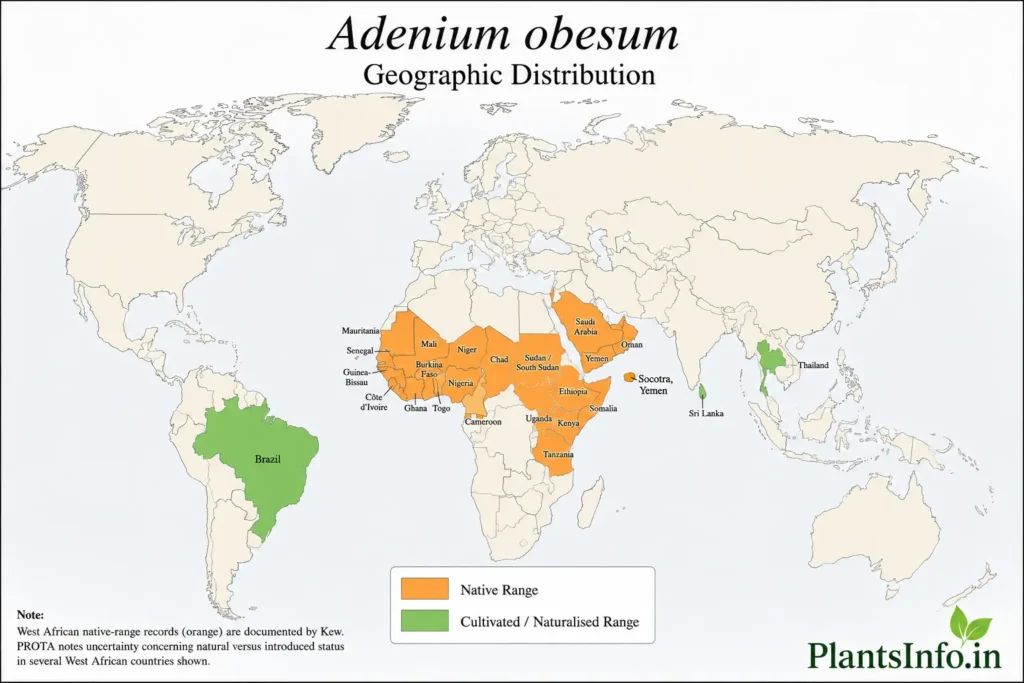
- A. obesum occupies a broad but discontinuous dryland distribution extending across tropical Africa and the Arabian Peninsula. Kew currently recognizes the species as native from western tropical Africa through the Arabian Peninsula and Tanzania, while GRIN provides a more granular country-level treatment.
The distribution is associated primarily with hot, seasonally dry environments. Recent ecological-niche modelling identifies temperature, annual precipitation, precipitation in the wettest month, and altitude among the strongest environmental predictors of the species’ distribution; precipitation in the wettest month was the most influential variable in the reported models.
There is a native-range classification issue at the western edge: PROTA explicitly notes uncertainty over whether A. obesum is naturally native in West Africa or was introduced and subsequently naturalized there, whereas current Kew POWO lists several West African countries as native. This difference should remain visible rather than being silently reconciled.
Native Range and Distribution
| Region | Countries or Sub-regions | Notes |
|---|---|---|
| West Tropical Africa | Benin, Burkina Faso, Cameroon, Ghana, Guinea, Guinea-Bissau, Côte d’Ivoire, Mali, Mauritania, Niger, Nigeria, Senegal, Togo | Listed as native by current Kew POWO; PROTA notes uncertainty concerning natural versus introduced status in West Africa. |
| Northeast Tropical Africa | Chad, Ethiopia, Sudan/South Sudan, Somalia | Native range documented by GRIN and consistent with Kew’s broad African range. (apg.pir.sa.gov.au) |
| East Tropical Africa | Kenya, Tanzania, Uganda | Native range documented by Kew and GRIN. |
| Arabian Peninsula | Oman, Saudi Arabia, Yemen | Native range documented by Kew and GRIN. |
| Socotra | Socotra, Yemen | Included within the current Kew distribution for A. obesum. |
Global Cultivation and Naturalisation
A. obesum is widely cultivated as an ornamental plant. PROTA describes worldwide ornamental cultivation, while Brazilian literature documents its development as a commercial potted crop.
| Region | Countries or Areas | Cultivation Status | Notes |
|---|---|---|---|
| South America | Brazil | Commercially established | Commercial-scale ornamental production is documented, although technical production information was historically limited. (Ornamental Horticulture) |
| Southeast Asia | Thailand | Commercially established | GRIN records cultivation; PROTA records naturalisation in parts of Southeast Asia and worldwide ornamental cultivation. (apg.pir.sa.gov.au) |
| Indian Subcontinent | Sri Lanka | Naturalised | GRIN explicitly records A. obesum as naturalized in Sri Lanka. (apg.pir.sa.gov.au) |
| Global ornamental trade | Worldwide | Commercially established | PROTA describes worldwide ornamental cultivation; specific country-level production statistics are not established in the sources reviewed. |
Cultivation Range Note: The strongest published production evidence located in this audit concerns Brazil, where A. obesum had become commercially important by the 2010s. The literature is disproportionately concentrated on Brazilian ornamental production and propagation, while globally comparable production statistics are sparse.
Natural Habitat
The species occurs primarily in desert and dry-shrubland biomes. Its native environments are characterized by seasonal water limitation rather than uniformly extreme aridity across the entire range. Kew places the species primarily in desert or dry-shrubland biome categories, while ecological modelling identifies precipitation regime and temperature as major distributional predictors.
Elevation varies geographically; the available species-level distribution sources establish occurrence from lowland Arabian and African sites into higher-elevation parts of the continental range, but a single verified species-wide elevation envelope suitable for publication could not be established from the authoritative sources reviewed.
The species is therefore best regarded as ecologically broad within warm dryland environments, rather than as an obligate inhabitant of a single narrowly defined habitat type. The West African native-range question remains an important qualification to broad distribution statements.
Ecological Role
Evidence for ecosystem-level ecological function is limited compared with the strength of the distribution and cultivation literature. The available evidence supports its occurrence as a native component of dryland plant communities, but does not adequately establish a species-specific keystone, indicator, or ecosystem-engineering role.
| Role Type | Species or Agent Involved | Notes |
|---|---|---|
| Native dryland vegetation component | Adenium obesum | Documented occurrence in desert and dry-shrubland biomes. |
| Rhizosphere microbial association | Fungal and bacterial communities | A species-specific rhizosphere study documented diverse microbial communities, but did not establish a unique ecosystem function attributable to A. obesum. |
| Seed dispersal | Not resolved | Species-specific disperser identity was not sufficiently established in the current evidence set. |
| Pollination relationship | Not resolved | A species-specific pollinator identity was not sufficiently established |
No evidence reviewed here establishes A. obesum as a keystone or indicator species. The ecological-role evidence is consequently low to moderate, with distributional occurrence much better documented than species-specific interaction networks.
Invasive Status
Naturalisation outside the native range is documented, particularly in Sri Lanka and parts of Southeast Asia. GRIN explicitly records Sri Lanka as naturalized, while PROTA reports naturalisation in Sri Lanka and parts of Southeast Asia.
No sufficiently documented species-specific evidence was identified in the current audit demonstrating a defined ecological impact or a formal management programme directed specifically at A. obesum as an invasive species. Recent ecological-niche modelling nevertheless identifies the species’ potential expansion under warmer, drier future climates as a research concern, rather than as proof of present invasive impact.
Optimal Climate Parameters
Species-specific quantitative climate-envelope data are substantially less developed than the distributional literature. The most recent ecological-niche study used WorldClim 2.1 variables including maximum temperature of the warmest month, mean temperature of the warmest quarter, mean temperature of the coldest quarter, annual precipitation, precipitation of the wettest month and altitude as the principal predictors.
A published WorldClim-based occurrence synthesis gives a broad native-range estimate of approximately 25°C mean annual temperature and 608 mm (23.9 in) annual precipitation, but these are modelled native-range summaries rather than experimentally established cultivation optima. The underlying WorldClim methodology is documented by Fick & Hijmans (2017).
| Parameter | Represented climatic range | Tolerance Range | Notes |
|---|---|---|---|
| Mean Annual Temperature | ~25°C (~77°F) native-range estimate | ~13–39°C (55–102°F) represented in the cited native-climate synthesis | Broad occurrence-climate estimate, not an experimentally determined optimum. (Exotic Manual) |
| Annual Rainfall | ~608 mm (~23.9 in) native-range estimate | Not experimentally established as a species-wide tolerance range | Native-climate estimate; the recent niche model confirms precipitation as an important predictor but does not establish a physiological rainfall threshold. (Exotic Manual) |
The climate values above should therefore be interpreted as distributional climate descriptors, not universal cultivation prescriptions. The available evidence does not support a defensible species-wide numerical optimum for rainfall.
Climate Interpretation
Temperature and precipitation are the principal documented climatic dimensions shaping the distribution of A. obesum. The recent ecological-niche modelling study gives particular weight to precipitation during the wettest month, indicating that precipitation seasonality and water availability remain important even for a drought-adapted species.
The native climate envelope is broad enough to encompass both seasonally dry tropical environments and substantially arid regions. Cultivation has extended the plant far beyond this native climatic context, including commercial production in Brazil.
The principal documented expansion constraint is therefore not simply annual heat: the interaction of temperature with precipitation regime and seasonal moisture availability appears more informative. Recent modelling projects increased environmental suitability in some warmer, drier future scenarios, but these are distribution-model projections rather than demonstrations of physiological adaptation under future climates.
Stress Tolerance Profile
| Stress Type | Tolerance Level | Physiological Response | Notes |
|---|---|---|---|
| Water deficit / drought | Verified | Water restriction reduces stomatal conductance and gas exchange, while stored water and physiological adjustment allow continued function and recovery after rewatering. | |
| Cold stress | Supported | Cold-associated reduction in activity can include leaf loss and dormancy. | Species-specific evidence supports seasonal dormancy/leaf drop under unfavourable colder conditions, but a precise physiological threshold is not established. (ResearchGate) |
| Heat stress | Conditional | Physiological responses under high temperature are less directly characterized than drought responses. | Distribution and niche modelling support association with warm environments, but a quantified upper physiological threshold was not established. |
The strongest direct physiological evidence remains for water deficit. The species responds to restricted water availability through altered stomatal conductance and gas exchange and can recover following rewatering. Its distribution in hot, dry environments provides ecological corroboration but should not substitute for physiological measurements.
Compound Stress Assessment
No sufficiently direct species-specific study was identified that experimentally characterizes the interaction of combined drought and heat stress in A. obesum. The recent ecological-niche modelling work examines temperature and precipitation jointly at the distributional level, but this does not establish the plant’s physiological response to simultaneous heat and water deficit.
Combined-stress physiology therefore remains a knowledge gap, rather than a basis for assuming that the species’ drought tolerance automatically confers equivalent tolerance to compound heat–drought stress.
Adaptations, Phenology, Pollination, and Reproductive Biology
Structural and Physiological Adaptations
The principal adaptive architecture of Adenium obesum is its caudiciform water-storage system. The swollen stem and associated enlarged storage tissues allow the species to persist through seasonally dry periods, while deciduous behaviour can reduce the costs of maintaining foliage during unfavourable seasons. These traits are especially relevant to its dryland distribution.
| Adaptation | Mechanism Description | Ecological Context |
|---|---|---|
| Caudiciform water-storage architecture | Enlarged succulent tissues provide a substantial internal storage compartment that can remain functional through periods of reduced external water availability. | Consistent with occupation of seasonally dry and arid environments. |
| Deciduous seasonal response | Seasonal loss of leaves reduces the exposed photosynthetic surface during unfavourable periods. | Relevant to environments with pronounced seasonal moisture limitation. |
| Wind-dispersal structures | Seeds bear conspicuous hairs at both ends, increasing their aerodynamic surface and facilitating movement away from the parent plant. | Compatible with open, dryland habitats where wind can transport exposed seeds. |
Climate Change Vulnerability
| Factor | Assessment | Notes |
|---|---|---|
| Primary Climate Sensitivity Factors | Temperature and precipitation regime | Distribution modelling identifies temperature variables, annual precipitation and precipitation of the wettest month among important predictors; precipitation in the wettest month was particularly influential in the reported model. |
| Key Threatening Climate Processes | Altered precipitation and warming | Changes in the amount and seasonal distribution of rainfall may alter climatic suitability; warming may also modify the geographic envelope. Model projections indicate potential expansion in some future scenarios, but this is not equivalent to demonstrated physiological resilience. |
| Resilience Factors | Seasonal drought adaptation; broad climatic distribution | The species occupies a geographically broad range of warm dry environments and has documented responses to water limitation. These characteristics provide qualitative evidence of resilience, but do not establish resilience under compound future stresses. |
| Confidence Level | Moderate | Supported by distribution modelling and species-specific physiological studies, but confidence is limited by the scarcity of field experiments testing future climate combinations. |
The climate-change assessment is therefore mixed rather than uniformly negative: climatic suitability may increase in some areas while altered precipitation regimes and compound heat–drought conditions remain incompletely characterized.
Phenological Calendar
| Event | Native Range Timing | Cultivated Range Timing | Environmental Triggers |
|---|---|---|---|
| Vegetative Growth Onset | Not documented as a species-wide date range | Not documented as a species-wide date range | Specific physiological trigger not documented. |
| Flower Bud Initiation | Budding period approximately 90 days in an introduced cultivation study | Approximately 90 days in the Kyiv introduction study | Specific temperature, photoperiod or rainfall threshold not established. (Zenodo) |
| Anthesis or Peak Flowering | August–October documented in Dhofar, with sporadic flowering also reported | Approximately 30–35 days of flowering in the Kyiv introduction study | Specific environmental threshold not established. |
| Fruit Development | Begins after successful pollination; species-wide seasonal timing not established | Approximately 110–120 days to fruit ripening in the Kyiv study | Pollination and subsequent fruit development are documented; a specific environmental trigger is not established. (Zenodo) |
| Fruit Maturation | October in the cited Dhofar treatment | Approximately 110–120 days after reproductive development in the Kyiv study | Specific maturation threshold not documented. |
| Seed Dispersal | Seasonal timing not documented | Timing follows follicle maturation and dehiscence; species-wide cultivated timing not established | Specific dispersal trigger not documented. |
| Dormancy or Rest Period | Seasonal leaf loss is documented, but a species-wide dormancy calendar is not established | Timing varies under introduction conditions | Specific temperature or photoperiod threshold not established. |
Phenological Notes
Phenology varies substantially with geographic context. Kew’s treatment for Dhofar records flowering and fruiting principally from August to October, with fruit maturation in October, whereas the controlled introduction study in Kyiv documented a much longer sequence of approximately 90 days of budding, 30–35 days of flowering and 110–120 days for fruit ripening. These observations demonstrate phenological plasticity but do not establish a universal calendar for the species.
The available evidence does not identify a sufficiently precise rainfall, temperature or photoperiod threshold that can be assigned as the universal trigger for each phenological transition.
Pollination Ecology
The floral architecture is consistent with animal-mediated pollination: the reproductive structures are positioned within the funnel-shaped corolla, and the anthers form a structure that can restrict direct access to the stigma. Experimental reproductive work demonstrates that pollen can successfully effect fertilization and that pollen fertility remains high during part of anthesis.
| Parameter | Value | Notes |
|---|---|---|
| Primary Pollinators | Not documented in the available species-specific literature reviewed. | Natural pollinator identity remains unresolved at the required species-level resolution. |
| Secondary Pollinators | Not documented in the available species-specific literature reviewed. | No adequately verified secondary pollinator was identified. |
| Pollination Syndrome | Animal-mediated / entomophilous, supported | Floral form and reproductive-structure positioning are consistent with insect-mediated transfer, but a specific pollinator taxon is not established here. |
| Floral Mechanism | Anther cone and concealed receptive stigma | The anthers form a cone-like structure around the reproductive region; experimental work shows that access to the receptive stigma is spatially restricted. |
| Reproductive System | Self- and cross-pollination documented | Seed formation has been reported after both self-pollination and cross-pollination; relative compatibility among genotypes is not sufficiently resolved here. |
| Seed Dispersal Agent | Wind — supported by seed morphology; direct field-agent evidence not identified | The seeds possess terminal hair tufts that facilitate aerial movement. |
| Reproductive Evidence Status | Partially Verified | Flowering, pollen fertility, pollination timing and fruit production are experimentally documented, but natural pollinator identity remains unresolved. (Zenodo) |
| Human Intervention | Biologically feasible | Artificial pollination has produced mature fruits and viable seeds experimentally; no procedural protocol is provided here. (Zenodo) |
Pollination Context
The strongest evidence concerns the timing and mechanics of reproductive success, rather than the identity of natural pollinators. One experimental study found that individual flowers remained open for approximately five days, while effective pollination was possible principally during the first two days; high pollen fertility persisted for approximately three to four days.
Self- and cross-pollination are both documented, but the available evidence does not justify assigning a fixed population-wide self-compatibility status. Likewise, no sufficiently authoritative species-specific study was located that permits a defensible assessment of pollinator-decline vulnerability.
Seed Biology and Germination
Adenium obesum seeds exhibit rapid germination under favourable experimental conditions and do not show evidence in the cited studies of a requirement for prolonged dormancy-breaking treatment. Colombo et al. found 25°C and 30°C suitable for germination testing and reported that seeds retained viability after 12 months of storage at 25°C.
| Parameter | Value | Notes |
|---|---|---|
| Seed Type | Non-dormant or weakly dormant — Supported | Rapid germination and successful testing without a specialized dormancy-breaking treatment support this classification, although a formal dormancy-class experiment was not identified. |
| Dormancy Class | No pronounced physiological dormancy documented — Supported | Seeds germinate readily under suitable conditions; formal dormancy classification remains limited. |
| Dormancy-Breaking Requirement | None documented — Supported | No scarification, stratification or other specialized dormancy-breaking requirement was established in the cited germination studies. |
| Optimal Germination Temperature | 25–30°C (77–86°F) — Verified | Both temperatures were effective in the species-specific germination study. |
| Germination Rate | 96% for freshly harvested seed in one reproductive study — Verified | Aviekin & Gaidarzhy reported 96% germination of freshly harvested seed; results are study-specific rather than a universal species value. (Zenodo) |
| Germination Period | Rapid; exact species-wide period not established — Conditional | Germination experiments demonstrate rapid emergence, but the available sources do not establish one universal germination duration. |
| Storage Behaviour | Retains viability for at least 12 months at 25°C — Verified | Colombo et al. reported no loss of viability after 12 months under the tested storage conditions. |
| Seed Longevity | At least 12 months under tested conditions — Supported | Longer-term longevity was not established by the cited experiment. |
Germination Notes
The germination process follows a documented sequence beginning with primary-root protrusion, followed by root elongation, root-hair formation and emergence of the cotyledonary leaves. Water uptake follows a triphasic imbibition pattern, with the cited study reporting entry into the germination phase after approximately five hours of imbibition.
Seed storage behaviour is therefore better characterized than long-term ecological seed-bank persistence. The available evidence concerns cultivated or experimentally handled seed lots and does not establish whether wild populations maintain persistent soil seed banks.
Vegetative Reproduction
Vegetative reproduction is well established in horticultural practice and experimental literature through stem cuttings and grafting. Seed-derived plants differ structurally from cutting-derived plants, and grafting has been used extensively to combine scion and rootstock material. These observations establish vegetative propagation capacity but do not by themselves quantify natural vegetative regeneration in wild populations.
| Parameter | Value | Notes |
|---|---|---|
| Vegetative Regeneration Capacity | Supported | Stem cuttings and grafting can generate new plants under cultivation; natural population-level regeneration from detached or damaged tissues is not established. |
| Primary Regeneration Mechanism | Stem cutting / graft-derived regeneration | Both mechanisms are documented in cultivated A. obesum. |
| Minimum Propagule Size | Not documented in the available species-specific literature reviewed. | No defensible minimum viable propagule size was identified. |
| Ecological or Invasive Significance | Conditional | Vegetative propagation contributes to horticultural multiplication, but evidence is insufficient to demonstrate that vegetative regeneration is an important mechanism of establishment in naturalised populations. |
Verification Summary
Phenology: Partially Verified — flowering and fruiting periods are documented for Dhofar and reproductive timing has been measured under introduction conditions, but a universal species-wide calendar and environmental thresholds are not established.
Pollination Ecology: Partially Verified — reproductive mechanics, pollen fertility and self-/cross-pollination are documented, but natural pollinator identity remains unresolved in the authoritative evidence reviewed.
Vegetative Regeneration: Supported — stem cutting and grafting are documented, while the ecological importance of natural vegetative regeneration remains uncertain.
Human Interaction and Applied Cultivation Knowledge
Economic Importance
The principal documented economic importance of Adenium obesum is ornamental floriculture. In Brazil, the species became commercially popular relatively recently, with its sculptural form and flowers driving demand as a potted ornamental. Peer-reviewed production literature describes commercial-scale production as an emerging sector that was constrained by limited technical information and challenges involving hybrid propagation, substrate composition, irrigation/fertilization, pests and diseases.
The available evidence does not support a defensible global market-size, export-value, or international trade estimate. The literature is concentrated on ornamental production and cultivation studies rather than standardized international production statistics. The species is primarily cultivated rather than dependent on wild-harvested commercial supply in the documented ornamental sector.
| Use Category | Description | Economic Impact |
|---|---|---|
| Ornamental floriculture | Cultivated for its flowers, sculptural growth form and caudiciform appearance; used as a potted ornamental and in gardens/public spaces. | High relative importance within the documented Adenium ornamental sector; Brazil provides peer-reviewed evidence of commercial-scale production. |
| Bonsai / collector horticulture | Its distinctive form is shaped and maintained as a bonsai-like ornamental specimen. | Supports specialized collector and ornamental markets; quantitative market value was not established. (FAO AGRIS) |
| Eco-printing / plant-based craft | Flowers and other plant material are used to transfer patterns and colour onto fabrics and craft materials. | Documented as a small-scale cultural/artisan use in Indonesia; no quantified economic value identified. (ResearchGate) |
| Traditional-use materials | Ethnobotanical literature documents medicinal, ceremonial and toxic/hunting uses. | Economic significance is not sufficiently quantified and should not be conflated with the much better documented ornamental trade. (FAO AGRIS) |
| Summary Economic Assessment | A. obesum is principally an ornamental crop with additional localized cultural and craft uses. | Moderate–high ornamental importance; global market magnitude not established from qualifying datasets. |
Traditional Uses
Documented ethnobotanical use exists, but the available review does not consistently identify a formal named medical knowledge system for every medicinal practice. In accordance with the evidence rule, generic labels such as “traditional medicine” are not converted into a named system without supporting attribution. The 2024 review explicitly identifies ornamental use, eco-printing, religious ceremonies, medicinal uses, and hunting-related toxic use as distinct ethnobotanical categories. (FAO AGRIS)
| Use Category | Knowledge System | Region or Cultural Group | Practice Summary | Documentation Level | Source |
|---|---|---|---|---|---|
| Religious offering | Indonesian Buddhist ceremonial practice | Buddhists associated with Maha Vihara Majapahit, Bejijong Village, Mojokerto, East Java, Indonesia | Stem, leaf and flower material is used as offerings during Vesak Day ceremonies. | Documented | Setiyanto et al. (2024). (ResearchGate) |
| Cemetery pilgrimage | Javanese/Indonesian pilgrimage practice | Pasar Baru cemetery context, Indonesia | A. obesum is used in nyekar, the practice of visiting graves and praying for deceased family members. | Documented | Setiyanto et al. (2024). (ResearchGate) |
| Eco-printing | Indonesian artisan craft practice | Rumah Batik B.eco, Bangka Tengah, Bangka Belitung, Indonesia | Plant material is used by direct-contact eco-printing to produce patterns on textile and craft products. | Documented | Setiyanto et al. (2024). (ResearchGate) |
| Medicinal use | Specific knowledge system not sufficiently resolved in the accessible source | Multiple regions reported in the ethnobotanical review | Various plant parts have been reported in traditional treatment practices. | Documented at review level; cultural attribution varies | Setiyanto et al. (2024). (FAO AGRIS) |
| Hunting-related toxic use | Specific knowledge system not sufficiently resolved in the accessible source | Native-range cultures reported in the ethnobotanical literature | Toxic plant material has been used in hunting. | Documented at ethnobotanical-review level | Setiyanto et al. (2024). (FAO AGRIS) |
Traditional Use Summary
The best-resolved cultural evidence currently comes from Indonesia, where A. obesum participates in Buddhist Vesak offerings, cemetery-pilgrimage practice and artisan eco-printing. The species therefore has cultural roles extending beyond ornamental horticulture. The medicinal and hunting-related records have broader geographic coverage in the review, but their attribution to specific named knowledge systems is less consistently resolved in the accessible evidence.
The documented Indonesian uses also illustrate a transition from plant material embedded in cultural practice to contemporary craft and ornamental activity. The evidence does not establish that these traditional practices have been replaced by commercialization; rather, utilitarian, ceremonial, craft and ornamental uses coexist in the documented record.
Regional Ethnobotanical Context
The strongest recent synthesis is the 2024 ethnobotanical review, which specifically notes that different regions and cultures use A. obesum in different ways. Its Indonesian evidence demonstrates continuity between plant use, religious practice and artisan production.
The historical depth of individual practices is unevenly documented. The accessible evidence is sufficient to establish contemporary cultural attribution, but not sufficient to construct a reliable multi-century chronology for each use.
Traditional Ecological Knowledge
No sufficiently documented species-specific traditional ecological knowledge concerning agroforestry, living fences, ecological indicators or deliberate landscape/resource management was identified during the current audit.
Ethical Considerations
Three ethical considerations are relevant.
First, medicinal and toxic uses should retain their cultural attribution rather than being detached from the communities and practices in which they were documented. The 2024 review explicitly frames A. obesum as having diverse ethnobotanical applications across regions and cultures.
Second, the species’ toxicity makes cultural knowledge particularly important when traditional uses involve plant preparations. Modern commercial presentation of the plant primarily as an ornamental should not obscure its documented toxic properties.
Third, the accessible sources do not establish a documented biopiracy dispute, formal intellectual-property conflict, or quantified overharvesting crisis specifically attributable to A. obesum. These should therefore not be asserted without additional evidence.
Cultural Significance
Cultural significance is documented beyond utilitarian use. In Indonesia, A. obesum has a role in Vesak offerings at Maha Vihara Majapahit and in cemetery pilgrimage practices. These uses give the plant religious and memorial significance rather than merely decorative value.
Cultivation Summary
Biologically, A. obesum is well suited to ornamental cultivation because of its succulent architecture, conspicuous flowering and capacity for both sexual and vegetative reproduction. It has become a commercially important potted ornamental in Brazil and is cultivated widely in tropical and subtropical regions.
Commercial production remains technically variable. Peer-reviewed Brazilian literature specifically identifies limited species-specific production knowledge and challenges involving propagation, substrate, water and nutrient management, pests and diseases. This indicates that the species is commercially viable but that production performance is sensitive to the biological and environmental conditions of cultivation.
No cultivation protocol or management recommendation is provided here.
Pest, Disease and Physiological Burden Summary
The documented production literature identifies pests, diseases, water-management problems and nutrient-management issues among the principal biological or physiological burdens encountered in commercial production.
A dedicated Brazilian survey documented phytophagous insects and mites associated with A. obesum in Goiás. The study describes the rapid expansion of the ornamental plant in newly introduced areas as creating opportunities for colonization by sucking insects and mites.
Failure Points and Commercial Risks
The principal documented commercial vulnerabilities are:
- Propagation complexity, particularly for ornamental hybrids and in-vitro multiplication.
- Limited standardized production knowledge, historically restricting commercial consistency.
- Pest and disease pressure, documented in commercial-production literature and Brazilian field surveys.
- Water and nutrient sensitivity, which can affect growth and production performance.
- Market dependence on ornamental appeal and specialized forms, with no qualifying global market dataset identified to quantify the resulting commercial exposure.
No evidence reviewed here establishes a specific export-chain vulnerability or standardized international price risk.
Recommended Products
Disclosure: As an Amazon Associate, PlantsInfo may earn from qualifying purchases.
🌱 Plant Care Essentials
The following tools can help with pruning, plant health, soil management, and fruit garden maintenance.

Neem Oil for Plant Care
Natural plant protection against aphids, whiteflies, mites, and other common garden pests.

Fungicide for Root Care
Helps suppress soil-borne fungal diseases and supports healthier root systems.

Spray Bottle for Plants
Ideal for applying foliar sprays, neem oil solutions, and liquid plant treatments.

Rubber Hand Gloves
Protects hands during pruning, planting, soil preparation, and garden maintenance.
Conservation, Research, and Synthesis
Conservation Analysis
- A. obesum* is currently assessed as Least Concern (LC). The species has a broad native distribution, and current Kew records retain a substantial geographic range from western tropical Africa through the Arabian Peninsula and Tanzania. The available evidence therefore does not support treating cultivated abundance as the basis for conservation security; the LC assessment rests on the species’ evaluated wild status.
A more important conservation issue is intraspecific and taxonomic resolution. Kew currently accepts several historically separated Adenium names within A. obesum, while recent cytogenetic and genetic studies demonstrate substantial variation among material treated under the species complex. This creates a germplasm-conservation concern: aggregate species-level status can conceal geographically or genetically distinctive populations. Recent Brazilian work has demonstrated genetic polymorphism among cultivated genotypes, but this is not a substitute for population-level sampling across the native range.
Commercial cultivation can provide ex-situ material, but it should not be interpreted as securing wild genetic diversity. The current research record is heavily weighted toward ornamental breeding and cultivated material, leaving the genetic structure of wild populations comparatively poorly characterized.
Conservation Status
| Parameter | Value | Notes | Source |
|---|---|---|---|
| IUCN Red List Category | Least Concern (LC) | Formal species-level assessment published in 2019. | BGCI & IUCN SSC Global Tree Specialist Group (2019) (collections.snm.ku.dk) |
| Population Trend | Stable | Current secondary biodiversity aggregation reports a stable trend; this should not be mistaken for a newly reassessed IUCN population trend. | Pl@ntNet World Flora record (PlantNet) |
| Primary Conservation Concern | No species-wide primary threat established in the current assessment | Localized habitat alteration and collection remain reasonable monitoring subjects, but the available evidence does not justify assigning them as global primary threats to A. obesum. | IUCN assessment record / Kew synthesis |
| Major Conservation Approach | Maintain wild populations and improve population/genetic monitoring | The principal evidence gap is not an established global decline but insufficient population-level genetic and demographic resolution. | Synthesized from conservation and research evidence. (DOI) |
| IUCN URL | Species-specific assessment: Adenium obesum | Assessment identifier T62541A149059021. | IUCN species assessment |
| Access Date | 2026-08-11 | Species-specific IUCN URL was checked during this profile audit; direct IUCN retrieval was access-restricted, so the assessment was cross-checked through Kew and the Natural History Museum of Denmark record. | Kew / NHMD cross-check |
Conservation Risk Factors
| Risk Factor | Severity | Evidence Status |
|---|---|---|
| Species-wide habitat loss | Not established as a primary global threat | Insufficient species-specific evidence |
| Wild collection / removal | Not established as a global population threat | Conditional — use and collection are documented, but a quantified population impact for A. obesum was not established. |
| Genetic underrepresentation of wild populations in research and ex-situ collections | Research/conservation concern | Supported — current genetic studies are concentrated on cultivated material rather than range-wide wild populations. (DOI) |
| Climate-driven range change | Emerging research concern, not established extinction threat | Supported — 2026 niche modelling projects increased climatic suitability in some warmer/drier scenarios rather than a simple global decline. (ResearchGate) |
Conservation Assessment
The evidence supports retaining the current Least Concern assessment. A. obesum is geographically widespread, and there is no verified species-wide evidence in the sources reviewed here demonstrating a sufficiently severe decline to warrant a higher global threat category.
The main conservation limitation is resolution rather than demonstrated global rarity. Population-level demographic monitoring, genetic structure across the native range, and clearer separation of geographically distinctive lineages would improve confidence in the current broad species-level assessment.
The Socotra-associated material illustrates why this matters: historical taxonomic treatments have separated geographically distinctive forms that Kew now treats within the broader A. obesum framework. Conservation planning based solely on the aggregate species name may therefore be less informative than population- or lineage-level assessment.
Research Coverage and Knowledge Gaps
| Research Topic | Coverage Level | Key Gaps | Priority |
|---|---|---|---|
| Taxonomy and nomenclature | High | Delimitation of historical geographic forms | High |
| Morphology | High | Quantitative geographic variation | Medium |
| Cytogenetics | Moderate | Range-wide ploidy structure; wild-population sampling | High |
| Molecular genetics | Moderate | Wild-population structure and gene flow | High |
| Physiology | Moderate | Field validation of drought responses; compound stress | High |
| Phytochemistry | Moderate–High | Whole-plant quantitative distribution; under-sampled organs | Medium |
| Soil microbiome | Low–Moderate | Functional microbial relationships and mycorrhizal specificity | High |
| Phenology | Moderate | Range-wide timing and environmental triggers | Medium |
| Pollination ecology | Low | Verified natural pollinator identities | High |
| Seed ecology | Moderate | Wild seed-bank persistence and longevity | Medium |
| Ecological interactions | Low | Dispersal networks and ecosystem function | High |
| Conservation biology | Low–Moderate | Population monitoring and demographic trends | High |
| Ornamental genetics | Moderate | Broader germplasm representation beyond cultivated lines | Medium–High |
Research Landscape
Research on A. obesum is active but strongly application-weighted. The literature is particularly concentrated on phytochemistry, pharmacological screening, ornamental production, propagation and breeding. More recent work has expanded into genome characterization and genetic-diversity analysis.
Geographically, the research record is disproportionately concentrated in Brazil and other cultivation-oriented settings, while ecological and genetic work across the species’ broad African–Arabian native range is comparatively sparse. This concentration improves knowledge of commercially relevant cultivated material but reduces confidence when extrapolating those findings to wild populations.
A similar bias occurs in phytochemistry: roots, stems and stem bark are better represented than a whole-plant quantitative metabolomic survey. In reproductive biology, experimental pollination and seed studies are substantially better developed than field identification of natural pollinators.
Priority Knowledge Gaps
- Range-wide population genetics — determine whether geographically separated populations contain significant genetic structure that is obscured by the current broad species circumscription.
- Wild-population demographics — establish population density, recruitment and mortality across representative native habitats.
- Natural pollinator identification — resolve pollinator taxa through field observation rather than floral-syndrome inference.
- Compound-stress physiology — experimentally test combined heat and drought rather than extrapolating from single-stress responses.
- Functional soil interactions — distinguish rhizosphere community composition from demonstrated mutualistic or nutrient-transfer relationships.
- Wild seed ecology — establish persistence, recruitment and seed-bank behaviour under natural conditions.
- Conservation genetics of geographically distinctive forms — assess whether currently synonymized lineages warrant separate conservation attention.
- Native-range research balance — increase studies in African and Arabian populations relative to cultivated Brazilian material.
Interesting Facts
- Kew currently accepts A. obesum while treating numerous historically published Adenium names as synonyms, making its nomenclatural history unusually important for interpreting older literature.
- The species’ complete chloroplast genome has been sequenced; the reported plastome is 154,437 bp and contains 127 annotated genes.
- Recent genetic research found 100% polymorphism across the ISSR loci examined in a cultivated full-sibling family, demonstrating substantial genetic variation within the studied material.
- The species is currently assessed as Least Concern, despite its highly specialized dryland appearance.
- Its ornamental research base is now expanding from conventional breeding toward molecular characterization of cultivated genetic diversity.
Frequently Asked Questions
Is Adenium obesum endangered?
No. The current species-level IUCN assessment is Least Concern (LC).
Is the species genetically uniform?
No. Cultivated genetic studies demonstrate substantial variation, although range-wide wild-population structure remains insufficiently characterized.
Is the plant naturally drought adapted?
Yes. Its dryland distribution and species-specific water-deficit experiments support a drought-adapted strategy, although combined heat–drought physiology remains insufficiently tested.
Are its medicinal effects clinically established?
No. Traditional use and experimental pharmacological activity are documented, but the profile did not establish human clinical efficacy.
Is A. obesum toxic?
Yes. Cardiac-glycoside toxicity is documented, with veterinary poisoning evidence and limited human clinical documentation.
Does cultivation guarantee conservation security?
No. Cultivated material represents ex-situ horticultural germplasm and cannot substitute for maintaining genetic diversity in wild populations.
What is the largest research gap?
For conservation purposes, the most consequential gap is range-wide population and genetic characterization.
Conclusion
Adenium obesum is a broadly distributed, taxonomically accepted dryland shrub with substantial ornamental, cultural and scientific importance. Its current global conservation status is Least Concern, and available evidence does not demonstrate a species-wide extinction crisis. Its distinctive succulent strategy, documented reproductive capacity and broad climatic distribution help explain its persistence across dry African and Arabian environments.
The strongest knowledge base concerns taxonomy, morphology, phytochemistry, toxicology and ornamental cultivation. By contrast, population genetics, natural pollination, wild seed ecology, functional soil interactions and range-wide demographic monitoring remain comparatively weak. Recent genetic and climate-modelling studies indicate that the research frontier is moving toward genetic diversity and environmental-change questions, but much of the evidence still derives from cultivated or geographically restricted material.
Taken as a whole, the profile supports a species that is not currently globally threatened but is scientifically under-resolved at population and ecological scales. Future work should therefore improve representation of wild African and Arabian populations, clarify geographically differentiated germplasm, and test ecological interactions directly rather than relying on cultivated-material extrapolation.
References
A. Primary Taxonomic Sources
- Forsskål, P. (1775). Nerium obesum Forssk., Flora Aegyptiaco-Arabica, p. 205 — basionym. IPNI nomenclatural record
- Roemer, J.J. & Schultes, J.A. (1819). Adenium obesum (Forssk.) Roem. & Schult., Systema Vegetabilium 4: 411 — accepted combination. IPNI nomenclatural record
- Royal Botanic Gardens, Kew. (2026). Plants of the World Online: Adenium obesum (Forssk.) Roem. & Schult. — accepted name, synonymy, classification and distribution. Kew POWO species record
B. Peer-Reviewed Literature
- Yamauchi, T. & Abe, F. (1990). “Cardiac Glycosides and Pregnanes from Adenium obesum.” Chemical and Pharmaceutical Bulletin 38(3): 669–672 — cardiac glycosides and pregnanes. J-STAGE article
- Yamauchi, T. & Abe, F. (1990). “2′-O-Acetates of Obeside B, Honghelin, and Obebiosides A and B from Adenium obesum.” Chemical and Pharmaceutical Bulletin 38(5): 1140–1142 — additional cardiac glycosides. J-STAGE article
- Versiani, M.A. et al. (2014). “Chemical constituents and biological activities of Adenium obesum (Forsk.) Roem. et Schult.” Chemistry & Biodiversity 11: 171–180 — phytochemical and biological-activity synthesis. PubMed record
- Colombo, R.C. et al. (2015). “Biometric description of fruits and seeds, germination and imbibition pattern of desert rose.” Journal of Seed Science 37 — seed biology and germination. SciELO article
- Colombo, R.C. et al. (2018). “Adenium obesum as a new potted flower: growth management.” Ornamental Horticulture 24(3): 197–205 — ornamental production and reproductive/cultivation context. Ornamental Horticulture article
- Khan, A.L. et al. (2020). “Rhizosphere Microbiome of Arid Land Medicinal Plants and Extra Cellular Enzymes Contribute to Their Abundance.” Microorganisms 8: 213 — A. obesum rhizosphere microbiome. MDPI article
- Alanazi, K.M., Ali, M.A. & Kim, S.-Y. (2021). “The cp genome characterization of Adenium obesum: Gene content, repeat organization and phylogeny.” Saudi Journal of Biological Sciences 28(7): 3768–3775 — chloroplast genome. PMC article
- Akhtar et al. (2017). “Isolation and characterization of antimicrobial compound from the stem-bark of the traditionally used medicinal plant Adenium obesum.” Journal of Traditional and Complementary Medicine 7: 296–300 — stem-bark chemistry. ScienceDirect article
- Al-Rawahi et al. (2017). “Two new flavonoids from Adenium obesum grown in Oman.” Journal of King Saud University – Science 29: 62–69 — flavonoid characterization. ScienceDirect article
- Tiago Neto, L.J. et al. (2017). “Ocorrência de insetos fitófagos em Adenium obesum … no estado de Goiás.” Revista Agro@mbiente On-line 11(4) — phytophagous insects and mites. Journal article
- Fleck, I.M. et al. (2026). “Climate change may favor the expansion of Adenium obesum in arid and semi-arid regions?” Acta Scientiarum. Biological Sciences 48: e77535 — climate suitability modelling. Journal article
- Paraiso, I.G.M. et al. (2026). “Integrating morphological and molecular data to assess genetic diversity in Desert rose.” Crop Breeding and Applied Biotechnology — ISSR and morphological genetic-diversity analysis. Article DOI record
- Zúñiga Orozco, A. & Carrodeguas González, A. (2022). “Bases para la mejora genética en la rosa del desierto (Adenium obesum).” Repertorio Científico 24(1) — genetic-breeding research landscape. Journal article
- Dilna, D., Sheena, A. & Thomas, B. (2024). “Micro propagation of non-seed setting hybrid of ornamental plant Adenium obesum and genetic fidelity assessment using ISSR markers.” Journal of Applied Horticulture 26: 117–121 — vegetative regeneration and genetic fidelity. Journal article
C. Monographs, Books and Technical Reports
- Omino, E.A. (2002). Flora of Tropical East Africa: Apocynaceae — morphology and regional distribution. Kew POWO source record
- Ghazanfar, S.A. (2003–2018). Flora of the Sultanate of Oman — regional morphology, ecology and distribution. Kew POWO source record
- Aviekin, Ya.V. & Gaidarzhy, M.M. (2016). “Generative reproduction of Adenium obesum … under conditions of introduction.” Plant Introduction 71: 57–63 — reproductive phenology and seed biology. Zenodo record
D. Databases and Online Resources
- International Union for Conservation of Nature (IUCN) / BGCI & IUCN SSC Global Tree Specialist Group (2019). Adenium obesum assessment, T62541A149059021 — Least Concern. IUCN species assessment
- Plants of the World Online / Royal Botanic Gardens, Kew (2026). Adenium obesum — taxonomy, distribution and conservation-linked data. Kew POWO
- Pl@ntNet World Flora. (2026). Adenium obesum — secondary aggregation of occurrence and population-trend information. Pl@ntNet record
- International Plant Names Index (IPNI). (2026). Adenium obesum — nomenclatural record and basionym. IPNI record
- Global Invasive Species Database / relevant distribution resources were not promoted to this bibliography because no qualifying species-specific invasive-impact source was established.
E. Acceptable Grey Literature
- Hong Kong Hospital Authority. Atlas of Poisonous Plants in Hong Kong — Adenium obesum — toxicological mechanism and poisoning context. Hospital Authority toxic-plant record
- ASPCA Animal Poison Control. Kudu Lily / Adenium obesum — veterinary toxicity information for companion animals. ASPCA plant-toxicity record
- Setiyanto, A.E.R. et al. (2024). Ethnobotany of Adenium obesum (Forssk.) Roem. & Schult.: A Review — cultural and ethnobotanical documentation. AGRIS record