Introduction
Morus alba L., commonly known as white mulberry or Shahtoot, is a deciduous mulberry of the family Moraceae. It is currently accepted at species rank, with Central China identified as its native range. Its identity is supported by its placement within Morus and by the established species-level taxonomic record.
Classification
- Plant Type
- Tree
- Lifecycle
- Perennial
- Leaf Habit
- Deciduous
- Native Region
- Central Asia
- Plant Family
- Moraceae
Within its native range, Morus alba occupies temperate environments and is associated with a long-established tree growth form. Its ecological significance is also reflected in its capacity to persist beyond its native range, where it has become cultivated or naturalised in numerous regions. The species’ reproductive and genetic biology includes substantial cytogenetic documentation, providing a comparatively well-established foundation for species-level study.
Morus alba has a long history of cultivation, particularly for its foliage in sericulture and for its fruit and other uses. Its cultural and economic importance has contributed to extensive movement and selection of cultivated material, which is relevant when interpreting historical taxonomic and genetic literature. A formal current global IUCN Red List category was not established in the present evidence baseline; Kew’s separate extinction-risk prediction should not be treated as an IUCN assessment. The profile therefore distinguishes established species identity from areas where conservation interpretation remains qualified.
Quick Plant Information
| Field | Value |
|---|---|
| Accepted name | Morus alba L. |
| Family | Moraceae |
| Common names | White mulberry; Shahtoot |
| Life form | Deciduous tree |
| Native range | Central China |
| Conservation status | Not established / species-level IUCN assessment not located |
| Uses category | Fruit, foliage, sericulture, food, traditional and ethnobotanical uses |
Kew currently accepts Morus alba L. and records it as a tree native to Central China, with food, animal-food, medicinal, fuel, and other uses. Its current Kew extinction-risk prediction is “not threatened,” but this is an Angiosperm Extinction Risk Prediction rather than an IUCN Red List category.
Classification and Taxonomy
| Rank | Taxon |
|---|---|
| Kingdom | Plantae |
| Phylum | Tracheophyta |
| Class | Magnoliopsida |
| Order | Rosales |
| Family | Moraceae |
| Genus | Morus L. |
| Species | Morus alba L. |
The accepted species and genus placement are supported by current Kew POWO and World Flora Online records. No additional infraspecific rank is included here because the accepted species-level record does not require one for this profile. World Flora Online does list historical or subordinate varietal records associated with M. alba, illustrating why historical material should be checked against the accepted species record rather than automatically treated as equivalent.
Related Species of Significance
| Species | Relationship | Distinguishing Note |
|---|---|---|
| Morus nigra L. | Congeneric mulberry species | A distinct Morus species; historical mulberry literature can require careful species-level attribution. |
| Morus rubra L. | Congeneric mulberry species | A distinct North American mulberry species and an important comparative species because of documented ecological interaction and hybridisation with introduced M. alba. |
Taxonomic Context
Historical Morus nomenclature and cultivated-mulberry names can complicate interpretation of older literature. This is particularly important because genomic research has supported the interpretation that some domesticated mulberry accessions previously treated as different species belong to a single species concept represented by M. alba. Researchers using older names should therefore verify the taxonomic identity of the material rather than equating historical species or cultivar names automatically with the current accepted taxon.
Cytogenetics
| Parameter | Value | Source |
|---|---|---|
| Chromosome number | 2n = 28 | Jiao et al. (2020) |
| Ploidy level | Diploid | Jiao et al. (2020) |
Morus alba is established as a diploid species with 28 chromosomes (2n = 2x = 28). Independent experimental work likewise records 2n = 28 for diploid M. alba material. Polyploid cultivated mulberry material exists, so chromosome number should be interpreted for the particular taxon or accession under study rather than assumed from the genus as a whole.
Scientific Stability and Nomenclature
Morus alba L. is the current accepted species name in Kew POWO and World Flora Online, with Linnaeus as the naming authority. The species was originally published in Species Plantarum in 1753.
The nomenclatural issue of greatest practical importance is the historical treatment of cultivated mulberry material under different Morus species or varietal names. Modern genomic evidence indicates that some accessions formerly classified as different species are more appropriately treated within M. alba. Consequently, researchers using older germplasm, breeding, or cytogenetic literature should verify the identity of the material and the nomenclature used in the source.
Growth Habit and Architecture
Morus alba is a deciduous woody tree or shrub with a variable crown and branching form. Its field gestalt is defined less by a single architectural character than by the combination of a relatively small-to-medium tree habit, gray shallowly furrowed bark, hairy young branches, highly variable leaves, and fleshy aggregated fruits. The species can therefore be identified most reliably from several characters considered together.
| Field | Value |
|---|---|
| Life form | Deciduous tree or shrub |
| Mature height | Approximately 3–10 m |
| Stem type | Woody, branched |
| Bark / surface texture | Gray, shallowly furrowed |
| Branching pattern | Branched; young branches finely hairy |
| Distinguishing architectural feature | Combination of deciduous woody habit, variable leaf form, and fleshy syncarps |
Stem
The stem provides useful supporting characters for field identification, particularly bark texture and the pubescence of young branches. The gray, shallowly furrowed bark is relatively distinctive when considered together with the leaf and fruit characters. Young branches are finely hairy, while winter buds are reddish brown, ovoid, and finely hairy.
| Field | Value |
|---|---|
| Stem type | Woody, branched |
| Surface texture | Mature bark shallowly furrowed; young branches finely hairy |
| Young / mature colour | Young branches not otherwise quantified; mature bark gray |
| Winter buds | Reddish brown, ovoid, finely hairy |
| Stipules | Lanceolate, approximately 2–3.5 cm, densely short-pubescent |
Recommended Products
Disclosure: As an Amazon Associate, PlantsInfo may earn from qualifying purchases.
🌱 Plant Care Essentials
The following tools can help with pruning, plant health, soil management, and fruit garden maintenance.

Neem Oil for Plant Care
Natural plant protection against aphids, whiteflies, mites, and other common garden pests.

Fungicide for Root Care
Helps suppress soil-borne fungal diseases and supports healthier root systems.

Spray Bottle for Plants
Ideal for applying foliar sprays, neem oil solutions, and liquid plant treatments.

Rubber Hand Gloves
Protects hands during pruning, planting, soil preparation, and garden maintenance.
Leaves
Leaves are alternate and simple, with considerable variation in blade shape and lobing. This variability is an important identification feature but also means that a single leaf is not always sufficient for confident identification. The upper surface is bright green and glabrous, while the lower surface can bear sparse hairs along the midvein or in tufts near the axils of the midvein and primary lateral veins.
| Field | Value |
|---|---|
| Presence | Present during the growing season; deciduous |
| Leaf type | Simple |
| Arrangement | Alternate |
| Blade shape | Ovate to broadly ovate |
| Blade size | Approximately 5–30 × 5–12 cm |
| Lobing | Irregularly lobed; degree of lobing variable |
| Upper surface | Bright green, glabrous |
| Lower surface | Sparsely pubescent along midvein or in tufts at vein axils |
| Margin | Coarsely serrate to crenate |
| Base | Rounded to approximately cordate |
| Apex | Acute, acuminate, or obtuse |
| Petiole | Approximately 1.5–5.5 cm, pubescent |
Flowers
Morus alba bears small unisexual flowers in axillary catkin-like inflorescences. Male and female inflorescences differ in size and structure, with male catkins pendulous and densely hairy and female catkins shorter. The flowers have a four-parted perianth; male flowers have four stamens, while female flowers have an ovoid ovary and divergent stigmatic branches.
| Field | Value |
|---|---|
| Inflorescence type | Male and female catkins |
| Male inflorescence | Pendulous, approximately 2–3.5 cm, densely white-hairy |
| Female inflorescence | Approximately 1–2 cm, pubescent |
| Perianth / sepals | Four-parted; male perianth pale green |
| Stamens | Four |
| Pistil | Ovary ovoid; style absent; stigmatic branches divergent |
| Primary pollinator identity | Not documented in available literature |
The pollinator field is deliberately limited to identity. No pollination interactions, networks, efficiency, or reproductive strategy are inferred here.
Fruit
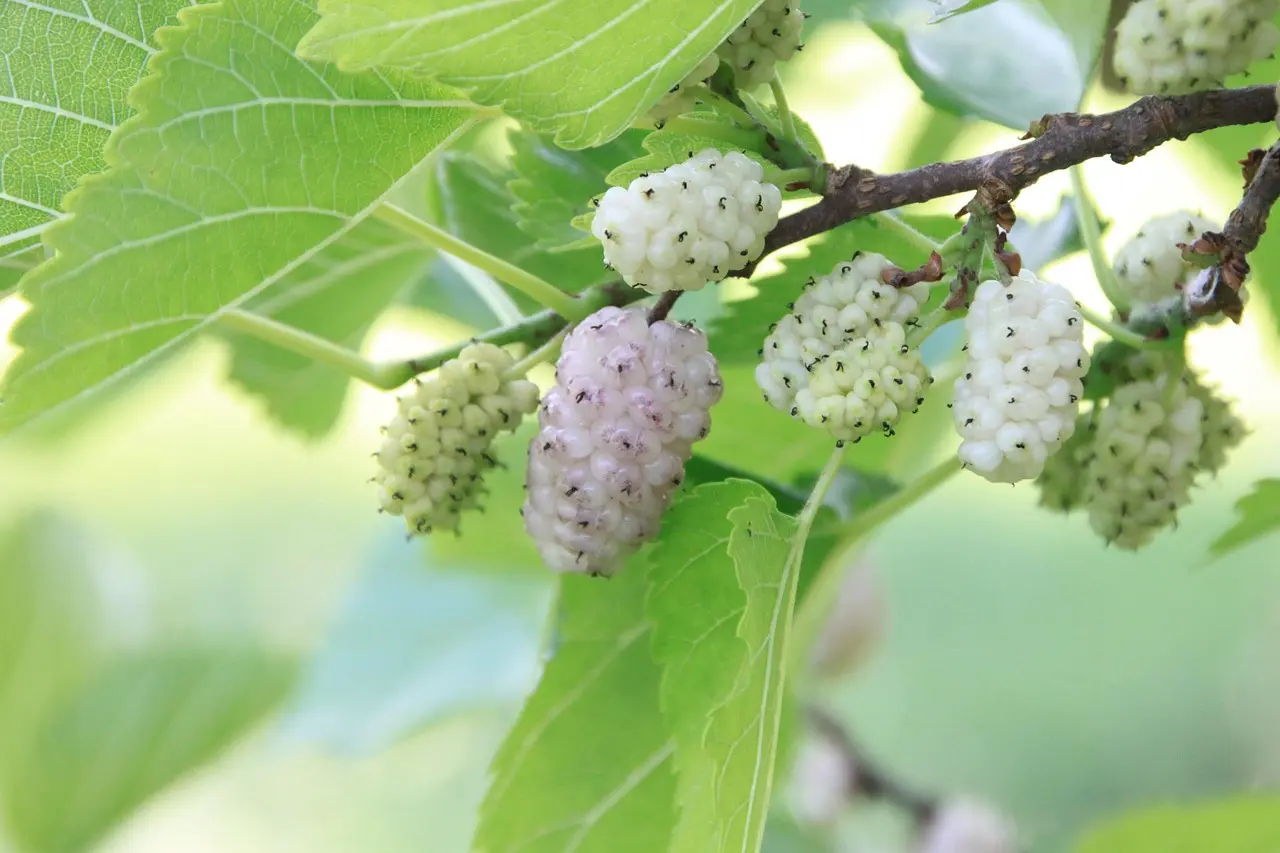
The fruit is a fleshy multiple fruit, or syncarp, produced from the female inflorescence. Its mature appearance is variable, and this colour variation is useful diagnostically but should not by itself be treated as evidence of a separate taxon.
| Field | Value |
|---|---|
| Fruit type | Multiple fruit (syncarp) |
| Shape | Ovoid, ellipsoid, or cylindric |
| Length | Approximately 1–2.5 cm |
| Surface features | Fleshy; composed of numerous closely associated fruiting structures |
| Maturation colour | Blackish purple, purple, or greenish white; red when immature |
| Maturation period | May–August |
Seeds
The individual achenes are small and ovoid. They are embedded within the fleshy aggregate fruit and are substantially smaller than the apparent fruiting unit visible in the field.
| Field | Value |
|---|---|
| Shape | Ovoid |
| Colour | Light brown |
| Size | Approximately 2–3 mm |
Root System
A sufficiently detailed species-specific description of root type, rooting depth, lateral spread, and structural organization was not established from the available evidence. These characteristics are therefore not inferred from general characteristics of woody trees.
Field Identification
In the field, Morus alba is best recognized by the combination of gray, shallowly furrowed bark; alternate simple leaves that may be unlobed or irregularly lobed; and fleshy syncarps whose mature colour can range from greenish white to purple or blackish purple.
Single best distinguishing feature: the combination of highly variable simple leaves with sparse characteristic lower-surface pubescence and fleshy 1–2.5 cm syncarps is more diagnostic than any single vegetative character.
A particularly useful comparative character within Morus is the lower-leaf pubescence pattern described for M. alba, together with its characteristic stigmatic morphology. These features are used in the Flora of China treatment to distinguish M. alba from related Chinese Morus species.
Normal vs. Concerning Observations
| Observation | Status | Notes |
|---|---|---|
| Leaves vary from unlobed to irregularly lobed | Normal | Leaf-shape and lobing variation is documented for the species. |
| Mature syncarps differ in colour among individuals or fruiting structures | Normal | Mature fruits may be greenish white, purple, or blackish purple. |
| Young branches are finely hairy | Normal | Fine pubescence of young branches is a documented morphological character. |
| Leaves show substantially different morphology from the documented species range | Investigate | Because leaf morphology is variable but diagnostically important, an extreme or unexpected form warrants confirmation using additional characters rather than assuming a different taxon. |
Cultivar Summary
Named and historically documented Morus alba cultivars or accessions do exist. The available germplasm documentation records numerous names, including M. alba selections and cultivars maintained in international collections.
| Cultivar | Key Characteristic | Commercial Status | Origin |
|---|---|---|---|
| Ichinose | Named Morus alba cultivar/accession maintained in mulberry germplasm collections | Historically documented | Japan |
| Kokusou 27 | Named Morus alba cultivar/accession maintained in mulberry germplasm collections | Historically documented | Japan |
| Nansu | Named Morus alba cultivar/accession documented in a mulberry collection | Historically documented | Not documented in the cited source |
| Tago Wase | Named Morus alba cultivar/accession documented in a mulberry collection | Historically documented | Not documented in the cited source |
| Wellington | Named Morus alba cultivar/accession documented in a mulberry collection | Historically documented | Not documented in the cited source |
The historical status of these names should be distinguished from current international commercial dominance. The cited germplasm records demonstrate documented cultivar/accession identity and collection history but do not establish a current global commercial ranking.
Functional Traits
Morus alba exhibits a flexible physiological response to environmental conditions rather than a single uniformly expressed stress syndrome. Species-specific experiments show that declining soil water availability reduces stomatal conductance and carbon assimilation, while moderate water limitation can increase intrinsic water-use efficiency and shift biomass allocation toward below-ground tissues. Nutrient supply also modifies leaf secondary chemistry, linking physiological resource status with metabolite composition.
| Trait | Mechanism Description | Ecological Context |
|---|---|---|
| Photosynthetic carbon assimilation | Reduced water availability decreases carbon assimilation through changes in leaf gas exchange. | Demonstrated experimentally in M. alba under controlled water-stress conditions. |
| Water-stress response | Declining soil moisture reduces stomatal conductance and transpiration; intrinsic water-use efficiency can increase under moderate stress. | Indicates physiological adjustment to water limitation, although severe deficit progressively restricts photosynthetic performance. |
| Biomass allocation | Water limitation can increase the proportion of biomass allocated below ground, increasing the root-to-shoot ratio. | Documented particularly in young plants exposed to experimental water limitation. |
| Nutrient-response regulation | Nitrogen supply changes the relative abundance of chlorogenic acid, flavonols, and 1-deoxynojirimycin in leaves. | Demonstrates coupling between nutrient availability and secondary metabolism. |
| Salinity and combined-stress response | Water and salinity stress alter photosynthetic performance, oxidative-status indicators, ionic relationships, and secondary metabolism. | Demonstrated under controlled experimental stress; the magnitude and combination of responses depend on treatment conditions. |
Physiological Integration
The available evidence supports interaction among water status, gas exchange, biomass allocation, and secondary metabolism, but it does not establish a single universal drought-adaptation programme for the species. Under water deficit, reduced stomatal conductance accompanies reduced carbon assimilation, while moderate stress can be associated with greater intrinsic water-use efficiency and increased relative investment below ground. With more severe water limitation, physiological impairment becomes progressively stronger.
Resource status also connects physiological performance with chemical composition. Nitrogen availability changes several characteristic leaf metabolites, while magnesium imbalance has been associated with changes in photosynthesis, chlorophyll, and biomass. These findings indicate that physiological and chemical responses are environmentally coupled, although the available studies do not establish a single quantitative model linking all of these processes across genotypes and environments.
Phytochemistry
The phytochemical profile of Morus alba is diverse and strongly dependent on plant organ, genotype, developmental stage, geographic origin, and analytical method. Species-specific studies have documented multiple classes of secondary metabolites, including flavonoids, phenolic acids, stilbenoids, prenylated polyphenols, anthocyanins, and iminosugar-type compounds. Frequently reported constituents include mulberroside A, oxyresveratrol, morusin, kuwanone H, chalcomoracin, chlorogenic acid, rutin, isoquercitrin, astragalin, quercitrin, and 1-deoxynojirimycin.
Chemical characterization is particularly extensive for the leaves, root bark, twigs or branches, and fruits. However, the occurrence and abundance of individual constituents are not uniform across these organs, and reported concentrations should not be generalized across the species without considering the plant material and analytical conditions examined.
| Compound class | Representative compounds | Documented organs or tissues | Interpretation |
|---|---|---|---|
| Flavonoids and related polyphenols | Rutin, isoquercitrin, astragalin, quercitrin, morusin | Leaves, roots, branches and other documented tissues | Widely documented components of M. alba secondary metabolism. Their ecological functions in the species are not sufficiently resolved. |
| Phenolic acids | Chlorogenic acid, 4-hydroxycinnamic acid and related compounds | Leaves, twigs or branches and other documented tissues | Components of phenolic secondary metabolism. Species-specific ecological functions remain incompletely characterized. |
| Stilbenoids | Mulberroside A, oxyresveratrol | Roots, branches and leaves | Characteristic constituents of M. alba and particularly well documented in root-associated tissues. Their ecological functions in the intact plant remain incompletely established. |
| Prenylated flavonoids and related polyphenols | Kuwanone H, chalcomoracin, morusin | Especially root tissues; also documented in other organs | Characteristic mulberry secondary metabolites. Their occurrence is well documented, but specific ecological roles in M. alba remain insufficiently resolved. |
| Iminosugars | 1-Deoxynojirimycin | Leaves and other documented tissues | A characteristic mulberry-associated iminosugar. Its biological activities have been investigated extensively, but those activities should not be equated with a demonstrated ecological function in the plant. |
| Anthocyanins | Cyanidin and related anthocyanin derivatives | Fruit | Associated with fruit pigmentation. The ecological contribution of individual pigments in M. alba has not been established with sufficient specificity. |
The available literature is therefore sufficient to establish recurring compound classes and numerous named constituents, but chemical composition should be interpreted as organ- and study-specific rather than as a fixed species-wide profile. Reported biological activities of isolated compounds, purified fractions, or extracts are also kept conceptually separate from ecological function: pharmacological or in-vitro activity does not, by itself, demonstrate a role for the compound in the ecology of M. alba.
Phytochemical Organ Distribution
Direct organ-comparison research provides particularly clear evidence that secondary metabolites are distributed unevenly among leaves, branches, and roots. Zhu et al. (2019) analyzed methanolic extracts of these three organs by HPLC and quantified five major secondary metabolites: mulberroside A, oxyresveratrol, kuwanone H, chalcomoracin, and morusin. The study found substantially greater accumulation of several of these compounds in roots than in leaves or branches.
The quantitative values below are reproduced from that single experimental study. They are reported on a dry-weight basis (mg/g DW) and represent the sampled material and analytical conditions of that study; they should not be interpreted as fixed species-wide concentrations. The study used three independent biological replicates and reported values as mean ± standard deviation.
| Organ | Compound class | Compound | Concentration (mg/g DW) |
|---|---|---|---|
| Leaf | Stilbenoid | Mulberroside A | 0.917 ± 0.015 |
| Leaf | Prenylated polyphenol | Chalcomoracin | 0.045 ± 0.005 |
| Branch | Stilbenoid | Mulberroside A | 0.451 ± 0.012 |
| Branch | Stilbenoid | Oxyresveratrol | 0.453 ± 0.008 |
| Branch | Prenylated flavonoid | Morusin | 0.043 ± 0.008 |
| Root | Stilbenoid | Mulberroside A | 24.206 ± 0.688 |
| Root | Stilbenoid | Oxyresveratrol | 0.345 ± 0.022 |
| Root | Prenylated flavonoid | Kuwanone H | 5.551 ± 0.226 |
| Root | Prenylated polyphenol | Chalcomoracin | 0.610 ± 0.051 |
| Root | Prenylated flavonoid | Morusin | 2.874 ± 0.158 |
Zhu et al. detected mulberroside A and chalcomoracin in leaves; mulberroside A, oxyresveratrol, and morusin in branches; and all five target metabolites in roots. Kuwanone H was detected only in the root among the three organs examined. Oxyresveratrol was detected in branches and roots but was not detected in the leaf sample.
The magnitude of organ differentiation is notable. Mulberroside A, for example, was measured at 24.206 ± 0.688 mg/g DW in the root, compared with 0.917 ± 0.015 mg/g DW in the leaf and 0.451 ± 0.012 mg/g DW in the branch. Kuwanone H was measured at 5.551 ± 0.226 mg/g DW in the root, whereas it was not detected in the leaf or branch samples. These values demonstrate pronounced organ-specific accumulation within the experimental material, rather than defining universal concentrations for the species.
The same study also reported higher total flavonoid content and antioxidant activity in roots than in the corresponding leaf and branch samples. The authors associated this pattern with greater accumulation of flavonoid-related metabolites and root-specific representation of proteins involved in flavonoid biosynthesis. This represents an experimentally observed association within the study; it should not be interpreted as proof that any individual metabolite is responsible for the ecological function of the root.
Broader multi-organ chemical profiling likewise supports strong tissue differentiation in M. alba. Root bark has been particularly associated with constituents such as mulberroside A, taxifolin, kuwanon G, and morusin, whereas twigs and leaves exhibit different characteristic phenolic profiles. Such findings reinforce the conclusion that phytochemical composition in M. alba is strongly organ-dependent and that comparisons among studies require attention to tissue identity, extraction procedure, cultivar or genotype, geographic origin, and analytical methodology.
Interpretation of Phytochemical Evidence
The phytochemical literature supports three conservative conclusions:
- Morus alba possesses a chemically diverse secondary-metabolite profile, including several compound classes that recur across independent studies.
- Secondary-metabolite abundance varies substantially among plant organs, with root tissues capable of accumulating markedly higher concentrations of particular constituents than leaves or branches under the conditions examined by Zhu et al. (2019).
- Reported concentrations are study-specific measurements rather than universal species values. Differences in genotype, organ, developmental stage, cultivation conditions, extraction procedure, analytical platform, and reporting basis can materially affect the measured profile.
Accordingly, phytochemical data in this profile are presented as documented observations from defined experimental systems, rather than as fixed chemical specifications for the species as a whole.
Evidence Hierarchy for Medicinal Use
Morus alba is a medicinal, nutraceutical, and food-use species, so the full evidence hierarchy applies.
| Evidence Layer | Status | Notes |
|---|---|---|
| Traditional Use | Documented | Leaves, root bark, fruits, and other preparations have longstanding use in traditional medical systems, particularly East Asian traditions. |
| Nutritional Evidence | Documented | Species-specific nutritional analyses document macronutrients, vitamins, minerals, and other food constituents of the fruit. |
| In Vitro Studies | Documented | Numerous species-specific studies report biological activities of mulberry extracts and constituents, including α-glucosidase inhibition and other biochemical effects. |
| Animal Studies | Documented | Experimental animal studies have evaluated metabolic effects and safety of M. alba preparations. |
| Human Clinical Studies | Documented | Randomized and controlled human studies have evaluated mulberry leaf preparations or standardized extracts, particularly for postprandial glycaemic responses and metabolic measures. |
| Regulatory Recognition | Partial | M. alba has longstanding traditional-food and medicinal use, but the evidence assembled here does not establish a universal regulatory approval of M. alba itself as a therapeutic agent. |
| Unsupported Commercial Claims | Disputed | Commercial products and claims exist, particularly around DNJ-containing mulberry preparations, but clinical evidence applies to particular preparations and study conditions rather than to unrestricted claims about the whole plant. |
Evidence Assessment
The medicinal evidence for Morus alba is substantially stronger than would be implied by traditional-use documentation alone, because controlled human studies have been conducted. For example, randomized studies have examined DNJ-containing leaf preparations and standardized M. alba extracts in relation to postprandial glucose responses, while a 2022 double-blind trial evaluated a 300-mg M. alba leaf extract twice daily in people with type 2 diabetes.
The strongest human evidence is therefore preparation-specific, rather than evidence that the whole species has a uniformly established therapeutic effect. The weakest component is the generalization from individual extracts, isolated constituents, or short-duration trials to broad claims about long-term disease prevention or treatment. A recent review also notes that DNJ-containing Morus products have generated clinical research but that DNJ itself has not been established as an approved food supplement on that basis.
Accordingly, the evidence supports describing M. alba as a species with documented traditional use and a meaningful experimental and clinical research record, but not as a universally validated treatment for metabolic or other diseases.
Nutritional Composition
Species-specific analyses of Morus alba fruit from Pakistan provide quantitative data on moisture, proximate composition, vitamins, minerals, and other food constituents. The principal Pakistani dataset was obtained from ripe fruits collected in northern Pakistan and analyzed for proximate composition, essential minerals, vitamins, and antioxidant-related constituents. Because the original study reports different constituents on different analytical bases, the reported fresh-weight (FW) and dry-weight (DW) bases are retained without mathematical conversion.
Proximate Composition
| Nutrient | Reported value per 100 g | Analytical basis | Source |
|---|---|---|---|
| Moisture | 81.72 ± 2.25 g | FW | Imran et al. (2010) |
| Ash | 0.57 ± 0.11 g | DW | Imran et al. (2010) |
| Lipid | 0.48 ± 0.11 g | DW | Imran et al. (2010) |
| Protein | 1.55 ± 0.30 g | DW | Imran et al. (2010) |
| Fibre | 1.47 ± 0.15 g | DW | Imran et al. (2010) |
| Total carbohydrate | 14.21 ± 1.01 g | DW | Imran et al. (2010) |
| Energy | 67.36 ± 3.22 kcal | DW | Imran et al. (2010) |
The original study calculated crude protein from Kjeldahl nitrogen and determined total carbohydrate by difference. Energy was calculated from the reported carbohydrate, lipid, and protein contents using standard conversion factors.
These values describe the specific fruit material examined in the study and should not be interpreted as universal nutritional specifications for M. alba. In particular, the dry-weight values should not be directly compared with fresh-weight food-composition data without appropriate conversion and consideration of the original analytical methodology.
Vitamins and Minerals
For the same Pakistani fruit material, Imran et al. (2010) reported the following vitamin and mineral concentrations:
| Nutrient | Reported value per 100 g | Analytical basis | Source |
|---|---|---|---|
| Riboflavin (vitamin B₂) | 0.088 ± 0.001 mg | FW | Imran et al. (2010) |
| Niacin (vitamin B₃) | 3.10 ± 0.60 mg | FW | Imran et al. (2010) |
| Vitamin C (ascorbic acid) | 15.20 ± 1.25 mg | FW | Imran et al. (2010) |
| Potassium | 1731 ± 11.50 mg | FW | Imran et al. (2010) |
| Calcium | 576 ± 7.37 mg | FW | Imran et al. (2010) |
| Sodium | 280 ± 3.50 mg | FW | Imran et al. (2010) |
| Magnesium | 240 ± 3.90 mg | FW | Imran et al. (2010) |
| Iron | 73.0 ± 2.60 mg | FW | Imran et al. (2010) |
| Zinc | 50.20 ± 1.93 mg | FW | Imran et al. (2010) |
| Nickel | 2.20 ± 0.15 mg | FW | Imran et al. (2010) |
Among the minerals measured by Imran et al. (2010), potassium was reported at the highest concentration, followed by calcium and magnesium. Sodium, iron, zinc, and nickel were also quantified. The reported vitamin measurements included riboflavin, niacin, and vitamin C.
The reported vitamin C concentration of 15.20 ± 1.25 mg/100 g FW, together with the riboflavin and niacin values, applies specifically to the Pakistani M. alba fruit material examined in that study. These measurements should therefore be treated as sample-specific analytical observations rather than fixed species-level nutrient concentrations.
Comparison with Other M. alba Fruit Data
Nutritional composition varies among M. alba populations and studies. Ercisli and Orhan (2007), for example, analyzed white mulberry fruit from the East Anatolia region of Türkiye and reported a moisture content of approximately 71.5%, vitamin C at 22.4 mg/100 g, and mineral concentrations of approximately 1668 mg/100 g potassium, 152 mg/100 g calcium, 106 mg/100 g magnesium, and 4.2 mg/100 g iron.
These differences illustrate why nutritional values from different studies should not be combined into a single generalized species profile. Variation may reflect genotype, geographic origin, environmental conditions, maturity, cultivation conditions, sample preparation, and analytical methodology. Differences in reporting basis are also important: proximate constituents in Imran et al. (2010) were reported partly on a dry-weight basis, whereas the vitamin and mineral measurements were reported for fresh fruit.
Accordingly, the values presented here should be interpreted as documented measurements for defined samples and analytical conditions, rather than fixed species-wide nutrient concentrations.
Interpretation
The available evidence supports describing Morus alba fruit as containing substantial water together with carbohydrates, fibre, protein, lipids, minerals, and vitamins. However, quantitative nutritional composition is strongly context-dependent. Values from different populations or studies should therefore be compared only when the plant material, analytical basis, units, and methodology are sufficiently comparable.
The numerical values are retained in their reported forms rather than normalized across studies. This preserves the provenance and analytical context of the primary data and avoids introducing potentially misleading conversions.
Nutritional Significance
Morus alba fruit is predominantly water on a fresh-weight basis, while the cited dry-weight analysis documents carbohydrate, protein, lipid, fibre, and ash fractions. Potassium was the predominant mineral among those measured in the Pakistani material, while calcium and magnesium were also reported at substantial concentrations. Vitamins including riboflavin, niacin, and vitamin C were measurable in the analyzed fruit.
Nutritional composition can vary with genotype, geographic origin, environmental conditions, maturity, cultivation conditions, and analytical methodology. Consequently, an individual analytical profile should be regarded as a sample-specific measurement rather than a fixed species constant.
Processing can also alter the nutritional and functional composition of mulberry material. However, the evidence assembled here does not justify applying a universal quantitative correction between fresh and processed fruit. Fresh and dried values should therefore remain explicitly distinguished unless they have been appropriately normalized using the original study data and methodology.
Soil Ecology and Mycorrhizal Associations
Evidence for M. alba soil ecology is moderate to high, with particularly good species-specific evidence for arbuscular mycorrhizal fungi and rhizosphere microbial communities.
Arbuscular Mycorrhizal Associations
A controlled greenhouse experiment directly tested three arbuscular mycorrhizal fungi with M. alba: Acaulospora scrobiculata, Funneliformis mosseae, and Rhizophagus intraradices. Colonisation by these fungi increased several measured growth variables, including shoot height, taproot length, stem-base and taproot diameter, leaf and fibrous-root numbers, and shoot and root biomass. Responses differed among fungal species, demonstrating host–AMF specificity at the experimental level.
Rhizosphere Bacteria and Fungi
Species-specific field studies show that the M. alba rhizosphere contains structured bacterial and fungal communities whose composition varies with cultivar and environmental conditions. A 2025 cultivar comparison identified Proteobacteria, Acidobacteriota and Actinobacteriota among the dominant bacterial phyla, while Ascomycota and Basidiomycota were major fungal groups. Bacillus showed a positive correlation with leaf yield in that study; Penicillium and Phytophthora were also correlated with yield in particular cultivar rhizospheres. These correlations do not establish that those organisms universally promote or impair M. alba.
Independent work on mineral-weathering bacteria found greater representation of highly effective Si-, Al-, K-, and Fe-solubilizing isolates in the M. alba rhizosphere than in associated bulk soil, indicating that mineral-weathering functional groups can be enriched near the plant.
Soil Microbial Functional Relationships
Intercropping studies show that altering the plant community can change the bacterial community and soil nutrient environment associated with M. alba. In one M. alba–alfalfa system, intercropping increased bacterial richness and diversity and altered the relative abundance of major bacterial groups including Proteobacteria, Actinobacteria and Firmicutes.
Allelopathy
Evidence for allelopathy is present but context-dependent. Earlier experimental work reported inhibition of Brassica juncea germination by M. alba leaf leachate. More recent work found that M. alba leaf-litter extracts could inhibit germination and early growth in laboratory and pot experiments, while longer-term pot trials to maturity did not show adverse effects on crop growth, biomass, or yield. The available evidence therefore supports conditional allelopathic activity rather than a generalized claim that M. alba is strongly allelopathic.
The specific phytochemical basis of the observed allelopathy is not sufficiently resolved here to attribute the effect to a particular compound or compound mixture.
Toxicity and Safety
| Subject | Toxic Compounds | Clinical Effects | Source |
|---|---|---|---|
| Humans | No single species-wide toxic compound established from the evidence reviewed. Preparation-specific constituents and adverse reactions remain relevant. | Human trials of selected leaf preparations have reported generally manageable safety profiles, but adverse-event and long-term safety evidence is preparation-specific. | Taghizadeh et al. (2022); recent M. alba/DNJ clinical review |
| Cats | No verified species-specific toxic compound identified during current audit. | No verified species-specific poisoning syndrome identified during current audit. | Current literature audit |
| Dogs | No verified species-specific toxic compound identified during current audit. | No verified species-specific poisoning syndrome identified during current audit. | Current literature audit |
| Livestock | No verified species-wide toxic syndrome established during current audit. | Mulberry foliage is used as livestock feed, but the evidence reviewed here does not establish a universal toxicity threshold for all livestock species or preparations. | Species-specific safety literature; livestock-use literature |
Human safety evidence includes a 90-day rat study of M. alba fruit extract, in which daily oral doses up to 1000 mg/kg produced no observed adverse effects under the tested conditions and the Ames assay showed no genotoxicity. This is useful nonclinical evidence, but it is not equivalent to establishing safety for every human preparation.
A separate repeated-dose study evaluated an aqueous M. alba leaf extract and was designed specifically to assess safety of a DNJ-standardized preparation, illustrating why safety conclusions need to remain preparation-specific.
For cats, dogs, and livestock, the present audit did not establish sufficiently specific species-level toxicology to support a positive or negative safety classification. This absence of verified evidence is not a guarantee of safety.
Toxicity Context
Dose and preparation
Safety depends on the plant material, extraction method, concentration, route, and dose. The 90-day fruit study and repeated-dose leaf-extract studies therefore provide evidence for particular preparations under particular experimental conditions rather than for unrestricted whole-plant exposure.
Whole-plant versus isolated constituents
DNJ is a characteristic constituent of mulberry leaves and has been studied independently as well as within M. alba preparations. Clinical evidence involving DNJ-enriched or standardized leaf preparations should not be interpreted as evidence that every part of the plant produces the same pharmacological or safety profile.
Vulnerable populations
Documented allergic reactions to mulberry have been reported in the clinical literature, including food-related and respiratory/allergic manifestations. Evidence concerning pregnancy, lactation, renal impairment and hepatic impairment is not sufficiently established in the current audit to support species-specific safety conclusions.
Drug interactions
Potential interactions are biologically plausible for preparations that alter carbohydrate-digesting enzymes or glucose handling, but the current evidence does not establish a comprehensive clinical interaction profile for M. alba. Such interactions should therefore not be inferred as established clinical facts.
This profile does not constitute medical or veterinary advice.
Biogeographic Context
Morus alba has a relatively narrow authoritative native-range baseline but an exceptionally broad introduced distribution. Kew currently identifies Central China as the native range and places the species primarily in the temperate biome. Outside that range, its distribution reflects centuries of cultivation, deliberate movement for sericulture and food production, and subsequent naturalisation.
The species’ broad climatic occurrence is consistent with its establishment across humid, continental, semiarid and temperate environments. In North America it occurs from approximately sea level to 1,500 m and across sites with annual precipitation from about 286 to 1,400 mm. Its occurrence in floodplains, riparian systems, woodland margins and disturbed habitats indicates that both natural dispersal and human disturbance have contributed to its present distribution.
The global literature is strongly concentrated in regions where M. alba is cultivated for sericulture, particularly East and South Asia. Consequently, cultivation records are much more abundant than comparable documentation of unmanaged wild populations. This distinction is important when interpreting the species’ very large present-day geographic range.
Native Range and Distribution
| Region | Countries or Sub-regions | Notes |
|---|---|---|
| East Asia | Central China | Current Kew POWO native-range baseline for M. alba. |
| China | Central Chinese regions | The authoritative baseline is expressed by Kew as Central China rather than as a comprehensive list of Chinese provinces. |
The native range is therefore kept deliberately narrower than the species’ global occurrence. Introduced and naturalised populations are not incorporated into the native-range table.
Global Cultivation and Naturalisation
| Region | Countries or Areas | Cultivation Status | Notes |
|---|---|---|---|
| East Asia | China and neighbouring East Asian production regions | Commercially established | Long-established cultivation associated particularly with sericulture. |
| South Asia | India and other South Asian mulberry-growing regions | Commercially established | Extensive cultivation for silkworm production and associated uses. |
| Southeast Asia | Southeast Asian cultivation regions | Commercially established | Established cultivation is documented within the major Asian mulberry-production zone. |
| Middle East | Multiple countries | Commercially established | Identified as a major cultivation region in global feed and forage literature. |
| Europe | Multiple countries | Historically established | Introduced for sericulture; cultivation declined in some regions after the collapse of silk-production initiatives. |
| North America | United States and southern Canada | Naturalised | Introduced in the 1600s; subsequently established outside cultivation over a wide area. |
| Australia | New South Wales and Queensland | Naturalised | Naturalised populations are documented and the species is treated as a weed in parts of eastern Australia. |
| Colombia | Antioquia, Bogotá D.C., Caldas, Cauca and Quindío | Naturalised | Kew records both cultivation and naturalisation at approximately 1,200–1,500 m in the Andes. |
The major production centre remains the broad East Asian and South Asian cultivation zone, with additional cultivation in the Middle East and other regions. North American and Australian records illustrate a different process: establishment beyond intentional cultivation.
Natural Habitat
Morus alba is not restricted to one narrowly defined habitat type. In North America it is repeatedly documented in floodplain and riparian communities, woodland and forest edges, low stream banks, thickets, and disturbed or ruderal sites. It can occur in early-, mid-, and mature-successional communities and is particularly well represented in places affected by previous human disturbance.
The documented elevation range in North America is approximately 0–1,500 m, with additional records at higher elevations elsewhere. Soil associations are broad, including silt loam, clay loam, and sandy loam; the species has been reported on both well-drained and poorly drained soils. The habitat evidence therefore supports a broad habitat niche rather than strong habitat specialization.
Ecological Role
Evidence for ecosystem-level interactions is moderate rather than comprehensive.
| Role Type | Species or Agent Involved | Notes |
|---|---|---|
| Fruit-mediated dispersal | Birds | Establishment in some successional sites has been associated with perches used by seed-dispersing birds; the evidence supports bird-mediated dispersal but does not establish a complete dispersal network. |
| Host/resource for introduced silkworm production | Bombyx mori | The species is the principal foliage resource in sericulture, representing a major human-mediated ecological relationship. |
| Competition / plant-community interaction | Native vegetation communities | In parts of its introduced range, M. alba occurs in native forest, floodplain and disturbed plant communities and can locally become common. |
| Hybridisation | Morus rubra | In North America, M. alba hybridizes with the native red mulberry, creating a documented genetic interaction between introduced and native congeners. |
The species is not adequately established as a universal keystone or indicator species. Its ecological importance is highly context-dependent: in cultivation it is a deliberately managed biological resource, whereas in parts of its introduced range it participates in naturalised plant communities and hybridisation with native Morus.
Invasive Status
Naturalisation outside the native range is well documented, and some regions explicitly classify M. alba as invasive or weedy.
| Region | Status | Impact | Management |
|---|---|---|---|
| United States / North America | Naturalised; invasive in the USDA FEIS assessment | Establishes across riparian, floodplain, woodland-edge and disturbed habitats; hybridises with native M. rubra. | Regional concern and control occur, but a single continent-wide management regime is not established in the evidence reviewed. |
| Australia — New South Wales and Queensland | Naturalised / weed | Documented as a weed in parts of eastern Australia, including riparian areas, native bushland, forest margins and roadsides. | Regional weed-management classification; specific control requirements vary by jurisdiction. |
| Colombia | Naturalised | Naturalised populations documented in several Andean departments; the available record does not establish a uniform invasive impact across Colombia. | No uniform species-wide management conclusion established in the present evidence. |
The invasive status is therefore regional rather than globally uniform. Naturalisation itself is well documented, but ecological impact varies by environment and should not be inferred solely from the existence of an introduced population.
Optimal Climate Parameters
The values below distinguish reported cultivation-optimum values from the much wider absolute ranges recorded in FAO EcoCrop. They represent a cultivation climate envelope, not experimentally demonstrated physiological optima for every population. EcoCrop reports 20–28°C as the temperature requirement range classified as optimal and 13–45°C as its absolute range; for annual rainfall, it reports 700–2,500 mm as optimal and 300–5,100 mm as absolute.
| Parameter | Optimal Range | Tolerance Range | Notes |
|---|---|---|---|
| Mean Annual Temperature | 20–28°C (68–82.4°F) | 13–45°C (55.4–113°F) | EcoCrop cultivation parameters; these are not equivalent to experimentally demonstrated species-wide physiological limits. |
| Annual Rainfall | 700–2,500 mm (27.6–98.4 in) | 300–5,100 mm (11.8–200.8 in) | EcoCrop cultivation envelope; observed North American occurrence spans approximately 286–1,400 mm annually. |
| Relative Humidity | 65–80% | Not established as a species-wide tolerance range | Frequently reported as a favourable cultivation range in FAO mulberry literature, but a quantified absolute tolerance range was not established in the evidence used here. |
The temperature and rainfall values should therefore be read as reported cultivation parameters, while the broader observed occurrence data demonstrate substantially greater climatic breadth.
Climate Interpretation
The documented cultivation envelope is centred on warm conditions with moderate-to-high annual rainfall, but the observed distribution is substantially broader. North American populations occur from semiarid environments receiving roughly 286 mm annual precipitation to humid environments receiving approximately 1,400 mm, and from sites with mean January temperatures around −5°C to sites with July temperatures around 26.7°C.
Cold extremes and water availability emerge as important contextual constraints. Historical plantations in the northeastern United States were damaged or killed by cold winters, while branch-tip freezing is reported from northwestern Oklahoma. Conversely, the species can establish in substantially drier environments than its commonly cited cultivation envelope.
The difference between cultivation requirements and observed occurrence indicates considerable geographic plasticity, but it should not be interpreted as proof that all genotypes perform equally across that full climatic range.
Stress Tolerance Profile
| Stress Type | Tolerance Level | Physiological Response | Notes |
|---|---|---|---|
| Drought | Verified | Increasing water deficit reduces stomatal conductance, transpiration and photosynthetic performance; biomass allocation can shift toward roots and physiological indicators change progressively with stress intensity. | Directly demonstrated in M. alba seedlings under controlled water-deficit treatments. |
| Salinity | Verified | Salinity alters ion distribution and water relations and can reduce photosynthetic performance; responses include changes in stomatal conductance, osmotic/stress metabolites and antioxidant systems. | Multiple species-specific studies document genotype- and salt-type-dependent responses. |
| Alkalinity / carbonate stress | Verified | NaHCO₃ stress suppresses photosynthetic and respiratory activity more strongly than comparable NaCl exposure in tested seedlings and alters ROS-scavenging systems. | Physiological response differs from neutral-salt stress and should not be treated as interchangeable with salinity. |
| Flooding | Supported | Flooding inhibits chlorophyll synthesis and alters photosynthetic electron transfer and Calvin-cycle-related processes. | Species-specific physiological and transcriptomic evidence exists, but the duration and severity of experimental flooding vary among studies. |
| Combined drought + salinity | Verified | Combined stress changes root/shoot ratio, chlorophyll fluorescence, carbon status, ion redistribution and pathways associated with carbon metabolism, photosynthesis, redox balance and secondary metabolism. | Directly demonstrated in M. alba; combined-stress responses cannot be inferred simply by adding single-stress responses. |
Drought experiments show progressive physiological impairment as soil moisture declines, while salt experiments demonstrate substantial variation among genotypes and between neutral salt and alkaline-salt stress.
Compound Stress Assessment
The strongest combined-stress evidence concerns drought plus salinity. Experimental M. alba exposed to both stresses showed changes in root/shoot ratio, chlorophyll fluorescence, total carbon and ion redistribution, with large changes in proteins associated with photosynthesis, carbon metabolism, redox processes, secondary metabolism and hormone metabolism.
The combined response therefore cannot be reduced to a simple additive model of drought tolerance plus salt tolerance. The documented interaction involves simultaneous changes in carbon allocation, ion balance and stress-response metabolism.
Evidence for other combined stresses remains comparatively limited. In particular, a sufficiently species-specific experimental basis was not established here for assigning a quantified combined heat–drought tolerance range.
Structural and Physiological Adaptations
The strongest adaptation evidence concerns traits that support reproduction and persistence across disturbed environments rather than a narrowly specialized habitat morphology. The species’ wind-pollinated reproductive system is associated with separate male and female plants in most individuals and with floral structures capable of rapid pollen release. Its capacity for vegetative regeneration after injury also provides a mechanism for persistence where stems are damaged.
| Adaptation | Mechanism Description | Ecological Context |
|---|---|---|
| Wind-pollination specialization | Male flowers release pollen directly into the air from exposed reproductive structures, allowing pollen movement without dependence on animal floral visitation. | Suited to an open, wind-mediated reproductive system and contributes to reproductive interaction with nearby Morus populations. |
| Rapid pollen release | Anthers dehisce explosively, releasing pollen rapidly into surrounding air. | Particularly relevant where M. alba occurs near compatible Morus individuals; rapid release has been implicated in interspecific pollen movement. |
| Injury-associated vegetative regeneration | Dormant or adventitious buds on stumps, roots, and cut stems can produce new shoots after above-ground injury. | Provides persistence after physical disturbance and contributes to regeneration in naturalised populations. |
These traits are treated as adaptations because their ecological function is directly documented; ordinary leaf, stem, fruit, and root characters remain part of the morphological treatment rather than being relisted here.
Climate Change Vulnerability
| Factor | Assessment | Notes |
|---|---|---|
| Primary Climate Sensitivity Factors | Qualitative: precipitation regime and cold-season temperature | A species-specific MaxEnt study for Mexico identified precipitation of the wettest month and mean temperature of the coldest month as the strongest distribution predictors. |
| Key Threatening Climate Processes | Potential contraction under some warming scenarios | Mexico modelling predicted contraction of environmentally suitable area under three of four tested future scenarios, although one RCP4.5 late-century scenario projected expansion. |
| Resilience Factors | Broad climatic and habitat occurrence | The species occupies a wide geographic and climatic range and is established in both cultivated and naturalised populations; this breadth may provide some buffering, but it does not demonstrate future climate resilience at population level. |
| Confidence Level | Moderate for regional modelling; low for global vulnerability | Species-specific climate modelling exists for Mexico, but a comparable global vulnerability assessment or demographic climate-response model was not established in the evidence used here. |
Climate Vulnerability Note
The available evidence supports conditional rather than categorical vulnerability. The Mexican model provides species-specific evidence that changing temperature and precipitation can alter the area climatically suitable for M. alba, but its results cannot be extrapolated directly to the global species range.
Phenological Calendar
| Event | Native Range Timing | Cultivated Range Timing | Environmental Triggers |
|---|---|---|---|
| Vegetative Growth Onset | Spring; exact native-range date not established in the evidence used here | Spring; species-specific studies in northeastern China report leaf-out around May, while warmer regions initiate earlier | Specific temperature or photoperiod threshold not established. |
| Flower Bud Initiation | Before spring anthesis; exact initiation date not established | Spring; exact bud-initiation threshold not established | Specific environmental threshold not documented. |
| Anthesis or Peak Flowering | Spring; approximately April–May in available regional records | Approximately March–June depending on geography; April–May is common in temperate cultivated populations | Specific minimum temperature or photoperiod threshold not established. |
| Fruit Development | Late spring to summer | Approximately May–August; regional records include May–June development and later summer maturation | Specific trigger threshold not established. |
| Fruit Maturation | Early to mid-summer in documented Chinese phenological observations | Approximately May–August depending on region; FAO observations recorded mass ripening from late May to mid-June for sampled M. alba accessions | Specific temperature/rainfall threshold not established. |
| Seed Dispersal | Summer after fruit maturation | Summer; dispersal follows fruit availability and animal consumption | Fruit maturation and animal feeding are documented; a quantitative environmental trigger is not established. |
| Dormancy or Rest Period | Autumn–winter leafless period | Autumn–winter in temperate populations | Seasonal cooling and photoperiod are associated with dormancy, but a species-specific threshold was not established here. |
Phenological Notes
Phenology is geographically plastic. The U.S. Forest Service records flowering generally from April to May, with earlier flowering in March in the Carolinas and later flowering into June in the upper Midwest. Fruit formation begins in May and can continue into late July. A long-term FAO dataset recorded M. alba flowering beginning around 17 April and mass flowering around 27 April, with fruit ripening beginning around 20–25 May and mass ripening during June.
The available evidence does not establish a universal temperature or photoperiod threshold for each phenological transition. Consequently, specific triggers are not inferred from correlations with climate.
Pollination Ecology
Morus alba is predominantly dioecious and wind-pollinated. Occasional monoecious individuals are documented. The reproductive system is therefore primarily based on airborne pollen transfer rather than dependence on a specialized animal pollinator. Sexual dimorphism in floral timing and structure is well documented and forms part of the species’ reproductive biology.
| Parameter | Value | Notes |
|---|---|---|
| Primary Pollinators | Wind — abiotic pollen vector | M. alba is documented as wind-pollinated; no animal pollinator is required for the primary reproductive syndrome. |
| Secondary Pollinators | No verified animal pollinator established | The evidence used here does not establish a consistent secondary animal-pollination system. |
| Pollination Syndrome | Anemophily (wind pollination) | Consistent with dioecious reproduction and exposed, rapidly dehiscing male flowers. |
| Floral Mechanism | Rapid anther dehiscence and airborne pollen release | This is the physical pollen-release mechanism; no specialized animal landing or nectar-guidance structure is established. |
| Reproductive System | Generally dioecious; monoecious individuals also occur | Male and female flowers are usually borne on separate plants, with occasional monoecious individuals. |
| Seed Dispersal Agent | Birds and small mammals; box turtles locally documented | Birds and mammals consume the fleshy fruits; box turtles have also been reported as dispersal agents. |
| Reproductive Evidence Status | Verified | Species-specific evidence establishes wind pollination, dioecy, occasional monoecy, sexual dimorphism, animal-mediated seed dispersal and hybridisation with M. rubra. |
| Human Intervention | Biological feasibility not established in the evidence used here | No hand-pollination procedure or assisted-pollination protocol is inferred. |
Pollination Context
The predominant dioecious, wind-pollinated system favours pollen movement among spatially separated individuals. The documented rapid pollen release is especially relevant where M. alba grows near M. rubra, because interspecific hybridisation has been demonstrated in natural populations. The evidence does not establish a quantified pollinator-decline risk because the primary pollen vector is abiotic.
Seed Biology and Germination
| Parameter | Value | Notes |
|---|---|---|
| Seed Type | Verified — orthodox seed | Seeds tolerate drying and can retain viability under suitable storage conditions. |
| Dormancy Class | Conditional | Evidence is conflicting: one controlled study found no dormancy in its tested fresh seed lots, whereas other sources report dormant or variably dormant seed. |
| Dormancy-Breaking Requirement | Conditional | Cold stratification has been reported to improve germination, but controlled variety studies also demonstrate substantial germination without stratification. |
| Optimal Germination Temperature | Verified for tested accessions — alternating 25/35°C (77/95°F) | The 25/35°C thermoperiod produced the highest germination percentages and shortest germination times across the tested Cuban varieties. |
| Germination Rate | Conditional — approximately 5–96% across tested conditions and varieties | Variation was strongly dependent on variety, temperature, light and seed lot; at 25/35°C, mean final germination was approximately 70.8% and 68.5% for the two tested annual seed lots. |
| Germination Period | Verified for tested accessions — onset approximately 2–5 days; optimum-condition mean germination approximately 2.4–7.1 days | Values depend strongly on variety, seed lot and temperature. |
| Storage Behaviour | Verified — orthodox | Hermetic storage can preserve viability for several years; deterioration is faster under less favourable ambient conditions. |
| Seed Longevity | Conditional — at least 720 days documented; several years under suitable storage | The U.S. Forest Service reports viability for at least a year under cool sealed conditions, while seed-storage databases report several years under hermetic conditions. |
Germination Notes
Seed biology is notably variable. A controlled experiment on five M. alba varieties found no dormancy and the highest germination at a 25/35°C thermoperiod, with more than 70% germination for most varieties under the optimum condition. In contrast, horticultural references report dormant embryos or dormancy characteristics and improved germination after cold treatment. The older forest-seed literature also suggests that most seeds may lack innate dormancy and that apparent failure after storage can reflect loss of viability rather than persistent dormancy.
This conflict is best interpreted as accession-, seed-lot-, maturity- or condition-dependent variation, rather than evidence for a single universal dormancy class. Persistent soil seed-bank behaviour also appears weak: experimental burial work found substantial viability loss over 13 months and concluded that the evidence did not support a strong persistent seed bank.
Vegetative Reproduction
| Parameter | Value | Notes |
|---|---|---|
| Vegetative Regeneration Capacity | Verified — present | Regeneration from stump, roots and cut stems is documented after injury. |
| Primary Regeneration Mechanism | Sprouting from stump, roots and cut stems | Documented as a post-injury regeneration pathway in addition to sexual reproduction. |
| Minimum Propagule Size | Not documented in available literature. | No defensible species-specific minimum size threshold was established. |
| Ecological or Invasive Significance | Supported | Post-disturbance sprouting can aid persistence and may contribute to the maintenance of naturalised populations following cutting or physical damage. |
Vegetative regeneration is therefore biologically significant but should not be treated as replacing sexual reproduction: seed reproduction remains an important pathway for establishment and spread.
Economic Importance
Morus alba has an unusually strong economic association with sericulture. Its foliage is the principal food resource of the domesticated silkworm, Bombyx mori, and leaf quantity and quality directly influence cocoon production. FAO describes mulberry foliage as a major economic component of sericulture and documents extensive cultivation in India, while broader FAO assessments identify mulberry cultivation as a component of rural employment and silk-production economies across Asia and other regions.
| Use Category | Description | Economic Impact |
|---|---|---|
| Sericulture | Leaves provide the principal food resource for Bombyx mori, linking M. alba directly to cocoon and raw-silk production. | Very high within mulberry-based silk systems; foliage yield and quality directly affect downstream silk production. |
| Fruit | Fleshy fruits are consumed fresh and are also used in processed foods and beverages. | Documented but secondary relative to the species’ sericultural importance. |
| Livestock feed | Mulberry foliage is used as forage or feed supplement for cattle, sheep, goats and other livestock. | Regionally significant, particularly where mulberry is integrated into mixed farming systems. |
| Medicinal raw material | Leaves, root bark, twigs and fruit enter traditional medicinal and herbal-product supply chains. | Commercially significant, with established materia-medica markets and growing standardized-product development. |
| Timber and other plant materials | Wood and other plant material have documented fuel, timber and household uses. | Secondary and regionally variable compared with sericulture and food uses. |
| Summary Economic Assessment | The species supports interconnected silk, food, forage and herbal-material economies. | Sericulture is the dominant documented economic role, with other uses diversifying the value of cultivated trees. |
FAO documentation shows the scale of the sericultural system particularly clearly: India alone historically reported approximately 282,244 ha of mulberry cultivation, with Karnataka accounting for the largest share in the cited national dataset. China has also maintained extensive mulberry cultivation integrated with silk production. These figures are historical agricultural datasets rather than current global production statistics and are not presented as contemporary totals.
Cultivated foliage overwhelmingly dominates the documented supply chain for sericulture; evidence for economically important wild-harvested M. alba foliage as a substitute for cultivated supply was not established. The medicinal-material market presents a different supply-chain issue: authenticated root bark is commercially traded, and recent quality-control studies demonstrate substantial chemical and geographical variation among marketed samples.
Traditional Uses
| Use Category | Knowledge System | Region or Cultural Group | Practice Summary | Documentation Level | Source |
|---|---|---|---|---|---|
| Leaf medicinal use | Traditional Chinese Medicine (TCM) | China | Mulberry leaf (Sang Ye) has been used traditionally for conditions including cough, sore throat, fever and bronchial complaints, and historically for “Xiao-ke.” | Well documented | NCCIH; TCM literature |
| Root-bark medicinal use | Traditional Chinese Medicine (TCM) | China | Mulberry root bark (Sang Bai Pi) is an established Chinese materia-medica material derived from M. alba. | Well documented | ISO/TC 249; pharmacognostic literature |
| Twig medicinal use | Traditional Chinese Medicine (TCM) | China | Dried young branches (Mori Ramulus) are established materia-medica material and have been chemically and pharmacognostically characterized. | Well documented | TCM pharmacognostic literature |
| Fruit medicinal use | Traditional Chinese Medicine (TCM) | China | Mulberry fruit (Sang Shen) has a longstanding medicinal history and is also consumed as food. | Well documented | Species-specific ethnopharmacological reviews |
| Food use | East Asian food traditions | China and other Asian regions | Fruits are eaten as food; leaves have also been incorporated into foods such as tea, noodles and bean curd in parts of Asia. | Documented | NCCIH and food-use literature |
| Ayurvedic use | Ayurveda | South Asia | Species-specific reviews document use of different M. alba parts within Ayurvedic practice. | Documented, but source-specific | Species-specific ethnopharmacological literature |
Traditional Use Summary
The strongest culturally attributed medicinal record is associated with Traditional Chinese Medicine, where multiple separately recognized M. alba materials—leaf, root bark, twig, and fruit—have distinct materia medica identities. The species also has documented food and medicinal use within South Asian traditions, including Ayurveda.
Traditional use has not remained separate from commercialization. Chinese materia medica materials derived from M. alba now circulate in standardized herbal supply chains, creating a transition from locally transmitted knowledge toward formalized botanical identification and quality-control systems. The development of an ISO work item specifically for M. alba root bark illustrates this continuing standardization.
Regional Ethnobotanical Context
In China, the ethnobotanical history of M. alba is inseparable from the development of sericulture. Mulberry cultivation, silkworm rearing, silk processing and associated agricultural practices became an integrated cultural system rather than an isolated use of the plant. UNESCO documents this system in Zhejiang, Jiangsu and Sichuan, including transmission through families and apprenticeships and the integration of mulberry cultivation with village pond systems.
In South Asia, the plant’s ethnobotanical significance has developed alongside both sericulture and medicinal traditions. The overlap between food, fodder, medicinal material and silk production gives M. alba a particularly broad human-use profile compared with species cultivated primarily for one commodity.
Traditional Ecological Knowledge
Documented traditional ecological knowledge is particularly strong in Chinese sericulture systems. UNESCO records an integrated landscape in which mulberry trees, silkworms, fish ponds and agricultural households functioned as interconnected components: silkworm waste was used in fish systems, pond mud fertilized mulberry trees, and mulberry leaves fed silkworms. The knowledge was transmitted through families and apprenticeship and included seasonal cultural practices associated with silk production.
This represents more than crop use: it is documented landscape-level knowledge integrating plant production, animal rearing, nutrient cycling, and cultural practice.
Ethical Considerations
Community-origin knowledge and cultural attribution are relevant because M. alba medicinal and sericultural knowledge has deep roots in Chinese and South Asian knowledge systems. The evidence reviewed here supports attribution to those traditions, but no species-specific biopiracy dispute or documented benefit-sharing conflict was established.
A separate ethical issue concerns material authentication and substitution in commercial herbal markets. Recent quality-control studies demonstrate variation among marketed M. alba root-bark materials, while current research has also documented cases in which M. alba material can appear as an adulterant of another herbal drug because of morphological similarity after processing. These are quality, identity, and patient-safety concerns rather than evidence of a cultural-property dispute.
Cultural Significance
The cultural significance of M. alba extends well beyond utilitarian cultivation in Chinese sericulture. UNESCO inscribed Sericulture and Silk Craftsmanship of China on the Representative List of the Intangible Cultural Heritage of Humanity in 2009. The documented tradition includes planting mulberry, raising silkworms, silk processing, family and apprenticeship transmission, seasonal ceremonies and symbolic associations surrounding the silkworm’s life cycle.
The plant is consequently embedded within a broader cultural system in which agricultural practice, household labour, craft production and seasonal ritual are interconnected.
Cultivation Summary
Morus alba is biologically suited to cultivation across a broad range of temperate, subtropical and tropical environments. Its long cultivation history reflects selection for foliage production, fruit characteristics, environmental adaptation and sericultural performance. Both sexual and vegetative reproduction are documented, and cultivated material includes diploid, triploid and other selected forms.
Its principal cultivation value is its ability to produce substantial foliage suitable for Bombyx mori. Leaf quality varies with genotype, maturity and environmental conditions, and this variation is directly relevant to sericultural productivity. The species is also biologically suitable for fruit production, forage and medicinal raw-material production.
No cultivation protocol, input schedule, pruning programme or propagation procedure is provided here.
Pest, Disease and Physiological Burden Summary
The cultivated species has a substantial pest and disease burden because foliage quality is economically critical in sericulture. Documented problems include sap-sucking insects, defoliating insects, root-knot nematodes, powdery mildew, leaf rust, leaf spots, bacterial diseases, root rots and mulberry-dwarf disease.
Root-knot nematodes of Meloidogyne are particularly important because root injury can reduce plant vigour and foliage production. Disease complexes affecting leaves are likewise economically important because damaged foliage can reduce the quality and quantity of feed available to silkworms.
Recent literature also documents a broad pest complex involving sap-sucking, defoliating, and boring insects. Insecticide resistance has become a documented concern in some mulberry pests, while pesticide exposure creates an additional sericultural constraint because residues or inappropriate pesticide use can affect Bombyx mori.
Failure Points and Commercial Risks
The principal biological vulnerability is the close coupling between leaf quality and downstream sericultural output. Poor foliage quantity or nutritional quality can reduce silkworm performance and therefore propagate losses through the silk-production chain.
A second vulnerability is the disease and pest burden of intensive foliage production. Root-knot nematodes, leaf diseases, and defoliating or sap-sucking pests can directly reduce usable leaf yield. Commercial production is therefore exposed not only to plant-health problems but also to the downstream sensitivity of Bombyx mori to leaf quality.
A third risk concerns medicinal-material quality. Marketed M. alba root bark can vary chemically among batches and geographic sources, and authentication becomes more difficult after processing. This creates a supply-chain risk for standardized herbal products.
Finally, the species’ economic success has itself contributed to extensive movement outside its native range. In some introduced regions it is naturalised or invasive, creating a distinction between its value as a cultivated economic species and its ecological status outside cultivation.
Conservation Analysis
Cultivated abundance does not establish conservation security for Morus alba. The species has been extensively propagated and maintained in germplasm collections, but this cultivated abundance does not provide a reliable measure of the distribution, demographic condition, or genetic integrity of genuinely wild populations.
The principal conservation uncertainty is therefore population-level rather than evidence of demonstrated global collapse. Historical germplasm programmes show substantial ex situ representation, including M. alba material in Japanese and Indian collections, but these collections contain mixtures of cultivars, selections, hybrids, landraces and other material whose wild provenance is not always resolved. FAO documentation also identifies unresolved taxonomic and provenance problems within Morus, reinforcing the importance of distinguishing wild-origin genetic resources from long-cultivated material.
Naturalisation creates a second conservation dimension. Outside its native range, M. alba can interact with native congeners, including hybridisation with M. rubra. Conservation interpretation must therefore distinguish preservation of wild M. alba diversity from management of introduced populations.
Conservation Status
| Parameter | Value | Notes | Source |
|---|---|---|---|
| IUCN Red List Category | Not Evaluated / no species-specific assessment located | A current species-specific IUCN assessment was not located in the present review. Under IUCN guidance, species not included on the Red List are treated as Not Evaluated. | IUCN Red List FAQ and current Red List resources; accessed 2026-09-12 |
| Population Trend | Not established globally | No sufficiently robust global trend for wild populations was established. Extensive cultivation and naturalisation make total occurrence unsuitable as a proxy for wild-population trend. | Conservation and germplasm literature |
| Primary Conservation Concern | Inadequate characterization of wild genetic diversity — Conditional | The principal documented concern is incomplete provenance and population-level characterization rather than demonstrated global population decline. | FAO mulberry genetic-resource assessments |
| Major Conservation Approach | Ex situ germplasm conservation plus improved documentation of wild genetic resources — Supported | National germplasm collections provide substantial ex situ resources, while wild-origin material remains less completely characterized. | FAO genetic-resource assessments |
| IUCN URL | No species-specific assessment URL located | No species-specific assessment page was identified. A generic IUCN homepage is not substituted for a nonexistent species assessment page. | IUCN Red List assessment resources; accessed 2026-09-12 |
| Access Date | 2026-09-12 | Date of the present IUCN status check. | IUCN Red List resources |
Conservation Risk Factors
| Risk Factor | Severity | Evidence Status |
|---|---|---|
| Loss or underrepresentation of wild genetic diversity in ex situ collections | Conditional | Supported as a conservation-information gap by FAO germplasm assessments documenting extensive cultivated collections alongside unresolved wild-material representation. |
| Taxonomic and provenance uncertainty in cultivated germplasm | Moderate | Supported; FAO documentation explicitly describes unresolved Morus classification and identification problems. |
| Habitat alteration affecting genuinely wild populations | Conditional | Species-specific global population impact was not established sufficiently to classify this as a demonstrated global threat. |
| Naturalisation and hybridisation with native Morus | Regional | Verified in introduced regions, particularly through documented interaction with M. rubra; this is an ecological-conservation issue outside the native range rather than evidence of global decline of M. alba. |
| Climate-driven range change | Conditional | Regional species-specific modelling indicates possible changes in climatic suitability, but a global population-level assessment is lacking. |
Conservation Assessment
The available evidence does not establish Morus alba as globally threatened, but neither does the species’ enormous cultivated and naturalised presence demonstrate conservation security for wild populations. The central conservation problem is an incomplete understanding of wild population distribution, provenance and genetic structure against a background of extensive human movement and selection.
Ex situ conservation is comparatively well developed. FAO documentation records substantial mulberry germplasm holdings in India and Japan, including numerous M. alba accessions.
The appropriate evidence-based interpretation is therefore conservation uncertainty rather than demonstrated global population decline.
Research Coverage and Knowledge Gaps
| Research Topic | Coverage Level | Key Gaps | Priority |
|---|---|---|---|
| Taxonomy and nomenclature | Strong | Wild-population delimitation; historical-name reconciliation | High |
| Morphology | Strong | Quantitative geographic variation | Medium |
| Phytochemistry | Strong | Standardized cross-population comparison | Medium |
| Physiology | Moderate | Whole-plant integration across environments | Medium |
| Reproductive biology | Moderate | Mating structure and natural gene flow | High |
| Seed ecology | Moderate | Wild dormancy and recruitment | High |
| Population genetics | Limited-to-moderate | Range-wide wild-population sampling | Very high |
| Conservation biology | Limited | Global demographic baseline | Very high |
| Naturalisation ecology | Moderate | Region-by-region ecosystem effects | High |
| Medicinal evidence | Strong experimentally; narrower clinically | Preparation-specific long-term human evidence | High |
Research Landscape
Research on Morus alba is concentrated in phytochemistry, pharmacology, sericulture, germplasm improvement, and molecular biology, particularly in China, India, and other regions with long-established cultivation systems. This concentration provides substantial evidence for economically important cultivars, leaves, root bark, medicinal preparations, and cultivated germplasm, but considerably less information on unmanaged wild populations and long-term ecological processes.
Research coverage is therefore uneven across biological and geographic contexts. Wild-population demography, provenance-resolved genetics, global climate vulnerability, and natural reproductive ecology remain less developed than research on commercially valuable plant material. Consequently, the volume of available literature should not be interpreted as uniformly comprehensive species-level knowledge.
Priority Knowledge Gaps
- Wild-population characterization — establish the distribution and demographic condition of genuinely wild populations within the native range.
- Provenance-resolved germplasm — distinguish wild-origin material from long-cultivated selections and undocumented historical introductions.
- Population genomics — quantify genetic structure and gene flow among wild, cultivated and naturalised populations.
- Global climate vulnerability — extend regional climate-suitability modelling into population-level assessments.
- Reproductive ecology — quantify mating structure, reproductive success and gene flow among M. alba and sympatric Morus species.
- Wild seed ecology — resolve dormancy, recruitment and persistence under natural conditions.
- Naturalisation impacts — distinguish simple persistence from measurable ecosystem-level effects in introduced regions.
- Standardized medicinal evidence — separate evidence for defined preparations from generalized claims about the whole species.
Interesting Facts
- Morus alba has a documented diploid chromosome complement of 2n = 28, while cultivated mulberry germplasm encompasses substantially broader ploidy diversity.
- The species simultaneously functions as a major cultivated resource and as a naturalised plant capable of interacting genetically with native Morus species.
- Its phytochemical literature is unusually organ-specific: root, branch, leaf and fruit studies emphasize different chemical groups.
- Mulberry sericulture is embedded within a UNESCO-recognized Chinese cultural tradition rather than representing only an agricultural commodity.
Frequently Asked Questions
Is Morus alba the same as white mulberry?
Yes. Morus alba L. is the accepted scientific name for white mulberry.
Is Morus alba native to China?
Yes. The current Kew treatment places its native range in Central China, while its present distribution is much broader because of cultivation and naturalisation.
Is white mulberry important for silk production?
Yes. Its foliage is a principal feed resource for domesticated silkworms and is foundational to conventional mulberry sericulture.
Is Morus alba medicinal?
It has documented traditional medicinal uses in named knowledge systems, especially Traditional Chinese Medicine, and has also been investigated experimentally and clinically in defined preparations. Those findings should not be generalized automatically to every plant part or preparation.
Is white mulberry invasive?
It is naturalised outside its native range and is considered invasive or problematic in some regions. One important documented ecological interaction is hybridisation with Morus rubra in North America.
Does Morus alba have conservation concerns?
Yes, but the principal concern established here is uncertainty surrounding wild genetic resources and provenance rather than demonstrated global population collapse.
Can Morus alba reproduce vegetatively?
Yes. Sprouting from stumps, roots, and cut stems is documented in addition to reproduction by seed.
What is the major research gap?
The most consequential gap is reliable characterization of wild genetic diversity and its relationship to the extensive cultivated germplasm already preserved in collections.
Conclusion
Morus alba is a biologically versatile mulberry whose importance spans ecology, agriculture, sericulture, food, traditional knowledge and modern chemical and biological research. Its long cultivation history has generated extensive knowledge of useful germplasm and economically important traits, while naturalisation has created a separate body of ecological and hybridisation research.
The evidence is nevertheless uneven. Phytochemistry, medicinal research, sericulture and cultivated germplasm are comparatively well studied, whereas wild-population demography, provenance-resolved genetic diversity, global climate vulnerability and several aspects of natural reproductive ecology remain less certain.
Taken together, the profile supports treating Morus alba as a well-documented but incompletely resolved species. Its cultivated abundance should not substitute for assessment of wild genetic resources, and its broad climatic and ecological occurrence should not be interpreted as proof of uniform resilience under future environmental change.
References
A. Primary Taxonomic and Nomenclatural Sources
- Royal Botanic Gardens, Kew. Plants of the World Online: Morus alba L. Accepted name, taxonomy, native range, and distribution. Accessed September 12, 2026.
- World Flora Online. Morus alba L. Taxonomic identity and nomenclatural information. Accessed September 12, 2026.
- Wu, Z.-Y., Raven, P. H., & Hong, D.-Y., eds. (2003). Flora of China, Vol. 5: Ulmaceae through Basellaceae. Beijing & St. Louis: Science Press & Missouri Botanical Garden Press. Treatment: Morus alba Linnaeus.
B. Peer-Reviewed Literature
- Chan, E. W.-C., Lye, P.-Y., & Wong, S.-K. (2016). Phytochemistry, pharmacology, and clinical trials of Morus alba. Chinese Journal of Natural Medicines, 14(1), 17–30. https://doi.org/10.3724/SP.J.1009.2016.00017
- Jiao, F., Luo, R., Dai, X., Liu, H., Yu, G., Han, S., Lu, X., Su, C., Chen, Q., Song, Q., Meng, C., Li, F., Sun, H., Zhang, R., Hui, T., Qian, Y., Zhao, A., & Jiang, Y. (2020). Chromosome-level reference genome and population genomic analysis provide insights into the evolution and improvement of domesticated mulberry (Morus alba). Molecular Plant, 13(7), 1001–1012. https://doi.org/10.1016/j.molp.2020.05.005
- Zhu, W., Zhong, Z., Liu, S., Yang, B., Komatsu, S., Ge, Z., & Tian, J. (2019). Organ-specific analysis of Morus alba using a gel-free/label-free proteomic technique. International Journal of Molecular Sciences, 20(2), 365. https://doi.org/10.3390/ijms20020365
- Liu, Y., Ji, D., Turgeon, R., Chen, J., Lin, T., Huang, J., Luo, J., Zhu, Y., Zhang, C., & Lv, Z. (2019). Physiological and proteomic responses of mulberry trees (Morus alba L.) to combined salt and drought stress. International Journal of Molecular Sciences, 20(10), 2486. https://doi.org/10.3390/ijms20102486
- Taghizadeh, M., Mohammad Zadeh, A., Asemi, Z., Farrokhnezhad, A. H., Memarzadeh, M. R., Banikazemi, Z., Shariat, M., & Shafabakhsh, R. (2022). Morus alba leaf extract affects metabolic profiles, biomarkers of inflammation and oxidative stress in patients with type 2 diabetes mellitus: A double-blind clinical trial. Clinical Nutrition ESPEN, 49, 68–73. https://doi.org/10.1016/j.clnesp.2022.03.027
- Chang, B. Y., Kim, S. B., Lee, M. K., Park, H., & Kim, S. Y. (2016). Nonclinical safety assessment of Morus alba L. fruits: Study of 90-D toxicity in Sprague-Dawley rats and genotoxicity in Salmonella. Journal of Food Science, 81(5), T1328–T1335. https://doi.org/10.1111/1750-3841.13285
- Shi, S.-M., Chen, K., Gao, Y., Liu, B., Yang, X.-H., Huang, X.-Z., Liu, G.-X., Zhu, L.-Q., & He, X.-H. (2016). Arbuscular mycorrhizal fungus species dependency governs better plant physiological characteristics and leaf quality of mulberry (Morus alba L.) seedlings. Frontiers in Microbiology, 7, 1030. https://doi.org/10.3389/fmicb.2016.01030
- Burgess, K. S., & Husband, B. C. (2006). Habitat differentiation and the ecological costs of hybridization: The effects of introduced mulberry (Morus alba) on a native congener (Morus rubra). Journal of Ecology, 94(6), 1066–1075. https://doi.org/10.1111/j.1365-2745.2006.01152.x
- Sánchez-Rendón, J. A., Reino-Molina, J. J., Pernús-Alvarez, M., Morales-Querol, D., & Martín-Martín, G. J. (2017). Effect of controlled conditions on the germination of five Morus alba L. varieties. Pastos y Forrajes, 40(4), 264–271.
- He, X., Fang, J., Ruan, Y., Wang, X., Sun, Y., Wu, N., Zhao, Z., Chang, Y., Ning, N., Guo, H., & Huang, L. (2018). Structures, bioactivities, and prospects of polysaccharides from Morus alba (white mulberry): A review. Food Chemistry, 245, 899–910. https://doi.org/10.1016/j.foodchem.2017.11.084
- Zhang, R., Zhang, Q., Zhu, S., Liu, B., Liu, F., & Xu, Y. (2022). Mulberry leaf (Morus alba L.): A review of its potential influences on mechanisms of action on metabolic diseases. Pharmacological Research, 175, 106029. https://doi.org/10.1016/j.phrs.2021.106029
- Li, R., Wang, J., Liu, J., Li, M., Lu, J., Zhou, J., Zhang, M., Ferri, N., & Chen, H. (2024). Mulberry leaf and its effects against obesity: A systematic review of phytochemistry, molecular mechanisms, and applications. Phytomedicine, 128, 155528. https://doi.org/10.1016/j.phymed.2024.155528
- Tricase, A. F., Cavalluzzi, M. M., Catalano, A., De Bellis, M., De Palma, A., Basile, G., Sinicropi, M. S., & Lentini, G. (2025). Insights into the activities and usefulness of deoxynojirimycin and Morus alba: A comprehensive review. Molecules, 30(15), 3213. https://doi.org/10.3390/molecules30153213
- Ercisli, S., & Orhan, E. (2007). Chemical composition of white (Morus alba), red (Morus rubra), and black (Morus nigra) mulberry fruits. Food Chemistry, 103(4), 1380–1384. https://doi.org/10.1016/j.foodchem.2006.10.054
- Imran, M., Khan, H., Shah, M., Khan, R., & Khan, F. (2010). Chemical composition and antioxidant activity of certain Morus species. Journal of Zhejiang University Science B, 11(12), 973–980. https://doi.org/10.1631/jzus.B1000173
- Taylor, P. E., Card, G. M., House, J., Dickinson, M. H., & Flagan, R. C. (2006). High-speed pollen release in the white mulberry tree, Morus alba L. Sexual Plant Reproduction, 19(1), 19–24. https://doi.org/10.1007/s00497-005-0018-9
- Duran Puga, N., Loya Olguin, J. L., Ruiz Corral, J. A., González Eguiarte, D. R., García Paredes, J. D., & Martínez González, S. (2016). Impacts of climate change in potential distribution of Morus alba L. in Mexico. Revista Mexicana de Ciencias Agrícolas, 7(Special Issue 13), 2511–2521.
- Aelenei, P., Luca, S. V., Horhogea, C. E., Rimbu, C. M., Dimitriu, G., Macovei, I., Silion, M., Aprotosoaie, A. C., & Miron, A. (2019). Morus alba leaf extract: Metabolite profiling and interactions with antibiotics against Staphylococcus spp. including MRSA. Phytochemistry Letters, 31, 217–224. https://doi.org/10.1016/j.phytol.2019.04.006
- Liu, Y., Ji, D., Turgeon, R., Chen, J., Lin, T., Huang, J., Luo, J., Zhu, Y., Zhang, C., & Lv, Z. (2019). Physiological and proteomic responses of mulberry trees (Morus alba L.) to combined salt and drought stress. International Journal of Molecular Sciences, 20(10), 2486. https://doi.org/10.3390/ijms20102486
- [2025 rhizosphere study] Response of rhizosphere microenvironment of mulberry (Morus alba L.) to different cultivars. Microorganisms, 13(9), 2157. https://doi.org/10.3390/microorganisms13092157
C. Monographs, Genetic-Resource Reports and Technical Literature
- Rao, A. A. (2002). Conservation status of mulberry genetic resources in India. In Expert Consultation on Promotion of Global Exchange of Sericultural Germplasm Resources. Rome: Food and Agriculture Organization of the United Nations.
- Cappellozza, S. (2002). Conservation status of genetic resources of mulberry species in Italy. In Expert Consultation on Promotion of Global Exchange of Sericultural Germplasm Resources. Rome: Food and Agriculture Organization of the United Nations.
- Conservation of Mulberry Genetic Resources in China. (2002). In Expert Consultation on Promotion of Global Exchange of Sericultural Germplasm Resources. Rome: Food and Agriculture Organization of the United Nations.
- Conservation of Mulberry Genetic Resources in Japan. (2002). In Expert Consultation on Promotion of Global Exchange of Sericultural Germplasm Resources. Rome: Food and Agriculture Organization of the United Nations.
- Current Status of Mulberry Germplasm Conservation in the World. (2002). In Expert Consultation on Promotion of Global Exchange of Sericultural Germplasm Resources. Rome: Food and Agriculture Organization of the United Nations.
D. Databases and Authoritative Online Resources
- Royal Botanic Gardens, Kew. Plants of the World Online: Morus alba L. Accessed September 12, 2026.
- World Flora Online. Morus alba L. Accessed September 12, 2026.
- U.S. Department of Agriculture, Forest Service. Morus alba, White Mulberry — Fire Effects Information System (FEIS). Accessed September 12, 2026.
- Food and Agriculture Organization of the United Nations. EcoCrop: Morus alba. Accessed September 12, 2026.
- IUCN Red List of Threatened Species. Red List Assessment Resources and FAQ. Accessed September 12, 2026.
- World Agroforestry. Morus alba Germplasm and Seed-Storage Resources. Accessed September 12, 2026.
- National Center for Complementary and Integrative Health. White Mulberry Leaf: Usefulness and Safety. Accessed September 12, 2026.
E. Cultural and Institutional Sources
- UNESCO. Sericulture and Silk Craftsmanship of China. Intangible Cultural Heritage of Humanity. Accessed September 12, 2026.
- International Sericultural Commission. India — National Delegate Information. Accessed September 12, 2026.
- Datta, R. K. Mulberry Cultivation and Utilization in India. Food and Agriculture Organization of the United Nations.
- Huo, Y. K. Mulberry Cultivation and Utilization in China. Food and Agriculture Organization of the United Nations.