Arrowroot Flowering Season: When and What to Expect in India

Quick Answer: Arrowroot flowers briefly during the monsoon growing season — typically August through September in Indian conditions. The plant is grown primarily for its rhizomes, not its flowers; the key seasonal dates for a home gardener are June–July for planting and April–May of the following year for harvest.
See also: Arrowroot plant profile, how to grow it, common problems, its benefits, and its varieties.
Unlike flowering ornamentals, where the bloom is the point, arrowroot’s seasonal calendar is structured around two events at opposite ends of the year: the planting that begins the cycle and the dormancy-triggered harvest that ends it. The flowers in between are a quiet detail, not the main event. Understanding the full arc — planting, growth, bulking, dormancy, harvest — is what allows a home gardener to get the timing right.
Recommended Products
Disclosure: As an Amazon Associate, PlantsInfo may earn from qualifying purchases.
🌱 Growing Essentials
The following products can help with container gardening, potting, root development, soil management, and healthy plant growth.

Organic Potting Soil Mix
Provides nutrients, structure, and healthy growing conditions for container plants.

Coco Peat Growing Medium
Enhances moisture retention while maintaining excellent root-zone aeration.

Grow Bags for Plants
Improve drainage, root aeration, and vegetable production in limited spaces.

Plastic Pots for Plants
Ideal containers for seedlings, ornamentals, herbs, and balcony gardens.
India’s Seasons and This Plant
| Season (months) | What the plant is doing |
|---|---|
| Pre-monsoon (Mar–May) | Dormancy or late dormancy; last chance to lift and store rhizomes; prepare beds for replanting |
| Monsoon (Jun–Sep) | Primary vegetative growth; shoot emergence; flowering in Aug–Sep; rapid rhizome development begins |
| Post-monsoon (Oct–Nov) | Growth slows; rhizome bulking phase; best period for mid-season organic top-dressing |
| Winter (Dec–Feb) | Active rhizome bulking continues in South India; aerial parts begin to decline; harvest approaching |
Flowering Season in Detail
Arrowroot flowers are produced on slender, branching panicles that rise above the foliage during the active monsoon growth phase. In Indian cultivation, flowers appear most commonly in August and September, when the plant is at its vegetative peak.
The individual flowers are small, white, and somewhat irregular — characteristic of the Marantaceae family — and last only a few days each. The overall flowering display is modest and easily overlooked in a leafy garden setting.
Flowering is not tied to day length or temperature in a precise way — it occurs as part of the plant’s natural vegetative cycle during the warm, humid monsoon period. Plants that are heavily shaded or root-stressed may produce fewer flowers or none at all in a given season. Flowering has no practical impact on rhizome development; the gardener need not do anything in response to it.
The plant does not set fruit reliably in Indian cultivation, and seed production is not a practical concern for home growers.
Best Time to Plant
Monsoon onset — June through mid-July — is the ideal planting window across most of India’s arrowroot-growing regions. The combination of warming soil, increasing humidity, and consistent rainfall creates optimal conditions for rhizome pieces to root and shoot rapidly. In Kerala and the northeast, where the monsoon arrives earlier (late May to early June), planting from late May onward is both practical and common.
A second planting window exists in February–March in South India and the northeast, where conditions remain warm enough for establishment. Plants from a February planting will be well-established before the monsoon arrives and typically show stronger first-year growth than late-monsoon plantings in the same region. This window is less practical in North India, where February temperatures are still marginal for tropical rhizome crops.
Container planting is possible year-round in South India, given consistent temperatures, but the monsoon window produces the fastest establishment for any growing format.
Month-by-Month Calendar
| Month | Season | What to Do |
|---|---|---|
| January | Winter | Rhizome bulking continues; aerial parts beginning to decline in some regions; no intervention needed |
| February | Late winter | Monitor for natural die-back; last window for second planting in South India and northeast |
| March | Pre-monsoon | Natural leaf die-back underway; lift and harvest rhizomes as leaves yellow fully |
| April | Pre-monsoon | Harvest window peak for most Indian growing regions; process or store rhizomes promptly |
| May | Pre-monsoon | Complete harvest; prepare beds; retain planting rhizomes in moist sand for June replanting |
| June | Monsoon onset | Best planting window nationwide; plant rhizome pieces at 5–8 cm depth |
| July | Monsoon | Shoot emergence; consistent moisture critical; no supplemental action needed with good rainfall |
| August | Monsoon | Vigorous vegetative growth; flowering begins; rhizome development underway below ground |
| September | Monsoon / post-monsoon | Flowering continues; growth peak; apply mid-season organic top-dressing if not done |
| October | Post-monsoon | Vegetative growth slowing; rhizome bulking active; maintain moisture in dry spells |
| November | Post-monsoon | Rhizome bulk increasing; aerial growth declining slowly; maintain irrigation if dry |
| December | Winter | Plant entering final bulking phase; no active intervention needed |
What Can Go Wrong Seasonally?
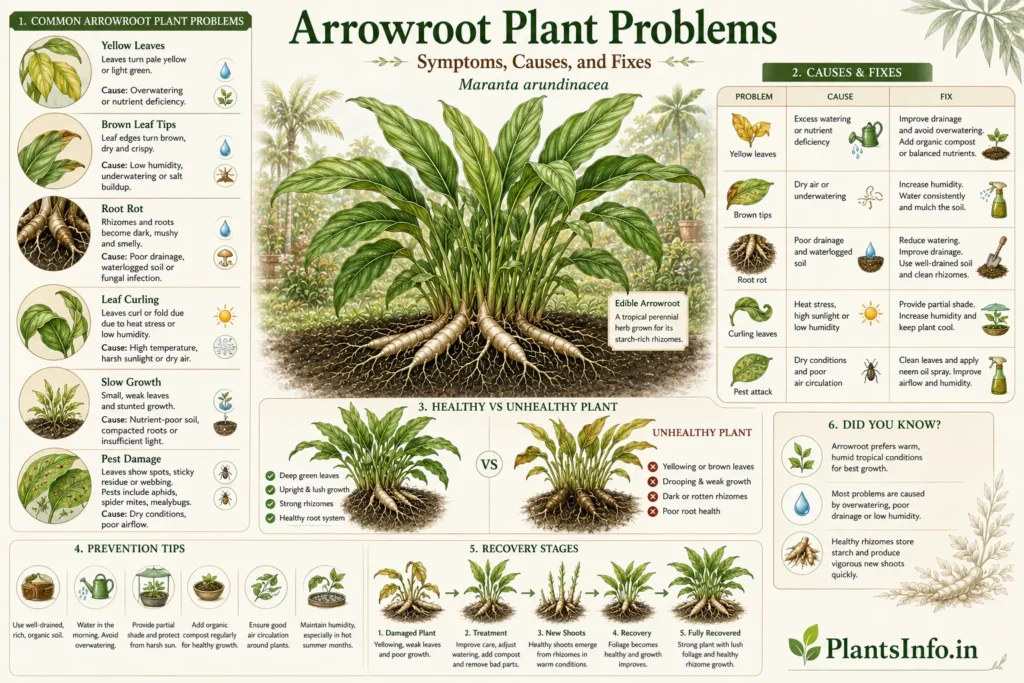
The most common seasonal mistake is harvesting too early — lifting rhizomes in February or March before the leaves have fully died back naturally. Early-lifted rhizomes have lower starch content and do not store as well. The plant’s own timing is the reliable indicator: wait until the aerial parts have fully yellowed and collapsed before harvesting.
Monsoon waterlogging at the planting site is the most damaging seasonal condition for arrowroot. Unlike a temporary dry spell, which the plant can survive with some stress, an extended period of root zone inundation in July–August causes rapid rhizome rot that is not recoverable. Ensure drainage is active before the monsoon begins — not after the problem appears.
Post-monsoon moisture withdrawal in November–December in dryland gardens can cause premature dormancy and reduced rhizome bulk. Maintaining irrigation through the dry post-monsoon period in drier growing regions is one of the most impactful things a gardener can do for final yield.
Post-Harvest Care
After rhizome harvest in April–May, the planting bed benefits from a rest period before replanting. Incorporate fresh vermicompost or decomposed cow dung into the bed, and allow it to rest for two to four weeks before the next planting cycle begins at monsoon onset.
In perennial growing situations — particularly in Kerala and the northeast, where arrowroot is sometimes left in the ground through mild dry seasons — selectively thin the clump rather than lifting the entire planting. Remove old, exhausted rhizomes and leave younger sections in place. This approach maintains a productive stand over multiple years without a complete replanting cycle.
Conclusion: Arrowroot’s seasonal calendar is simple and forgiving — plant at monsoon, harvest when the plant tells you to, and the cycle repeats reliably.