Introduction
Yellow Bells (Tecoma stans) is a flowering shrub or small tree in the family Bignoniaceae. It is recognised by its bright yellow, trumpet-shaped flowers, opposite pinnately compound leaves and long, narrow seed capsules. Native to tropical and subtropical regions of the Americas, the species is widely cultivated as an ornamental plant in warm climates and has become naturalised in several regions beyond its native range.
Classification
- Plant Type
- Shrub
- Lifecycle
- Perennial
- Leaf Habit
- Evergreen, Semi-evergreen
- Native Region
- North America, Northern South America
- Plant Family
- Bignoniaceae
The species occurs in a variety of habitats, including seasonally dry vegetation, open woodland, shrubland and disturbed environments. Its ecological characteristics include tolerance of some periods of moisture limitation, vigorous regrowth following damage and the production of numerous winged seeds that can be dispersed by wind. These traits contribute to its establishment in open habitats, although its responses vary with environmental conditions and are not evidence of unlimited drought tolerance.
The flowers provide nectar and pollen resources for a range of animals. Bees and other insects visit the flowers, while hummingbirds are also recorded in parts of the native range. The identity and relative importance of flower visitors vary geographically, and the presence of a visitor does not necessarily establish its effectiveness as a pollinator.
Tecoma stans has a long history of ornamental cultivation and documented traditional uses, particularly in parts of Central America and Mexico. Phytochemical investigations have identified several groups of secondary metabolites, including monoterpene alkaloids, flavonoids, phenylethanoid glycosides and iridoids. Pharmacological studies have examined extracts and isolated constituents under experimental conditions, but such findings should be distinguished from evidence of clinical efficacy or established therapeutic safety.
The species has also demonstrated invasive behaviour in certain introduced regions, where established populations can affect native vegetation. Its global conservation assessment is Least Concern (LC), a category that concerns extinction risk at the global level and does not preclude ecological impacts in regions where the plant has been introduced.
Quick Plant Information
| Characteristic | Information |
|---|---|
| Common name | Yellow Bells |
| Other common names | Yellow Elder, Yellow Trumpetbush, Trumpetbush |
| Accepted scientific name | Tecoma stans (L.) Juss. ex Kunth |
| Family | Bignoniaceae |
| Order | Lamiales |
| Growth form | Perennial shrub or small tree |
| Native range | Tropical and subtropical America |
| Leaf type | Opposite, odd-pinnately compound |
| Flower colour | Predominantly bright yellow, often with reddish or brownish throat markings |
| Fruit type | Elongated, dry capsule |
| Seed type | Flattened seeds with papery wings |
| Primary ornamental feature | Abundant trumpet-shaped yellow flowers |
| Primary contemporary use | Ornamental landscaping |
| Reported somatic chromosome number | 2n = 36 |
| Global conservation category | Least Concern (LC) |
Classification and Taxonomy
Taxonomic Classification
Tecoma stans belongs to Bignoniaceae, a family of flowering plants that includes trees, shrubs and woody climbers. Within the order Lamiales, the genus Tecoma comprises species native primarily to the Americas.
| Taxonomic rank | Classification |
|---|---|
| Kingdom | Plantae |
| Clade | Tracheophytes |
| Clade | Angiosperms |
| Clade | Eudicots |
| Clade | Asterids |
| Order | Lamiales |
| Family | Bignoniaceae |
| Genus | Tecoma |
| Species | Tecoma stans |
Accepted botanical name: Tecoma stans (L.) Juss. ex Kunth
Basionym: Bignonia stans L.
The species was originally described by Carl Linnaeus under the name Bignonia stans. The combination Tecoma stans was subsequently published by Humboldt, Bonpland and Kunth, with Jussieu acknowledged in the nomenclatural authorship.
Nomenclatural History
Older botanical literature, herbarium records and pharmacological publications may refer to Tecoma stans under historical combinations. These names are important when consulting older records but do not necessarily represent separate accepted species.
| Historical name | Nomenclatural significance |
|---|---|
| Bignonia stans L. | Original name and basionym |
| Stenolobium stans (L.) Seem. | Historical combination associated with the species |
| Gelseminum stans (L.) Kuntze | Historical combination associated with the species |
The accepted name remains Tecoma stans (L.) Juss. ex Kunth.
Related Taxa and Nomenclatural Context
Several taxa within or historically associated with Tecoma are relevant when interpreting older botanical descriptions and taxonomic treatments.
| Taxon | Geographic context | Taxonomic significance |
|---|---|---|
| Tecoma fulva (Cav.) G.Don | Peru to north-western Argentina | Distinct South American species with recognised infraspecific diversity |
| Tecoma castanifolia (D.Don) Melch. | Western Ecuador | Distinct species with a history of placement under Stenolobium |
| Tecoma stans var. sambucifolia (Kunth) J.R.I.Wood | South America | Recognised infraspecific taxon associated with historical species-level treatment as Tecoma sambucifolia |
| Tecomaria capensis (Thunb.) Spach | Southern and tropical Africa | Separate Bignoniaceae species historically published under the combination Tecoma capensis |
The taxonomic treatment of Tecoma sambucifolia has changed over time. In his 2008 revision of Tecoma in Bolivia, John R. I. Wood treated it as Tecoma stans var. sambucifolia, considering its morphological differences insufficient to maintain it as a separate species. The infraspecific name is retained in Kew’s taxonomic backbone.
The Cape honeysuckle is another source of nomenclatural confusion. It is frequently encountered in older horticultural literature as Tecoma capensis, but its accepted name is Tecomaria capensis. It is a separate species and should not be confused with Yellow Bells.
Cytogenetics
Cytogenetic information provides a limited but useful component of the biological description of Tecoma stans. A somatic chromosome number of 2n = 36 has been reported in the PROSEA botanical reference and independently documented in Mexican populations from the Mezquital Valley, Hidalgo.
The Mexican cytogenetic study described a karyotype formula of 14m + 3sm + 1st, including a satellite-bearing subtelocentric chromosome pair.
A 2024 review reports a basic chromosome number of x = 7 and discusses polyploidy and aneuploid chromosome variation in the genus. The reported somatic chromosome count and basic chromosome number should therefore be interpreted in the context of possible chromosome-number variation. The available species-specific evidence does not justify assigning a definitive ploidy level.
| Cytogenetic characteristic | Reported information |
|---|---|
| Somatic chromosome number | 2n = 36 |
| Reported karyotype formula | 14m + 3sm + 1st |
| Basic chromosome number discussed in a genus-level review | x = 7 |
| Definitive ploidy assignment | Not established here |
| Species-specific genome-size measurement | Not identified in the sources examined |
A species-specific genome-size measurement was not identified in the sources examined.
Growth Habit and Morphology
Growth Habit and Architecture
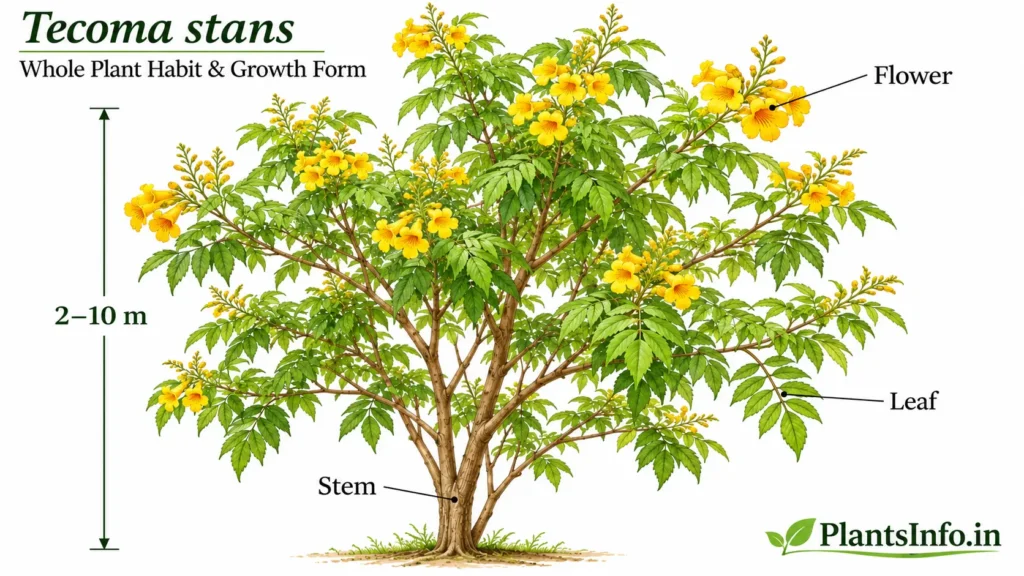
Tecoma stans is a perennial woody shrub or small tree with a variable growth form. Plants commonly reach approximately 2–10 m in height, although smaller shrub-like individuals are also recorded in local floras. Its architecture ranges from relatively upright forms to plants with spreading or arching peripheral branches.
The main shoot system is generally erect and woody. Lower branches may extend away from the central axis, producing a broad and irregular outline. Additional shoots can develop from basal or lower stem nodes, contributing to a multi-stemmed appearance in some plants.
The plant’s overall form is influenced by growth conditions, developmental stage and disturbance. Consequently, a single architectural pattern should not be treated as universal for the species.
| Character | Description |
|---|---|
| Life form | Perennial shrub or small tree |
| Common mature height | Approximately 2–10 m |
| Stem diameter | Reported up to approximately 25 cm in mature specimens |
| Canopy spread | No consistent species-wide measurement established |
| Stem type | Woody, branched and generally erect |
| Bark | Darkening and becoming more distinctly ridged with age |
| Young branchlets | May be lepidote and variably puberulent |
| Branching pattern | Upright shoots with spreading or arching peripheral branches |
| Basal growth | Additional shoots may develop from basal or lower stem nodes |
| Root development | Seedlings are reported to develop a strong taproot |
| Growth rate | Seedlings may grow rapidly under favourable conditions |
Stem
The stems form the woody framework that supports the foliage and reproductive shoots. Branches are generally rounded in cross-section, or approximately terete, rather than conspicuously winged.
Young branchlets may carry small scale-like structures and fine hairs. These features are described as lepidote and variably puberulent. With increasing age, the bark becomes darker and more distinctly ridged.
| Character | Description |
|---|---|
| Stem type | Woody and branched |
| Cross-section | Generally terete (rounded) |
| Mature diameter | Reported up to approximately 25 cm |
| Young branch surface | Lepidote and variably puberulent |
| Mature bark | Darker and increasingly ridged |
| Stem colour | Descriptions vary with age and drying condition |
| Prominent spines | No prominent stem spines reported |
Leaves
The leaves are among the most reliable vegetative identification features of Tecoma stans. They are opposite and odd-pinnately compound, usually bearing several leaflets along a central rachis.
A typical mature leaf has three to nine leaflets, with five to seven commonly recorded. Leaflet shape varies from ovate-lanceolate and lanceolate to elliptic or narrowly linear-lanceolate. The margins are serrate or toothed, while the apex is generally acute to acuminate and the base commonly cuneate.
Leaflet dimensions vary among botanical descriptions and populations. The reported range is approximately 2.4–15 cm in length and 0.8–6 cm in width.
| Character | Description |
|---|---|
| Leaf arrangement | Opposite |
| Leaf type | Odd-pinnately compound |
| Leaflet number | Usually 3–9; commonly 5–7 |
| Leaflet shape | Ovate-lanceolate, lanceolate, elliptic or narrowly linear-lanceolate |
| Leaflet length | Approximately 2.4–15 cm |
| Leaflet width | Approximately 0.8–6 cm |
| Leaflet margin | Serrate to toothed |
| Leaflet apex | Acute to acuminate |
| Leaflet base | Generally cuneate |
| Surface | Usually glabrous to sparsely hairy |
| Leaflet size along rachis | Often increases towards the terminal end |
The earliest leaves on a developing branch may be simple before the more characteristic compound foliage develops. This is a recognised developmental variation and should not, by itself, be interpreted as evidence of a different species.
Some descriptions also record variation in leaflet size, shape and hairiness. Identification should therefore rely on a combination of vegetative and reproductive characters rather than on a single leaflet measurement.
Flowers
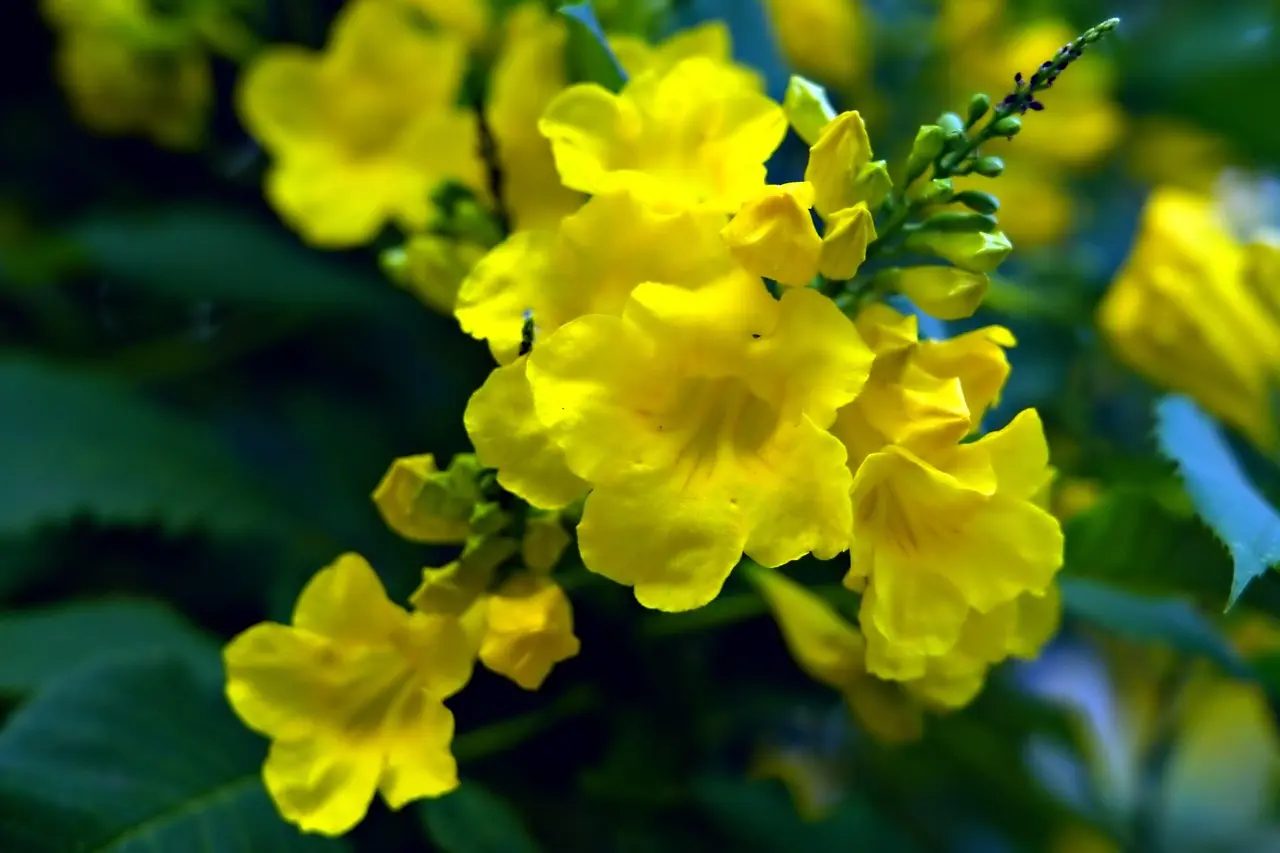
The flowers are the most conspicuous feature of Tecoma stans. They are borne in terminal or subterminal racemes and have a fused, tubular-campanulate corolla that widens towards the opening, creating the characteristic trumpet-like appearance.
The corolla is predominantly bright yellow, although an orange flush may occur. Reddish or brownish lines are commonly visible inside the throat and form a distinctive pattern.
| Character | Description |
|---|---|
| Inflorescence | Terminal or subterminal raceme |
| Flowers per inflorescence | Up to approximately 20 reported |
| Flower length | Approximately 3.5–6 cm |
| Corolla width at mouth | Approximately 1.2–2.4 cm |
| Corolla structure | Fused, tubular-campanulate and five-lobed |
| Corolla colour | Predominantly bright yellow; occasionally with an orange flush |
| Throat markings | Reddish or brownish lines, commonly described as seven prominent lines |
| Calyx | Elongate-cupular, approximately 3–7 mm long, with five small teeth |
| Fertile stamens | Four, arranged in two unequal pairs |
| Staminode | One reduced sterile stamen |
| Pistil | One; ovary narrowly cylindrical |
Some botanical accounts describe the flowers as sweetly fragrant or vanilla-like. The intensity and consistency of fragrance are not sufficiently established to treat it as a universal identification character.
Flower visitors include bees, wasps, moths and other insects. Hummingbirds are also recorded in parts of the native range. These observations concern floral visitation; the effectiveness of individual visitor groups as pollinators is considered separately in the reproductive biology section.
Fruit
The fruit is a dry, elongated capsule. It is generally narrow and tapering towards both ends, with a nearly cylindrical appearance when fresh. Some botanical descriptions record variation in its degree of flattening.
As the capsule matures, it dries and splits open to release the winged seeds.
| Character | Description |
|---|---|
| Fruit type | Dry capsule |
| Shape | Linear and elongated, generally tapering towards both ends |
| Length | Approximately 7–21 cm |
| Width | Approximately 0.5–1 cm |
| Surface | Generally smooth to inconspicuously lenticellate |
| Fresh form | Nearly terete (almost cylindrical) |
| Dehiscence | Splits open at maturity |
Seeds
The seeds are flattened and broadly winged. Each seed has a relatively small central body surrounded by a thin, papery membrane. The wings increase the seed’s capacity for wind dispersal.
Published descriptions do not always measure the same part of the seed. Some report the central seed body, whereas others include the complete winged structure. These measurements should not be combined into a single species-wide dimension without accounting for the difference.
| Character | Description |
|---|---|
| Overall form | Flattened and broadly winged |
| Central seed body | Small, thin and elliptic to ovate |
| Wing | Thin, translucent and papery |
| Wing structure | Clearly differentiated from the central seed body |
Root System
Seedlings of Tecoma stans are reported to develop a strong taproot. Observations from parts of the native range indicate that the primary root can penetrate rocky substrates and become difficult to remove.
This evidence supports the presence of substantial early primary-root development, but it does not establish a measured rooting depth for mature plants.
The available species descriptions do not provide a sufficiently consistent numerical range for mature rooting depth or lateral root spread. A detailed model of the mature root architecture therefore cannot be established from the sources examined.
Field Identification
A mature Tecoma stans can generally be recognised through a combination of foliage, flowers and fruit characters:
- Opposite, pinnately compound leaves.
- Serrate or toothed leaflets, usually numbering three to nine.
- Bright yellow, trumpet-shaped flowers, often with reddish or brownish throat markings.
- Terminal or near-terminal flower clusters.
- Long, narrow capsules that taper towards both ends.
- Flattened seeds with conspicuous papery wings.
One possible source of confusion is yellow oleander (Cascabela thevetia). Both species may have yellow flowers, but their foliage and fruit differ substantially. Tecoma stans has opposite compound leaves with several toothed leaflets and elongated capsules. Yellow oleander has simple, narrow leaves and fleshy fruits.
The opposite, pinnately compound leaf with serrate leaflets is particularly useful for distinguishing Tecoma stans when flowers and fruits are absent.
Recognising Normal Morphological Variation
Some variation in foliage and branching is part of the species’ documented morphology.
| Observation | Interpretation |
|---|---|
| Simple early leaves on a developing branch | May occur before typical compound foliage develops |
| Three to nine leaflets per leaf | Normal variation in leaflet number |
| Leaflets increasing in size towards the terminal end | Recognised compound-leaf characteristic |
| Purplish tint on expanding terminal foliage | Anthocyanin pigmentation has been observed in young leaf primordia under some environmental conditions |
| Spreading or arching peripheral branches | Part of the documented variation in growth architecture |
| Additional shoots near the base | Basal or lower-stem shoot development may occur |
| Variation in leaflet size, shape or hairiness | Described among botanical treatments and populations; identification should use multiple characters |
Named Horticultural Selections
Named horticultural selections of Tecoma stans have been documented. They should be distinguished from botanical varieties, which are taxonomic entities recognised in botanical classification.
| Cultivar or selection | Reported characteristics | Documentation |
|---|---|---|
| Tecoma stans ‘Gold Star’ | Early and abundant yellow flowering; described as relatively compact compared with some cultivated forms | Horticultural selection originating in San Antonio, Texas, USA |
| Tecoma stans ‘TEC60109105’ | Early flowering, short internodes, light-green foliage and relatively few seed pods | Formally documented plant selection originating in a breeding programme in Gilbert, Arizona, USA |
The designation ‘TEC60109105’ is a formal selection or patent designation, not a botanical variety name. ‘Gold Star’ is recognised in horticultural references as an early-flowering selection.
Functional Traits and Physiology
Light Response
Tecoma stans is frequently associated with open, well-lit environments. Its occurrence in open woodland, shrubland, disturbed ground and other exposed habitats is consistent with an ability to establish under relatively high light availability.
Some botanical and ecological accounts describe the species as a heliophyte in humid parts of its range. This characterisation should be understood in the context of the habitats documented in those sources rather than as evidence that the plant cannot grow under partial shade.
Drought Response and Water Stress
The species exhibits several responses to periods of reduced water availability. In dry environments, it may shed leaves, reducing the amount of exposed foliage. Temporary wilting has also been reported, with recovery possible after moisture becomes available again.
These responses do not indicate unlimited drought resistance. Prolonged water deficit may cause persistent wilting from which the plant does not recover.
The available observations support a degree of environmental flexibility, but they do not establish precise physiological thresholds. No sufficiently supported species-wide values for critical soil moisture, maximum drought duration, stomatal response or quantitative water-use efficiency can be assigned from the sources examined.
Seasonal Foliage Strategy
The foliage-retention pattern varies with environmental conditions and geographic location. Tecoma stans is described as evergreen in some environments and as winter-deciduous in others.
This variation should not be interpreted as a single fixed seasonal strategy throughout the species’ range. Regional climate and local growing conditions influence the timing and extent of leaf loss.
Regeneration After Disturbance
Regrowth following cutting or fire is an important documented characteristic. Surviving stump or basal tissues can produce new shoots after damage, allowing established plants to recover vegetatively.
This form of regeneration supports local persistence where above-ground stems are removed or damaged. It should be distinguished from seed-based reproduction, which contributes to dispersal and establishment at other sites.
The available evidence supports stump-sprouting and basal shoot development. It does not, by itself, establish a universal pattern of regeneration from all below-ground root tissues.
Physiological Integration
The documented traits suggest a life-history strategy involving environmental flexibility, disturbance recovery and effective seed dispersal.
During periods of moisture limitation, leaf shedding and wilting may reduce the plant’s exposed foliage. Temporary wilting can be reversible, although prolonged water stress may exceed the plant’s capacity to recover.
Regeneration and seed dispersal operate at different spatial scales. Regrowth from surviving stump or basal tissues supports local persistence after damage, while winged seeds facilitate movement away from the parent plant, principally through wind dispersal.
These characteristics are consistent with the species’ occurrence in open and disturbed habitats and with its ability to establish dense stands in some introduced regions. They do not, however, establish a complete physiological explanation for its ecological distribution.
The available literature does not provide a sufficiently detailed experimental model linking water relations, photosynthetic performance, nutrient acquisition and secondary-metabolite production. A specific photosynthetic pathway, quantitative water-use efficiency, stomatal response curve or integrated stress-response mechanism cannot therefore be assigned from the evidence examined.
Phytochemistry and Organ-Specific Chemical Composition
Overview of Chemical Composition
Phytochemical investigations of Tecoma stans have identified a diverse range of secondary metabolites and other chemical constituents. Reported groups include monoterpene alkaloids, flavonoids, phenolic acids, phenylethanoid glycosides, iridoids, volatile compounds, sterols and fatty-acid derivatives.
The chemical profile varies among plant organs and analytical methods. Research has examined leaves, flowers, fruits, roots, stems and seeds, although the amount and type of available evidence differ considerably among these tissues.
Several compounds have been isolated and structurally characterised in individual studies. Other compounds have been detected through analytical techniques or proposed through mass-spectrometric annotation. These evidence types are not interchangeable: a tentative analytical annotation does not establish the same degree of structural certainty as isolation and full characterisation.
Major Phytochemical Groups
| Compound class | Representative reported compounds | Plant material investigated | Evidence context |
|---|---|---|---|
| Monoterpene alkaloids | Tecomanine, tecostanine, boschniakine, 4-hydroxytecomanine and hydroxyskytanthine derivatives | Leaves and other plant material | Includes isolated compounds and analytical detections; individual compound identification requires source-specific interpretation |
| Flavonoids and flavonoid glycosides | Luteolin, apigenin, chrysoeriol, rutin and diosmetin or luteolin glycosides | Leaves, flowers and fruits | Reported through isolation studies and extract analyses |
| Phenylethanoid glycosides and caffeoyl derivatives | Acteoside (verbascoside), isoacteoside and related caffeoyl-containing glycosides | Flowers, fruits and leaf extracts | Identified in isolation studies and analytical investigations |
| Iridoid glycosides | 5-Deoxystantioside and plantarenaloside | Roots | Reported in root-constituent investigations |
| Volatile compounds and terpenoid-related constituents | Linalool, α-terpineol, β-selinene, (E)-β-ionone and 1-octen-3-ol | Leaves, stems, seeds and flowers | Reported in volatile-oil analyses |
| Fatty acids and lipid derivatives | Linolenic-, linoleic- and palmitic-acid derivatives; stearidonic-acid-related constituents | Seeds, fruit pericarp and leaf extracts | Reported in extract-based chemical analyses |
| Phytosterols and triterpenoids | β-Sitosterol and lupeol acetate | Roots and other investigated material | Reported in compound-isolation and extract studies |
The occurrence of a compound in an extract does not necessarily establish its ecological function in the intact plant. Although many of these chemical groups have been investigated for biological activity, their roles in defence, signalling, environmental adaptation or interactions with other organisms require direct evidence.
Organ-Specific Chemical Composition
Chemical investigations indicate that the composition of Tecoma stans differs among plant organs. The strongest quantitative comparison across several organs in the assembled evidence concerns volatile-oil composition.
The percentages reported in the volatile-oil study represent the relative proportions of identified compounds within the extracted oil. They are not measurements of compound concentration in fresh or dry plant tissue.
Volatile Constituents
| Plant organ | Reported compound | Relative proportion of identified volatile oil |
|---|---|---|
| Leaves | 1-Octen-3-ol | 24.8% |
| Leaves | 2,6,10-Trimethylpentadecane | 10.4% |
| Stems | Linalool | 11.4% |
| Stems | 2,6,10-Trimethylpentadecane | 10.7% |
| Seeds | α-Terpineol | 11.7% |
| Seeds | β-Selinene | 9.3% |
| Flowers | (E)-β-Ionone | 11.2% |
| Flowers | Linalool | 10.8% |
These results show differences in the relative volatile profiles of the investigated organs. They should not be treated as fixed chemical proportions for all plants or populations, because plant provenance, developmental stage, extraction procedures and analytical conditions can influence the measured profile.
Flowers and Fruits
Isolation studies of flowers and fruits have reported several phenolic constituents, including flavonoid glycosides and phenylethanoid glycosides.
| Plant organ | Compound group | Reported constituents | Evidence context |
|---|---|---|---|
| Fruits | Phenylethanoid glycosides | E/Z-acetoside, isoacetoside and 4-O-E-caffeoyl glycoside | Identified in isolation research; concentrations were not quantified in the cited study |
| Fruits | Flavonoids | Rutin, luteolin 7-O-neohesperidoside and luteolin 7-O-glucoside | Identified in isolation research |
| Fruits | Monoterpene alkaloids | 5-Hydroxyskytanthine hydrochloride | Reported in the fruit-constituent investigation |
| Flowers | Flavonoid glycosides | Luteolin 7-O-glucuronide, diosmetin 7-O-glucuronide, diosmetin 7-O-glucoside and its methyl ester | Identified in isolation research |
| Flowers | Phenylethanoid glycosides | Acetoside | Identified in isolation research |
The name acetoside is also encountered in the literature in connection with verbascoside. These names should not automatically be counted as separate compounds without checking the chemical identity and nomenclature used in the original study.
Roots
Root investigations have reported iridoid glycosides and other constituents.
| Compound group | Reported constituents | Evidence context |
|---|---|---|
| Iridoid glycosides | 5-Deoxystantioside and plantarenaloside | Identified in root-constituent research |
| Flavonoids | Luteolin | Reported in root extracts |
| Triterpenoid and sterol-related constituents | Lupeol acetate and β-sitosterol | Reported in root-constituent research |
These findings establish the presence of several chemical constituents in the investigated root material. They do not demonstrate that the same compounds occur at comparable concentrations in all populations or growing conditions.
Fruit Pericarp
A study of fruit-pericarp extracts reported several fatty-acid methyl esters, including methyl linolenate, methyl linoleate and methyl palmitate in the hexane-extract fraction. Methyl hexacosanoate was reported as a major constituent of the methanol-extract fatty-acid methyl ester fraction.
These methyl esters were identified following analytical preparation. Their detection should not be interpreted as proof that the same compounds occur naturally in the intact tissue in those methyl-ester forms. The study did not establish their concentrations in fresh or dry pericarp tissue.
Leaves and LC–MS/MS Profiling
A 2026 metabolomic and biochemometric investigation expanded the reported chemical profile of leaf material through LC–MS/MS analysis. The study reported 107 annotated metabolites, with chrysoeriol isolated for further characterisation.
The 107 annotations should not be interpreted as 107 individually isolated and fully structurally confirmed compounds. The distinction between analytical annotation, further characterisation and full compound isolation remains important when interpreting the study.
Reported leaf constituents include flavonoids such as chrysoeriol, luteolin and apigenin, as well as monoterpene alkaloids including tecomanine and hydroxyskytanthine-related compounds.
Phytochemical Significance and Experimental Context
Monoterpene alkaloids and phenolic constituents are among the most frequently investigated chemical groups in Tecoma stans. Tecomanine and related pyrindane-type alkaloids have received attention in chemical and pharmacological research. Flavonoids such as chrysoeriol, luteolin and apigenin, together with phenylethanoid glycosides such as acteoside, are also repeatedly reported.
Some studies have examined the biological activity of extracts, fractions or isolated compounds under laboratory conditions. These results provide experimental context for the plant’s chemical composition but do not, by themselves, establish therapeutic effectiveness, safety in humans or ecological function in the living plant.
One study of flower extracts and fractions reported synergistic interactions with the antibiotics amoxicillin and tetracycline in laboratory assays. This finding concerns interactions between plant extracts or fractions and antibiotics. It does not demonstrate synergism between two individual T. stans phytochemicals, nor does it establish clinical effectiveness.
The available evidence should therefore be separated into three categories:
- Extract-level interactions: Experimental effects involving crude extracts or fractions, including reported interactions with antibiotics.
- Compound-level interactions: Evidence involving individually identified compounds. A sufficiently established interaction between two individual T. stans compounds was not identified in the assembled evidence.
- Ecological chemical functions: The roles of individual compounds in the intact plant, including defence and environmental interactions, remain incompletely established.
No individual compound has been established as a commercially dominant product derived from T. stans. Its present chemical significance is primarily associated with research into isolated constituents, organ-specific extracts and experimentally investigated biological properties.
Research Coverage and Limitations
The available phytochemical literature is uneven in both plant-organ and geographic coverage. Leaf extracts have received considerable attention, particularly in studies conducted in South Asia and Egypt. Flower chemistry has also been investigated, including in studies from Brazil. Root chemistry is represented by selected compound-isolation studies, while seed and stem data are more concentrated in volatile-oil analysis. Fruit-pericarp chemistry has received comparatively limited attention.
The geographic distribution of the assembled studies is also uneven. Detailed chemical investigations from the species’ native Neotropical range are less extensively represented than research conducted on cultivated or naturalised material elsewhere. This is a qualitative observation about the available evidence, not the result of a formal bibliometric analysis.
The existing compound inventory should not be interpreted as a complete representation of the chemical diversity of Tecoma stans. Differences in plant provenance, developmental stage, environmental conditions, extraction solvent and analytical method limit direct comparisons among studies.
Further comparative work across plant organs and populations would help establish how consistently reported compounds occur across the species’ range and how their profiles vary with environmental and developmental conditions.
Medicinal Evidence, Nutrition and Safety
Traditional Medicinal Uses
Traditional medicinal use of Tecoma stans is documented particularly in Mexico and other parts of Central America. Different plant parts, especially leaves and roots, have been used in traditional preparations for a range of complaints.
Reported applications include:
- Traditional management of elevated blood glucose.
- Gastrointestinal and urinary disorders.
- Jaundice.
- Toothache and headaches.
- Respiratory complaints.
- Certain bites and stings.
These records document historical and regional medicinal practices. They do not establish that the preparations are clinically effective or safe. Traditional preparations may differ in plant part, preparation method, concentration and route of administration, making direct comparisons with standardised laboratory extracts difficult.
Evidence for Pharmacological Activity
Experimental investigations of Tecoma stans have examined antioxidant, antimicrobial, anti-inflammatory, cytotoxic and glucose-related activities. Research has used crude extracts, solvent fractions and isolated constituents, with results depending on the material and experimental conditions.
| Evidence category | Available evidence | Interpretation |
|---|---|---|
| Traditional use | Ethnobotanical records, particularly from Mexico and Central America | Documents reported practices, not clinical efficacy |
| In vitro studies | Antioxidant, antimicrobial, anti-inflammatory, cytotoxic and glucose-related investigations | Demonstrates experimental activity under specified laboratory conditions |
| Animal studies | Investigations of glucose-related effects, antimicrobial activity, wound healing and toxicity | Provides preclinical evidence; results cannot be directly translated into human outcomes |
| Human clinical studies | A controlled trial investigated a combined preparation containing T. stans and Guazuma ulmifolia | Does not establish the independent efficacy or safety of T. stans |
| Pharmacopoeial recognition | PROSEA reports inclusion in the Mexican Pharmacopoeia | Recognition does not establish clinical efficacy for every traditional use |
The strongest experimental evidence currently comes from laboratory investigations and animal studies. These demonstrate that particular extracts or constituents can produce measurable biological effects under defined conditions. They do not establish that traditional preparations produce equivalent effects in humans.
Human Clinical Evidence
Pascoe-González et al. (2021) conducted a randomised, double-blind, placebo-controlled trial involving 40 adults with type 2 diabetes. The intervention was a combined herbal preparation containing Guazuma ulmifolia and Tecoma stans, administered over 90 days.
The study reported improvements in certain glycaemic measurements. However, because the preparation contained two plant species, the contribution of T. stans cannot be isolated. The results therefore do not establish the independent clinical efficacy of T. stans.
Species-specific human evidence remains limited. The evidence reviewed here does not establish a controlled clinical trial of T. stans alone using a clearly characterised preparation, dose and adverse-event assessment sufficient to demonstrate its therapeutic efficacy and long-term safety.
Claims that the plant is a proven treatment for diabetes, cancer or infectious diseases therefore exceed the available species-specific human evidence.
Nutritional Composition and Food Use
A general food-use category is recorded for Tecoma stans in the Kew plant database. However, the available sources examined do not establish a sufficiently defined edible plant part or a reliable quantitative nutritional-composition dataset.
| Nutritional information | Evidence status |
|---|---|
| General food-use record | Recorded in a botanical database |
| Clearly established edible plant part | Not established in the sources reviewed |
| Quantitative proximate composition | No reliable species-specific dataset identified |
| Vitamins and minerals | No sufficiently verified composition profile identified |
| Standardised food-use assessment | Not established |
A lack of verified nutritional measurements should not be interpreted as evidence that every plant part is inedible or nutritionally devoid. It means that the available evidence is insufficient to provide a reliable nutritional profile.
Toxicity and Safety
The available safety evidence is incomplete. Experimental animal studies provide information about particular extracts and exposure conditions, but they cannot establish the safety of every plant part, preparation or route of exposure.
Species-specific human poisoning data and clinical toxicity thresholds remain insufficiently characterised. The available evidence does not justify describing the plant as either universally safe or conclusively poisonous to humans.
Experimental Animal Toxicity
Larbie et al. (2019) investigated the acute and subchronic toxicity of a hydroethanolic leaf extract of T. stans.
In the acute experiment, the detailed results report no mortality at doses up to 5,000 mg/kg body weight and estimate the median lethal dose (LD₅₀) as at least 5,000 mg/kg body weight. However, the paper contains an inconsistency: its abstract reports an LD₅₀ below 5,000 mg/kg, whereas the detailed results report an estimate of at least 5,000 mg/kg. This discrepancy should be retained when interpreting the study rather than silently resolving it in favour of one value.
The subchronic experiment administered the extract to rats at 100, 250 and 500 mg/kg body weight over 28 days. No mortality or obvious clinical signs were reported, but changes in several haematological and biochemical measurements were observed. These included alterations in white blood cell and platelet-related indices, increased blood glucose and changes in certain indicators associated with liver and kidney function at higher doses.
The study involved small experimental groups, with three animals of each sex per dose group. Its findings are therefore limited by the experimental design and cannot establish a safe human dose or the absence of organ-related effects.
| Experimental characteristic | Reported information |
|---|---|
| Plant material | Leaves |
| Extract | Hydroethanolic |
| Acute toxicity model | Mice |
| Highest acute dose reported | 5,000 mg/kg body weight |
| Detailed acute-result interpretation | No mortality; LD₅₀ reported as at least 5,000 mg/kg |
| Abstract inconsistency | Abstract reports an LD₅₀ below 5,000 mg/kg |
| Subchronic model | Rats |
| Exposure period | 28 days |
| Subchronic doses | 100, 250 and 500 mg/kg body weight |
| Group size | Three animals of each sex per dose group |
| Reported observations | Changes in selected haematological and biochemical measurements |
These findings concern a particular hydroethanolic leaf extract administered under experimental conditions. They cannot be directly translated into toxicity thresholds for fresh plant material, ordinary environmental exposure or other preparations.
Human Safety
Human safety information remains limited. The combined-herbal clinical trial described above cannot provide a definitive assessment of adverse effects attributable specifically to T. stans.
The available sources do not establish a reliable species-specific human poisoning profile or clinical dose threshold. The absence of a conclusively identified toxic principle is not evidence that all preparations are harmless.
Pregnancy and Breastfeeding
Reliable species-specific reproductive safety and lactation studies were not identified in the evidence reviewed. Safety during pregnancy and breastfeeding therefore remains undetermined.
Drug Interactions
The plant has been investigated for glucose-related biological activity, but clinically established interaction data with antidiabetic medicines are lacking. The absence of documented clinical interactions should not be interpreted as proof that interactions cannot occur.
Liver and Kidney Considerations
Larbie et al. (2019) reported changes in certain biochemical indicators associated with liver and kidney function in rats exposed to higher doses of a hydroethanolic leaf extract. These findings do not establish human organ toxicity, but human renal and hepatic safety has not been adequately characterised.
Animal Exposure
Species-specific toxicity evidence for cats, dogs and livestock is insufficient in the sources reviewed.
The ASPCA general plant-toxicity database does not provide a basis for assigning T. stans-specific gastrointestinal toxicity to cats or dogs. Consequently, general claims that ingestion of this species causes gastrointestinal upset in these animals are not retained as established species-specific effects.
Similarly, records of animal-food use do not establish safety for every livestock species, plant part or quantity.
| Animal group | Available evidence | Interpretation |
|---|---|---|
| Cats | No sufficiently verified species-specific clinical toxicity profile identified | Safety cannot be inferred from the absence of a listing |
| Dogs | No sufficiently verified species-specific clinical toxicity profile identified | Safety cannot be inferred from the absence of a listing |
| Livestock | General animal-food use is recorded in some botanical sources | Does not establish safety at every dose or for every livestock species |
Soil Ecology and Experimental Allelopathy
Mycorrhizal Associations
Research on the soil biology of Tecoma stans is limited, but a species-specific experimental investigation has examined its interaction with mycorrhizal fungi.
Becerril-Navarrete et al. (2022) studied seedlings under semicontrolled conditions using three fungal inoculants:
- Rhizophagus intraradices
- Pisolithus arhizus
- Scleroderma verrucosum
The experiment also included the plant-associated bacterium Azospirillum brasilense.
All three fungal species were observed infecting the seedlings. The fungal treatments produced different effects on plant growth and measured functional traits. Seedlings inoculated with Scleroderma verrucosum showed greater growth and changes in above-ground and below-ground characteristics compared with other treatments.
The fungi represented more than one mycorrhizal group. Rhizophagus intraradices is an arbuscular mycorrhizal fungus, whereas Pisolithus arhizus and Scleroderma verrucosum are associated with ectomycorrhizal relationships.
These findings demonstrate experimental compatibility between the seedlings and the tested fungi under the conditions of the study. They do not establish that all three fungi are common natural symbionts of T. stans throughout its geographic range.
The experiment also included Azospirillum brasilense. However, the researchers could not determine the degree of bacterial infection or colonisation at harvest because the necessary methods were unavailable. The study therefore does not establish a confirmed bacterial colonisation relationship or a specific bacterial functional role in the natural rhizosphere of the species.
| Organism | Biological group | Experimental finding |
|---|---|---|
| Rhizophagus intraradices | Arbuscular mycorrhizal fungus | Observed infecting seedlings |
| Pisolithus arhizus | Ectomycorrhizal fungus | Observed infecting seedlings |
| Scleroderma verrucosum | Ectomycorrhizal fungus | Observed infecting seedlings; associated with greater growth in the reported comparison |
| Azospirillum brasilense | Plant-associated bacterium | Included as an inoculant, but colonisation could not be determined |
The experiment provides evidence that fungal associations may influence early establishment and growth. Further field studies are required to establish the dominant natural fungal partners, the importance of these relationships for nutrient acquisition and their consistency across populations.
Experimental Allelopathy
A 2026 laboratory investigation examined the effects of aqueous leaf extracts of T. stans on seed germination and early seedling development in Allium cepa and Portulaca oleracea.
The researchers tested four extract concentrations: 10, 20, 30 and 40 g/L. Qualitative screening reported relatively high levels of phenolic compounds, moderate levels of alkaloids and lower levels of flavonoids, saponins and glycosides.
Inhibitory effects increased with extract concentration. The strongest reported effect was a 76.22% reduction in average root length in A. cepa at an extract concentration of 40 g/L.
These results support the possibility of allelopathic activity under laboratory conditions. They do not establish that compounds naturally released by living plants or decomposing tissues reach comparable concentrations in field soils.
The specific compounds responsible for the observed inhibition were not conclusively identified by the experiment. The qualitative detection of broad chemical groups is insufficient to attribute the effect to an individual allelochemical.
| Experimental feature | Reported information |
|---|---|
| Plant material | Aqueous leaf extract of T. stans |
| Test species | Allium cepa and Portulaca oleracea |
| Extract concentrations | 10, 20, 30 and 40 g/L |
| Chemical screening | Phenolics, alkaloids, flavonoids, saponins and glycosides |
| Concentration response | Inhibition increased with extract concentration |
| Strongest reported effect | 76.22% reduction in average root length of A. cepa |
| Highest tested concentration | 40 g/L |
| Field-level allelopathic mechanism | Not established |
The results should be interpreted as preliminary experimental evidence of extract-level phytotoxic potential, not as proof that allelopathy is a major mechanism driving the species’ ecological effects in natural habitats.
Research Gaps in Soil Ecology
The available soil-ecological evidence is strongest for experimental fungal compatibility and preliminary laboratory allelopathy. It does not yet establish a complete model of natural below-ground interactions.
Important unresolved questions include:
- Which mycorrhizal fungi are the dominant natural partners of T. stans across its native and introduced ranges?
- How does the natural rhizosphere bacterial community vary among populations and soil types?
- To what extent do fungal associations influence nutrient acquisition under field conditions?
- Which compounds are responsible for the observed extract-level inhibitory effects?
- Do naturally released compounds reach biologically active concentrations in field soils?
- What are the long-term consequences of these interactions for neighbouring plant communities?
These questions require field-based ecological studies and experiments that distinguish effects observed in concentrated extracts or controlled inoculations from processes occurring in natural soils.
Native Distribution, Introduced Range and Habitat
Biogeographic Overview
Tecoma stans is native to tropical and subtropical America. Its native distribution extends from the southern United States through Mexico, Central America and the Caribbean into northern and western South America, with records reaching north-western and north-eastern Argentina.
The species occupies a broad range of tropical and subtropical environments rather than a single narrowly defined vegetation type. It occurs in relatively dry vegetation, including xerophytic shrubland and thorn forest, as well as in open and disturbed landscapes in more humid regions.
Its present distribution beyond the Americas is strongly associated with ornamental cultivation. Introductions have been recorded across Africa, Asia, the Indian Ocean, the Pacific and parts of Europe. Some introduced populations have become naturalised, while others are documented only as introduced or cultivated occurrences.
An introduced occurrence should not automatically be interpreted as evidence of a self-sustaining wild population. The distinctions among cultivation, introduction, naturalisation and invasion are therefore maintained in the regional summaries below.
Native Range
The native-range summary follows the geographic records represented in Plants of the World Online (Kew) and the USDA GRIN-Global taxonomic database. Their geographic categories and levels of resolution are not identical in every detail.
| Geographic region | Native distribution records |
|---|---|
| Southern United States | Arizona, New Mexico, Texas and Florida |
| Mexico | Northern, north-western, north-eastern, central, south-western and Gulf regions |
| Central America | Costa Rica, El Salvador, Guatemala, Honduras, Nicaragua and Panama |
| Caribbean | Bahamas, Cayman Islands, Cuba, Dominican Republic, Haiti, Jamaica, Puerto Rico, Trinidad and Tobago, Netherlands Antilles, Leeward Islands, Windward Islands and Venezuelan Antilles |
| Northern South America | Colombia and Venezuela |
| Western South America | Bolivia, Ecuador and Peru |
| Southern South America | North-western and north-eastern Argentina |
Kew’s country-level record does not list Belize among the cited native records, although the broader regional distribution includes much of Central America. This database-specific absence should not be treated as proof that the species is absent from Belize.
The geographic records are best interpreted according to the source and resolution in which they are presented. Regional categories, country listings and subregional occurrences should not be merged into a single exhaustive distribution statement without accounting for their different definitions.
Introduced and Naturalised Range
The species is widely cultivated as an ornamental shrub or small tree in tropical and subtropical regions. Kew records introductions across several continents and island groups, while regional weed databases provide additional evidence of naturalisation and invasive behaviour in selected locations.
| Region | Countries or areas recorded | Occurrence status and qualification |
|---|---|---|
| South Asia | India, Bangladesh and Pakistan | Introduced and widely cultivated. The sources reviewed do not justify treating the entire region as uniformly naturalised. |
| South-East Asia | Myanmar and other regional localities | Naturalisation is reported in parts of the region; country-level establishment should be assessed separately. |
| Southern Africa | South Africa and Eswatini | Naturalised in South Africa, with invasive populations and formal regulation in that country. |
| East Africa and western Indian Ocean | Ethiopia, Eritrea, Kenya, Tanzania, Comoros, Mayotte and Réunion | Introductions are recorded; naturalisation is documented in selected island locations, but should not be assumed across every listed area. |
| West and central Africa | Gambia, Guinea, Chad and Mauritania | Introduced records; the sources examined do not establish naturalisation throughout these locations. |
| Atlantic and other islands | Ascension, Saint Helena, Bermuda and the Canary Islands | Introductions are recorded; alien or naturalised occurrence is documented in selected locations. |
| Pacific islands | Hawaii, Guam, Micronesia, Marshall Islands, Palau, Cook Islands, French Polynesia, New Caledonia, Samoa, Tonga and other island groups | Naturalised in several island regions; invasive concerns and ecological impacts are documented in selected locations. |
| Australia | Queensland and other recorded states | Naturalised and invasive in parts of Australia, with well-documented concerns in Queensland and regional records in New South Wales. |
| Europe and Mediterranean | Spain, Tunisia and Italy | Introduced or alien-range records; the available sources do not establish a uniform naturalisation status across these locations. |
The table describes the geographic coverage of the sources reviewed. It is not a complete census of all cultivated or escaped plants, and the occurrence status of individual local populations may change over time.
Cultivation and Geographic Spread
Ornamental cultivation has been the principal documented pathway for the species’ introduction beyond its native range. Its bright yellow flowers and ability to grow as a shrub or small tree have contributed to its use in tropical and subtropical landscapes.
The available evidence does not establish a single global commercial production centre or quantify worldwide production volumes. The species is principally documented as a landscape and ornamental plant rather than as a globally traded plantation crop.
Naturalisation and invasive impacts are particularly well documented in South Africa, Australia and selected Pacific and Indian Ocean island settings. In other regions, records may establish only cultivation or introduction, without enough evidence to classify the species as naturalised.
Natural Habitat
Tecoma stans occurs in a range of tropical and subtropical vegetation types. In drier parts of its native range, it is associated with xerophytic shrubland and thorn-forest communities. In more humid environments, it is often found in open woodland margins, deforested areas, roadsides and other disturbed sites.
Rocky slopes and limestone outcrops are characteristic habitats in some parts of its range. The species also occurs on alluvial and other substrates where drainage is effective.
| Habitat attribute | Documented information |
|---|---|
| Climate and biome | Tropical and subtropical environments |
| Dry-region vegetation | Xerophytic shrubland and thorn forest |
| Humid-region vegetation | Open woodland margins, deforested areas and disturbed vegetation |
| Common landscape settings | Rocky slopes, roadsides and disturbed sites |
| Substrate | Rocky, frequently limestone, and alluvial substrates |
| Drainage | Occurrence is associated with effective drainage |
| Elevation | EcoCrop records an ecological envelope extending to approximately 2,000 m |
| Moisture regime | Occurs in both arid and humid environments; partial foliage loss during dry periods is reported |
| Disturbance | Seedlings may be abundant in disturbed sites; established plants can regenerate after cutting or fire |
The elevation value of approximately 2,000 m is a database envelope recorded by EcoCrop, not a demonstrated upper limit for every native population.
The available sources do not establish a complete quantitative description of natural soil preferences or the relative frequency of each habitat type across the native range. The species is best characterised as an ecologically flexible shrub or small tree associated with open, well-lit habitats and a range of substrates, particularly where drainage is effective.
Climatic and Soil Suitability Estimates
The FAO EcoCrop database provides a set of indicative climate and soil parameters for T. stans. These values are ecological database estimates rather than results from a single controlled physiological experiment or a global survey of cultivated populations.
| Parameter | EcoCrop optimum range | EcoCrop tolerance range |
|---|---|---|
| Mean annual temperature | 15–25 °C | 10–35 °C |
| Annual rainfall | 500–700 mm | 400–800 mm |
| Soil pH | 6.0–8.5 | 5.5–9.0 |
EcoCrop also records an elevation envelope extending to approximately 2,000 m and a preference for well-drained soils.
These values should be treated as indicative suitability estimates, not as experimentally established biological thresholds. In particular, the lower temperature value should not be interpreted as a measured frost-tolerance limit.
Climate Interpretation and Stress Evidence
The available distribution records indicate suitability across warm tropical and subtropical environments, including tropical wet-and-dry and steppe or semi-arid climate zones.
The species’ occurrence in both dry and humid environments is consistent with a relatively broad moisture envelope. However, the EcoCrop rainfall estimates should not be interpreted as strict survival boundaries, because field observations document occurrence across contrasting moisture regimes.
Winter temperature is an important geographic constraint, particularly towards the poleward margins of the species’ distribution. The sources examined do not provide a sufficiently substantiated species-wide frost injury threshold or minimum survival temperature.
Drought response is the best-supported species-specific physiological stress observation in the ecological literature. Partial leaf abscission and survival through prolonged wilting have been reported, but the evidence does not establish a quantified soil-moisture or plant-water-potential threshold.
Species-specific evidence was insufficient to assign reliable tolerance levels for salinity, waterlogging, extreme heat, frost or combined environmental stresses. The available literature also does not provide a sufficiently documented experimental assessment of interactions between drought and heat, salinity and waterlogging, or other combined stress conditions.
Ecological Relationships and Invasive Impacts
Ecological Relationships
The clearest documented ecological roles of Tecoma stans concern floral resource provision, pollination and seed dispersal.
Its flowers provide nectar and pollen resources for insects and birds. However, floral visitation records must be distinguished from evidence that a visitor transfers pollen effectively and contributes to successful reproduction.
| Ecological role | Organism or agent | Evidence and interpretation |
|---|---|---|
| Pollination | Hummingbirds | Important floral visitors and reported pollinators in parts of the native range |
| Pollination | Bees, including Centris tarsata and Exomalopsis fulvofasciata | Reported as effective pollinators in observations discussed in the ecological literature |
| Floral resource provision | Bees and other flower-visiting insects | Flowers provide nectar and pollen |
| Floral visitation | Wasps and hawk moths | Recorded visiting flowers; visitation alone does not establish pollination effectiveness |
| Primary seed dispersal | Wind | Lightweight winged seeds are released from dehiscent capsules and dispersed by wind |
| Additional seed movement | Water and discarded garden material | Potential pathways of seed movement in introduced environments |
An Indian study documented visits by bees, wasps and hawk moths. Broader ecological accounts identify hummingbirds as important pollinators in parts of the native range. The relative contribution of these groups is likely to differ geographically.
The species should not be assigned a universal pollination syndrome solely from the presence of particular visitors. More geographically distributed studies would be needed to compare pollinator effectiveness across its native and introduced populations.
Seed Dispersal and Local Spread
Wind is the principal documented seed-dispersal agent. The elongated capsules release numerous lightweight seeds with papery wings, allowing them to move away from the parent plant.
Water movement and discarded garden material may provide additional routes of seed movement, particularly in introduced environments. These pathways should be distinguished from local vegetative regeneration.
Stump-sprouting and the development of basal shoots allow established plants to persist after damage. This is a form of local vegetative regeneration rather than long-distance seed dispersal.
The available evidence does not establish a single universal dispersal distance or quantify the relative contribution of wind, water and human-assisted movement across the species’ introduced range.
Invasive Behaviour
Naturalisation outside the native range is documented in several regions. In some introduced locations, T. stans forms dense stands and competes with native vegetation. The extent of ecological impact and the regulatory response vary geographically.
The principal invasion pathway involves seed production followed by dispersal, particularly by wind. Water movement and discarded garden material can provide additional routes. Establishment is frequently associated with open and disturbed environments, including roadsides, riparian areas and waste ground.
Dense populations can restrict the regeneration of native vegetation through competition. However, the nature and scale of documented impacts should be assessed region by region rather than generalised across the entire introduced range.
Regional Invasive Status and Documented Impacts
| Region | Recorded status | Documented ecological concern | Management or regulatory context |
|---|---|---|---|
| South Africa | Invasive; Category 1b listed species | Occurs along roadsides, riparian areas, waste ground, disturbed sites and rocky habitats; reported to displace indigenous flora and fauna | Category 1b regulation requires control where present or removal and destruction where possible; planting and trade are prohibited under the cited regulatory framework |
| Queensland, Australia | Restricted invasive plant; naturalised in northern and eastern areas | Invades native bushland and roadsides and affects native trees, shrubs and other plants | Listed under Queensland biosecurity controls; prevention and control measures apply |
| New South Wales, Australia | Recorded as an environmental weed in regional accounts | Regional environmental-weed concern is documented | The sources reviewed do not establish one uniform statewide control programme |
| Pacific islands, including French Polynesia and New Caledonia | Naturalised in selected locations; invasive concern documented | Dense growth and competition may affect native vegetation; biodiversity-related impacts are recorded in selected island accounts | Management is location-specific; the available sources do not establish a single regional control method |
| Réunion and Mayotte | Alien-range records with invasive concerns | Included in regional assessments of introduced woody plants and alien flora | Regional management records exist, but a uniform island-wide control method is not established here |
| Cayman Islands | Alien-range records | Competition and biodiversity-related outcomes are reported in the relevant database account | Management details are not sufficiently specified in the available account |
The regulatory categories in this table are specific to their respective jurisdictions. A legal designation in South Africa or Queensland should not be assumed to apply in another country or territory.
South Africa
South Africa provides one of the clearest examples of the species’ invasive behaviour and formal regulatory response.
The Agricultural Research Council records T. stans in seven provinces: Gauteng, Mpumalanga, Limpopo, KwaZulu-Natal, Eastern Cape, North West and, rarely, Western Cape. It occurs in roadsides, riparian areas, waste ground, disturbed sites and rocky habitats.
The species is listed as a Category 1b invasive species under the cited Alien and Invasive Species Regulations. The regulatory framework requires control where the species is present or removal and destruction where possible, with planting and trade prohibited under the applicable listing.
Australia
In Queensland, T. stans is recorded as a restricted invasive plant. It occurs in northern and eastern parts of the state and readily invades native bushland and roadsides. Regional accounts identify effects on native trees, shrubs and other plants.
New South Wales also has regional environmental-weed records. These should be interpreted at the level of the relevant regional accounts rather than as evidence of identical distribution, abundance or management requirements throughout the state.
Pacific and Indian Ocean Islands
Invasive concerns are documented in selected Pacific and Indian Ocean island settings. Regional databases record naturalised populations and competition-related or biodiversity-related impacts in some locations.
The available evidence does not support treating every introduced island population as equally invasive or assigning the same ecological impact to all island groups. Local habitat, population density, disturbance and management history may influence the consequences of establishment.
Global Conservation and Regional Ecological Impact
The global conservation status of Tecoma stans and its invasive status in introduced regions address different questions.
A global assessment of extinction risk concerns the likelihood of the species disappearing across its native range. Invasive-plant assessments concern ecological effects in regions where the species has been introduced and established.
Consequently, a species can be classified globally as Least Concern while also being a significant environmental weed in particular introduced regions. Its global conservation category should not be interpreted as evidence that naturalised populations are ecologically harmless.
The ecological impact of T. stans is therefore region-dependent. Its presence as an ornamental plant does not automatically indicate ecological harm, but dense naturalised populations have become a management concern in several locations.
Recommended Products
Disclosure: As an Amazon Associate, PlantsInfo may earn from qualifying purchases.
🌱 Plant Care Essentials
The following tools can help with pruning, plant health, soil management, and fruit garden maintenance.

Neem Oil for Plant Care
Natural plant protection against aphids, whiteflies, mites, and other common garden pests.

Fungicide for Root Care
Helps suppress soil-borne fungal diseases and supports healthier root systems.

Spray Bottle for Plants
Ideal for applying foliar sprays, neem oil solutions, and liquid plant treatments.

Rubber Hand Gloves
Protects hands during pruning, planting, soil preparation, and garden maintenance.
Reproductive Biology and Pollination
Reproductive Strategy
Tecoma stans reproduces sexually through flowers, fruit and seed production. Its reproductive performance depends on flower development, pollen transfer, fertilisation and subsequent fruit maturation. The species is capable of producing viable seed under natural and controlled pollination conditions, although the proportion of flowers that develop into mature fruits can be relatively low.
The species also regenerates vegetatively, particularly through vigorous shoots produced from cut stumps or following disturbance such as fire. This form of regeneration is distinct from seed production and is especially relevant to the persistence of established plants after cutting. Vegetative sprouting does not, however, replace the role of seed production in dispersal over longer distances.
Floral Function and Pollen Transfer
The tubular-funnel-shaped flowers are adapted to animal visitation. Nectar and pollen provide floral rewards, while the position of the reproductive structures allows visiting animals to contact the anthers and stigma during flower entry. The available observations document both bird and insect visitation, with the relative contribution of visitor groups varying geographically.
Hummingbirds are recognised as important flower visitors in parts of the species’ native range. Studies from India and Brazil have also documented substantial insect activity, particularly by bees. In India, bees and wasps collect pollen or nectar during daylight hours, while hawk moths have been recorded visiting flowers during early morning and evening periods. These observations demonstrate that the species is not dependent on a single pollinator group throughout its range.
The bilobed stigma responds to physical contact by closing its receptive surfaces. This is a documented floral response, but its effectiveness in preventing self-pollination or promoting outcrossing has not been conclusively established across populations. Floral visitors may transfer pollen between flowers, but visitation alone does not demonstrate equal pollination effectiveness among all visitor groups.
Breeding System and Self-Compatibility
Evidence concerning the breeding system of T. stans is not entirely consistent. Controlled pollination studies have reported reproductive success following autogamous, geitonogamous and xenogamous pollen transfer, supporting the capacity for self-fertilisation in at least some experimental material. However, spontaneous self-pollination has not consistently resulted in fruit production.
Singh and Chauhan (1994) interpreted their observations as evidence of gametophytic self-incompatibility. Contreras (2009), however, questioned that interpretation because reported fruit set after geitonogamous pollination was inconsistent with the proposed mechanism. Other studies have reported self-compatibility.
The available evidence therefore supports the possibility of self-compatibility, but the extent of autonomous self-pollination and the consistency of breeding-system responses across populations remain unresolved. Self-compatibility should not be interpreted as evidence that pollinator-mediated pollen transfer is unimportant.
Fruit Set and Reproductive Success
Not all flowers develop into mature fruits. An ecological study by Pelton (1964) recorded 209 mature fruits from 1,422 flowers across four shrubs, equivalent to approximately 14.7% fruit set. Other observations have also reported relatively low fruit production in relation to flower number.
Fruit development can be affected by pollen transfer, weather conditions, water availability and competition for light and other resources. Drought has been associated with flower-bud abscission and failure of buds to open fully. Plants growing under substantial shade or in competition with surrounding vegetation may also produce fewer flowers or show reduced reproductive performance.
These observations indicate that flower abundance alone is not a reliable measure of reproductive output. Fruit set and subsequent seed production provide more direct measures of reproductive success.
Controlled Pollination and Breeding Research
Controlled pollen transfer has demonstrated that fruit and viable seed can be produced under experimental conditions. Interspecific crossing research involving T. stans and T. garrocha has also produced ornamental hybrid material with modified floral characteristics.
These studies demonstrate the feasibility of controlled breeding and horticultural selection. They do not establish that natural populations require human-assisted pollination or that interspecific hybridisation occurs routinely under field conditions.
Flowering, Fruiting and Phenology
Flowering Patterns
Flowering in T. stans varies geographically. Some populations produce repeated flowering flushes or flower over extended periods, whereas others show a more concentrated seasonal pattern. The timing of flowering should therefore be interpreted in relation to the location and growing conditions of the observed population rather than treated as a single species-wide calendar.
Documented regional observations include:
| Region | Reported flowering period |
|---|---|
| Mexico | Mainly August–November, often with two flowering flushes |
| Costa Rica | November–April |
| Colombia | September–January |
| Puerto Rico | Flowering reported throughout the year, with a winter peak |
| Florida, USA | Spring through September |
| India | Extended flowering has been reported, including two daily anthesis periods |
| Parts of Australia | Spring–summer flowering has been recorded |
In tropical cultivated settings, flowering may continue for much of the year. In subtropical locations, flowering is generally more seasonal. These regional records should not be combined into a universal flowering calendar because local climate, habitat and cultivation conditions differ.
Daily Anthesis
Daily anthesis observations from India describe two principal periods of flower opening: approximately 05:00–08:00 and 15:00–17:00. These are daily opening intervals, not seasonal flowering periods.
The timing of anthesis is relevant to flower visitation because different pollinator groups may be active at different times. Bees and wasps have been observed collecting floral rewards during daylight hours, while hawk moth visitation has been reported during early morning and evening intervals.
Flower Bud Development
Flower development proceeds through recognisable stages, from bud initiation and enlargement to the opening of the corolla. Following successful pollination and fertilisation, the petals shrivel and the ovary develops into a capsule.
No universal month range for flower-bud initiation has been established across the species’ native and introduced ranges. Although flowering has been associated with open, sunny conditions, the available observations do not establish a single photoperiod, temperature or rainfall threshold that initiates flowering.
Temperatures reported during flowering observations should be treated as environmental context, not as experimentally established flowering-induction limits.
Fruiting and Capsule Maturation
Fruit development follows successful fertilisation. The developing capsules initially remain green and gradually change colour as they mature, becoming pale brown and eventually greyish. The fruits are elongated capsules containing numerous flattened, winged seeds arranged in overlapping positions.
Mature capsules may remain attached to the plant for an extended period. They can open along their longitudinal sutures and release seeds, although the timing and intensity of fruit maturation vary among locations. Florida observations, for example, record fruiting mainly during spring and autumn, while fruits may also be present at other times of the year.
In some Colombian tropical dry-forest observations, seed dispersal is concentrated during the dry season. This should be understood as a regional pattern rather than a universal dispersal period.
Environmental Influences on Phenology
Rainfall, temperature, sunlight, water availability and competition from surrounding vegetation are all relevant to the growth and reproductive performance of T. stans. However, the available evidence does not isolate the relative contribution of these factors to flowering initiation across the species’ range.
Drought may reduce reproductive output through flower-bud loss or incomplete flower development. Shade and competition may also reduce flowering intensity. These observations indicate environmental influences on reproductive performance, but they do not establish a universal phenological mechanism.
The species may retain leaves, flowers, developing fruits and mature capsules on the same plant at overlapping times. This asynchronous pattern is consistent with the extended or recurrent reproductive activity reported in some populations.
Seed Biology, Germination and Regeneration
Seed Structure and Storage Characteristics
The seeds of T. stans are exalbuminous: the mature seed lacks endosperm and contains conspicuous cotyledons. The seed coat is relatively thin and papery, and the flattened seeds have membranous wings that facilitate dispersal by air.
Research indicates that the seeds exhibit orthodox storage behaviour. This means that they can tolerate drying and can be stored under suitable conditions while retaining viability. Laboratory observations have reported seed viability after several years of storage, but this should not be interpreted as evidence of indefinite longevity or equivalent persistence in natural soil conditions.
Dormancy and Germination Requirements
Primary dormancy is not generally reported as a characteristic of T. stans seeds. Germination can occur without a routine scarification or other specialised dormancy-breaking treatment under suitable experimental conditions.
Germination is influenced by temperature and light. Socolowski, Vieira and Takaki (2008) identified approximately 25–30 °C as an optimum temperature range under the conditions tested in their laboratory study. This range is an experimental result rather than a universal field threshold.
Research using seed material from a Colombian tropical dry-forest population recorded germination exceeding 90% under tested alternating-temperature and white-light conditions. The result demonstrates high germination potential under those experimental conditions, but it should not be generalised to every seed lot or habitat.
Some experiments have also reported reduced germination or secondary dormancy under high-temperature treatments in darkness or restricted-light conditions. This indicates that germination responses can depend on the interaction between temperature and light exposure.
Germination and Seedling Establishment
Germination is epigeal, with the cotyledons emerging above the soil surface. Published observations distinguish radicle emergence from subsequent cotyledon emergence; reported timings therefore depend on which developmental event is being measured and on the experimental conditions.
Seedlings can establish rapidly under favourable conditions. They develop a strong taproot, which can penetrate compact or rocky substrates and contribute to persistence once established. However, seedling recruitment is affected by environmental conditions, including water availability, light and disturbance.
Prolonged drought, grazing, trampling, competition from established vegetation and fire can constrain seedling survival. Consequently, high laboratory germination does not necessarily translate into high recruitment in natural populations.
Seed Longevity and Natural Seed Banks
Laboratory storage experiments indicate that seeds can retain viability for several years under suitable storage conditions. Pelton (1964) reported no significant reduction in viability after four years under the storage conditions examined. Other reported storage observations also indicate that adequately developed seeds can remain viable after prolonged room-temperature storage when moisture is controlled.
These results concern stored seed lots and should not be treated as direct measurements of natural soil seed-bank longevity. Seeds retained in mature capsules or exposed to repeated environmental stress may show reduced viability. The persistence, depth distribution and long-term turnover of seeds in natural soil seed banks remain insufficiently characterised.
Seed Dispersal
The dry capsules release numerous lightweight, winged seeds. Their flattened shape and membranous wings facilitate wind dispersal, allowing seeds to move away from the parent plant. Secondary movement by water and human activities may also contribute to dispersal in particular settings.
Wind dispersal is relevant to the species’ colonisation of open and disturbed habitats. However, actual dispersal distances depend on local wind conditions, vegetation structure, capsule position and the timing of seed release. A single dispersal distance should not be assigned to the species without population-specific measurements.
Vegetative Regeneration
Tecoma stans can regenerate vegetatively through shoots produced from basal or axillary buds, particularly after cutting or fire. Stump sprouting is reported to be vigorous, and established plants may produce new shoots following removal of the main stem.
This response allows plants to persist after above-ground disturbance. It is important to distinguish such resprouting from the production of new, independent plants through seed germination. Vegetative regeneration primarily supports local persistence and recovery; it should not be treated as equivalent to the long-distance dispersal achieved by winged seeds.
Economic Importance and Ethnobotany
Ornamental and Horticultural Importance
The most clearly documented contemporary use of T. stans is ornamental horticulture. It is cultivated as a flowering shrub or small tree in tropical and subtropical landscapes, including gardens, parks, roadside plantings and shrub borders. Its conspicuous yellow flowers and ability to grow under a range of warm-climate conditions contribute to its horticultural appeal.
The species is also used in container cultivation and has been discussed in horticultural literature as a flowering pot plant. However, the available sources do not establish global nursery production volumes, export quantities, market value or the structure of an international commercial supply chain. Widespread cultivation should therefore not be interpreted as evidence of a quantified global commodity industry.
Traditional Medicinal Uses
Regional ethnobotanical and government sources document medicinal uses of T. stans in Mexico. In the Yucatán region, leaves, roots and bark have been reported in traditional preparations associated with diabetes management.
These records establish the presence of regional medicinal use but do not demonstrate clinical efficacy or safety. The available documentation does not consistently identify the particular communities responsible for each practice, nor does it provide a complete account of preparation methods, dosage, continuity or transmission of knowledge.
The Maya-language name X k’anlol is recorded alongside Spanish vernacular names in regional sources. A vernacular name establishes linguistic recognition of the plant but does not, by itself, demonstrate the details of a particular medicinal practice.
Historical Material and Other Uses
Historical and horticultural references record several uses beyond ornamental cultivation and medicine. These include the use of the wood for bowmaking and the preparation of a fermented beverage from the roots. The plant has also been recorded as a source of bee forage.
The available accounts generally associate these practices with Indigenous or regional communities in Mexico and the southwestern United States, but they do not consistently identify specific nations, communities or knowledge systems. The root-based beverage should therefore be described as a recorded historical use without assigning it a more specific cultural identity than the sources support.
The documentation also does not establish the current prevalence of these practices or their contribution to contemporary local economies.
Cultural Significance
Tecoma stans, known locally as yellow elder, is recognised as the national flower of The Bahamas. Its designation is associated with its occurrence in the Bahamian islands and its extended flowering.
Beyond this national-symbolic role, the sources reviewed do not provide sufficiently specific evidence to assign additional religious, ceremonial or symbolic functions to particular cultural groups.
Traditional Ecological Knowledge and Documentation
The available sources document selected medicinal, material and horticultural uses, but do not provide enough community-level detail to reconstruct a broader traditional ecological knowledge system for the species. In particular, the evidence does not establish specific, culturally attributed practices involving agroforestry, living fences, ecological indicators or resource management.
Further ethnobotanical documentation should preserve the geographical and cultural attribution provided by original sources. Where a source does not identify a particular community or knowledge system, that limitation should remain explicit rather than being replaced by a broad Indigenous or national attribution.
The reviewed literature did not identify a specific species-related biopiracy case, intellectual-property dispute or benefit-sharing dispute. This is a limitation of the documented evidence and should not be interpreted as proof that such concerns have never occurred.
Economic Evidence and Market Information
The evidence supports a clear ornamental role and several documented regional uses. It does not establish the scale of commercial medicinal production, the relative contribution of cultivated and wild-collected material, or species-specific international trade values.
Accordingly, the economic importance of T. stans is best described qualitatively. Its horticultural use is well documented, while the scale and commercial structure of other uses remain uncertain.
Cultivation and Horticultural Performance
Growing Conditions
Tecoma stans is cultivated primarily in warm tropical and subtropical climates. It performs best in sunny locations and is generally associated with well-drained soils. Horticultural sources describe its ability to grow in a range of soil textures, although prolonged waterlogging is inconsistent with the drainage conditions generally recommended for the species.
Established plants can tolerate periods of dry weather, but drought tolerance should not be interpreted as an absence of water requirements during establishment. Young plants require suitable moisture conditions while developing their root systems.
Frost is a significant horticultural limitation. Cold conditions can cause dieback and restrict the use of the species in regions with severe or recurrent winter temperatures.
Light, Water and Soil Management
Full sun is generally recommended for flowering and compact growth. Plants grown under substantial shade or in competition with surrounding vegetation may produce fewer flowers or show reduced reproductive performance.
A well-drained growing medium is preferable. Watering should support establishment and active growth while avoiding prolonged saturation around the roots. Once established, plants can tolerate some reduction in water availability, particularly in warm climates.
The species can be grown in containers, but container cultivation requires attention to drainage, available root space and the plant’s eventual size. Regular structural pruning may be necessary where space is limited.
Propagation
Propagation is possible through both seeds and vegetative cuttings.
Seed propagation: Mature seeds can be collected from ripened capsules and sown under suitable warm and light conditions. The reported laboratory germination results indicate that specialised dormancy-breaking treatments are not normally required. Seed quality is important because empty, poorly developed or damaged seeds may have reduced viability.
Cutting propagation: Horticultural sources report the use of semi-hardwood cuttings, particularly during the warmer growing season. This method can be used to produce plants vegetatively, although rooting performance may depend on cutting maturity, environmental conditions and propagation technique.
Seedlings may reach flowering maturity within approximately two years under favourable conditions, although the time required can vary with climate, plant growth and cultivation practice.
Growth Form and Pruning
Depending on growing conditions and horticultural treatment, T. stans may develop as a multi-stemmed shrub or a small tree. Its branching pattern can be irregular, and vigorous shoots may develop from basal or lower stem regions.
Pruning can be used to maintain a suitable landscape form, control plant size and remove damaged or unwanted branches. Because the species can resprout after cutting, severe pruning may be followed by vigorous shoot production. In confined landscapes, periodic structural management may be necessary to prevent plants from occupying more space than intended.
Volunteer seedlings may also appear near cultivated plants where mature capsules release viable seed. Their presence is a horticultural management consideration and does not, by itself, establish that a particular planting has become invasive.
Pests and Diseases
Horticultural assessments generally report a relatively limited range of serious pest and disease problems in outdoor cultivation. Scale insects and chewing insects are recorded as occasional problems. Spider mites and whiteflies are more relevant in some indoor or protected growing environments.
Major diseases are not consistently identified as widespread constraints. The Royal Horticultural Society notes possible susceptibility to honey fungus, but the degree of susceptibility is insufficiently established. This should not be interpreted as evidence that honey fungus is a common or economically significant disease of the species.
Pest and disease observations are influenced by local climate, growing conditions and plant health. A low reported burden in one horticultural setting should not be assumed to apply uniformly across all regions.
Regional Suitability and Invasive Risk
Horticultural suitability must be considered separately from ecological suitability. Although T. stans is widely cultivated in tropical and subtropical regions, it has become naturalised or invasive in some introduced ranges.
In Florida, the University of Florida’s assessment identifies the species as presenting a high invasion risk in natural areas and generally advises against its planting in landscapes where escape into natural habitats is a concern. Other introduced regions have also documented invasive behaviour and management requirements.
Consequently, ornamental planting should be guided by regional invasive-species assessments and local regulations. A species’ drought tolerance, attractive flowers or ease of propagation does not establish that it is environmentally appropriate for every warm-climate landscape.
Horticultural Constraints and Market-Information Gaps
The principal documented horticultural constraints include:
- Cold sensitivity: Frost can cause dieback and restrict outdoor cultivation in cooler climates.
- Variable growth form: Multi-stemmed or irregular branching may require periodic pruning in formal or confined landscapes.
- Volunteer seedlings: Seed release can result in unwanted seedlings around cultivated plants.
- Regional invasive risk: Planting may be discouraged or restricted in areas where the species escapes cultivation and affects natural vegetation.
- Limited market data: Species-specific production, export and sales figures are insufficient to quantify the size or stability of the international ornamental market.
Conservation Status and Research Gaps
Global Conservation Status
Tecoma stans (L.) Juss. ex Kunth is assessed as Least Concern (LC) on the IUCN Red List. The category reflects its global extinction-risk assessment and should be interpreted separately from the ecological effects of introduced populations.
| Conservation parameter | Assessment | Interpretation |
|---|---|---|
| IUCN Red List category | Least Concern (LC) | The species is not currently assessed as globally threatened. |
| Population trend | Displayed as stable in the Pl@ntNet World Flora record | The accessible record does not provide a detailed population time series or an independently examinable population estimate. |
| Native-range condition | Insufficiently characterised at population level | Broad distribution does not establish the security of every native population. |
| Introduced-range impacts | Documented in several regions | Invasive behaviour concerns recipient ecosystems and is distinct from global extinction risk. |
The IUCN category is also reported by the Royal Botanic Gardens, Kew, in Plants of the World Online. The population-trend entry displayed by Pl@ntNet should be treated cautiously because the accessible record does not provide the monitoring data needed to evaluate the trend independently.
Conservation Interpretation
The broad native distribution of T. stans across tropical and subtropical America is consistent with its current global assessment as Least Concern. Its occurrence in cultivation and naturalised populations outside its native range further demonstrates its capacity to establish in a variety of environments.
These distributional characteristics do not, however, replace direct assessment of wild populations. The available evidence does not provide a comprehensive account of population trajectories, recruitment, mortality or genetic diversity across the native range. Geographically isolated populations may therefore have conservation characteristics that are not apparent from the global category alone.
A separate conservation and management issue concerns introduced populations. In some regions, T. stans forms dense stands, competes with native vegetation and restricts the regeneration of other species. Such impacts require region-specific management and should not be interpreted as evidence that the species itself is globally threatened.
Conservation Risk Factors
The available evidence do not establish a major species-wide extinction threat or a sustained global decline in wild T. stans populations. It would therefore be inappropriate to assign severity ratings to unverified threats.
The principal unresolved conservation questions concern:
- the condition and genetic diversity of geographically isolated native populations;
- local population trends and recruitment success;
- the effects of habitat modification on native populations;
- the degree to which introduced populations alter recipient ecosystems; and
- the capacity of affected native plant communities to recover following control or removal.
The absence of a demonstrated global threat should not be interpreted as proof that every population is secure.
Research Coverage and Evidence Limitations
Research on T. stans covers taxonomy, morphology, reproductive biology, ecology, phytochemistry, pharmacological investigation and horticulture. However, the depth and geographical distribution of research vary considerably among subjects.
Morphological, reproductive and phytochemical characteristics have received substantial attention. Phytochemical investigations are particularly extensive for leaves, while other plant organs and populations from different parts of the native range are less consistently represented in the assembled evidence.
Population genetics, long-term field demography and range-wide conservation monitoring remain comparatively underrepresented. Reproductive and seed studies also require greater geographical replication to determine how consistently experimental results apply across native populations.
Priority Research Gaps
The following areas represent important opportunities for future research.
1. Range-wide population genetics: Comparative sampling across the native range is needed to clarify genetic structure, population differentiation and the distribution of genetic diversity.
2. Long-term population monitoring: Repeated field measurements of abundance, recruitment and mortality would help determine whether the global conservation assessment is consistent with local population trajectories.
3. Native-range ecological studies: More field research from Central America, the Caribbean and South America would reduce reliance on observations from introduced or cultivated populations.
4. Quantitative invasion-impact assessment: Comparative studies of native vegetation, seedling recruitment and ecosystem recovery would improve understanding of the effects of introduced populations.
5. Climate-response research: Controlled and field-based studies of combined drought, heat and cold stress are needed to distinguish general climatic tolerance from the conditions under which growth and recruitment become constrained.
6. Geographical balance in phytochemical research: Sampling across a wider range of native populations would help establish whether reported chemical profiles are consistent or influenced by provenance and environmental conditions.
7. Species-specific human evidence: Appropriately designed clinical and safety research is necessary before stronger conclusions can be drawn about the medicinal potential of the species.
8. Reproductive and regeneration studies: Further work on breeding-system variation, pollinator effectiveness, natural seed-bank behaviour and field recruitment would help explain population persistence and colonisation.
Overall Research Assessment
The available literature provides a substantial foundation for understanding the morphology, reproductive biology, phytochemistry and horticultural characteristics of T. stans. However, much of the evidence comes from a limited number of locations, experimental settings or plant organs.
The most consequential gaps concern the condition and genetic structure of wild populations, the ecological consequences of introduction, and the extent to which findings from intensively studied regions represent the species throughout its native range. These limitations should guide interpretation of existing research and the design of future studies.
Frequently Asked Questions
Identity and Distribution
What is the accepted scientific name of Yellow Bells?
The accepted scientific name is Tecoma stans (L.) Juss. ex Kunth. It belongs to the family Bignoniaceae.
Where is Tecoma stans native?
Its native range extends across tropical and subtropical America, including parts of North, Central and South America and the Caribbean.
Is Tecoma stans native to India?
No. It is introduced in India, where it is cultivated and has naturalised in some areas. Its occurrence in the country should not be confused with its native American distribution.
Ecology and Conservation
Is Tecoma stans endangered?
It is assessed as Least Concern (LC) on the IUCN Red List. This is a global extinction-risk category and does not establish that every local population is secure.
Can a Least Concern species also be invasive?
Yes. Global extinction risk and ecological impact in introduced regions are different assessment questions. T. stans is globally assessed as Least Concern but has invasive populations in several introduced regions.
Does widespread cultivation demonstrate that wild populations are secure?
No. Cultivated abundance does not establish the condition, recruitment or genetic security of wild populations. These require direct field assessment.
Biology and Reproduction
How does Tecoma stans reproduce?
It reproduces sexually through flowers, fruits and seeds. It can also regenerate vegetatively, particularly through shoots produced from cut stumps or following disturbance.
Which pollinators visit Tecoma stans flowers?
Hummingbirds and bees are among the documented flower visitors. Wasps and hawk moths have also been recorded. Their relative importance varies geographically, and visitation does not necessarily demonstrate equal pollination effectiveness.
Do Tecoma stans seeds require special treatment to germinate?
Specialised dormancy-breaking treatment is not generally required under suitable conditions. Laboratory studies indicate that germination responds to temperature and light, with one study identifying 25–30 °C as an optimum range under its experimental conditions.
Human Uses and Cultivation
What is Tecoma stans commonly used for?
Its best-documented contemporary use is ornamental horticulture. Regional sources also record traditional medicinal uses, bowmaking, a root-based fermented beverage and use as bee forage.
Can Tecoma stans be grown from seed?
Yes. It can be propagated from seed, and horticultural sources also report propagation through stem cuttings. Suitable warmth, light and drainage support establishment.
Is Tecoma stans drought-tolerant?
Established plants can tolerate periods of dry weather. However, young plants require suitable moisture during establishment, and drought can affect flowering and reproductive performance.
Is Tecoma stans suitable for planting in every tropical or subtropical region?
No. Although it is cultivated widely, it has become invasive in some introduced regions. Local invasive-species assessments and planting restrictions should be checked before cultivation.
Research and Medicinal Evidence
Which areas of Tecoma stans biology have received substantial research attention?
Morphology, reproductive biology, phytochemistry, ecological characteristics and pharmacological investigations have received substantial attention, although research coverage varies geographically and by subject.
What are the most important remaining research needs?
Range-wide population genetics, long-term monitoring of wild populations, native-range ecological studies, quantitative invasion-impact assessment and better clinical and safety evidence are among the principal research needs.
Do laboratory studies establish that Tecoma stans is an effective medicine?
No. Laboratory studies can identify chemical constituents and investigate biological activity under controlled conditions, but they do not establish clinical efficacy or safety in humans. Traditional use and experimental findings should not be treated as substitutes for well-designed clinical evidence.
Conclusion
Tecoma stans (L.) Juss. ex Kunth is a widely distributed American species with substantial ornamental importance and documented regional medicinal, material and cultural uses. Its morphology, reproductive biology, seed characteristics and ecological responses help explain its capacity to persist in a range of habitats and establish in some introduced regions.
The species is globally assessed as Least Concern, but this status should be interpreted independently of its invasive behaviour in recipient ecosystems. A favourable global extinction-risk category does not establish the security of every native population, just as invasive impacts outside the native range do not demonstrate a global conservation threat to the species.
Research has established a broad foundation in morphology, reproductive biology, phytochemistry and horticulture. Nevertheless, geographical concentration, uneven sampling among plant organs and limited population-level research constrain the extent to which existing findings can be generalised across the species’ full range.
The most important unresolved questions concern the genetic structure and condition of wild populations, the ecological consequences of introduction, climate-related constraints on recruitment, and the relationship between experimental findings and field performance. Addressing these gaps would improve both conservation interpretation and the responsible management of T. stans in cultivated and naturalised environments.
References
A. Primary Taxonomic Sources
- Gentry, A. H. (1992). Bignoniaceae—Part II (Tribe Tecomeae). Flora Neotropica Monograph, 25(II), 1–370. The New York Botanical Garden, New York.
- Royal Botanic Gardens, Kew. (2026). Tecoma stans (L.) Juss. ex Kunth. Plants of the World Online. Accessed 2 November 2026.
https://powo.science.kew.org/taxon/urn:lsid:ipni.org:names:111284-1 - International Plant Names Index (IPNI). (n.d.). Tecoma stans (L.) Juss. ex Kunth. Nomenclatural record. Accessed 2 November 2026.
https://www.ipni.org/n/111284-1 - Wood, J. R. I. (2008). A revision of Tecoma Juss. (Bignoniaceae) in Bolivia. Botanical Journal of the Linnean Society, 156(1), 143–172.
https://doi.org/10.1111/j.1095-8339.2007.00731.x
B. Peer-Reviewed Literature
- Anand, M., & Basavaraju, R. (2021). A review on phytochemistry and pharmacological uses of Tecoma stans (L.) Juss. ex Kunth. Journal of Ethnopharmacology, 265, 113270.
https://doi.org/10.1016/j.jep.2020.113270 - Jonathan, K. H., Raju, A. J. S., Branham, K. S., & Devi, D. S. (2009). Interactions between insect pollinators and the ornamental tree, Tecoma stans (L.). Journal of Threatened Taxa, 1(2), 126–127.
https://doi.org/10.11609/JoTT.o1871.126-7 - Larbie, C., Owusu Nyarkoh, C., & Owusu Adjei, C. (2019). Phytochemical and safety evaluation of hydroethanolic leaf extract of Tecoma stans (L.) Juss. ex Kunth. Evidence-Based Complementary and Alternative Medicine, 2019, Article 7417624.
https://doi.org/10.1155/2019/7417624 - Massuod, M. A. A., & Alnass, S. M. K. (2026). Assessment of allelopathic effects of an aqueous leaf extract of Tecoma stans (L.) Juss. ex Kunth, on seed germination and seedling growth of Allium cepa L. and Portulacca oleraceae L. Journal of Insights in Basic and Applied Sciences, 2(3), 569–579.
https://doi.org/10.65421/jibas.v2i3.183 - Pelton, J. (1964). A survey of the ecology of Tecoma stans. Butler University Botanical Studies, 14(2), 53–88.
https://digitalcommons.butler.edu/botanical/vol14/iss1/11/ - Sekkien, A., Swilam, N., Al-Mahdy, D. A., Abdollah, M. R. A., Elmazar, M. M., Meselhy, M. R., & Alsherbiny, M. A. (2026). Metabolomic and biochemometric profiling of Tecoma stans with mechanistic insights of its in vitro cytotoxic activity. Scientific Reports, 16, Article 26940.
https://doi.org/10.1038/s41598-026-67317-z - Singh, J., & Chauhan, S. V. S. (1994). Floral polymorphism and establishment of self-incompatibility in Tecoma stans L. Journal of Tree Sciences, 13(1), 57–60.
- Singh, S., Miller, C. T., Singh, P., Sharma, R., Rana, N., Dhakad, A. K., & Dubey, R. K. (2024). A comprehensive review on ecology, life cycle and use of Tecoma stans (Bignoniaceae). Botanical Studies, 65, Article 6.
https://doi.org/10.1186/s40529-024-00412-4 - Socolowski, F., Vieira, D. C. M., & Takaki, M. (2008). Interaction of temperature and light on seed germination in Tecoma stans L. Juss. ex Kunth (Bignoniaceae). Brazilian Archives of Biology and Technology, 51(4), 723–730.
https://doi.org/10.1590/S1516-89132008000400010 - Tapia-Pastrana, F. (2023). Cytogenetics of four common shrub species of the Mexican xerophile scrub in the Mezquital Valley, Hidalgo, Mexico. Cytologia, 88(1), 9–13.
https://doi.org/10.1508/cytologia.88.9 - Vargas-Figueroa, J. A., & Torres-González, A. M. (2018). Germination and seed conservation of a pioneer species, Tecoma stans (Bignoniaceae), from tropical dry forest of Colombia. Revista de Biología Tropical, 66(2), 918–936.
https://doi.org/10.15517/rbt.v66i2.33423
C. Monographs, Books and Technical Works
- Harapini, M. (2003). Tecoma stans (L.) Juss. ex Kunth. In R. H. M. J. Lemmens & N. Bunyapraphatsara (Eds.), Plant Resources of South-East Asia No. 12(3): Medicinal and Poisonous Plants 3. PROSEA Foundation, Bogor, Indonesia.
https://prosea.prota4u.org/view.aspx?id=2936 - Proctor, G. R. (2012). Flora of the Cayman Islands (2nd ed.). Royal Botanic Gardens, Kew.
- Food and Agriculture Organization of the United Nations. (n.d.). Tecoma stans. EcoCrop database. Accessed 2 November 2026.
https://ecocrop.apps.fao.org/ecocrop/srv/en/dataSheet?id=2052
D. Databases and Online Resources
- International Union for Conservation of Nature (IUCN). (n.d.). Tecoma stans. The IUCN Red List of Threatened Species. Accessed 2 November 2026.
https://www.iucnredlist.org/species/82858855/149060597 - IUCN Species Survival Commission, Invasive Species Specialist Group. (2026). Tecoma stans. Global Invasive Species Database. Accessed 2 November 2026.
https://www.iucngisd.org/gisd/species.php?sc=1266 - Pl@ntNet. (n.d.). Tecoma stans (L.) Juss. ex Kunth. World Flora record. Accessed 2 November 2026.
https://identify.plantnet.org/central-america/species/Tecoma%20stans%20%28L.%29%20Juss.%20ex%20Kunth/data - Singapore National Parks Board. (2024). Tecoma stans (L.) Juss. ex Kunth. Flora and Fauna Web. Record last updated 21 June 2024.
https://www.nparks.gov.sg/florafaunaweb/flora/3/1/3177
E. Grey Literature and Institutional Resources
- Agricultural Research Council, Plant Health and Protection. (n.d.). Yellow bells (Tecoma stans). South African invasive-plant information.
https://www.arc.agric.za/arc-ppri/Pages/Yellow-bells.aspx - Embassy of The Bahamas to the United States. (n.d.). National Symbols: The Yellow Elder.
https://www.bahamasembdc.org/about/national-symbols/ - North Carolina State University Extension. (n.d.). Tecoma stans. North Carolina Extension Gardener Plant Toolbox.
https://plants.ces.ncsu.edu/plants/tecoma-stans/ - Royal Horticultural Society. (n.d.). Tecoma stans — Shrubby Trumpet Flower. RHS Plants.
https://www.rhs.org.uk/plants/52836/tecoma-stans/details - University of Florida, Institute of Food and Agricultural Sciences. (2018). Tecoma stans: Yellow Elder. UF/IFAS Extension, Publication ENH783/ST625.
https://edis.ifas.ufl.edu/publication/ST625 - University of Florida, Institute of Food and Agricultural Sciences. (2018). Tecoma stans. Assessment of Non-Native Plants in Florida’s Natural Areas.
https://assessment.ifas.ufl.edu/assessments/tecoma-stans/ - Universidad Nacional Autónoma de México. (n.d.). Tronadora: Tecoma stans (L.) Juss. ex Kunth. Atlas de las Plantas de la Medicina Tradicional Mexicana.
https://www.medicinatradicionalmexicana.unam.mx/apmtm/termino.php?l=3&t=tecoma-stans