Introduction
Flacourtia montana J.Graham, commonly known as Mountain Sweet Thorn, is a native Indian tree belonging to the family Salicaceae. It is distinguished by its thorn-bearing woody growth and bright red fruits. Its natural distribution is centred on western and southern India, particularly the Western Ghats.
Classification
- Plant Type
- Tree
- Lifecycle
- Perennial
- Leaf Habit
- Deciduous
- Native Region
- Indian Subcontinent
- Plant Family
- Salicaceae
The species forms part of the tropical evergreen and semi-evergreen forest vegetation of peninsular India. Its occurrence in these forest systems makes it a component of the region’s native woody plant diversity. Its association with wet tropical environments is also reflected in its accepted geographical distribution.
The species is locally recognised through several regional names, and its edible fruits have documented food use. However, detailed information on its cultivation history, wider cultural importance and conservation requirements remains limited. This profile examines its botanical identity, biological characteristics, geographical distribution, ecological relationships and documented human uses.
Quick Plant Information
| Field | Value |
|---|---|
| Accepted scientific name | Flacourtia montana J.Graham |
| Family | Salicaceae |
| Common names | Mountain Sweet Thorn; Attak; Arpu; Champe Hannu; Hennu Sampige; Raan Tambut |
| Life form | Tree |
| Native range | Western and southern India |
| Conservation status | Not Evaluated (NE) in the available regional database; no verified global IUCN category established |
| Uses category | Edible fruit; food use |
The regional names include Kannada, Marathi, Malayalam, Gujarati and Konkani variants. The conservation designation should not be confused with the separate model-based extinction-risk prediction available through Kew.
Classification and Taxonomy
| Rank | Taxon |
|---|---|
| Kingdom | Plantae |
| Phylum | Streptophyta |
| Class | Equisetopsida |
| Subclass | Magnoliidae |
| Order | Malpighiales |
| Family | Salicaceae |
| Genus | Flacourtia |
| Species | Flacourtia montana J.Graham |
The accepted name is recognised by the Royal Botanic Gardens, Kew, through Plants of the World Online. The USDA GRIN Taxonomy database also recognises the species under Salicaceae.
The species was first published by J. Graham in A Catalogue of the Plants of Bombay in 1839.
Related Species of Significance
Several other species within Flacourtia are relevant when identifying and distinguishing F. montana, particularly in Indian botanical collections.
| Species | Relationship | Distinguishing note |
|---|---|---|
| Flacourtia indica (Burm.f.) Merr. | Closely related genus member; potential identification confusion | Regional identification descriptions distinguish it by its glabrous young twigs and leaves that do not turn brown on drying. |
| Flacourtia latifolia (Hook.f. & Thomson) T.Cooke | Regional taxonomic comparison | Distinguished in regional identification treatments by floral characters, particularly the absence of distinct styles. |
| Flacourtia jangomas (Lour.) Raeusch. | Congeneric species | A separate accepted species with its own taxonomic identity and fruit characteristics. |
The distinctions involving young-twig indumentum, leaf drying characteristics and floral structures are particularly relevant when identifying Indian Flacourtia specimens.
Taxonomic Context
An identification complication involves the name Flacourtia inermis Miq. ex Hook.f. & Thomson, which is mentioned as an ambiguous synonym in some Indian botanical documentation.
This association should be treated cautiously. It does not establish that the separately recognised Flacourtia inermis Roxb. is synonymous with F. montana. The latter name must not be conflated with the ambiguous historical designation.
The accepted identity of F. montana remains independently recognised in current taxonomic databases.
Cytogenetics
No verified species-specific chromosome number, ploidy level or genome-size measurement has been established from the sources examined.
Cytogenetic note: Species-specific cytogenetic documentation remains insufficient for reporting numerical values. Chromosome counts and genome-size measurements should not be inferred from other members of Salicaceae or the genus Flacourtia.
Scientific Stability and Nomenclature
The accepted name Flacourtia montana J.Graham remains recognised in the current taxonomic records consulted.
Its nomenclatural history is anchored to Graham’s 1839 publication. Current recognition by Kew and USDA GRIN provides independent support for its continued treatment as a distinct species within Salicaceae.
No confirmed subsequent reclassification or accepted-name replacement has been identified. The ambiguous historical synonym association described above remains unresolved and should not be incorporated into the accepted synonym list without further taxonomic evidence.
Growth Habit and Morphology
Flacourtia montana is a thorn-bearing deciduous tree characterised by a woody trunk, prominent spines, broad simple leaves, unisexual flowers and fleshy red berries. Its most useful field-identification features include the armed trunk, pubescent young branches, crenate leaf margins and distinctly ribbed mature fruits.
Growth Habit and Architecture
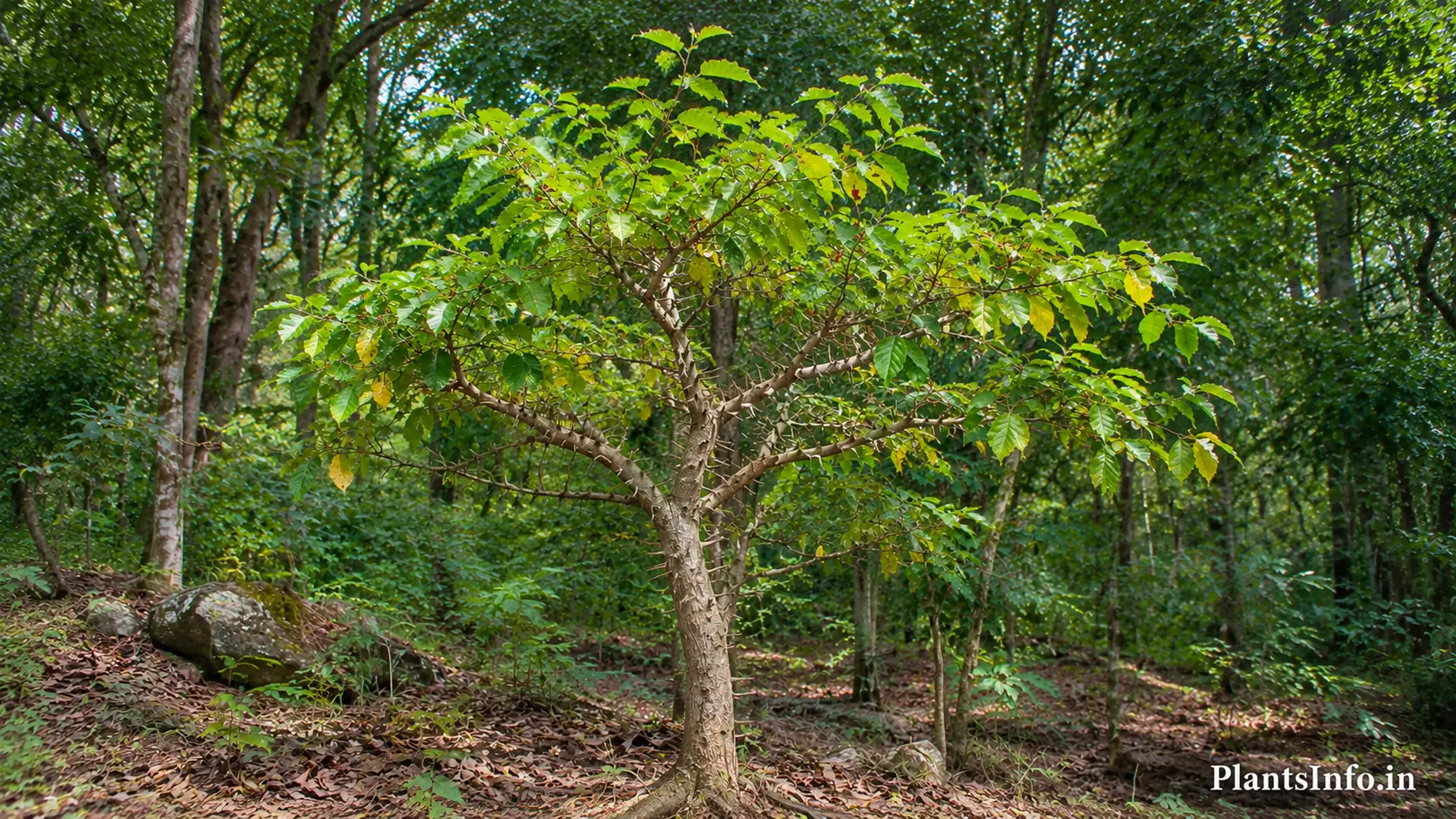
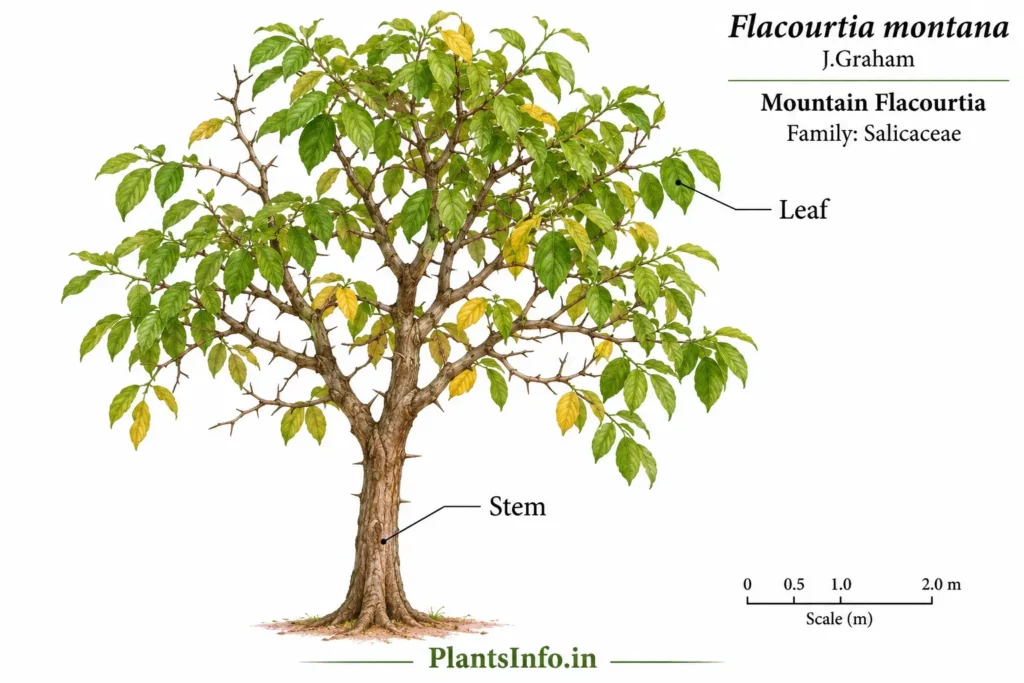
Flacourtia montana develops as a small to medium-sized deciduous tree. Its trunk and principal branches bear prominent woody thorns, while younger branches and shoots may exhibit dense soft pubescence. The combination of an armed trunk and broad foliage gives the species a distinctive architectural appearance.
The tree has a relatively substantial woody framework, with lateral branching supporting its broad leaves. Its thorn-bearing trunk and branches are particularly useful for recognition when foliage or reproductive structures are unavailable.
| Field | Value |
|---|---|
| Life form | Tree |
| Growth habit | Deciduous |
| Mature height | Reported up to approximately 8 m in one regional description; other accounts report greater heights |
| Branching pattern | Woody, branched |
| Stem architecture | Thorn-bearing trunk and branches |
| Young branch surface | Softly pubescent to densely tomentose |
| Bark | Thin, smooth and grey |
| Distinguishing architectural feature | Prominent woody thorns on the trunk and branches |
Published descriptions vary in reported mature height and the density of branch pubescence. These differences should not be interpreted as a single universal measurement.
Recommended Products
Disclosure: As an Amazon Associate, PlantsInfo may earn from qualifying purchases.
🌱 Plant Care Essentials
The following tools can help with pruning, plant health, soil management, and fruit garden maintenance.

Neem Oil for Plant Care
Natural plant protection against aphids, whiteflies, mites, and other common garden pests.

Fungicide for Root Care
Helps suppress soil-borne fungal diseases and supports healthier root systems.

Spray Bottle for Plants
Ideal for applying foliar sprays, neem oil solutions, and liquid plant treatments.

Rubber Hand Gloves
Protects hands during pruning, planting, soil preparation, and garden maintenance.
Stem
The stem is woody and armed with conspicuous thorns, which may occur on the trunk and larger branches. Some botanical descriptions record simple thorns, while other regional accounts describe both simple and branched forms.
The bark is generally described as thin, smooth and grey. Young branches are frequently pubescent, although the density of hairs may decrease as the branches mature.
| Field | Value |
|---|---|
| Stem type | Woody |
| Trunk | Thorn-bearing |
| Thorn arrangement | On trunk and branches |
| Thorn morphology | Simple; occasionally branched |
| Thorn length | Reported approximately 4–10 cm |
| Bark colour | Grey |
| Bark texture | Thin and smooth |
| Young branch surface | Pubescent to tomentose |
| Mature branch surface | May become less pubescent |
The long thorns are among the most conspicuous structural features of the species. Their presence distinguishes it from several other regional trees with superficially similar foliage.
Leaves
The leaves are simple, alternate and arranged spirally along the branches. Their blades are generally elliptic, ovate or oblong, with a broad outline and a distinctly toothed margin.
The upper surface is typically shining and becomes glabrescent, while the lower surface retains hairs along the midrib and lateral veins. Several prominent veins arise near the leaf base, contributing to the characteristic venation pattern.
| Field | Value |
|---|---|
| Leaf presence | Present |
| Leaf type | Simple |
| Arrangement | Alternate, spiral |
| Shape | Ovate, elliptic or oblong |
| Length | Approximately 12–25 cm |
| Width | Approximately 4–8 cm |
| Leaf margin | Crenate to crenate-serrate |
| Leaf apex | Acute to obtusely acuminate |
| Leaf base | Acute, rounded or occasionally broadly tapered |
| Upper surface | Usually shining, glabrescent |
| Lower surface | Pubescent along veins |
| Basal venation | Typically 3–5 prominent nerves |
| Lateral veins | Approximately 4–8 pairs |
| Petiole length | Approximately 5–10 mm |
| Petiole surface | Pubescent or glabrescent |
Leaf dimensions and venation counts vary between regional botanical descriptions. The ranges above represent documented descriptive variation rather than a single measured specimen.
Flowers
The flowers of Flacourtia montana are small, unisexual and borne in compact axillary clusters. They occur in densely pubescent racemes or congested cymose arrangements, sometimes emerging from the axils of fallen leaves.
The flowers are generally dull white or pale yellowish-green. The floral structure is relatively simple, with a small calyx and no petals. Male and female flowers possess different reproductive structures.
| Field | Value |
|---|---|
| Flower sexuality | Unisexual |
| Inflorescence | Axillary, densely pubescent clusters or racemes |
| Flower colour | Dull white to pale yellowish-green |
| Sepals | 4–5 |
| Sepal surface | Rusty-pubescent |
| Petals | Absent |
| Stamens | Numerous in male flowers |
| Ovary | Superior, urceolate |
| Styles | Usually 5 |
| Style characteristics | Reflexed, notched at apex |
The absence of petals and the presence of separate male and female flowers are important diagnostic floral characteristics.
Fruit
The fruit is a fleshy, globose berry with a characteristically ribbed exterior. During ripening, its surface develops a bright scarlet-red to pinkish-red colour. Some regional descriptions also record reddish-purple mature fruits.
The ripe berries are edible and have been described as having an agreeable acidic flavour.
| Field | Value |
|---|---|
| Fruit type | Berry |
| Shape | Globose |
| Surface | Obtusely ribbed |
| Diameter | Approximately 1–1.5 cm |
| Mature colour | Scarlet-red to pinkish-red |
| Flesh | Fleshy |
| Taste | Acidic |
| Seed arrangement | Seeds embedded within fleshy fruit |
Fruit colour descriptions vary between botanical accounts, potentially reflecting differences in maturity and regional observations.
Seeds
The seeds are relatively few, compressed and enclosed within the fleshy berry. Their hard, woody seed coats distinguish them from the softer surrounding fruit tissues.
| Field | Value |
|---|---|
| Seed shape | Compressed |
| Seed texture | Hard and woody |
| Seed surface | Rough |
| Seed colour | Reddish |
| Seed number | Approximately 6 in one regional description |
The exact range of seed number across populations has not been established from the available descriptions.
Root System
A sufficiently detailed species-specific description of the root system of Flacourtia montana has not been identified.
The available botanical treatments concentrate primarily on above-ground structures, including the thorn-bearing trunk, branches, foliage, flowers and fruits. Root architecture, rooting depth, lateral root distribution and root-system development therefore remain undocumented in the evidence currently available.
Field Identification
Flacourtia montana can be recognised by its combination of a thorn-bearing woody trunk, broad alternate leaves and distinctive red, ribbed berries.
The most useful field characters are:
- Armed trunk: Prominent woody thorns occur on the trunk and branches.
- Young branches: Frequently covered with soft, dense pubescence.
- Leaves: Broad, simple and alternate, with crenate or crenate-serrate margins.
- Venation: Several prominent nerves arise near the leaf base.
- Flowers: Small, unisexual and arranged in compact axillary clusters.
- Fruits: Globose, fleshy, distinctly ribbed and bright red when ripe.
The distinction from Flacourtia indica is particularly useful in regional identification. The latter is described as having glabrous young twigs and leaves that do not develop the characteristic brown colour on drying associated with F. montana in certain identification treatments.
Normal vs. Concerning Observations
| Observation | Status | Notes |
|---|---|---|
| Prominent thorns on trunk and branches | Normal | Characteristic structural feature of the species |
| Pubescence on young branches | Normal | Young shoots may have dense soft hairs |
| Variation in leaf shape | Normal | Leaves range from ovate to elliptic and oblong |
| Variation in fruit colour | Normal | Mature fruits are described as scarlet-red or pinkish-red |
| Unisexual flowers | Normal | Male and female flowers have distinct reproductive structures |
Species-specific diagnostic criteria for distinguishing pathological leaf, stem or fruit abnormalities have not been sufficiently documented. No disease diagnosis or treatment recommendation is made here.
Cultivar Summary
No documented cultivars or named selections identified.
Physiology and Phytochemistry
The available species-specific research on Flacourtia montana is concentrated primarily on fruit chemistry, particularly volatile constituents, phenolic content and flavonoids. Published investigations provide an initial biochemical characterisation, but detailed physiological studies covering photosynthesis, water relations, nutrient acquisition and stress responses remain limited.
Functional Traits
The physiological characteristics of F. montana have not been investigated comprehensively in the available species-specific literature.
Its woody, deciduous growth form and seasonal foliage development are documented botanically, but these observations do not establish the underlying physiological mechanisms. No sufficiently verified species-specific measurements were identified for photosynthetic pathway, stomatal regulation, transpiration, water-use efficiency or nutrient acquisition.
| Trait | Mechanism Description | Ecological Context |
|---|---|---|
| Photosynthetic pathway | Not documented in available literature. | Species-specific photosynthetic pathway has not been established. |
| Water-use strategy | Not documented in available literature. | No verified physiological measurements establish its water-use strategy. |
| Nutrient acquisition | Not documented in available literature. | Species-specific nutrient uptake mechanisms remain insufficiently investigated. |
| Stress-response mechanisms | Not documented in available literature. | Physiological responses to drought, temperature and other environmental stresses remain uncharacterised. |
| Chemical defence | Not documented in available literature. | The ecological defensive functions of identified fruit compounds have not been demonstrated. |
Physiological Integration
The available research does not establish how the physiological processes of F. montana interact to regulate growth, seasonal development or environmental responses.
Although the species has recognisable deciduous growth and woody architecture, there is insufficient experimental evidence to connect these characteristics with specific physiological mechanisms.
Consequently, its integrated physiological strategy remains incompletely characterised.
Phytochemistry
Phytochemical investigations of F. montana have focused principally on its fruits.
Two studies by Mundaragi and colleagues provide the main species-specific analytical evidence:
- A 2015 study examined fruit composition, total phenolic content, flavonoids and antioxidant activity.
- A 2017 investigation used gas chromatography–mass spectrometry (GC–MS) to characterise volatile constituents extracted from ripe fruits.
The latter investigation identified 36 volatile constituents, representing several chemical classes. Alcohols were the predominant group, followed by alkanes, alkenes and esters. The study also identified several fatty acids and other volatile compounds.
Documented phytochemical constituents
| Compound Class | Representative Compounds | Primary Location | Ecological or Biological Function |
|---|---|---|---|
| Aliphatic alcohols | 1-Undecanol, 1-hexadecanol, trans-9-hexadecen-1-ol, 2-phenylethanol | Fruit | Contribute to the documented volatile profile and aroma characteristics. |
| Alkenes | (Z)-3-Tetradecene, 9-hexacosene | Fruit | Volatile-profile constituents; specific biological function unestablished. |
| Fatty acids | Octanoic acid, dodecanoic acid, tetradecanoic acid, hexadecanoic acid | Fruit | Contribute to the fruit’s chemical composition; specific ecological function unestablished. |
| Aldehydes | (E)-15-Heptadecenal | Fruit | Identified volatile constituent; specific biological function unestablished. |
| Esters | Methyl octanoate, n-hexyl-2-butenoate | Fruit | Contribute to the volatile profile and fruit aroma. |
| Phenolic compounds | 2,4-Di-tert-butylphenol | Fruit | Identified volatile constituent; its endogenous biological role has not been established. |
The named compounds are based on the published GC–MS investigation. Their identification relied on comparison with a reference mass-spectral library, so they should be regarded as reported analytical identifications rather than independently confirmed structures.
Phenolic and flavonoid composition
The 2015 investigation reported measurable total phenolic and flavonoid contents in the fruit.
These measurements indicate the presence of phenolic and flavonoid constituents but do not establish the identities of individual molecules within those groups.
The study also examined antioxidant activity using several in-vitro assays, including free-radical scavenging, nitric oxide scavenging, superoxide radical scavenging and total antioxidant capacity.
The findings provide preliminary biochemical evidence for the fruit’s antioxidant capacity under laboratory assay conditions. They do not establish corresponding physiological or ecological functions within the living plant.
Indian Journals
Phytochemical Organ Distribution
Available analytical research identifies the fruit as the principal investigated plant organ.
| Organ | Compound Class | Representative Compounds | Concentration |
|---|---|---|---|
| Fruit | Volatile alcohols | 1-Undecanol, 1-hexadecanol | Relative GC–MS peak areas reported |
| Fruit | Alkenes | (Z)-3-Tetradecene, 9-hexacosene | Relative GC–MS peak areas reported |
| Fruit | Fatty acids | Octanoic acid, dodecanoic acid, hexadecanoic acid | Relative GC–MS peak areas reported |
| Fruit | Phenolic constituents | Total phenolic compounds | Quantified as aggregate content; individual compound concentrations not established |
| Fruit | Flavonoids | Total flavonoid constituents | Quantified as aggregate content; individual compound concentrations not established |
No comparable species-specific organ-distribution dataset was identified for roots, stems, bark, leaves or flowers.
Phytochemical Significance
The most substantial phytochemical contribution of F. montana research is its preliminary characterisation of fruit constituents.
Three aspects are particularly relevant:
1. Volatile diversity: The GC–MS investigation identified 36 constituents, demonstrating a chemically diverse fruit volatile profile.
2. Phenolic and flavonoid presence: Aggregate measurements establish the presence of these broad compound groups, although individual molecular identities remain insufficiently characterised.
3. Research concentration: Existing investigations are strongly fruit-centred. Other plant organs have received substantially less documented analytical attention.
The volatile analysis provides preliminary information about the fruit’s aroma-associated chemistry. However, the available research does not establish specific synergistic or antagonistic interactions among its compounds.
Overall, the phytochemical characterisation of F. montana remains preliminary. Further analytical work would be required to confirm individual compounds, investigate variation between populations and developmental stages, and establish the chemical composition of other plant organs.
Flacourtia montana is primarily documented as a wild edible fruit species of the Western Ghats. Its nutritional composition and in-vitro antioxidant properties have received some scientific attention, particularly through investigations of fresh fruit and fruit-derived wine.
However, evidence of nutritional composition, laboratory antioxidant activity and therapeutic efficacy represents three different levels of scientific evidence. The available research does not establish clinical medicinal benefits in humans.
Evidence Hierarchy for Medicinal and Health-Related Claims
| Evidence Layer | Status | Notes |
|---|---|---|
| Traditional Use | Documented | Fruits are consumed fresh and used in food preparations, including jelly. |
| Nutritional Evidence | Documented | Species-specific research has investigated fruit composition and nutritional constituents. |
| In Vitro Studies | Documented | Fruit extracts and fruit wine have been evaluated using several antioxidant assays. |
| Animal Studies | Absent | No documented animal studies establishing therapeutic efficacy identified. |
| Human Clinical Studies | Absent | No documented clinical trials establishing health benefits identified. |
| Regulatory Recognition | Absent | No verified therapeutic or medicinal regulatory recognition identified. |
| Unsupported Commercial Claims | Partial | Antioxidant findings and preliminary food research should not be presented as established disease-prevention or treatment benefits. |
Evidence Assessment
The strongest evidence concerns the fruit’s nutritional composition and laboratory-measured antioxidant activity.
Traditional consumption establishes the fruit’s food-use history but does not independently establish medicinal efficacy. Similarly, antioxidant activity observed in chemical assays does not demonstrate that consuming the fruit produces equivalent physiological effects in humans.
The 2015 investigation by Mundaragi and Thangadurai provides species-specific nutritional and biochemical evidence. A subsequent 2019 study examined the physicochemical properties and antioxidant activity of wine prepared from the fruit.
Neither study establishes clinical therapeutic efficacy.
The distinction is particularly important when interpreting descriptions of F. montana as a medicinal or therapeutic plant. Its documented food use and experimental biochemical properties do not justify disease-treatment claims.
Nutritional Composition
The fruit of Flacourtia montana has been investigated for its proximate composition, nutritional constituents, acidity and antioxidant-related properties.
The available 2015 study reports ascorbic acid content alongside protein, phenolic compounds, flavonoids and other physicochemical characteristics.
Nutritional composition of the fruit
| Nutrient | Value per 100 g | Notes |
|---|---|---|
| Ascorbic acid (vitamin C) | 23.3 mg | Reported in the species-specific fruit analysis. |
Only the nutrient value explicitly reported on a per-100-g basis is included here. Other measurements in the original study use different units or analytical bases.
Additional reported nutritional and physicochemical measurements
| Parameter | Reported value | Unit |
|---|---|---|
| Protein | 5.110 | % |
| Total soluble solids | 21.2 | °Brix |
| Total acidity | 0.251 | % |
| Total phenolic content | 1.625 | % |
| Total flavonoid content | 0.655 | % |
| Fruit juice pH | 3.34 | pH units |
These measurements are reported from the 2015 investigation and should not be interpreted as interchangeable nutritional concentrations. In particular, total soluble solids represent a measure of dissolved solids rather than a direct measurement of total sugar.
Indian Journals
Nutritional Significance
The available findings indicate that F. montana fruit contains vitamin C and measurable protein, alongside phenolic and flavonoid constituents.
Three aspects deserve attention:
- Vitamin C: The reported ascorbic acid concentration provides direct evidence of a nutritional contribution.
- Protein: The 2015 study reports protein content, although its analytical basis should be checked before comparing it with other fruits.
- Phenolic constituents: The fruit contains measurable phenolic and flavonoid fractions, which have also been investigated through in-vitro antioxidant assays.
Processing and nutritional variation
A 2019 investigation examined wine production from F. montana fruit. The researchers documented changes in sugars, organic acids, phenolic content and flavonoids during fermentation.
HPLC analysis identified glucose, fructose and sucrose in the initial fruit must. Fermentation substantially changed the sugar composition and produced an alcoholic beverage containing ethanol.
The study also identified gallic acid, chlorogenic acid, catechin and epicatechin in the finished wine.
The reported total phenolic and flavonoid measurements decreased during fermentation. These findings demonstrate that processing can alter the chemical composition of fruit-derived products.
The wine measurements cannot be used as nutritional values for fresh fruit, and the study does not establish that fermentation improves the fruit’s health benefits.
Nutritional research limitations
Species-specific information remains insufficient for establishing:
- A complete vitamin and mineral profile.
- Dietary fibre content on a standardised basis.
- Essential amino-acid composition.
- Fatty-acid composition of the edible portion.
- Mineral bioavailability.
- Differences between wild populations.
- Nutritional changes during drying, cooking or storage.
No reliable comparison between fresh and dried fruit, or between different geographical populations, can presently be established from the identified evidence.
Soil Ecology and Mycorrhizal Associations
Species-specific research on the soil biology of Flacourtia montana is limited.
The available botanical and biochemical studies do not provide sufficient evidence to establish its mycorrhizal associations, rhizosphere microbial communities or soil-related physiological interactions.
| Soil-biological component | Available evidence |
|---|---|
| Mycorrhizal association | Not documented in available literature. |
| Mycorrhizal type | Not documented in available literature. |
| Associated fungal genera | Not documented in available literature. |
| Rhizosphere bacterial communities | Not documented in available literature. |
| Nitrogen-fixing associations | Not documented in available literature. |
| Phosphate-solubilising bacteria | Not documented in available literature. |
| Allelopathic activity | Not documented in available literature. |
The absence of documented species-specific findings prevents a reliable assessment of its below-ground microbial relationships.
Although members of Salicaceae may possess specialised root-associated microbial interactions, family-level observations cannot establish the presence of particular associations in F. montana.
Toxicity and Safety
The available literature provides information about the consumption and nutritional composition of ripe fruits. However, these findings do not constitute a comprehensive toxicological assessment of the species.
No sufficiently verified species-specific toxicological studies were identified for establishing safety thresholds or clinical effects across different exposure routes.
| Subject | Toxic Compounds | Clinical Effects |
|---|---|---|
| Humans | No species-specific evidence identified. | No species-specific evidence identified. |
| Cats | No species-specific evidence identified. | No species-specific evidence identified. |
| Dogs | No species-specific evidence identified. | No species-specific evidence identified. |
| Livestock | No species-specific evidence identified. | No species-specific evidence identified. |
Toxicity Context
Human consumption: Ripe fruits are documented as edible and traditionally consumed. This establishes food use but does not demonstrate the safety of every plant part, preparation method or quantity.
Dose dependency: No verified species-specific toxicological threshold or dose-response study was identified.
Whole-plant versus isolated compounds: Available fruit-composition studies do not establish the toxicity profile of isolated constituents or other plant organs.
Vulnerable populations: Species-specific safety information for children, pregnant individuals and people with underlying medical conditions has not been established.
Drug interactions: No verified species-specific interaction studies were identified.
Renal and hepatic considerations: No sufficiently documented species-specific studies establish effects on kidney or liver function.
Veterinary exposure: The available evidence does not establish whether consumption of different plant parts is safe for domestic animals or livestock.
The absence of documented toxicity is not evidence that all plant parts are safe. The edible-fruit record should not be extrapolated to the bark, roots, leaves, seeds or unripe fruits.
This profile does not constitute medical or veterinary advice.
Flacourtia montana is a tree native to the Western Ghats of India, where it occurs in evergreen, semi-evergreen and moist deciduous forests. Its documented distribution extends across Maharashtra, Karnataka, Kerala and Tamil Nadu.
The species is associated with the wet tropical biome and is recorded across a substantial elevational range. However, precise climatic requirements, physiological stress limits and population-level ecological relationships remain insufficiently investigated.
Biogeographic Context
The geographical distribution of F. montana is concentrated in the Western Ghats, one of India’s major tropical biodiversity regions. Its occurrence across the mountain chain reflects its association with forest environments ranging from evergreen to moist deciduous vegetation.
The Western Ghats experience strong seasonal rainfall patterns associated with the southwest and northeast monsoons. However, the distribution of F. montana cannot currently be attributed to a specific rainfall threshold or temperature envelope because species-specific climatic modelling and physiological measurements are lacking.
Its documented occurrence in different forest formations suggests that it is not restricted to a single narrowly defined forest type.
The geographical evidence is strongest for the western peninsular states. The species has also appeared in some regional botanical records from outside this core range, but these records require further examination before being incorporated into its confirmed native distribution.
Native Range and Distribution
Native distribution: India
| Region | Countries or Sub-regions | Notes |
|---|---|---|
| Western India | Maharashtra | Recorded in the northern and central Western Ghats, including the Sahyadri region. |
| Southwestern India | Karnataka | Documented in several Western Ghats districts, including Uttara Kannada, Shivamogga, Chikkamagaluru, Hassan and Kodagu. |
| Southwestern India | Kerala | Recorded across multiple districts, including Wayanad, Kozhikode, Palakkad, Idukki and Thiruvananthapuram. |
| Southern India | Tamil Nadu | Documented in the Western Ghats, including southern mountain districts. |
The USDA GRIN Taxonomy database records Maharashtra, Karnataka, Kerala and Tamil Nadu as native distribution states. Kew’s Plants of the World Online identifies the broader native range as western and southern India.
Distribution qualification: India Flora Online also records the species from Visakhapatnam district in Andhra Pradesh. This outlying record should remain geographically provisional until its voucher documentation and taxonomic determination are reconciled with the better-established Western Ghats distribution.
The available botanical literature generally treats F. montana as endemic to the Western Ghats or western peninsular India. No confirmed native population outside India has been established in the sources examined.
Natural Habitat
Flacourtia montana occurs primarily in tropical forest environments of the Western Ghats.
Its documented habitat associations include:
- Tropical evergreen forests.
- Tropical semi-evergreen forests.
- Moist deciduous forests.
The species is recorded in both relatively humid forest formations and moist deciduous vegetation. This indicates an association with more than one forest community, although its relative abundance and ecological preferences within these formations remain insufficiently quantified.
Elevational Distribution
Published botanical records provide different elevational limits:
| Source | Reported elevation |
|---|---|
| India Flora Online | Approximately 150–1,100 m |
| Flora of Kerala | Up to approximately 500 m |
| eFlora of India | Up to approximately 1,000 m, with an additional reported upper limit of 1,800 m |
The higher reported elevation of 1,800 m requires independent verification. It should not be treated as an established species-wide upper limit.
The available records suggest that the species occurs across low- and middle-elevation forest environments, with some reports extending into higher mountain locations.
Soil and Vegetation Associations
No sufficiently detailed species-specific dataset establishes preferred soil texture, soil pH, nutrient availability or soil-moisture thresholds.
Its occurrence in evergreen, semi-evergreen and moist deciduous forests provides a broad vegetation context, but does not establish a single preferred soil category.
Detailed below-ground microbial relationships are discussed separately in the soil ecology assessment.
Moisture Regime
The documented forest associations indicate occurrence in landscapes supporting substantial seasonal or year-round moisture availability.
However, the species’ minimum moisture requirements, tolerance of seasonal soil drying and response to prolonged waterlogging have not been established through species-specific physiological experiments.
Global Cultivation and Naturalisation
No sufficiently verified evidence of established commercial cultivation, international plantation production or widespread cultivation outside the native range was identified.
Its edible fruits and regional food uses are documented, but these do not establish a significant organised cultivation industry.
Ecological Role
The ecological role of Flacourtia montana is not comprehensively characterised in published species-specific research. Available documentation establishes its presence as a native woody component of Western Ghats forest vegetation, but detailed studies of its interactions with wildlife and other organisms remain limited.
Documented ecological relationships
| Role Type | Species or Agent Involved | Notes |
|---|---|---|
| Forest vegetation component | Native Western Ghats forest communities | Occurs in evergreen, semi-evergreen and moist deciduous forests. |
| Human food resource | Humans | Ripe fruits are documented as edible and locally consumed. |
| Fodder resource | Domestic herbivores; specific consumers unresolved | Leaves are recorded as fodder in regional ethnobotanical documentation. |
The species’ fleshy fruits may represent a potential food resource for frugivorous wildlife, but specific animal consumers and their contribution to seed dispersal have not been established in the evidence examined.
No verified evidence currently establishes F. montana as a keystone species, ecological indicator or species with a quantified influence on forest-community structure.
Invasive Status
No confirmed naturalised or invasive populations outside the documented native range of India were identified.
Optimal Climate Parameters
The species is classified by Kew as a tree of the wet tropical biome. However, a biome classification does not provide experimentally established temperature, rainfall or humidity thresholds.
No verified species-specific climatic dataset was identified that establishes its optimal growth conditions or physiological tolerance limits.
| Parameter | Optimal Range | Tolerance Range | Notes |
|---|---|---|---|
| Mean Annual Temperature | Not documented in available literature. | Not documented in available literature. | No verified species-specific temperature envelope identified. |
| Annual Rainfall | Not documented in available literature. | Not documented in available literature. | Native occurrence is associated with wet tropical forest environments, but quantitative limits are unverified. |
Climate Interpretation
The known distribution of F. montana is associated with the tropical forest environments of the Western Ghats.
Its presence in evergreen, semi-evergreen and moist deciduous forests indicates that its geographical occurrence encompasses different seasonal moisture conditions.
Nevertheless, the available evidence does not establish:
- An optimum mean annual temperature.
- A minimum annual rainfall requirement.
- A maximum tolerable dry-season duration.
- A minimum relative humidity requirement.
- A measurable drought threshold.
- A temperature threshold for reproductive development.
The distinction between geographical occurrence and experimentally established climatic tolerance is important. The environmental conditions recorded at collection locations cannot automatically be interpreted as the species’ physiological limits.
The present distribution also does not establish whether the species could maintain viable populations in comparable tropical environments outside India.
Stress Tolerance Profile
No sufficiently verified species-specific physiological studies were identified that demonstrate quantitative or experimentally established tolerance to particular environmental stresses.
Consequently, no stress category can presently be assigned a verified, supported or conditional tolerance rating without overstating the evidence.
| Stress Type | Tolerance Level | Physiological Response | Notes |
|---|---|---|---|
| — | — | — | No species-specific stress-tolerance entry meets the evidence requirement. |
Compound Stress Assessment
No documented experimental research was identified examining the combined effects of environmental stresses on F. montana.
In particular, the following interactions remain unresolved:
- Drought combined with elevated temperature.
- Seasonal moisture limitation combined with high atmospheric evaporative demand.
- Heat exposure combined with changes in soil moisture.
- Altered rainfall seasonality combined with reproductive development.
Although these conditions are relevant to tropical forest trees, their effects on F. montana cannot be established through general observations of its family or genus.
Species-specific physiological experiments and long-term field observations would be necessary to determine its response to compound environmental stresses.
Structural and Physiological Adaptations
The clearest potentially adaptive structural feature documented for Flacourtia montana is its thorn-bearing trunk and branches. Thorns may provide mechanical protection against browsing herbivores, although a species-specific experimental study demonstrating this function was not identified. The trait is therefore best treated as a plausible defensive adaptation rather than a demonstrated ecological mechanism.
| Adaptation | Mechanism Description | Ecological Context |
|---|---|---|
| Thorn-bearing woody stems | Stiff, pointed woody structures may deter or impede browsing animals and reduce access to vulnerable stem tissues | A plausible mechanical defence in forest habitats; its effectiveness against particular herbivores has not been experimentally established |
Other recorded features, including leaf texture, pubescence and leaf arrangement, are not included as adaptations because their ecological functions have not been sufficiently demonstrated for this species. The available evidence does not establish specialised physiological adaptations to drought, heat, flooding or nutrient limitation.
Climate-Change Vulnerability
No species-specific climate-change impact assessment, population-projection model or experimental study of climate sensitivity was identified. The species is associated with wet tropical forest environments in the Western Ghats, but this distribution alone cannot establish its temperature or rainfall limits.
| Factor | Assessment | Notes |
|---|---|---|
| Primary Climate Sensitivity Factors | Undetermined | No verified species-specific thresholds for temperature, rainfall, humidity, seasonal drought or climatic extremes are available |
| Key Threatening Climate Processes | Potential exposure; unquantified | Changes in rainfall seasonality, temperature and dry-season intensity could alter forest habitat conditions, but their effects on this species have not been measured |
| Resilience Factors | Undetermined | No adequate species-specific evidence on drought recovery, heat tolerance, reproductive resilience or capacity to shift its distribution was identified |
| Confidence Level | Low | The assessment is based on the species’ documented wet-tropical forest association and the absence of direct climate-response evidence, not on a species-specific vulnerability model |
Kew’s Angiosperm Extinction Risk Predictions entry reports a model-predicted threatened category for the species. This is a general extinction-risk prediction, not a climate-change vulnerability assessment or a substitute for a formal IUCN Red List evaluation.
Phenological Calendar
Available regional accounts indicate variation in the reported flowering and fruiting periods. The Flora of Kerala records flowering from November to February and fruiting from January to April. A KFRI forest survey reports both flowering and fruiting from January to April, while the Botanical Survey of India’s Koyna Valley account records February to April. Other regional records extend the reported period into April–June. These differences may reflect geographic or observational variation; the available records do not establish the causes.
| Event | Native Range Timing | Cultivated Range Timing | Environmental Triggers |
|---|---|---|---|
| Vegetative Growth Onset | Not established | Not documented | No species-specific trigger identified |
| Flower Bud Initiation | Not separately documented; flowering is recorded from November in Kerala | Not documented | No verified temperature, rainfall or photoperiod threshold |
| Anthesis or Peak Flowering | November–February in Kerala; January–April in a KFRI survey; February–April in the Koyna Valley account; some regional records extend to April–June | Not documented | No species-specific environmental trigger established |
| Fruit Development | Overlaps the reported flowering period; fruiting records include January–April and February–April | Not documented | No verified trigger or development-duration measurement |
| Fruit Maturation | Regional fruiting records include January–April; other accounts report later periods | Not documented | No species-specific maturation cue established |
| Seed Dispersal | Timing and dispersal season not separately documented | Not documented | No verified dispersal trigger |
| Dormancy or Rest Period | No distinct seasonal dormancy period established | Not documented | No species-specific dormancy cycle identified |
Phenological Notes: The published observations do not support a single uniform flowering or fruiting calendar for the entire native range. The Kerala flora and KFRI records suggest reproductive activity concentrated broadly between the cooler-season months and early part of the year, while other regional accounts report later activity. The broad February–October record in India Flora Online should be interpreted as a regional occurrence range rather than proof of continuous flowering or fruiting. No study was identified that directly links the timing to rainfall onset, temperature, day length or other environmental cues.
Pollination Ecology
Flacourtia montana bears small, unisexual flowers, and regional botanical descriptions identify the species as dioecious. Male and female flowers therefore occur on separate plants, making pollen transfer between individuals necessary for sexual reproduction. This reproductive arrangement has implications for pollen movement and the spatial distribution of reproductive individuals, but the actual pollinating agents and pollination mechanism have not been established in the available species-specific literature.
| Parameter | Value | Notes |
|---|---|---|
| Primary Pollinators | Undocumented | No pollinator species has been verified for F. montana |
| Secondary Pollinators | Undocumented | No secondary pollinator group has been established |
| Pollination Syndrome | Undetermined | The available floral descriptions do not establish a reliable pollination syndrome |
| Floral Mechanism | Unisexual flowers; male flowers produce numerous stamens and female flowers bear an ovary and styles | Flowers are small and lack petals; no species-specific observations of pollen presentation, stigma receptivity or pollen transfer were identified |
| Reproductive System | Dioecious | Male and female flowers occur on separate plants in the regional botanical descriptions |
| Reproductive Evidence Status | Partially documented | Flower structure and unisexuality are described in regional floras; pollinator identity, pollen-transfer mechanism and breeding-system experiments remain unverified |
| Human Intervention | No documented intervention | No species-specific evidence of hand pollination or other human-mediated pollination was identified |
Pollination Context: Dioecy means that successful sexual reproduction depends on pollen reaching female flowers from male individuals. Consequently, the distribution and relative abundance of reproductive individuals may influence reproductive opportunity. However, no direct study was identified on self-compatibility, pollen limitation, outcrossing rates, pollinator dependence or the effects of pollinator decline in this species. The biological feasibility of assisted pollination has likewise not been experimentally assessed.
Seed Biology and Germination
The fruit contains a small number of seeds. The Flora of Kerala describes them as compressed, hard, woody and rough, with six seeds reported in its account. These observations provide a morphological description but do not establish dormancy behaviour, germination requirements or storage characteristics.
| Parameter | Value | Notes |
|---|---|---|
| Seed Type | Supported — compressed, hard-coated seeds | Regional flora describes hard, woody and rough seeds; the reported number is approximately six per fruit |
| Dormancy Class | Undetermined | No species-specific dormancy experiment was identified |
| Dormancy-Breaking Requirement | Undocumented | No verified requirement for scarification, stratification or chemical treatment |
| Optimal Germination Temperature | Undocumented | No verified experimental temperature range |
| Germination Rate | Undocumented | No species-specific germination percentage or rate established |
| Germination Period | Undocumented | No verified time-to-germination data |
| Storage Behaviour | Undocumented | No species-specific seed-storage experiment identified |
| Seed Longevity | Undocumented | No verified viability period under natural or controlled storage conditions |
Germination Notes: The hard seed covering is a documented structural feature, but it is not sufficient evidence of physical dormancy. Studies on other species of Flacourtia, including F. indica, report germination responses to seed-coat treatment and temperature conditions. Those findings cannot be transferred to F. montana without direct testing. No reliable comparison between wild and cultivated seed behaviour was identified.
Vegetative Reproduction
No reliable species-specific study was identified that establishes vegetative regeneration capacity or a naturally occurring vegetative reproduction mechanism in Flacourtia montana. Propagation methods reported for other species in the genus are not treated as evidence for this species.
| Parameter | Value | Notes |
|---|---|---|
| Vegetative Regeneration Capacity | Undocumented | No verified species-specific field or experimental evidence |
| Primary Regeneration Mechanism | Undocumented | Natural regeneration through root suckers, coppicing, layering or stem sprouting has not been established |
| Minimum Propagule Size | Undocumented | No species-specific measurements available |
| Ecological or Invasive Significance | Undetermined | The contribution of vegetative reproduction to population persistence or spread has not been demonstrated |
Economic Importance
Flacourtia montana, commonly known as Mountain Sweet Thorn, is an indigenous but underutilised wild fruit tree of the Western Ghats and other parts of peninsular India. Its economic potential is associated mainly with edible fruits and possible fruit processing. Research collections have also demonstrated substantial variation in fruit yield and thorniness, which is relevant to its evaluation as a horticultural crop.
However, the available evidence does not establish large-scale commercial production, organised export, a documented national supply chain or a quantified market value. Its economic importance should therefore be described as local and potential rather than as an established commercial fruit industry.
| Use Category | Description | Economic Impact |
|---|---|---|
| Fresh fruit | Ripe fruits are documented as edible in regional botanical and ethnobotanical accounts | Local food value; commercial market scale has not been quantified |
| Fruit processing | The fruit is described as suitable for jelly and other processed products; research has also examined wine production | Demonstrated processing potential, but no verified industrial production or market-size data |
| Fodder | Leaves are recorded as fodder in the Koyna Valley ethnobotanical survey | A documented local subsidiary use; volume and economic value are unknown |
| Timber and construction | The Flora of Kerala records wood use in house construction | Local material use is documented; timber production and trade are not quantified |
| Horticultural germplasm | ICAR–Indian Institute of Horticultural Research evaluated collections for variation in fruiting, yield and thorniness | Research and crop-development value; not evidence of an established commercial industry |
| Summary Economic Assessment | A locally useful wild fruit tree with documented food, fodder and construction uses, and emerging horticultural research interest | Economic potential is evident, but commercial scale, market structure, trade and profitability remain unquantified |
Traditional Uses
The strongest species-specific ethnobotanical documentation located is the Botanical Survey of India’s study of Koyna Valley, Maharashtra. It records the local name Atak, edible fruits, leaves used as fodder and a regional medicinal use of the fruit. The source documents these practices in a regional ethnobotanical inventory; it does not identify a formal medical knowledge system for the medicinal use.
BSI
| Use Category | Knowledge System | Region or Cultural Group | Practice Summary | Documentation Level | Source |
|---|---|---|---|---|---|
| Food | Local food use; formal knowledge system not specified | Koyna Valley, Maharashtra; local communities | Fruits are recorded as edible | Documented in a Botanical Survey of India regional ethnobotanical survey | Badave and Kothari, Ethnobotanical Studies on Koyna Valley, Maharashtra (2024) |
| Fodder | Local livestock-fodder practice; formal knowledge system not specified | Koyna Valley, Maharashtra | Leaves are recorded as fodder | Documented in the same regional ethnobotanical survey | Badave and Kothari (2024) |
| Medicinal use | Local ethnomedicinal practice; specific system not identified | Koyna Valley, Maharashtra | Fruit use for jaundice is recorded | Regionally documented; no clinical or pharmacological efficacy is established by this record | Badave and Kothari (2024) |
| Fruit processing | Local food-processing knowledge; formal knowledge system not specified | Kerala | Fruit is described as suitable for jelly preparation | Documented in a regional flora | Flora of Kerala, Volume 1 (2005) |
The medicinal entry records a reported practice only. It does not establish that the fruit treats jaundice, nor does it establish an effective or safe preparation. This distinction is consistent with the separate evidence assessment of medicinal activity and safety.
Traditional Use Summary
The documented uses are associated with regional communities in the Western Ghats, particularly Koyna Valley in Maharashtra and the fruit-processing record from Kerala. The evidence supports local food, fodder and medicinal-use documentation, but does not establish continuity across generations, the prevalence of these practices or their current commercial importance.
Regional Ethnobotanical Context
The Koyna Valley study was based on fieldwork and acknowledges assistance from local vaidus, women and older residents. This provides a regional community context for the recorded uses. The publication does not, however, provide a detailed history of F. montana use, identify a single named knowledge tradition for the species, or trace how the practices have changed over time.
Traditional Ecological Knowledge
The available species-specific record documents leaf use as fodder in Koyna Valley. No sufficiently detailed evidence was identified for use of F. montana in agroforestry systems, living fences, ecological indicators or formal community-based forest management.
BSI
Ethical Considerations
The Koyna Valley ethnobotanical record acknowledges contributions from local knowledge holders. No species-specific biopiracy dispute, intellectual-property conflict or documented benefit-sharing controversy was identified in the sources examined. This absence of identified reports does not establish that no ethical concerns exist, particularly if future commercial development draws on community knowledge or wild-collected material.
Cultural Significance
The available documentation establishes practical food, fodder and medicinal uses, but does not establish a distinct religious, ceremonial or symbolic role for Flacourtia montana.
Cultivation Summary
Flacourtia montana is primarily documented as a component of Western Ghats forest vegetation, particularly semi-evergreen and moist deciduous forests. Its status as an underutilised indigenous fruit species has prompted horticultural evaluation.
A significant study by the ICAR–Indian Institute of Horticultural Research assessed collections raised from seed collected at different locations. It reported substantial variation among accessions in plant size, thorniness, fruit number, fruit weight and yield. Accession 0106 produced the highest reported yield in that evaluation, at 9.46 kg per plant, while accession 0201 was considered comparatively favourable for yield, regular bearing and reduced thorniness. These are results from the evaluated collection, not universal production expectations or commercial orchard yields.
Journal of Horticultural Sciences+1
The species has potential as a fruit-processing and horticultural resource, but its commercial cultivation remains insufficiently established. The available evidence does not define a validated production system, broad cultivated range, standardised cultivar portfolio or commercial-scale propagation industry. Its dioecious reproductive system, described in regional botanical accounts, is also relevant to the biological organisation of fruit production.
A species-specific fungal disease has been documented. A 2022 research note reported leaf spot on Flacourtia montana caused by Lasiodiplodia theobromae. Identification was supported by morphological characteristics, molecular analyses and pathogenicity testing. The authors described it as the first report of this pathogen causing leaf spot on the species in the Western Ghats.
This report establishes a documented host–pathogen association, but does not demonstrate that the disease is widespread, causes major economic losses or represents a persistent constraint across the species’ native range. No adequately supported species-specific inventory of major insect pests, additional pathogens or physiological disorders was identified.
Failure Points and Commercial Risks
The species has been evaluated for horticultural potential, but it is not established in the available evidence as a large-scale commercial fruit crop. The principal documented constraints and uncertainties are:
- Thorniness: The 2021 horticultural study identifies thorns as a major obstacle to commercialisation. Variation in thorniness among accessions suggests that this characteristic is not uniform.
- Variable fruiting and yield: The evaluated accessions differed substantially in fruit number and yield. The reported range included accessions with no fruit and others with thousands, demonstrating considerable variation within that collection.
- Limited market evidence: No reliable national production statistics, export data, market-size estimates or commercial supply-chain studies were identified.
- Disease information gaps: Leaf spot caused by Lasiodiplodia theobromae has been reported, but its prevalence and production impact are unknown.
- Unstandardised crop material: The collection study demonstrates variation among accessions, but the available evidence does not establish a widely adopted commercial cultivar or standardised production system.
These limitations describe the present evidence base and documented crop-development challenges; they do not establish that commercial cultivation is infeasible.
Conservation Analysis
The conservation evidence for Flacourtia montana is mixed in scope and resolution. Kew’s Plants of the World Online reports a model-predicted threatened extinction risk with confident model confidence under the Angiosperm Extinction Risk Predictions (AERP) dataset. This is a predictive result, not a formal IUCN Red List category.
Regional sources add important context. A conservation programme report from the Western Ghats lists the species as locally rare, while a 2023 floristic inventory records it from Biligiri Rangaswamy Temple Tiger Reserve in Karnataka, including a voucher specimen. India Flora Online labels it Not Evaluated. These records describe different assessment scopes and should not be treated as interchangeable global categories.
The available material does not provide a species-wide population estimate, mature-individual count, population trend, extent of occurrence, area of occupancy or quantified rate of decline. It is therefore not possible to determine a formal extinction category from the regional observations alone.
Wild-population condition remains the central conservation question. The species’ documented association with evergreen, semi-evergreen and moist deciduous forests makes the condition and continuity of these habitats relevant. The Western Ghats face broader pressures from land-use change, habitat fragmentation, infrastructure development, invasive species and climate change; however, these regional pressures have not been quantified as direct population-level threats to F. montana.
Conservation Status
| Parameter | Value | Notes |
|---|---|---|
| IUCN Red List Category | Not formally established in the sources located | No species-specific IUCN assessment page was identified during this review. AERP predicts threatened risk, but that is not an IUCN category |
| Population Trend | Unknown | No species-wide population monitoring or trend estimate identified |
| Primary Conservation Concern | Insufficient population-level evidence; local rarity reported | A Western Ghats conservation programme lists the species as locally rare; this is not a global category |
| Major Conservation Approach | In situ habitat and population assessment; ex situ germplasm documentation | These are evidence-led priorities, not a claim that a species-specific programme is currently operating |
| IUCN URL | No species-specific assessment URL identified | IUCN Red List consulted for assessment context; species not located as a formally assessed taxon |
| Access Date | 17 November 2026 | Date of this review |
Important distinction: The AERP result should not be presented as “Threatened” in the IUCN category field. Similarly, the regional “locally rare” designation should not be promoted to a global status.
Conservation Risk Factors
| Risk Factor | Severity | Evidence Status |
|---|---|---|
| Local rarity | Unknown at species-wide scale | Reported as locally rare in a Western Ghats conservation programme; population size and trend were not supplied |
| Habitat loss and fragmentation | Not quantified for this species | Broad Western Ghats pressure is documented, but a direct population-level effect on F. montana has not been measured |
| Unsustainable fruit or timber extraction | Undetermined | Local uses are recorded, but no species-specific overharvesting or extraction-impact study was identified |
| Climate change | Undetermined | No species-specific climate-impact assessment or population model identified |
Conservation Assessment
The evidence supports conservation attention, but not a definitive global threat category. The model-predicted threatened result, regional local-rarity record and occurrence in a protected-area inventory together justify further assessment. They do not provide the population and threat data needed to assign an IUCN category.
The present conservation evidence is best described as data deficient at the species-wide population level, rather than as proof that the species is either secure or globally threatened. The absence of a formal assessment should not be interpreted as evidence of low risk.
Research Coverage and Knowledge Gaps
Research on Flacourtia montana is concentrated in regional floristics, fruit composition and horticultural evaluation. The available literature provides useful descriptive information, but several fundamental questions about wild populations, reproductive ecology and long-term viability remain unanswered.
| Research Topic | Coverage Level | Key Gaps | Priority |
|---|---|---|---|
| Taxonomy and nomenclature | Moderate | Molecular delimitation; resolution of historical synonym records | Medium |
| Distribution and habitat | Moderate | Voucher-confirmed range limits; outlying records; updated distribution mapping | High |
| Population ecology | Low | Population density; age structure; recruitment; mature-individual estimates | Very high |
| Conservation assessment | Low | Species-wide IUCN assessment; extent of occurrence; area of occupancy; population trend | Very high |
| Morphology | Moderate | Quantitative variation across populations; intraspecific character variation | Medium |
| Cytogenetics and genomics | Very low | Chromosome number; ploidy; genome size; population genetic diversity | High |
| Physiology and climate response | Very low | Thermal limits; drought response; water-use traits; climate sensitivity | High |
| Phenology and pollination | Low | Multi-year phenology; pollinator identity; pollen limitation; breeding experiments | High |
| Seed biology and regeneration | Low | Dormancy; germination; seed viability; natural recruitment; seed dispersal | Very high |
| Phytochemistry and nutrition | Limited but established | Independent replication; geographic and seasonal variation; broader organ sampling | Medium |
| Ethnobotany | Low | Additional regionally attributed use records; continuity and knowledge transmission | Medium |
| Horticulture and crop development | Emerging | Multi-location trials; stable selection material; yield consistency; fruit quality | High |
| Plant pathology | Very low | Disease prevalence; additional pathogens; impact on wild and cultivated trees | Medium |
Research Landscape
The research record is geographically concentrated in the Western Ghats, especially Karnataka and Kerala. Regional floras and forest inventories provide much of the evidence for morphology, habitat and distribution. The horticultural evaluation conducted by ICAR–Indian Institute of Horticultural Research represents a more applied research stream, while the fruit-composition and processing studies provide an initial nutritional and food-science evidence base.
Research appears to be expanding in horticultural characterisation and applied fruit studies, but population ecology, reproductive biology and species-specific climate response remain comparatively underdeveloped. The literature examined does not establish a sustained, coordinated research programme for the species.
The concentration of evidence in a limited number of forest regions and institutional studies affects reliability. Regional observations are valuable, but they cannot automatically represent the entire native range. Likewise, a horticultural accession trial cannot substitute for monitoring natural populations. The broader Western Ghats literature identifies habitat fragmentation and land-use change as major regional conservation concerns, but species-level exposure and consequences still require direct investigation.
Priority Knowledge Gaps
- Wild population assessment: Locate and survey known populations, record mature individuals and juveniles, and establish repeatable monitoring plots.
- Formal conservation evaluation: Compile verified occurrence records and population data for a species-specific IUCN Red List assessment.
- Genetic diversity: Assess genetic variation among geographically separated populations and compare wild populations with horticultural accessions.
- Reproductive ecology: Confirm pollinator identity, pollen transfer, breeding compatibility and reproductive success under natural conditions.
- Seed and recruitment ecology: Establish seed dormancy, viability, germination requirements, seedling survival and natural regeneration patterns.
- Climate-response research: Investigate temperature and moisture sensitivity and model potential changes in climatically suitable habitat.
- Ethnobotanical documentation: Record community-specific knowledge with attribution, consent and appropriate recognition of knowledge holders.
- Horticultural evaluation: Test accession performance across locations and seasons, including fruit quality, bearing consistency and disease susceptibility.
Interesting Facts
- Flacourtia montana was described by J. Graham in 1839 in the Catalogue of the Plants of Bombay.
- The species is a member of Salicaceae, the willow family, despite older Indian floras placing it in Flacourtiaceae.
- Its ripe fruits are described as bright scarlet or pinkish red, and regional botanical accounts record their use in jelly preparation.
- A horticultural evaluation documented considerable variation among accessions, including differences in thorniness and fruit yield.
- Kew’s extinction-risk prediction dataset identifies the species as predicted threatened, although this is not a formal IUCN assessment.
- A 2022 research note documented leaf spot caused by Lasiodiplodia theobromae on this species. International Plant Names Index+4
Frequently Asked Questions
Is Flacourtia montana an accepted botanical name?
Yes. Kew Plants of the World Online recognises Flacourtia montana J.Graham as an accepted species in Salicaceae.
Where is Mountain Sweet Thorn native?
It is native to western and southern India. Its principal documented distribution is associated with the Western Ghats.
Are the fruits edible?
Yes. Regional botanical and ethnobotanical sources record the ripe fruits as edible. Their acidic flavour and suitability for jelly preparation are also documented.
Is Mountain Sweet Thorn medicinal?
A regional ethnobotanical survey records a medicinal use of its fruit. This is evidence of a reported practice, not proof of clinical efficacy or safety.
Is Flacourtia montana threatened?
Kew’s AERP dataset predicts a threatened extinction risk, and a regional conservation report describes it as locally rare. However, no species-specific formal IUCN Red List assessment was identified in this review.
Can Mountain Sweet Thorn be cultivated?
It has been evaluated in horticultural collections, and variation in fruit yield and thorniness has been documented. However, widespread commercial cultivation has not been established by the available evidence.
Which disease has been reported on this species?
Leaf spot caused by Lasiodiplodia theobromae was reported in 2022. The extent of the disease and its impact on wild populations remain unknown.
What is known about its pollination?
The species is described as dioecious, with unisexual flowers. The identity of its pollinators and the detailed pollination mechanism remain undocumented in the sources examined.
Conclusion
Flacourtia montana is an indigenous Indian tree of the Western Ghats with distinctive thorn-bearing stems, unisexual flowers and edible red fruits. Regional botanical accounts and ethnobotanical surveys document its occurrence and practical uses, while fruit-composition studies and horticultural evaluations demonstrate its value as an underutilised fruit species.
The available research remains uneven. Morphology, regional distribution, fruit characteristics and some aspects of horticultural performance are documented, but population trends, genetic diversity, pollination, seed germination, natural regeneration and species-specific climate responses remain poorly understood. A model-predicted threatened risk and regional reports of local rarity strengthen the case for further conservation assessment, without establishing a formal global category.
This profile brings together the available evidence on the species’ identity, morphology, physiology, phytochemistry, nutrition, safety, distribution, ecology, reproduction, human uses, cultivation and conservation. Its conclusions should be interpreted in light of the geographic and experimental limitations of the current literature.
References
A. Primary Taxonomic Sources
- Graham, J. (1839). A Catalogue of the Plants Growing in Bombay and Its Vicinity. Government Press, Bombay, p. 10. Nomenclatural record: International Plant Names Index.
- Hooker, J.D. & Thomson, T. (1872). The Flora of British India, Vol. 1. L. Reeve & Co., London. Species account for Flacourtia montana.
B. Peer-Reviewed Literature
- Mundaragi, A. & Thangadurai, D. (2015). Proximate composition, nutritive value and antioxidant activity of a wild fruit, Flacourtia montana J. Graham (Salicaceae). Vegetos, 28(4), 181–187. https://doi.org/10.5958/2229-4473.2015.00102.0
- Mundaragi, A.C., Thangadurai, D., Sangeetha, J., Byahatti, S.D. & Anu Appaiah, K.A. (2017). Chemical analysis of volatile constituents of Flacourtia montana J. Graham (Salicaceae): An edibile [sic] and wild fruit of Western Ghats of India. Plant Archives, 17(1), 506–508.
- Mundaragi, A., Thangadurai, D., Anu Appaiah, K.A., Dandin, C.J. & Sangeetha, J. (2019). Physicochemical characterization, antioxidant potential and sensory quality of wine from wild edible fruits of Flacourtia montana J. Graham. Brazilian Archives of Biology and Technology, 62, e19180377. https://doi.org/10.1590/1678-4324-2019180377
- Tripathi, P.C., Ganeshan, S., Radhika, V. & Shetti, D.L. (2021). Characterization and evaluation of mountain sweet thorn (Flacourtia montana J. Grah) collections. Journal of Horticultural Sciences, 16(1), 14–25. https://doi.org/10.24154/jhs.v16i1.1074
- Rasmi, C.K., Shambhu Kumar & Jose, P.A. (2022). First report of Lasiodiplodia theobromae causing leaf spot on Flacourtia montana, a wild edible fruit tree of Western Ghats, India. Journal of Horticultural Sciences, 17(2), 555–559. https://doi.org/10.24154/jhs.v17i2.1269
- Jayanthi, J. (2023). An inventory of endemic and near endemic angiosperm flora of Biligiri Rangaswamy Temple Tiger Reserve, peninsular India. Journal of Threatened Taxa, 15(2), 22695–22717. https://doi.org/10.11609/jott.8090.15.2.22695-22717
- Bachman, S.P., Brown, M.J.M., Leão, T.C.C., Nic Lughadha, E. & Walker, B.E. (2024). Extinction risk predictions for the world’s flowering plants to support their conservation. New Phytologist, 242(2), 797–808. https://doi.org/10.1111/nph.19592
C. Monographs, Books and Technical Reports
- Saldanha, C.J. & Nicolson, D.H. (eds.) (1976). Flora of Hassan District, Karnataka, India. Amerind Publishing Co., New Delhi.
- Sharma, B.D., Balakrishnan, N.P., Rao, R.R. & Hajra, P.K. (eds.) (1993). Flora of India, Vol. 2. Botanical Survey of India, Calcutta. Family Flacourtiaceae treatment by R.L. Mitra.
- Daniel, P. (ed.), with G.V.S. Murthy & P. Venu (assistance) (2005). The Flora of Kerala, Vol. 1. Botanical Survey of India, Kolkata.
- Sasidharan, N. (2002). Floristic Studies in Parambikulam Wildlife Sanctuary. Kerala Forest Research Institute, Research Report No. 246. Peechi, Kerala.
- Sharma, J.K., Nair, K.K.N., Mathew, G., Ramachandran, K.K., Jayson, E.A., Mohanadas, K., Nandakumar, U.N. & Vijayakumaran Nair, P. (2002). Studies on the Biodiversity of New Amarambalam Reserved Forests of Nilgiri Biosphere Reserve. Kerala Forest Research Institute, Research Report No. 247. Peechi, Kerala.
D. Databases and Online Resources
- Royal Botanic Gardens, Kew. (2026). Plants of the World Online: Flacourtia montana J.Graham. Species record. Accessed 17 November 2026.
- International Plant Names Index. (2026). Flacourtia montana J.Graham. Nomenclatural record. Accessed 17 November 2026.
- United States Department of Agriculture, Agricultural Research Service. (2026). Germplasm Resources Information Network (GRIN Taxonomy): Flacourtia montana. GRIN taxon record. Accessed 17 November 2026.
- Sankara Rao, K. & Deepak Kumar. (n.d.). India Flora Online: Flacourtia montana. Species record. Accessed 17 November 2026.
- Centre for Ecological Sciences, Indian Institute of Science. (n.d.). India Trees Portal: Flacourtia montana. Species record. Accessed 17 November 2026.
- Institute of Mathematical Sciences, Chennai. (n.d.). Indian Medicinal Plants, Phytochemistry and Therapeutics (IMPPAT): Flacourtia montana. Phytochemical record. Accessed 17 November 2026.
- eFlora of India. (n.d.). Flacourtia montana. Species account. Accessed 17 November 2026.
E. Acceptable Grey Literature
- Badave, G.N. & Kothari, M.J. (2024). Ethnobotanical Studies on Koyna Valley, Maharashtra. Assistance by Arpan Dey. Botanical Survey of India, Kolkata. Published July 2024. ISBN 978-81-970647-2-2. Full publication.