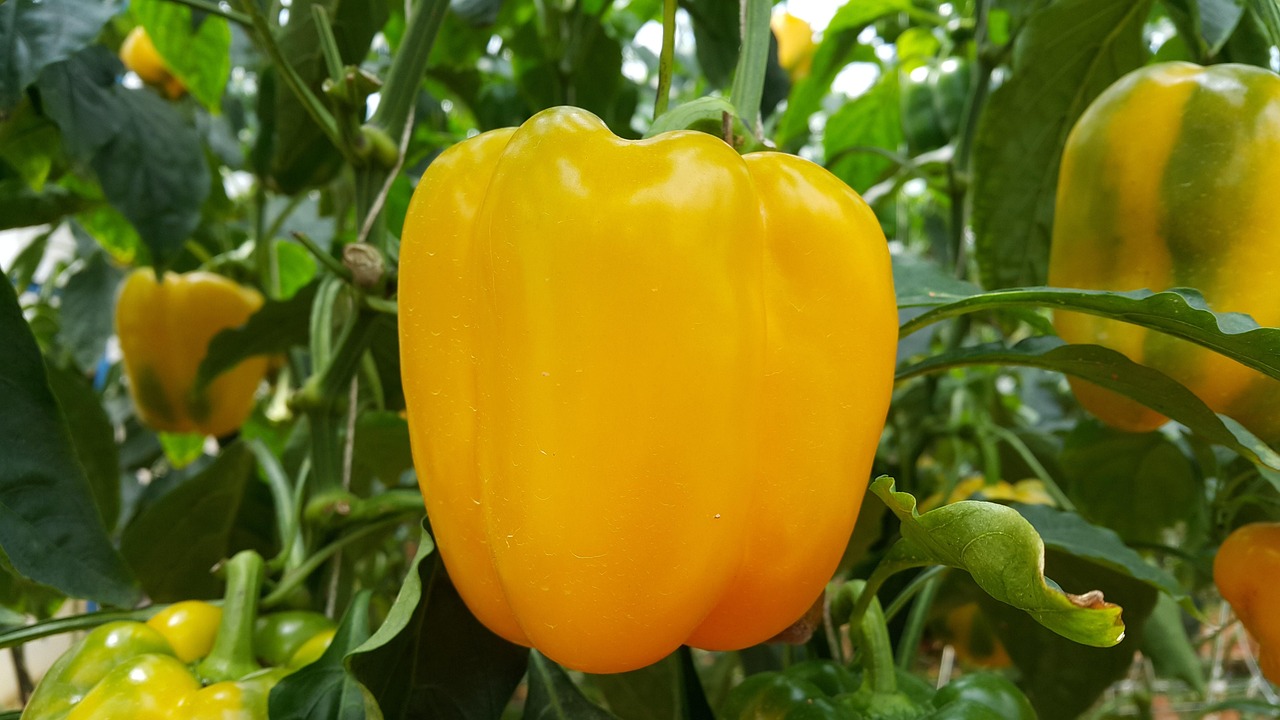
The Capsicum plant, commonly known as bell pepper, is a cultivated member of the nightshade family recognized for its distinctive, non-pungent fruits. It belongs to the species Capsicum annuum, a highly diverse taxon that includes both sweet and pungent pepper forms. Bell peppers are distinguished within this group by their thick-walled, hollow fruits and the absence of capsaicin, the compound responsible for heat in chili peppers.
Classification
- Plant Type
- Herb
- Lifecycle
- Perennial
- Leaf Habit
- Evergreen
- Native Region
- South America
- Plant Family
- Solanaceae
Botanically, the Capsicum genus holds significant importance due to its morphological diversity and long history of domestication. Bell peppers represent a domesticated form that has been selectively developed for fruit size, shape, and color rather than pungency. Their prominent role in agriculture and global food systems makes them one of the most widely recognized Capsicum types.
Culturally and economically, bell peppers are deeply integrated into cuisines around the world and are cultivated across many temperate and tropical regions. Beyond their culinary presence, they are frequently referenced in botanical studies as a model for fruit development and plant domestication within the Solanaceae family.
Quick Plant Information
| Attribute | Details |
|---|---|
| Common Name(s) | Bell Pepper, Sweet Pepper, Capsicum |
| Scientific Name | Capsicum annuum |
| Family | Solanaceae |
| Plant Type | Herbaceous flowering plant |
| Lifespan | Perennial (often cultivated as an annual) |
| Growth Habit / Growth Form | Upright, bushy |
| Native Range | Central and South America |
| Climate Adaptation / Habitat Type | Tropical to warm temperate regions |
| Leaf Type | Simple, broad |
| Flower Color(s) | White to pale green |
| Fruit Type | Berry |
| Evergreen / Deciduous | Evergreen in frost-free conditions |
Botanical Description
The Capsicum plant exhibits a soft, green, and moderately branching stem structure. Stems are typically angular when young and may become slightly woody at the base as the plant matures. The overall plant structure is compact to moderately spreading, depending on genetic variety.
Leaves are simple, ovate to lanceolate in shape, with smooth margins and a pointed apex. They are arranged alternately along the stem and display a glossy to matte surface. Leaf coloration ranges from light to deep green, with visible venation extending from a central midrib.
Flowers are borne singly or occasionally in small clusters at the leaf axils. Each flower is typically star-shaped, with five to seven petals that are white or pale green in color. The reproductive structures include a central pistil surrounded by several stamens with pale yellow anthers.
The fruit of the bell pepper plant is botanically classified as a berry. Fruits are hollow, multi-lobed, and thick-walled, enclosing numerous flattened, cream-colored seeds attached to a central placenta. Fruit coloration varies widely and may include green, red, yellow, orange, purple, or brown depending on cultivar and maturity stage.
Root systems are generally fibrous and shallow, spreading laterally rather than deeply. These roots support the plant’s upright growth form and anchor it within the soil substrate.
Plant Classification & Growth Habit
Capsicum plants are classified as herbaceous flowering plants within the Solanaceae family, which also includes tomatoes, eggplants, and potatoes. Capsicum annuum is the most widely cultivated species in the genus and encompasses a broad range of pepper types, from sweet bell peppers to various chili forms.
Bell peppers are botanically perennial plants in their native and frost-free environments, though they are frequently treated as annuals in agricultural systems. The growth habit is upright and bushy, with multiple branching stems emerging from a central base. Plants typically maintain a compact structure with foliage concentrated around the upper portions of the stems.
Common Types / Varieties / General Classifications
Bell peppers are often grouped based on fruit characteristics rather than formal botanical subspecies. Common high-level classifications include:
- By Fruit Color
- Green bell peppers
- Red bell peppers
- Yellow bell peppers
- Orange bell peppers
- Purple and brown bell peppers
- By Fruit Shape
- Blocky or square-shaped types
- Elongated or tapered types
- By Seed Presence
- Standard-seeded varieties
- Reduced-seed or seedless selections (rare)
These classifications are descriptive and reflect visual and morphological variation rather than taxonomic distinction.
Native Range & Distribution
The native range of Capsicum annuum extends across parts of Central America and northern South America, where wild and early domesticated forms originated. Archaeological evidence suggests that Capsicum species were domesticated thousands of years ago by Indigenous cultures in these regions.
Following European contact with the Americas, Capsicum plants were rapidly disseminated across Europe, Africa, and Asia. Today, bell peppers are cultivated and naturalized in many parts of the world, particularly in regions with warm growing seasons. Their global distribution reflects both human agricultural activity and the adaptability of the species to diverse climatic conditions.
Cultural, Culinary, or Traditional Context
Bell peppers have a long-standing presence in global culinary traditions, valued primarily for their flavor, texture, and visual appeal. Unlike many other Capsicum types, bell peppers are characterized by their mild taste, which has contributed to their widespread acceptance across cultures.
Historically, Capsicum plants were introduced to Europe in the late 15th and early 16th centuries following transatlantic exploration. From there, they became integrated into regional cuisines, agricultural systems, and trade networks. Bell peppers, in particular, gained prominence as a distinct category through selective breeding that emphasized sweetness and fruit size.
In modern contexts, bell peppers are a significant agricultural commodity, traded internationally and incorporated into countless regional dishes. They also hold importance in food processing industries, where their consistent shape and color are utilized for various culinary applications.
Interesting Facts / Did You Know
- Bell peppers are the only common Capsicum fruits that lack capsaicin, the compound responsible for pungency.
- The different colors of bell peppers represent stages of fruit maturity rather than separate species.
- Botanically, bell peppers are classified as berries due to their seed-bearing structure.
- The Capsicum genus is one of the few plant groups native to the Americas that achieved rapid global spread after the 15th century.
- Bell peppers share close botanical relatives with tomatoes and eggplants within the Solanaceae family.
FAQs
Are bell peppers and chili peppers the same plant?
Both belong to the species Capsicum annuum, but they represent different cultivated forms selected for either pungency or sweetness.
Is a bell pepper a fruit or a vegetable?
Botanically, a bell pepper is a fruit classified as a berry, though it is commonly treated as a vegetable in culinary contexts.
Why do bell peppers come in different colors?
Color variation reflects genetic differences and stages of fruit maturity, with green typically representing an earlier stage and red or yellow indicating full maturity.
Are bell peppers naturally occurring in the wild?
Wild relatives of Capsicum annuum exist, but modern bell peppers are the result of extensive domestication and selective breeding.
Conclusion
The Capsicum plant, commonly known as the bell pepper, represents a distinctive non-pungent form within the diverse Capsicum annuum species. Characterized by its bushy growth habit, broad leaves, and thick-walled fruits, it holds botanical significance as both a cultivated crop and a subject of plant domestication studies.
With origins in the Americas and a long history of global dissemination, bell peppers occupy an important place in agriculture, culture, and botanical classification. Their visual diversity and structural characteristics continue to make them a notable and widely recognized member of the nightshade family.
The Plants Info resource provides a structured plant database designed for learning and reference, offering clear botanical profiles and factual overviews of a wide range of plant species for educational purposes.