Introduction
Calathea is a genus of tropical perennial plants known for its highly decorative foliage and distinctive leaf patterns. Belonging to the family Marantaceae, Calathea species are recognized for their broad, often vividly marked leaves that display contrasting colors, intricate striping, or feather-like designs. These plants are native to the understory of tropical forests, where they form part of the low-growing vegetation layer.
Classification
- Plant Type
- Herb
- Lifecycle
- Perennial
- Leaf Habit
- Evergreen
- Native Region
- South America
- Plant Family
- Marantaceae
Botanically, Calathea is notable for its nyctinastic leaf movement, in which leaves change position between day and night. This behavior, sometimes described as “prayer-like” movement, reflects adaptive responses to light and environmental conditions. The genus has attracted scientific and horticultural interest due to its specialized leaf anatomy and pigmentation.
Calathea plants also hold cultural and economic relevance as ornamental foliage plants. Their visual appeal has led to widespread recognition in botanical collections and interior plant displays, making the genus one of the most identifiable members of the Marantaceae family.
Quick Plant Information
| Field | Details |
|---|---|
| Common Name(s) | Calathea, Prayer Plant (applied broadly) |
| Scientific Name | Calathea spp. |
| Family | Marantaceae |
| Plant Type | Tropical perennial foliage plant |
| Lifespan | Perennial |
| Growth Habit / Growth Form | Clumping, upright to spreading |
| Native Range | Tropical Americas |
| Climate Adaptation / Habitat Type | Tropical rainforest understory |
| Leaf Type | Broad, patterned leaves |
| Flower Color(s) | White, yellow, or purple (species-dependent) |
| Fruit Type | Capsule |
| Evergreen / Deciduous | Evergreen |
Botanical Description
Calathea plants are characterized by their prominent leaves, which emerge from short, often subterranean rhizomes. Stems are typically reduced, with leaf petioles arising directly from the base of the plant. The overall form is compact to spreading, depending on species and maturity.
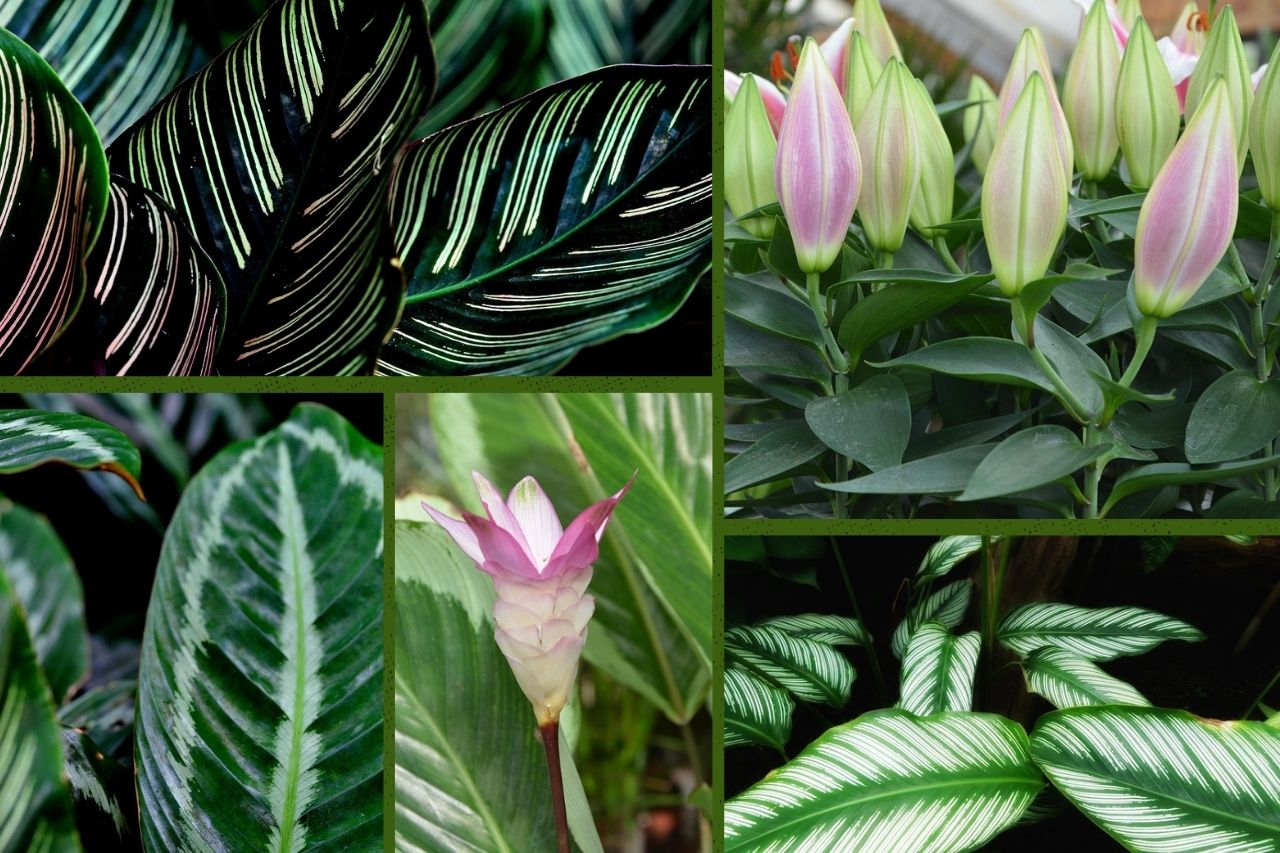
Leaves are the most defining feature of Calathea. They are generally oval, lance-shaped, or elongated, with smooth or slightly wavy margins. Leaf surfaces often display complex patterns, including stripes, spots, or feathered markings in shades of green, silver, cream, pink, or purple. The undersides of the leaves are frequently darker in color, sometimes appearing deep purple or maroon.
Flowers are usually small and less conspicuous than the foliage. They are produced on short inflorescences near the base of the plant and may be white, pale yellow, or violet. The root system consists of fibrous roots associated with rhizomatous structures that support the plant’s perennial growth cycle.
Plant Classification & Growth Habit
Calathea is classified as a herbaceous perennial genus within the Marantaceae family. Plants in this genus are non-woody and maintain foliage year-round in suitable climates. Growth typically occurs in clumps, with new leaves emerging sequentially from the base.
The genus is adapted to shaded forest environments and exhibits a low to medium height profile. Rather than vertical branching, Calathea expands laterally through rhizomes, forming dense foliage clusters. Its classification emphasizes foliage structure and movement rather than floral display.
Common Types / Varieties / General Classifications
Calathea includes numerous species and cultivated forms that are often grouped by leaf appearance:
- Striped-Leaf Types
Species with linear or feathered striping patterns across the leaf surface. - Spotted or Patterned Types
Characterized by oval or rounded markings that contrast with the base leaf color. - Velvet-Textured Types
Recognized for soft, matte leaf surfaces with deep color saturation. - Narrow-Leaf Types
Featuring elongated, lance-shaped leaves with repeating patterns.
These groupings are descriptive and reflect visual and morphological traits rather than taxonomic rank.
Native Range & Distribution
Calathea species are native to the tropical regions of Central America, South America, and parts of the Caribbean. They are most commonly found in humid rainforest environments, where they grow beneath the forest canopy. Their natural habitat includes riverbanks, forest floors, and shaded clearings.
Outside their native range, Calathea plants are widely distributed through cultivation and are commonly found in botanical gardens and plant collections worldwide. They are not generally considered invasive and typically remain associated with managed or indoor environments when grown outside tropical regions.
Cultural, Culinary, or Traditional Context
Calathea does not have a significant role in culinary traditions. However, some species within the broader Marantaceae family have been historically used for their leaves in food wrapping or craft applications. In certain regions of South America, related plants were utilized for weaving and decorative purposes.
Culturally, Calathea has become associated with ornamental design and interior aesthetics due to its striking foliage. Its patterned leaves have influenced decorative motifs and inspired plant-based design elements in visual art and interior spaces. Economically, Calathea contributes to the global ornamental plant trade as a foliage-focused genus.
Interesting Facts / Did You Know
- Calathea leaves often move in response to daily light cycles, a behavior known as nyctinasty.
- The undersides of many Calathea leaves are darker than the upper surface.
- The genus name Calathea is derived from a Greek word meaning “basket,” referencing historical uses of related plants.
- Calathea is closely related to genera such as Maranta and Goeppertia.
- Some species formerly classified as Calathea have been reclassified under different genera based on genetic studies.
FAQs
Is Calathea the same as a prayer plant?
The term “prayer plant” is commonly used for several genera in the Marantaceae family, including Calathea, though it is not exclusive to this genus.
Do all Calathea plants flower?
Calathea plants are capable of flowering, but their flowers are generally small and less prominent than the foliage.
Why do Calathea leaves move?
Leaf movement is a natural response to changes in light and internal water pressure within specialized cells.
Is Calathea an evergreen plant?
Yes, Calathea is considered evergreen, maintaining its foliage throughout the year in suitable conditions.
Conclusion
Calathea is a visually distinctive genus of tropical perennial plants valued primarily for its ornate foliage and dynamic leaf movement. Native to the tropical Americas, it occupies shaded forest environments and displays a wide range of leaf shapes, colors, and patterns. Its botanical characteristics and aesthetic appeal have established Calathea as a notable member of the Marantaceae family.
As a foliage-focused plant group with ecological and ornamental relevance, Calathea continues to be recognized for its unique combination of form, movement, and visual complexity.
The Plants Info resource includes Calathea within its structured plant database, offering consistent, reference-oriented information designed to support learning and plant identification across diverse species.