Introduction
Garlic is a widely recognized bulbous plant belonging to the genus Allium, which also includes onions, leeks, and chives. It is characterized by its segmented underground bulb, composed of individual cloves enclosed within a papery outer skin. Garlic has been associated with human societies for thousands of years and holds botanical, culinary, and cultural significance across many regions of the world.
Classification
- Plant Type
- Herb
- Leaf Habit
- Deciduous
- Native Region
- Asia
- Plant Family
- Amaryllidaceae
From a botanical perspective, garlic is notable for its vegetative reproduction through cloves rather than seeds in most cultivated forms. Its distinctive aroma and sulfur-containing compounds have made it a prominent plant in traditional cuisines and historical records. Archaeological and textual evidence place garlic among the earliest domesticated plants used by humans.
Beyond its physical characteristics, garlic has maintained a consistent role in agriculture, trade, and cultural symbolism. Its presence in folklore, religious texts, and traditional food systems underscores its long-standing relationship with human civilization.
Quick Plant Information
| Field | Details |
|---|---|
| Common Name(s) | Garlic |
| Scientific Name | Allium sativum |
| Family | Amaryllidaceae |
| Plant Type | Bulbous flowering plant |
| Lifespan | Perennial (commonly cultivated as an annual) |
| Growth Habit / Growth Form | Upright, bulb-forming |
| Native Range | Central Asia |
| Climate Adaptation / Habitat Type | Temperate regions |
| Leaf Type | Linear, flat leaves |
| Flower Color(s) | White to pale pink |
| Fruit Type | Capsule (rarely produced) |
| Evergreen / Deciduous | Deciduous |
Botanical Description
Garlic develops from an underground bulb that is typically composed of multiple individual segments known as cloves. These cloves are arranged around a central basal plate and are covered by thin, papery protective layers that vary in color from white to pale purple depending on the variety. The bulb serves as a storage organ for the plant.
The stem of the garlic plant is an upright, cylindrical structure that emerges from the bulb. In many cultivated forms, a flowering stalk known as a scape may develop, often exhibiting a coiled or curved appearance. The scape supports an umbel-shaped inflorescence when present.
Leaves are long, narrow, and flat, arising alternately from the base of the plant. They are typically blue-green in color and possess parallel venation, consistent with monocotyledonous plants. The leaves taper to a pointed tip and have a smooth surface.
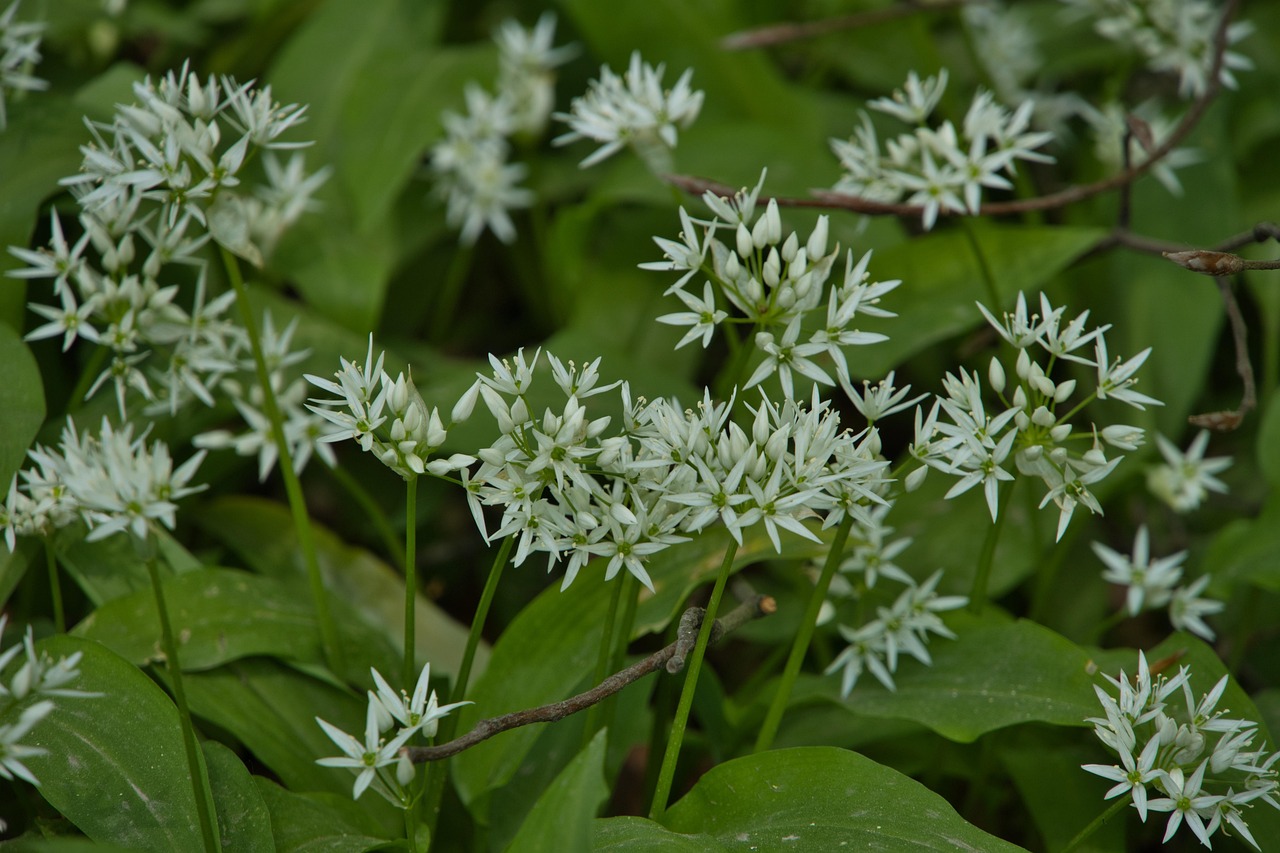
Flowers, when produced, are small and clustered in a rounded umbel at the top of the scape. They are usually white, pale pink, or light purple. In many cultivated garlic types, flower development is incomplete or replaced by bulbils. The root system consists of fibrous roots extending from the basal plate at the bottom of the bulb.
Plant Classification & Growth Habit
Garlic is classified as a herbaceous, bulb-forming perennial plant. Although botanically perennial, it is often treated as an annual in agricultural systems due to its harvesting cycle. The plant exhibits an upright growth habit, with leaves and stems emerging vertically from the underground bulb.
Within the broader classification of Allium, garlic is distinguished by its clove-based bulb structure and reduced seed production. Its growth pattern emphasizes vegetative structures rather than extensive branching or woody tissue. The plant completes its above-ground life cycle within a single growing season before returning to dormancy.
Common Types / Varieties / General Classifications
Garlic is broadly categorized into several high-level groups based on morphological and reproductive traits:
- Hardneck Garlic
Characterized by a central flowering stalk (scape) and fewer, larger cloves arranged in a single ring. - Softneck Garlic
Lacks a rigid central stalk and typically produces more numerous cloves in multiple layers. - Creole and Asiatic Types
Regional classifications are recognized for distinct bulb coloration and growth characteristics.
These classifications are commonly used in botanical and agricultural literature to distinguish structural and genetic differences rather than performance or suitability.
Native Range & Distribution
Garlic is believed to have originated in Central Asia, with early domestication occurring in regions that include parts of modern-day Kazakhstan, Uzbekistan, and surrounding areas. From its center of origin, garlic spread westward into the Middle East and Mediterranean regions and eastward into South and East Asia.
Over centuries, garlic became established across Europe, Africa, and eventually the Americas through trade routes and human migration. Today, it is cultivated globally in temperate regions and is naturalized in some areas outside its original range. Its widespread distribution reflects its adaptability and long history of association with human cultivation.
Cultural, Culinary, or Traditional Context
Garlic has played a prominent role in the culinary traditions of numerous cultures. Historical records indicate its use in ancient Egyptian, Greek, Roman, Chinese, and Indian societies. It has been referenced in early texts, inscriptions, and folklore, often symbolizing strength, protection, or sustenance.
In culinary contexts, garlic has been valued for its distinctive flavor and aroma, contributing to a wide range of traditional dishes worldwide. It has also been used as a preserved food item and as a traded commodity in historical markets. Garlic’s economic importance remains significant, with large-scale production in multiple countries.
Culturally, garlic has appeared in rituals, legends, and symbolic practices. In some traditions, it has been associated with warding off misfortune or negative influences, reflecting its strong sensory presence and historical mystique.
Interesting Facts / Did You Know
- Garlic has been cultivated by humans for more than 5,000 years.
- Most cultivated garlic does not produce fertile seeds and reproduces through cloves.
- The distinctive odor of garlic results from sulfur-containing compounds released when cloves are crushed.
- Garlic belongs to the same botanical genus as onions, leeks, and chives.
- Some garlic plants produce bulbils instead of fully developed flowers.
FAQs
Is garlic a root or a bulb?
Garlic is classified as a bulb, consisting of modified leaves that store nutrients underground.
Why does garlic have individual cloves?
The cloves are separate storage units within the bulb, each capable of developing into a new plant.
Is garlic always perennial?
Botanically, garlic is a perennial plant, though it is commonly cultivated as an annual.
Does garlic produce seeds?
Most cultivated garlic varieties rarely produce viable seeds and instead reproduce vegetatively.
Conclusion
Garlic (Allium sativum) is a bulbous flowering plant with a long history of cultivation and cultural relevance. Its distinctive physical structure, including segmented cloves and upright foliage, sets it apart within the Allium genus. Originating in Central Asia, garlic has spread worldwide and become deeply integrated into human societies.
As both a botanical specimen and a cultural artifact, garlic remains notable for its historical continuity, global distribution, and recognizable morphology. Its enduring presence reflects its adaptability and the lasting relationship between plants and human civilization.
The Plants Info platform presents garlic as part of a structured and comprehensive plant database designed for reference and educational purposes, supporting consistent learning across a wide range of plant species.