Introduction
The Prayer Plant, scientifically classified under the genus Maranta, is a group of tropical perennial plants recognized for their vividly patterned foliage and distinctive daily leaf movements. The name “Prayer Plant” refers to the observable behavior in which the leaves fold upward in the evening, resembling hands in prayer. This movement, known as nyctinasty, is a natural response to changes in light.
Classification
- Plant Type
- Herb
- Lifecycle
- Perennial
- Leaf Habit
- Evergreen
- Native Region
- South America
- Plant Family
- Marantaceae
Belonging to the family Marantaceae, Maranta species are native to the tropical regions of Central and South America. They are primarily valued for their ornamental foliage rather than floral display. The genus holds botanical significance for its adaptive leaf movements and intricate venation patterns, which vary among species and cultivars.
Prayer Plants have become widely recognized in ornamental horticulture and interior landscaping due to their striking leaf coloration and compact growth form. Despite their popularity, they remain botanically notable for their structural and physiological traits rather than for cultivation characteristics.
Quick Plant Information
| Field | Information |
|---|---|
| Common Name(s) | Prayer Plant |
| Scientific Name | Maranta spp. (commonly Maranta leuconeura) |
| Family | Marantaceae |
| Plant Type | Tropical ornamental perennial |
| Lifespan | Perennial |
| Growth Habit / Form | Low-growing, spreading herbaceous plant |
| Native Range | Central and South America |
| Climate Adaptation / Habitat Type | Tropical rainforest understory |
| Leaf Type | Broad, simple leaves with patterned variegation |
| Flower Color(s) | White to pale lavender (varies by species) |
| Fruit Type | Small capsule |
| Evergreen / Deciduous | Evergreen in native habitat |
Botanical Description
Stem
Prayer Plants possess soft, herbaceous stems that grow horizontally along the soil surface or slightly above it. The stems are typically slender and flexible, contributing to the plant’s spreading habit. Nodes along the stem produce leaves and occasionally roots when in contact with suitable substrate.
Leaves
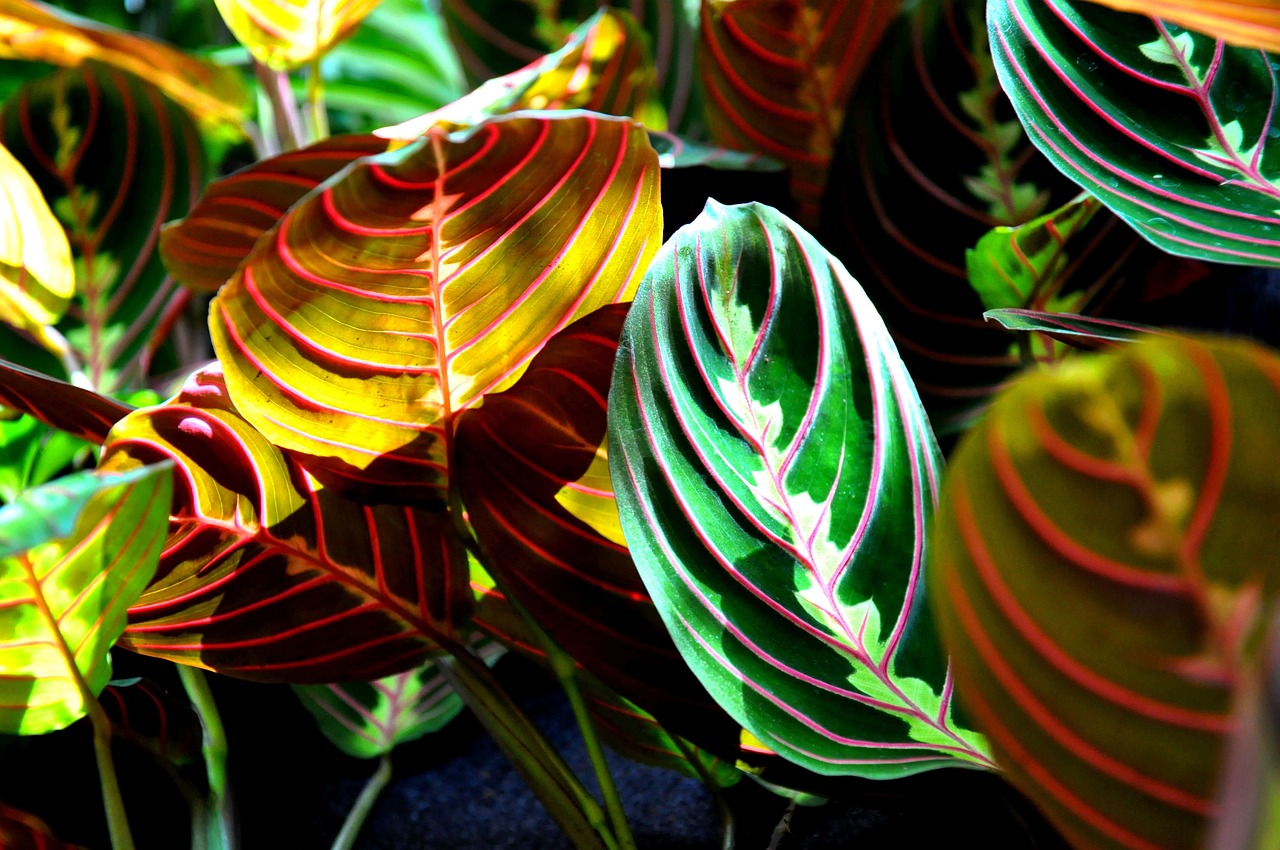
The foliage is the most distinctive feature of the genus. Leaves are broad, oval to elliptical in shape, and arranged alternately along the stems. The upper leaf surface commonly displays contrasting patterns of dark green, light green, red, or cream along the veins and midrib. The underside of many species, particularly Maranta leuconeura, often shows a reddish or purplish coloration.
A defining characteristic is the presence of pulvini—specialized swellings at the base of the leaf petioles—that enable nyctinastic movement. During low-light conditions or nighttime hours, leaves fold upward; during daylight, they flatten outward. This movement is caused by changes in turgor pressure within the pulvinus.
Leaf venation is typically pinnate, with prominent secondary veins that contribute to the decorative pattern. Texture ranges from smooth to slightly velvety depending on species and variety.
Flowers
Flowers of Maranta species are relatively small and inconspicuous compared to the foliage. They are borne on slender stalks and may appear singly or in small clusters. Flower coloration typically ranges from white to pale lavender, sometimes with subtle markings.
The floral structure includes three petals and three sepals, characteristic of many members of the Marantaceae family. While flowering can occur under suitable environmental conditions, it is not the primary ornamental feature of the plant.
Fruits
The fruit is a small capsule that develops after pollination. Inside the capsule are small seeds. In cultivated ornamental contexts, fruit production is relatively uncommon compared to foliage display.
Roots
Prayer Plants possess fibrous root systems that anchor the plant and absorb nutrients and moisture. In natural habitats, roots spread through the forest floor’s organic layer. The root system supports the plant’s low-growing, spreading growth form.
Plant Classification & Growth Habit
The genus Maranta belongs to the order Zingiberales, which also includes related ornamental and tropical plant families. Within the family Marantaceae, Maranta is closely related to genera such as Calathea and Ctenanthe, which also exhibit leaf movement behavior.
Prayer Plants are classified botanically as herbaceous perennials. They do not develop woody stems and maintain a relatively compact height. Their growth habit is typically prostrate to semi-trailing, forming a low, spreading mat of foliage.
In natural rainforest environments, they function as understory plants. Their broad leaves maximize light capture beneath the forest canopy, and their horizontal growth allows them to occupy ground-level ecological niches.
The nyctinastic leaf movement is a defining functional trait and serves as an adaptive characteristic within shaded tropical ecosystems.
Common Types / Varieties / General Classifications
Several recognized species and cultivars of Maranta are commonly referenced in ornamental contexts:
- Maranta leuconeura var. erythroneura
Characterized by deep green leaves with prominent red veins. - Maranta leuconeura var. kerchoveana
Often called the “Rabbit’s Foot” Prayer Plant due to dark blotches along the midrib. - Maranta leuconeura ‘Tricolor’
Displays green leaves with red venation and lighter green or yellowish centers. - Maranta arundinacea
Known as Arrowroot; differs in having larger, more uniform green leaves and a more upright growth form.
These types vary primarily in foliage coloration, pattern intensity, and leaf size rather than in fundamental structural differences.
Native Range & Distribution
Prayer Plants are native to tropical regions of Central and South America, particularly Brazil and surrounding areas. They occur naturally in humid, shaded forest environments where they grow along the forest floor.
Their native habitat includes tropical rainforest understories characterized by filtered light and consistent warmth. Within these ecosystems, they form part of the ground vegetation layer and contribute to biodiversity in low-light zones.
Due to ornamental interest, Maranta species are now widely distributed in tropical and subtropical regions around the world as cultivated plants. In temperate regions, they are maintained in controlled interior environments but are not typically naturalized outdoors.
Cultural, Culinary, or Traditional Context
Within the Marantaceae family, certain species have historical economic importance. Maranta arundinacea, commonly known as arrowroot, has been cultivated for its starch-producing rhizomes in tropical regions. The starch derived from this plant has long been incorporated into traditional food preparations.
Ornamental species such as Maranta leuconeura gained popularity in the 19th and 20th centuries as decorative foliage plants. Their patterned leaves and dynamic movement made them notable additions to botanical collections and interior plant displays.
The leaf-folding behavior has contributed to the plant’s symbolic associations with reflection and daily rhythms, although these associations are cultural rather than botanical.
Interesting Facts / Did You Know
- The leaf-folding behavior of Prayer Plants is an example of nyctinasty, a circadian rhythm-driven plant movement.
- The genus name Maranta honors Bartolomeo Maranta, a 16th-century Italian botanist and physician.
- Members of the Marantaceae family are sometimes referred to collectively as “prayer plants,” though the term most commonly applies to Maranta species.
- The underside pigmentation of many varieties is linked to light adaptation mechanisms in shaded environments.
- Leaf patterns vary significantly even within the same species due to genetic variation and selective breeding.
FAQs
Is Prayer Plant the same as Calathea?
No. Although both belong to the family Marantaceae and exhibit similar leaf movements, Maranta and Calathea are distinct genera with different structural and morphological traits.
Why is it called a Prayer Plant?
The name derives from the upward folding of the leaves during nighttime, which resembles hands held together in prayer.
Is Maranta a flowering plant?
Yes. Maranta species produce small flowers, though they are typically less visually prominent than the foliage.
Is Arrowroot a type of Prayer Plant?
Maranta arundinacea belongs to the same genus and family. While it shares botanical lineage, it differs in morphology and traditional use compared to ornamental Maranta leuconeura varieties.
Recommended Products
Disclosure: As an Amazon Associate, PlantsInfo may earn from qualifying purchases.
🌱 Plant Care Essentials
The following tools can help with pruning, plant health, soil management, and fruit garden maintenance.

Neem Oil for Plant Care
Natural plant protection against aphids, whiteflies, mites, and other common garden pests.

Fungicide for Root Care
Helps suppress soil-borne fungal diseases and supports healthier root systems.

Spray Bottle for Plants
Ideal for applying foliar sprays, neem oil solutions, and liquid plant treatments.

Rubber Hand Gloves
Protects hands during pruning, planting, soil preparation, and garden maintenance.
Conclusion
The Prayer Plant (Maranta) is a tropical herbaceous perennial recognized for its patterned foliage and characteristic leaf movements. Native to Central and South America, it occupies understory habitats within rainforest ecosystems. Its botanical identity is defined by its herbaceous stems, broad variegated leaves, and nyctinastic response to light cycles.
As a member of the Marantaceae family, Maranta holds both ornamental and historical significance, particularly through species such as Maranta leuconeura and Maranta arundinacea. Its distinctive physiology and visual appeal contribute to its recognition in botanical collections and interior plant culture worldwide.
The Plants Info database provides structured, educational plant profiles designed for learning and reference purposes, offering consistent botanical information across a wide range of species.