Lotus Flowering Season: When and What to Expect in India
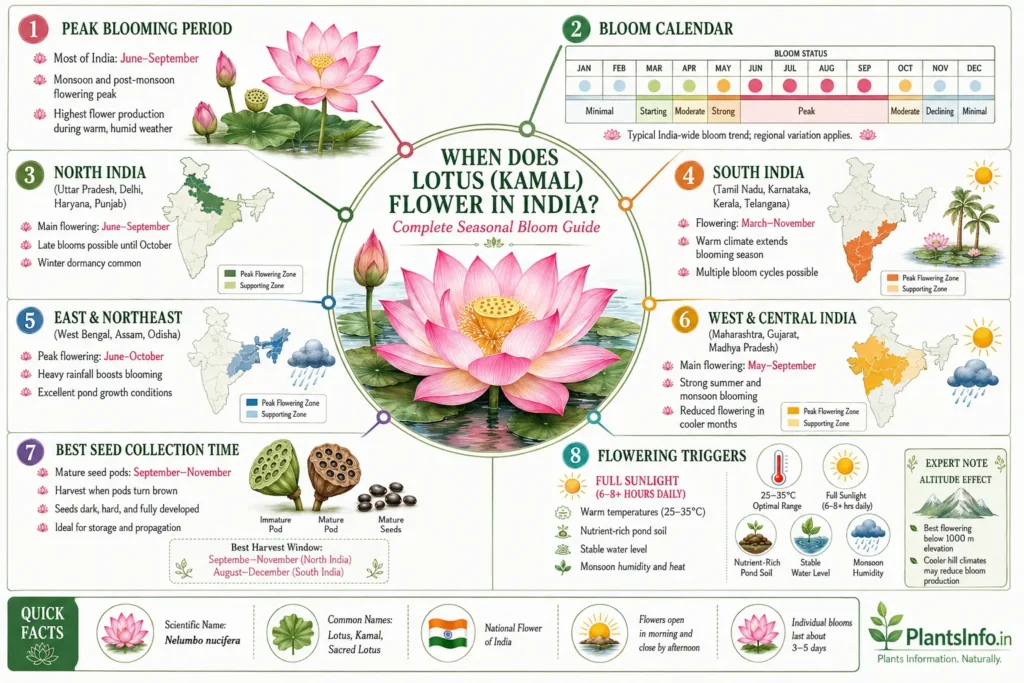
Quick Answer: Lotus blooms during the monsoon and early post-monsoon months in India — the main flowering window runs from June to September, with peak bloom in July and August. In warmer southern and coastal regions, flowers can appear from late April or May. The plant goes semi-dormant in winter (December–February) and revives as temperatures rise above 25°C in spring.
Walk past any temple pond in August, and you will know the season has arrived without checking a calendar. The fragrance reaches you first — warm, faintly sweet, a little fruity — before the flowers even come into view. Lotus does not tease with a few stray blooms; when it flowers, it flowers all at once, and the timing is governed almost entirely by water temperature and accumulated warmth.
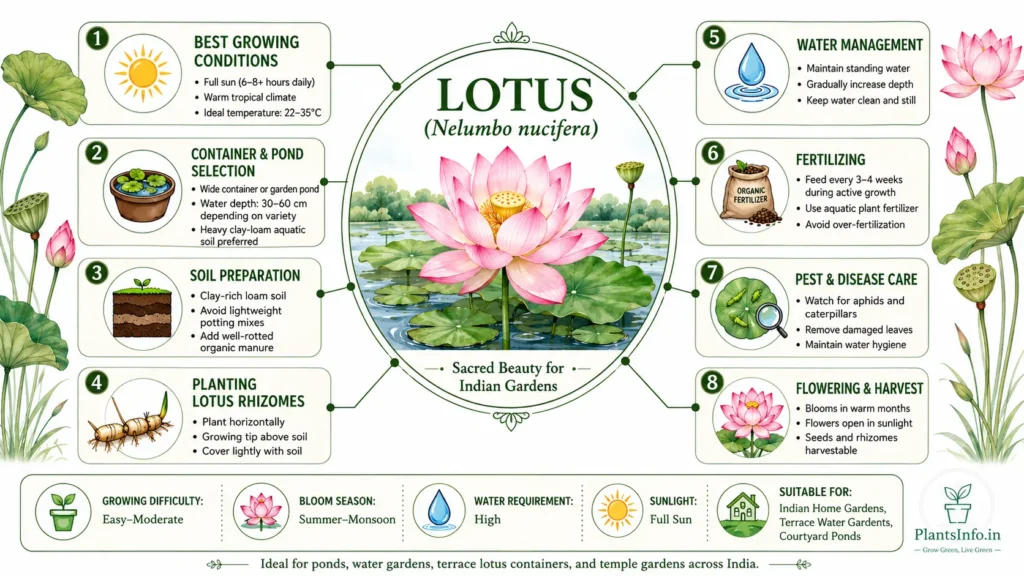
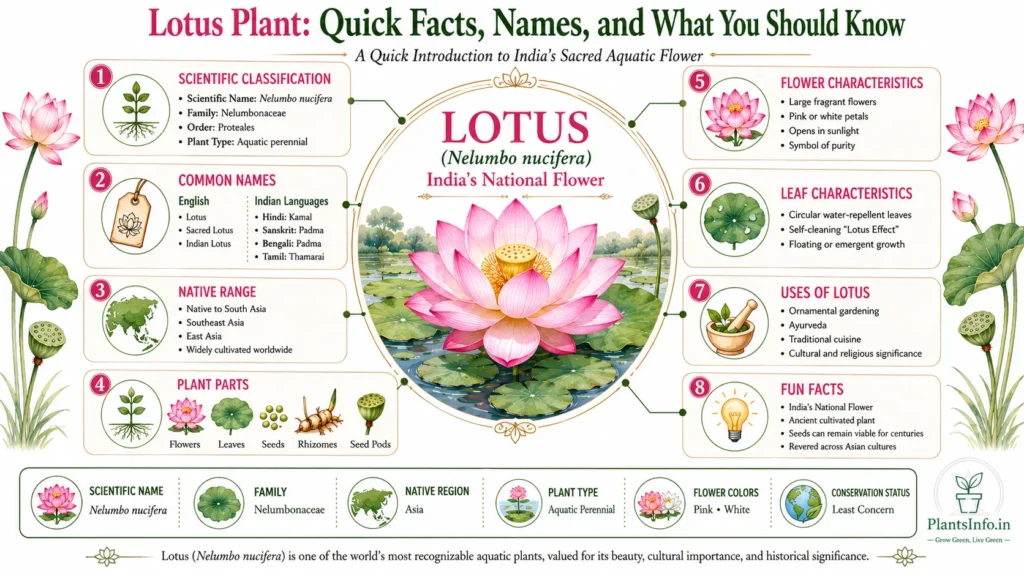
This guide primarily refers to the Indian Sacred Lotus (Nelumbo nucifera), commonly called Kamal, the species most widely grown in ponds, lakes, temple tanks, and ornamental water gardens across India.
What Month Does Lotus Bloom in India?
The lotus (Nelumbo nucifera), commonly known as Kamal in India, typically blooms between June and September, with the most abundant flowering occurring in July and August during the monsoon season.
The exact flowering period varies slightly by region:
Region
Typical Flowering Period
Peak Bloom
North India
June–September
July–August
East India
June–September
July–August
West India
June–September
July–August
South India
April/May–October
June–September
Northeast India
July–September
July–August
India’s Seasons and This Plant
Season (months)
What the plant is doing
Pre-monsoon (Mar–May)
Rhizomes reviving; floating leaves emerge; no flowers yet in most of North India; early blooms possible in South India from April
Monsoon (Jun–Sep)
Peak growth and peak flowering; new buds appear continuously; seed pods forming alongside open flowers
Post-monsoon (Oct–Nov)
Flowering slows and stops; seed pods mature; leaves begin to yellow and die back
Winter (Dec–Feb)
Semi-dormancy; aerial parts die back; rhizome rests in mud; no flowering
Flowering Season in Detail
Flower buds on lotus appear on separate stalks from the leaves, rising well above the water surface. The first buds of the season typically appear two to four weeks after the plant produces its first strong aerial leaves — in North India, this means buds from late May to June, in South India from late April or May.
Peak bloom across most of India falls in July and August, driven by the combination of warm water temperature, long daylight hours, and the increased moisture and humidity of the monsoon. Research confirms that lotus requires accumulated warmth — water temperatures consistently above 25°C — to trigger and sustain flowering. Once that threshold is met, a well-established plant produces new buds continuously for six to ten weeks.
Each flower opens in the morning, typically between 6 and 9 AM, and closes by early afternoon. Individual flowers last two to three days, opening and closing on each of those days before the petals drop. Lotus flowers exhibit a mild thermogenic capability, maintaining floral temperatures slightly above ambient conditions during key reproductive stages. Researchers believe this may help attract pollinators and support pollen function.
Regional variation is significant. In Kerala, Tamil Nadu, and coastal Andhra Pradesh, where winters are mild and water temperatures rarely drop sharply, early blooms can appear from April, and flowering may extend into October or November. In Bihar and much of Uttar Pradesh, flowering is typically concentrated between June and September. In West Bengal, flowering often begins slightly earlier, especially in warmer southern districts. The most abundant bloom is concentrated in July and August, coinciding with monsoon onset. In the higher-altitude foothills of the northeast (Manipur, Assam), flowering begins later, typically in July, and ends earlier in September as temperatures fall.
Fruiting Season
After the petals drop, the flat-topped seed receptacle enlarges rapidly into the iconic showerhead-shaped receptacle, pockmarked with seed chambers. Seed pods are visible on the plant simultaneously with new flowers throughout the peak flowering period — a lotus pond in August typically shows buds, open flowers, and ripening pods all at once.
Pods turn from green to dark brown as they mature. A ripe pod rattles when shaken — the seeds sit loosely in their chambers. In India, the seed harvest window runs broadly from August to October, with earlier pods from June–July flowers ripening first. Commercial growers in West Bengal and Bihar harvest continuously through this period.
If pods are left unharvested, they dry on the stalk and eventually tip into the water, releasing seeds into the pond sediment — the plant’s natural self-seeding mechanism. Pods allowed to dry fully on the stalk are also used in dried flower arrangements; they retain their shape and colour for years. If pods are harvested too early — before the chambers have darkened and the seeds rattle — viability is low, and the seeds will not germinate reliably.
Best Time to Plant
The ideal planting window in India is late winter to pre-monsoon (February to April), when water is beginning to warm, and the risk of cold shock to rhizomes has passed. Planting in this window gives the rhizome two to three months of establishment before peak flowering season arrives.
The reason this window works is temperature-driven: rhizomes planted in warming water (rising from roughly 20°C toward 28–30°C) establish quickly and produce aerial leaves within two to three weeks. The same rhizome planted in December into cold water may sit dormant for months or begin to rot.
The second-best window is immediately after monsoon onset (June–July), when water temperatures are high, and the plant can establish and flower within the same season — though this is a compressed schedule and first-year blooms may be fewer. For container growing, the February to March window is more practical than for pond planting, as container water warms faster in direct sun.
Month-by-Month Calendar
Month
Season
What to Do
January
Winter
Plant dormant — rhizome resting in mud; maintain shallow water over soil; no action needed
February
Late winter
Watch for first signs of rhizome revival; new growth tips may appear by late February in South India
March
Pre-monsoon
Floating leaves emerging in most regions; ideal time to plant rhizomes in North India
April
Pre-monsoon
Aerial leaves establishing; first buds possible in Kerala and Tamil Nadu; plant rhizomes now if not done in March
May
Pre-monsoon / early summer
Strong aerial leaves in most regions; buds appearing in South India; water level management important as evaporation rises
June
Monsoon onset
First flowers opening in North and East India; peak bud formation begins; monitor water depth after heavy rain
July
Monsoon
Peak flowering across all regions; continuous bud production; seed pods forming alongside open flowers
August
Monsoon
Peak flowering continues; earliest seed pods ripening; best month for observing the full plant cycle simultaneously
September
Late monsoon
Flowering slowing; seed pod harvest window open; leaf production reducing
October
Post-monsoon
Flowering largely over; seed pods maturing and drying; leaves beginning to yellow
Full dormancy in most northern regions; in tropical southern regions some leaves may persist through winter.
What Can Go Wrong Seasonally?
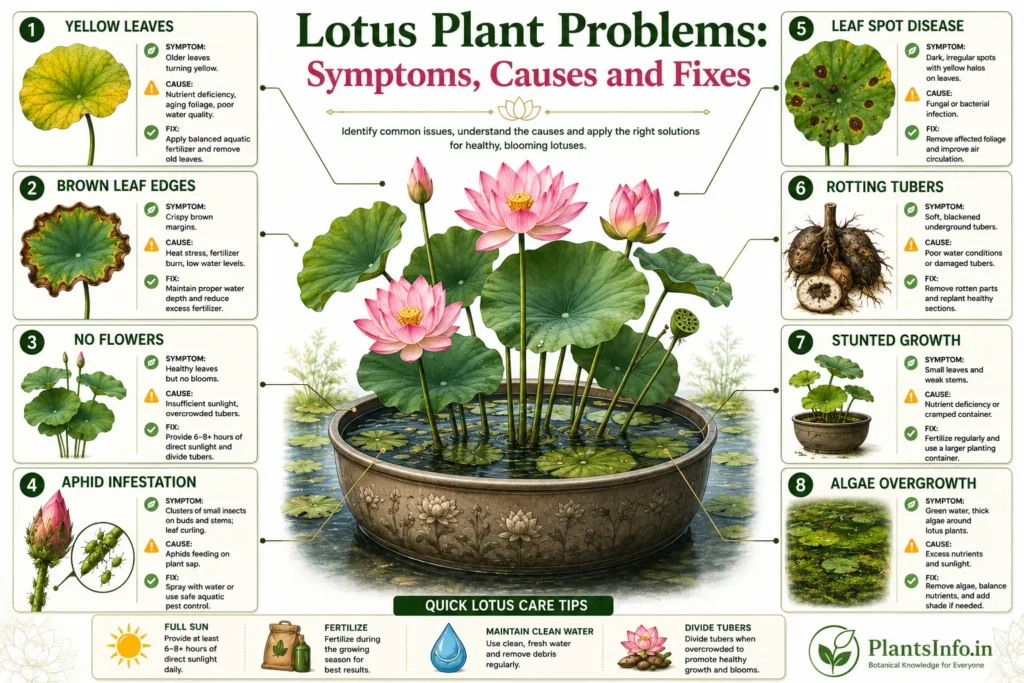
Failure to flower in the first season is the most common disappointment for home gardeners, and it is almost always a timing problem rather than a plant problem. Rhizomes planted too late (after June) in containers may produce good leaf growth but spend their energy on establishment rather than flowers. Patience through one full season — with a February planting the following year — almost always resolves this.
Monsoon water shock is a genuine seasonal risk for container growers. Sudden heavy rain can rapidly cool and dilute standing water in a container, dropping the temperature below the flowering threshold mid-season. If containers are on an exposed terrace, partial shelter during heavy downpours and a return to full sun once rain eases will help maintain water temperature.
Early dormancy in October is sometimes mistaken for disease. When leaves yellow and collapse in October and November, this is the normal seasonal transition — not a sign the plant is dying. The rhizome is alive and will re-emerge in February or March. The mistake is to remove the plant, repot it, or let the container dry out completely during dormancy.
Dormancy and Off-Season Care
Lotus dormancy in India is mild compared to temperate climates — in most of the country, the rhizome simply rests in mud through December and January rather than requiring any special overwintering. The visible sign of dormancy is the complete die-back of all aerial parts. This is normal.
The key distinction between dormancy and distress is timing and sequence. A plant that collapses in October after a full flowering season is dormant. A plant that collapses in June or July before flowering, with yellowing petioles and soft, darkening rhizomes, is likely experiencing root rot or cold-water stress — see the Lotus Problems Guide for diagnosis.
Expect revival in February (South India) or March (North India) as water temperatures climb and new growth tips push through the mud. A plant that does not show any new growth by April despite warm conditions should be checked for rhizome viability.
Frequently Asked Questions
How long does a lotus flower last?
A lotus flower typically remains open for 2–3 days, opening in the morning and closing later in the day.
Does the lotus bloom all year in India?
No. Most lotus plants flower between June and September, although flowering may begin earlier and last longer in warmer southern regions.
Which month has the most lotus flowers?
July and August usually produce the heaviest flowering across most of India.
Can a lotus flower grow in a container?
Yes. Lotus grows well in large containers provided it receives full sunlight and warm water temperatures.
Why is my lotus producing leaves but no flowers?
Common causes include insufficient sunlight, immature rhizomes, overcrowding, excessive nitrogen fertiliser, or planting too late in the season.
The lotus is one of India’s most reliable seasonal calendars — when the ponds fill with pink in July, the monsoon has truly arrived.