Introduction
Bitter gourd, scientifically known as Momordica charantia, is a tropical and subtropical vine cultivated and naturalized in many parts of Asia, Africa, and the Americas. It belongs to the gourd family, Cucurbitaceae, which also includes cucumbers, pumpkins, and melons. The plant is particularly recognized for its distinctive elongated fruit with a warty or ridged surface and a characteristically bitter taste.
Classification
- Plant Type
- Vine
- Lifecycle
- Annual
- Leaf Habit
- Deciduous
- Plant Family
- Cucurbitaceae
The species has long been integrated into culinary traditions across South and Southeast Asia, East Asia, the Caribbean, and parts of Africa. In addition to its role as a vegetable, bitter gourd has historical and cultural significance in traditional systems of knowledge. Botanically, it represents a climbing annual vine with specialized tendrils and separate male and female flowers borne on the same plant.
Bitter gourd is notable for its adaptability to warm climates and its wide geographic distribution, both in cultivated fields and in semi-wild or naturalized habitats.
Quick Plant Information
| Field | Information |
|---|---|
| Common Name(s) | Bitter Gourd, Bitter Melon, Bitter Squash, Karela |
| Scientific Name | Momordica charantia |
| Family | Cucurbitaceae |
| Plant Type | Flowering vine |
| Lifespan | Annual |
| Growth Habit / Growth Form | Climbing or trailing vine with tendrils |
| Native Range | Tropical regions of Africa and South Asia (widely naturalized) |
| Climate Adaptation / Habitat Type | Tropical and subtropical regions |
| Leaf Type | Simple, palmately lobed |
| Flower Color(s) | Yellow |
| Fruit Type | Pepo (a type of berry with a hard rind) |
| Evergreen / Deciduous | Not Applicable or Deciduous |
Botanical Description
Stem
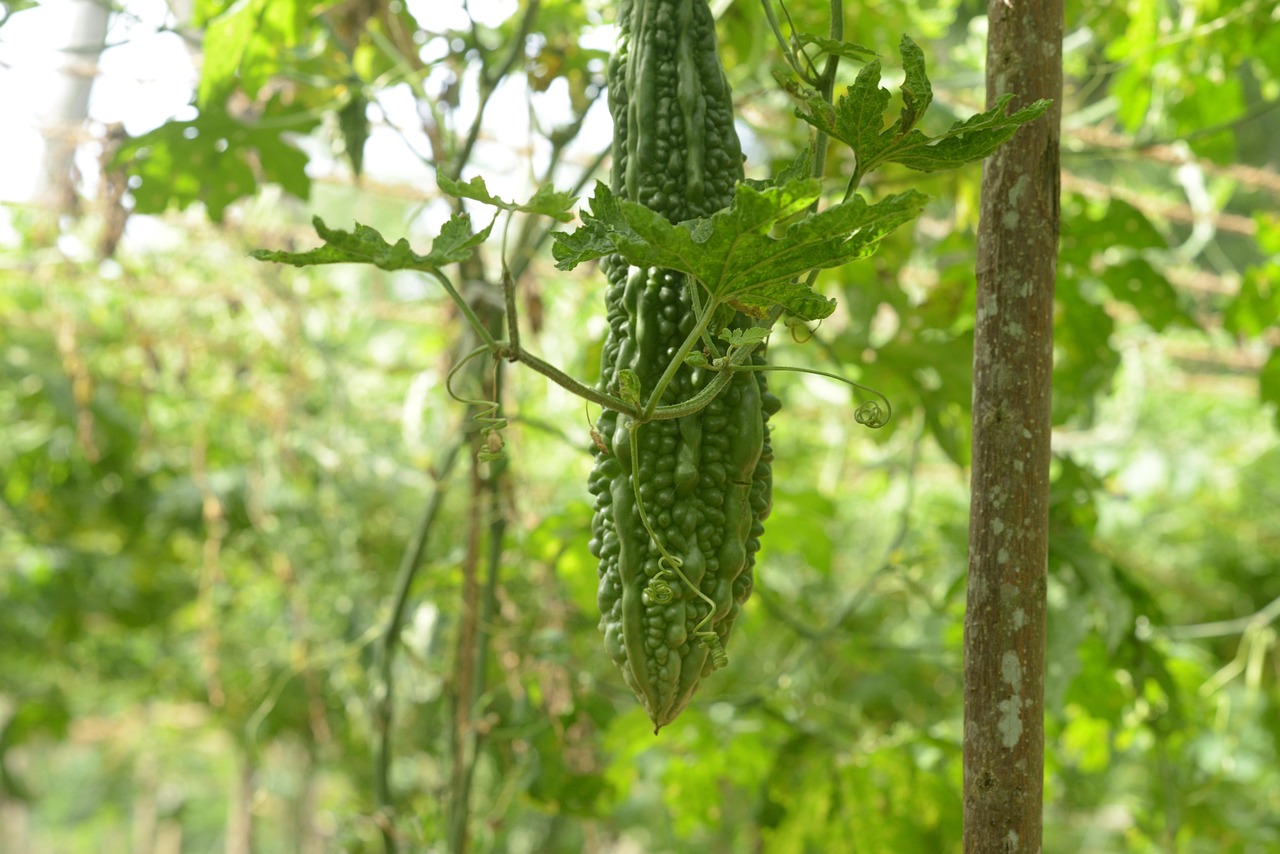
Bitter gourd develops slender, angular stems that are green and herbaceous in texture. The stems are flexible and equipped with coiling tendrils, enabling the plant to climb vertical supports or spread across the ground. The surface of the stem may exhibit fine ridges and slight pubescence when young.
Leaves
The leaves are simple and arranged alternately along the stem. They are palmately lobed, typically with five to seven deep segments. Each lobe is irregularly toothed or slightly serrated. The leaf surface is green and moderately textured, with visible venation radiating from the central petiole attachment point. Petioles are long and slender, allowing the leaves to spread outward from the vine.
Flowers
Bitter gourd produces unisexual flowers, meaning separate male and female flowers occur on the same plant (monoecious). The flowers are solitary and bright yellow in color. Male flowers are borne on long peduncles and contain prominent stamens, while female flowers have a noticeable inferior ovary at the base, which later develops into the fruit. The floral structure is typical of members of the Cucurbitaceae family, with five fused petals forming a shallow corolla.
Fruits
The fruit of Momordica charantia is classified botanically as a pepo. It is elongated and varies in size depending on the variety. The outer surface is irregular, featuring warty projections or longitudinal ridges. The immature fruit is green and firm. As it matures, it may turn yellow or orange and eventually split open to reveal bright red arils surrounding the seeds.
Internally, the fruit contains a central cavity filled with seeds embedded in spongy pith. The seeds are flat, oval, and brown when mature, with sculpted seed coats.
Roots
The plant develops a fibrous root system with a primary taproot and numerous lateral roots. The root structure supports rapid seasonal growth and anchorage in loose or cultivated soils.
Plant Classification & Growth Habit
Bitter gourd is classified as an annual herbaceous vine within the Cucurbitaceae family. It completes its life cycle within a single growing season, progressing from seed germination to flowering and fruit production.
The plant exhibits a climbing or trailing growth pattern. Through the use of tendrils, it can ascend nearby structures or vegetation. When unsupported, it spreads along the ground, forming a network of interconnected stems. The overall growth habit is vigorous and sprawling, with extensive lateral branching.
As a flowering angiosperm, it produces both male and female reproductive structures on the same individual plant. Its fruit type, the pepo, is characteristic of many cucurbit species.
Common Types / Varieties / General Classifications
Bitter gourd varieties are generally categorized based on fruit shape, size, surface texture, and regional origin.
- Indian Types
Typically smaller, darker green, and more prominently ridged or spiny in appearance. - Chinese Types
Generally longer, lighter green, and smoother with broader ridges. - Wild Types
Smaller fruits with more intense bitterness and thinner flesh. - Hybrid Cultivars
Developed for uniform fruit shape, color, and yield characteristics in agricultural systems.
These classifications reflect morphological differences rather than separate species.
Native Range & Distribution
The precise origin of Momordica charantia is debated, though it is widely believed to have originated in tropical regions of Africa and South Asia. Over centuries, the plant spread throughout Asia and became deeply integrated into regional cuisines and agricultural systems.
Today, bitter gourd is cultivated extensively in:
- South Asia (India, Sri Lanka, Bangladesh)
- Southeast Asia (Thailand, Philippines, Indonesia, Malaysia)
- East Asia (China, Japan)
- The Caribbean
- Parts of Central and South America
- Tropical regions of Africa
It thrives in warm climates and is commonly found in cultivated fields, home gardens, and occasionally as a naturalized vine in disturbed habitats.
Cultural, Culinary, or Traditional Context
Bitter gourd holds longstanding culinary importance across multiple cultures. In South Asia, it is commonly incorporated into a variety of savory dishes. In East and Southeast Asia, it is often included in soups, stir-fries, and stuffed preparations. Caribbean cuisines also feature the fruit in traditional recipes.
The plant has also been referenced in traditional knowledge systems for centuries. Historical texts from various regions mention the fruit and leaves in association with customary practices and regional food traditions. Its pronounced bitterness has influenced both culinary techniques and symbolic interpretations in different cultures.
Economically, bitter gourd is a significant vegetable crop in several tropical countries, contributing to local markets and agricultural trade networks.
Interesting Facts / Did You Know
- The genus name Momordica is derived from a Latin term meaning “to bite,” referring to the jagged appearance of the seeds.
- The fruit naturally splits open at maturity, exposing bright red seed coverings that contrast sharply with the yellow rind.
- Bitter gourd is one of the most bitter-tasting commercially cultivated vegetables.
- The plant’s tendrils are sensitive to touch and coil around nearby supports as they grow.
- Despite its name, bitter gourd is botanically classified as a fruit.
FAQs
Is bitter gourd the same as bitter melon?
Yes. Bitter gourd and bitter melon are common names for Momordica charantia. The choice of name varies by region.
Is bitter gourd a fruit or a vegetable?
Botanically, it is a fruit because it develops from the flower’s ovary and contains seeds. In culinary contexts, it is treated as a vegetable.
Is bitter gourd related to cucumber?
Yes. Both belong to the Cucurbitaceae family, which includes cucumbers, pumpkins, and squash.
Are Indian and Chinese bitter gourds different species?
No. They are different cultivated forms of the same species, Momordica charantia, distinguished primarily by fruit shape and surface texture.
Recommended Products
Disclosure: As an Amazon Associate, PlantsInfo may earn from qualifying purchases.
🌱 Plant Care Essentials
The following tools can help with pruning, plant health, soil management, and fruit garden maintenance.

Neem Oil for Plant Care
Natural plant protection against aphids, whiteflies, mites, and other common garden pests.

Fungicide for Root Care
Helps suppress soil-borne fungal diseases and supports healthier root systems.

Spray Bottle for Plants
Ideal for applying foliar sprays, neem oil solutions, and liquid plant treatments.

Rubber Hand Gloves
Protects hands during pruning, planting, soil preparation, and garden maintenance.
Conclusion
Bitter gourd (Momordica charantia) is a tropical annual vine belonging to the Cucurbitaceae family. Recognized for its distinctive warty fruit and pronounced bitterness, it occupies a significant place in agricultural systems and culinary traditions across Asia, Africa, and the Caribbean.
Botanically classified as a climbing herbaceous vine with separate male and female flowers, the plant produces a pepo-type fruit characteristic of gourds. Its widespread cultivation and long-standing cultural associations underscore its importance as both a food crop and a plant of historical interest.
Plants Info provides structured, reference-based plant profiles designed for educational and botanical learning purposes, offering consistent and organized information across a wide range of species.