Introduction
Tradescantia is a genus of herbaceous perennial plants in the family Commelinaceae. Comprising more than 70 recognized species, this genus includes a wide range of ornamental foliage plants known for their distinctive leaves and delicate three-petaled flowers. Native primarily to the Americas, Tradescantia species are distributed from southern Canada to northern Argentina.
Classification
- Plant Type
- Herb
- Lifecycle
- Perennial
- Leaf Habit
- Evergreen, Semi-evergreen
- Native Region
- North America, South America
- Plant Family
- Commelinaceae
The genus is botanically notable for its diverse growth habits, including trailing, clumping, and spreading forms. Many species are recognized for their variegated foliage, vibrant pigmentation, and adaptability to different environments. Over time, Tradescantia has become widely established in horticultural collections and interior landscapes, contributing to its global recognition.
Quick Plant Information
| Field | Information |
|---|---|
| Common Name(s) | Spiderwort, Wandering Jew, Wandering Dude, Inch Plant |
| Scientific Name | Tradescantia spp. |
| Family | Commelinaceae |
| Plant Type | Herbaceous perennial |
| Lifespan | Perennial |
| Growth Habit / Form | Trailing, creeping, clumping, or spreading |
| Native Range | North, Central, and South America |
| Climate Adaptation / Habitat Type | Tropical, subtropical, and temperate regions; woodlands, grasslands |
| Leaf Type | Simple, fleshy or semi-succulent |
| Flower Color(s) | Purple, pink, blue, white |
| Fruit Type | Capsule |
| Evergreen / Deciduous | Evergreen in mild climates; semi-evergreen in cooler regions |
Botanical Description
Tradescantia species exhibit considerable variation in size, coloration, and structure, though they share several defining botanical characteristics.
Stem:
Stems are typically soft, succulent to semi-succulent, and jointed. They may be upright in some species, but are often creeping or trailing along the ground. Nodes are clearly defined, and adventitious roots may develop at these points when stems contact soil surfaces.
Leaves:
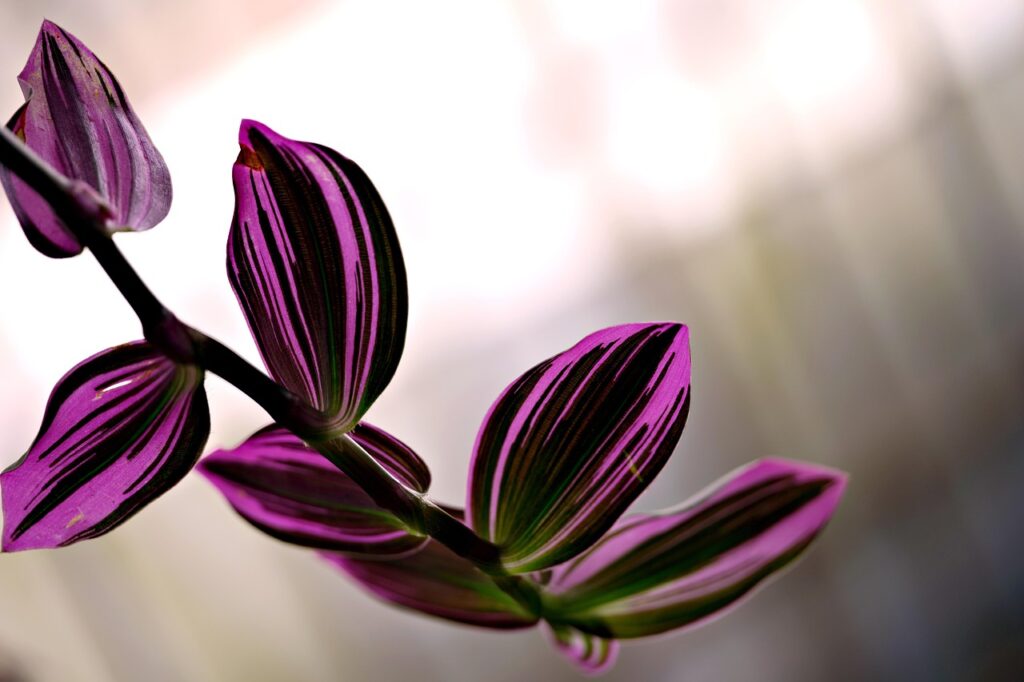
Leaves are simple, alternate, and sheathing at the base, wrapping partially around the stem. They are often lance-shaped or ovate and may display solid green, purple, silver, or striped variegation. The surface texture ranges from smooth and glossy to slightly hairy, depending on the species. Leaf coloration is one of the most distinguishing features of the genus.
Flowers:
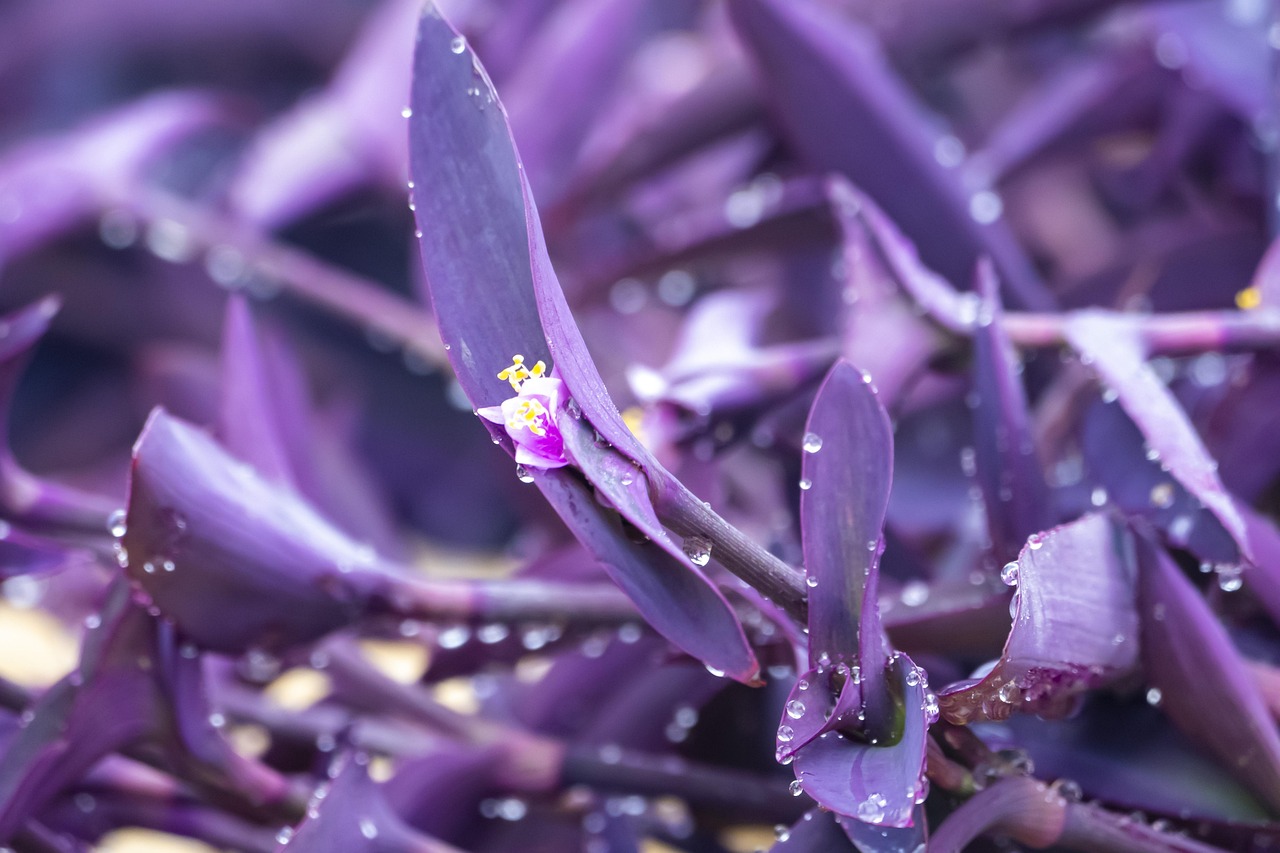
Flowers are small and typically composed of three petals, a characteristic feature of the Commelinaceae family. Petals are often bright purple, pink, blue, or white. The flowers are short-lived, often lasting a single day, but may appear in succession over an extended blooming period. Stamens are frequently prominent and may have distinctive filament hairs.
Fruits:
The fruit is a small capsule containing several seeds. The capsule develops after pollination and splits open when mature.
Roots:
Tradescantia plants develop fibrous root systems. In creeping species, roots may form at nodes along trailing stems, contributing to spreading growth patterns.
Plant Classification & Growth Habit
Tradescantia is classified within the Commelinaceae family, a group characterized by herbaceous plants with simple leaves and three-petaled flowers. The genus encompasses species adapted to a wide range of ecological environments.
Botanically, Tradescantia species are:
- Herbaceous perennials
- Often semi-succulent in stem structure
- Ground-covering or trailing in growth form
- Clump-forming or mat-forming in some species
Growth habits vary significantly between species. Some exhibit upright clumping forms commonly found in temperate regions, while others demonstrate low-growing, creeping habits more typical of tropical species.
Common Types / Varieties / General Classifications
The genus includes numerous species and cultivated forms. Several widely recognized species include:
- Tradescantia zebrina – Noted for purple and silver-striped foliage.
- Tradescantia pallida – Characterized by elongated purple leaves.
- Tradescantia fluminensis – Features green or variegated trailing foliage.
- Tradescantia virginiana – An upright species with grass-like leaves and prominent flowers.
- Tradescantia spathacea (often classified under Rhoeo) – Recognized for its rosette form and contrasting leaf coloration.
These species vary in plant architecture, leaf pigmentation, and regional origin, but share common floral structure and vegetative traits typical of the genus.
Native Range & Distribution
Tradescantia species are native to the Americas, ranging from southern Canada through the United States, Mexico, Central America, and into South America. Different species occupy distinct ecological niches, including woodland clearings, grasslands, riverbanks, and forest understories.
Temperate species such as Tradescantia virginiana occur in North American prairies and open woodlands, while tropical species like Tradescantia zebrina and Tradescantia fluminensis originate in Mexico and South America.
Due to ornamental cultivation, Tradescantia species have been introduced to various regions worldwide. In some climates, certain species have naturalized beyond their original native range.
Cultural, Culinary, or Traditional Context
The genus name Tradescantia honors John Tradescant the Elder and John Tradescant the Younger, English naturalists and plant collectors active during the 17th century. Their contributions to botanical exploration influenced early plant classification and horticulture.
Tradescantia species have long been valued in ornamental horticulture for their foliage patterns and adaptability to indoor and outdoor decorative settings. In some regions, particular species have been associated with local folklore or informal naming traditions.
The common name “Spiderwort” is believed to reference the web-like appearance of the sticky floral filaments or the sap’s thread-like quality. The name “Wandering Jew,” historically used for trailing species, has cultural and linguistic origins tied to European folklore; alternative common names such as “Wandering Dude” are increasingly used in contemporary contexts.
Interesting Facts
- Tradescantia flowers typically last only one day but bloom sequentially over extended periods.
- Some species exhibit natural color changes in response to environmental factors such as light intensity.
- The genus includes both upright prairie species and trailing tropical species.
- Tradescantia has been used in scientific research due to its visible chromosome structure in certain species.
- The plant’s sheathing leaf bases are characteristic of the Commelinaceae family.
FAQs
Is Tradescantia a single species or a genus?
Tradescantia is a genus that includes more than 70 species.
Why is it called Spiderwort?
The name likely refers to the thread-like sap or the delicate, web-like appearance of flower filaments.
Are all Tradescantia plants trailing?
No. Some species grow upright in clumps, while others have creeping or trailing growth habits.
Is Tradescantia related to succulents?
Tradescantia is not classified as a true succulent, though some species have semi-succulent stems and leaves.
Conclusion
Tradescantia is a diverse genus of herbaceous perennial plants native to the Americas. Characterized by simple sheathing leaves, three-petaled flowers, and variable growth forms, it occupies a distinct place within the Commelinaceae family. Its broad distribution, ornamental diversity, and botanical distinctiveness contribute to its continued recognition in plant collections and ecological studies.
Plants Info provides a structured plant database designed for learning and reference purposes. Each entry presents consistent botanical information to support plant identification, classification, and general understanding.