Introduction
Bay Laurel (Laurus nobilis) is an aromatic evergreen tree or large shrub belonging to the laurel family, Lauraceae. It is widely recognized for its glossy leaves, which have held botanical, culinary, and cultural importance for thousands of years. Native to the Mediterranean region, the plant has been associated historically with symbolism, literature, and traditional food practices.
Classification
In ancient civilizations, particularly in Greece and Rome, bay laurel leaves were fashioned into wreaths symbolizing honor, achievement, and authority. Today, the species remains significant both as an ornamental evergreen and as a historically valued aromatic plant. Its enduring presence in horticulture and cultural history makes it one of the most recognized members of the Lauraceae family.
Quick Plant Information
| Field | Information |
|---|---|
| Common Name(s) | Bay Laurel, Sweet Bay, True Laurel, Grecian Laurel |
| Scientific Name | Laurus nobilis |
| Family | Lauraceae |
| Plant Type | Evergreen shrub or small tree |
| Lifespan | Perennial |
| Growth Habit / Form | Upright, dense, bushy to tree-form |
| Native Range | Mediterranean region |
| Climate Adaptation / Habitat Type | Mediterranean climates; woodland margins, rocky slopes |
| Leaf Type | Simple, leathery, aromatic |
| Flower Color(s) | Pale yellow-green |
| Fruit Type | Berry (drupe) |
| Evergreen / Deciduous | Evergreen |
Botanical Description
Bay Laurel is a slow-growing evergreen species that may reach heights of 7–18 meters (23–59 feet) in tree form, though it commonly remains smaller when cultivated as a shrub. Its growth habit is typically upright and compact, forming a dense canopy of glossy foliage.
Stem and Bark:
The trunk is generally straight with smooth, dark gray bark in younger specimens, gradually becoming rougher and fissured with age. Branching is dense, contributing to its full and structured appearance.
Leaves:
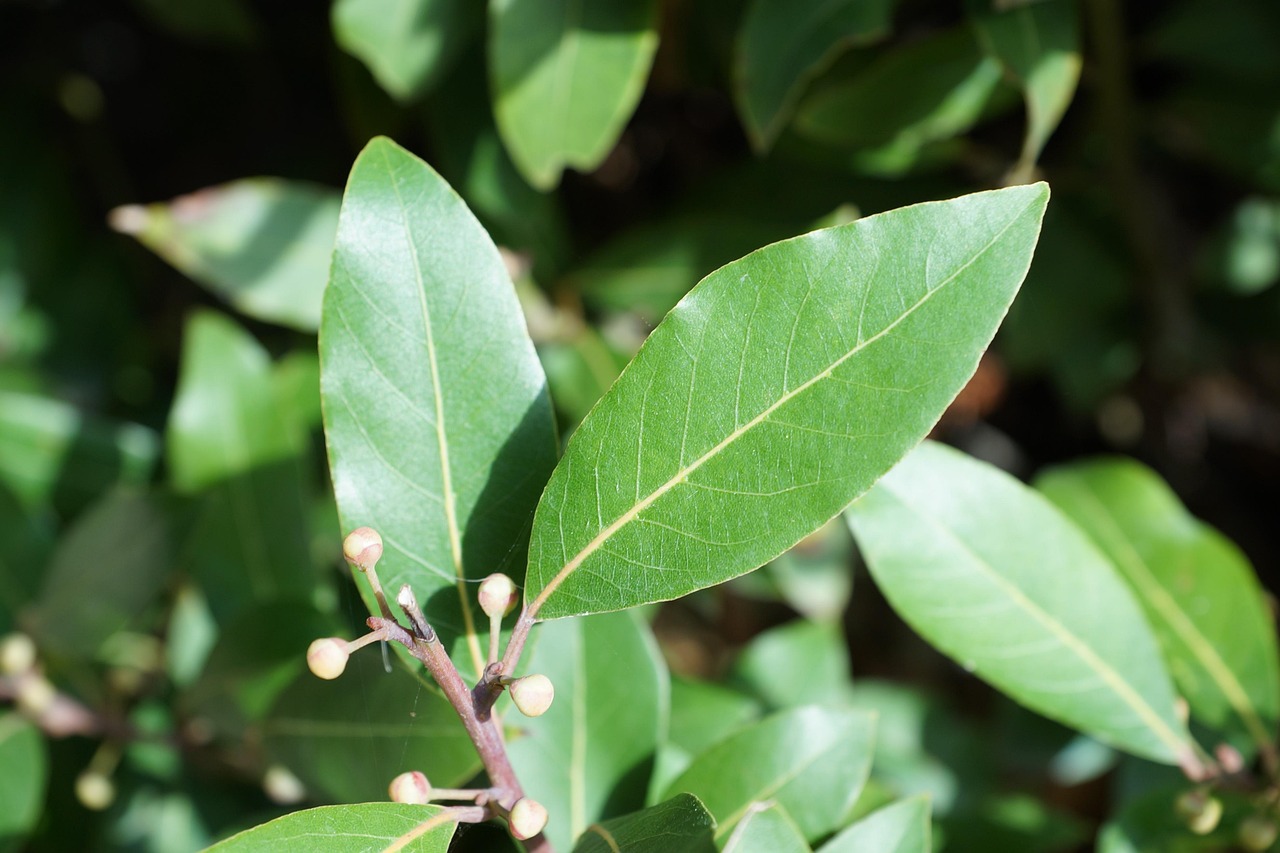
Leaves are simple, alternate, and lanceolate to elliptic in shape. They measure approximately 5–10 cm (2–4 inches) in length. The surface is dark green and glossy on the upper side, with a lighter underside. The texture is leathery, and when crushed, the leaves release a characteristic aromatic scent due to essential oils contained within specialized glands.
Flowers:
Bay Laurel is dioecious, meaning individual plants bear either male or female flowers. The small flowers appear in clusters in the leaf axils and are pale yellow to yellow-green in color. They are modest in appearance and typically bloom in spring.
Fruits:
Female plants produce small, oval berries (drupes) that ripen from green to dark purple or black. Each fruit contains a single seed enclosed within fleshy tissue.
Roots:
The root system is woody and branching, supporting its perennial evergreen structure. It is generally well-developed and adapted to Mediterranean soil conditions.
Plant Classification & Growth Habit
Laurus nobilis is classified as an evergreen broadleaf tree or shrub within the Lauraceae family. Members of this family are often aromatic due to the presence of volatile oils in their leaves and tissues.
Botanically, Bay Laurel is:
- A woody perennial
- An evergreen species retaining foliage year-round
- Typically upright in growth form
- Capable of being maintained as a shrub or developing into a small tree
Its natural form tends to be dense and bushy, with compact branching. The species responds structurally to pruning in cultivated environments, which contributes to its frequent use in formal landscapes, though its inherent classification remains that of a small evergreen tree or shrub.
Common Types / Varieties / General Classifications
While Laurus nobilis is a single species, it is sometimes categorized into cultivated forms based on leaf shape and ornamental traits.
Common classifications include:
- Standard Bay Laurel – Traditional broad, lance-shaped leaves.
- Willow-Leaf Bay (Laurus nobilis ‘Angustifolia’) – Narrower leaves with a more slender appearance.
- Aurea Form – Leaves exhibit a golden tint, especially in new growth.
These variations differ primarily in leaf morphology and visual characteristics rather than fundamental botanical structure.
Native Range & Distribution
Bay Laurel is native to the Mediterranean basin, including southern Europe, North Africa, and parts of Western Asia. It is historically associated with regions such as Greece, Italy, Turkey, and Spain.
In its natural habitat, the plant is found along woodland margins, rocky hillsides, and coastal regions characteristic of Mediterranean climates. It is adapted to areas with mild, wet winters and warm, dry summers.
Over centuries, Laurus nobilis has been introduced to other temperate and subtropical regions worldwide. It is now present in parts of North America, South America, Australia, and Southern Africa, particularly in areas with climates similar to its region of origin.
Cultural, Culinary, or Traditional Context
Bay Laurel holds a prominent place in classical history. In ancient Greece, laurel wreaths were used to crown victors in athletic competitions and to honor poets and scholars. The plant was sacred to the god Apollo and symbolized wisdom and achievement. The term “baccalaureate” is historically linked to the Latin bacca lauri, meaning “berry of the laurel.”
In Roman society, laurel wreaths became emblems of military victory and imperial authority. Emperors and generals were often depicted wearing crowns made from bay leaves.
Culinarily, dried bay leaves have long been incorporated into traditional dishes across Mediterranean cuisines. The leaves are typically used as a flavoring element in soups, stews, and sauces. This culinary association has contributed to its global recognition.
Economically, Bay Laurel has also been cultivated for ornamental landscaping and for its aromatic leaves used in various industries, including perfumery and specialty products.
Interesting Facts
- Bay Laurel wreaths were historically used as symbols of triumph and intellectual accomplishment.
- The genus name Laurus is derived from Latin, reflecting its deep association with Roman culture.
- The plant is dioecious, meaning male and female flowers grow on separate plants.
- The berries were historically pressed for oil in certain Mediterranean regions.
- Bay Laurel is one of the few culinary herbs that grows as a woody evergreen tree.
FAQs
Is Bay Laurel the same as all “bay leaves” sold commercially?
True bay leaves come from Laurus nobilis. However, other plants are sometimes referred to as “bay” in different regions, and they may belong to unrelated species.
Is Bay Laurel a tree or a shrub?
It is botanically a small evergreen tree, but it often appears as a shrub depending on its growth form and management.
Are male and female flowers on the same plant?
No. Laurus nobilis is dioecious, meaning male and female flowers occur on separate plants.
Is Bay Laurel related to cherry laurel?
No. Cherry laurel belongs to a different genus (Prunus) and family (Rosaceae), despite the shared common name “laurel.”
Conclusion
Bay Laurel (Laurus nobilis) is an evergreen Mediterranean species recognized for its aromatic foliage, historical symbolism, and longstanding cultural significance. As a member of the Lauraceae family, it represents a classic example of an evergreen broadleaf tree adapted to warm temperate climates. Its botanical structure, dioecious flowering system, and distinctive leathery leaves distinguish it within both ornamental and cultural contexts.
With roots in ancient traditions and continued global recognition, Bay Laurel remains a notable species in botanical classification and historical study.
Plants Info provides a structured plant database for learning and reference. Each entry presents clear, consistent botanical information to support plant identification, classification, and general understanding.