Sweet Flag Plant: Quick Facts, Names, and What You Should Know
Quick Answer
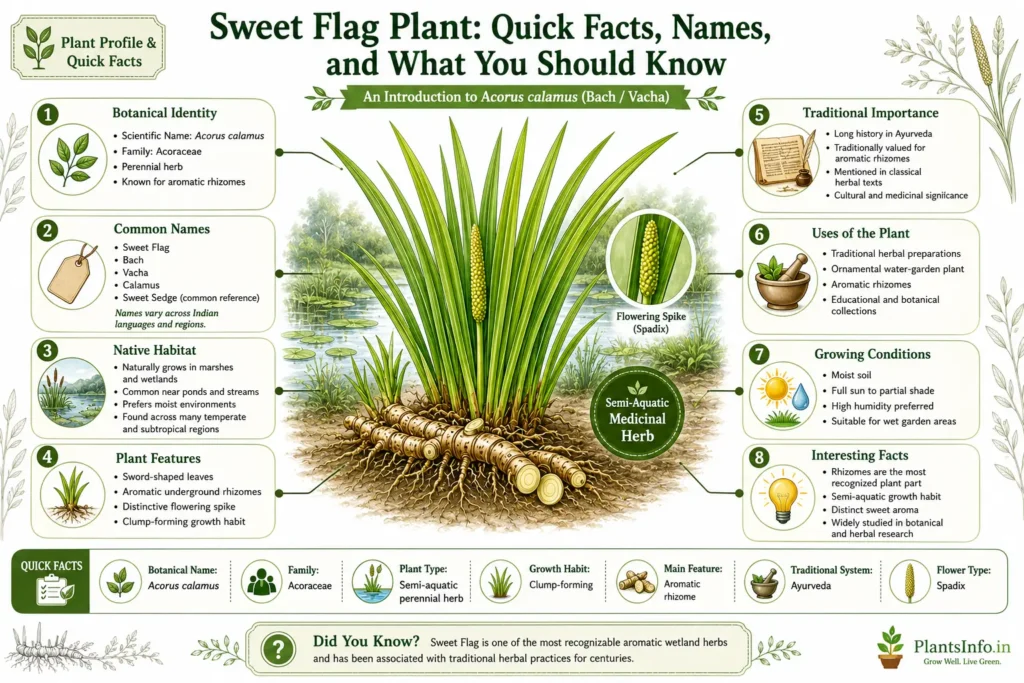
Slice open a fresh rhizome of Bach and the smell hits before you process what you are holding — sharp, camphoraceous, almost medicinal-sweet, unlike anything else in the Indian botanical world. That scent is not incidental; it is the reason this plant has been traded, prescribed, and revered across Asia for millennia.
See also: Sweet Flag plant profile, how to grow it, common problems, its flowering season, and its benefits.
Names in Different Languages
| Language | Name |
|---|---|
| English | Sweet Flag, Calamus, Myrtle Flag |
| Hindi | Bach, Vach, Ghorvach |
| Bengali | Bach, Bacha |
| Tamil | Vashambu, Vasambu |
| Telugu | Vasa, Baje |
| Marathi | Vekhand, Bach |
| Kannada | Baje, Bache |
| Malayalam | Vayambu, Vacha |
| Gujarati | Ghodavaj, Vaj |
| Punjabi | Waj, Ghorbach |
| Sanskrit | Vacha, Ugragandha, Shadgrantha |
| Scientific name | Acorus calamus L. |
| Family | Acoraceae |
The Sanskrit name Vacha (meaning “speech” or “voice”) is widely used in Ayurvedic literature and herbal traditions throughout India. Vasambu (or Vashambu) is the most widely recognised regional name in Tamil Nadu, where the plant has a long history of traditional household and Ayurvedic use.
Recommended Products
Disclosure: As an Amazon Associate, PlantsInfo may earn from qualifying purchases.
🌱 Growing Essentials
The following products can help with container gardening, potting, root development, soil management, and healthy plant growth.
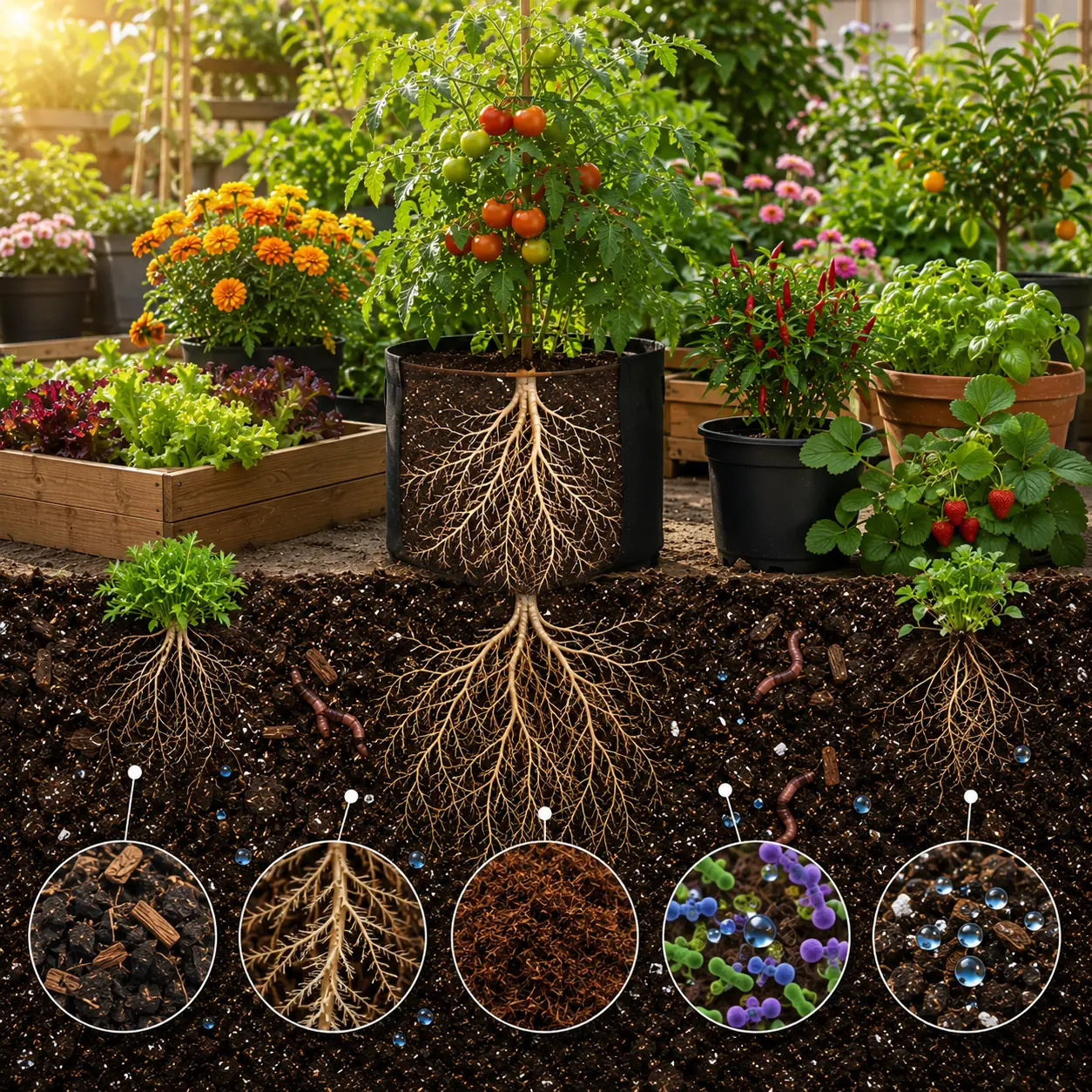
Organic Potting Soil Mix
Provides nutrients, structure, and healthy growing conditions for container plants.
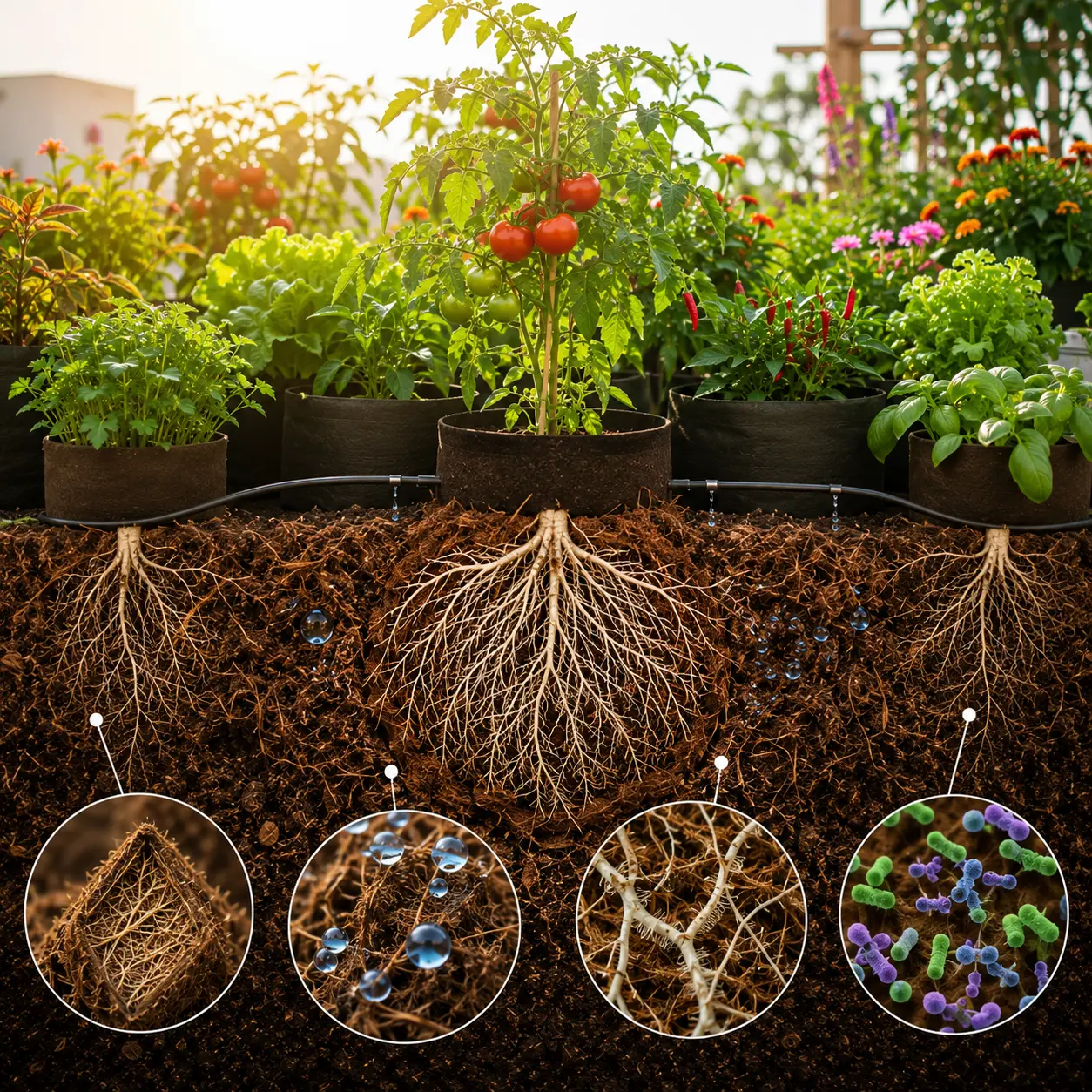
Coco Peat Growing Medium
Enhances moisture retention while maintaining excellent root-zone aeration.

Grow Bags for Plants
Improve drainage, root aeration, and vegetable production in limited spaces.

Plastic Pots for Plants
Ideal containers for seedlings, ornamentals, herbs, and balcony gardens.
What Does It Look Like?
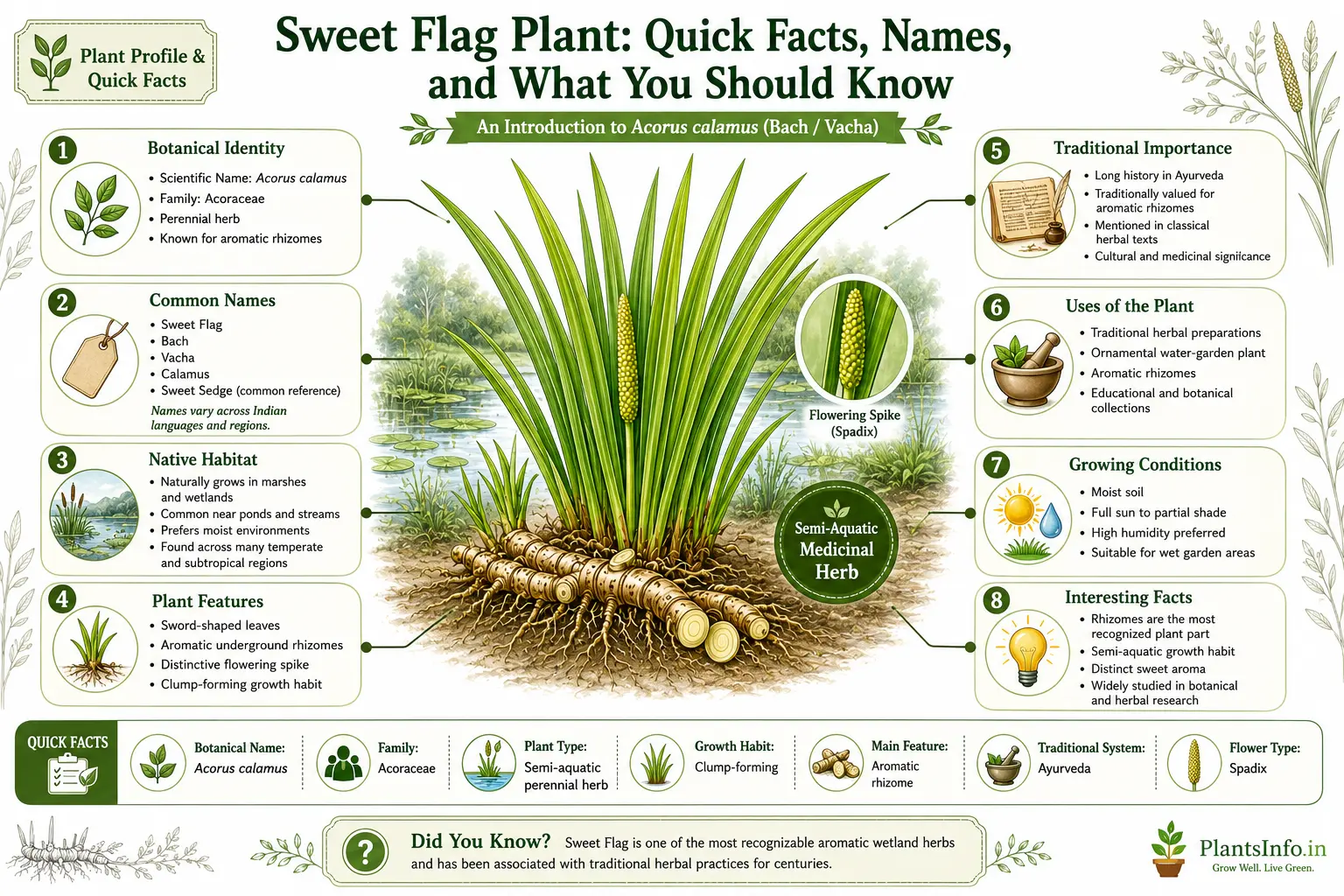
Sweet Flag is a semi-aquatic herb that grows 60–120 cm tall in dense, grass-like clumps. The leaves are sword-shaped, bright mid-green, and slightly twisted at the midrib — a reliable distinguishing feature. They emerge in a fan-like arrangement from the rhizome, closely resembling iris foliage but without the iris’s prominent central rib.
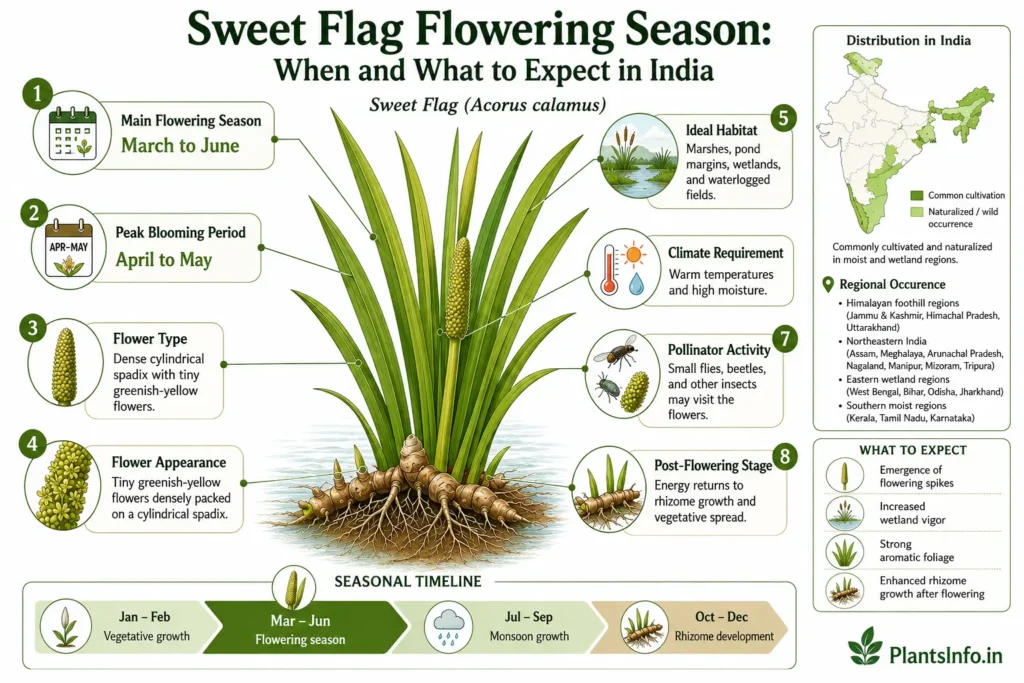
Flowers are produced on a cylindrical, yellowish-green spadix (a club-like spike) that emerges obliquely from the leaf, appearing inconspicuous and easy to miss. In Indian conditions, flowering is erratic and infrequent in cultivated plants. The rhizome — the part most people grow it for — is brown-surfaced, cream-white inside, strongly aromatic, and horizontally spreading just below or at the soil surface. The unmistakable detail: pinch any part of the plant, leaf, or root, and the sharp camphorous scent is instant and strong.
Where Does It Grow in India?
Sweet Flag is found naturally along the banks of slow-moving rivers, wetlands, and marshy ground across a wide altitude range — from the plains of West Bengal and Assam to the foothills of the Himalayas in Uttarakhand and Himachal Pradesh, reaching up to approximately 2,200 metres. It is cultivated in home gardens, nurseries, and small medicinal herb plots in most Indian states where rainfall exceeds 1,200 mm annually or reliable irrigation is available.
The Northeast, particularly Assam, Manipur, and Meghalaya, remains an important region for both wild and cultivated Sweet Flag populations. West Bengal, particularly the districts of Nadia, Murshidabad, and the Sundarbans fringe, has a long tradition of cultivated Bach in household gardens. In the South, Kerala and coastal Karnataka are the primary growing regions.
Urban distribution is predominantly in pot and container gardens, water features, and home Ayurvedic herb collections. Rural distribution centres on paddy-field edges, village pond margins, and medicinal crop plots attached to traditional households.
What Is It Used For?
Sweet Flag has four primary uses documented across Indian traditions. The rhizome is a classical Ayurvedic medicinal herb, particularly for cognitive and speech-related conditions — for full details, see the Benefits Guide. The dried root is used as a traditional grain preservative, placed among stored rice to deter insects. The aromatic root is burned as incense and used in ritual purification in several Indian traditions. The plant is cultivated as an ornamental for water gardens and pond margins.
In Mythology and Ancient Texts
Vacha is mentioned in the Charaka Samhita and the Ashtanga Hridayam — two of the foundational classical Ayurvedic texts — as a medhya rasayana, a herb for nourishing the intellect and speech faculty. Classical Ayurvedic texts, including the Charaka Samhita and Ashtanga Hridayam, describe Vacha as a valuable herb associated with intellect, speech, and mental clarity. The Sanskrit name Ugragandha (fierce-smelling) reflects both the sensory character of the root and the classical belief that strongly aromatic herbs carry particular penetrating power.
In folk traditions across Bengal and Assam, Bach root is associated with the protection of newborns — it is held near the infant or placed at the birth room threshold as a purifying and protective agent. This practice blends Ayurvedic application with animist protection ritual in ways characteristic of regional Indian folk medicine.
Is It Easy to Grow?
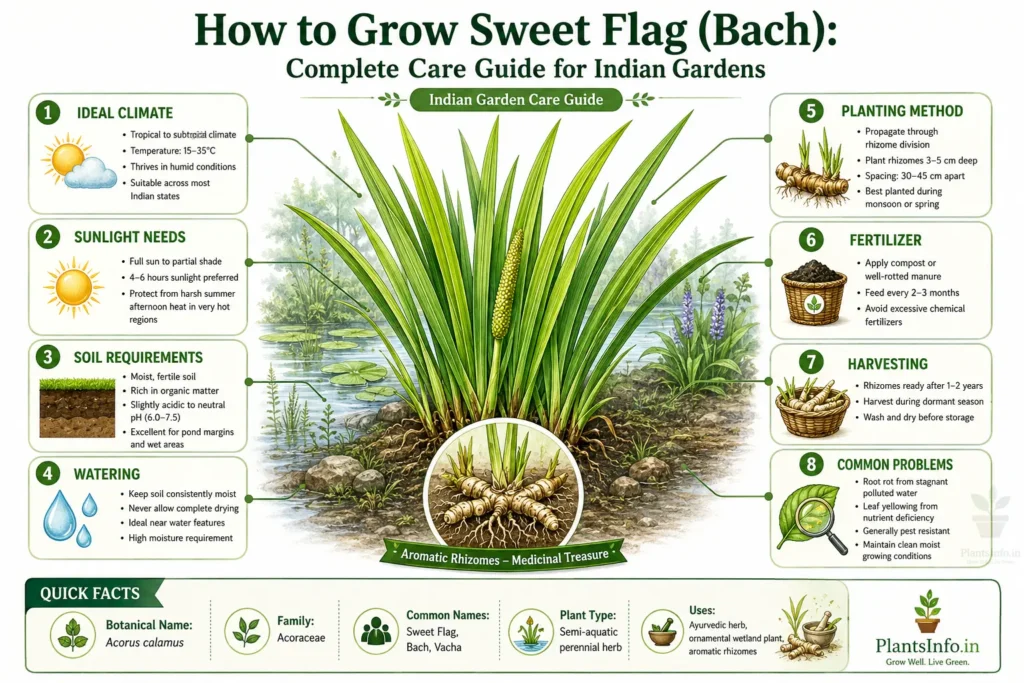
For gardeners willing to provide permanently moist or lightly flooded conditions, Bach is genuinely easy. The challenge is cultural rather than horticultural: most people apply standard potting and watering practices and then wonder why the leaves yellow and die back. Given a pot tray kept filled with water or a boggy garden corner, the plant is vigorous, fast-spreading, and low-maintenance across most of India.
⚠ Special Flags
Toxicity: The rhizome contains beta-asarone, which is considered potentially harmful in large doses. Internal preparations should be taken only under qualified Ayurvedic or medical supervision. The plant is not considered toxic on external contact for most people. Keep internal use preparations away from children and do not administer to infants without professional guidance, despite traditional practices.
Commonly confused with: Iris (Iris spp.) in the vegetative stage — the leaves are visually similar. The distinguishing test is the scent: crushing a Sweet Flag leaf produces a strong camphoraceous smell; iris leaves are odourless. The rhizomes also differ sharply in appearance and smell on cutting.
Frequently Asked Questions
Is Sweet Flag safe to grow in a garden with children and pets?
The growing plant poses minimal contact risk. The rhizome should be stored out of reach, as internal consumption in significant quantities is not safe without supervision — particularly for young children.
Can Bach be grown in standing water like a true aquatic?
Yes — it thrives with roots submerged in up to 5 cm of water. It is not a fully submerged aquatic plant but grows comfortably in pond shallows and permanently flooded pot trays.
Is Wild Bach the same as cultivated Bach?
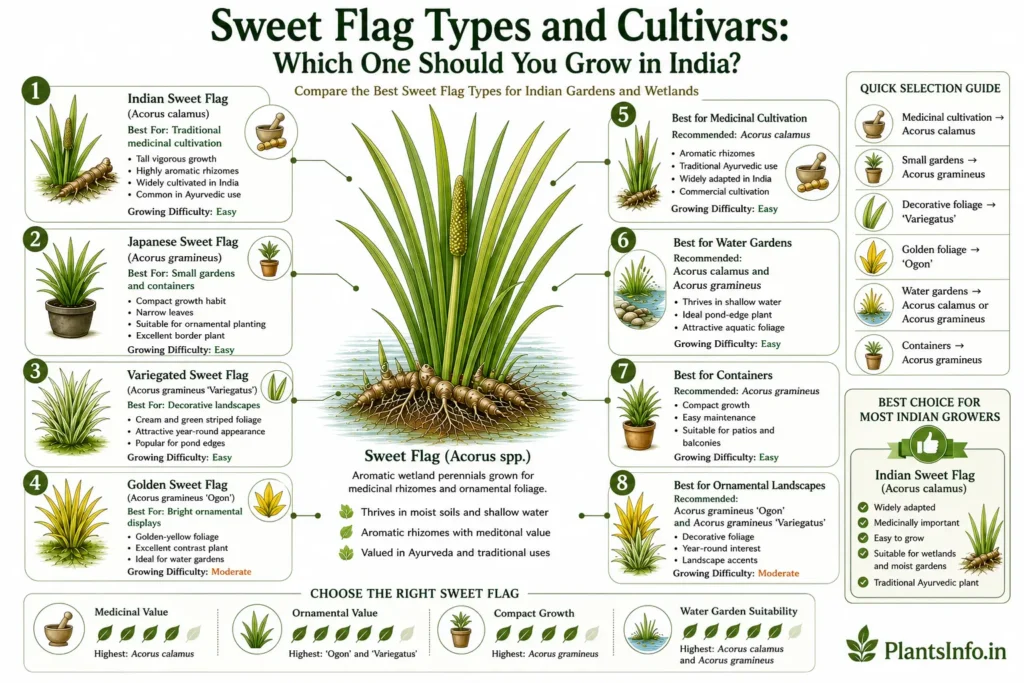
Wild and cultivated plants are the same species, but cultivated plants in India are often selected for vigorous growth and larger rhizome production. Wild populations are declining in some regions; cultivated material from nurseries is the responsible choice.
Sweet Flag is one of those plants that rewards you for looking closely — the scent, the history, and the habit are all remarkable once you know what you are growing.