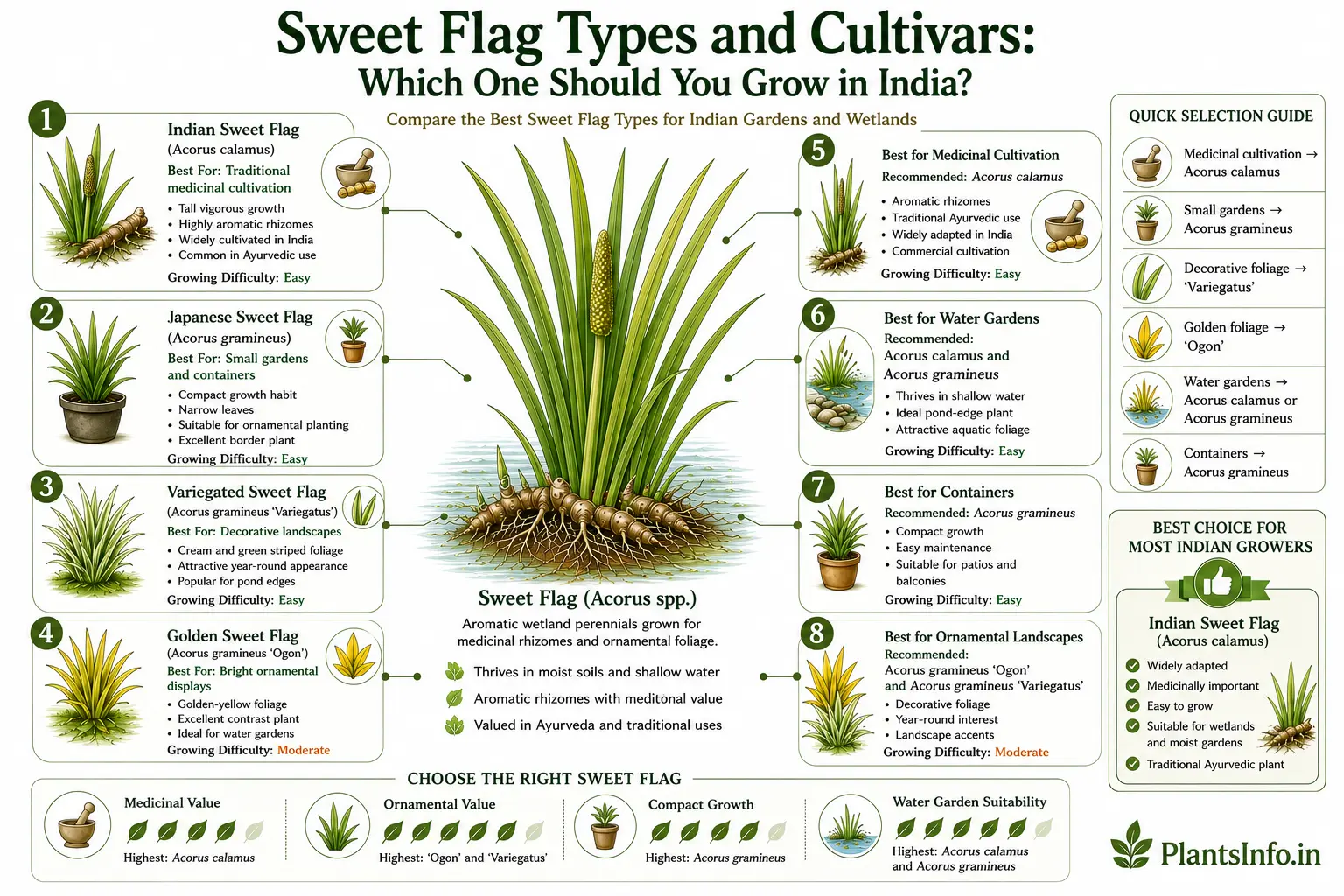
Sweet Flag Varieties: Which One Should You Grow in India?
Quick Answer
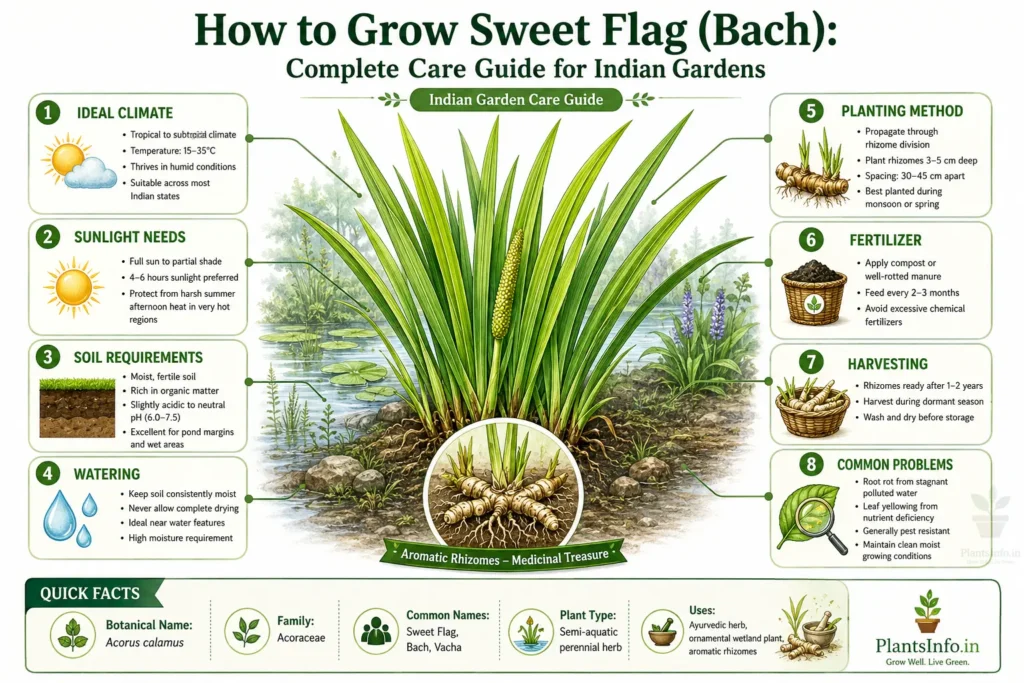
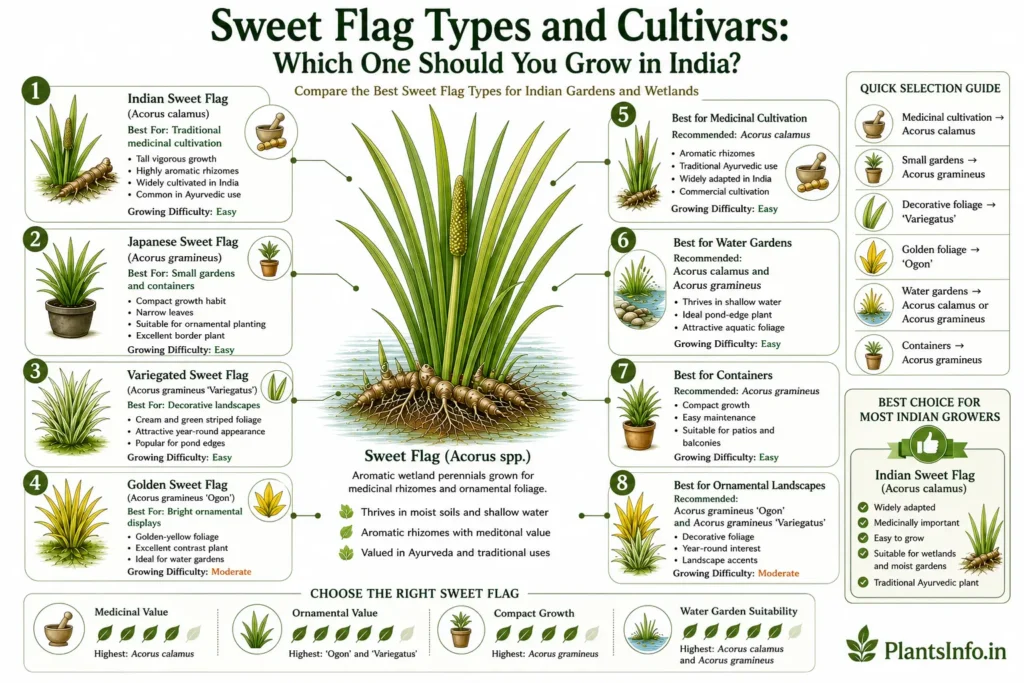
For most Indian home gardeners, the standard cultivated form of Sweet Flag (Bach) is the best choice. It is widely available, vigorous, adaptable to a range of growing conditions, and suitable for both ornamental and traditional household uses. Gardeners looking for a more compact plant for containers or water features may prefer narrow-leaf forms, while locally adapted plants sourced from established regional growers often perform exceptionally well in their native climate.
See also: Sweet Flag plant profile, how to grow it, common problems, its flowering season, and its benefits.
The variety question in Sweet Flag is less about flowers or foliage colour and more about how you intend to use the plant. A gardener growing Bach for a decorative pond has different priorities from someone growing it as part of a medicinal herb collection. Fortunately, all commonly cultivated forms share the same basic care requirements and characteristic aromatic rhizomes.
Recommended Products
Disclosure: As an Amazon Associate, PlantsInfo may earn from qualifying purchases.
🌱 Growing Essentials
The following products can help with container gardening, potting, root development, soil management, and healthy plant growth.
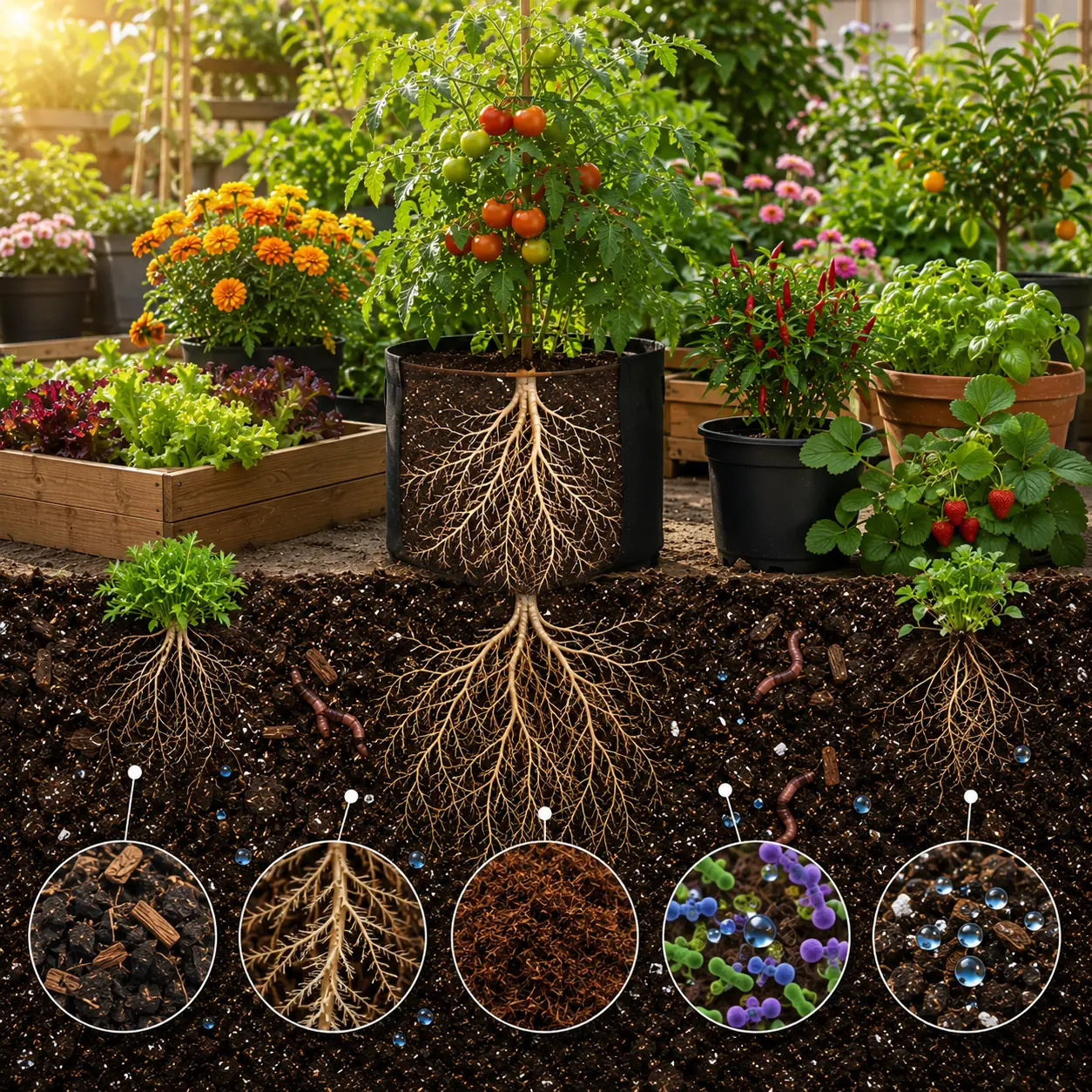
Organic Potting Soil Mix
Provides nutrients, structure, and healthy growing conditions for container plants.
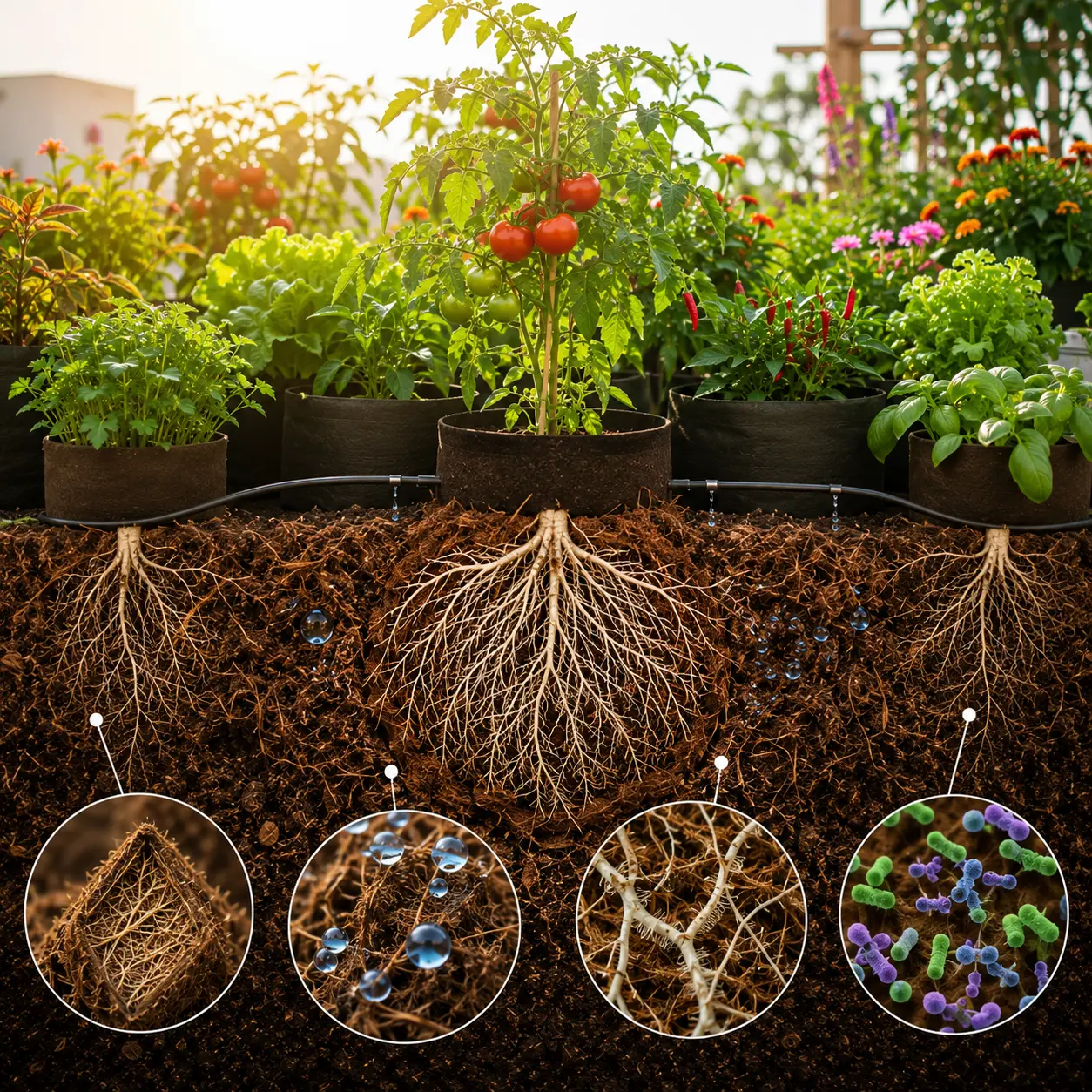
Coco Peat Growing Medium
Enhances moisture retention while maintaining excellent root-zone aeration.

Grow Bags for Plants
Improve drainage, root aeration, and vegetable production in limited spaces.

Plastic Pots for Plants
Ideal containers for seedlings, ornamentals, herbs, and balcony gardens.
Quick Variety Selector
| Variety/Form | Characteristics | Typical Size | Best For | Notes |
|---|---|---|---|---|
| Standard cultivated Sweet Flag | Robust growth, broad leaves, vigorous rhizome production | 80–120 cm | General gardening, herb gardens, traditional use | Most commonly available form |
| Narrow-leaf Sweet Flag | Slimmer, more graceful foliage and restrained growth | 50–80 cm | Containers, ornamental ponds, water gardens | Easier to manage in small spaces |
| Local or regional selections | Long-established plants adapted to local conditions | Variable | Home gardens, traditional cultivation | Often sourced from nearby growers or household gardens |
| Ornamental Sweet Flag forms | Selected for appearance rather than rhizome production | Variable | Landscaping and decorative plantings | Availability varies by nursery |
When purchasing Sweet Flag, focus on plant health, vigorous rhizomes, and reliable identification rather than specific genetic classifications. A healthy, well-established plant from a reputable nursery will generally outperform a poorly maintained specimen regardless of variety.
For most gardeners, the standard cultivated form remains the simplest and most dependable option. If space is limited or aesthetics are the primary concern, a narrow-leaf form may be a better fit.
Varieties in Detail
Standard Cultivated Sweet Flag
The standard cultivated form of Sweet Flag is the type most commonly available from Indian nurseries and medicinal plant suppliers. It is valued for its vigorous growth, strong aromatic rhizomes, and adaptability to a wide range of growing conditions. Mature plants produce dense clumps of upright, sword-like leaves and gradually expand through rhizome growth.
For most home gardeners, this is the most practical choice. It establishes quickly, tolerates regular harvesting, and performs well in both garden beds and large containers when adequate moisture is provided. If you simply want a reliable Sweet Flag plant for ornamental, traditional, or household use, the standard cultivated form is usually the best option.
Narrow-Leaf Sweet Flag
Narrow-leaf forms of Sweet Flag are distinguished by their slimmer, more gracefully arching foliage. Compared with standard plants, they typically create a lighter, more refined appearance, making them popular in decorative water gardens, pond margins, and container displays.
The narrower leaves make these forms particularly attractive in small spaces where the broader foliage of standard Sweet Flag may appear too coarse or vigorous. While the aromatic rhizomes remain characteristic of the species, narrow-leaf plants are generally chosen for their ornamental qualities rather than maximum rhizome production.
For terrace gardens, balcony water features, and ornamental container collections, narrow-leaf Sweet Flag is often the easiest form to manage over the long term.
Local and Regional Selections
Across India, Sweet Flag has been cultivated in home gardens, wetlands, and traditional herb plots for generations. As a result, many local populations have become well adapted to their regional climate, soil conditions, and seasonal rainfall patterns.
These locally maintained plants may vary slightly in height, leaf width, vigour, and rhizome characteristics. While they are rarely sold under formal variety names, they often perform exceptionally well when grown within the same region from which they originated.
For gardeners who have access to divisions from established local plants, regional selections can be an excellent choice. Their long history of cultivation under local conditions often contributes to reliable establishment and growth.
Ornamental Sweet Flag Relatives
Some nurseries also sell ornamental Sweet Flag relatives and cultivars intended primarily for landscaping. These may include compact forms, variegated foliage selections, or smaller species used around ponds and water features.
While attractive, ornamental selections may differ in size, growth habit, and rhizome development from the traditional medicinal Sweet Flag. Gardeners interested in herbal or traditional uses should always confirm the plant’s identity before purchase.
When in doubt, buy from a reputable nursery, medicinal plant supplier, botanical garden sale, or government-supported herb nursery where plant identification is more likely to be accurate.
Head-to-Head Comparison
Standard Sweet Flag vs. Narrow-Leaf Sweet Flag
For most home gardeners, the choice comes down to growth habit rather than medicinal or botanical distinctions. Standard Sweet Flag is the more vigorous plant, producing larger clumps, broader leaves, and greater rhizome mass over time. It is ideal for gardeners who want a robust, low-maintenance plant that can naturalise in consistently moist areas.
Narrow-leaf Sweet Flag offers a more refined appearance. Its slimmer foliage and restrained growth make it easier to incorporate into ornamental landscapes, pond margins, and container gardens. While it produces the same characteristic aromatic rhizomes, it is generally chosen for aesthetics and ease of management rather than maximum rhizome production.
For large garden spaces, the standard form is usually the better choice. For small gardens, balconies, terraces, and decorative water features, narrow-leaf forms are often more practical.
Standard Sweet Flag vs. Local Garden Selections
Many gardeners obtain Sweet Flag from neighbours, local herb growers, or established household gardens rather than commercial nurseries. These locally maintained plants may not carry a formal variety name, but they are often well adapted to the regional climate and growing conditions.
Commercial nursery stock offers consistency and availability, while local selections may provide the advantage of long-term adaptation to local rainfall patterns, temperatures, and soils. For most gardeners, a healthy local division is just as valuable as a nursery-grown plant.
How to Choose for Your Space
Container or Terrace Garden
Choose a narrow-leaf form if available, as it is generally easier to manage in containers over the long term. Standard Sweet Flag can also be grown successfully in large pots, provided adequate moisture is maintained, and the clump is divided periodically to prevent overcrowding.
Small Ground Plot
Standard Sweet Flag is usually the best option for small garden beds. Plant it in the dampest area of the garden where the soil remains consistently moist. Given suitable conditions, it will gradually expand into an attractive clump over several growing seasons.
Water Gardens and Pond Margins
Both standard and narrow-leaf forms perform well around water features. Standard plants create a bold, lush appearance, while narrow-leaf forms provide a more delicate and ornamental effect. Choose according to the visual style you prefer.
Dedicated Herb Garden
Any healthy, correctly identified Sweet Flag plant can be grown successfully in a medicinal or traditional herb garden. Focus on obtaining vigorous planting material from a reputable nursery, medicinal plant supplier, or local grower rather than searching for specific genetic types that may be difficult to verify.
Regional Suitability
North India
Sweet Flag grows well throughout North India, where adequate moisture is available. In colder regions, foliage may decline during winter, but established rhizomes typically resume growth when temperatures rise in spring.
South India
The warm, humid climate of South India is highly suitable for Sweet Flag cultivation. Both standard and narrow-leaf forms perform well in gardens, containers, and water features when provided with consistent moisture.
Northeast India
The high rainfall and humid conditions of the Northeast are particularly favourable for Sweet Flag. Plants often grow vigorously in gardens, wetlands, and traditional herb plots throughout the region.
Hill Stations and Cooler Regions
Sweet Flag adapts well to many hill-station climates, provided the soil remains moist throughout the growing season. Growth may be slower at higher elevations, but healthy plants can remain productive for many years under suitable conditions.
Desi vs. Hybrid — What Should Gardeners Know?
Unlike many vegetable crops, Sweet Flag is not commonly marketed through named hybrid varieties in Indian nurseries. Most plants sold as Bach are propagated through rhizome division rather than seed, which means gardeners are typically choosing between commercially propagated nursery stock and locally maintained plants rather than between hybrid and desi varieties.
For most home gardeners, this distinction is less important than plant health and correct identification. A vigorous, well-established plant from a reputable source will generally perform better than a poorly maintained specimen regardless of its origin.
Local plants passed down through generations of cultivation may offer the advantage of adaptation to regional growing conditions, while nursery-grown stock is often easier to source and provides more consistent availability. Both can be excellent choices when properly identified and cared for.
Watch Out for Mislabelling
Sweet Flag is generally sold under its correct name, but occasional misidentification does occur, particularly in ornamental plant nurseries where several moisture-loving plants have a similar appearance.
One potential source of confusion is certain Iris species, whose upright, sword-shaped leaves can resemble Sweet Flag at first glance. A simple identification check is to gently crush a leaf. Sweet Flag produces a distinctive aromatic fragrance, while Iris foliage typically lacks the characteristic scent associated with Bach.
Another plant sometimes confused with Sweet Flag is Acorus gramineus, commonly known as Japanese Sweet Flag. This ornamental relative has much finer, grass-like foliage and usually remains considerably smaller than traditional Sweet Flag. While attractive in water gardens and decorative containers, it is grown primarily as an ornamental plant rather than for the larger aromatic rhizomes associated with Acorus calamus.
When purchasing Sweet Flag for a medicinal herb garden or traditional use, buy from reputable nurseries, medicinal plant suppliers, botanical gardens, or government-supported herbal plant programs whenever possible. These sources are generally more likely to provide correctly identified planting material.
Choose based on your gardening goals rather than simply buying the nearest available plant. Taking a few extra minutes to confirm identification at the nursery can help ensure that the Sweet Flag you grow is the plant you intended to cultivate.