How to Grow Lotus: Complete Care Guide for Indian Gardens
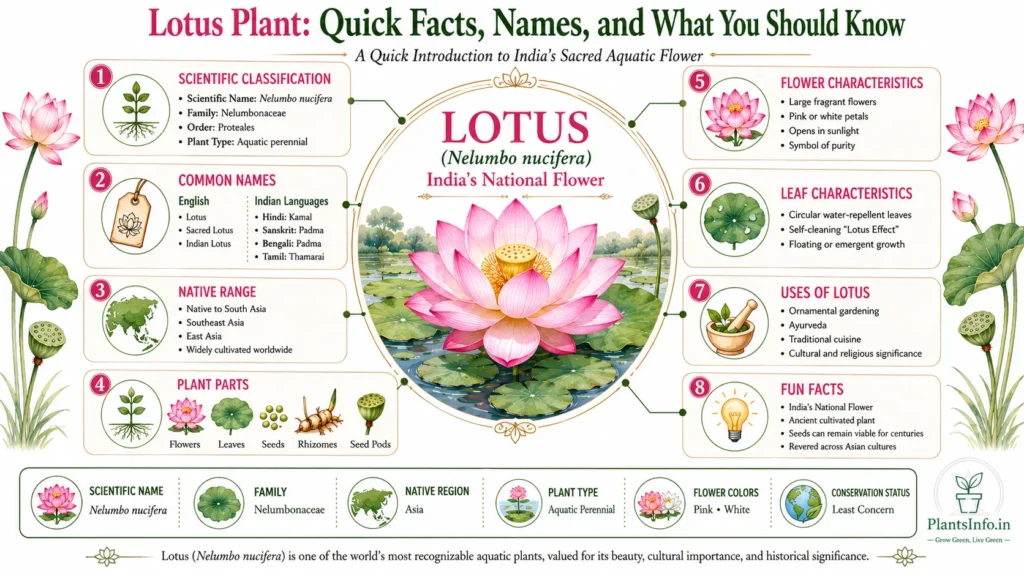
Quick Answer: Lotus (Nelumbo nucifera) grows well in containers, buckets, or small ponds at home across most of India. It needs full sun, still water, and heavy clay-rich soil — no drainage holes, no flowing water. With the right setup, most gardeners see their first flowers within two to three months of planting.
See also: Lotus plant profile, common problems, its flowering season, its benefits, and its varieties.
Most people think Kamal needs a temple pond or a farmer’s field. It doesn’t. A wide plastic tub on a sunny terrace is enough to grow India’s national flower at home — and once it flowers, it flowers abundantly.
Recommended Products
Disclosure: As an Amazon Associate, PlantsInfo may earn from qualifying purchases.
🌱 Growing Essentials
The following products can help with container gardening, potting, root development, soil management, and healthy plant growth.
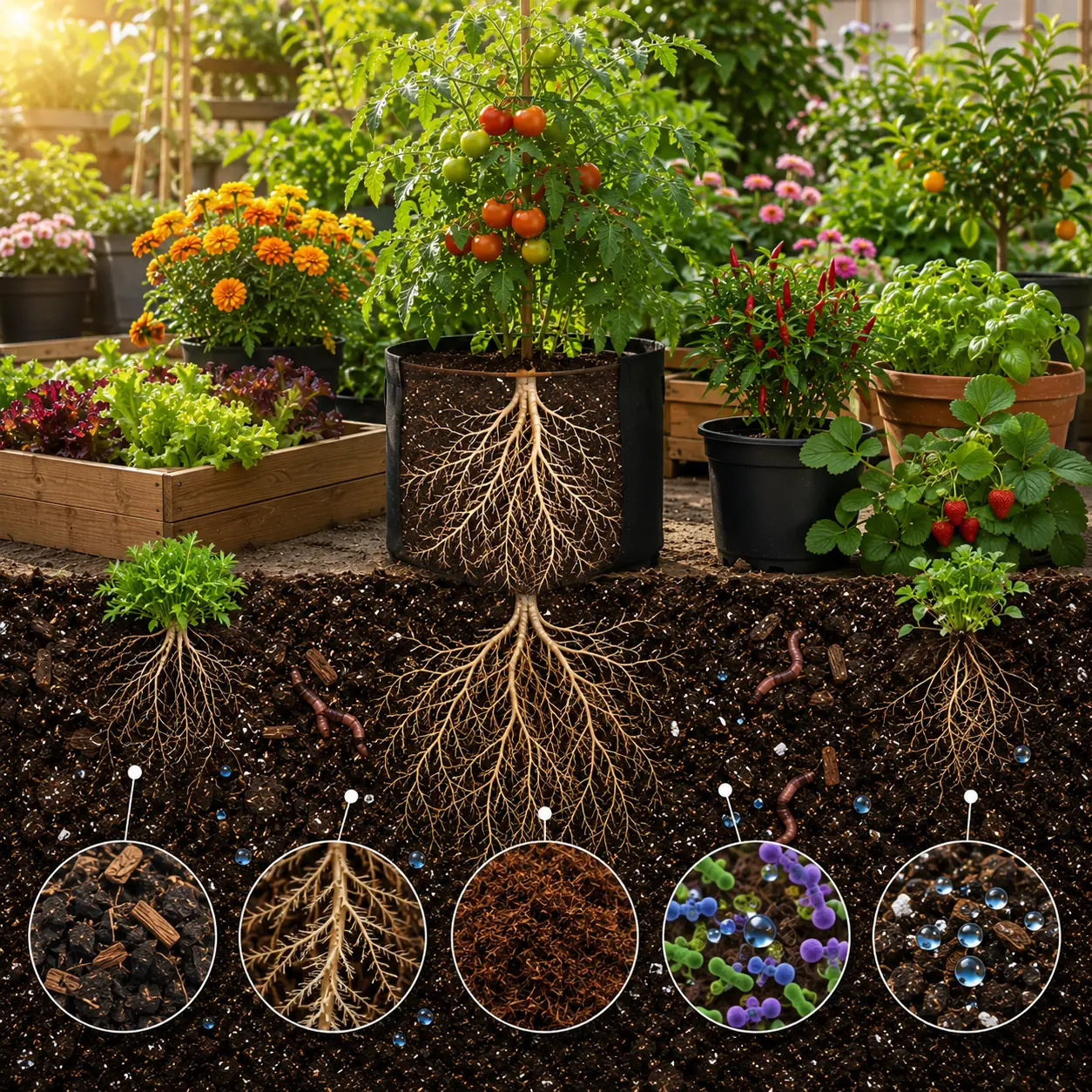
Organic Potting Soil Mix
Provides nutrients, structure, and healthy growing conditions for container plants.
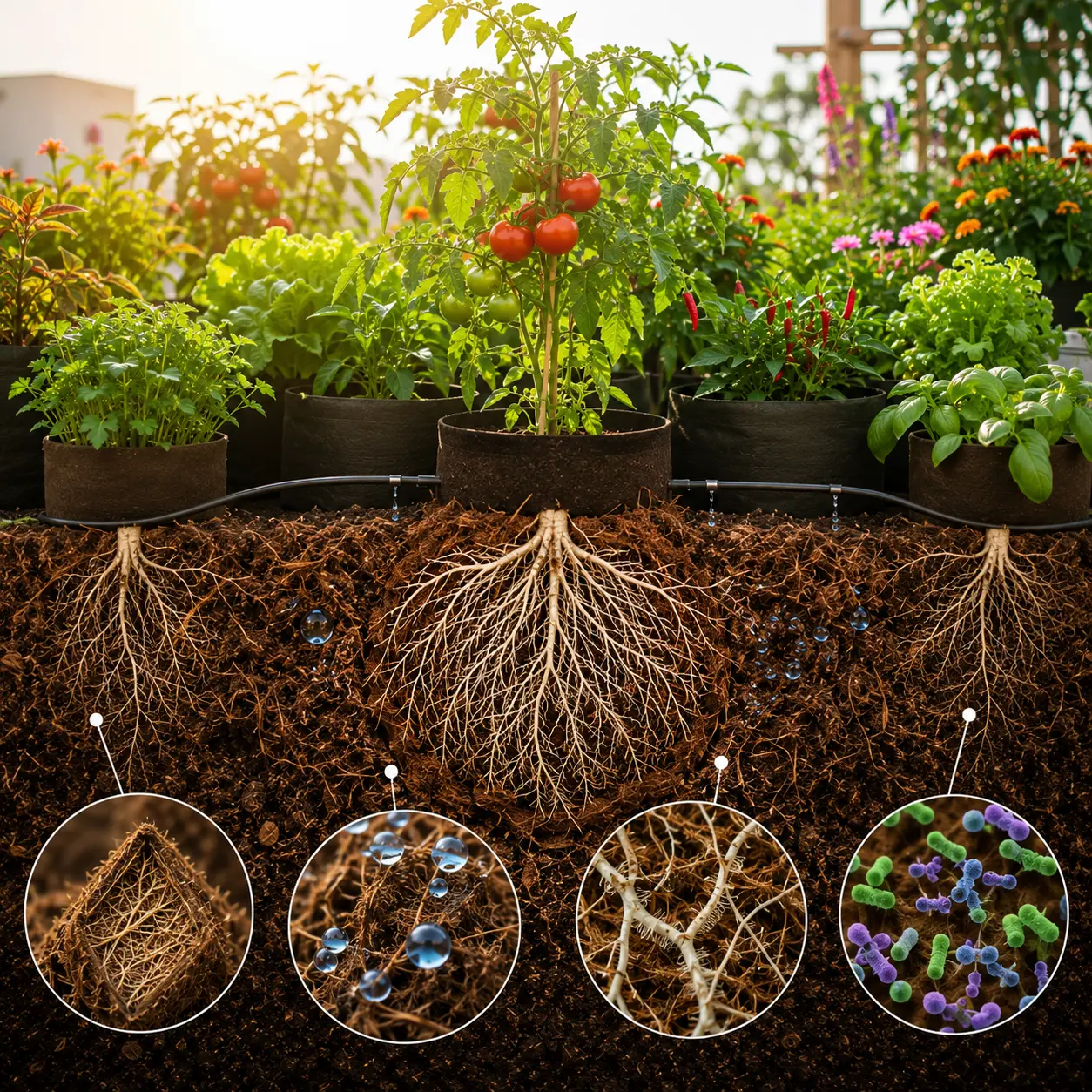
Coco Peat Growing Medium
Enhances moisture retention while maintaining excellent root-zone aeration.

Grow Bags for Plants
Improve drainage, root aeration, and vegetable production in limited spaces.

Plastic Pots for Plants
Ideal containers for seedlings, ornamentals, herbs, and balcony gardens.
The difficulty is Moderate: the setup is unconventional compared to regular container gardening, and the single biggest mistake beginners make is using standard potting mix, which floats away the moment you add water.
Quick Facts
| Attribute | Detail |
|---|---|
| Common names | Lotus, Kamal (Hindi), Padma (Sanskrit/Bengali), Thamara (Tamil/Malayalam), Tamara (Telugu), Kamal (Marathi/Gujarati/Punjabi) |
| Scientific name | Nelumbo nucifera |
| Varieties | Pink Lotus (standard), White Lotus, Dwarf/Bowl Lotus. See Varieties Guide for full comparison. |
| Plant type | Aquatic perennial |
| Mature size | 90–200 cm above water; leaves up to 80 cm across |
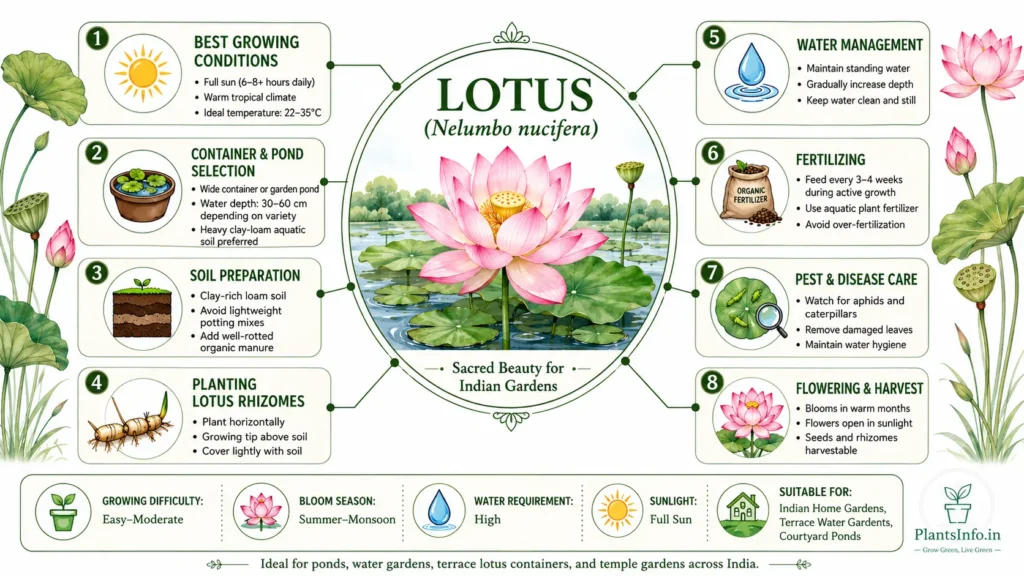
| Sunlight | Full sun — minimum 6 hours, ideally 8+ hours daily |
| Water needs | Still standing water, 15–60 cm deep depending on variety |
| Best season to plant | Late winter to pre-monsoon (February–April) |
| Suitable states | All of India; thrives especially in West Bengal, Bihar, Odisha, Uttar Pradesh, Tamil Nadu, Kerala, Maharashtra |
Choosing the Right Spot
Lotus is one of the most sun-hungry plants you can grow at home — less than 6 hours of direct sunlight,n and it will produce leaves but rarely bloom. In North India, a south or west-facing terrace from March through October is ideal. In coastal states like Kerala and Tamil Nadu, even an east-facing spot works well given the intensity of the summer sun.
Keep the container away from fountains, water pumps, or any moving water source. Lotus roots anchor in still mud; flowing water disturbs the rhizomes and stunts growth. Unlike most container plants, lotus actually does better in a wide, shallow vessel than a tall, narrow one — width matters more than depth.
Container growing is the most practical option for home gardeners. A wide plastic tub, a halved cement drum, a large earthen pot sealed with clay, or even a sturdy bucket works perfectly for dwarf varieties.
Soil and Potting Mix
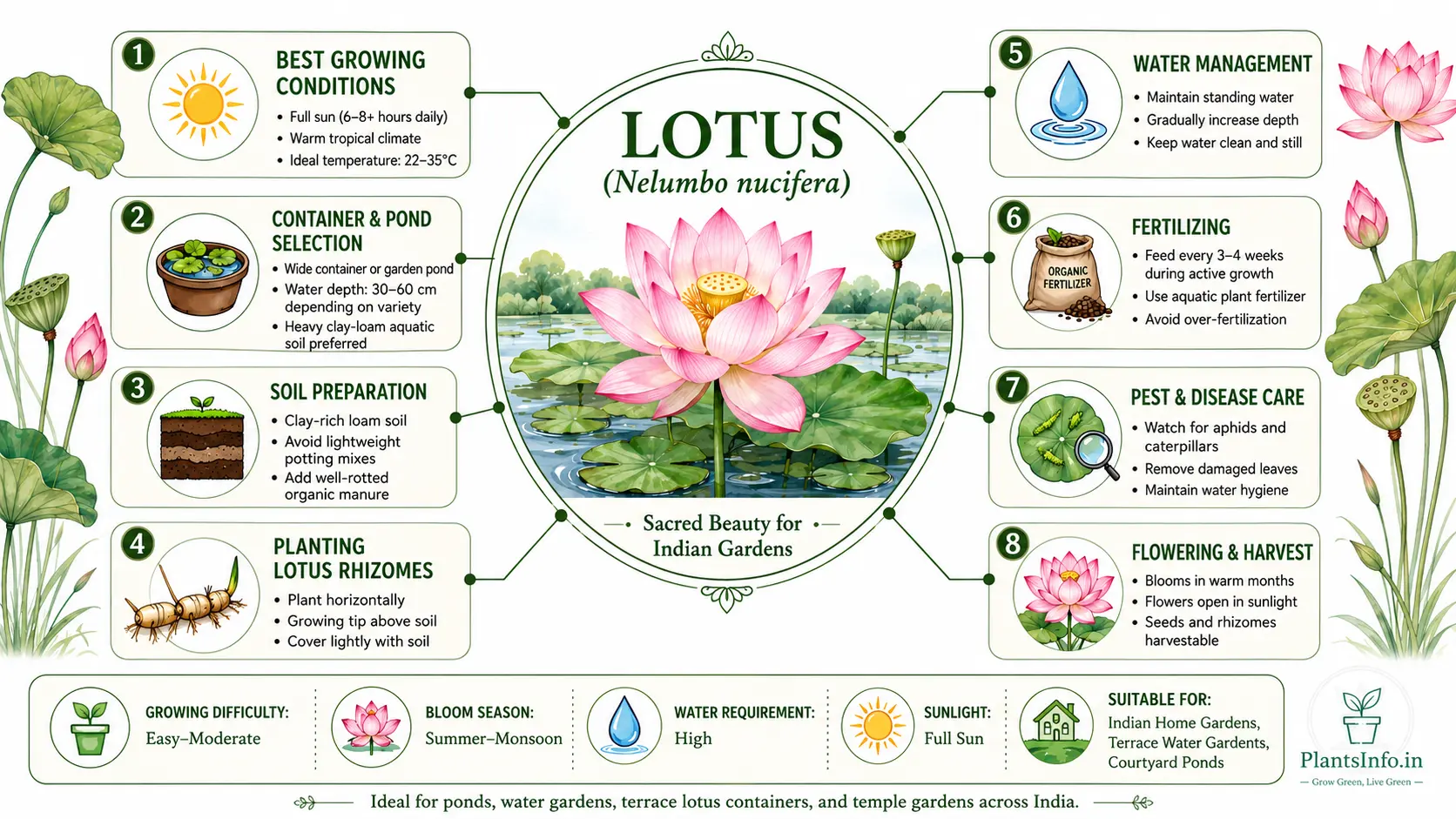
The most important rule: never use standard potting mix or cocopeat. Both are too light and will float when submerged, leaving your rhizome exposed and your water murky for weeks.
Use heavy clay-rich soil from a pond, river bank, or a local nursery that stocks aquatic soil. Garden soil from a vegetable bed works if it is dense and loamy — mix it with river sand in a roughly 2:1 ratio to improve structure while keeping it heavy. Add a layer of well-decomposed cow dung or farmyard manure (FYM) worked into the bottom of the container before planting, not on top.
The most common soil mistake Indian gardeners make is adding organic compost or vermicompost on the surface. It floats, rots, and creates a foul-smelling, anaerobic water layer — mix all organic matter into the lower soil layer before filling with water.
Planting — Season and Method
The best time to plant lotus in India is late winter to pre-monsoon (February to April), when temperatures are rising, and water begins to warm. Planting in cold water (below 20°C) will stall the rhizome and invite rot. In South India, planting can begin as early as January in some years.
Rhizome planting is far more practical than growing from seed for home gardeners. Seeds require scarification, germination in warm water, and several weeks before they are ready to plant out — rhizomes, by contrast, can produce aerial leaves within two to three weeks.
Place the rhizome horizontally in the prepared soil with the growing tip angled slightly upward. Do not bury the tip — press the rhizome gently into the mud, cover only the body, and leave the tip just at or above the soil surface. Start with 5–10 cm of water above the soil. Gradually increase the depth to 20–40 cm as aerial leaves emerge and the plant establishes.
Watering
Lotus is not watered in the traditional sense — the container is kept filled with still water at all times. The key management task is maintaining the correct water depth and topping up for evaporation.
In the first four to six weeks, keep the water depth shallow (5–15 cm above the soil). This allows the water to warm quickly in sunlight, which encourages faster root establishment. Once strong aerial leaves appear, gradually raise the water level to 20–40 cm for standard varieties, or 10–20 cm for dwarf bowl varieties.
The warning sign of waterlogging stress in lotus is not yellow leaves but petioles turning yellow-green and collapsing before the leaf fully opens — this usually means the water is too cold, too deep, or stagnant and oxygen-depleted. During the monsoon, ensure no overflow floods the container with cold rainwater suddenly; a dramatic temperature drop can shock the rhizome.
Fertiliser
Lotus is a heavy feeder once it establishes, but fertilising too early is a common mistake — adding fertiliser before the plant has aerial leaves encourages algae growth and can burn young roots.
Once the plant has at least two strong aerial leaves (typically four to six weeks after planting), begin feeding. The most effective method for home containers is slow-release fertiliser tabs or bone meal pellets pushed into the mud near — but not touching — the rhizome. Cow dung or FYM worked into the bottom layer at planting time provides a long-term nutrient base.
Avoid liquid fertilisers entirely in lotus containers — they disperse through the water column, feed algae more than the plant, and can burn leaves. In Indian markets, look for aquatic plant fertiliser tablets, or use bone meal mixed into small clay balls pressed into the soil every six to eight weeks during the growing season (March to October). Neem cake worked into the base at planting also deters soil-borne pests.
Common Problems and Fixes
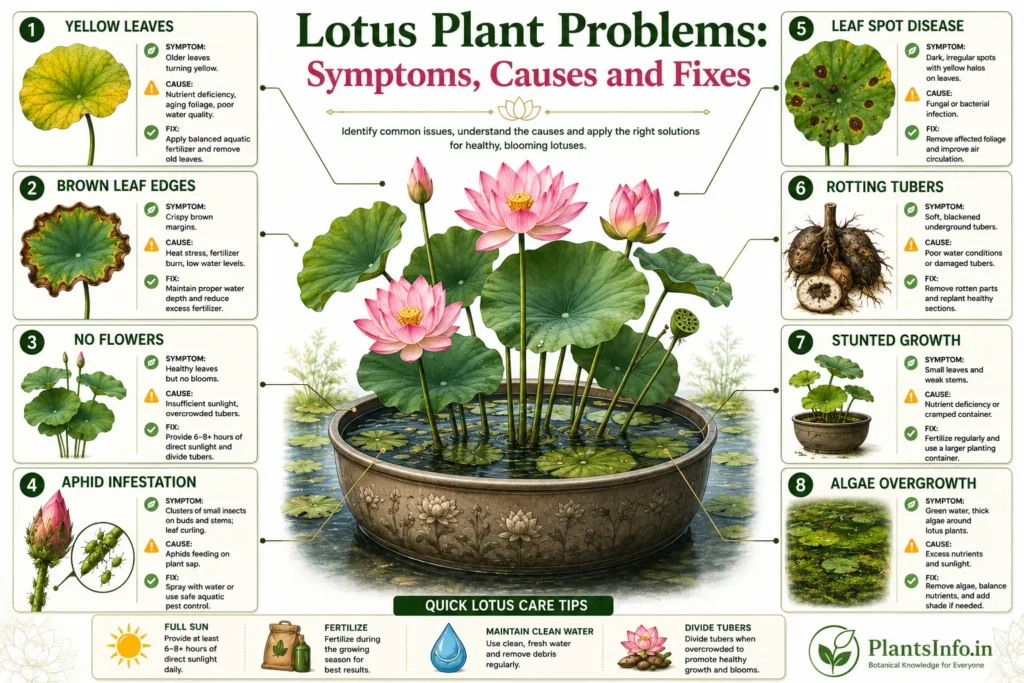
The three most common problems with home-grown lotus in India are:
- Leaf yellowing and collapse — usually a water depth or temperature problem, not a nutritional one
- No flowers despite healthy leaves — most often caused by insufficient sunlight or fertilising with too much nitrogen
- Aphid infestation on new buds and petioles — a pest problem, especially in dry pre-monsoon conditions
For full diagnosis and treatment of these and other issues, see the Lotus Problems Guide.
Propagation
The most practical propagation method for home gardeners is rhizome division — simply separating a healthy section of rhizome with at least one intact growing node during the dormant or early-season period (December to February).
Handle rhizomes with care; the growing tips are fragile and snap easily. A broken tip means that the section of the rhizome cannot produce new growth. Seed propagation is possible but takes significantly longer to reach flowering — typically one full season more than rhizome-grown plants.
Container Growing
For terraces and balconies, a wide plastic tub of at least 45–60 cm diameter and 30–40 cm depth suits standard varieties comfortably. Dwarf and bowl lotus varieties can be grown in containers as small as 30 cm across — making them ideal for apartment gardeners.
Use containers with no drainage holes. This is non-negotiable: lotus needs standing water, and drainage holes will drain the container within hours. Seal any existing holes with epoxy putty or waterproof sealant before filling.
Repot every two to three years, or when rhizomes begin pushing against the container walls and leaf production slows. The best time to repot is during dormancy (November to January) before new season growth begins.
Harvesting
Flowers can be harvested in the early morning as buds just beginning to open, which extends their vase life significantly. Fully open flowers last one to two days once cut; buds picked at the right stage last up to five days.
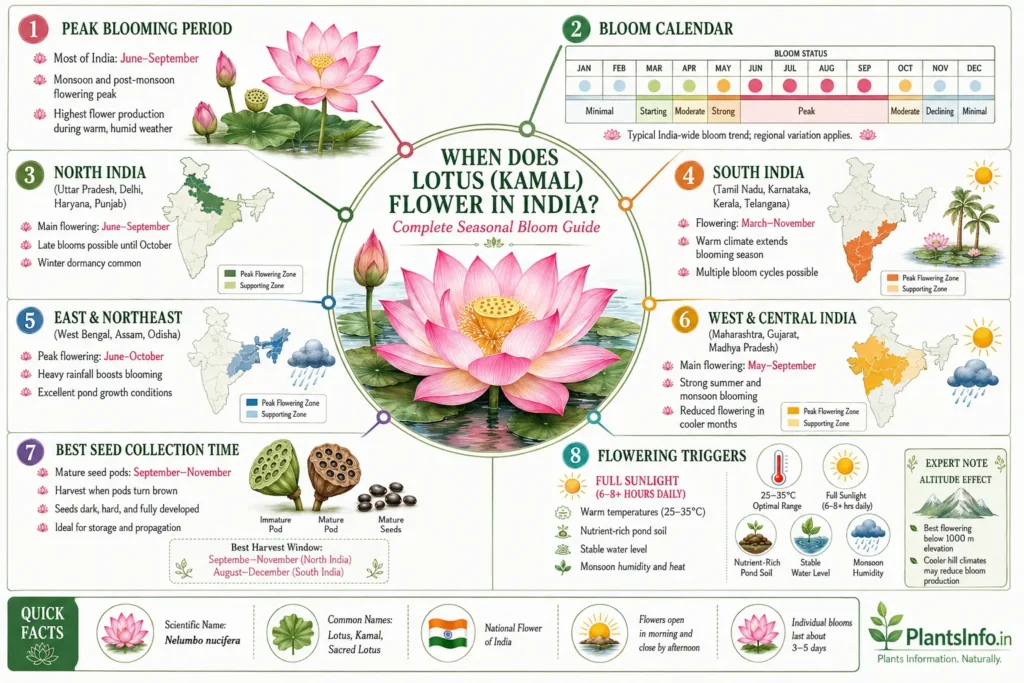
Lotus seeds are ready to harvest when the seed head (the characteristic cone-shaped receptacle) turns dark brown, and the seeds rattle loosely inside. Rhizomes for eating are best harvested in late autumn to early winter, after the aerial leaves have died back and the plant has gone semi-dormant — this is when starch content in the rhizome is at its peak. Store harvested rhizomes in cool, moist sand or refrigerate and use within a week.
Seasonal Protection
Lotus in India faces its greatest stress not from cold but from sudden temperature drops during the early monsoon, when heavy rain rapidly cools standing water. If your container is on an exposed terrace, move it to partial shelter during the peak of heavy rain spells in June and July, then return it to full sun once the rain eases.
In the plains of North India, lotus goes semi-dormant in December and January — leaves die back, and the rhizome rests in the mud. Do not remove the plant; do not let the container dry out completely. Maintain a shallow water level over the soil and allow the plant to rest. It will re-emerge strongly in February as temperatures climb.
In South India and coastal regions, lotus may continue producing leaves year-round with only a brief slowdown in the coolest months.
Key Takeaways
- Lotus grows well in containers on terraces — you do not need a pond or large outdoor space.
- Use heavy clay-based soil only; standard potting mix floats and will fail.
- Never fertilise before the plant produces aerial leaves — early feeding feeds algae, not the lotus.
- The most common reason a healthy lotus won’t flower is insufficient sunlight — eight or more hours daily is the realistic minimum for reliable blooming.
- Plant rhizomes in February to April as water warms; cold water planting in December–January will stall establishment.
Start with a single rhizome in a wide tub, give it full sun, and let the mud settle — kamal is more forgiving than its sacred reputation suggests.