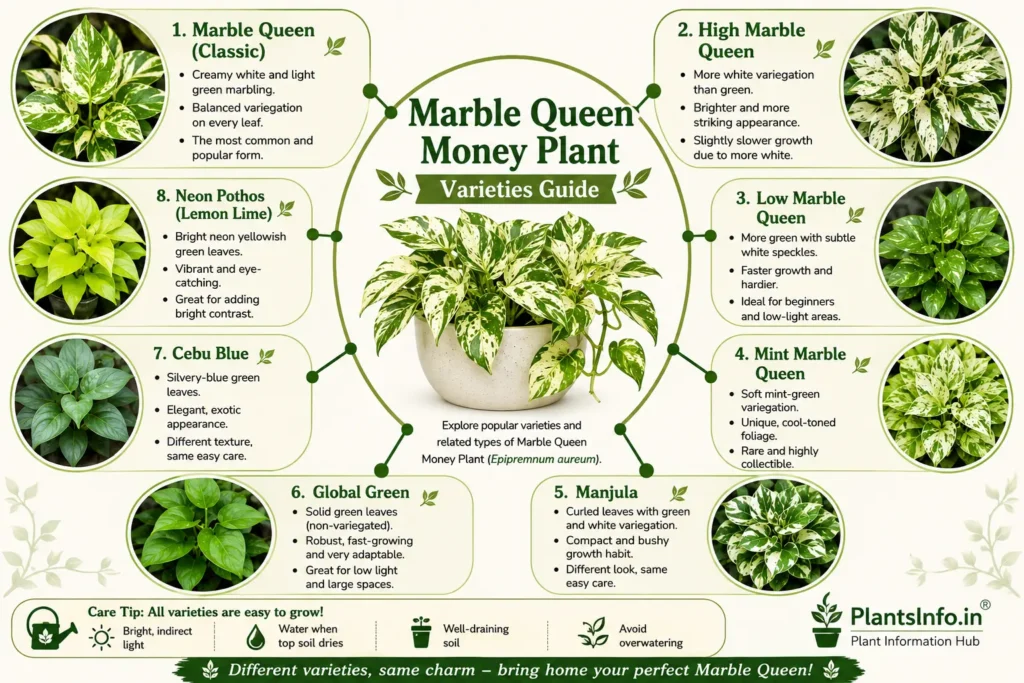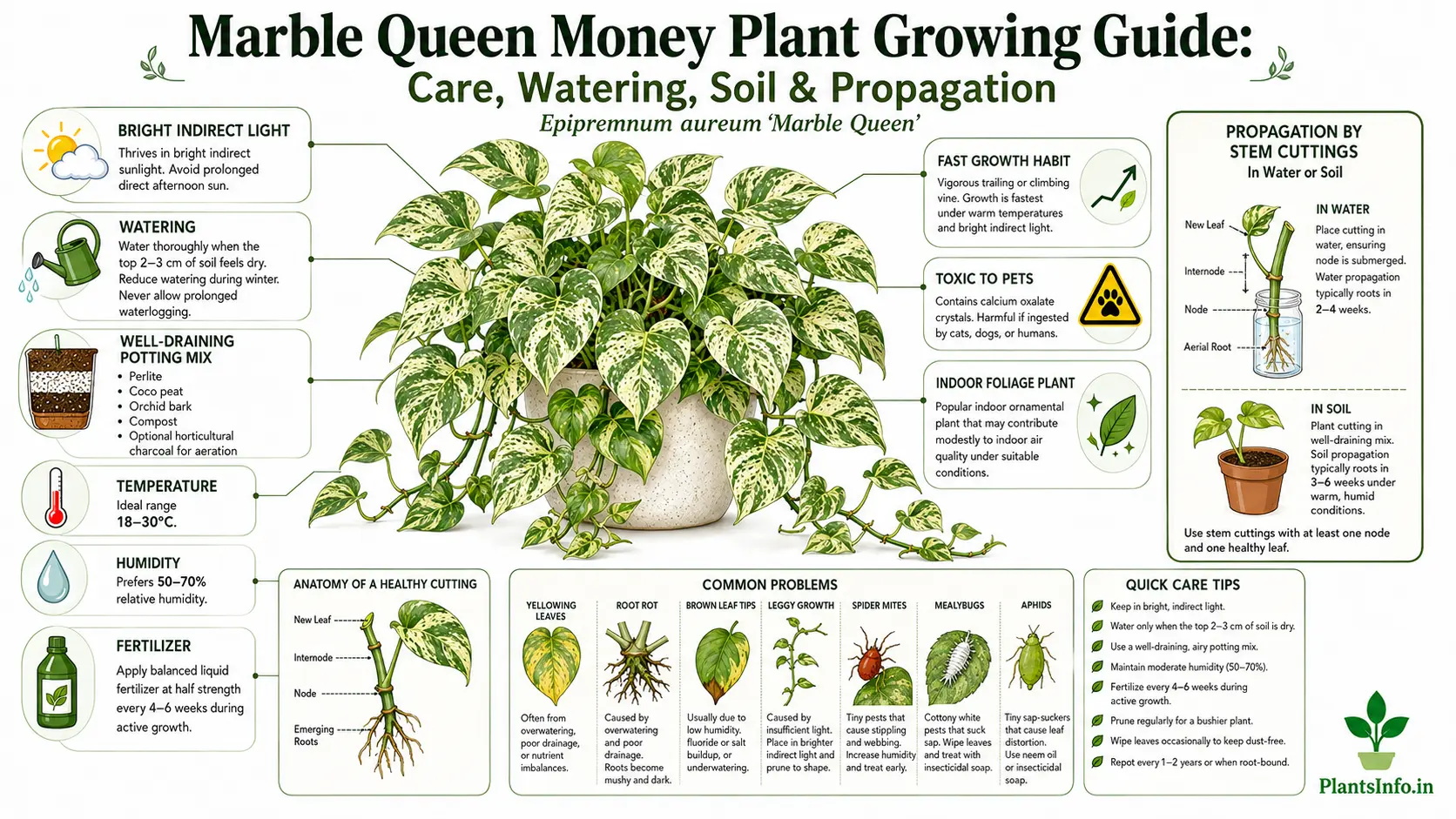
How to Grow Marble Queen Money Plant: Complete Guide
At a Glance
| Quick Facts | Information |
|---|---|
| Common Name | Marble Queen Money Plant |
| Botanical Name | Epipremnum aureum ‘Marble Queen’ |
| Family | Araceae |
| Plant Type | Evergreen perennial climbing and trailing vine |
| Cultivar Type | Variegated ornamental foliage cultivar |
| Mature Vine Length | Typically 1.5–3 m indoors; considerably longer under ideal climbing conditions |
| Growth Rate | Slow to moderate |
| Growth Habit | Trailing, climbing, or cascading |
| Difficulty Level | Easy |
| Best Growing Environment | Bright indoor spaces, shaded balconies, covered patios, tropical gardens |
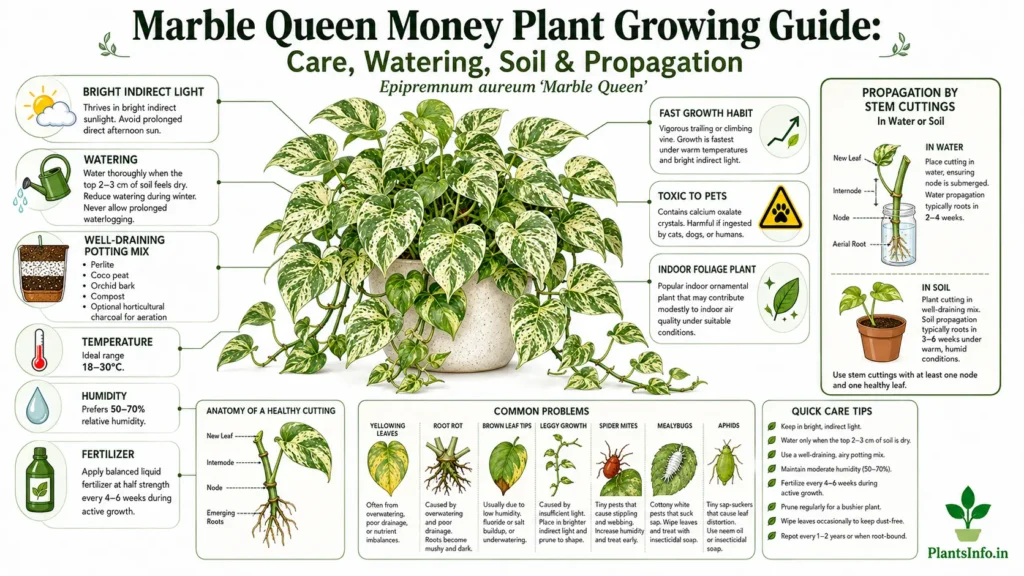
| Sunlight | Bright, indirect light |
| Soil Type | Loose, well-drained, organic-rich growing medium |
| Preferred Soil pH | Slightly acidic to neutral (about 6.0–7.0) |
| Water Requirement | Moderate |
| Humidity Preference | Moderate to high |
| Temperature Preference | Approximately 18–30°C |
| Frost Tolerance | Poor |
| Container Friendly | Excellent |
| Suitable for Hydroponic Growing | Yes |
| Propagation Method | Stem cuttings with at least one healthy node |
| Indoor Air Purification | Commonly grown for indoor greenery; air-purifying claims should not be considered a primary reason for cultivation due to limited real-world evidence. |
| Pet Safety | Not pet-safe; contains insoluble calcium oxalate crystals |
| Best Growing Regions in India | Suitable across most of India as an indoor or protected ornamental plant |
Quick Info
| Growing Requirement | Recommendation |
|---|---|
| Best Light | Bright, indirect sunlight |
| Watering | Water when the top 2–4 cm of the growing medium feels dry |
| Soil | Well-drained, airy potting mix |
| Feeding | Light, balanced fertilization during active growth |
| Main Success Factor | Consistent bright filtered light with excellent drainage |
| Suitable for Beginners | Yes |
Marble Queen Money Plant is one of the easiest variegated indoor foliage plants to grow, provided its basic requirements are met. Unlike greener forms of Epipremnum aureum, this cultivar has extensive cream-white variegation that reduces its chlorophyll content. As a result, it generally grows more slowly and requires brighter indirect light to maintain its characteristic marbled foliage.
See also: Marble Queen Money Plant plant profile, common problems, seasonal care, its benefits, and its varieties.
For most Indian homes, success depends less on frequent maintenance and more on selecting an appropriate location. Bright filtered light, a free-draining potting mix, moderate watering, and protection from harsh afternoon sun are usually sufficient to keep the plant healthy for many years.
Recommended Products
Disclosure: As an Amazon Associate, PlantsInfo may earn from qualifying purchases.
🌱 Growing Essentials
The following products can help with container gardening, potting, root development, soil management, and healthy plant growth.
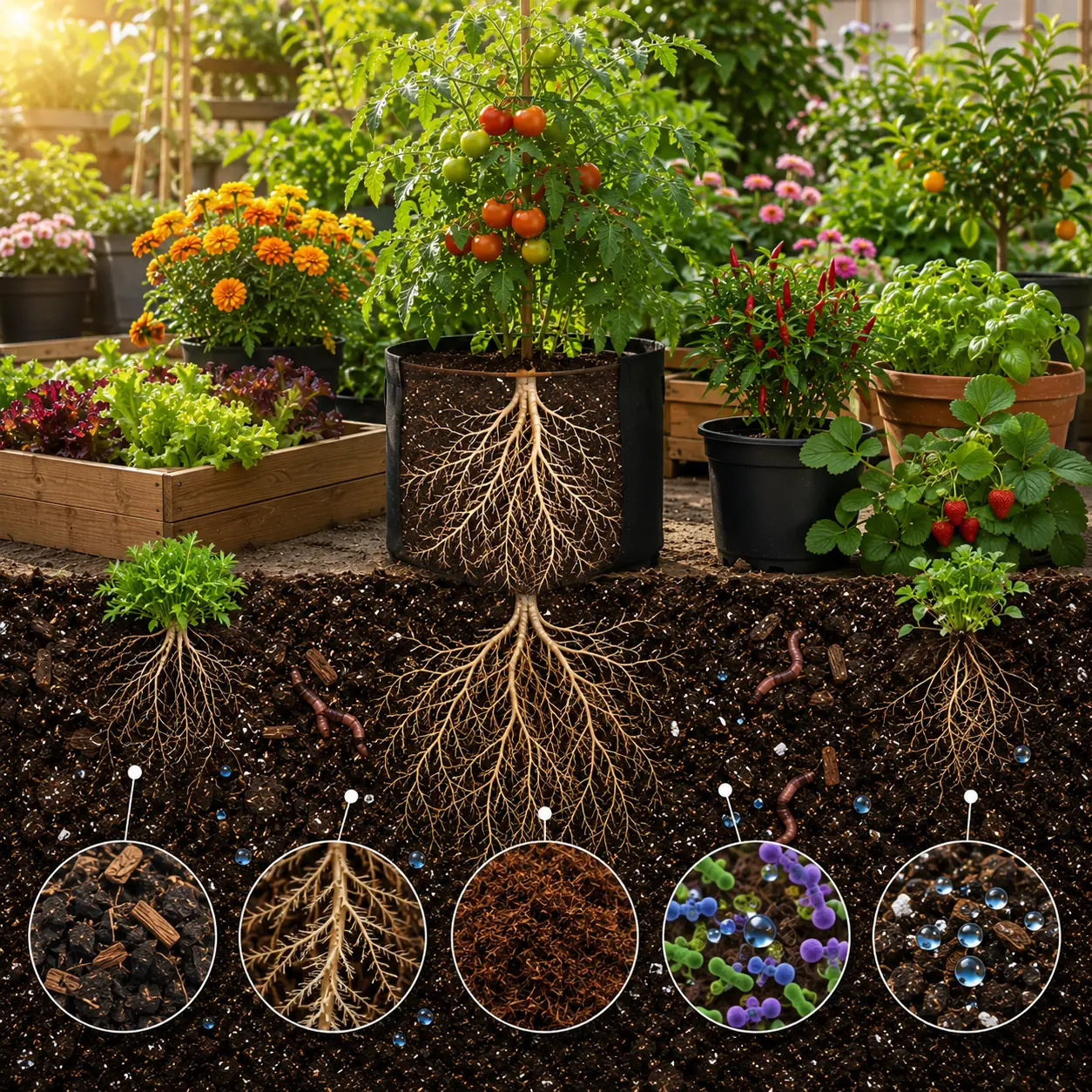
Organic Potting Soil Mix
Provides nutrients, structure, and healthy growing conditions for container plants.
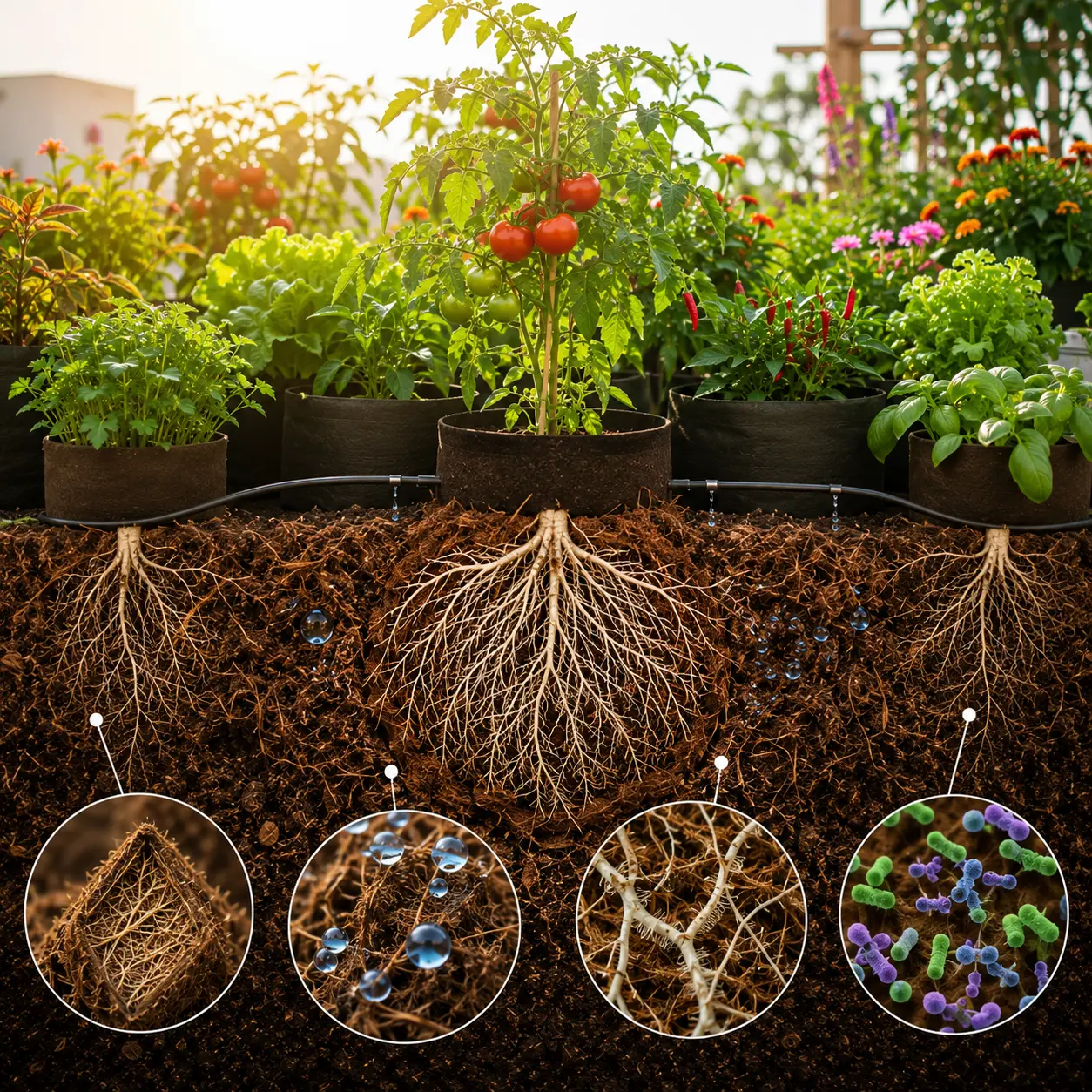
Coco Peat Growing Medium
Enhances moisture retention while maintaining excellent root-zone aeration.

Grow Bags for Plants
Improve drainage, root aeration, and vegetable production in limited spaces.

Plastic Pots for Plants
Ideal containers for seedlings, ornamentals, herbs, and balcony gardens.
Introduction
Marble Queen Money Plant is a cultivated selection of Epipremnum aureum valued for its striking cream and green marbled leaves. Unlike flowering ornamentals, its primary appeal lies in its decorative foliage, making it one of the most widely grown indoor vines in homes, offices, and commercial interiors.
Its heavy variegation distinguishes it from cultivars such as Golden Money Plant, Neon Money Plant, or Jade Money Plant. Because large portions of each leaf lack chlorophyll, Marble Queen naturally grows more slowly and often requires brighter growing conditions than greener cultivars. This slower growth is a normal characteristic of the cultivar rather than an indication of poor health.
The plant is highly adaptable and can be grown as:
- A trailing plant in hanging baskets
- A cascading shelf plant
- A climbing vine on moss poles or trellises
- An indoor tabletop specimen
- A shaded outdoor ornamental in frost-free tropical and subtropical climates
One of its notable characteristics is its ability to produce progressively larger leaves when allowed to climb a suitable support. Climbing vines develop stronger aerial roots that help anchor the plant while improving access to light, often resulting in more vigorous foliage than freely hanging stems.
Although Marble Queen tolerates lower light better than many ornamental houseplants, prolonged dim conditions gradually reduce its ornamental value. New leaves often emerge with increased green coloration, wider spacing between nodes, and slower overall growth. Providing brighter indirect light helps maintain the cultivar’s distinctive marbled appearance.
Before You Start
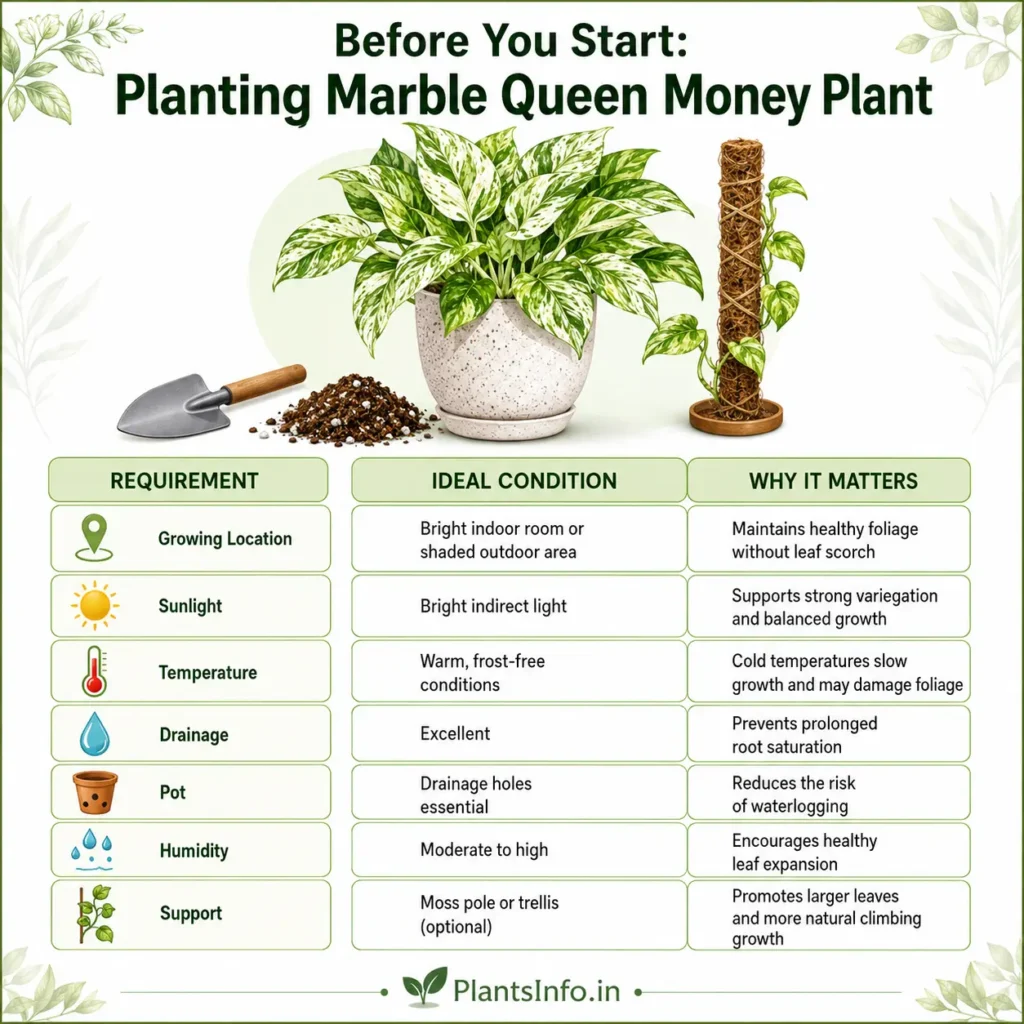
| Requirement | Ideal Condition | Why It Matters |
|---|---|---|
| Growing Location | Bright indoor room or shaded outdoor area | Maintains healthy foliage without leaf scorch |
| Sunlight | Bright indirect light | Supports strong variegation and balanced growth |
| Temperature | Warm, frost-free conditions | Cold temperatures slow growth and may damage foliage |
| Drainage | Excellent | Prevents prolonged root saturation |
| Pot | Drainage holes essential | Reduces the risk of waterlogging |
| Humidity | Moderate to high | Encourages healthy leaf expansion |
| Support | Moss pole or trellis (optional) | Promotes larger leaves and more natural climbing growth |
Before planting Marble Queen Money Plant, evaluate whether your growing environment can consistently provide bright filtered light and good drainage. These two factors influence long-term performance more than any fertilizer or maintenance routine.
Indoor growers should avoid placing the plant in rooms that remain dark throughout the day. Although survival is possible under relatively low light, ornamental quality usually declines over time.
Similarly, avoid decorative containers without drainage holes unless the nursery pot remains inside a removable outer cachepot. Standing water around the roots is one of the most common causes of decline in container-grown pothos cultivars.
Quick Decision Matrix
| If You Want… | Marble Queen Money Plant Is… |
|---|---|
| A beginner-friendly houseplant | Excellent choice |
| A fast-growing indoor vine | Good, but slower than greener cultivars |
| Bright white variegated foliage | Excellent |
| A low-maintenance office plant | Excellent if adequate natural light is available |
| A hanging basket plant | Excellent |
| A climbing feature plant | Excellent with a moss pole |
| A plant for dark corners | Not recommended |
| A drought-tolerant indoor plant | Moderately tolerant once established |
| Hydroponic growing | Suitable |
| Outdoor landscape planting | Suitable only in warm, frost-free climates |
For gardeners primarily seeking vigorous growth, greener cultivars of Epipremnum aureum generally grow faster. However, for those prioritizing ornamental foliage, Marble Queen remains one of the most attractive variegated selections available.
Biggest Success Factor
| Success Factor | Importance | Impact on Plant Health |
|---|---|---|
| Bright indirect light | Critical | Maintains variegation and compact growth |
| Excellent drainage | High | Protects root health |
| Moderate watering | High | Prevents root decline |
| Warm temperatures | Moderate | Supports continuous growth |
| Humidity | Moderate | Encourages healthy foliage development |
If only one growing condition can be optimized, make it light.
Because Marble Queen produces extensive cream-white leaf tissue that cannot photosynthesize efficiently, the remaining green portions of each leaf must produce sufficient energy for the entire plant. Bright indirect light maximizes photosynthesis without exposing the delicate variegated tissue to damaging direct afternoon sunlight.
This explains why Marble Queen often loses some of its characteristic white marbling in darker locations. The plant responds by producing greener new leaves containing more chlorophyll, an adaptive response that improves energy production rather than indicating disease.
A practical observation is that many indoor growers assume the cultivar prefers shade because it survives there. In reality, survival and optimal ornamental performance are not the same. The plant usually displays its finest foliage only when provided with consistently bright filtered light.
Growing Essentials
| Growing Factor | Recommendation |
|---|---|
| Difficulty | Easy |
| Growth Speed | Slow to moderate |
| Light | Bright indirect sunlight |
| Water | Moderate |
| Soil | Loose, airy, well-drained |
| Fertility | Moderate |
| Humidity | Moderate to high |
| Repotting | Every 2–3 years or when root-bound |
| Support | Optional but beneficial |
| Indoor Suitability | Excellent |
| Outdoor Suitability | Suitable in frost-free tropical and subtropical climates |
Marble Queen does not require intensive maintenance, but consistency is important. Stable growing conditions generally produce healthier foliage than frequent changes in watering, lighting, or container placement.
Growers should also recognize that this cultivar naturally grows more slowly than many other pothos selections. Expecting rapid vine production often leads to unnecessary fertilization, which provides little benefit and may contribute to salt accumulation in container soils.
Climate Suitability (India)
| Region | Suitability | Remarks |
|---|---|---|
| Kerala | Excellent | Thrives with protection from direct afternoon sun |
| Tamil Nadu | Excellent | Performs well indoors and in shaded outdoor spaces |
| Karnataka | Excellent | Well suited to homes and shaded gardens |
| Goa | Excellent | Warm, humid climate supports vigorous growth |
| Maharashtra | Excellent | Indoor cultivation recommended during peak summer heat |
| West Bengal | Excellent | Performs well in bright indoor conditions |
| Northeast India | Excellent | High humidity is generally favourable |
| Central India | Good | Benefits from increased humidity during dry periods |
| Rajasthan | Moderate | Indoor cultivation preferred due to hot, dry conditions |
| Punjab, Haryana & Delhi | Good | Protect from winter cold and summer afternoon sun |
| Himalayan Foothills | Moderate | Indoor cultivation during cooler months |
Across India, Marble Queen is primarily an indoor ornamental rather than a landscape climber. Outdoor cultivation is most reliable in frost-free tropical and subtropical regions where direct afternoon sunlight can be avoided.
Regional differences mainly influence growth rate rather than survival. Plants growing in humid coastal climates often produce more vigorous foliage than those grown in very dry inland environments.
Choosing a Location
| Location | Suitability | Reason |
|---|---|---|
| East-facing window | Excellent | Gentle morning light encourages healthy growth |
| North-facing bright room | Excellent | Consistent indirect light throughout the day |
| South-facing window with sheer curtain | Excellent | Bright filtered light without scorching |
| Bright office | Excellent | Stable indoor conditions support foliage quality |
| Covered balcony | Excellent | Ideal if protected from harsh afternoon sun |
| Hanging basket near a bright window | Excellent | Encourages attractive cascading growth |
| Low-light hallway | Fair | Plant survives but may lose variegation over time |
| Dark room | Poor | Slow growth and greener foliage |
| West-facing window without protection | Poor | High risk of leaf scorch during summer |
Choose a location where the plant receives several hours of bright ambient daylight without prolonged exposure to intense direct sun. Morning sunlight is generally well tolerated, while strong afternoon sun can bleach or scorch the cream-coloured portions of the leaves.
If growing the plant as a climber, install a moss pole or similar vertical support from the beginning. Climbing stems often produce larger leaves and stronger aerial roots than trailing vines, giving the plant a fuller and more mature appearance over time.
For indoor cultivation, avoid frequently relocating the plant. Stable light conditions allow new leaves to develop more consistently and reduce stress associated with repeated environmental changes.
Soil Requirements
| Soil Factor | Recommendation | Why It Matters |
|---|---|---|
| Soil Type | Loose, airy, organic-rich growing medium | Encourages healthy root development |
| Drainage | Excellent | Prevents prolonged root saturation |
| Soil pH | Slightly acidic to neutral (approximately 6.0–7.0) | Supports nutrient availability |
| Organic Matter | Moderate | Improves moisture retention without excessive compaction |
| Aeration | High | Promotes healthy root respiration |
Marble Queen Money Plant develops a relatively shallow but active root system that performs best in a well-aerated growing medium. Unlike dense garden soil, an airy potting mix provides adequate oxygen around the roots while allowing excess water to drain quickly.
Recommended Potting Mix
| Ingredient | Approximate Proportion | Purpose |
|---|---|---|
| Coco peat | 35–40% | Moisture retention |
| Compost or well-decomposed organic matter | 20–25% | Nutrient supply |
| Perlite or pumice | 20–25% | Aeration and drainage |
| Pine bark or coarse coco chips | 15–20% | Long-term structure and drainage |
This combination provides a balance between moisture retention and drainage, reducing the likelihood of root problems while supporting steady growth.
Avoid using heavy clay soil or compact garden soil alone in containers. Such media retain excessive moisture indoors and gradually become compacted, restricting oxygen movement around the roots.
Signs the Growing Medium Needs Improvement
| Observation | Likely Cause |
|---|---|
| Water remains on the surface for several minutes | Compacted growing medium |
| Soil remains wet for many days | Poor drainage |
| Roots appear dark or soft during repotting | Excessive moisture retention |
| Plant grows slowly despite adequate light | Root-zone aeration may be inadequate |
Well-structured growing media usually remain productive for several years, but gradual decomposition eventually reduces aeration. Repotting every two to three years helps restore healthy root conditions.
Planting
| Planting Factor | Recommendation |
|---|---|
| Best Time | Any time indoors; preferably during active growth |
| Container | Drainage holes essential |
| Planting Depth | Maintain original nursery soil level |
| Initial Watering | Thorough watering after planting |
| Immediate Fertilizer | Not usually necessary |
Marble Queen can be planted throughout the year when grown indoors because temperature fluctuations are generally moderate. Outdoor planting is best undertaken during warm weather when frost is not expected.
Planting Steps
| Step | Action |
|---|---|
| 1 | Select a container slightly larger than the existing root ball. |
| 2 | Fill the base with fresh potting mix. |
| 3 | Position the plant at its original growing depth. |
| 4 | Backfill gently without compacting the medium excessively. |
| 5 | Water thoroughly until excess water drains freely. |
| 6 | Place the plant in bright indirect light while it establishes. |
Avoid planting too deeply. Covering the stem beyond its original soil line may increase the likelihood of stem rot under persistently moist conditions.
Following planting, allow the growing medium to begin drying naturally before watering again rather than maintaining constant moisture.
Watering
| Growing Stage | Water Requirement | Guidance |
|---|---|---|
| Newly planted | Moderate | Maintain lightly moist growing medium while roots establish |
| Established plant | Moderate | Water only after the upper layer begins drying |
| Winter growth slowdown | Reduced | Lower frequency as evaporation decreases |
Water management is often the single most misunderstood aspect of Marble Queen cultivation. The plant tolerates brief periods of dryness more successfully than continuously saturated growing media.
Rather than watering according to a fixed schedule, monitor soil moisture directly. Environmental conditions such as temperature, humidity, ventilation, container size, and light intensity all influence how rapidly the potting mix dries.
Seasonal Watering Guide
| Season | Typical Requirement |
|---|---|
| Summer | Moderate to slightly increased depending on temperature |
| Monsoon | Reduced if natural humidity remains high |
| Winter | Less frequent in cooler regions |
Indoor conditions vary considerably across India, so watering frequency may differ even between homes in the same city.
Signs of Incorrect Watering
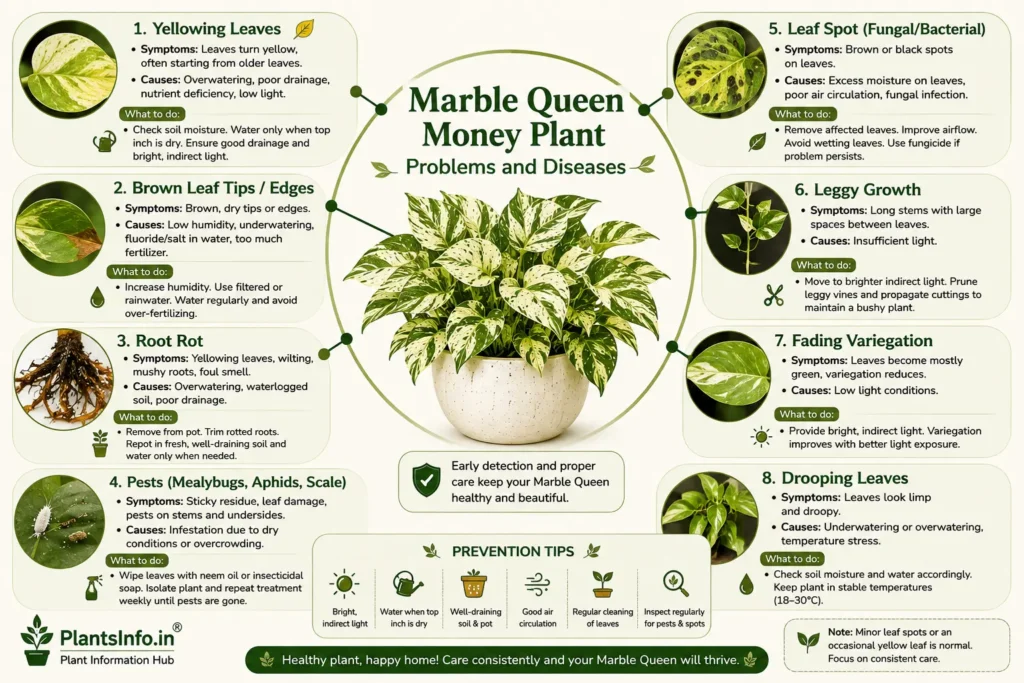
| Symptom | Possible Cause |
|---|---|
| Yellow lower leaves | Often excessive watering |
| Soft stems near the base | Persistent waterlogging |
| Dry leaf edges | Extended drought or very low humidity |
| Wilted foliage with dry soil | Delayed watering |
| Wilted foliage with wet soil | Possible root damage |
A useful practical observation is that growers often overestimate the plant’s water requirements because its foliage remains lush throughout the year. In reality, slower-growing variegated cultivars generally consume less water than vigorous green pothos varieties.
Fertilizing
| Factor | Recommendation |
|---|---|
| Fertilizer Type | Balanced liquid or slow-release fertilizer |
| Feeding Frequency | Every 4–6 weeks during active growth |
| Winter Feeding | Reduce or suspend if growth slows significantly |
| Excess Fertilizer | Avoid |
Marble Queen is not considered a heavy feeder. Its naturally slower growth means nutrient demand is generally moderate throughout the year.
Moderate fertilization encourages healthy foliage production without promoting excessively soft growth. Increasing fertilizer beyond recommended levels rarely improves variegation because leaf coloration is determined primarily by genetics and light availability rather than nutrient supply.
Fertilizer Schedule
| Season | Recommendation |
|---|---|
| Spring | Begin regular feeding as growth increases |
| Summer | Continue balanced feeding |
| Monsoon | Continue if active growth persists |
| Winter | Reduce in cooler climates where growth slows |
Nutrient Management Tips
| Recommendation | Reason |
|---|---|
| Apply fertilizer to moist soil | Reduces root stress |
| Flush containers occasionally | Removes accumulated salts |
| Follow label recommendations | Prevents overfeeding |
Healthy foliage depends far more on appropriate light than on excessive fertilization.
Mulching
| Growing Situation | Recommendation |
|---|---|
| Indoor containers | Usually unnecessary |
| Outdoor containers | Thin organic mulch optional |
| Landscape planting | Light mulch beneficial where appropriate |
Mulching plays only a minor role in Marble Queen cultivation because the plant is most commonly grown indoors in containers.
Where plants are grown outdoors in suitable climates, a thin layer of organic mulch can help moderate soil temperature and reduce moisture loss during warmer months.
Avoid piling mulch directly against stems, as constant moisture around stem tissue may increase the likelihood of decay.
Pruning
| Pruning Objective | Recommended Practice |
|---|---|
| Maintain size | Shorten excessively long vines |
| Encourage branching | Cut immediately above a healthy node |
| Remove damaged growth | Prune as required |
| Improve appearance | Remove yellow or damaged leaves |
Pruning is primarily performed to improve plant shape rather than stimulate rapid growth.
Each pruning cut redirects growth toward dormant buds below the cut, encouraging fuller branching instead of producing a single elongated vine.
Best Time to Prune
| Season | Suitability |
|---|---|
| Spring | Excellent |
| Summer | Excellent |
| Monsoon | Good if growth remains active |
| Winter | Light corrective pruning only where growth slows |
Sterile, sharp pruning tools help produce cleaner cuts and reduce unnecessary stem injury.
A useful practical observation is that regular light pruning generally produces a denser, more ornamental plant than infrequent heavy pruning.
Container Growing
| Factor | Recommendation |
|---|---|
| Container Type | Plastic, ceramic, terracotta, or fibre pots |
| Drainage Holes | Essential |
| Hanging Basket | Excellent |
| Moss Pole | Recommended for climbing growth |
| Repotting | Every 2–3 years or when root-bound |
Marble Queen is exceptionally well suited to container cultivation, making it one of the most adaptable ornamental vines for indoor gardening.
Choosing the Right Container
| Container Type | Advantages |
|---|---|
| Plastic | Retains moisture longer |
| Terracotta | Improves evaporation and aeration |
| Ceramic | Attractive and stable |
| Hanging basket | Ideal for trailing growth |
Container size should increase gradually rather than dramatically. Excessively large containers retain unused moisture for longer periods, increasing the possibility of root problems.
Climbing vs Trailing Growth
| Growth Style | Typical Result |
|---|---|
| Hanging | Graceful cascading vines |
| Climbing on moss pole | Larger leaves and stronger aerial roots |
| Trellis support | Upright ornamental display |
Allowing Marble Queen to climb more closely resembles its natural growth habit. As aerial roots attach to a support, leaf size often increases progressively, producing a more mature appearance.
Propagation
| Method | Reliability | Recommended |
|---|---|---|
| Stem cuttings | Excellent | Yes |
| Water propagation | Excellent | Yes |
| Potting mix propagation | Excellent | Yes |
| Seed propagation | Rarely practical | No |
Stem cuttings remain the simplest and most reliable method of propagating Marble Queen Money Plant.
Each cutting should contain at least one healthy node because roots develop primarily from nodal tissue rather than the stem internodes.
Propagation Process
| Step | Action |
|---|---|
| 1 | Select a healthy vine. |
| 2 | Cut below a node. |
| 3 | Remove the lowest leaf if necessary. |
| 4 | Place the node in water or moist growing medium. |
| 5 | Maintain bright indirect light. |
| 6 | Transplant after a healthy root system develops. |
Water-propagated cuttings usually establish readily, although they may require a short adjustment period after transfer into potting mix.
For fuller containers, several rooted cuttings can be planted together.
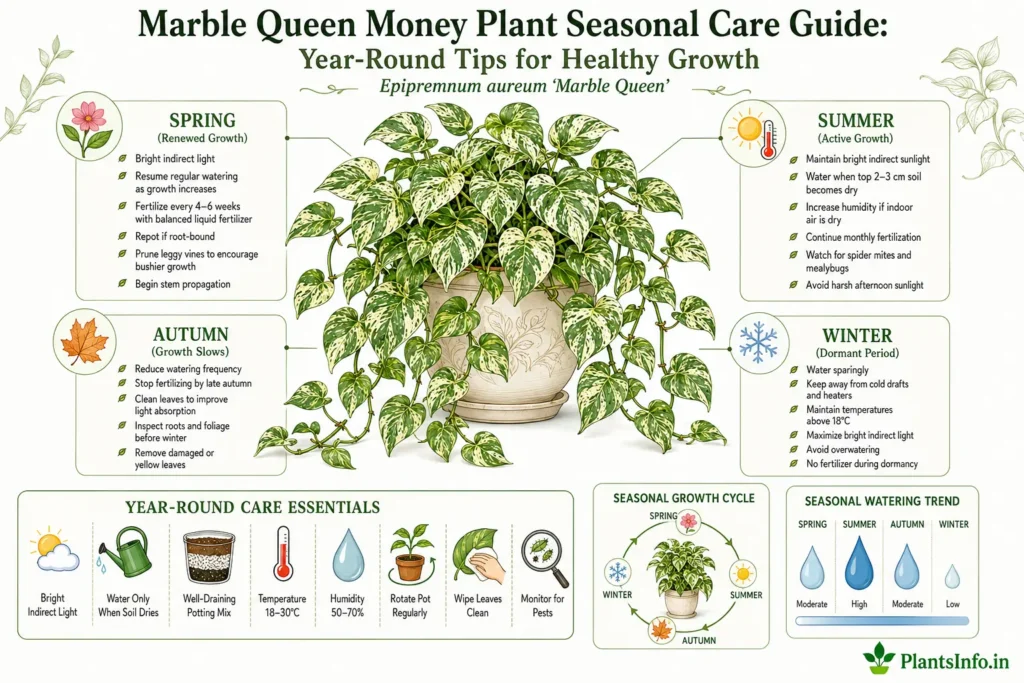
Seasonal Care Overview
| Season | Primary Care Focus |
|---|---|
| Spring | Resume active growth and regular feeding |
| Summer | Protect from harsh afternoon sun and monitor watering |
| Monsoon | Prevent prolonged soil saturation |
| Autumn | Maintain stable growing conditions |
| Winter | Reduce watering where temperatures fall significantly |
Although Marble Queen can grow throughout much of the year indoors, seasonal changes still influence growth rate, water use, and nutrient demand.
Plants growing in warm tropical regions may continue producing new leaves almost continuously, while those in cooler northern regions often slow during winter.
Annual Care Priorities
| Season | Priority |
|---|---|
| Spring | Inspect roots, refresh nutrition if needed |
| Summer | Maintain adequate humidity and filtered light |
| Monsoon | Ensure excellent drainage and airflow |
| Autumn | Continue routine maintenance |
| Winter | Protect from cold drafts and avoid excessive watering |
This overview introduces how seasonal conditions influence cultivation. Detailed month-by-month maintenance schedules, seasonal watering adjustments, fertilization timing, pruning calendars, and weather-specific care belong in the dedicated Seasonal Care Guide, ensuring this Growing Guide remains focused on year-round cultivation fundamentals.
Harvesting and Using Stem Cuttings
| Purpose | Recommendation |
|---|---|
| Ornamental Harvest | Not applicable |
| Stem Cuttings | Primary method for propagation |
| Best Time | During active growth in spring, summer, or warm monsoon conditions |
| Cutting Length | 10–15 cm with at least one healthy node |
| Rooting Method | Water or well-drained propagation mix |
| Reuse of Pruned Vines | Highly recommended |
Unlike fruiting or flowering crops, Marble Queen Money Plant is grown exclusively for its ornamental foliage. Consequently, there is no traditional harvesting stage. Instead, routine pruning provides healthy stem cuttings that can be used to propagate new plants or rejuvenate mature specimens.
When to Take Stem Cuttings
| Situation | Suitable for Propagation |
|---|---|
| Routine pruning | Excellent |
| Overgrown vines | Excellent |
| Leggy plants requiring rejuvenation | Excellent |
| Recently stressed or unhealthy plants | Not recommended until recovery |
Healthy vines with vigorous growth generally produce the highest success rates. Select stems that are free from pest damage, disease symptoms, or mechanical injury.
Preparing Stem Cuttings
| Step | Recommendation |
|---|---|
| Select a healthy vine | Choose firm, mature growth |
| Locate a node | Ensure each cutting contains at least one node |
| Remove lower leaves | Prevent submerged foliage from rotting |
| Root in water or potting mix | Maintain bright indirect light |
| Transplant after rooting | Move carefully into a suitable growing medium |
Nodes are the most important part of every cutting because they contain the dormant tissues from which new roots and shoots develop. Stem sections without nodes rarely establish successfully.
Practical Observation
One mature Marble Queen plant can supply numerous propagation cuttings over many years without significantly reducing its ornamental value. Regular, selective pruning often results in a fuller parent plant while simultaneously producing new plants for additional containers or sharing with other gardeners.
Resource Availability
| Resource | Availability in India | Remarks |
|---|---|---|
| Nursery plants | Widely available | Commonly sold by local nurseries and garden centres |
| Rooted cuttings | Widely available | Frequently sold through local growers and hobbyists |
| Stem cuttings | Very common | Easy to obtain from existing plants |
| Decorative pots | Widely available | Available in numerous sizes and materials |
| Moss poles | Common | Increasingly available through garden retailers |
| Potting mix ingredients | Widely available | Easily sourced in most urban gardening markets |
Marble Queen Money Plant is one of the more readily available ornamental foliage plants in India. Small-rooted plants are commonly offered by neighbourhood nurseries, indoor plant specialists, online retailers, and home gardeners.
Because propagation from stem cuttings is highly reliable, availability is generally not a limiting factor for gardeners wishing to expand their collection.
For beginners, purchasing a healthy rooted plant usually offers faster establishment than starting with unrooted cuttings.
Common Mistakes
| Mistake | Why It Happens | Likely Result |
|---|---|---|
| Growing in very low light | Assuming all money plants thrive in deep shade | Reduced variegation, slower growth, longer internodes |
| Overwatering | Watering on a schedule rather than checking soil moisture | Root decline and yellowing foliage |
| Using heavy garden soil | Poor aeration and drainage | Slow growth and unhealthy roots |
| Exposing the plant to harsh afternoon sun | Excessive light intensity | Leaf scorch and bleaching |
| Excessive fertilization | Expecting faster growth | Salt accumulation with little improvement in growth |
| Planting in oversized containers | More soil retains more moisture | Increased risk of waterlogging |
| Ignoring drainage holes | Decorative pots without drainage | Standing water around roots |
| Frequent relocation | Constantly changing light conditions | Temporary stress and inconsistent growth |
One of the most widespread misconceptions is that Marble Queen performs best in deep shade because it survives there. Although the plant is remarkably adaptable, ornamental quality gradually declines under persistently low light. New leaves often become greener, vine growth slows, and the characteristic marbled appearance becomes less pronounced.
Another common mistake is attempting to accelerate growth with additional fertilizer. Marble Queen’s relatively slow growth is a natural consequence of its extensive variegation rather than poor nutrition. Providing brighter indirect light is usually far more beneficial than increasing fertilizer applications.
Growers should also recognise that larger leaves develop primarily when the vine climbs a suitable support. Plants grown only as hanging baskets typically retain smaller foliage, even under otherwise favourable conditions.
Frequently Asked Questions
Can Marble Queen Money Plant grow in low light?
| Condition | Expected Performance |
|---|---|
| Bright indirect light | Excellent growth and variegation |
| Moderate indirect light | Good growth with slight reduction in vigour |
| Low light | Survival possible but slower growth and greener foliage |
| Very dark rooms | Not recommended |
The plant tolerates lower light better than many indoor ornamentals, but its characteristic cream-and-green variegation is maintained most effectively in bright filtered light.
How often should Marble Queen Money Plant be watered?
| Guideline | Recommendation |
|---|---|
| Check soil first | Yes |
| Fixed watering schedule | Not recommended |
| Waterlogged soil | Avoid |
| Slight drying between watering | Preferred |
Water only after the upper layer of the growing medium begins to dry. Actual watering frequency varies with temperature, humidity, light, container size, and seasonal growth.
Why are the new leaves becoming greener?
| Possible Cause | Explanation |
|---|---|
| Reduced light | Plant produces more chlorophyll to improve energy production |
| Natural variation | Minor differences in variegation can occur between leaves |
Greener new growth is commonly associated with insufficient light rather than disease. Relocating the plant to a brighter position generally improves variegation in future leaves, although existing green leaves usually remain unchanged.
Is Marble Queen suitable for hydroponic growing?
| Answer | Remarks |
|---|---|
| Yes | Performs well in water if maintained properly |
Many gardeners successfully grow Marble Queen in water-filled decorative containers. Regular water replacement and occasional nutrient supplementation help maintain healthy long-term growth.
Does Marble Queen need a moss pole?
| Requirement | Recommendation |
|---|---|
| Essential | No |
| Beneficial | Yes |
The plant grows well as both a trailing and climbing vine. However, climbing plants often produce larger leaves and a more mature appearance because aerial roots can attach to a vertical support.
Is Marble Queen Money Plant safe around pets?
| Answer | Remarks |
|---|---|
| No | Keep away from pets and young children |
Like other Epipremnum aureum cultivars, Marble Queen contains insoluble calcium oxalate crystals. Accidental chewing or ingestion may irritate the mouth and digestive tract. Position the plant where children and pets cannot easily access it.
How often should the plant be repotted?
| Plant Condition | Recommendation |
|---|---|
| Healthy, actively growing | Every 2–3 years, or when root-bound |
| Recently repotted | No immediate need |
| Roots circling the pot | Consider repotting |
Repot only when necessary. Excessively frequent repotting can unnecessarily disturb the root system without improving growth.
Conclusion
| Key Takeaway | Importance |
|---|---|
| Bright indirect light | Critical for maintaining attractive variegation |
| Excellent drainage | Essential for long-term root health |
| Moderate watering | Prevents the most common cultivation problems |
| Consistent growing conditions | Encourages healthy, steady growth |
| Climbing support | Promotes larger, more mature foliage |
Marble Queen Money Plant combines the adaptability of Epipremnum aureum with distinctive cream-and-green variegated foliage, making it one of the most attractive ornamental vines for indoor cultivation. Although naturally slower growing than greener pothos cultivars, it rewards consistent care with long-lasting decorative appeal.
For most Indian gardeners, success depends on mastering a few essential fundamentals rather than complex maintenance. Bright filtered light, a well-drained growing medium, moderate watering, and protection from prolonged direct afternoon sun will support healthy growth in most indoor environments.
Gardeners should also maintain realistic expectations. Marble Queen is valued for its foliage rather than rapid growth, and its slower development reflects the biology of its variegated leaves rather than poor cultivation. When given appropriate light and allowed to grow either as a cascading vine or on a climbing support, it can remain an attractive and reliable ornamental plant for many years.
=======================================================================
| Quick Seasonal Summary | Recommendation |
|---|---|
| Primary Purpose | Adjust care according to seasonal changes without altering core cultivation practices |
| Best Growing Season | Spring through the monsoon in warm climates |
| Peak Vegetative Growth | Spring to early monsoon under favourable indoor conditions |
| Slowest Growth | Winter in cooler regions |
| Most Important Seasonal Concern | Prevent prolonged waterlogging during the monsoon and avoid cold stress during winter |
| Watering Strategy | Increase or reduce frequency based on seasonal drying rather than a fixed schedule |
| Fertilization | During active growth; reduce when growth naturally slows |
| Pruning | Best during active growing periods |
| Repotting | Preferably during spring or early summer |
| Indoor Performance | Stable throughout the year with suitable light and temperature |
| Outdoor Performance | Seasonal adjustments required depending on regional climate |
Seasonal care for Marble Queen Money Plant focuses on adapting maintenance to changing environmental conditions rather than changing how the plant is fundamentally grown. Temperature, humidity, rainfall, and daylight influence growth rate, water use, and maintenance requirements throughout the year.