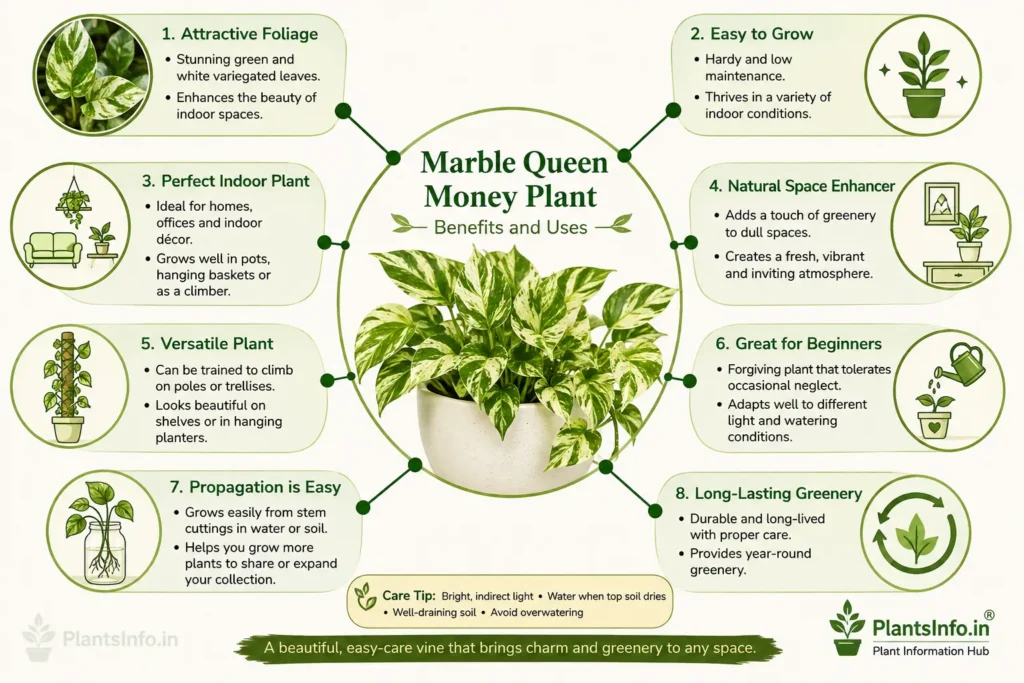
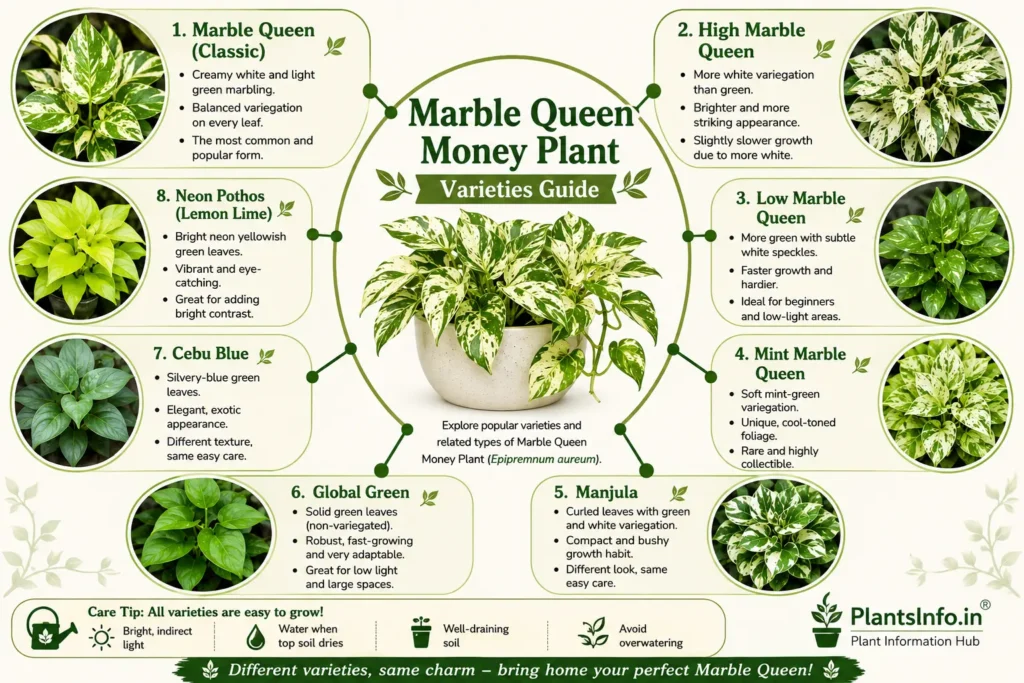
Marble Queen Money Plant: Benefits and Uses
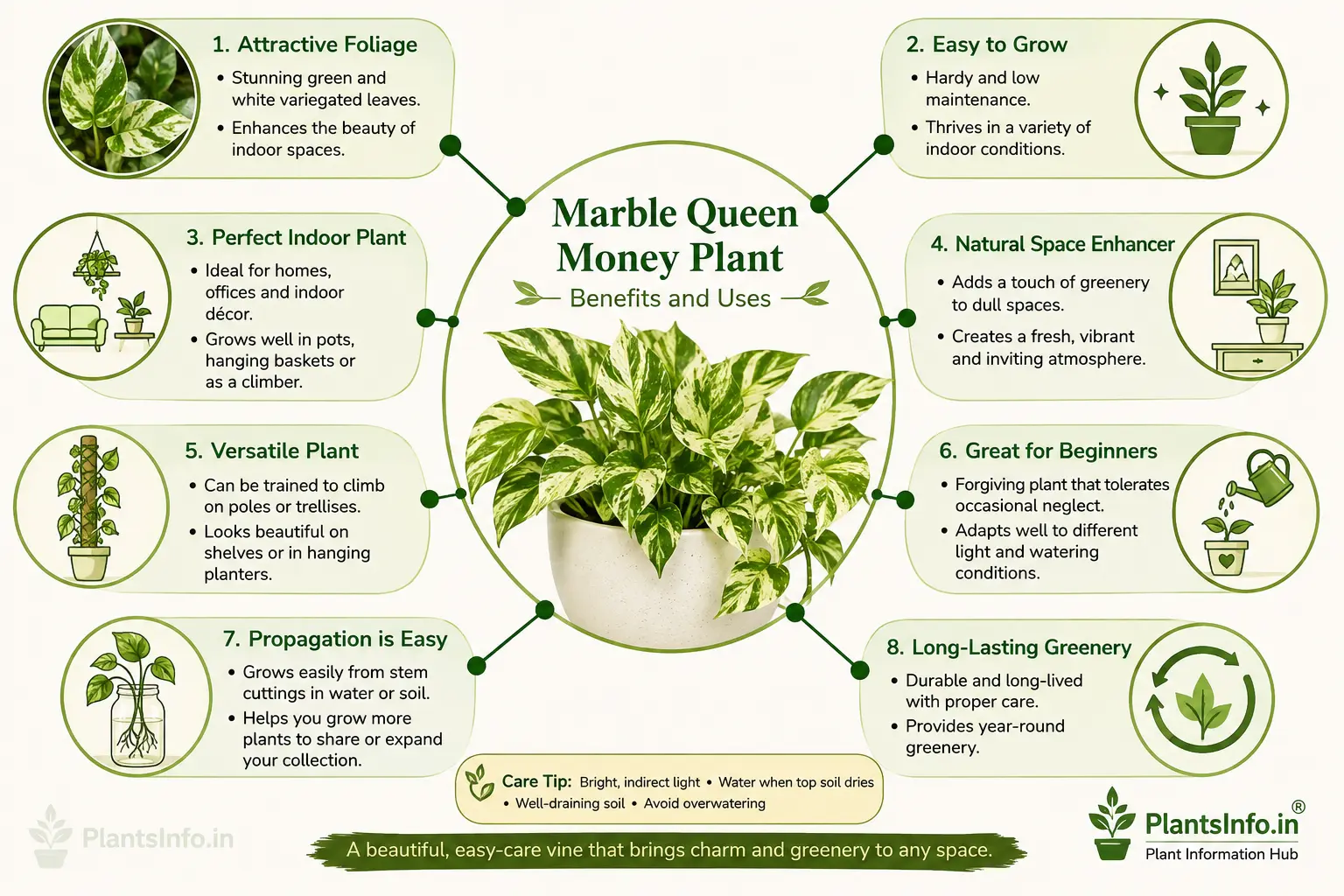
| Quick Benefits Summary (Evidence Summary) | Evidence Strength | Summary |
|---|---|---|
| Ornamental Value | Strong | Widely cultivated for its attractive cream-and-green variegated foliage. |
| Indoor Landscaping | Strong | Commonly used in homes, offices, hotels, and commercial interiors. |
| Container Gardening | Strong | Well suited to hanging baskets, tabletops, shelves, and vertical supports. |
| Vertical Greening | Strong | Frequently used for indoor green walls and climbing displays. |
| Psychological Well-being | Moderate | Indoor ornamental plants may contribute to improved perceived well-being and interior aesthetics, although benefits are not specific to Marble Queen. |
| Indoor Air Quality Improvement | Limited to Moderate | Laboratory studies have demonstrated pollutant removal by Epipremnum aureum, but current evidence indicates these effects are unlikely to produce meaningful improvements in typical indoor environments without extremely large numbers of plants. |
| Traditional Medicinal Uses | Limited | Some traditional practices involving Epipremnum aureum have been reported, but scientific validation remains limited. |
| Clinically Proven Medicinal Benefits | Insufficient | At present, Marble Queen Money Plant should not be considered a medicinal plant. |
| Culinary Value | Not Applicable | Plant is not edible. |
| Pet Safety | Unsafe | Contains insoluble calcium oxalate crystals that may cause irritation if chewed or ingested. |
The strongest evidence supports Marble Queen Money Plant as an ornamental foliage plant. Claims regarding significant air purification or medicinal value should be interpreted cautiously because current scientific evidence does not support many popular claims made in gardening and social media sources.
See also: Marble Queen Money Plant plant profile, how to grow it, common problems, seasonal care, and its varieties.
Quick Answer
| Question | Answer |
|---|---|
| What is Marble Queen primarily grown for? | Its highly decorative variegated foliage. |
| Is it useful indoors? | Yes, it is one of the most popular indoor ornamental vines. |
| Does it purify indoor air? | It can remove certain airborne compounds under laboratory conditions, but the practical effect in homes is limited. |
| Is it edible? | No. |
| Does it have proven medicinal uses? | No established clinical evidence currently supports medicinal use. |
| Is it safe for pets? | No. |
Marble Queen Money Plant is valued almost entirely for its ornamental characteristics. Its attractive cream-and-green foliage, adaptability to indoor conditions, and versatile growth habit make it one of the most widely cultivated decorative houseplants worldwide.
Recommended Products
Disclosure: As an Amazon Associate, PlantsInfo may earn from qualifying purchases.
🌱 Growing Essentials
The following products can help with container gardening, potting, root development, soil management, and healthy plant growth.
Organic Potting Soil Mix
Provides nutrients, structure, and healthy growing conditions for container plants.
Coco Peat Growing Medium
Enhances moisture retention while maintaining excellent root-zone aeration.

Grow Bags for Plants
Improve drainage, root aeration, and vegetable production in limited spaces.

Plastic Pots for Plants
Ideal containers for seedlings, ornamentals, herbs, and balcony gardens.
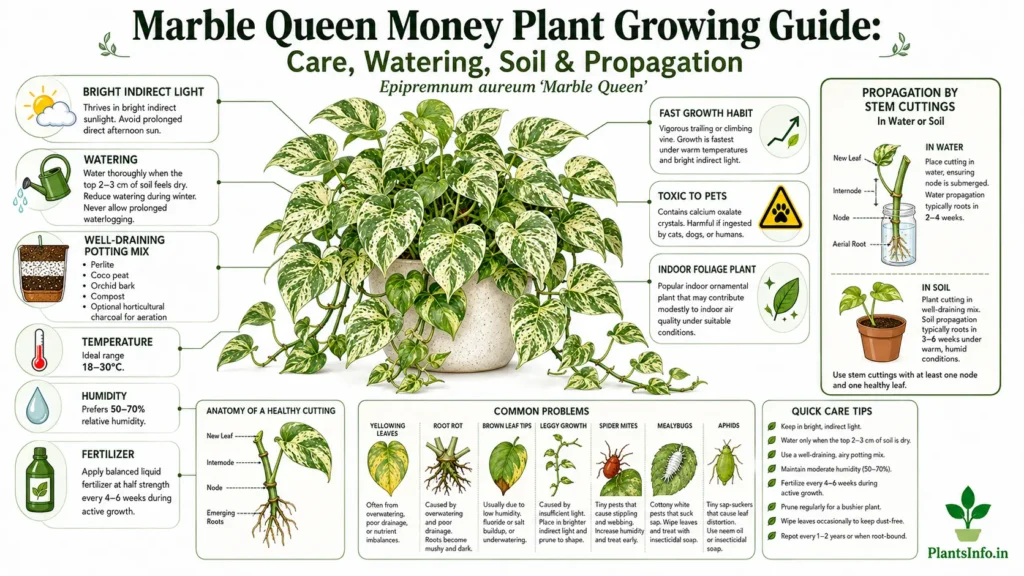
Although the species has been investigated for potential indoor air quality applications and has occasional references in traditional medicine, the strongest scientific support remains its use as a low-maintenance ornamental plant rather than a medicinal or functional crop.
Introduction
Marble Queen Money Plant (Epipremnum aureum ‘Marble Queen’) is a variegated ornamental cultivar grown primarily for decorative landscaping and interior plant displays. Unlike food crops or medicinal herbs, its principal value lies in its foliage, which provides year-round visual interest in homes, offices, commercial buildings, and shaded gardens.
Its cream-and-green marbled leaves distinguish it from greener cultivars of Epipremnum aureum, making it especially popular among collectors of ornamental foliage plants. Because of its adaptability, it is commonly used in hanging baskets, climbing displays, tabletop containers, indoor green walls, and decorative shelving.
Public interest in Marble Queen has also grown because of widely circulated claims regarding air purification, health benefits, and positive energy. While some of these claims originate from scientific studies or cultural traditions, others have been exaggerated beyond what current evidence supports.
Nutritional Overview
Marble Queen Money Plant has no nutritional or culinary value because it is not an edible plant.
Unlike vegetables, herbs, or edible foliage plants, it is cultivated exclusively for ornamental purposes. The leaves and stems contain insoluble calcium oxalate crystals, which can irritate the mouth, tongue, throat, and digestive tract if chewed or swallowed.
For this reason, Marble Queen should never be promoted as an edible houseplant or as a source of nutritional benefits.
Traditional Uses
| Traditional Use | Evidence Status | Remarks |
|---|---|---|
| Ornamental decoration | Strong | Long-established horticultural use worldwide. |
| Indoor landscaping | Strong | Widely used in homes and commercial interiors. |
| Feng Shui | Traditional belief | Cultural practice without scientific validation. |
| Vastu-associated placement | Traditional belief | Cultural interpretation rather than scientific evidence. |
| Traditional medicinal references | Limited | Reported in some regions but poorly documented scientifically. |
Historically, Epipremnum aureum has been cultivated primarily as a decorative foliage plant. Its adaptability, evergreen habit, and ease of propagation have made it a popular ornamental across tropical and subtropical regions.
In several Asian cultures, money plants are associated with prosperity, good fortune, and positive energy. Marble Queen is sometimes placed in homes or workplaces according to Feng Shui or Vastu practices because of these cultural beliefs.
These practices remain important aspects of cultural heritage and personal preference but should not be interpreted as scientifically established effects.
Some traditional medicinal references involving Epipremnum aureum have been documented in ethnobotanical literature. However, these reports are generally localised, inconsistent, and lack sufficient clinical validation to support therapeutic recommendations.
Medicinal Uses (Evidence-Based)
| Claim | Current Evidence | Scientific Assessment |
|---|---|---|
| General medicinal use | Insufficient | No established clinical evidence. |
| Antimicrobial activity | Preliminary laboratory evidence | Requires further research before practical application. |
| Antioxidant activity | Preliminary laboratory evidence | Observed in experimental studies, not validated clinically. |
| Pharmaceutical use | Not established | No approved therapeutic applications. |
| Clinical effectiveness | Not demonstrated | Human clinical evidence is lacking. |
At present, Marble Queen Money Plant should not be considered a medicinal plant.
Experimental laboratory studies involving Epipremnum aureum have investigated certain biological properties, including antioxidant and antimicrobial activity. However, these investigations remain largely preliminary and have not established safe or effective therapeutic applications for humans.
Importantly, laboratory observations should not be interpreted as evidence that the plant can prevent or treat disease. Demonstrating biological activity under controlled experimental conditions is only an early stage of scientific investigation and does not establish clinical usefulness.
Furthermore, because the plant contains insoluble calcium oxalate crystals capable of causing oral and gastrointestinal irritation, self-medication or consumption of any plant part is inappropriate.
From an evidence-based perspective, Marble Queen’s greatest value remains ornamental horticulture, while medicinal claims should be regarded as unproven unless supported by high-quality clinical research.
Scientific Evidence
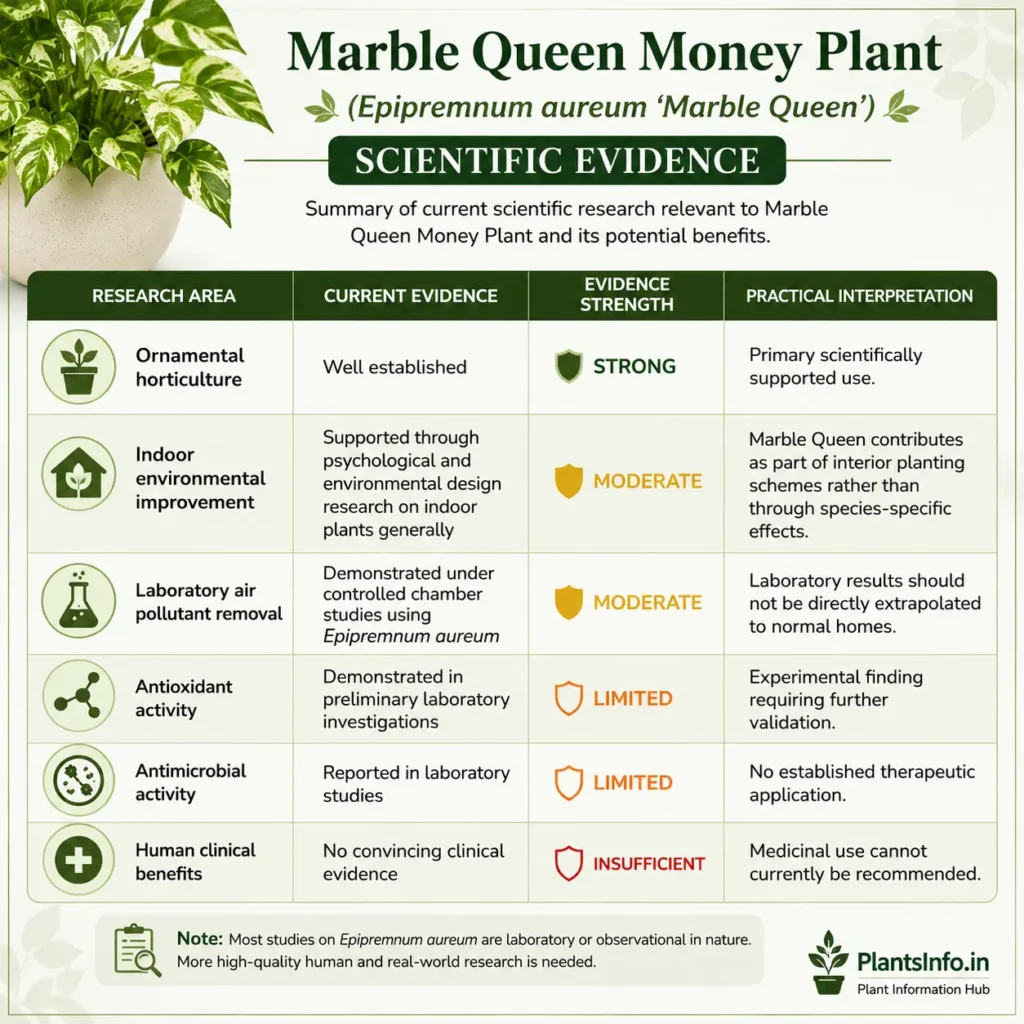
| Research Area | Current Evidence | Evidence Strength | Practical Interpretation |
|---|---|---|---|
| Ornamental horticulture | Well established | Strong | Primary scientifically supported use. |
| Indoor environmental improvement | Supported through psychological and environmental design research on indoor plants generally | Moderate | Marble Queen contributes as part of interior planting schemes rather than through species-specific effects. |
| Laboratory air pollutant removal | Demonstrated under controlled chamber studies using Epipremnum aureum | Moderate | Laboratory results should not be directly extrapolated to normal homes. |
| Antioxidant activity | Demonstrated in preliminary laboratory investigations | Limited | Experimental finding requiring further validation. |
| Antimicrobial activity | Reported in laboratory studies | Limited | No established therapeutic application. |
| Human clinical benefits | No convincing clinical evidence | Insufficient | Medicinal use cannot currently be recommended. |
Scientific research on Epipremnum aureum spans horticulture, indoor environmental science, plant physiology, and laboratory-based biological investigations. However, the quality and applicability of evidence vary considerably between these research areas.
The strongest evidence supports the plant’s value as an ornamental species with excellent adaptability to indoor cultivation. Its commercial popularity is supported by decades of horticultural experience rather than experimental uncertainty.
Evidence Classification
| Evidence Level | What It Means |
|---|---|
| Strong | Consistent scientific evidence and widespread practical validation. |
| Moderate | Multiple studies support the finding, but practical limitations exist. |
| Limited | Early-stage or laboratory evidence requiring further research. |
| Insufficient | Current evidence is inadequate to support reliable conclusions. |
One of the most misunderstood research topics surrounding Marble Queen is indoor air purification.
Laboratory experiments have demonstrated that Epipremnum aureum can absorb certain airborne volatile organic compounds (VOCs) under tightly controlled experimental conditions. However, more recent building science research indicates that achieving comparable improvements in typical indoor environments would require an impractically large number of plants. Consequently, Marble Queen should be appreciated primarily as an ornamental plant, with any contribution to indoor air quality regarded as a secondary rather than primary benefit.
Similarly, laboratory studies reporting antioxidant or antimicrobial properties identify interesting biological activity but do not establish that the plant has clinically useful medicinal properties. Human therapeutic effectiveness remains unproven.
Ornamental Benefits
| Benefit | Importance | Remarks |
|---|---|---|
| Attractive variegated foliage | Very High | Primary ornamental feature. |
| Year-round evergreen appearance | Very High | Provides continuous decorative value. |
| Adaptable growth habit | High | Suitable for trailing or climbing displays. |
| Architectural foliage | High | Adds texture and visual contrast. |
| Suitable for multiple display styles | High | Hanging baskets, shelves, moss poles, and tabletop containers. |
| Low maintenance | High | Popular among beginners and experienced gardeners alike. |
Marble Queen is cultivated almost exclusively for its ornamental foliage. Its irregular cream-and-green marbling creates strong visual contrast, allowing the plant to function as both a focal specimen and a complementary foliage plant in mixed indoor displays.
Ornamental Applications
| Application | Suitability |
|---|---|
| Hanging baskets | Excellent |
| Indoor shelves | Excellent |
| Tabletop displays | Excellent |
| Vertical gardens | Excellent |
| Moss poles | Excellent |
| Office interiors | Excellent |
| Hotel lobbies | Excellent |
| Shaded balconies | Excellent |
The cream-and-green variegation creates strong visual contrast and can make the plant particularly effective as an accent in interior displays.
Another advantage is the plant’s changing appearance over time. Trailing specimens create cascading displays, while climbing plants gradually develop larger, more mature foliage, offering two distinct ornamental forms from the same cultivar.
Indoor Environmental Benefits
| Benefit | Evidence Strength | Practical Value |
|---|---|---|
| Improves interior aesthetics | Strong | High |
| Increases connection with nature | Moderate | Moderate to High |
| Contributes to biophilic interior design | Moderate | High |
| Laboratory VOC removal | Moderate | Limited practical household impact |
| Indoor humidity contribution | Limited | Minor under normal household conditions |
| Noise reduction | Limited | Minimal for individual plants |
Indoor plants contribute to the quality of interior environments through both visual and psychological effects.
Marble Queen is particularly well suited to indoor spaces because of its adaptable trailing or climbing habit and tolerance of a range of indoor growing conditions.
Environmental Contributions
| Contribution | Description |
|---|---|
| Interior greening | Adds living vegetation to built environments |
| Visual comfort | Softens architectural spaces with natural foliage |
| Biophilic design | Supports incorporation of natural elements into interior design |
| Space utilisation | Suitable for vertical and hanging displays where floor space is limited |
Biophilic design research suggests that incorporating plants into indoor environments may improve occupants’ perception of comfort, satisfaction, and overall environmental quality. These benefits arise from interaction with indoor vegetation generally rather than from unique characteristics of Marble Queen itself.
While laboratory studies have shown that Epipremnum aureum can remove certain airborne compounds under experimental conditions, current scientific consensus indicates that ordinary household numbers of plants are unlikely to produce substantial improvements in indoor air chemistry. Consequently, the plant should be appreciated primarily for its ornamental contribution to interior environments.
Economic Uses
| Economic Use | Importance | Remarks |
|---|---|---|
| Ornamental nursery production | Very High | Major commercial application. |
| Interior landscaping | High | Widely used in commercial projects. |
| Retail houseplant trade | Very High | Popular worldwide. |
| Landscaping services | High | Used in residential and commercial installations. |
| Tissue culture production | High | Enables large-scale commercial propagation. |
| Home-based plant businesses | Moderate | Frequently propagated from stem cuttings. |
Marble Queen has considerable economic value within the ornamental horticulture industry.
Its popularity among indoor plant enthusiasts has created sustained demand across retail nurseries, online plant stores, garden centres, and commercial interior landscaping businesses.
Commercial Advantages
| Characteristic | Commercial Benefit |
|---|---|
| Easy propagation | Reduces production costs |
| Reliable container performance | Simplifies transportation and retail display |
| Attractive foliage | Maintains strong consumer demand |
| Long display life | Increases retail marketability |
| Wide climatic adaptability indoors | Expands market distribution |
Commercial growers typically propagate Marble Queen vegetatively through stem cuttings or tissue culture to preserve the cultivar’s distinctive variegation. Seed propagation is not used commercially because it does not reliably maintain cultivar characteristics.
The increasing popularity of indoor gardening has also encouraged many small-scale growers and hobbyists to propagate and exchange rooted cuttings, making Marble Queen one of the most accessible ornamental foliage plants in the houseplant market.
Cultural Significance
| Cultural Aspect | Status | Remarks |
|---|---|---|
| Decorative symbolism | Well established | Widely associated with prosperity and greenery. |
| Feng Shui | Traditional belief | Popular placement practice without scientific validation. |
| Vastu associations | Traditional belief | Cultural interpretation rather than evidence-based guidance. |
| Modern interior design | Strong | Frequently incorporated into contemporary living spaces. |
| Botanical collecting | Strong | Popular among variegated foliage enthusiasts. |
Marble Queen forms part of the broader cultural popularity of money plants, which are commonly associated with prosperity, abundance, and positive fortune in several traditions.
Although these beliefs are culturally significant, they should be understood as traditional practices rather than scientifically verified outcomes.
Common Cultural Uses
| Setting | Purpose |
|---|---|
| Homes | Decorative indoor greenery |
| Offices | Interior beautification and symbolic prosperity |
| Reception areas | Welcoming ornamental display |
| Cafés and restaurants | Natural interior decoration |
| Commercial buildings | Modern biophilic design |
In contemporary interior design, Marble Queen has become an important foliage plant because it combines decorative appeal with relatively simple maintenance. Its distinctive variegation allows it to complement minimalist, tropical, contemporary, and naturalistic design styles alike.
The plant has also gained popularity among collectors of variegated aroids, where cultivars are appreciated for the unique patterns found on individual leaves. Since no two leaves display identical marbling, each plant develops its own distinctive ornamental character over time.
From a cultural perspective, Marble Queen’s enduring popularity reflects a combination of horticultural performance, aesthetic appeal, and longstanding symbolic associations, even though the symbolic meanings themselves remain matters of personal belief rather than scientific evidence.
Safety Considerations
| Safety Aspect | Recommendation | Importance |
|---|---|---|
| Human Consumption | Do not consume any part of the plant. | Critical |
| Pet Safety | Keep away from cats, dogs, birds, and other pets. | Critical |
| Child Safety | Place out of reach of young children. | Critical |
| Skin Contact | Usually safe for routine handling, but sensitive individuals may experience mild irritation from sap. | Moderate |
| Eye Contact | Avoid direct contact with plant sap. | High |
| Pruning | Wash hands after handling and sterilise pruning tools. | Moderate |
| Indoor Placement | Position where accidental chewing is unlikely. | High |
Marble Queen Money Plant contains insoluble calcium oxalate crystals, which serve as a natural defence mechanism against herbivores. These microscopic needle-shaped crystals can irritate when plant tissues are chewed or damaged.
Although routine handling is generally safe, ingestion of leaves or stems may result in irritation of the mouth, tongue, lips, throat, and digestive tract in both humans and animals.
Potential Hazards
| Exposure | Possible Effect |
|---|---|
| Chewing leaves | Oral irritation and discomfort |
| Swallowing plant tissue | Throat and digestive irritation |
| Sap contact with eyes | Temporary irritation |
| Sap contact with sensitive skin | Mild irritation in susceptible individuals |
Serious systemic toxicity is generally uncommon, but ingestion can cause significant oral and gastrointestinal irritation, and severe swelling may interfere with swallowing or breathing.
Safety Around Pets
| Pet | Risk Level |
|---|---|
| Cats | High |
| Dogs | High |
| Rabbits | High |
| Birds | High |
| Small mammals | High |
Curious pets may chew foliage, particularly young leaves. Positioning the plant on elevated shelves, hanging baskets, or inaccessible climbing supports helps minimise accidental exposure.
Safe Indoor Placement
| Location | Suitability |
|---|---|
| High shelves | Excellent |
| Hanging baskets | Excellent |
| Office desks | Good |
| Children’s play areas | Not recommended |
| Pet feeding areas | Not recommended |
A practical observation is that Marble Queen remains an excellent indoor ornamental for households with pets or children, provided reasonable precautions are taken to prevent chewing or ingestion.
Most Important Takeaway
| Benefit | Evidence Strength | Practical Importance |
|---|---|---|
| Ornamental foliage | Strong | Primary reason to grow Marble Queen |
| Indoor decorative value | Strong | Excellent |
| Commercial horticultural importance | Strong | High |
| Air purification | Limited to Moderate | Secondary benefit only |
| Medicinal value | Insufficient | Not recommended |
| Edibility | Not applicable | Do not consume |
The most strongly supported benefit of Marble Queen Money Plant is its exceptional ornamental value.
Its attractive variegated foliage, adaptability to indoor environments, and versatile growth habit have established it as one of the world’s most popular foliage houseplants. While laboratory research has explored additional biological properties, current scientific evidence does not support promoting Marble Queen as a medicinal or edible plant.
Readers should therefore appreciate Marble Queen primarily for what it demonstrably offers: reliable ornamental performance, decorative interior landscaping, and long-term aesthetic value.
Frequently Asked Questions
Is Marble Queen Money Plant edible?
| Answer | Explanation |
|---|---|
| No. | The plant contains insoluble calcium oxalate crystals and should not be eaten. |
Marble Queen is cultivated exclusively as an ornamental foliage plant and has no recognised culinary use.
Does Marble Queen really purify indoor air?
| Answer | Explanation |
|---|---|
| Under laboratory conditions, yes. | Practical improvements in normal homes are generally limited because laboratory conditions differ greatly from everyday indoor environments. |
The plant may contribute modestly to indoor environmental quality, but it should not be considered a substitute for proper building ventilation.
Can Marble Queen be used medicinally?
| Answer | Explanation |
|---|---|
| Current evidence does not support routine medicinal use. | Laboratory studies have identified certain biological activities, but clinically proven therapeutic applications are lacking. |
Medicinal claims should therefore be interpreted cautiously.
Why is Marble Queen associated with prosperity?
| Answer | Explanation |
|---|---|
| This association comes from cultural traditions such as Feng Shui and Vastu. | These beliefs are part of cultural practice rather than scientific evidence. |
Many people enjoy the symbolic value of the plant alongside its ornamental appeal.
Is Marble Queen suitable for offices?
| Answer | Explanation |
|---|---|
| Yes. | Its attractive foliage, relatively compact growth, and adaptability make it well suited to offices, reception areas, hotels, and other indoor commercial spaces. |
Its decorative value remains its greatest practical benefit.
Is Marble Queen safe for households with pets?
| Answer | Explanation |
|---|---|
| Yes, with precautions. | The plant should be placed where pets cannot chew or ingest the foliage. |
Responsible placement allows many households to enjoy the plant safely while reducing the risk of accidental exposure.
Conclusion
| Key Conclusion | Importance |
|---|---|
| Marble Queen is primarily an ornamental foliage plant. | Critical |
| Scientific evidence strongly supports its decorative and horticultural value. | High |
| Air-purifying claims should be interpreted realistically. | High |
| Medicinal and nutritional claims remain unsupported by strong clinical evidence. | High |
| Safe placement is essential in homes with children and pets. | High |
Marble Queen Money Plant has earned its popularity through its distinctive variegated foliage, adaptability, and exceptional ornamental performance rather than through medicinal or nutritional properties. Its ability to thrive in a wide range of indoor settings has made it a cornerstone of modern interior landscaping, container gardening, and decorative foliage collections.
Current scientific evidence supports its value as an ornamental species and recognises limited laboratory evidence for certain biological properties. However, these findings should not be interpreted as proof of meaningful medicinal benefits or significant improvements in indoor air quality under normal household conditions.
For gardeners, designers, and plant enthusiasts, Marble Queen’s greatest strengths remain its aesthetic appeal, versatility, and ease of maintenance. Appreciating the plant for these well-established qualities—while recognising its safety considerations and the limits of current scientific evidence—provides the most accurate and balanced understanding of its benefits and uses.