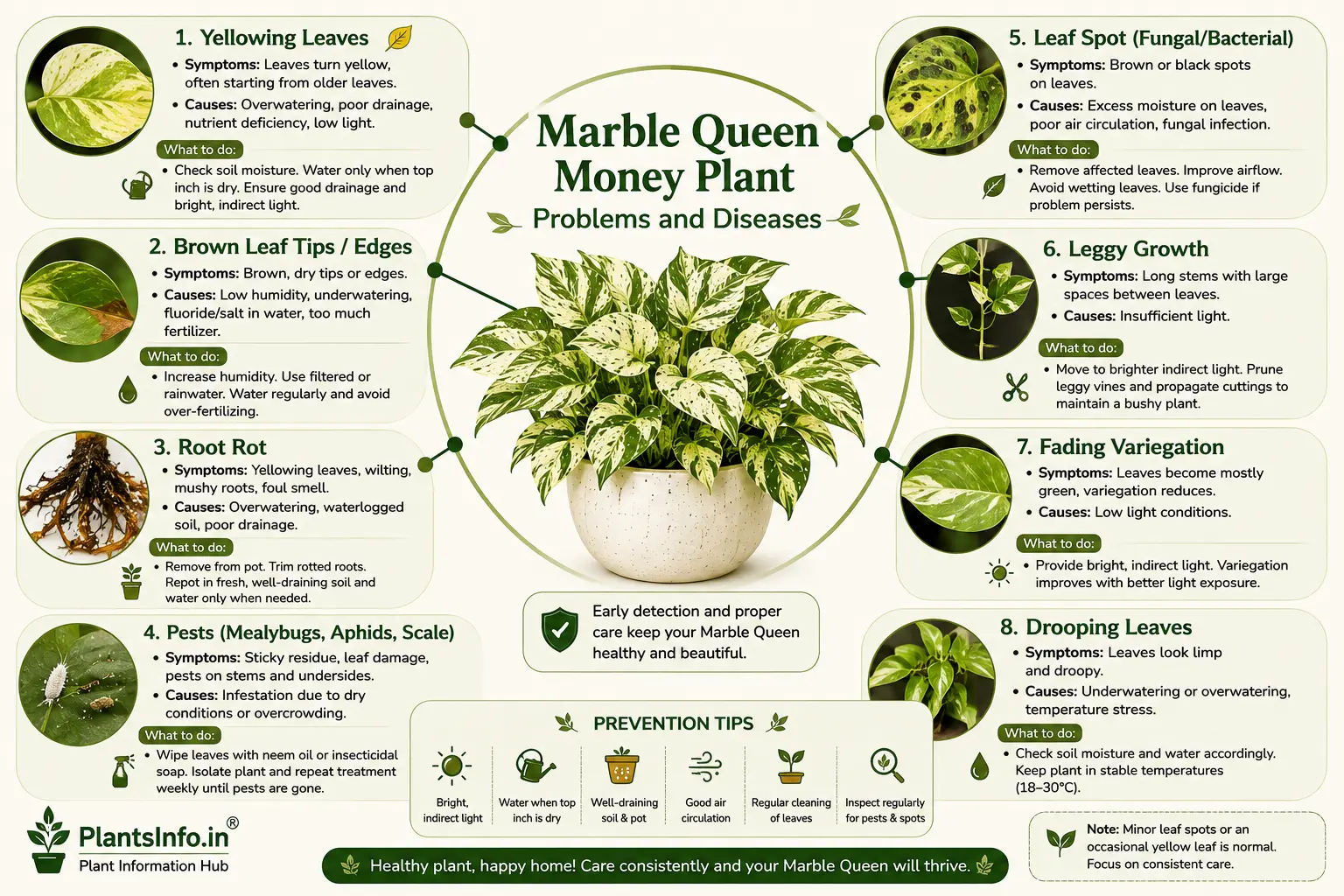
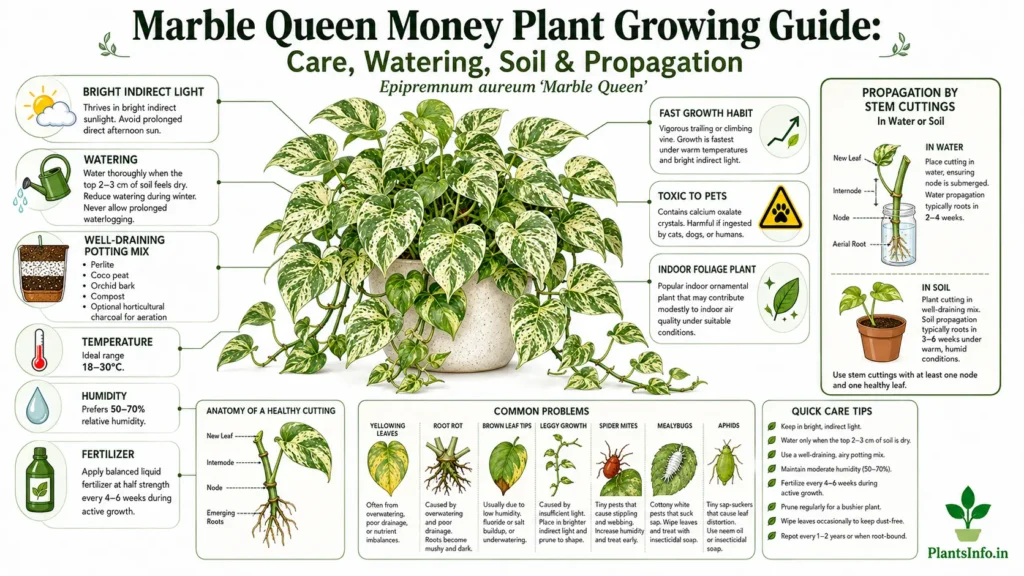
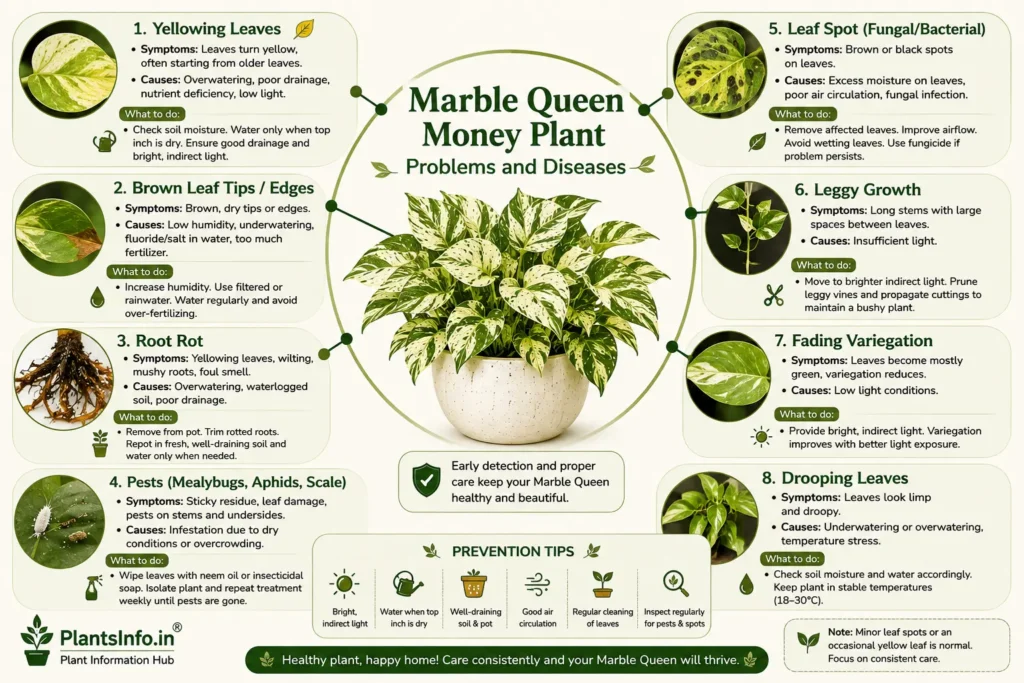
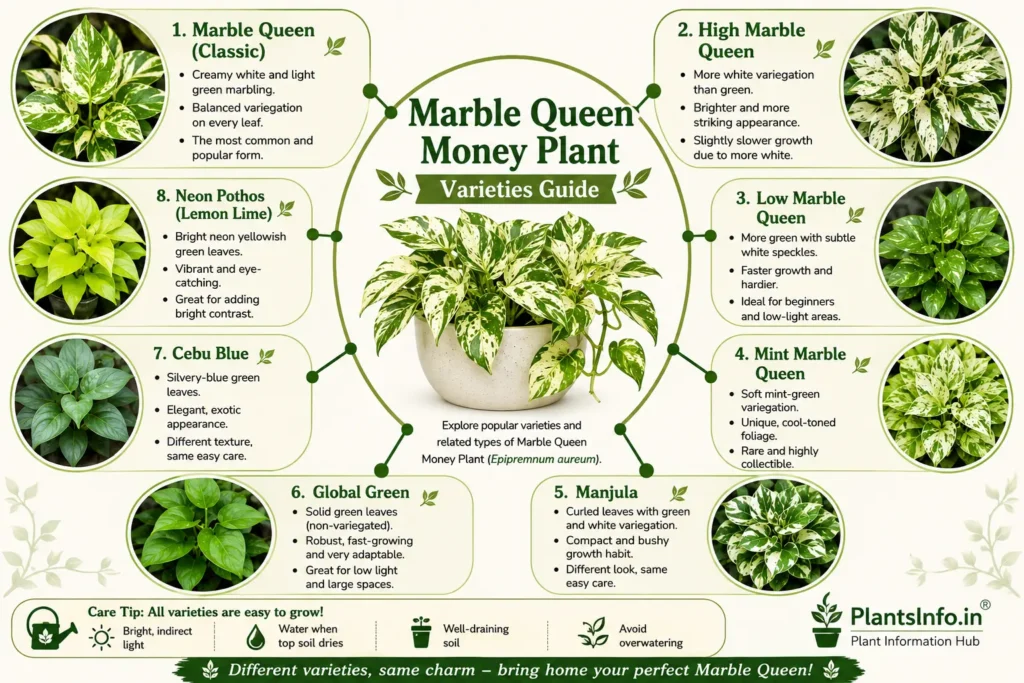
Many common Marble Queen Money Plant problems are associated with environmental stress, while infectious diseases are only one possible cause of declining foliage.
Yellow leaves, wilting, brown edges, reduced variegation and slow growth can have several different causes. The same symptom does not always indicate the same problem, so treatment should begin only after the likely cause has been identified.
Recommended Products
Disclosure: As an Amazon Associate, PlantsInfo may earn from qualifying purchases.
🌱 Growing Essentials
The following products can help with container gardening, potting, root development, soil management, and healthy plant growth.
Organic Potting Soil Mix
Provides nutrients, structure, and healthy growing conditions for container plants.
The most important diagnostic principle is simple: identify the first visible symptom and examine the growing conditions before applying a treatment.
Introduction
Marble Queen Money Plant is generally a resilient ornamental vine, but plants grown indoors or in containers can develop problems when moisture, light, temperature, airflow, or root conditions become unsuitable.
Many common symptoms are not diseases. Yellowing leaves, for example, may result from excess moisture, insufficient water, natural ageing or root dysfunction. Similarly, brown leaves can result from direct sunlight, dry conditions or tissue damage.
This makes diagnosis more important than immediately applying a fungicide, fertilizer or pesticide.
A useful diagnostic sequence is:
Identify the first symptom.
Check whether the growing medium is wet or dry.
Examine the location and pattern of the damage.
Inspect stems and leaves for pests.
Examine roots when root problems are suspected.
Consider recent changes in light, watering, temperature, or placement.
Treat only after the likely cause has been identified.
Most Critical Problem: Root and Stem Decay
Root and stem decay deserve the fastest attention because extensive tissue damage can eventually prevent the plant from taking up water and nutrients or supporting its foliage.
The underlying problem is usually associated with prolonged moisture around the roots or stems. Continuously saturated growing media can reduce oxygen availability around roots and create conditions in which damaged tissues deteriorate.
Early Root Problems
Early symptoms can include:
Yellowing of older leaves
Reduced growth
Wilting despite moist growing media
Progressive loss of foliage quality
Softening of lower stem tissue
These symptoms are not specific to root rot, so they should be interpreted together with soil moisture and root condition.
Advanced Root Damage
More serious root deterioration may produce:
Brown or black roots
Soft rather than firm root tissue
Loss of healthy roots
Persistent wilting despite wet soil
Progressive leaf loss
Stem collapse in severe cases
The most reliable way to distinguish serious root damage from a simple watering problem is to inspect the root system when the symptoms justify doing so.
Recovery Potential
Recovery depends primarily on how much healthy root and stem tissue remains.
When only part of the root system is damaged, the plant may recover after the underlying moisture problem is corrected and affected tissue is removed where appropriate.
When most of the root system has decayed, recovery becomes less certain. Healthy stem sections may provide an alternative means of preserving the plant if suitable propagation material remains.
Damaged leaves should not be used as the main measure of recovery. New, healthy growth is a more useful indicator.
Disease Problems
Root Rot
Root rot describes deterioration of the root system associated with prolonged poor root conditions. It should not be diagnosed from yellow leaves alone.
Feature
What to look for
Main warning sign
Wilting or yellowing despite persistently wet growing media
Root appearance
Soft, brown or black roots rather than firm healthy roots
Plant response
Reduced growth, progressive leaf decline
Urgency
High to critical when extensive
Recovery
Depends on remaining healthy roots
Early recognition matters because a plant with substantial healthy roots has a better chance of recovery than one with extensive root-system loss.
Stem Rot
Stem decay can occur when stem tissues remain excessively wet or when decay progresses from damaged root or stem tissue.
Feature
What to look for
Main symptom
Softening or darkening of affected stems
Typical location
Lower stems or previously damaged tissue
Urgency
High when spreading
Recovery
Better when healthy stem tissue remains
Soft, collapsing tissue should not be confused with normal stem colour or minor surface damage. Where decay is clearly present, affected tissue should be separated from healthy growth where practical.
Leaf Spot
Brown, black or otherwise discoloured leaf lesions can have several causes. Fungal or bacterial pathogens may be involved, but a visual symptom alone does not reliably identify the specific pathogen.
Feature
What to look for
Main symptom
Localised brown, dark or necrotic lesions
Distribution
One or several leaves
Risk factors
Persistently wet foliage, poor airflow or damaged tissue
Urgency
Usually moderate unless damage is spreading rapidly
Recovery
Depends on the underlying cause and extent of damage
Before assuming that a leaf spot is an infectious disease, examine the plant for direct sunlight injury, mechanical damage, moisture stress and pest activity.
Bacterial Soft Rot
Rapidly softening, water-soaked tissue accompanied by an unpleasant odour is more concerning than an isolated dry leaf spot.
Feature
What to look for
Main symptom
Rapid softening and collapse of tissue
Additional warning sign
Unpleasant odour
Urgency
High
Recovery
Poorer when the affected area is extensive
Because different forms of tissue decay can look similar, the article should not imply that a specific bacterial pathogen can be confirmed from symptoms alone.
Sooty Mould
Sooty mould appears as a dark coating on the surface of leaves and stems. It is associated with honeydew produced by sap-feeding insects rather than being the primary cause of the insect infestation.
Feature
What to look for
Main symptom
Black or dark surface coating
Associated problem
Scale, aphids, mealybugs or other honeydew-producing insects
Urgency
Usually low by itself
Priority
Find and address the underlying insect problem
The presence of sooty mould should therefore trigger a careful inspection for sap-feeding pests rather than being treated as an isolated leaf disease.
Disease Diagnosis Summary
Problem
Most useful diagnostic clue
Priority
Root damage
Wet growing medium plus declining roots and plant vigour
High
Stem decay
Soft, darkening or collapsing stem tissue
High
Leaf spot
Localised lesions requiring differentiation from environmental damage
Moderate
Soft rot
Rapid tissue collapse, often with an unpleasant odour
High
Sooty mould
Dark surface coating associated with sap-feeding insects
Low to moderate
A key diagnostic rule is to avoid treating every brown or yellow area as a disease. Environmental damage and pest activity can produce similar symptoms.
Pest Problems
Marble Queen Money Plant can be affected by several sap-feeding pests, particularly when plants are stressed or when an infested plant is introduced into a collection. Early inspection is useful because small infestations are generally easier to manage than established populations.
Mealybugs
Mealybugs are small sap-feeding insects that commonly hide around leaf axils, stem joints and other sheltered areas.
Feature
What to look for
Main symptom
White, cotton-like clusters
Common locations
Leaf axils, nodes, stems and leaf undersides
Other signs
Sticky residue or reduced plant vigour
Urgency
Moderate
Recovery
Usually favourable when detected early
A useful diagnostic clue is the combination of white cotton-like material and insect activity. Dust or mineral deposits may resemble mealybugs, so suspicious material should be examined closely before treatment.
Heavy infestations can weaken new growth and may also produce honeydew, which can lead to sooty mould.
Spider Mites
Spider mites are very small and may be difficult to see individually. Their presence is often first noticed through changes in the foliage.
Feature
What to look for
Main symptom
Fine pale or stippled areas on leaves
Advanced sign
Fine webbing, particularly beneath leaves
Favourable conditions
Warm, dry environments
Urgency
Moderate
Recovery
Usually favourable when detected early
Fine webbing should be distinguished from ordinary spider webs. When webbing is accompanied by widespread stippling or pale foliage, inspect the undersides of leaves carefully.
Scale Insects
Scale insects may appear as small, attached bumps on stems or leaves. Because they can resemble natural plant structures, early infestations are easy to overlook.
Feature
What to look for
Main symptom
Small brown or tan attached bumps
Other signs
Sticky honeydew and reduced vigour
Common locations
Stems and leaf surfaces
Urgency
Moderate
Recovery
Usually favourable when infestation is limited
A sticky surface combined with attached bumps is more suggestive of scale than simple dust or residue.
Aphids
Aphids are soft-bodied sap-feeding insects that may occasionally colonise young growth.
Feature
What to look for
Main symptom
Clusters of small insects on tender growth
Other signs
Distorted or curled new growth and sticky residue
Common location
Growing tips and young leaves
Urgency
Low to moderate
Recovery
Usually favourable
Aphid problems are generally easier to recognise on young shoots than on mature leaves.
Fungus Gnats
Fungus gnats are small flying insects commonly associated with persistently moist growing media.
Feature
What to look for
Main symptom
Small flying insects around the growing medium
Adult damage
Usually limited
Root-zone concern
Larvae may affect fine roots when populations are high
Urgency
Usually low
Recovery
Generally favourable
The presence of fungus gnats can therefore be a useful clue that the root environment deserves attention, although seeing adult gnats does not by itself establish serious root damage.
Pest Diagnosis Summary
Pest
Most useful clue
Main area to inspect
Mealybugs
White cotton-like clusters
Nodes and leaf axils
Spider mites
Fine stippling and possible webbing
Leaf undersides
Scale
Attached brown or tan bumps
Stems and leaves
Aphids
Insects clustered on tender growth
Growing tips
Fungus gnats
Small flying insects around growing medium
Root zone and soil surface
Pest identification should precede pesticide use. Similar-looking deposits or leaf symptoms can have non-pest causes, and unnecessary pesticide applications can add stress without addressing the underlying problem.
Environmental Problems
Environmental disorders are an important part of Marble Queen diagnosis because several common symptoms can occur without an infectious disease or pest infestation.
Insufficient Light
Low light can reduce growth and alter the appearance of Marble Queen foliage.
Feature
What to look for
Main symptoms
Smaller leaves, longer gaps between leaves and reduced visible variegation
Growth response
Elongated or sparse shoots
Urgency
Low to moderate
Recovery
Usually favourable in new growth
Reduced variegation in new leaves should not automatically be interpreted as disease. Light availability can influence the amount of visible green and cream tissue produced by variegated plants.
Existing leaves may not change substantially after conditions improve, so recovery is better judged from subsequent growth.
Leggy Growth
Long stems with widely spaced leaves usually indicate that the plant is receiving insufficient light for compact growth.
Feature
What to look for
Main symptom
Long internodes and sparse foliage
Typical cause
Insufficient light
Urgency
Low
Recovery
New growth can improve
Leggy growth is primarily a diagnostic clue rather than a disease. It indicates that the plant’s current growing position may not provide the conditions needed for compact development.
Leaf Scorch
Brown, bleached or crispy patches can develop when foliage is exposed to excessive direct sunlight, particularly after a plant has been maintained in lower light.
Feature
What to look for
Main symptom
Localised brown or bleached patches
Common location
Areas directly exposed to intense sunlight
Urgency
Moderate
Recovery
Future growth can remain healthy
Existing damage
Usually permanent
Cream or white portions of variegated leaves can be particularly vulnerable to intense light exposure.
Leaf scorch should be distinguished from fungal or bacterial leaf spots by considering the location and pattern of the damage. Damage concentrated on the most exposed surfaces is more suggestive of environmental injury.
Overwatering and Prolonged Saturation
Excess moisture is an important risk factor for root problems.
Feature
What to look for
Main symptoms
Yellowing, wilting despite wet growing media and reduced growth
Important risk
Root deterioration
Urgency
High when persistent
Recovery
Usually better when identified before extensive root damage
Overwatering should not be understood simply as “too much water on one occasion.” The more important diagnostic concern is how long the root environment remains excessively wet.
A plant that is repeatedly kept in saturated growing media is at greater risk of root dysfunction than one that occasionally receives more water than necessary.
Underwatering
Insufficient moisture can produce wilting and dry or crispy leaf margins.
Feature
What to look for
Main symptom
Wilting with dry growing media
Other symptoms
Dry margins or curling
Urgency
Usually low to moderate
Recovery
Generally favourable if damage is limited
Underwatering becomes more serious when it is repeated or severe. A single episode of wilting does not necessarily indicate permanent damage.
The key diagnostic distinction is:
Wilting with dry growing media suggests moisture shortage; wilting with persistently wet growing media requires investigation of the roots.
Temperature Stress
Sudden or prolonged temperature stress can reduce plant vigour and cause foliage damage.
Condition
Possible response
Prolonged cold
Reduced growth and foliage damage
Sudden temperature change
Temporary stress or leaf damage
Excessive heat
Wilting and increased moisture stress
Temperature-related symptoms can overlap with watering problems, so recent changes in the plant’s environment should be considered before assigning a single cause.
Low Humidity
Dry indoor air can contribute to brown or crispy leaf margins, particularly when combined with heat or inadequate moisture.
Feature
What to look for
Main symptom
Brown or dry leaf margins
Typical context
Dry indoor air, heat or air-conditioning
Urgency
Usually low
Recovery
New growth can remain healthy after conditions improve
Low humidity should not be diagnosed solely from brown leaf tips. Watering problems, salt accumulation, heat and direct sunlight can produce similar symptoms.
Environmental Diagnosis Summary
Problem
Key diagnostic clue
Typical urgency
Recovery outlook
Low light
Sparse growth and reduced visible variegation
Low to moderate
Usually favourable
Leggy growth
Long internodes and widely spaced leaves
Low
New growth can improve
Leaf scorch
Brown or bleached damage on exposed surfaces
Moderate
Existing damage remains
Prolonged saturation
Wet growing medium with yellowing or wilting
High
Better when corrected early
Underwatering
Wilting with dry growing medium
Low to moderate
Usually favourable
Temperature stress
Damage following unsuitable temperatures
Variable
Depends on severity
Low humidity
Dry or brown margins in a dry environment
Low
Usually favourable
A useful diagnostic habit is to compare the location of the damage with the plant’s environment. Damage on the window-facing side may suggest light injury, while symptoms occurring throughout the plant together with persistently wet growing media warrant closer examination of the root system.
India-Specific Diagnostic Context
Marble Queen is commonly grown indoors or in sheltered locations in India, where environmental conditions can change considerably between regions and seasons.
Indian situation
Problem worth checking
Monsoon conditions with slow-draining containers
Prolonged moisture and root problems
Strong afternoon sun through a window
Leaf scorch
Dark interior rooms
Leggy growth and reduced variegation
Air-conditioned rooms
Dry-air stress and possible spider-mite pressure
Hot periods combined with irregular watering
Moisture stress
Newly purchased plants placed beside an established collection
Introduction of pests
These are diagnostic considerations rather than fixed regional rules. The actual condition of the plant and its immediate growing environment should take priority over assumptions based only on location.
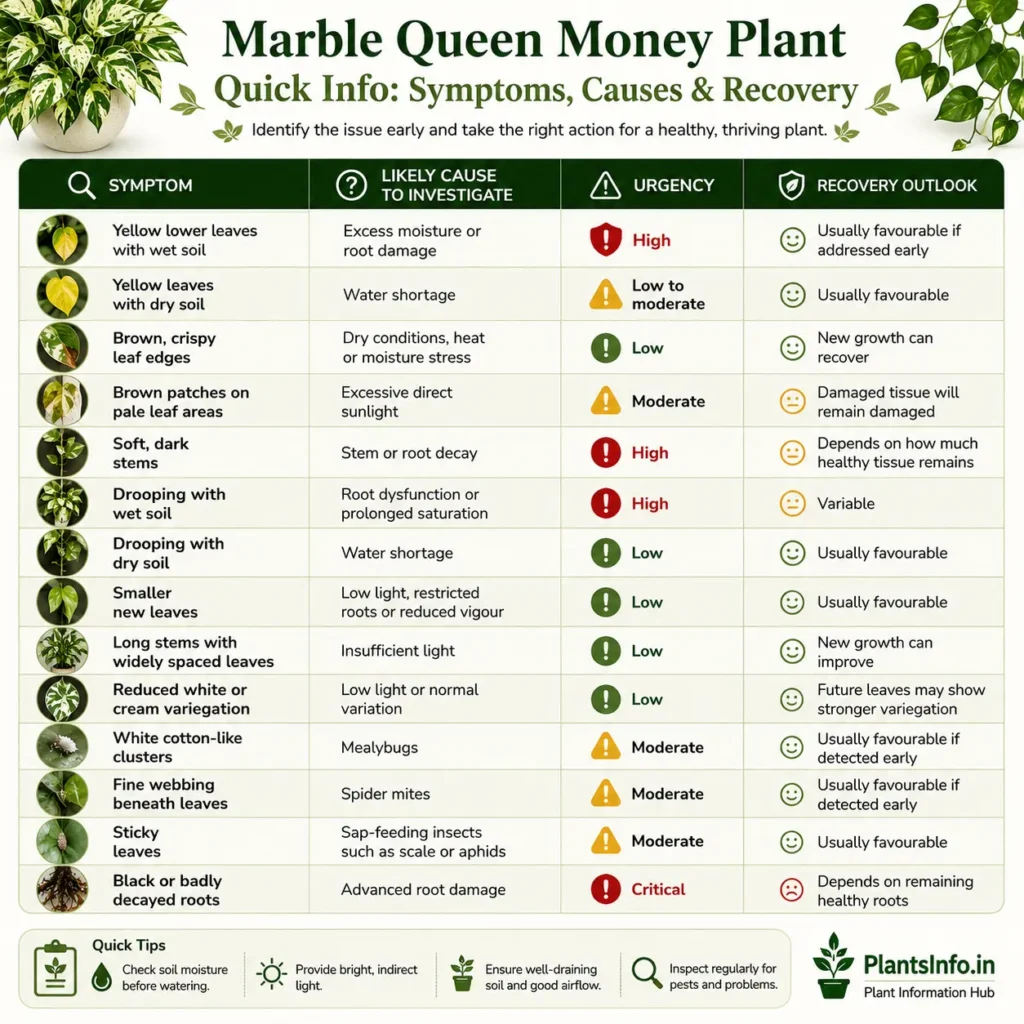
When Symptoms Overlap
Some Marble Queen problems are difficult to distinguish from one another because the visible symptoms are similar.
Symptom
Possible causes to investigate first
Yellow leaves
Excess moisture, insufficient water, root damage, natural ageing or nutrition
Wilting
Dry roots, damaged roots, heat stress or other environmental stress
Brown margins
Dry conditions, heat, direct light or moisture problems
Brown spots
Sun injury, physical damage or leaf-spot disease
Green new leaves
Reduced light or normal variation in variegation
Small leaves
Low light, root restriction or reduced vigour
Sticky foliage
Scale, aphids, mealybugs or other sap-feeding insects
Fine webbing
Spider mites or, less commonly, unrelated web-building spiders
When more than one explanation is plausible, avoid treating immediately. Compare the symptom with soil moisture, light exposure, root condition, recent environmental changes, and visible pests.
Most Useful Diagnostic Rule
The most reliable first question is not:
“Which treatment should I use?”
It is:
“What changed before the symptom appeared?”
Recent changes in watering, placement, sunlight, temperature, repotting, or neighbouring plants can provide important clues.
Diagnosis becomes more reliable when several observations point toward the same cause rather than when one symptom is used in isolation.
Nutrient Deficiencies
Nutrient deficiencies can occur in container-grown Marble Queen Money Plant, but visual symptoms should be interpreted cautiously. Yellowing or poor growth can also result from inadequate light, excessive moisture, damaged roots, or other environmental stresses.
A nutrient deficiency should therefore be considered only after more common environmental and root-related causes have been assessed.
Nitrogen Deficiency
Nitrogen deficiency can produce general paling or yellowing, particularly in older foliage, together with reduced growth.
Feature
What to look for
Typical symptom
General yellowing or paling
Leaves often affected first
Older leaves
Other sign
Reduced growth and vigour
Diagnostic caution
Similar symptoms can occur with root problems
Priority
Low to moderate
Uniform yellowing across older leaves is more suggestive of a nutrient issue than isolated yellowing of a single old leaf.
Potassium Deficiency
Potassium deficiency may be associated with marginal browning or poor growth, but these symptoms are not specific enough to confirm a deficiency on their own.
Feature
What to look for
Possible symptom
Browning around leaf margins
Other possible sign
Reduced vigour
Diagnostic caution
Dry conditions and root problems can look similar
Priority
Low
Avoid adding potassium solely because leaf edges are brown. The growing environment should be assessed first.
Magnesium Deficiency
Magnesium deficiency can produce interveinal chlorosis, in which tissue between the leaf veins becomes lighter while the veins remain relatively greener.
Feature
What to look for
Possible symptom
Interveinal yellowing
Leaves potentially affected
Older foliage
Diagnostic caution
Similar patterns may have other causes
Priority
Low
A visual diagnosis should not be treated as confirmation of magnesium deficiency.
Iron Deficiency
Iron deficiency is generally associated with chlorosis of younger foliage, particularly when the tissue between veins becomes pale while veins remain greener.
Feature
What to look for
Possible symptom
Interveinal chlorosis
Leaves potentially affected
Younger leaves
Diagnostic caution
Root dysfunction can interfere with nutrient uptake
Priority
Low
If young leaves are pale while the root environment is unhealthy, correcting the root problem is more important than assuming the plant simply needs additional iron.
Nutrient Diagnosis Summary
Possible deficiency
Pattern to investigate
Important alternative causes
Nitrogen
General yellowing, especially older leaves
Root dysfunction, poor nutrition
Potassium
Marginal browning and reduced vigour
Dryness, root problems
Magnesium
Interveinal chlorosis on older leaves
Other nutritional or root issues
Iron
Interveinal chlorosis on younger leaves
Root dysfunction, growing-medium conditions
Before Adding Fertilizer
A common mistake is treating yellow leaves with fertilizer without identifying the underlying cause.
Before assuming nutrient deficiency, check:
Soil or growing-medium moisture
Root condition
Light availability
Recent repotting
Recent fertilization
Overall growth pattern
Whether symptoms affect old or new leaves
Adding nutrients cannot correct a root system that is unable to function properly.
Physiological Disorders
Physiological disorders are problems caused by environmental conditions, plant development, or internal responses rather than an infectious pathogen.
Loss of Visible Variegation
Marble Queen can produce greener-looking growth when light conditions are inadequate.
Feature
What to look for
Main symptom
New leaves show less cream or white
Common factor
Insufficient light
Severity
Low
Recovery
Future growth may show stronger variegation after conditions improve
This is not necessarily a disease.
Existing leaves may remain unchanged, so improvement should be judged primarily from new growth.
Variegation can also vary naturally between individual leaves, meaning that a single greener leaf does not automatically indicate a problem.
Leggy Growth
Leggy growth occurs when stems become elongated and leaves are spaced farther apart.
Feature
What to look for
Main symptom
Long internodes and sparse foliage
Likely factor
Insufficient light
Severity
Low
Recovery
New growth can become more compact under better conditions
Leggy growth is best treated as a diagnostic indicator of the plant’s current environment rather than as a disease.
Small New Leaves
Small leaves can have several causes and should not automatically be attributed to nutrient deficiency.
Possible contributing factors include:
Insufficient light
Root restriction
Reduced root function
General plant stress
Normal variation between growth stages
Feature
What to look for
Main symptom
New leaves smaller than expected
Severity
Usually low
Recovery
Depends on the underlying cause
When small leaves occur together with slow growth and persistently wet growing media, root health deserves particular attention.
Oedema
Oedema is a physiological disorder associated with an imbalance between water uptake and water loss from plant tissues.
Possible symptoms include:
Corky areas
Blister-like marks
Localised abnormal tissue development
It is more likely under conditions where the growing medium remains wet while transpiration is limited.
Feature
What to look for
Type
Physiological disorder
Possible contributing conditions
Wet roots combined with limited water loss
Severity
Usually low
Existing damage
May remain visible
Oedema is less common as a major problem than moisture-related root damage and should not be confused with fungal or bacterial lesions solely from appearance.
Natural Leaf Senescence
An occasional oldest leaf turning yellow and eventually declining can be part of normal plant development.
Feature
Natural ageing
Typical location
Oldest leaves
Pattern
Usually limited rather than widespread
Severity
None
Treatment
Generally unnecessary
Natural ageing becomes less convincing as an explanation when yellowing is widespread, rapidly progressing, or accompanied by abnormal root or stem symptoms.
Physiological Disorder Summary
Disorder
Main clue
Typical priority
Reduced visible variegation
Greener new growth
Low
Leggy growth
Long internodes and sparse leaves
Low
Small new leaves
Reduced leaf size and vigour
Low to moderate
Oedema
Corky or blister-like tissue
Low
Natural senescence
Isolated decline of oldest leaves
None
Prevention
Prevention should focus on reducing the conditions that make serious problems more likely. For Marble Queen, moisture management, suitable light, and routine inspection are particularly useful diagnostic and preventive measures.
Preventive measure
Main purpose
Problems it may help reduce
Avoid prolonged saturation
Protect root function
Root and stem problems
Provide suitable indirect or filtered light
Support healthy growth and variegation
Leggy growth and reduced visible variegation
Avoid sudden exposure to intense direct sunlight
Reduce tissue injury
Leaf scorch
Inspect leaves and stems regularly
Detect problems early
Pests and developing disease symptoms
Check the growing medium before watering
Avoid unnecessary saturation
Moisture-related root problems
Maintain reasonable airflow
Reduce persistently wet foliage
Some leaf-spot problems
Inspect new plants before placing them with others
Reduce accidental pest introduction
Mealybugs, scale and mites
Use clean tools when removing damaged tissue
Reduce avoidable contamination
Spread of pathogens between plants
Avoid unnecessary fertilizer applications
Prevent additional stress
Fertilizer-related problems
Prevention does not guarantee that a plant will remain problem-free. It reduces avoidable stress and makes early diagnosis easier.
Preventive Inspection Checklist
A short inspection can often identify problems before serious damage develops.
Area to inspect
What to look for
Leaves
Yellowing, spots, scorch, stippling or unusual deposits
Leaf undersides
Mites, scale, aphids or other pests
Nodes and leaf axils
Mealybugs and scale
Stems
Softness, darkening or attached pests
Growing medium
Persistently wet or excessively dry conditions
Overall growth
New leaf size, spacing and variegation
Plant surroundings
Sudden changes in light, temperature or airflow
Weekly inspection can be useful for plants kept in collections, especially when new plants have recently been introduced.
Recovery Expectations
Recovery should be judged according to the cause, severity and amount of healthy tissue remaining rather than by a fixed number of days or weeks.
Problem
General recovery outlook
What to monitor
Mild moisture stress
Usually favourable
Return of normal growth and leaf firmness
Early root damage
Often favourable if corrected promptly
Root condition and new growth
Extensive root decay
Uncertain
Remaining healthy roots and stems
Leaf scorch
Plant can continue growing
Healthy new leaves rather than damaged tissue
Mealybugs
Usually favourable when controlled
New infestation and plant vigour
Spider mites
Usually favourable when controlled
New stippling or webbing
Scale infestation
Usually favourable when detected early
Continued presence on stems and leaves
Nutrient-related stress
Depends on the actual cause
New growth after the underlying issue is corrected
Reduced variegation
Future leaves may improve
Variegation of new growth
Natural senescence
Normal
Whether yellowing remains limited to old leaves
What Recovery Looks Like
Recovery does not necessarily mean that damaged leaves return to their previous appearance.
For example:
A scorched leaf may remain brown even after the plant is moved to a more suitable position.
A yellow leaf may eventually be shed even after the underlying moisture problem is corrected.
Pest-damaged foliage may remain marked.
Root damage may leave the plant temporarily weak.
The most useful indicators of recovery are:
New growth resumes.
New leaves develop normally.
Wilting stops.
Further damage does not continue.
Root or stem deterioration stops progressing.
Pest populations decline.
When Propagation May Be Preferable
If severe root or stem decay leaves very little healthy root tissue but healthy stem sections remain, propagation may offer a way to preserve the plant.
This is particularly relevant when:
Most roots have decayed.
Healthy nodes remain above the damaged area.
The remaining healthy stem tissue is not showing signs of active decay.
Propagation should not be presented as a guaranteed rescue method. Its success depends on the quality and viability of the remaining plant material.
When to Escalate the Problem
Some symptoms warrant more immediate attention than others.
Act Promptly When You See
Rapidly spreading soft or collapsing tissue
Extensive root decay
Persistent wilting despite wet growing media
Rapidly increasing pest populations
Widespread leaf or stem lesions
Strongly declining new growth
Monitor Rather Than Overreact When You See
One naturally ageing lower leaf
Minor cosmetic leaf damage
A small amount of isolated browning
A single greener leaf on an otherwise normally variegated plant
The aim is to distinguish progressive problems from isolated cosmetic damage.
A Practical Diagnostic Sequence
When Marble Queen begins to decline, work through the following sequence before choosing a treatment:
Step 1: Check the Growing Medium
Is it persistently wet, moderately moist, or dry?
Step 2: Inspect the Plant
Look at both sides of the leaves, stems, nodes,s and growing tips.
Step 3: Check the Roots if Necessary
If the plant is wilting despite wet conditions or has persistent yellowing and poor growth, root inspection may be justified.
Step 4: Consider Light
Look for signs of excessive direct exposure or long, sparse growth and reduced visible variegation.
Step 5: Look for Pests
Check sheltered areas rather than inspecting only the upper surfaces of leaves.
Step 6: Review Recent Changes
Consider:
Repotting
Change of location
Change in watering
Exposure to stronger sunlight
Temperature changes
Introduction of another plant nearby
Step 7: Treat the Cause
Do not select a treatment solely from the appearance of one leaf.
This sequence reduces the risk of treating a symptom while leaving the underlying problem unresolved.
Common Mistakes
Assuming Every Yellow Leaf Means Disease
Yellowing is a symptom, not a diagnosis.
Possible causes include:
Excess moisture
Insufficient water
Root dysfunction
Natural ageing
Light-related stress
Nutritional problems
The condition of the growing medium and the pattern of yellowing should be considered before treatment.
Treating the Symptom Instead of the Cause
A brown leaf does not automatically require a fungicide, and a yellow leaf does not automatically require fertilizer.
For example:
Yellowing with persistently wet growing media warrants investigation of root conditions.
Brown patches concentrated on exposed foliage may indicate light injury.
Greener new leaves may reflect reduced light rather than nutrient deficiency.
Sticky foliage may indicate sap-feeding insects rather than a fungal disease.
Watering on a Fixed Schedule
A fixed watering calendar can cause problems because moisture requirements change with the plant’s environment.
The more useful diagnostic question is whether the growing medium is remaining excessively wet or becoming excessively dry.
Adding Fertilizer to a Stressed Plant Without Diagnosis
Fertilizer does not correct root damage, pest infestations, or light stress.
When yellowing is caused by impaired roots, additional fertilizer may fail to solve the problem because the plant cannot use nutrients normally.
Using Pesticides Before Confirming a Pest
White deposits, brown spots, and fine webbing can have different causes.
Confirm the presence of a pest before selecting a pest-control method.
Removing Every Damaged Leaf Immediately
Removing severely damaged or dead tissue can be useful, but minor cosmetic damage does not necessarily justify removing otherwise functional leaves.
Healthy leaves continue contributing to the plant’s recovery.
Repotting for Every Problem
Repotting is not automatically the correct response to yellowing, browning, or slow growth.
It can add additional stress when the underlying problem is unrelated to the root system.
Root inspection is more appropriate when symptoms specifically suggest root dysfunction.
Ignoring the First Signs of Decline
Small changes can provide important diagnostic information.
Early signs such as:
One or two unusual leaves
New stippling
Reduced growth
Persistent wetness
A small pest colony
are easier to investigate than advanced plant decline.
Placing a Newly Purchased Plant Directly Beside Other Houseplants
New plants can occasionally introduce pests.
Inspecting and, where appropriate, temporarily separating new acquisitions reduces the chance of spreading an infestation through a plant collection.
Frequently Asked Questions
Why are my Marble Queen Money Plant leaves turning yellow?
Yellow leaves can have several causes. Start by checking the growing medium.
If the medium is persistently wet, investigate excess moisture and possible root damage. If it is very dry, insufficient water is more likely. An isolated yellowing of an old lower leaf may also be normal ageing.
Widespread or progressive yellowing deserves closer investigation rather than immediate fertilization.
Why is my Marble Queen wilting even though the soil is wet?
Wilting despite wet growing media can indicate that the roots are not functioning properly.
Prolonged saturation can damage roots and reduce their ability to supply water to the foliage. Check drainage and, when symptoms persist, inspect the roots for signs of deterioration.
Why are my Marble Queen leaves becoming greener?
Reduced visible variegation can occur when new growth develops under inadequate light.
Greener foliage is not necessarily a disease symptom. Existing leaves may not change substantially, so assess the colour of subsequent new growth after environmental conditions improve.
Natural variation between leaves should also be considered.
Why does my Marble Queen have brown leaf edges?
Brown edges can result from several forms of stress, including:
Dry conditions
Heat
Moisture fluctuations
Low humidity
Direct sunlight
Look at the location and pattern of the damage and consider recent environmental changes before assigning a single cause.
Why are there brown spots on my Marble Queen leaves?
Brown spots can result from environmental injury, physical damage, or leaf-spot disease.
Look at whether the spots are concentrated on areas exposed to strong sunlight, whether they are spreading, and whether the plant has persistently wet foliage or poor airflow.
A visual symptom alone may not establish whether a specific pathogen is responsible.
Can Marble Queen recover from root rot?
Recovery is possible when enough healthy root and stem tissue remains.
The outlook becomes less favourable as root damage becomes more extensive. Where the original root system cannot be preserved, but healthy stem sections remain, propagation may provide an alternative way to preserve the plant.
What do healthy Marble Queen roots look like?
Healthy roots should generally be firm rather than soft and decayed.
Brown or black roots should not automatically be labelled as diseased from colour alone, but soft, deteriorating roots combined with persistent moisture and declining plant health are more concerning.
Are mealybugs common on Marble Queen?
Mealybugs can occur, particularly on stressed or newly introduced plants.
Look for white cotton-like clusters around leaf axils, nodes, and stems. Sticky residue may also be present.
How can I tell if my Marble Queen has spider mites?
Look for fine stippling or pale speckling on leaves and inspect the undersides carefully.
Fine webbing combined with widespread stippling is more suggestive of spider mites than an ordinary spider web.
What causes sticky leaves?
Sticky foliage is commonly associated with honeydew produced by sap-feeding insects such as scale insects, aphids or mealybugs.
Inspect stems, leaf axils and the undersides of leaves for the insects themselves.
Are fungus gnats a serious problem?
Adult fungus gnats are primarily a nuisance. Their presence can also indicate persistently moist growing media.
Large larval populations may affect fine roots, so recurring infestations are a reason to examine the moisture conditions around the root zone.
Should I use fungicide for brown leaves?
Not automatically.
Brown leaves can result from direct sunlight, moisture stress, physical injury, ageing, or disease. A fungicide is unlikely to solve a problem caused by light or watering.
Diagnosis should come before treatment.
Should I fertilize a Marble Queen with yellow leaves?
Not until the likely cause has been assessed.
Yellowing can result from root problems, watering stress, or insufficient light as well as nutrient deficiency. Adding fertilizer without establishing a nutritional cause may fail to address the problem.
Will damaged Marble Queen leaves become healthy again?
Usually, damaged tissue remains damaged.
Recovery should instead be judged by:
Cessation of further decline
Healthy new leaves
Normal new growth
Improving plant vigour
Resolution of the underlying problem
When should I be most concerned?
Take rapidly progressing symptoms seriously, particularly:
Soft or collapsing stems
Extensive root decay
Persistent wilting despite wet growing media
Rapidly spreading lesions
Severe or rapidly increasing pest populations
Widespread decline in new growth
Early intervention gives the plant a better chance of retaining healthy tissue.
Most Important Takeaway
Diagnose the growing conditions before treating the symptom.
For Marble Queen Money Plant, yellowing, wilting, browning, and loss of variegation can have several different causes. The most useful first checks are:
Growing-medium moisture
Root condition
Light exposure
Visible pests
Recent environmental changes
Root and stem decay deserve the highest priority because extensive damage can become difficult to reverse. Most minor environmental problems, however, can be managed successfully once their underlying cause is identified and corrected.
Conclusion
Marble Queen Money Plant is generally a resilient ornamental, but problems can develop when its root environment, light exposure, temperature or moisture conditions become unsuitable.
The most important diagnostic lesson is that symptoms should not be treated as diagnoses. Yellow leaves may indicate excess moisture, drought, ageing or root dysfunction. Brown areas may result from sunlight, environmental stress or disease. Greener new leaves may reflect reduced light rather than a nutritional problem.
When a plant begins to decline, start with the simplest observations: check the growing medium, inspect the roots when warranted, examine leaves and stems for pests, assess light exposure, and consider what recently changed.
Early recognition is particularly valuable for root and stem problems. When healthy tissue remains, correcting the underlying condition can allow the plant to produce healthy new growth. Where severe root or stem damage has occurred, preserving healthy stem sections may provide an alternative means of recovery.
The goal is not to eliminate every imperfect leaf. It is to identify the cause early, prevent further damage, and restore conditions that allow healthy new growth to resume.
🌿 About Marble Queen Money Plant (Epipremnum aureum)