Resume active feeding, inspect growth, and repot if necessary
Summer
Protect from harsh afternoon sunlight and monitor soil moisture
Monsoon
Prevent waterlogging and maintain good air circulation
Autumn
Maintain stable care while preparing for slower growth
Winter
Reduce watering and protect from cold temperatures
Quick Answer
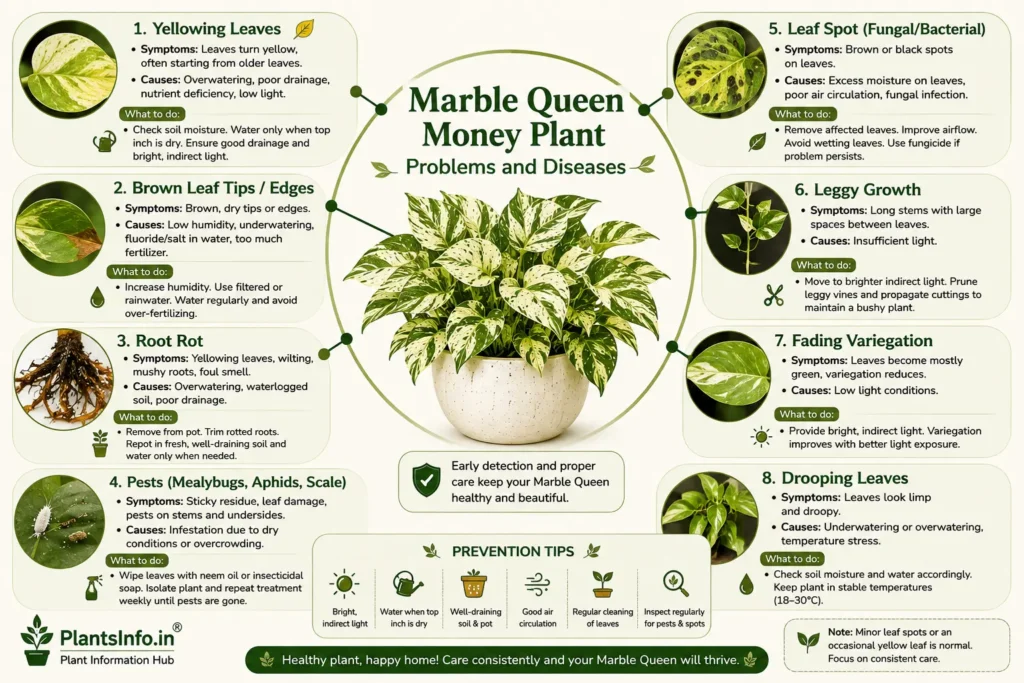
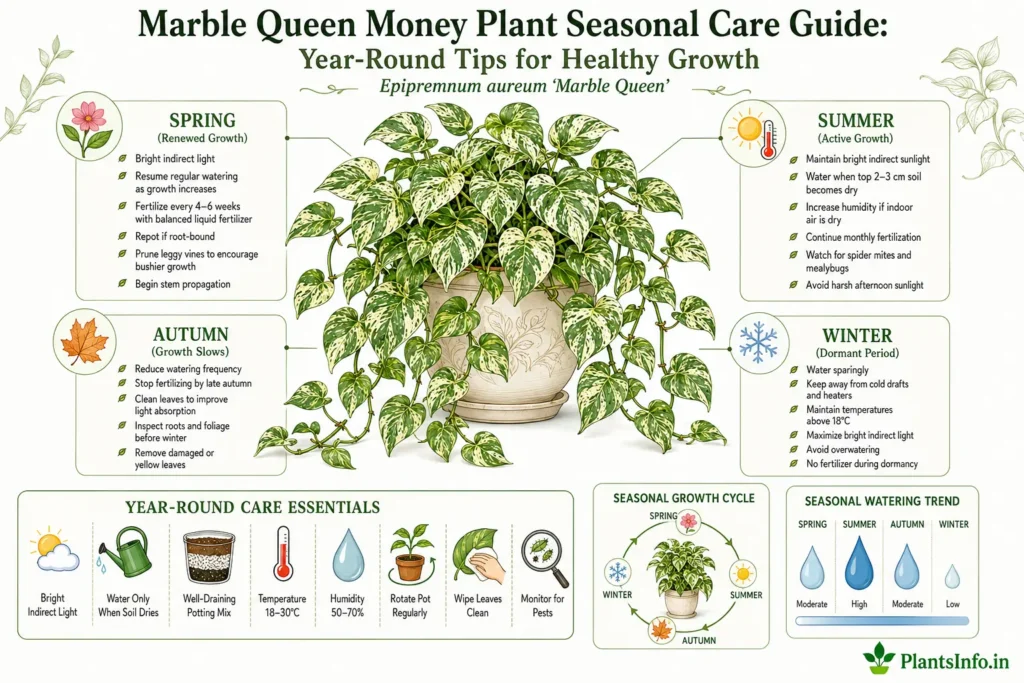
Marble Queen Money Plant responds to seasonal changes by adjusting its growth rate rather than entering complete dormancy. In warm tropical regions of India, growth may continue for much of the year, whereas plants in cooler northern regions often slow noticeably during winter.
The objective of seasonal care is to match watering, fertilization, pruning, and environmental management with the plant’s natural growth cycle. Consistent observation is generally more effective than following rigid seasonal schedules because indoor growing conditions vary considerably between homes.
Recommended Products
Disclosure: As an Amazon Associate, PlantsInfo may earn from qualifying purchases.
🌱 Growing Essentials
The following products can help with container gardening, potting, root development, soil management, and healthy plant growth.
Organic Potting Soil Mix
Provides nutrients, structure, and healthy growing conditions for container plants.
Adjust care according to seasonal changes without altering core cultivation practices
Best Growing Season
Spring through the monsoon in warm climates
Peak Vegetative Growth
Spring to early monsoon under favourable indoor conditions
Slowest Growth
Winter in cooler regions
Most Important Seasonal Concern
Prevent prolonged waterlogging during the monsoon and avoid cold stress during winter
Watering Strategy
Increase or reduce frequency based on seasonal drying rather than a fixed schedule
Fertilization
During active growth; reduce when growth naturally slows
Pruning
Best during active growing periods
Repotting
Preferably during spring or early summer
Indoor Performance
Stable throughout the year with suitable light and temperature
Outdoor Performance
Seasonal adjustments required depending on regional climate
Seasonal care for Marble Queen Money Plant focuses on adapting maintenance to changing environmental conditions rather than changing how the plant is fundamentally grown. Temperature, humidity, rainfall, and daylight influence growth rate, water use, and maintenance requirements throughout the year.
Introduction
Seasonal care differs from general cultivation because it focuses on how routine maintenance changes throughout the year rather than explaining how to grow the plant from the beginning.
Marble Queen Money Plant experiences fluctuations in growth as environmental conditions change. Day length, indoor temperatures, humidity, rainfall, and ventilation all influence how quickly the plant grows and how much water and nutrition it requires.
Unlike deciduous ornamentals, Marble Queen retains its foliage throughout the year. However, evergreen growth should not be interpreted as constant growth. New leaf production often accelerates during warm, bright periods and slows naturally during cooler months, particularly in regions experiencing lower winter temperatures.
For indoor gardeners across India, seasonal care is often influenced more by changes in indoor conditions than by the outdoor climate alone. Air-conditioning, heaters, reduced ventilation during monsoon weather, and lower winter light levels can all affect plant performance even when the plant remains indoors.
Understanding these seasonal patterns helps avoid two common mistakes:
Continuing heavy watering when growth has slowed.
Reducing care unnecessarily during periods of active vegetative growth.
The goal is not to change the plant’s growing method every season but to adjust routine maintenance so it remains appropriate for current conditions.
Season at a Glance
Season
Water
Fertilizer
Pruning
Light
Spring
↑
Resume
Excellent
Bright indirect
Summer
Moderate
Continue
Light
Protect from afternoon sun
Monsoon
↓ if soil stays wet
Continue if growing
Light
Brightest available
Autumn
Moderate
Reduce gradually
Minor
Stable
Winter
Lowest
Minimal
Remove dead leaves only
Maximize light
Annual Growth Cycle
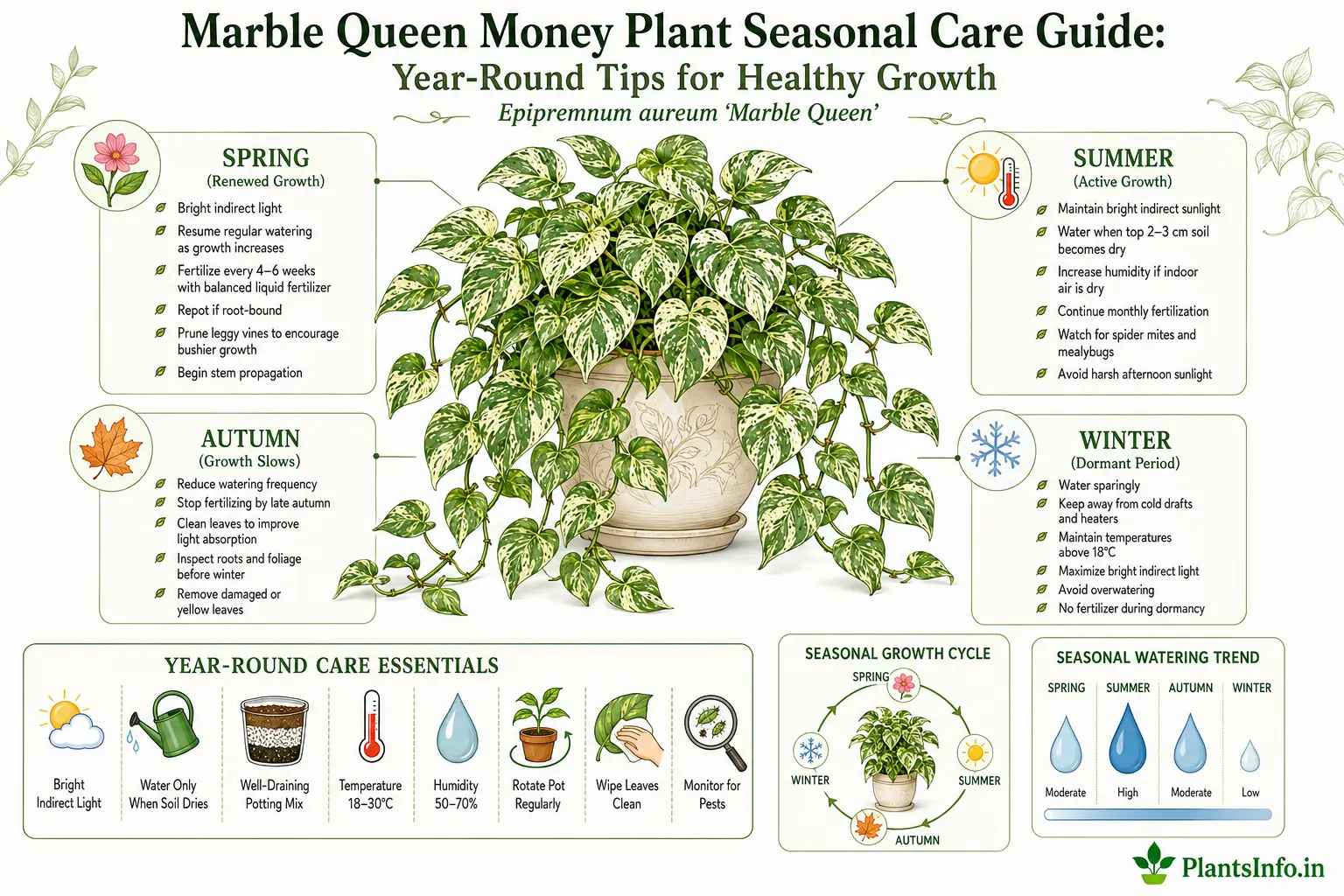
Annual growth cycle of the Marble Queen Money Plant (Epipremnum aureum ‘Marble Queen’) in India, illustrating seasonal growth patterns, plant activity, and essential care recommendations from spring through winter for healthy year-round growth.
Growth Stage
Typical Period (India)
Plant Activity
Primary Care Focus
Active Growth Begins
Spring
New shoots and leaves emerge more rapidly
Resume routine feeding and inspect plant health
Vigorous Growth
Summer
Continuous vine extension and leaf production
Maintain moisture balance and protect from excessive heat
Humid Active Growth
Monsoon
Continued growth where drainage remains adequate
Prevent prolonged wet conditions
Moderate Growth
Autumn
Growth gradually becomes steadier
Continue routine maintenance
Slower Growth
Winter
Reduced vegetative growth in cooler regions
Reduce watering and avoid unnecessary disturbance
Marble Queen does not follow a strict dormant period under most indoor conditions, but growth typically varies in response to available light and temperature.
In tropical and coastal parts of India, the annual growth cycle may remain relatively consistent throughout the year because warm temperatures continue to support leaf production. In contrast, plants grown in northern India often show noticeably slower growth during winter when both daylight and temperatures decline.
Understanding this natural cycle allows maintenance to be adjusted appropriately without assuming that every reduction in growth indicates a cultivation problem.
Spring Care
Spring Care Task
Recommendation
Reason
Watering
Gradually increase as growth resumes
Higher growth increases water demand
Fertilization
Resume balanced feeding
Supports new foliage development
Repotting
Ideal season if root-bound
Active growth improves recovery
Pruning
Excellent time
Encourages branching before vigorous growth
Pest Inspection
Recommended
Early detection prevents seasonal population increases
Spring generally marks the beginning of more vigorous vegetative growth for Marble Queen, particularly in regions where winter temperatures temporarily slowed development.
As new shoots begin forming, the plant gradually requires additional water and nutrients compared with winter. These increases should be based on actual growth and soil moisture rather than predetermined calendar dates.
Spring Maintenance Priorities
Priority
Importance
Inspect root health
High
Remove damaged foliage
High
Resume balanced nutrition
High
Check support structures
Moderate
Clean accumulated dust from leaves
Moderate
Repotting is usually most successful during spring because actively growing roots establish more quickly after disturbance.
Where vines are grown on moss poles or trellises, inspect supports before the growing season becomes more vigorous. Reposition stems if necessary so new growth develops evenly.
A practical observation is that many indoor plants appear healthier after a thorough spring cleaning. Removing dust from leaves improves light interception and helps maintain the attractive appearance of the variegated foliage.
Summer Care
Summer Care Task
Recommendation
Reason
Watering
Monitor more frequently
Higher temperatures increase evaporation
Light Management
Protect from harsh afternoon sun
Prevents leaf scorch
Humidity
Maintain moderate humidity
Supports healthy leaf expansion
Ventilation
Ensure good airflow
Reduces heat stress
Fertilization
Continue regular feeding if growth remains active
Supports ongoing vegetative growth
Summer often represents one of the most active growing periods for Marble Queen, particularly when temperatures remain warm and adequate indirect light is available.
Although the plant benefits from bright conditions, prolonged exposure to intense afternoon sunlight can damage the cream-coloured portions of the leaves. These variegated areas contain relatively little chlorophyll and are generally more susceptible to scorching than green tissue.
Summer Monitoring Checklist
Observation
Recommended Response
Soil drying more rapidly
Increase monitoring rather than automatically increasing watering volume
Leaf edges showing scorch
Move slightly farther from direct afternoon sunlight
Rapid vine growth
Continue routine feeding and inspect supports
Reduced indoor humidity
Consider improving humidity through normal household methods where appropriate
For homes using air-conditioning throughout summer, remember that cooler indoor temperatures do not always reduce water demand if bright light and active growth continue. Assess the growing medium directly before watering instead of relying on seasonal assumptions.
Where Marble Queen is grown on balconies or patios, filtered shade remains preferable to direct western exposure. Morning sunlight is generally well tolerated, while prolonged afternoon heat can reduce foliage quality even when adequate water is available.
By the end of summer, healthy plants should have produced a steady flush of new foliage, preparing them for continued growth during the humid monsoon season, provided drainage and ventilation remain adequate.
Monsoon Care
Monsoon Care Task
Recommendation
Reason
Watering
Water only after checking soil moisture
High humidity and slower evaporation reduce water demand
Drainage
Ensure excess water drains immediately
Prevents prolonged root saturation
Ventilation
Improve indoor airflow
Reduces fungal-friendly conditions around foliage
Fertilization
Continue only if active growth persists
Growth may vary depending on light availability
Plant Inspection
Check stems and roots regularly
Early detection of moisture-related problems
The monsoon season presents a unique challenge for Marble Queen Money Plant. While warm temperatures generally support continued vegetative growth, persistent humidity and reduced evaporation often keep the growing medium moist for much longer than during summer.
Rather than increasing watering simply because the weather is warm, assess the moisture level of the growing medium before every irrigation. In many homes, especially those with limited ventilation, pots may remain adequately moist for several additional days.
Monsoon Maintenance Priorities
Priority
Importance
Prevent waterlogging
Critical
Maintain airflow
High
Monitor soil moisture
High
Remove damaged foliage
Moderate
Inspect decorative cachepots
Moderate
Indoor growers frequently overlook standing water collected inside decorative outer pots. Even if the potting mix drains well, water trapped beneath the nursery container can keep the root zone excessively wet for prolonged periods.
Another practical observation is that cloudy weather often reduces indoor light intensity. While Marble Queen usually continues growing during the monsoon, prolonged dull conditions may slightly reduce variegation and slow new leaf production. Rotating the plant toward the brightest available indirect light helps maintain balanced growth.
Autumn Care
Autumn Care Task
Recommendation
Reason
Watering
Gradually adjust to slower drying rates if temperatures decline
Prevents unnecessary watering
Fertilization
Continue while active growth remains
Supports remaining seasonal growth
Plant Inspection
Assess overall plant health
Prepare for winter maintenance
Cleaning
Remove dust and aging leaves
Improves appearance and light interception
Repotting
Only if necessary
Major disturbance is generally better during spring
Autumn represents a transitional period rather than a dramatic change for Marble Queen. In much of southern and coastal India, favourable growing conditions may continue with only minor adjustments. In northern regions, however, gradually cooler temperatures and shorter days often reduce the plant’s growth rate.
During this season, observe how quickly the growing medium dries instead of maintaining the same watering routine used during peak summer.
Autumn Maintenance Checklist
Task
Priority
Review watering frequency
High
Remove yellow or damaged foliage
High
Inspect climbing supports
Moderate
Clean leaves
Moderate
Monitor new growth
Moderate
Autumn is also a suitable time to evaluate the overall shape of the plant. Minor corrective pruning can be performed if necessary, although heavy structural pruning is generally more beneficial during active growth periods.
Growers should remember that seasonal transitions occur gradually. Care routines should evolve in response to plant growth and environmental conditions rather than changing abruptly on fixed calendar dates.
Winter Care
Winter Care Task
Recommendation
Reason
Watering
Reduce frequency where growth slows
Lower temperatures reduce water use
Light
Maximise bright indirect light
Shorter days reduce available energy
Fertilization
Reduce or temporarily suspend if growth slows significantly
Prevents unnecessary nutrient accumulation
Temperature
Protect from cold drafts
Marble Queen has poor cold tolerance
Humidity
Maintain moderate humidity
Heated or dry indoor environments may reduce humidity
Winter care varies considerably across India. In tropical coastal regions, Marble Queen may continue growing steadily throughout the season. In northern plains and hill regions, cooler temperatures often slow vegetative growth noticeably.
The objective during winter is to maintain plant health rather than encourage rapid growth.
Winter Monitoring Guide
Observation
Recommended Response
Soil remains moist longer
Delay watering until necessary
Growth slows naturally
Reduce fertilizer applications
Leaves exposed to cold windows
Relocate slightly indoors
Cold drafts from doors or windows
Protect the plant from direct exposure
One of the most common winter mistakes is maintaining the same watering schedule used during summer. Reduced evaporation means the growing medium often remains moist for considerably longer, increasing the likelihood of root problems if watering is not adjusted accordingly.
In cooler regions, avoid placing Marble Queen near unheated windows during cold nights. Sudden temperature drops can stress foliage even when daytime conditions remain favourable.
Seasonal Watering Schedule
Season
Water Requirement
Primary Consideration
Spring
Moderate
Resume watering gradually as growth increases
Summer
Moderate to moderately high
Monitor faster evaporation during hot weather
Monsoon
Moderate to reduced
Check soil carefully before watering
Autumn
Moderate
Adjust according to changing temperatures
Winter
Reduced
Water less frequently if growth slows
Seasonal watering should always respond to the condition of the growing medium rather than following predetermined intervals.
Seasonal Watering Priorities
Season
Main Watering Objective
Spring
Support renewed vegetative growth
Summer
Prevent excessive drying without saturating the soil
Monsoon
Avoid prolonged moisture retention
Autumn
Transition gradually to seasonal conditions
Winter
Protect roots by preventing overwatering
Several factors influence watering requirements throughout the year, including:
Indoor temperature
Humidity
Pot size
Pot material
Air circulation
Available light
Plant maturity
Because these variables differ between households, two Marble Queen plants growing in the same city may require different watering frequencies despite experiencing the same season.
Seasonal Fertilizing Schedule
Season
Recommendation
Purpose
Spring
Resume regular balanced feeding
Supports vigorous new growth
Summer
Continue routine fertilization
Maintains healthy foliage production
Monsoon
Continue only while active growth persists
Match nutrition with plant demand
Autumn
Gradually reduce if growth slows
Avoid unnecessary nutrient accumulation
Winter
Minimal or none where growth is limited
Prevents fertilizer build-up
Fertilizer requirements closely follow the plant’s annual growth cycle. Nutrients are most beneficial when the plant is actively producing new leaves.
Applying fertilizer during periods of limited growth rarely improves performance and may gradually increase salt concentrations within container media.
Seasonal Feeding Priorities
Season
Focus
Spring
Encourage healthy vegetative development
Summer
Maintain consistent nutrition
Monsoon
Observe plant response before feeding
Autumn
Adjust feeding according to growth
Winter
Prioritise plant stability over active feeding
If Marble Queen continues growing vigorously under warm indoor conditions during winter, light feeding may still be appropriate. Seasonal recommendations should therefore be adjusted according to actual plant activity rather than calendar dates alone.
Seasonal Pruning Calendar
Season
Pruning Suitability
Recommended Activities
Spring
Excellent
Shape the plant, encourage branching, remove weak growth
Summer
Excellent
Light maintenance pruning and vine management
Monsoon
Good
Remove damaged or unhealthy foliage if required
Autumn
Moderate
Minor corrective pruning
Winter
Limited
Remove dead or damaged leaves only if growth has slowed
Pruning is most effective when the plant is actively growing because recovery and new shoot development occur more rapidly.
Seasonal Pruning Priorities
Season
Objective
Spring
Stimulate compact branching
Summer
Maintain plant shape
Monsoon
Improve airflow if foliage becomes dense
Autumn
Light structural correction
Winter
Preserve plant health with minimal disturbance
Heavy pruning immediately before or during periods of naturally slow growth is generally unnecessary. Instead, concentrate on removing damaged foliage and maintaining an attractive plant structure until more vigorous growth resumes.
For climbing specimens, inspect moss poles or other supports during each pruning session. Securing developing vines early encourages more uniform growth and helps maintain an orderly appearance throughout the growing season.
Protect outdoor containers from prolonged saturation and ensure rapid drainage
Cold Wave
High
Keep indoors in warm, frost-free conditions and protect from cold drafts
Dry Hot Winds
Moderate to High
Increase humidity where practical and avoid prolonged exposure
Strong Winds
Moderate
Move lightweight containers to sheltered locations and secure climbing supports
Extended Cloudy Weather
Moderate
Place the plant in the brightest available indirect light
Marble Queen Money Plant is an adaptable indoor ornamental, but sudden or prolonged weather extremes can affect both growth and foliage quality. Seasonal protection focuses on minimizing environmental stress rather than altering the plant’s basic care requirements.
Heatwave Protection
Situation
Recommended Action
Indoor temperatures rise significantly
Increase air circulation without exposing the plant to strong drying winds
Strong afternoon sunlight reaches the plant
Move slightly away from the window or filter the light with a sheer curtain
Growing medium dries much faster
Monitor soil moisture more frequently rather than increasing watering volume automatically
Cream-coloured leaf areas contain relatively little chlorophyll and are generally more sensitive to scorching than green tissue. During prolonged heatwaves, bright filtered light is preferable to direct afternoon sun.
Monsoon Protection
Risk
Preventive Measure
Waterlogged containers
Empty decorative outer pots after watering
Reduced indoor airflow
Improve natural ventilation where possible
Constantly wet growing medium
Delay watering until the upper layer begins drying
Monsoon conditions often reduce evaporation, meaning plants may require less frequent watering than expected despite warm temperatures.
Winter Protection
Risk
Recommended Protection
Cold drafts
Keep away from frequently opened doors and cold windows
Low indoor temperatures
Maintain a warm growing environment
Reduced daylight
Position in the brightest available indirect light
Marble Queen has poor tolerance for cold conditions. In regions where winter temperatures fall substantially, protecting the plant from sudden temperature fluctuations is more important than encouraging active growth.
Practical Observation
Many weather-related problems develop gradually rather than immediately. Regular observation of soil moisture, leaf appearance, and growth rate often identifies environmental stress before permanent damage occurs.
Monthly Care Calendar
Month
Typical Plant Activity
Primary Care Focus
January
Slow growth in cooler regions
Reduce watering and protect from cold
February
Gradual improvement in growing conditions
Monitor new growth and prepare for spring care
March
Active growth begins
Resume regular feeding and inspect root health
April
Vigorous vegetative growth
Maintain consistent watering and bright indirect light
May
Continued active growth
Protect from intense afternoon heat
June
Early monsoon growth
Monitor drainage and reduce unnecessary watering
July
Humid active growth
Improve airflow and inspect soil moisture carefully
August
Continued monsoon growth
Prevent prolonged waterlogging
September
Stable vegetative growth
Maintain routine seasonal care
October
Moderate growth
Review watering frequency as temperatures begin changing
November
Growth gradually slows in cooler regions
Reduce fertilization where appropriate
December
Slow growth
Prioritise warmth, light, and careful watering
This calendar represents a general guide for most parts of India. Actual plant activity depends on regional climate and indoor growing conditions.
Indoor plants growing in temperature-controlled homes may experience less seasonal variation than plants grown on balconies or shaded outdoor spaces.
Regional Care Notes (India)
Region
Seasonal Focus
Care Priority
South India
Growth often continues throughout the year
Monitor drainage during the monsoon and protect from intense summer sun
Coastal India
Warm, humid conditions
Improve ventilation and prevent prolonged soil saturation
Western India
Hot summers and seasonal monsoon
Increase summer monitoring and adjust watering during the rainy season
Eastern India
High humidity with seasonal rainfall
Ensure good airflow and bright indirect light
Central India
Hot, dry summers
Protect from heat stress and maintain moderate humidity
Northern Plains
Distinct seasonal variation
Reduce winter watering and protect from cold
Himalayan Foothills
Cooler winters
Indoor cultivation recommended during cold periods
Northeast India
Humid climate with abundant rainfall
Prioritise drainage and ventilation throughout the monsoon
Regional differences primarily influence maintenance schedules rather than cultivation methods.
In tropical southern states, Marble Queen often maintains relatively consistent growth throughout the year. In contrast, gardeners in northern India should expect slower winter growth and adjust watering and fertilization accordingly.
Regardless of region, the seasonal objective remains the same: adjust maintenance to current growing conditions rather than following identical routines throughout the year.
Frequently Asked Questions
Does Marble Queen Money Plant become dormant during winter?
Answer
Explanation
Usually no
Growth often slows rather than stopping completely, especially indoors.
Unlike deciduous plants, Marble Queen generally retains its foliage year-round. Reduced winter growth is a normal response to lower temperatures and reduced light rather than true dormancy.
Should watering increase during the monsoon?
Answer
Explanation
Not necessarily
High humidity often keeps the growing medium moist for longer periods.
Always check soil moisture before watering. During humid weather, plants frequently require less irrigation than expected.
Is summer the fastest growing season?
Answer
Explanation
Often yes
Warm temperatures and adequate light usually encourage vigorous vegetative growth.
Growth remains strongest when temperatures are warm, light is bright but indirect, and moisture levels remain balanced.
When is the best season to repot Marble Queen?
Answer
Explanation
Spring or early summer
Active root growth supports quicker establishment after repotting.
Repotting during active growth generally allows the plant to recover more efficiently than during cooler periods.
Should fertilization continue throughout winter?
Growing Condition
Recommendation
Growth continues actively
Light feeding may continue if required
Growth slows considerably
Reduce or temporarily suspend fertilization
Nutrient applications should reflect actual plant activity rather than fixed seasonal dates.
Does seasonal care differ for indoor and outdoor plants?
Answer
Explanation
Yes
Outdoor plants respond more directly to weather changes, while indoor plants are influenced by household conditions such as ventilation, lighting, and temperature control.
Indoor growers should adjust care based on the plant’s environment rather than outdoor weather alone.
Conclusion
Key Seasonal Principle
Importance
Adapt care to growth, not the calendar
Critical
Monitor soil moisture before watering
Critical
Maintain bright indirect light throughout the year
High
Reduce maintenance gradually as growth slows
High
Protect from weather extremes
High
Seasonal care for Marble Queen Money Plant is based on responding to changes in temperature, light, humidity, and rainfall while maintaining the same cultivation fundamentals throughout the year. Rather than following rigid schedules, successful growers observe how seasonal conditions influence growth and adjust watering, fertilization, pruning, and general maintenance accordingly.
For most Indian gardeners, the greatest seasonal challenges are preventing waterlogging during the monsoon, protecting foliage from intense summer sunlight, and reducing watering during cooler winter months. Small, timely adjustments made throughout the year are generally more effective than major changes in care routines.
🌿 About Marble Queen Money Plant (Epipremnum aureum)