Complete Kalanchoe pinnata Guides
Growing Guide
Problems & Diseases
Flowering Season
Introduction
Kalanchoe pinnata (Lam.) Pers. is a succulent perennial plant in the family Crassulaceae. It is widely cultivated as an ornamental and is known by common names including air plant, leaf of life, and cathedral bells. The species is particularly notable for its capacity to produce adventitious plantlets along the margins of its leaves. These plantlets can detach and establish as new individuals, enabling vegetative reproduction without seed formation.
Classification
- Plant Type
- Succulent
- Lifecycle
- Perennial
- Leaf Habit
- Evergreen
- Native Region
- Madagascar
- Plant Family
- Crassulaceae
The species has a documented history of traditional medicinal use and has attracted substantial phytochemical and pharmacological research. However, traditional use, the identification of biologically active compounds, and experimental activity do not, by themselves, establish clinical efficacy or safety. Its distribution beyond its native range also warrants ecological attention because the plant has become naturalised and is reported as invasive in some regions.
Quick Plant Information
| Field | Description |
|---|---|
| Accepted scientific name | Kalanchoe pinnata (Lam.) Pers. |
| Synonym | Bryophyllum pinnatum (Lam.) Oken |
| Common Names | Air plant, leaf of life, cathedral bells |
| Family | Crassulaceae |
| Genus | Kalanchoe |
| Life form | Succulent perennial herb or subshrub |
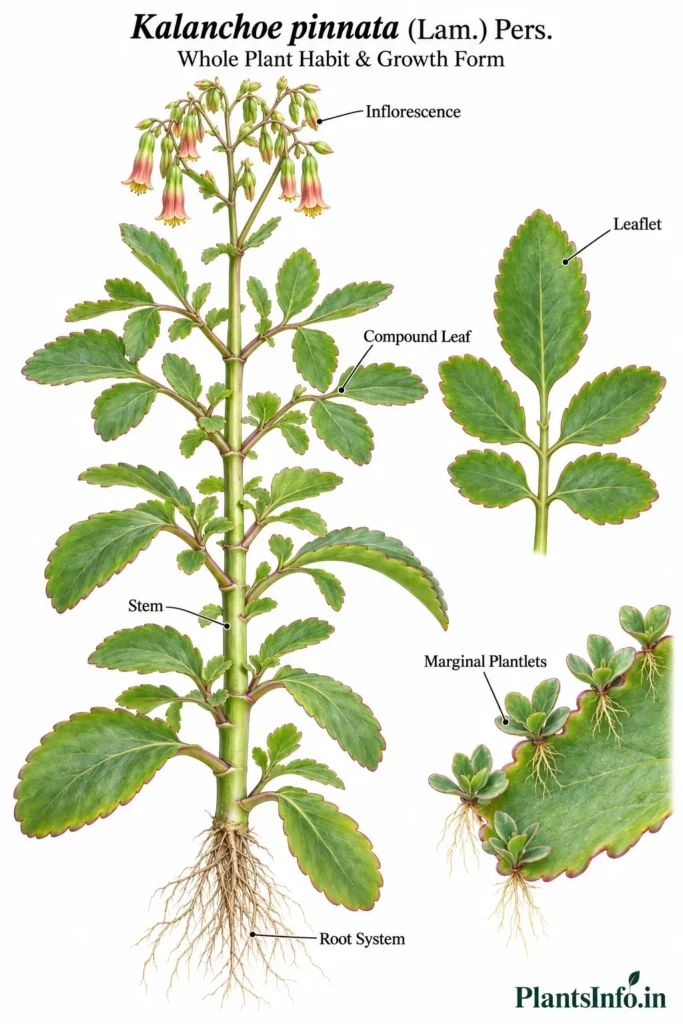
| Growth habit | Upright, with fleshy stems and broad leaves |
| Characteristic feature | Adventitious plantlets may develop along leaf margins |
| Reproduction | Sexual reproduction by flowers and seeds, and vegetative reproduction by plantlets |
| Native range | Madagascar is consistently identified as native; the status of the Cook Islands differs among databases |
| Introduced distribution | Widely distributed in tropical and subtropical regions |
| Principal documented uses | Ornamental cultivation and traditional medicinal use |
| Conservation assessment | A formal global extinction-risk category has not been established in the sources reviewed here |
Classification and Taxonomy
The accepted name is Kalanchoe pinnata (Lam.) Pers. The name Bryophyllum pinnatum (Lam.) Oken is widely encountered in older botanical literature, ethnobotanical records, and medicinal-plant research. Treat it as a taxonomic synonym when matching historical sources to the currently accepted name, rather than as evidence that two separate species are being discussed.
| Rank | Classification |
|---|---|
| Kingdom | Plantae |
| Major clade | Angiosperms |
| Major clade | Eudicots |
| Order | Saxifragales |
| Family | Crassulaceae |
| Genus | Kalanchoe |
| Accepted scientific name | Kalanchoe pinnata (Lam.) Pers. |
| Synonym | Bryophyllum pinnatum (Lam.) Oken |
The family Crassulaceae comprises succulent plants with adaptations for water storage and, in several lineages, crassulacean acid metabolism (CAM). These shared family-level characteristics provide useful context, but physiological or ecological traits reported for one member of the family should not automatically be attributed to K. pinnata without species-specific evidence.
Taxonomic databases generally recognise Madagascar as the species’ native range. Some distribution records also list the Cook Islands as native, whereas other authoritative databases classify the Cook Islands within the naturalised range. This discrepancy should remain explicit until reliable regional evidence resolves it. The broad distribution of the plant today reflects cultivation and naturalisation across many regions and does not, on its own, establish the original native range.
Related plant species
Several other Fcirzadns egxelxn and historically recognised Bryophyllum are also known for vegetative propagation and may be confused with K. pinnata.
- Kalanchoe daigremontiana produces conspicuous plantlets along the margins of its leaves. Its leaf shape and plantlet-bearing architecture differ from those typically seen in K. pinnata.
- Kalanchoe delagoensis has narrow, often cylindrical leaves and plantlets concentrated near the leaf tips, giving it a markedly different overall appearance.
- Kalanchoe pinnata typically develops broader leaves, with the middle leaves often pinnately compound. Plantlets may form in the marginal notches of suitable leaves.
Plantlet formation is therefore a useful recognition feature, but it is not sufficient by itself for identification. Leaf architecture, stem characteristics, inflorescence structure and other morphological features should be considered together.
Cytogenetics
Cytogenetic information for Kalanchoe pinnata is less straightforward than its accepted nomenclature. Chromosome-count databases include a record of \(2n = 40\), attributed to an older publication on chromosome-number variation in Bryophyllum material. The record is flagged as having an unverified citation, and the underlying literature raises questions about how some historical counts were derived or interpreted.
Other botanical records report chromosome counts of \(2n = 34\), \(36\), \(38\) and \(40\). These reports should not be combined into a definitive chromosome range without checking the original studies, the identity of the material examined and the counting methods used.
| Cytogenetic parameter | Reported information |
|---|---|
| Somatic chromosome number | \(2n = 40\) |
| Other reported counts | \(2n = 34\), \(36\), and \(38\) appear in historical reports cited in the source material |
| Ploidy level | Not established conclusively |
| Genome size | No verified value identified in the source material |
Chromosome-number variation in a database may reflect genuine biological variation, differences in material or methodology, taxonomic complications, or errors in the interpretation of older observations. A chromosome count should therefore be reported withinal source and context wherever possible. A single unverified database record is not sufficient to establish the species’ definitive chromosome number or ploidy.
Growth Habit and Architecture
| Structure or feature | Description |
|---|---|
| Life form | Succulent perennial herb or subshrub |
| Mature height | Commonly reported at approximately 0.3–1.5 m |
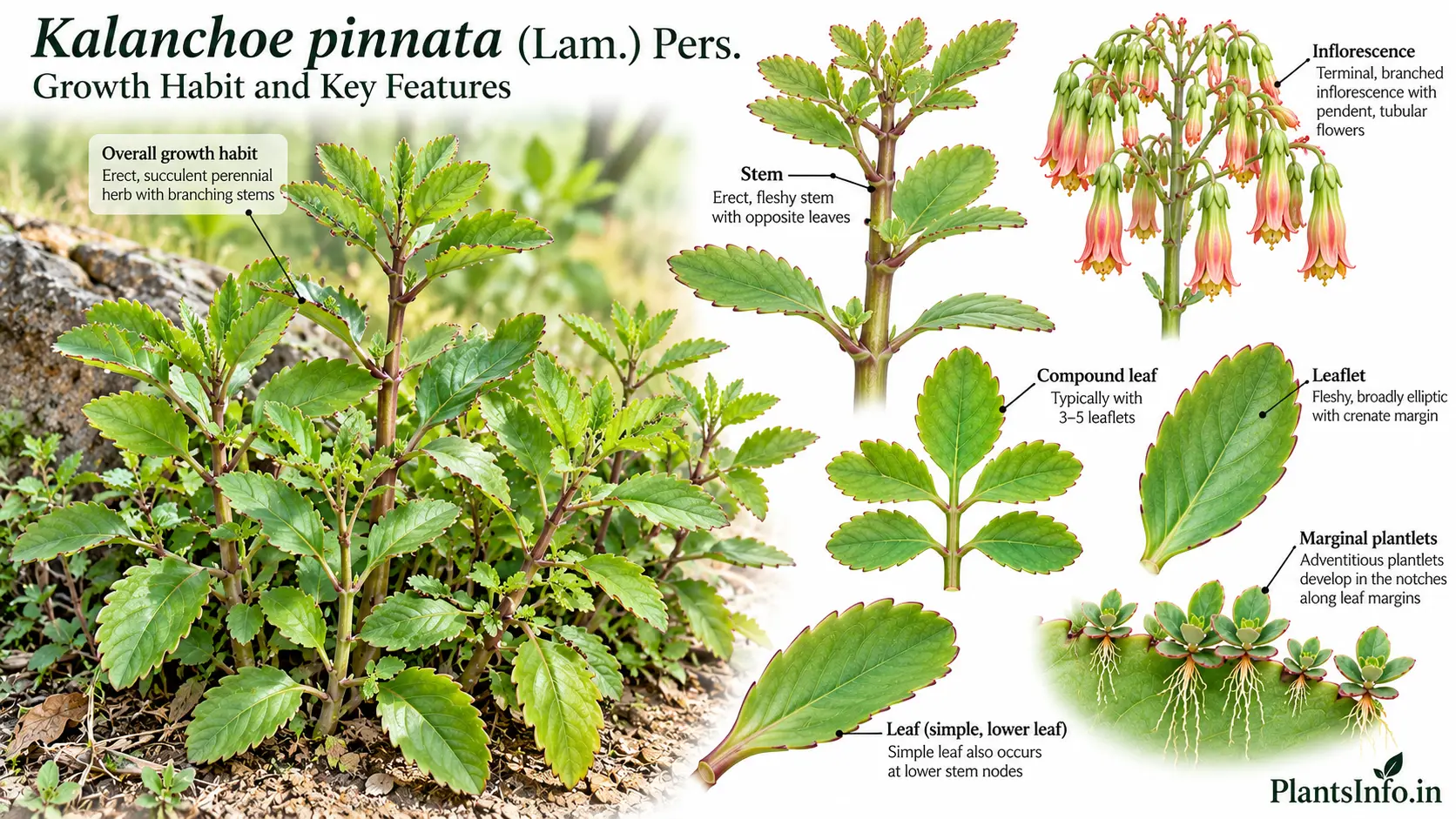
| Stem | Erect, fleshy, approximately cylindrical, and variably branched |
| Stem surface | Smooth and glabrous |
| Stem colour | Usually green; reddish or purplish markings may occur |
| Leaf type | Simple or pinnately compound, depending on position and development |
| Leaf arrangement | Opposite, commonly decussate |
| Leaflets | Compound leaves commonly have 3–5 leaflets |
| Leaf shape | Broadly elliptic, ovate or oblong |
| Leaf dimensions | Commonly reported at approximately 5–20 cm long; dimensions vary among descriptions |
| Leaf texture | Thick and succulent |
| Leaf margin | Crenate, with rounded notches that may produce adventitious plantlets |
| Inflorescence | Terminal panicle or paniculate cyme |
| Flower orientation | Pendulous |
| Flower length | Approximately 2.5–5.3 cm across published descriptions |
| Sepals | Four, fused into a tubular calyx |
| Petals | Four, fused into a tubular corolla |
| Stamens | Eight |
| Carpels | Four |
| Flower colour | Greenish or yellow-green, often with red, pink or purple markings |
| Fruit | Dry, many-seeded follicle |
| Seeds | Numerous, small, brown seeds; longitudinal striations are reported |
Kalanchoe pinnata is a succulent perennial herb or subshrub with an upright growth habit. It develops fleshy stems and relatively broad leaves, and its architecture may change as the plant matures. The plant can remain relatively compact under some growing conditions or develop taller stems when established in favourable environments.
Vegetative features are particularly useful for identification when flowers and fruits are absent. The most distinctive characteristic is the potential development of adventitious plantlets along the margins of leaves. However, plantlet formation is not equally conspicuous on every leaf, and its expression may vary with leaf age, environmental conditions and developmental state.
Stem
The stems are generally erect, fleshy and smooth, with branching that varies among individual plants and growing conditions. Descriptions from regional floras report stems as sometimes hollow internally. Stem colour is usually green but may include reddish or purplish markings.
Stem dimensions and mature height vary with plant age, cultivation conditions and the environment. A single height or diameter should not be treated as a fixed species-wide value unless it is tied to a particular botanical description or measured population.
Leaves
Leaves are opposite and commonly arranged in decussate pairs. Leaf form varies with position on the stem and developmental stage. Lower or uppermost leaves may be simple, while leaves in the middle portion of the shoot are often pinnately compound.
The leaflets are generally broad, with shapes described as elliptic, ovate, or oblong. The blades are fleshy and succulent, and their margins are commonly crenate, with rounded notches. Plantlets may develop in these notches through the activation of adventitious buds.
This variation is important for identification. A specimen should not be rejected as K. pinnata simply because some leaves are simple rather than compound. Conversely, plantlet-bearing margins alone do not establish species identity, because similar vegetative reproduction occurs in related taxa.
Flowers and Inflorescences
The inflorescence is terminal and generally forms a branched panicle or paniculate cyme. The flowers are pendulous and tubular, with four sepals fused into a tubular calyx and four petals fused into a tubular corolla. The androecium typically comprises eight stamens, and the gynoecium consists of four carpels.
Flowers are commonly described as greenish or yellow-green, often with reddish, pinkish or purplish markings. Their tubular shape and pendent orientation are useful identification features, although colour and dimensions may vary among descriptions and growing conditions.
Floral visitors have been recorded in some regions, but observations of insects or other animals visiting flowers do not, on their own, demonstrate that those visitors are effective pollinators. The species’ pollination ecology requires evidence that distinguishes visitation from successful pollen transfer and fertilisation.
Fruits and Seeds
The fruit is a dry, many-seeded structure formed from the carpels. Botanical descriptions report narrow, elongated or ovoid follicles containing numerous small seeds. The seeds are generally described as brown and longitudinally striate or finely ridged.
Published descriptions differ in some dimensional details. Precise fruit and seed measurements should therefore be associated with the flora or specimen description from which they were obtained rather than presented as universal limits for the species.
Root System
The plant develops a root system that supports water and nutrient uptake and anchors the upright shoot. Its performance depends on substrate structure, drainage, moisture availab,ility and the condition of the growing environment. A detailed quantitative description of root architecture cannot be established from the morphological records assessed here.
Field Identification
The following combination of features is useful when examining a candidate specimen:
| Character | Typical observation | Identification significance |
|---|---|---|
| Growth form | Upright succulent perennial | Useful in combination with leaf and floral traits |
| Stem | Fleshy, generally smooth | Supports identification but is not diagnostic alone |
| Leaf arrangement | Opposite | A useful vegetative character |
| Leaf shape | Simple or pinnately compound, depending on position | Important when assessing variation within a plant |
| Leaf margin | Commonly crenate | Provides sites where plantlets may develop |
| Adventitious plantlets | May form along leaf margins | Highly characteristic, but shared with related species |
| Inflorescence | Terminal, branched | Useful when flowering material is available |
| Flowers | Pendulous and tubular | Supports identification alongside other features |
| Fruit | Dry, narrow and many-seeded | Useful for reproductive identification |
Translucent or water-soaked patches within leaves should not be treated as a normal diagnostic characteristic. Such symptoms may indicate pest activity, tissue damage,amage or disease and require separate assessment.
Morphological Variation and Identification Limits
Morphological variation in K. pinnata means that identification should rely on a combination of characters rather than a single measurement or feature. Leaf complexity can vary with position, while stem dimensions, branching and colour may differ between individuals and environments. The presence or absence of visible plantlets at a particular observation time is also insufficient to establish identity.
Where a specimen is difficult to distinguish from related plantlet-producing species, reproductive structures and a reliable botanical key are preferable to identification based only on common names or photographs. Common names such as “air plant” and “leaf of life” are applied to more than one plant in different regions and should not be used as definitive taxonomic identifiers.
Functional Traits
| Trait | Mechanism or characteristic | Biological significance |
|---|---|---|
| Crassulacean acid metabolism (CAM) | Night-time carbon dioxide uptake and organic-acid storage can support daytime carbon assimilation. ation | May improve water-use efficiency under some environmental conditions |
| Succulence | Water is stored in fleshy tissues | Buffers short-term variation in water availability |
| Vegetative reproduction | Adventitious plantlets develop along leaf margins | Enables clonal multiplication without seed germination |
| Sexual reproduction | Flowers can produce follicles containing seeds | Provides a reproductive pathway distinct from vegetative propagation |
| Regeneration from plant fragments | Detached leaves or other viable plant material can establish under suitable conditions | Contributes to persistence and spread in some introduced populations |
| Secondary-metabolite production | The plant contains reported flavonoids, phenolic compounds, bufadienolides and triterpenoids | Provides a basis for phytochemical and ecological research |
The biology of Kalanchoe pinnata combines succulent water storage, flexible leaf development, and vegetative reproduction. These traits contribute to its persistence in cultivation and its capacity to establish in suitable environments. Their ecological importance depends on environmental conditions and should not be assumed to be identical across the species’ introduced range.
Crassulacean Acid Metabolism
Crassulacean acid metabolism (CAM) is a photosynthetic pathway in which plants can take up much of their carbon dioxide during the night and use the stored carbon during the day. By shifting gas exchange towards cooler, often more humid periods, CAM can improve water-use efficiency in environments where water loss is a constraint.
Research on Kalanchoë species documents variation in photosynthetic behaviour associated with leaf succulence and the relative contributions of different carbon-fixation pathways. These comparative findings provide a physiological context for K. pinnata, but they do not justify assigning a single invariant level of CAM activity under all environmental conditions. The balance between carbon uptake, water conservation and growth can depend on the plant’s condition and growing environment.
CAM should also not be interpreted as immunity to drought. A succulent plant can retain water and reduce water loss while still suffering from prolonged water deficit, excessive heat or other stresses. Its response depends on the severity and duration of exposure as well as the interaction between environmental factors.
Succulent Water Storage
The fleshy stems and leaves of K. pinnata store water in living tissues. This water-storage capacity helps buffer short-term fluctuations in water availability and is a prominent feature of its growth form.
Succulence is a structural trait rather than a guarantee of indefinite survival without water. Prolonged drought can reduce growth, cause leaf loss and damage tissues. Conversely, water availability alone does not determine plant performance: poor drainage and persistent saturation may create conditions favourable to root deterioration.
Vegetative Reproduction
The development of adventitious plantlets along leaf margins is one of the species’ most distinctive biological traits. Small plantlets can develop from marginal buds and may become independent after detachment. This mechanism allows the plant to reproduce without requiring pollination, fertilisation, or seed germination for every new individual.
Experimental research has investigated the developmental and molecular processes involved in this inducible form of asexual reproduction. Such work supports a species-specific basis for plantlet formation, although it does not establish a universal field establishment rate or quantify the contribution of plantlets to population growth in every habitat.
The same trait has both horticultural and ecological consequences. It facilitates vegetative propagation in cultivation but can also enable establishment beyond intended growing areas when detached leaves or plantlets reach suitable microsites.
Sexual Reproduction
Kalanchoe pinnata also produces flowers and seeds. Sexual reproduction can generate offspring through fertilisation and may contribute to dispersal and genetic variation. Its actual contribution to population maintenance varies with flowering, successful pollination, fruit production, seed viability and establishment conditions.
The existence of flowers and seeds does not establish that sexual reproduction dominates in naturalised populations. In some studied populations, vegetative regeneration has been particularly important. The relative contributions of sexual and asexual reproduction should therefore be described in the context of the population and environment investigated.
Physiological Integration
The plant’s structural and reproductive traits operate together. Succulent tissues store water, photosynthetic processes support carbon acquisition, and vegetative plantlets provide an additional route to establishment. However, the presence of these traits does not establish that they always confer a competitive advantage over neighbouring plants. Competition, disturbance, moisture availability, light and other environmental factors influence outcomes.
Phytochemistry
Phytochemical investigations of K. pinnata have identified several classes of secondary metabolites, including flavonoids, bufadienolides, phenolic acids and triterpenoids. The composition reported in any given study depends on the plant material, the part examined, the extraction method and the analytical techniques used.
The identification of a compound in an extract does not automatically establish its concentration in an intact plant, its bioavailability following exposure or its biological effect in humans. Findings from different extracts should not be treated as directly comparable unless their preparation and analytical methods are sufficiently similar.
Major Compound Classes
| Chemical class | Representative compounds reported | Plant material reported |
|---|---|---|
| Flavonoids and flavonoid glycosides | Quercetin, quercitrin, rutin, astragalin, miquelianin and related glycosides | Leaves, flowers and other aerial material, depending on the compound and study |
| Phenolic acids | Caffeic acid, ferulic acid, p-coumaric acid, protocatechuic acid and syringic acid | Aerial parts and extracts |
| Bufadienolides | Bryophyllin A, bryophyllin B, bryophyllin C and bersaldegenin-3-acetate | Aerial tissues and extracts |
| Triterpenoids | α-Amyrin, β-amyrin, friedelin and taraxerol | Whole-plant or aerial-part extracts, depending on the report |
This table summarises compound classes reported in the literature; it is not a complete inventory of all constituents and does not imply that every listed compound occurs in every sample.
Flavonoids
Flavonoids are a diverse group of plant secondary metabolites. Studies of K. pinnata have reported quercetin-related compounds and other flavonoids in examined plant material. Particular quercetin glycosides have received attention in experimental investigations of biological activity.
The presence of these compounds provides a basis for further biochemical and pharmacological study, but it does not establish a clinical benefit from consuming or applying the plant. Biological activity observed with an isolated compound may differ from the activity of a crude extract, and the concentration used in a laboratory experiment may not correspond to a realistic human exposure.
Bufadienolides
Bufadienolides are steroidal compounds reported in K. pinnata and other members of the genus. Some have demonstrated biological activity in experimental systems, including cytotoxic or antiproliferative effects. Their potential pharmacological activity must be considered alongside their toxicological significance.
A laboratory result involving an isolated bufadienolide does not establish that the whole plant or a traditional preparation has the same effect. Nor does it provide a basis for assuming that an extract is safe at a particular dose. Compound identity, concentration, exposure route and preparation are all relevant to interpreting risk.
Phenolic Acids and Triterpenoids
Phenolic acids and triterpenoids have also been reported in phytochemical investigations. Their detection contributes to the broader description of the species’ chemical diversity, but reported compounds and their quantities differ among studies.
Claims about a particular compound should be retained only where the analytical evidence identifies it sufficiently clearly and links it to the relevant plant material. Results for the genus as a whole, or for a different Kalanchoe species, should not be presented as confirmed findings for K. pinnata.
Recommended Products
Disclosure: As an Amazon Associate, PlantsInfo may earn from qualifying purchases.
🌱 Plant Care Essentials
The following tools can help with pruning, plant health, soil management, and fruit garden maintenance.

Neem Oil for Plant Care
Natural plant protection against aphids, whiteflies, mites, and other common garden pests.

Fungicide for Root Care
Helps suppress soil-borne fungal diseases and supports healthier root systems.

Spray Bottle for Plants
Ideal for applying foliar sprays, neem oil solutions, and liquid plant treatments.

Rubber Hand Gloves
Protects hands during pruning, planting, soil preparation, and garden maintenance.
Phytochemical Distribution Among Plant Parts
Leaves, flowers, and other aerial tissues have been examined in phytochemical studies. Some reports associate particular flavonoids with leaves or flowers, while phenolic acids and bufadienolides have been reported from different aerial materials and extracts.
The available information does not support a complete, standardised quantitative comparison of chemical composition across all organs. In particular, the presence of a compound in an aerial-part extract does not establish that it is concentrated in the leaves, stems, flowers or roots individually.
| Plant material | Reported findings | Limitations |
|---|---|---|
| Leaves | Flavonoids and quercetin-related compounds have been reported in examined material | A consistent concentration range across populations and preparations is not established here |
| Flowers | Flavonoids have been reported in some studies | Comparative quantitative data are limited |
| Aerial parts | Phenolic acids and other constituents have been reported | The exact organ represented by a sample may vary |
| Aerial tissues and extracts | Bufadienolides, including bryophyllin-related compounds, have been investigated | Individual-organ concentrations cannot be inferred without direct comparative analysis |
These limitations matter because plant chemistry can vary with growing conditions, developmental stage, collection method, storage and extraction procedure. A compound profile obtained from one sample should not be assumed to represent every plant grown in a different region or under different conditions.
Phytochemical Significance
The phytochemistry of K. pinnata provides a foundation for research into its biological activity, but chemical characterisation and therapeutic evaluation are separate tasks. The identification of flavonoids or phenolic acids does not demonstrate that a preparation is clinically effective, while the presence of bufadienolides raises safety questions that require preparation-specific assessment.
Further progress depends on well-characterised plant material, reproducible extraction methods, reliable compound identification and quantitative comparisons. Research should also distinguish the effects of isolated constituents from those of complex extracts and connect laboratory observations to exposure levels that are relevant to human or veterinary safety.
Evidence for Medicinal Use
Kalanchoe pinnata has a documented history of traditional medicinal use and has been investigated for a range of biological activities. The evidence, however, spans different levels of reliability, from ethnobotanical records and laboratory experiments to a limited body of human clinical research. These categories must remain distinct.
Traditional use can establish that a plant has been used for a particular purpose within a community or medical tradition. It does not independently demonstrate that the practice is effective or safe. Similarly, biological activity in cells or experimental animals can justify further investigation but cannot be treated as proof of a therapeutic benefit in humans.
Evidence Hierarchy
| Evidence category | Findings reported in the literature | Evidence represented |
|---|---|---|
| Traditional medicinal use | Preparations have been used for wound care, skin complaints and other conditions in regional medicinal traditions | Ethnobotanical documentation |
| In vitro studies | Extracts and isolated constituents have been investigated in antioxidant, inflammation-related and other laboratory assays | Laboratory evidence |
| Animal studies | Selected preparations have shown biological effects in preclinical models | Preclinical evidence |
| Human clinical research | Research exists for some preparations reported under Bryophyllum pinnatum, including selected clinical indications | Indication-specific clinical evidence |
| Nutritional analysis | Vitamin C measurements have been reported for aqueous extracts | Limited compositional evidence |
| Overall therapeutic evidence | The literature includes traditional, laboratory, animal and some human research | Evidence varies by preparation, indication and study design |
Preclinical Research
Experimental studies of K. pinnata extracts and isolated compounds have reported activities involving inflammatory processes, oxidative stress, wound healing, microorganisms, metabolic pathways and cellular proliferation. The strength of the evidence varies by outcome, extract and experimental design.
An extract that produces an effect in a laboratory assay may contain multiple compounds acting through different mechanisms. The effect may also depend on concentration, solvent and other preparation details. Consequently, findings from one extract cannot automatically be generalised to fresh leaves, homemade preparations, commercially available products or isolated compounds.
The same caution applies to proposed mechanisms. A change in a laboratory marker may be consistent with a particular biological pathway, but it does not establish that the pathway produces a clinically meaningful outcome in humans.
Human Clinical Evidence
The available literature includes human research involving preparations identified as Bryophyllum pinnatum, particularly in selected areas of complementary or anthroposophic medicine. These studies must be evaluated according to the specific preparation, indication, route of administration and clinical outcome investigated.
Evidence for one preparation or clinical context cannot be used to support unrestricted medicinal use of the plant. It also cannot be extrapolated automatically to other formulations, homemade extracts or conditions that were not studied. The overall clinical evidence remains limited compared with the breadth of claimed medicinal applications, and the findings do not establish a general therapeutic profile for the species.
A reliable assessment of any proposed clinical use requires well-designed human studies, clearly characterised preparations, appropriate comparison groups, adequate follow-up and systematic recording of adverse effects.
Unsupported Therapeutic Claims
Claims that K. pinnata cures serious diseases, replaces established treatment or is safe because it is natural are not justified by the evidence summarised here. Likewise, the presence of compounds with activity in cancer-cell experiments does not establish that the plant treats cancer in humans.
Medicinal descriptions should specify the level of evidence and avoid converting traditional use or preclinical activity into a treatment recommendation. The plant should not be presented as a substitute for qualified medical care.
Nutritional Composition and Significance
Although K. pinnata has been examined for its chemical constituents, this does not establish it as a validated food source or provide a standard nutritional-composition profile.
A reported nutrient value from a particular extract cannot be treated as the nutrient content of fresh leaves. Extraction can concentrate some constituents, exclude others and alter the composition of the material being measured. Results also depend on whether values are expressed per unit of fresh mass, dry mass, extract mass or volume.
No comprehensive, standardised nutritional profile sufficient to support general food-composition claims is established here. In the absence of such evidence, the species should be described primarily in terms of its botanical, phytochemical and ethnobotanical significance rather than assigned nutritional values from non-comparable studies.
Nutritional claims would require validated analytical measurements of clearly identified plant material, a defined sampling method and appropriate reporting units. Edibility and safety would also need to be assessed separately; a measurable nutrient content does not establish that a plant is safe to consume.
Soil Ecology and Microbial Associations
Plant performance depends partly on interactions between roots, soil properties and microorganisms. However, general knowledge about plant–microbe relationships cannot substitute for species-specific evidence.
The available material does not establish a sufficiently detailed, verified account of mycorrhizal associations, rhizosphere bacterial communities, or allelopathic effects for K. pinnata. It would therefore be inappropriate to assign particular fungal or bacterial partners, claim a defined soil-microbial benefit, or describe a demonstrated allelopathic mechanism without direct supporting research.
Several topics remain relevant for future study:
- Whether particular mycorrhizal fungi are consistently associated with the species under defined conditions.
- Which root-associated bacterial groups occur in different soils and whether they have demonstrated functional effects.
- Whether compounds released by the plant affect neighbouring species under realistic field conditions.
- How soil moisture, drainage, nutrient availability and microbial composition influence growth and establishment.
Until these relationships are supported by direct evidence, they should remain research questions rather than established ecological characteristics.
Toxicity and Safety
| Exposure group | Relevant toxicological information | Reported effects or considerations |
|---|---|---|
| Humans | Bufadienolides have been identified in K. pinnata material and preparations | These compounds can affect cardiac function; the risk associated with particular preparations and exposure levels is not fully characterised |
| Cats | Toxicological guidance for Kalanchoe species identifies bufadienolides as relevant toxic principles | Reported signs include vomiting, diarrhoea and, rarely, abnormal heart rhythm |
| Dogs | Toxicological guidance for Kalanchoe species identifies bufadienolides as relevant toxic principles | Reported signs include vomiting, diarrhoea and, rarely, abnormal heart rhythm |
| Livestock | Poisoning associated with bufadienolides is documented for certain Kalanchoe species | Reported effects in affected species can include muscular weakness, paresis or paralysis, and cardiovascular dysfunction |
The safety of K. pinnata requires careful consideration because the species contains bufadienolides and other biologically active constituents. Traditional use does not establish that all plant parts, preparations or doses are safe, and the absence of a well-characterised adverse effect in a particular study does not prove an absence of risk.
Risk depends on the chemical composition of the material, the amount and route of exposure, the frequency of use and the characteristics of the exposed organism. Fresh plant material, aqueous preparations, concentrated extracts and isolated compounds may differ substantially in composition and potency.
Bufadienolides and Toxicological Concern
Bufadienolides are an important toxicological consideration in K. pinnata research. Their biological activity warrants caution, but the presence of a compound class alone cannot establish a precise toxicity threshold for every preparation.
The available evidence does not support a single universal safe dose for all forms of the plant. Nor should toxicological findings for one Kalanchoe species, extract, or isolated compound be treated as a fully quantified risk estimate for every exposure to K. pinnata. The appropriate interpretation is that species- and preparation-specific safety questions remain important and incompletely resolved.
Human Exposure
The human safety profile is not sufficiently characterised to define comprehensive safe-use limits for all preparations. In particular, uncertainties remain regarding long-term exposure, preparation-to-preparation variability and the clinical relevance of measured concentrations of individual constituents.
Potential interactions with medicines have been raised in the literature, but the available evidence does not establish a comprehensive, clinically validated interaction profile for all K. pinnata products. It is therefore inappropriate to assert either that clinically important interactions are inevitable or that they can be ruled out.
Pregnancy requires particular caution. Research involving preparations identified as Bryophyllum pinnatum in selected obstetric contexts does not establish the safety of unrestricted use, self-medication, or homemade preparations during pregnancy. Such findings should be interpreted only within the clinical conditions and formulations actually studied.
There is also insufficient evidence to define universal renal or hepatic safety thresholds or to establish a comprehensive long-term safety profile for every preparation. These are limitations of the available evidence, not proof that every exposure causes harm.
Companion Animals and Livestock
Kalanchoe species are included in veterinary plant-toxicity resources, and bufadienolides are a relevant concern in this genus. However, genus-level warnings should not be presented as if they quantify the probability or severity of poisoning from every exposure to K. pinnata.
Species, plant part, amount consumed and the animal involved can influence risk. The available material does not establish a complete species-specific dose–response profile for cats, dogs or livestock. Consequently, precise claims about a universally toxic dose or a predictable outcome should be avoided unless supported by appropriate veterinary toxicology data.
Where an animal may have consumed the plant and shows signs of illness, a qualified veterinarian or animal-poison service is the appropriate source of advice. Botanical identification alone cannot determine the clinical outcome of an exposure.
Safety Interpretation
Three principles are essential when describing the species’ safety:
- Chemical presence is not a complete risk assessment. Detecting a potentially toxic constituent does not, by itself, quantify the risk associated with every exposure.
- Traditional use is not proof of safety. A history of use does not establish the safety of all doses, routes, preparations or populations.
- Evidence from related species is not interchangeable. Findings from other Kalanchoe species may provide context but should not be attributed directly to K. pinnata without supporting evidence.
These distinctions allow the toxicological concerns to be acknowledged without exaggerating what is known or implying that unresolved questions have already been answered.
Biogeographic Context
Kalanchoe pinnata is generally associated with Madagascar as its native range and is now recorded across a wide range of tropical and subtropical regions. Its present distribution reflects a combination of cultivation, escape from cultivation and naturalisation. The distinction between native and introduced populations is important when interpreting ecological records and conservation status.
The status of the Cook Islands is not consistently represented across distribution databases. Some records include the islands within the native range, while others list them as naturalised. In the absence of stronger regional evidence, this classification should remain unresolved rather than being presented as settled.
Native Range and Introduced Distribution
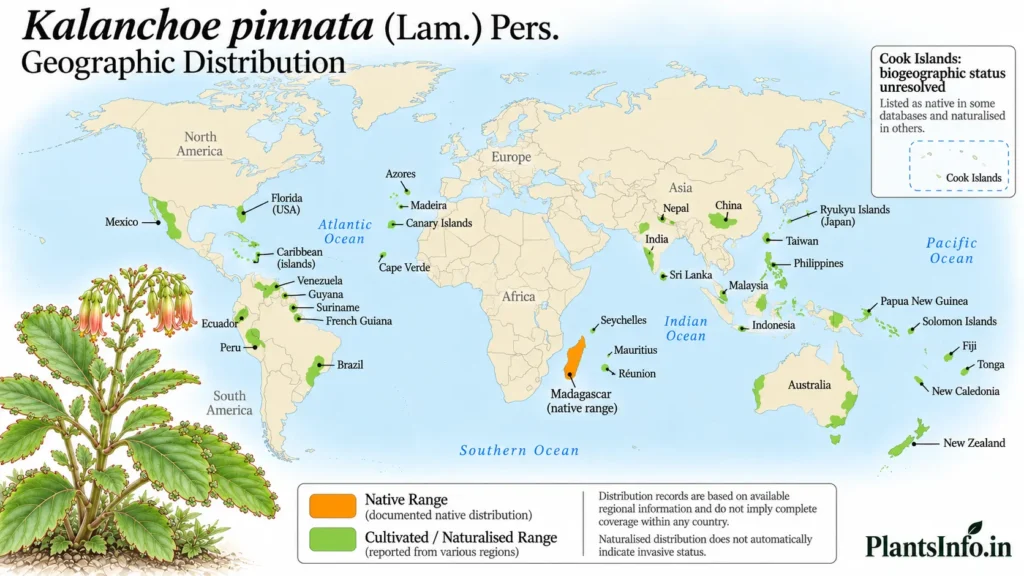
| Geographic region | Reported distribution status |
|---|---|
| Madagascar | Native range |
| Cook Islands | Listed as native by Kew POWO and as naturalised by USDA GRIN-Global |
| Indian Ocean islands and Macaronesia | Naturalised records include Mauritius, Réunion, Seychelles, Cape Verde, the Azores, Madeira and the Canary Islands |
| South and East Asia | Naturalised records include India, Sri Lanka, Nepal, China, Taiwan and the Ryukyu Islands of Japan |
| Southeast Asia and the western Pacific | Naturalised records include Indonesia, Malaysia, the Philippines, Papua New Guinea, the Solomon Islands, Fiji, Tonga and New Caledonia |
| Americas and the Caribbean | Naturalised records include Florida, Mexico, Brazil, Ecuador, Peru, Venezuela, French Guiana, Guyana, Suriname and parts of the Caribbean |
| Australia and New Zealand | Naturalised records are reported |
These regional categories summarise broad patterns rather than provide a complete country-by-country distribution inventory. Database records may differ in geographic resolution, the age of records and the criteria used to assign native, introduced or naturalised status.
Global Cultivation and Naturalisation
The plant is grown as an ornamental and medicinal plant in many regions. Its fleshy foliage, pendulous flowers and capacity for vegetative propagation contribute to its horticultural use. Where plantlets or detached leaf material reach suitable growing sites, they may establish beyond cultivated areas.
Naturalisation means that a non-native plant has established self-sustaining populations outside cultivation. It does not necessarily mean that the species is invasive at every naturalised location. Invasive status requires evidence of spread and adverse ecological or other impacts in the relevant region.
For K. pinnata, invasive behaviour and ecological concerns have been documented in some introduced environments, including island ecosystems. Such records should be interpreted geographically: evidence of local impact does not establish that the species has the same impact in every region where it occurs.
Natural Habitat and Establishment
The species is associated with seasonally dry tropical environments, but it also occurs in cultivated and disturbed habitats across its introduced range. Its presence in a location may reflect deliberate planting, escape from gardens or subsequent vegetative establishment.
Disturbed ground, garden margins, roadsides and other modified habitats can provide opportunities for establishment where moisture, light and substrate conditions are suitable. However, the presence of the plant in a habitat does not demonstrate that it is a dominant component of the local plant community or that it causes a measurable ecological effect there.
The species’ ability to produce marginal plantlets is relevant to its spread. Detached vegetative material can potentially establish new plants, while water, gravity and human movement may contribute to the movement of propagules in particular settings. The relative importance of each dispersal pathway depends on local conditions and should not be assumed to be uniform across its range.
Ecological Role and Invasive Impacts
The ecological effects of K. pinnata are context-dependent. In some introduced regions, the species has been reported as invasive, with concerns about its establishment and potential competition with native vegetation. These records justify regional monitoring and management where impacts are documented.
Three distinctions are necessary:
- Presence: a species has been recorded in a region.
- Naturalisation: it maintains populations outside cultivation.
- Invasion and impact: it spreads and has documented adverse effects in the relevant environment.
These categories are not interchangeable. A distribution record alone cannot establish invasion, and an invasive record from one island should not be used to claim that the species is ecologically damaging everywhere.
The ease of vegetative reproduction may complicate control in some settings because detached plant material can produce new individuals. Nevertheless, management effectiveness depends on the local ecology, the scale of infestation, and the methods used. A universal control outcome cannot be inferred from the plant’s reproductive biology alone.
Climate Requirements and Stress Tolerance
| Environmental factor | Reported information |
|---|---|
| Water availability | Succulent tissues store water; CAM-related physiology contributes to water-use strategy |
| Drought response | Comparative research reports lower CAM expression in K. pinnata than in K. daigremontiana under the studied conditions |
| Temperature tolerance | A verified species-wide optimal or tolerance range was not established in the source material |
| Annual rainfall | A verified quantitative rainfall range was not established |
| Habitat conditions | The species is recorded in disturbed vegetation, open areas and sites near human settlements |
| Climate resilience | Vegetative regeneration can support persistence, but species-specific responses to future climate extremes have not been quantified in the reviewed material |
The species’ succulent habit and reported CAM physiology provide a basis for discussing water conservation, but the available evidence does not establish a complete, species-specific set of optimal climate values or physiological tolerance thresholds.
Numerical ranges for mean annual temperature, annual rainfall, freezing tolerance, salinity tolerance, or waterlogging tolerance should not be presented as verified species-wide limits unless they are supported by direct data. The geographical distribution of a plant cannot be converted into a precise physiological tolerance range without accounting for cultivation, microclimate, habitat and the possibility that some records represent managed rather than self-sustaining populations.
Water Limitation
Succulent tissues can store water, and CAM-related physiology may improve water-use efficiency under appropriate conditions. These traits can help the plant tolerate some periods of limited water availability, but they do not establish a universal drought-tolerance rating.
Prolonged water deficit can still impair growth and damage tissues. The duration and intensity of drought, temperature, light and the condition of the plant all influence the outcome.
Excess Moisture and Poor Drainage
Succulence should not be interpreted as tolerance of persistent water saturation. Poor drainage may be associated with root deterioration and root rot in cultivation. The presence of these problems supports caution about prolonged waterlogging but does not establish a precise species-specific threshold for soil moisture or duration of exposure.
Heat, Cold and Salinity
The available evidence does not justify assigning quantitative tolerance limits for extreme heat, freezing or saline conditions. Occurrence in warm climates does not establish tolerance of all high-temperature conditions, and naturalisation in a region does not prove that every population can withstand its local climatic extremes.
Likewise, the response to salinity should not be inferred from general succulent physiology alone. Specific tolerance claims require controlled experiments or sufficiently detailed field evidence.
Combined Environmental Stress
Environmental stresses can interact. Drought may coincide with high temperature, while salinity may occur alongside heat or restricted water availability. The effect of one stress cannot reliably predict the response to a combination of stresses.
The sources assessed here do not establish a comprehensive set of controlled, species-specific experiments on combined stresses such as drought plus heat or salinity plus high temperature. The response of K. pinnata under these conditions therefore remains insufficiently characterised.
Climate Change Vulnerability
Climate change may alter the suitability of habitats and the conditions under which the species grows or spreads. However, a species-specific forecast requires evidence about climatic exposure, physiological limits, reproductive performance and the distribution of suitable habitat.
The plant’s succulent tissues and vegetative reproduction may provide resilience under some conditions, but these traits do not establish that it will benefit from climate change in every region. Climate effects may differ between native populations, cultivated plants and naturalised populations, and the outcome will also depend on competition, disturbance and other environmental changes.
A defensible assessment should distinguish known biological traits from predicted future responses. Without validated distribution modelling and relevant physiological data, precise claims about future range expansion or climate-driven population change would be premature.
Structural and Physiological Adaptations
The biology of Kalanchoe pinnata includes several traits relevant to survival and reproduction: succulent stems and leaves, photosynthetic flexibility associated with CAM, and the capacity to produce adventitious plantlets along leaf margins. These traits contribute to the plant’s ecological and horticultural characteristics, although their relative importance depends on the environment.
| Feature | Sexual reproduction | Vegetative reproduction |
|---|---|---|
| Reproductive structure | Flowers, fruits and seeds | Adventitious plantlets along leaf margins |
| Main process | Seed formation following successful sexual reproduction | Plantlet development from marginal buds |
| Genetic outcome | Can produce genetically variable offspring | Generally produces clonal offspring |
| Establishment | Depends on seed production, dispersal, viability and germination | Depends on plantlet development, detachment and establishment |
| Dispersal | Wind, rain and animal fur are reported as possible seed-dispersal pathways | Detached leaves and other viable plant material can contribute to spread |
| Pollination | Flowers are bisexual; the primary effective pollinators have not been established in the reviewed material | Pollination is not required for plantlet formation |
| Seed biology | Small, numerous seeds are produced in dry follicles | Not applicable |
| Ecological significance | Provides a route for sexual recruitment | Supports clonal multiplication and establishment in some naturalised populations |
Inducible Plantlet Formation
Plantlets can develop from marginal buds along suitable leaves. This process provides a route to asexual reproduction and may allow new individuals to establish without the production and germination of seeds.
Experimental research has examined the developmental regulation of this process, including the involvement of meristem-associated genes and plant hormone signalling. These findings support a mechanistic basis for inducible vegetative reproduction. They do not, however, establish a universal minimum propagule size, a fixed probability of establishment or a standard rate of population increase under field conditions.
Detachable Vegetative Propagules
Leaves and plantlets may become detached from the parent plant. If the material reaches a suitable microsite, it may remain viable and develop into a new plant. This mechanism is important in cultivation and can contribute to unintended establishment outside gardens.
The potential for vegetative establishment depends on the condition of the propagule, the substrate, moisture availability and other local factors. The capacity to reproduce vegetatively should therefore be treated as a significant biological trait, not as proof that every detached leaf will survive or that the species will become invasive in every environment.
Phenology
Phenology concerns the timing of biological events such as vegetative growth, flowering, fruit development and seed maturation. The timing of these events in K. pinnata is likely to vary geographically and with growing conditions.
Regional floras and botanical records document flowering in particular introduced populations, but the available evidence does not establish a complete phenological calendar for the species across its native and introduced ranges. A flowering period recorded in one region should not be presented as a universal schedule.
| Biological event | Evidence-based interpretation |
|---|---|
| Vegetative growth | Occurs during active growth, with timing dependent on environmental conditions |
| Flower-bud initiation | Species-wide timing and triggers are not established here |
| Anthesis and peak flowering | Regional flowering observations are available, but a universal calendar is not established |
| Fruit development | Occurs following successful sexual reproduction; detailed timing varies and is incompletely documented |
| Fruit maturation | Species-wide timing is not established |
| Seed dispersal | Small seeds are produced, but the relative contribution of seed dispersal to population establishment varies by setting |
| Rest or dormancy period | A universal, species-specific dormancy schedule is not established |
Temperature, water availability, light regime, and plant developmental state may influence phenological events. Nevertheless, a particular environmental factor should not be described as the principal flowering trigger without direct evidence from the relevant population or experiment.
Pollination Ecology
The flowers of K. pinnata are pendulous and tubular. Their structure may influence which animals visit the flowers and how pollen is transferred, but floral form alone cannot establish a species’ effective pollinators.
Regional observations have recorded animal visits to flowers. Such observations are useful evidence of visitation, but they do not necessarily show that a visitor carries compatible pollen, deposits it on a receptive stigma, or contributes to seed production.
Pollinators and Floral Visitors
The available evidence does not support a definitive, species-wide ranking of primary and secondary pollinators. Visitors recorded in one location should not be assumed to perform the same role throughout the species’ range.
A rigorous pollination study would distinguish among:
- Animals observed visiting flowers.
- Visitors that contact the reproductive structures.
- Visitors shown to transfer pollen.
- Visitors demonstrated to contribute to successful fertilisation or fruit and seed production.
Without those distinctions, it is more accurate to refer to documented floral visitors than to designate all observed visitors as confirmed pollinators.
Reproductive System
Kalanchoe pinnata reproduces sexually through flowers and seeds and asexually through vegetative plantlets. These pathways can contribute differently to population maintenance in different environments.
Sexual reproduction depends on successful flowering, pollen transfer, fertilisation, fruit development and viable seed production. Vegetative reproduction bypasses several of these steps because plantlets develop from marginal buds. The relative importance of the two pathways cannot be assumed to be constant across populations.
Research on an invaded population in a seasonally dry tropical forest has examined the mating system, population growth and management implications of the species. Such regional studies help explain how sexual and vegetative reproduction can contribute to establishment, but their results should not automatically be generalised to all habitats.
Seed Biology and Germination
The species produces numerous small seeds within its fruits. Botanical descriptions report narrow, elongated or ellipsoid-oblong seeds with longitudinal striations. These morphological observations provide a basis for identification, but they do not establish the seeds’ storage behaviour or germination requirements.
A complete, standardised account of seed dormancy, optimal germination temperature, germination rate, storage longevity and minimum viability duration is not established by the evidence assembled here. These parameters should not be supplied as precise numerical values without direct experimental support.
Seed germination can be influenced by seed maturity, storage conditions, moisture, temperature, and light. Those are general variables relevant to seed biology; their precise effects on K. pinnata require species-specific testing.
Vegetative Reproduction and Regeneration
Vegetative reproduction is particularly well documented in K. pinnata. Adventitious plantlets develop along leaf margins, and detached vegetative material can contribute to regeneration. Experimental research has investigated the genes and hormonal processes associated with plantlet development.
The ecological significance of this mechanism is substantial because vegetative reproduction can allow establishment even when sexual reproduction is limited. However, its contribution to population growth depends on the production and survival of propagules, dispersal, and the availability of suitable establishment sites.
| Parameter | Evidence-based interpretation |
|---|---|
| Regeneration mechanism | Adventitious plantlet formation along leaf margins is documented |
| Sexual reproduction | Flowers and seeds are produced |
| Minimum viable propagule | Not established as a universal species-specific threshold |
| Field establishment rate | Depends on local conditions; no universal rate is established |
| Relative contribution of vegetative reproduction | Important in studied settings, but varies among populations |
| Ecological significance | Can facilitate persistence and unintended establishment outside cultivation |
Reproductive Significance
The coexistence of sexual and vegetative reproduction provides K. pinnata with more than one route to population maintenance. Vegetative plantlets can facilitate rapid local establishment when conditions are suitable, while sexual reproduction can generate seed-derived offspring and contribute to genetic variation.
The balance between these pathways is likely to depend on the environment and the population being studied. The presence of a strong vegetative mechanism should not be interpreted as evidence that seeds are unimportant everywhere, nor should the production of seeds be taken to mean that sexual reproduction dominates population growth.
Future research would benefit from comparative studies that quantify seed production, seed viability, plantlet formation, propagule survival, and recruitment across native and introduced populations. These measurements would help distinguish the reproductive capacity of individual plants from the actual contribution of each pathway to population dynamics.
Economic Importance
Kalanchoe pinnata has documented ornamental and medicinal uses, and its chemical constituents have attracted scientific research. However, the available evidence does not establish reliable global production volumes, export values, market size, or the economic contribution of the species as a distinct commodity.
| Use category | Documented role | Economic interpretation |
|---|---|---|
| Ornamental horticulture | Grown for its foliage, flowers and vegetative propagation | Cultivation is documented, but global production and market value are not established |
| Medicinal plant resources | Included in regional ethnobotanical records and pharmacological research | Use and research interest are documented; the scale of commercial supply is uncertain |
| Research and development | Plant material and isolated constituents are investigated in experimental studies | Scientific interest is evident, but commercial revenue and established industrial demand are not quantified |
The species’ presence in gardens and traditional medicine does not demonstrate a large or internationally significant commercial supply chain. The available evidence does not establish whether commercial material is predominantly cultivated or wild-harvested, nor does it provide reliable estimates of export volumes, market concentration or adulteration rates.
Economic claims should therefore remain qualitative unless supported by species-specific production statistics, trade data or robust market studies.
Traditional Uses
Ethnobotanical records document the use of K. pinnata in several cultural and geographical contexts. These records are valuable for understanding the plant’s place in local knowledge systems, but they do not establish clinical efficacy, safety, or the current prevalence of a practice.
Documented Regional Uses
| Region or knowledge system | Reported use | Preparation or practice documented |
|---|---|---|
| Northern Madagascar; Antakarana ethnobotanical knowledge | Wounds, ulcerated wounds and other skin complaints | External use of crushed leaves or leaf juice |
| Mauritius; regional herbal practice | Sprains and foot swelling | Leaf infusion used in foot soaks |
| Amazonian Ecuador; Achuar, A’i Cofán, Kichwa, Secoya and Siona knowledge systems | Multiple reported medicinal applications | Macerated or cooked leaf preparations; specific practices vary among communities |
| India; records indexed in the IMPPAT database under Ayurveda, Siddha and Unani | Multiple traditional therapeutic-use associations | Database-indexed uses associated with Bryophyllum pinnatum |
These examples are geographically and culturally specific. They should not be combined into a single undifferentiated account of “traditional medicine,” because different communities may use different preparations and attach different meanings to the plant.
Reports of use for serious illnesses should not be presented as established treatment recommendations. The existence of a recorded practice is evidence of ethnobotanical use, not proof that the plant is effective against the condition concerned.
Regional Ethnobotanical Context
The species is native to Madagascar and has become established in many regions beyond its native range. Its presence in medicinal-plant records outside Madagascar is consistent with a history of cultivation and human movement, but distribution alone cannot establish the route, date, or circumstances through which a particular community adopted the plant.
The record associated with Antakarana knowledge provides a regional context for northern Madagascar. The Amazonian Ecuador record is notable for identifying particular Indigenous peoples and vernacular terminology rather than treating all local knowledge as a single tradition.
Published ethnobotanical documentation does not necessarily establish uninterrupted transmission across generations or prove that a practice remains common today. Claims about continuity, prevalence or commercialisation require additional evidence.
Traditional Ecological Knowledge
The evidence assessed here does not establish a sufficiently detailed account of K. pinnata as a component of particular agroforestry systems, living fences, ecological indicators or formal community resource-management practices.
Its cultivation in gardens and its ability to reproduce vegetatively do not, on their own, establish such roles. These associations should be described only where specific ethnobotanical or ecological research documents them.
Ethical Considerations
Ethnobotanical knowledge should be attributed accurately to the communities and sources in which it is documented. Where research or product development draws on traditional knowledge, relevant considerations include community consultation, appropriate attribution, access-and-benefit-sharing obligations and applicable national law.
No species-specific biopiracy dispute or intellectual-property conflict is established by the evidence assembled here. This is a limitation of the available documentation, not proof that no dispute exists. Similarly, the sources assessed do not quantify harvesting pressure attributable to traditional use or commercial extraction.
The plant’s toxicological concerns should also remain part of the discussion. Historical use does not establish safety, and ethnobotanical records should not be converted into medical or veterinary advice.
Cultural Significance
A Singapore government flora database records particular cultural practices involving the plant, including the hanging of stems or leaves in homes in connection with beliefs about good spirits and protection from evil. The same source records the use of leaves as living bookmarks.
These are specific documented examples. They should not be generalised to all communities or used to infer a common historical origin, broad cultural prevalence or universal symbolic meaning.
Cultivation Context
Kalanchoe pinnata is grown as an ornamental succulent and may also be maintained for its distinctive foliage and plantlet-forming leaves. Its fleshy tissues and capacity for vegetative propagation contribute to its horticultural appeal.
The species is associated with well-drained growing media, and new plants can develop from stem cuttings or marginal plantlets. Detached leaves may also establish under suitable conditions. These characteristics make propagation comparatively accessible but can create a risk of unintended spread where vegetative material is discarded or escapes cultivation.
These are general biological and cultivation observations, not a comprehensive cultivation protocol. Detailed growing conditions, propagation procedures and care recommendations are more appropriately addressed in a dedicated growing guide.
Pests, Diseases and Physiological Problems
Species-specific horticultural information identifies caterpillars of the Red Pierrot butterfly (Talicada nyseus) as a potential leaf-feeding concern. Larval activity may produce translucent or water-soaked patches as tissues are damaged. Poor drainage is also associated with root rot in cultivation.
These observations establish potential problems, but the evidence does not quantify their prevalence, yield impact, or relative importance across different cultivation regions. It also does not support a comprehensive global ranking of pests and diseases affecting K. pinnata.
Visible leaf damage should not automatically be attributed to one pest. Similar symptoms may arise from different forms of tissue injury, disease or environmental stress. Diagnosis requires consideration of the actual symptoms and, where possible, direct observation of the causal agent.
Applied Risks and Limitations
Two biological considerations are particularly relevant to cultivation and wider use.
Unintended spread: Plantlets and detached leaves may establish beyond intended growing areas. This possibility warrants care in handling and disposing of viable plant material, particularly in regions where the species is naturalised or invasive.
Product-safety communication: Traditional medicinal use and experimental biological activity should not be presented as proof of clinical efficacy or general safety. The species’ bufadienolide content and the variability of preparations make careful, evidence-based communication important.
The available evidence does not support numerical estimates of losses caused by pests, climate-related production failures, market volatility, adulteration or supply-chain disruption. Such estimates would require dedicated, species-specific data.
Conservation Analysis
Kalanchoe pinnata presents two distinct ecological pictures. It is widely cultivated and naturalised outside its native range, and invasive behaviour has been documented in some introduced regions. At the same time, the available evidence does not establish a reliable global population trend or a comprehensive extinction-risk assessment for its native populations.
These circumstances should not be conflated. Widespread cultivation does not prove that wild populations are secure, while invasive behaviour outside the native range does not establish that the species is globally threatened.
Conservation Status
The National Tropical Botanical Garden’s species information reports K. pinnata as not evaluated by the IUCN Red List. This is a database-reported status, not a formal finding that the species is secure or threatened. A species-specific, formally published global assessment was not established from the records examined for this draft.
| Topic | Reported status |
|---|---|
| IUCN Red List category | Not Evaluated (NE) in the consulted NTBG species record |
| Global population trend | Unknown |
| Native-range population status | No verified species-specific global or Madagascar population trend identified in the source material |
| Invasive spread | Documented in some introduced regions, including the Galápagos Islands and Hawaii |
| Native habitat loss | Species-specific impact not established in the reviewed material |
| Harvesting pressure | Species-specific harvest volumes and effects on wild populations not established |
| Genetic diversity | No verified species-specific population-genetic baseline identified |
| Taxonomy and distribution | Regional distribution records include a discrepancy in the reported status of the Cook Islands |
| Cytogenetics | Historical chromosome counts require verification against primary publications |
| Phytochemistry | Multiple compound classes are documented; standardised quantitative comparisons across plant parts remain limited |
| Toxicology | Preparation-specific exposure, dose-response and long-term safety require further study |
| Phenology and reproduction | Geographic variation, effective pollinators, seed germination and seed longevity require further investigation |
| Conservation research | Native-range population trends, genetic diversity and species-specific extinction-risk assessment remain priorities |
A lack of a formal assessment should not be interpreted as evidence that the species is globally secure. It should equally not be used as a basis for assigning a threatened category without supporting evidence.
Conservation Risk Factors
The following issues warrant different interpretations according to the evidence available.
Invasive spread in introduced regions. Regional records document naturalisation and invasive behaviour, including ecological concerns in some island ecosystems. The severity of impact depends on the location and affected ecosystem; a global impact rating is not justified by regional observations alone.
Loss or fragmentation of native habitat. Habitat change may be relevant to wild plant populations, but the material assessed here does not establish a species-specific causal effect or quantify the severity of this threat.
Overharvesting. Traditional medicinal and ornamental uses are documented, but the volume of wild harvesting and its effect on native populations are not established.
Loss of wild genetic diversity. No verified species-specific population-genetic baseline was established in the sources reviewed. The extent of genetic diversity and any changes over time therefore remain uncertain.
Representation in cultivation. The widespread cultivation of a species does not demonstrate that cultivated plants represent the genetic diversity of its wild populations. A comparative germplasm study would be needed to assess that question.
Conservation Assessment
The most defensible conclusion is that the conservation status of K. pinnata remains insufficiently characterised at the global population level, while invasive behaviour is documented in some introduced regions.
A stronger assessment would require verified occurrence records from Madagascar, population surveys, habitat-condition data and genetic sampling that distinguishes wild populations from naturalised and cultivated material. Until those data are available, conservation conclusions should remain geographically explicit and evidence-scaled.
Research Coverage and Knowledge Gaps
Research on K. pinnata is substantial in some areas but uneven overall. Phytochemistry, pharmacological screening, ethnobotanical use and vegetative reproduction have received considerable attention. In contrast, evidence about native-range population trends, population genetics, and comprehensive ecological interactions is more limited in the sources assembled here.
| Research area | Current evidence | Important unresolved questions |
|---|---|---|
| Taxonomy and nomenclature | Accepted name and synonymy are recorded in authoritative databases | Reconcile regional records and uncertain distribution classifications |
| Cytogenetics | Historical chromosome counts are available | Verify original counts, material identity and population-level variation |
| Morphology | Regional botanical descriptions are available | Standardise comparisons across leaf forms and related species |
| Photosynthetic physiology | Comparative research on CAM and succulence is available | Clarify environmental variation and species-specific responses |
| Phytochemistry | Multiple compound classes have been reported | Improve standardisation, geographic sampling and quantitative comparison |
| Toxicology and safety | Relevant compounds and experimental concerns are documented | Establish preparation-specific exposure, dose–response and long-term safety data |
| Traditional uses | Regional ethnobotanical records are available | Assess contemporary continuity and strengthen practice-specific attribution |
| Distribution | Broad native and introduced records exist | Validate uncertain records and distinguish native from naturalised populations |
| Phenology and reproduction | Regional observations and experimental studies are available | Improve knowledge of flowering variation, effective pollinators, seed biology and recruitment |
| Conservation and population genetics | Limited baseline information established here | Measure native-range population trends and genetic diversity |
| Pests and diseases | Some horticultural problems are documented | Establish comparative prevalence and impact across cultivation regions |
Research Priorities
Several priorities follow from these gaps.
- Native-range assessment: establish reliable occurrence, occupancy and population-trend baselines in Madagascar.
- Population genetics: compare wild, naturalised and cultivated plants to determine how well cultivated material represents wild genetic diversity.
- Phytochemical standardisation: document plant origin, developmental stage, plant part, extraction procedure and compound concentration in reproducible studies.
- Toxicological translation: connect chemical composition to realistic exposure levels and clinically relevant safety outcomes.
- Reproductive ecology: quantify the contributions of seed-derived recruitment and vegetative plantlets under contrasting environmental conditions.
- Distribution reconciliation: investigate disagreements in native, naturalised and introduced status, including the classification of the Cook Islands.
- Ethnobotanical continuity and governance: document contemporary practices with accurate community attribution and appropriate ethical safeguards.
These priorities identify questions that require further research. They should not be read as evidence that each corresponding risk has already caused measurable harm.
Interesting Facts
- The accepted scientific name is Kalanchoe pinnata (Lam.) Pers.; Bryophyllum pinnatum (Lam.) Oken is a widely encountered synonym.
- Plantlets can develop along leaf margins, allowing vegetative reproduction without seed germination.
- The species produces pendulous, tubular flowers, but floral form alone does not establish the identity of its effective pollinators.
- Phytochemical studies have reported flavonoids, bufadienolides, phenolic acids and triterpenoids, although the composition varies among samples and methods.
- The plant has documented ornamental and traditional medicinal uses, but these do not establish clinical efficacy.
- Invasive behaviour has been reported in some introduced regions; ecological impact depends on the location and environment.
- Widespread cultivation does not establish the conservation status or genetic diversity of wild populations.
Frequently Asked Questions
Is Kalanchoe pinnata the accepted scientific name?
Yes. Kalanchoe pinnata (Lam.) Pers. is accepted by the consulted taxonomic database. Bryophyllum pinnatum (Lam.) Oken is a synonym used in historical botanical, ethnobotanical and medicinal literature.
Where is Kalanchoe pinnata native?
Madagascar is consistently identified as part of the native range. The status of the Cook Islands differs among distribution databases, so the classification should not be presented as fully resolved.
How does the plant reproduce?
It reproduces sexually through flowers and seeds and asexually through adventitious plantlets that develop along leaf margins. The relative contribution of these pathways varies with the population and environment.
Does it use CAM photosynthesis?
Research on Kalanchoë species documents CAM-related physiology and relationships between leaf succulence and photosynthetic behaviour. The level of CAM activity should not be treated as invariant under all conditions, and comparative findings must be interpreted in the context of the study concerned.
What compounds have been reported in the plant?
Phytochemical studies have reported flavonoids, bufadienolides, phenolic acids, and triterpenoids. Individual compounds and their concentrations depend on the material and analytical method; the presence of a compound does not establish a clinical effect.
Is Kalanchoe pinnata proven to treat diseases?
No general therapeutic claim is established by the evidence reviewed here. Traditional uses and preclinical studies are documented, but clinical findings are limited and specific to the preparations and contexts studied. Laboratory activity should not be presented as proof of human therapeutic efficacy.
Is the plant safe to consume?
A general assurance of safety is not justified. The species contains biologically active compounds, including bufadienolides, and the safety of different preparations and exposure levels is not comprehensively established. Nutritional composition, edibility and toxicological safety are separate questions.
Is it invasive?
It is reported as invasive in some introduced regions, but not every occurrence outside the native range is necessarily invasive. Naturalisation and ecological impact should be assessed regionally.
Has the species been assessed by the IUCN Red List?
The consulted botanical database reports it as not evaluated. That record should not be interpreted as proof that the species is either secure or threatened; a formal global extinction-risk assessment was not established in the evidence reviewed here.
Conclusion
Kalanchoe pinnata is a distinctive succulent perennial recognised for its fleshy foliage and capacity to produce adventitious plantlets along leaf margins. Its accepted taxonomy and broad introduced distribution are documented, and research has investigated its photosynthetic physiology, reproductive mechanisms and diverse phytochemical constituents.
The species also has a history of ornamental and traditional medicinal use. These uses provide important horticultural and ethnobotanical context, but they must remain distinct from evidence of clinical efficacy. Experimental findings involving extracts or isolated compounds do not establish that the plant is an effective treatment or that all preparations are safe. Bufadienolide-related concerns and the variability of plant material make preparation-specific safety assessment particularly important.
Ecologically, vegetative reproduction may facilitate establishment beyond cultivation, and invasive behaviour has been documented in some introduced regions. Nevertheless, regional invasive impacts do not establish a global extinction risk, just as widespread cultivation does not demonstrate that native populations are secure.
The strongest overall interpretation is that K. pinnata is botanically well recognised and increasingly characterised in phytochemical and reproductive research, while important questions remain about quantitative physiology, clinical relevance, long-term safety, regional reproductive ecology and the conservation status of wild populations. Conclusions should therefore remain proportionate to the evidence available.
I misunderstood your request. You want the complete reference list for the Kalanchoe pinnata profile edited into a consistent bibliographic style and organised under five standard source categories—not a source-classification table.
References
A. Primary Taxonomic Sources
- Royal Botanic Gardens, Kew. (n.d.). Kalanchoe pinnata (Lam.) Pers. Plants of the World Online. https://powo.science.kew.org/taxon/urn:lsid:ipni.org:names:274438-1 (Accessed October 29, 2026).
- International Plant Names Index (IPNI). (n.d.). Kalanchoe pinnata name record. https://www.ipni.org/ (Accessed October 29, 2026).
- European and Mediterranean Plant Protection Organization (EPPO). (n.d.). Kalanchoe pinnata. EPPO Global Database. https://gd.eppo.int/taxon/KANPI (Accessed October 29, 2026).
- National Center for Biotechnology Information (NCBI). (n.d.). Kalanchoe pinnata. NCBI Taxonomy Database. https://www.ncbi.nlm.nih.gov/Taxonomy/ (Accessed October 29, 2026).
B. Peer-Reviewed Literature
- Andrade, E. A. de, Machinski, I., Ventura, A. C. T., Barr, S. A., Pereira, A. V., Beltrame, F. L., Strangman, W. K., & Williamson, R. T. (2023). A review of the popular uses, anatomical, chemical, and biological aspects of Kalanchoe (Crassulaceae): A genus of plants known as “miracle leaf.” Molecules, 28(14), 5574. https://doi.org/10.3390/molecules28145574
- Griffiths, H., Robe, W. E., Girnus, J., & Maxwell, K. (2008). Leaf succulence determines the interplay between carboxylase systems and light use during Crassulacean acid metabolism in Kalanchoë species. Journal of Experimental Botany, 59(7), 1851–1861. https://doi.org/10.1093/jxb/ern085
- Jácome-Blásquez, D., & Kim, K. (2023). Meristem genes are essential for the vegetative reproduction of Kalanchoë pinnata. Frontiers in Plant Science, 14, 1157619. https://doi.org/10.3389/fpls.2023.1157619
- Jácome-Blásquez, D., et al. (2025). Plant hormones regulate inducible asexual reproduction in Kalanchoë pinnata. Journal of Experimental Botany. https://doi.org/10.1093/jxb/eraf405
- Kolodziejczyk-Czepas, J., & Stochmal, A. (2017). Bufadienolides of Kalanchoe species: An overview of chemical structure, biological activity and prospects for pharmacological use. Phytochemistry Reviews, 16, 1155–1171. https://doi.org/10.1007/s11101-017-9525-1
- Mahomoodally, M. F. (2014). A quantitative ethnobotanical study of common herbal remedies used against 13 human ailment categories in Mauritius. African Journal of Traditional, Complementary and Alternative Medicines, 11(6), 1–32. Bibliographic pagination requires verification.
- Nguyen, H. T. N., et al. (2025). A review of phytocompounds of “Leaf of Life” medicinal plant (Kalanchoe pinnata (Lam.) Pers.). Natural Product Communications. https://doi.org/10.1177/1934578X251390294
- Smith, G. F., & Olivier, R. (2022). A review of the cytotaxonomy of Kalanchoe (Crassulaceae subfam. Kalanchooideae) with reference to evolutionary trends in the genus. Phytotaxa, 560(2), 153–185. https://doi.org/10.11646/phytotaxa.560.2.2
- Mating system, population growth, and management scenario for Kalanchoe pinnata in an invaded seasonally dry tropical forest. (2016). Research article. https://pmc.ncbi.nlm.nih.gov/articles/PMC4931000/ Author names and complete journal metadata require verification.
- A review on Kalanchoe pinnata. (2021). International Journal of Pharmacognosy and Phytochemical Research. https://journals.ipinnovative.com/ijpp/archive/volume/8/issue/3/article/23351 Author names, volume, issue and pagination require verification.
- Warden, J. (1959). Variación intraindividual del número cromosómico en el meristema radicular de los híbridos de Bryophyllum calycinum × Bryophyllum daigremontianum. Boletín de la Sociedad Argentina de Botánica, 7, 209–213.
C. Monographs, Books, and Technical Works
- Flora Zambesiaca. (1983). Flora Zambesiaca (Vol. 7, Part 1). Royal Botanic Gardens, Kew.
- Nicolas, J.-P. (2012). Plantes médicinales du Nord de Madagascar: ethnobotanique antakarana et informations scientifiques. Jardins du monde.
- Smith, G. F., Figueiredo, E., & van Wyk, A. E. (2019). Kalanchoe [Crassulaceae] in southern Africa. Academic Press, Elsevier.
- Flora of Tropical East Africa. Botanical treatment of Kalanchoe pinnata / Bryophyllum pinnatum. The specific treatment, author, publication year, and page range require identification before final publication.
D. Databases and Online Resources
- ChromoDB. (n.d.). Kalanchoe pinnata (Lam.) Pers.: Chromosome-count record. https://database.chromodb.net/record.php?id=chromodb-507948 (Accessed October 29, 2026).
- Darwin Foundation. (n.d.). Kalanchoe pinnata: Species checklist record. https://datazone.darwinfoundation.org/en/checklist/?species=14119 (Accessed October 29, 2026).
- Global Invasive Species Database. (2008). Kalanchoe pinnata. IUCN SSC Invasive Species Specialist Group. https://www.iucngisd.org/gisd/species.php?sc=1306 (Accessed October 29, 2026).
- Indian Medicinal Plants, Phytochemistry and Therapeutics (IMPPAT). (n.d.). Bryophyllum pinnatum: Therapeutic-use record. https://cb.imsc.res.in/imppat/therapeutics/Bryophyllum%20pinnatum (Accessed October 29, 2026).
- National Parks Board, Singapore. (n.d.). Kalanchoe pinnata (Lam.) Pers. Flora & Fauna Web. https://www.nparks.gov.sg/florafaunaweb/flora/3/3/3323 (Accessed October 29, 2026).
- National Tropical Botanical Garden. (n.d.). Kalanchoe pinnata. Tropical Plants Database. https://ntbg.org/database/plants/detail/kalanchoe-pinnata (Accessed October 29, 2026).
- New Zealand Flora. (n.d.). Kalanchoe pinnata: Species factsheet. https://nzflora.info/factsheet/Taxon/Kalanchoe-pinnata.html (Accessed October 29, 2026).
- New Zealand Plant Conservation Network. (n.d.). Kalanchoe pinnata. https://www.nzpcn.org.nz/flora/species/kalanchoe-pinnata/ (Accessed October 29, 2026).
- Smithsonian Institution, National Museum of Natural History. (n.d.). Kalanchoe pinnata. Flora of the Hawaiian Islands. https://naturalhistory2.si.edu/botany/hawaiianflora/speciesdescr.cfm?genus=Kalanchoe&species=pinnata (Accessed October 29, 2026).
- United States Department of Agriculture, Agricultural Research Service. (n.d.). Kalanchoe pinnata: Taxonomy and distribution record. GRIN-Global. https://npgsweb.ars-grin.gov/gringlobal/taxon/taxonomydetail?id=21076 (Accessed October 29, 2026).
- University of Hawai‘i, College of Tropical Agriculture and Human Resources. (n.d.). Kalanchoe pinnata: Weed information sheet. https://www.ctahr.hawaii.edu/invweed/WeedsHI/W_Kalanchoe_pinnata.pdf (Accessed October 29, 2026).
- ASPCA. (n.d.). Kalanchoe. Toxic and Non-Toxic Plants. https://www.aspca.org/pet-care/aspca-poison-control/toxic-and-non-toxic-plants/kalanchoe (Accessed October 29, 2026).
- Flora of Sri Lanka. (n.d.). Kalanchoe pinnata: Species record. https://floraofsrilanka.com/species/659 (Accessed October 29, 2026).
E. Grey Literature and Institutional Resources
- Cabrera, et al. (2011; repository record dated 2020). Etnofarmacología de Kalanchoe pinnata en Amazonía: Uso medicinal de “chugri yuyu”. Universidad Regional Amazónica Ikiam institutional repository. https://repositorio.ikiam.edu.ec/jspui/handle/RD_IKIAM/366 Full author list, document type and original publication details require verification.
- Ecuador conference proceedings. (2023). EMAPi Conference: Book of Abstracts. https://www.ibot.cas.cz/invasions/EMAPi_conferences/pdf/2023_book_of_abstracts.pdf (Accessed October 29, 2026).
- Botanical Survey of India. Botanical reference for the morphology and regional identification of Kalanchoe pinnata. The exact flora title, author, volume, page range and URL were not preserved in the source material.