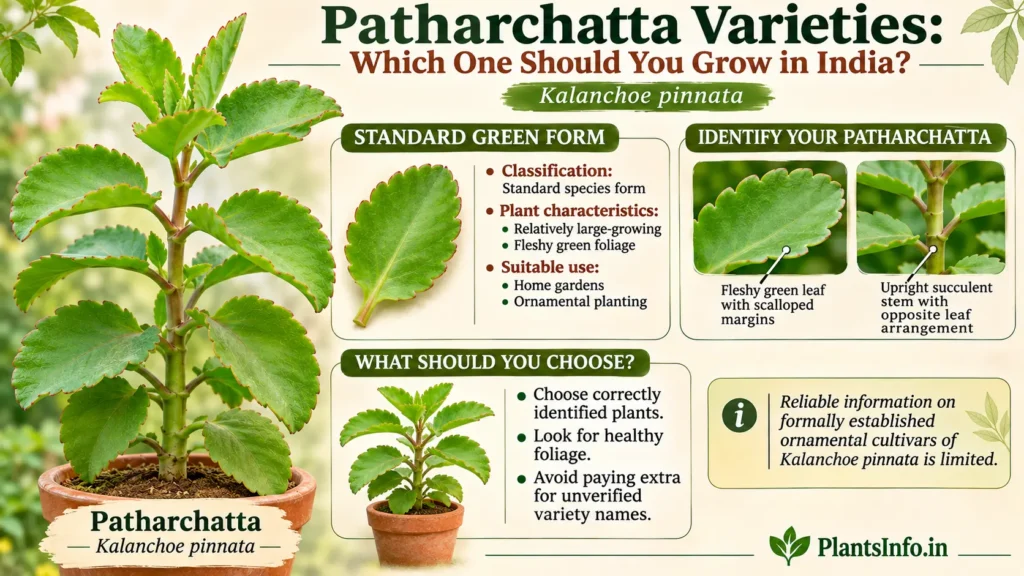
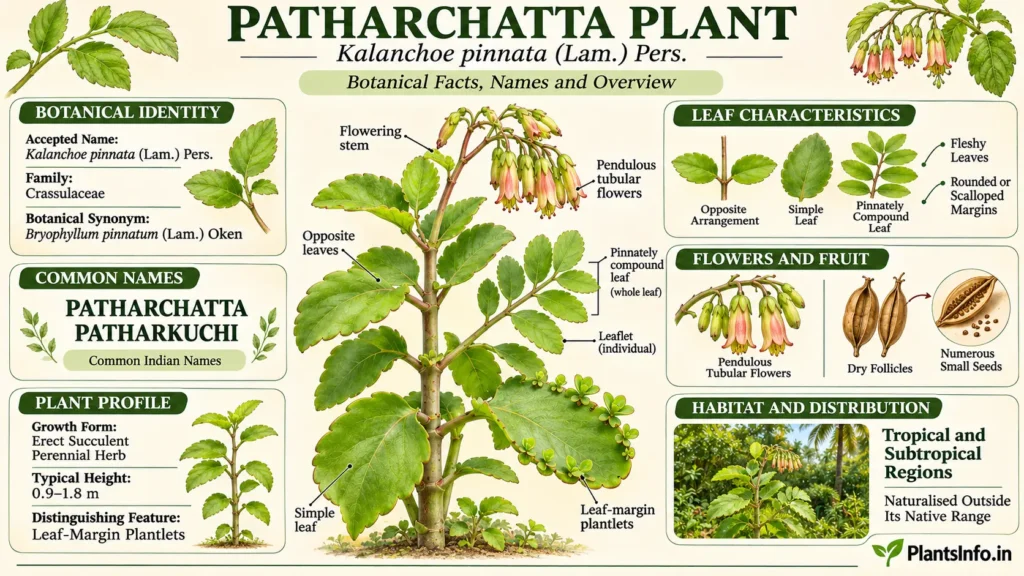
Patharchatta Plant Quick Facts: Names and Overview
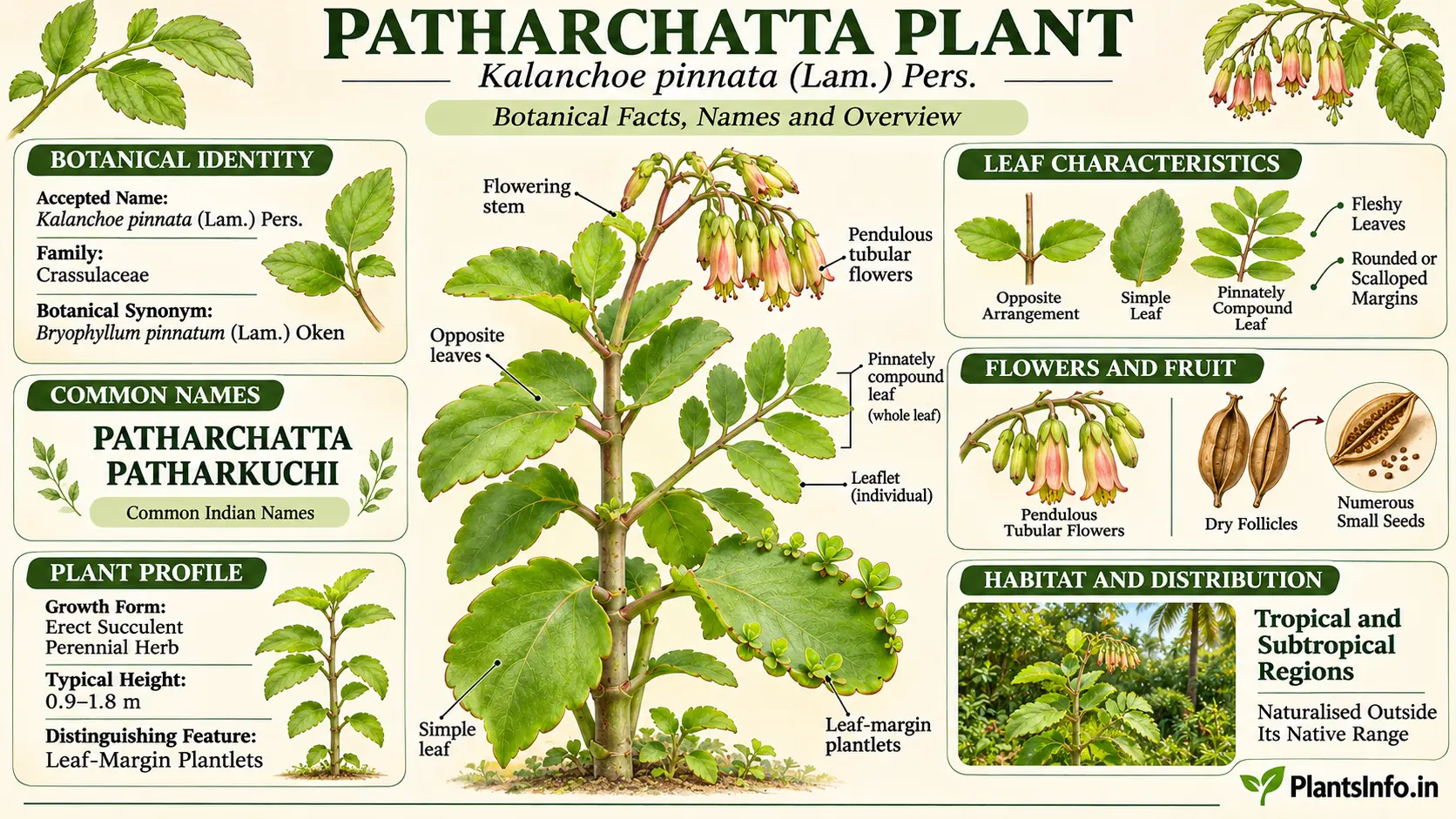
Kalanchoe pinnata* is a perennial succulent herb in the family Crassulaceae, recognised by its fleshy leaves and distinctive growth form. Known in India by names such as Patharchatta and Patharkuchi, it occurs as a naturalised species in tropical and subtropical regions outside its native range.
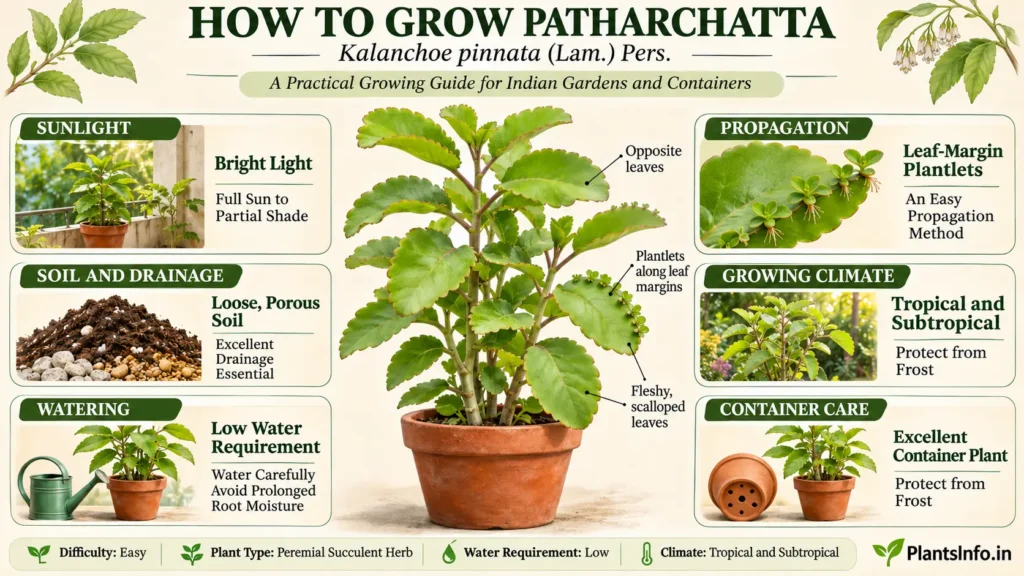
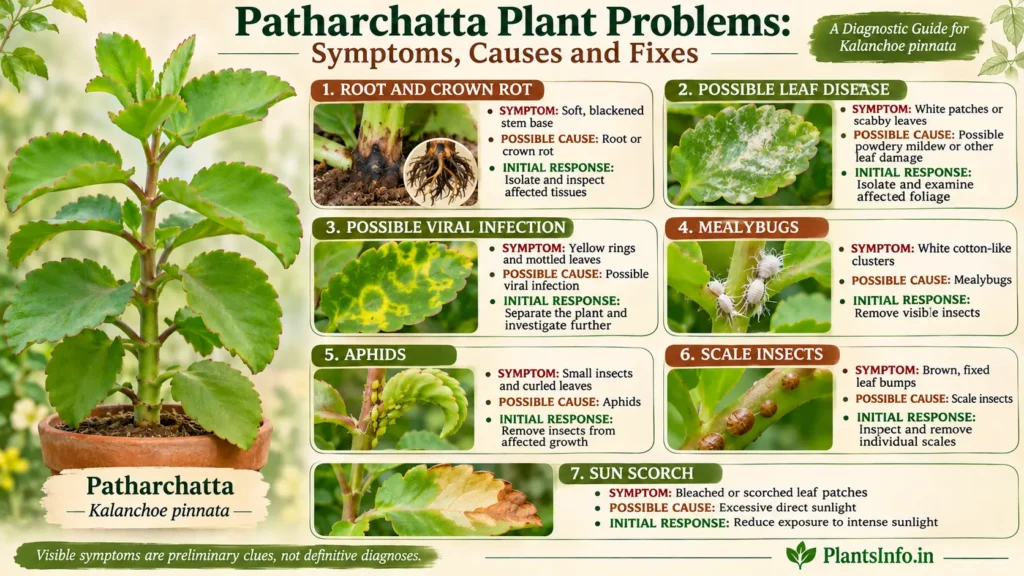
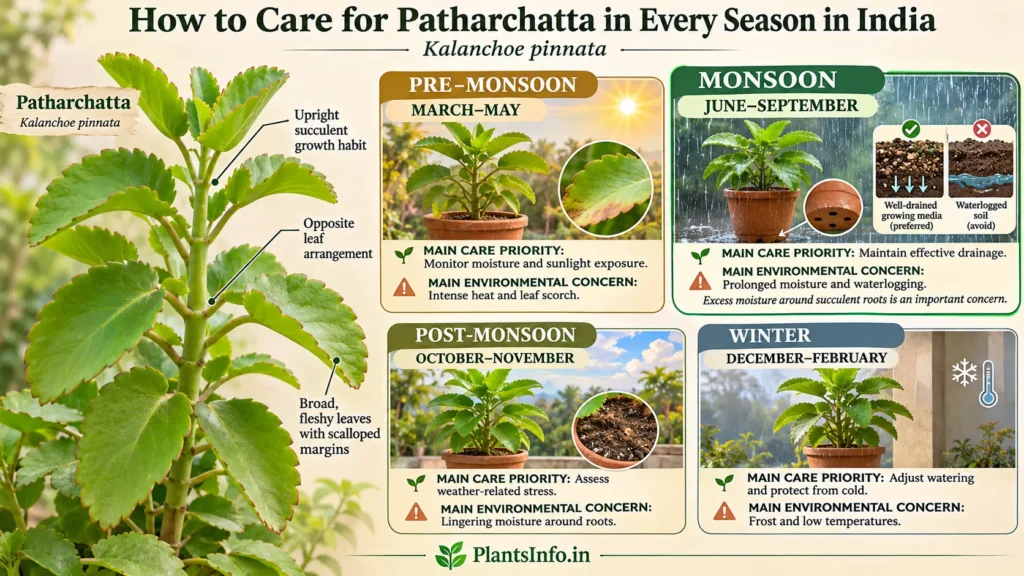
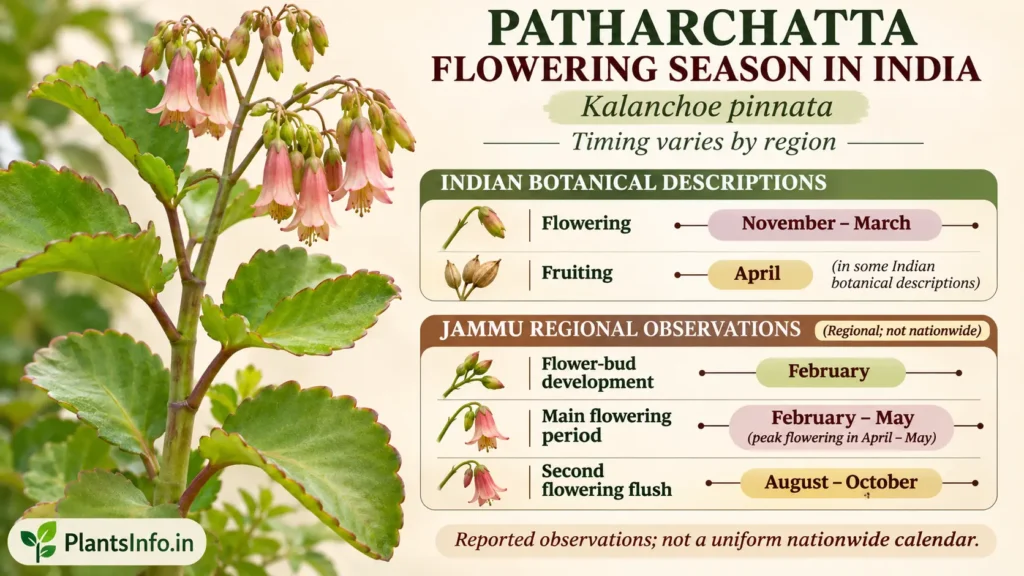
See also: Kalanchoe pinnata plant profile, how to grow it, common problems, seasonal care, and its flowering season.
Introduction
The upright growth habit, fleshy foliage, and characteristic leaf structure distinguish Kalanchoe pinnata from many other commonly cultivated succulents. Its botanical identity is also associated with the synonym Bryophyllum pinnatum, which remains widely encountered in botanical and horticultural literature.
Recommended Products
Disclosure: As an Amazon Associate, PlantsInfo may earn from qualifying purchases.
🌱 Growing Essentials
The following products can help with container gardening, potting, root development, soil management, and healthy plant growth.

Organic Potting Soil Mix
Provides nutrients, structure, and healthy growing conditions for container plants.

Coco Peat Growing Medium
Enhances moisture retention while maintaining excellent root-zone aeration.

Grow Bags for Plants
Improve drainage, root aeration, and vegetable production in limited spaces.

Plastic Pots for Plants
Ideal containers for seedlings, ornamentals, herbs, and balcony gardens.
Quick Facts
| Feature | Characteristic |
|---|---|
| Accepted scientific name | Kalanchoe pinnata (Lam.) Pers. |
| Botanical synonym | Bryophyllum pinnatum (Lam.) Oken |
| Family | Crassulaceae |
| Growth form | Erect, succulent perennial herb |
| Typical height | Approximately 0.9–1.8 m under favourable conditions |
| Leaves | Fleshy, opposite, simple or pinnately compound |
| Leaf margins | Rounded or scalloped |
| Flowers | Pendulous, tubular, greenish to reddish |
| Fruit | Dry follicle containing numerous small seeds |
| Distinguishing feature | Plantlets may develop along leaf margins |
Names in Different Languages
| Language or region | Common name |
|---|---|
| English | Cathedral Bells, Air Plant, Life Plant, Miracle Leaf |
| Hindi | Patharchatta, Patharchur |
| Bengali | Patharkuchi, Pathorchur |
| Marathi | Panfuti |
Common-name usage can vary between regions and communities. These names should be treated as vernacular names rather than substitutes for botanical identification.
Botanical Description
Growth Habit
Kalanchoe pinnata is an upright succulent herb with a fleshy stem and relatively open growth structure. Mature plants may reach approximately 0.9–1.8 m under favourable conditions, although actual size varies with environmental conditions.
Leaves
The leaves are thick, fleshy and generally arranged in opposite pairs along the stem. Lower leaves are commonly pinnately compound, with several leaflets attached along a central stalk, while upper leaves may be simple.
Leaf margins are typically rounded or scalloped. Small vegetative plantlets may develop along the margins, providing a useful visual characteristic for identification.
Flowers
The flowers are tubular and pendulous, usually arranged in branched clusters. Their colours may range from greenish to pinkish or reddish, depending on flower development and plant characteristics.
Fruit
The fruit is a dry follicle containing numerous small seeds. This fruit type is a botanical characteristic of the species.
Native and Introduced Distribution
Madagascar is the native geographical range of Kalanchoe pinnata. The species has subsequently become established in tropical and subtropical regions outside its original range, including India.
| Geographic area | Distribution status |
|---|---|
| Madagascar | Native |
| India | Naturalised |
| Sri Lanka | Naturalised |
| Nepal | Reported outside native range |
| China | Naturalised in parts |
| Taiwan | Introduced |
| Ryukyu Islands | Introduced |
| Indian Ocean islands | Introduced or naturalised in several localities |
| Macaronesia | Naturalised in parts |
These regional classifications do not indicate continuous occupancy throughout any country or island group. Distribution and establishment can vary between individual localities.
Distribution in India
In India, Kalanchoe pinnata is encountered in tropical and subtropical environments, including cultivated and disturbed landscapes. Reported habitat settings include:
- Home gardens and ornamental plant collections.
- Village gardens and household surroundings.
- Disturbed ground and abandoned cultivated areas.
- Localities with suitable warm environmental conditions.
The species is not restricted to a single Indian climatic region. However, a comprehensive, verified state-by-state distribution cannot be established from the information currently available, so individual state records should not be inferred from its general presence in India.
Habitat
The species occurs in tropical and subtropical environments, including cultivated landscapes and disturbed habitats. Its establishment varies with local habitat conditions and moisture availability.
It can be encountered in both urban and rural settings, particularly where ornamental cultivation and subsequent naturalisation have occurred.
Identification and Related Botanical Names
The accepted botanical name is Kalanchoe pinnata (Lam.) Pers. The name Bryophyllum pinnatum (Lam.) Oken is a widely used botanical synonym referring to the same species.
The distinction between botanical synonyms and separate species is important when interpreting older botanical descriptions, horticultural records, and plant identification references.
Special Identification and Safety Notes
Toxicity Consideration
Kalanchoe pinnata contains bufadienolides, a group of compounds associated with cardiac toxicity. Ingestion may pose risks to animals, particularly livestock.
The plant should not be assumed safe for children, pets, or domestic animals. Keep it out of their reach and seek appropriate medical or veterinary advice if ingestion is suspected.
Naturalisation
The species is established outside its native range and may occur beyond cultivated settings. Its distribution should therefore be considered in the context of introduced and naturalised plants rather than interpreted as evidence of native status.
Frequently Asked Questions
Is Patharchatta the same as Bryophyllum pinnatum?
Yes. Bryophyllum pinnatum (Lam.) Oken is a widely used botanical synonym of the currently accepted name Kalanchoe pinnata (Lam.) Pers.
Is Kalanchoe pinnata native to India?
No. Madagascar is its native geographical range. Its occurrence in India represents an introduced and naturalised distribution.
Which plant family does Patharchatta belong to?
Patharchatta belongs to the family Crassulaceae, which includes numerous succulent plant species.
Conclusion
Kalanchoe pinnata is a distinctive succulent herb recognised by its fleshy foliage, characteristic leaf structure, and naturalised distribution across tropical and subtropical regions. Its botanical identity and geographic origin are useful starting points for accurate species identification.