Introduction
Alocasia is a genus of flowering plants in the family Araceae, widely recognized for its dramatic foliage and architectural presence. Commonly referred to as Elephant Ear due to the large, prominently veined leaves of many species, Alocasia includes numerous tropical species native to Asia and eastern Australia. The genus is botanically significant for its distinctive leaf morphology and its role within tropical forest ecosystems.
Classification
Species within the genus vary in size, coloration, and leaf structure, ranging from compact ornamental forms to large, upright plants with expansive foliage. Alocasia has long been cultivated in tropical and subtropical regions and is associated with both ornamental horticulture and traditional agricultural systems in parts of Southeast Asia.
Belonging to a group of plants characterized by specialized inflorescences, Alocasia shares structural traits with other members of the Araceae family, including the production of a spathe and spadix. Its striking visual form and adaptability to humid environments have contributed to its widespread global recognition.
Quick Plant Information
| Field | Information |
|---|---|
| Common Name(s) | Alocasia, Elephant Ear, African Mask Plant |
| Scientific Name | Alocasia spp. |
| Family | Araceae |
| Plant Type | Tropical perennial foliage plant |
| Lifespan | Perennial |
| Growth Habit / Growth Form | Upright, clump-forming or rhizomatous |
| Native Range | Tropical and subtropical Asia, eastern Australia |
| Climate Adaptation / Habitat Type | Humid tropical forests, understory environments |
| Leaf Type | Large, broad, arrow-shaped or shield-shaped leaves |
| Flower Color(s) | Pale green, cream, or white spathe |
| Fruit Type | Berry |
| Evergreen / Deciduous | Evergreen in native climates |
Botanical Description
Alocasia species are herbaceous perennials characterized by thick, fleshy stems that arise from underground rhizomes or corm-like structures. The stems may be short and concealed at the base or elongated and upright, depending on the species. These stems support large, prominent leaves that are the most defining feature of the plant.
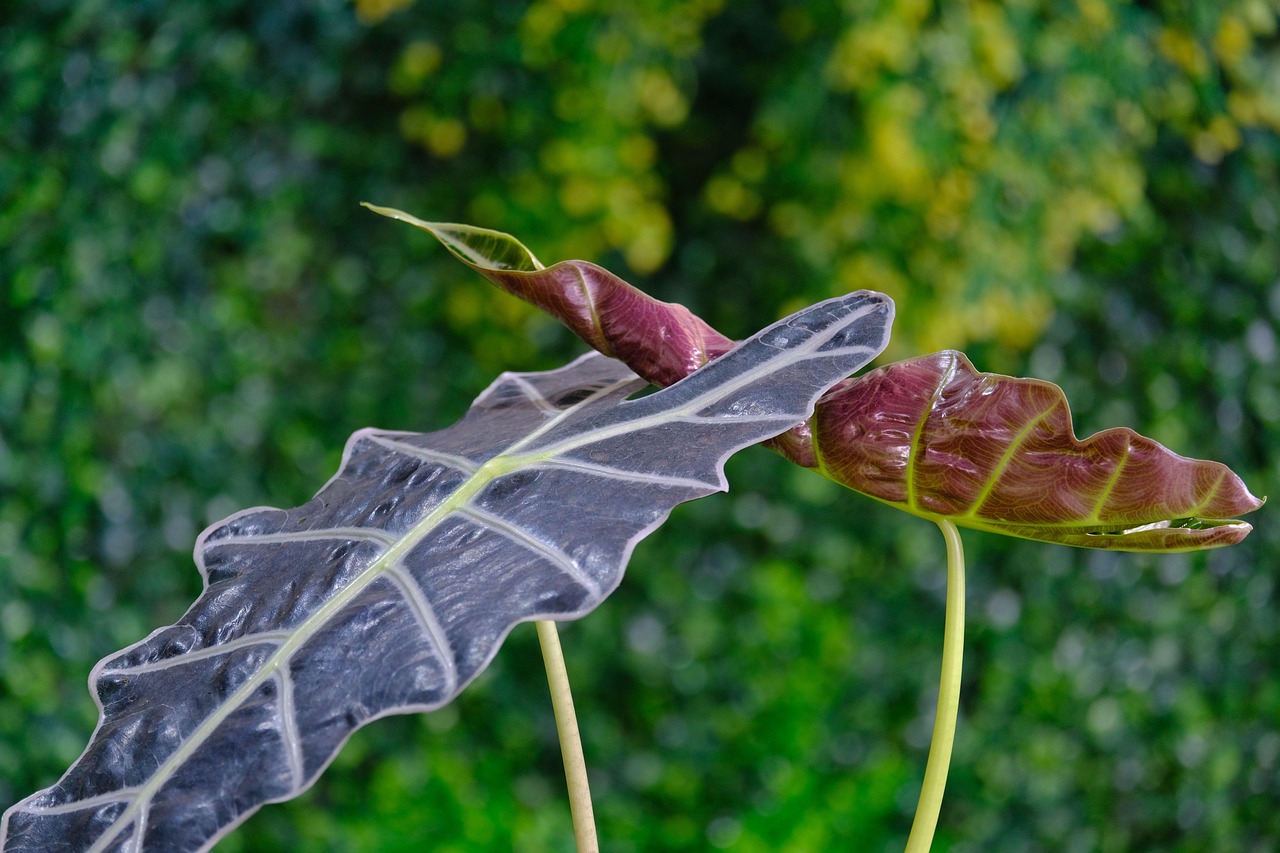
Leaves are typically sagittate (arrow-shaped) or cordate (heart-shaped), often with pronounced veins that contrast in color against the leaf blade. Leaf surfaces may be glossy, matte, or velvety, and coloration ranges from deep green to silvery-green with white or purple venation in certain species. The leaf petioles are generally long and sturdy, elevating the foliage above the base of the plant.
The inflorescence follows the typical Araceae structure, consisting of a spadix surrounded by a spathe. The spathe is often pale green or cream-colored and partially encloses the spadix, which bears numerous small flowers. Male and female flowers are typically separated within the spadix structure. Flowering is less conspicuous than the foliage and may occur seasonally depending on environmental conditions.
Fruits develop as clusters of small berries, often red or orange when mature. These berries contain seeds and form after successful pollination. The root system consists primarily of thickened rhizomes or tuberous structures that function in nutrient storage and vegetative expansion.
Plant Classification & Growth Habit
Alocasia is classified as a tropical herbaceous perennial within the Araceae family. It is closely related to genera such as Colocasia, Xanthosoma, and Caladium, which also produce large ornamental foliage and similar inflorescences.
Most Alocasia species exhibit an upright growth habit, with leaves emerging individually from the base or from a short stem. The growth form can be described as clump-forming, with multiple leaves radiating from a central rhizome. Some species remain compact, while others can reach several feet in height under suitable environmental conditions.
The genus is considered evergreen in its native tropical habitats. In environments outside its natural range, some species may display seasonal dormancy depending on climatic conditions.
Common Types / Varieties / General Classifications
Alocasia includes over 80 recognized species, along with numerous cultivated forms. Common classifications include:
• Large-Leaf Elephant Ear Types – Broad, expansive foliage with prominent veining
• Compact Decorative Types – Smaller forms with striking leaf contrast and texture
• Velvet-Leaf Types – Species with matte or velvety dark leaves
• Variegated Forms – Cultivars exhibiting white or cream marbling
Notable species within the genus include:
• Alocasia macrorrhizos – Giant Taro or Giant Elephant Ear
• Alocasia amazonica – African Mask Plant (a hybrid form)
• Alocasia zebrina – Recognized for its striped petioles
• Alocasia cuprea – Known for metallic leaf sheen
Each species displays distinct leaf structure, venation patterns, and coloration.
Native Range & Distribution
Alocasia species are native primarily to tropical and subtropical regions of Southeast Asia, South Asia, and eastern Australia. Their natural habitats include rainforest understories, riverbanks, and humid lowland forests where atmospheric moisture levels are consistently high.
Countries within the native distribution range include Malaysia, Indonesia, the Philippines, Papua New Guinea, Sri Lanka, and parts of northeastern Australia. Some species are localized to specific islands or forest regions, reflecting ecological specialization.
Through ornamental cultivation, Alocasia has become widely distributed in tropical and subtropical regions around the world. In certain climates, some species have naturalized outside their original geographic range.
Cultural, Culinary, or Traditional Context
Certain species within the genus, particularly Alocasia macrorrhizos, have historical significance in traditional agricultural systems of Southeast Asia and the Pacific Islands. In some regions, the plant has been cultivated for its starchy underground structures, which form part of traditional food systems after appropriate processing.
Alocasia also holds ornamental value in tropical landscaping and interior design due to its sculptural foliage. Its dramatic leaf shapes have contributed to its association with tropical aesthetics in botanical gardens and conservatories.
In various cultural traditions, large-leaved “Elephant Ear” plants symbolize abundance or tropical lushness. The plant’s bold foliage has also influenced decorative motifs and horticultural trends across different regions.
Interesting Facts / Did You Know
• The name “Alocasia” is derived from its distinction from the closely related genus Colocasia.
• Some species exhibit hydathodes—specialized structures that release water droplets from leaf tips.
• The inflorescence produces heat in certain species during pollination, a phenomenon known as thermogenesis.
• Alocasia leaves are often oriented upward, unlike Colocasia, whose leaves typically droop downward.
• The striking venation patterns seen in species like Alocasia amazonica are the result of selective hybridization.
FAQs
Is Alocasia the same as Colocasia?
No. Although both are commonly called Elephant Ear plants and belong to the Araceae family, they are distinct genera with differences in leaf orientation, structure, and botanical classification.
Is Alocasia a bulb or a rhizome?
Alocasia typically grows from a rhizome or corm-like underground stem structure rather than a true bulb.
Are all Alocasia species large plants?
No. While some species can reach considerable height, others remain relatively compact and are characterized by smaller ornamental foliage.
Does Alocasia produce flowers?
Yes. Like other members of the Araceae family, Alocasia produces a spathe and spadix inflorescence, although the foliage is generally more visually prominent than the flowers.
Conclusion
Alocasia is a tropical genus of perennial foliage plants distinguished by its large, sculptural leaves and characteristic Araceae inflorescence. Native to Southeast Asia and surrounding regions, it occupies an important place in tropical ecosystems and horticultural traditions. With diverse species exhibiting varied forms, textures, and coloration, Alocasia remains notable for its botanical uniqueness and strong visual identity.
Plants Info provides structured plant database entries designed for organized learning and botanical reference, supporting clear, consistent documentation of plant species for educational purposes.