Introduction
The Bodhi Tree is a large, long-lived deciduous tree of exceptional historical, religious, and botanical significance. Scientifically known as Ficus religiosa, it is widely recognized as a sacred fig species revered across South Asia and beyond.
Classification
The tree is most famously associated with the site where Siddhartha Gautama attained enlightenment, an event that established its enduring symbolic importance in Buddhist traditions. In addition to its spiritual associations, the Bodhi Tree is valued for its distinctive morphology, longevity, and ecological contributions.
Botanically, the Bodhi Tree belongs to the fig-bearing members of the mulberry family and exhibits a broad canopy, extensive root system, and uniquely shaped leaves. Its presence is common in temple grounds, monastery complexes, village commons, and historical landscapes. Over centuries, the tree has also gained prominence in Hindu and Jain cultural contexts, where it is regarded as a symbol of wisdom, continuity, and cosmic order.
Quick Plant Information
| Attribute | Details |
|---|---|
| Common Names | Bodhi Tree, Sacred Fig, Peepal Tree |
| Scientific Name | Ficus religiosa |
| Family | Moraceae |
| Plant Type | Deciduous tree |
| Lifespan | Perennial |
| Native Region | Indian Subcontinent |
| Growth Habit | Upright, spreading canopy |
| Average Height | 20–30 m |
| Leaf Characteristics | Heart-shaped with elongated tips, glossy |
| Flower Color (if applicable) | Inconspicuous (enclosed within fig) |
| Sunlight Requirement | Full sun |
| Water Requirement | Moderate |
| Soil Type | Well-drained, loamy to alluvial soils |
| Toxicity | Non-toxic to humans |
Botanical Characteristics
The Bodhi Tree is a large deciduous species characterized by a robust trunk, grey to brown bark, and an expansive crown that provides extensive shade. The bark surface is relatively smooth in younger trees and becomes fissured with age. The trunk often develops buttress-like extensions at the base, particularly in mature specimens growing in open landscapes.
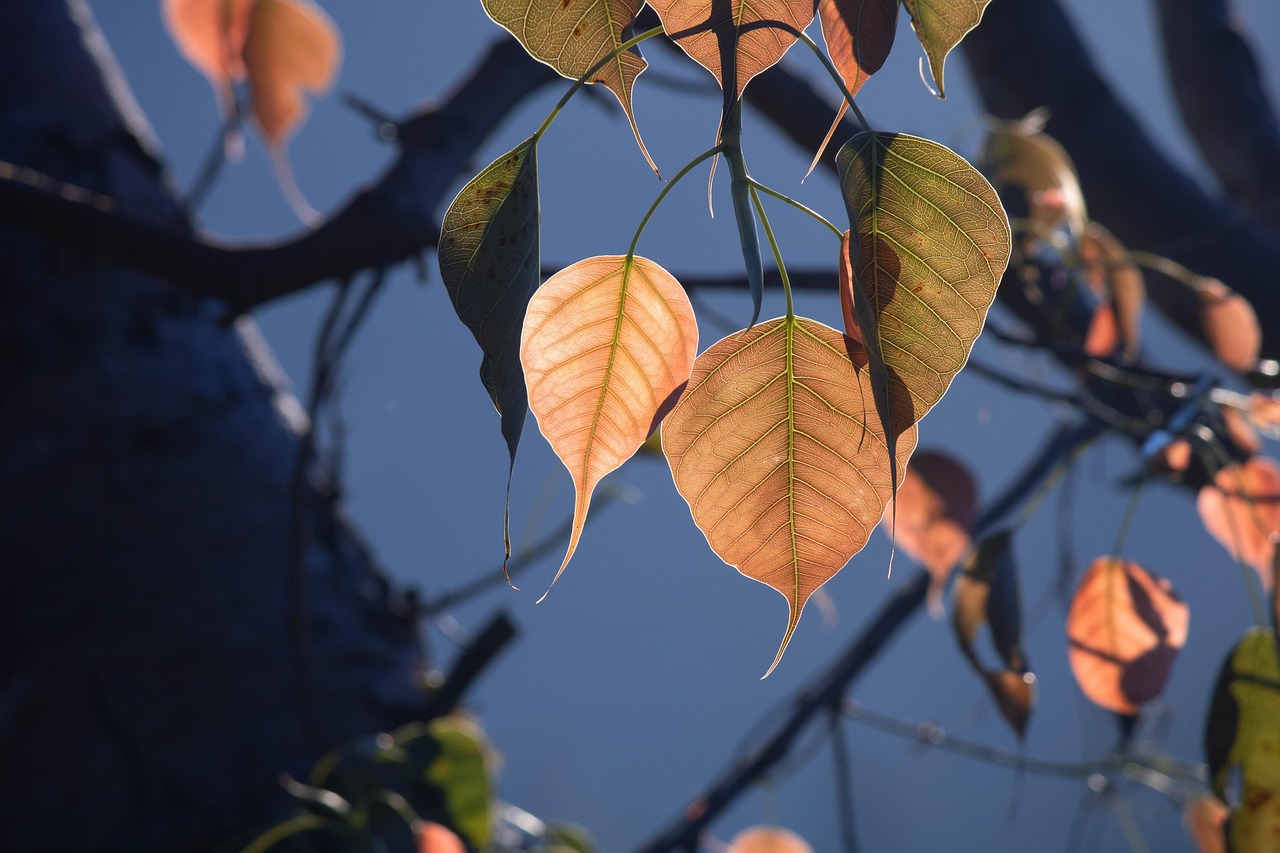
Leaves are a defining feature of Ficus religiosa. They are broadly cordate (heart-shaped) with a long, tapering drip tip that aids in water runoff during monsoon seasons. The leaf surface is smooth and leathery, with prominent venation visible on both sides. Seasonal leaf shedding typically occurs before new growth flushes.
As with other fig species, the Bodhi Tree produces specialized inflorescences known as syconia. These develop into small, rounded figs that remain green when immature and turn purplish or dark when mature. The flowers themselves are not externally visible, as they are enclosed within the fig structure.
Native Habitat and Distribution
The native range of the Bodhi Tree extends across the Indian subcontinent, including present-day India, Nepal, Sri Lanka, Bangladesh, and parts of Pakistan. In its natural environment, the tree is commonly found in riverine plains, open forests, and rocky slopes where deep-rooting systems can establish effectively.
Due to its cultural and religious importance, Ficus religiosa has been introduced and cultivated widely across Southeast Asia, East Asia, and parts of the Middle East. It is also present in tropical and subtropical regions worldwide, particularly in areas with historical Buddhist or Hindu influence.
The species demonstrates adaptability to a range of soil conditions and urban environments, which has contributed to its persistence in both natural and human-modified landscapes.
Common Varieties or Types
The Bodhi Tree is generally represented by the species Ficus religiosa without extensive formal cultivar differentiation. However, variations are observed in leaf size, canopy density, and growth form depending on regional conditions and age.
Related fig species are sometimes colloquially referred to as sacred figs due to cultural overlap, though they are botanically distinct. These include other members of the Ficus genus that share similar ecological roles but differ in leaf morphology and fruiting characteristics.
Despite limited varietal classification, Ficus religiosa remains clearly identifiable due to its characteristic leaf shape and historical associations.
Uses and Importance
The Bodhi Tree holds multifaceted importance spanning religious, cultural, medicinal, and ecological domains. In Buddhist traditions, it symbolizes enlightenment, mindfulness, and spiritual awakening. In Hindu belief systems, the tree is associated with divinity, longevity, and cosmic balance, while Jain traditions also regard it as sacred.
Beyond its spiritual role, the Bodhi Tree has long been referenced in traditional knowledge systems. Various parts of the tree, including leaves, bark, and figs, are documented in classical texts for their historical use in cultural and ethnobotanical contexts.
The tree is also significant as a landmark species in public spaces, temple complexes, and heritage sites, often serving as a focal point for community gatherings and cultural continuity.
Growth Behavior and Care
The Bodhi Tree exhibits vigorous growth during its early developmental stages and gradually transitions into a slow-growing, long-lived form. Its extensive root system allows it to access deep soil moisture, contributing to stability and drought tolerance once established.
The canopy expands broadly over time, forming a dense crown that casts deep shade. Leaf fall typically occurs seasonally, followed by rapid regeneration of new foliage. In urban and semi-urban environments, the tree often adapts to confined spaces, though mature specimens require substantial horizontal and vertical clearance.
The species demonstrates resilience in warm climates and shows tolerance to variable rainfall patterns, reflecting its adaptation to monsoonal ecosystems.
Lifecycle, Flowering, and Fruiting Patterns
As a perennial tree species, the Bodhi Tree follows a long and continuous lifecycle that may extend over several centuries. Vegetative growth dominates the early and middle stages, while reproductive maturity develops gradually.
Flowering is not externally conspicuous due to the enclosed nature of fig inflorescences. Fruiting typically occurs once or multiple times a year, depending on climatic conditions. The figs serve as a food source for birds and other wildlife, contributing to natural seed dispersal processes.
Seasonal leaf shedding and renewal form a regular part of the tree’s annual growth rhythm, aligning with temperature and rainfall variations.
Environmental or Ecological Value
The Bodhi Tree plays an important ecological role in the environments where it grows. Its figs support a wide range of bird species, insects, and small mammals, making it a keystone food resource in many ecosystems. The dense canopy provides shelter and nesting opportunities for avifauna.
The tree’s extensive root system contributes to soil stabilization and helps reduce erosion, particularly in riparian and open landscapes. Its large biomass also supports carbon sequestration over long periods, reflecting its value in mature ecological systems.
Through these functions, Ficus religiosa contributes to biodiversity maintenance and ecosystem resilience.
Recommended Products
Disclosure: As an Amazon Associate, PlantsInfo may earn from qualifying purchases.
🌱 Plant Care Essentials
The following tools can help with pruning, plant health, soil management, and fruit garden maintenance.

Neem Oil for Plant Care
Natural plant protection against aphids, whiteflies, mites, and other common garden pests.

Fungicide for Root Care
Helps suppress soil-borne fungal diseases and supports healthier root systems.

Spray Bottle for Plants
Ideal for applying foliar sprays, neem oil solutions, and liquid plant treatments.

Rubber Hand Gloves
Protects hands during pruning, planting, soil preparation, and garden maintenance.
Conclusion
The Bodhi Tree stands as one of the most culturally revered and botanically significant tree species of South Asia. Its distinctive morphology, long lifespan, and deep-rooted spiritual symbolism have ensured its continued presence across centuries of human history. Beyond its religious associations, the tree functions as an important ecological component, supporting wildlife and stabilizing landscapes.
As both a sacred symbol and a biological organism, the Bodhi Tree represents the enduring relationship between human culture and the natural world, securing its place as a cornerstone species in plant reference documentation.
Frequently Asked Questions (FAQs)
Is the Bodhi Tree evergreen or deciduous?
The Bodhi Tree is a deciduous species that sheds its leaves seasonally before producing new foliage.
Why is the Bodhi Tree considered sacred?
It is traditionally associated with spiritual enlightenment and is revered in Buddhist, Hindu, and Jain traditions.
Does the Bodhi Tree produce visible flowers?
The flowers are enclosed within the fig structure and are not externally visible.
How long can a Bodhi Tree live?
The species is known for exceptional longevity, with some trees surviving for several centuries.
Is the Bodhi Tree toxic?
The tree is generally regarded as non-toxic to humans.
Plants Info serves as a structured knowledge platform documenting plant species across medicinal, cultural, ecological, and ornamental categories. Reference entries such as the Bodhi Tree profile contribute to a broader understanding of plant diversity, historical relevance, and environmental value within a unified plant database framework.