Introduction
The bottle gourd plant, scientifically known as Lagenaria siceraria, is a fast-growing vine cultivated for its distinctive fruits, which vary widely in shape and size. Belonging to the Cucurbitaceae family, it is one of the oldest domesticated plants, with archaeological evidence indicating its use by ancient civilizations across Africa, Asia, and the Americas.
Classification
- Plant Type
- Vine
- Lifecycle
- Annual
- Leaf Habit
- Deciduous
- Native Region
- Africa
- Plant Family
- Cucurbitaceae
The plant is notable not only for its edible immature fruits but also for its mature, hardened shells, which have historically been used as containers, utensils, musical instruments, and decorative objects. Its broad cultural presence and long domestication history make the bottle gourd an important species in both agricultural and anthropological contexts.
Bottle gourd is widely cultivated in tropical and subtropical regions and is recognized under various regional names. It holds a significant place in traditional cuisines and cultural practices across multiple continents.
Quick Plant Information
| Field | Information |
|---|---|
| Common Name(s) | Bottle Gourd, Calabash, White-flowered Gourd, Long Melon, Lauki |
| Scientific Name | Lagenaria siceraria |
| Family | Cucurbitaceae |
| Plant Type | Flowering vine |
| Lifespan | Annual |
| Growth Habit / Growth Form | Climbing or trailing vine |
| Native Range | Believed to be native to Africa |
| Climate Adaptation / Habitat Type | Tropical and subtropical regions |
| Leaf Type | Broad, simple leaves |
| Flower Color(s) | White |
| Fruit Type | Pepo (berry with a hard rind) |
| Evergreen / Deciduous | Deciduous annual vine |
Botanical Description
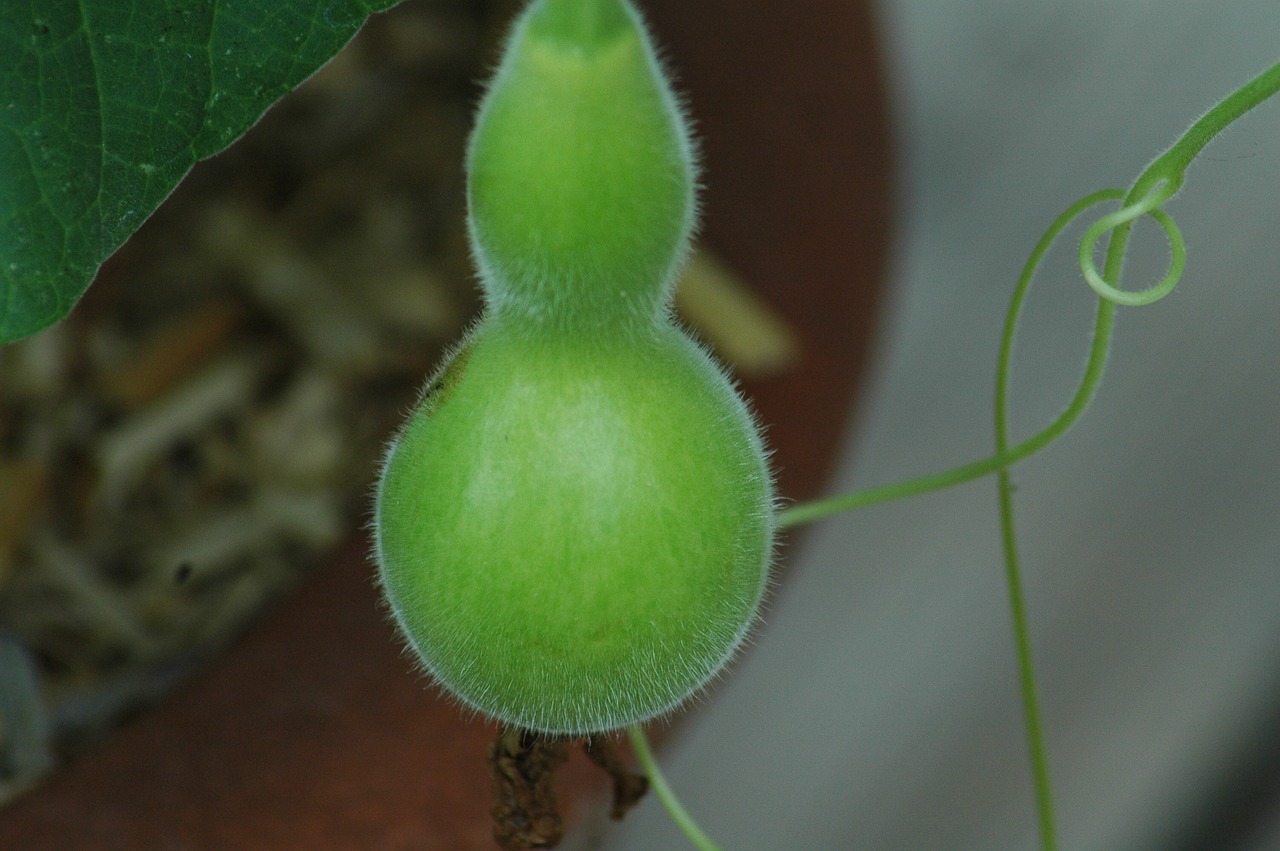
The bottle gourd plant is a vigorous, herbaceous climbing vine characterized by long, trailing stems equipped with tendrils. These tendrils assist in anchoring the plant to surrounding structures or vegetation. The stems are angular and covered with fine hairs, contributing to a slightly rough texture.
Leaves are large, simple, and broadly ovate to heart-shaped. They typically possess a soft, velvety surface due to fine hairs and display prominent veins radiating from the petiole. The foliage forms a dense canopy along the vine.
The plant produces large, white flowers that open primarily during the evening and night. The flowers are unisexual, with separate male and female flowers occurring on the same plant (monoecious). Male flowers are generally borne on longer stalks, while female flowers can be identified by the presence of a small ovary at the base.
The fruit is botanically classified as a pepo, a type of berry with a firm outer rind. Fruit shape varies significantly and may be elongated, cylindrical, round, club-shaped, or bottle-shaped. When immature, the fruit has a smooth green surface. As it matures, the rind hardens and may turn pale green to tan. The interior contains white flesh and numerous flattened seeds.
The root system consists of a primary taproot with lateral branching roots that spread into the surrounding soil.
Plant Classification & Growth Habit
Lagenaria siceraria is classified as a herbaceous annual vine within the Cucurbitaceae family, which includes cucumbers, pumpkins, melons, and squashes. As an annual species, it completes its life cycle within a single growing season.
The plant exhibits a climbing or sprawling growth habit. Through the use of coiled tendrils, it attaches itself to nearby supports. In the absence of vertical structures, the vine spreads across the ground. Its rapid vegetative growth and extensive vine length are characteristic features of the species.
As a monoecious plant, it bears both male and female flowers on the same individual, a trait common among cucurbits. Pollination typically occurs via insects.
Common Types / General Classifications
Bottle gourd exhibits notable morphological diversity, especially in fruit shape and size. General classifications are often based on fruit form:
- Long Type – Elongated, cylindrical fruits resembling a long melon
- Round Type – Globular or spherical fruits
- Bottle-Shaped Type – Narrow neck with a bulbous base
- Club-Shaped Type – Thickened at one end with gradual tapering
- Dipper Gourd Type – Extended neck forming a handle-like structure
These forms have developed through long-term cultivation and selection across different geographic regions.
Native Range & Distribution
The bottle gourd is widely believed to have originated in Africa, where wild relatives are found. Archaeological findings suggest early domestication in Africa, followed by dispersal to Asia and the Americas in ancient times.
It is now cultivated throughout tropical, subtropical, and warm temperate regions worldwide. Significant cultivation occurs in South Asia, Southeast Asia, parts of East Asia, Africa, and Central and South America. The plant has also been introduced into other regions as an agricultural crop and ornamental plant.
Due to its adaptability to warm climates, the bottle gourd is commonly found in regions with extended growing seasons.
Cultural, Culinary, and Traditional Context
Bottle gourd has played an important role in human societies for thousands of years. The mature dried fruits have historically been used as natural containers for water, grains, and liquids. In various cultures, hardened gourds have served as bowls, ladles, and storage vessels.
In several African, Asian, and Latin American traditions, the dried shell has been fashioned into musical instruments, including resonators for stringed instruments and percussion instruments. The calabash gourd, in particular, holds cultural and symbolic significance in parts of Africa and the Caribbean.
The immature fruits are incorporated into traditional cuisines in South Asia, China, and other regions. They are included in a variety of regional dishes and culinary preparations, forming part of longstanding food traditions.
In addition to its culinary and utilitarian roles, the bottle gourd has appeared in folklore, art, and ritual contexts in many societies.
Interesting Facts / Did You Know
- Bottle gourd is among the earliest domesticated plants known to humans.
- The hardened shell of mature fruits is buoyant, which has led to theories about transoceanic dispersal by ocean currents.
- Archaeological remains of bottle gourds have been found in sites dating back thousands of years in Africa, Asia, and the Americas.
- The plant’s flowers typically bloom at night, attracting nocturnal pollinators.
- The term “calabash” is commonly used to describe the mature dried fruit used as a container.
FAQs
Is bottle gourd a fruit or a vegetable?
Botanically, the bottle gourd is a fruit classified as a pepo. In culinary contexts, it is commonly treated as a vegetable.
Is bottle gourd the same as calabash?
Yes. The term “calabash” generally refers to the mature dried form of Lagenaria siceraria, particularly when used as a container.
Is bottle gourd related to pumpkin and cucumber?
Yes. Bottle gourd belongs to the Cucurbitaceae family, which includes pumpkins, cucumbers, melons, and squashes.
Is bottle gourd a perennial plant?
No. It is typically grown as an annual vine that completes its life cycle within one season.
Recommended Products
Disclosure: As an Amazon Associate, PlantsInfo may earn from qualifying purchases.
🌱 Plant Care Essentials
The following tools can help with pruning, plant health, soil management, and fruit garden maintenance.

Neem Oil for Plant Care
Natural plant protection against aphids, whiteflies, mites, and other common garden pests.

Fungicide for Root Care
Helps suppress soil-borne fungal diseases and supports healthier root systems.

Spray Bottle for Plants
Ideal for applying foliar sprays, neem oil solutions, and liquid plant treatments.

Rubber Hand Gloves
Protects hands during pruning, planting, soil preparation, and garden maintenance.
Conclusion
The bottle gourd (Lagenaria siceraria) is a historically significant annual vine known for its versatile fruits and extensive cultural heritage. As a member of the Cucurbitaceae family, it shares botanical traits with other gourds and melons while maintaining distinct morphological diversity.
From its African origins to its global cultivation, the bottle gourd has served culinary, utilitarian, and cultural purposes across civilizations. Its combination of agricultural importance and anthropological relevance makes it one of the most notable domesticated plant species in human history.
The Plants Info platform provides structured, reference-based plant profiles designed for educational and informational purposes. Its plant database supports accurate identification and botanical understanding across a wide range of species.