Introduction
The Kentia Palm, scientifically known as Howea forsteriana, is a slow-growing palm species recognized for its graceful fronds and refined architectural form. Native to a small region in the South Pacific, it has become widely established as an ornamental palm in interiors and subtropical landscapes. Its elegant structure and long-lived nature have contributed to its sustained botanical and horticultural significance.
Classification
- Plant Type
- Palm
- Lifecycle
- Perennial
- Leaf Habit
- Evergreen
- Native Region
- Australia & Oceania
- Plant Family
- Arecaceae
Belonging to the palm family Arecaceae, the Kentia Palm is valued for its adaptability to enclosed environments and its distinct feather-like leaves. Over time, it has developed cultural associations with classic interior design and formal landscaping, particularly during the late 19th and early 20th centuries, when it became a prominent decorative plant in Europe and North America.
The species represents one of the most widely recognized indoor palms worldwide and remains notable for its slender trunk, arching fronds, and understated appearance.
Quick Plant Information
| Field | Information |
|---|---|
| Common Name(s) | Kentia Palm, Thatch Palm, Paradise Palm |
| Scientific Name | Howea forsteriana |
| Family | Arecaceae |
| Plant Type | Palm |
| Lifespan | Perennial |
| Growth Habit / Growth Form | Upright, single-trunk palm with arching fronds |
| Native Range | Lord Howe Island (Australia) |
| Climate Adaptation / Habitat Type | Subtropical coastal forests |
| Leaf Type | Pinnate (feather-like) |
| Flower Color(s) | Cream to pale yellow |
| Fruit Type | Drupe |
| Evergreen / Deciduous | Evergreen |
Botanical Description
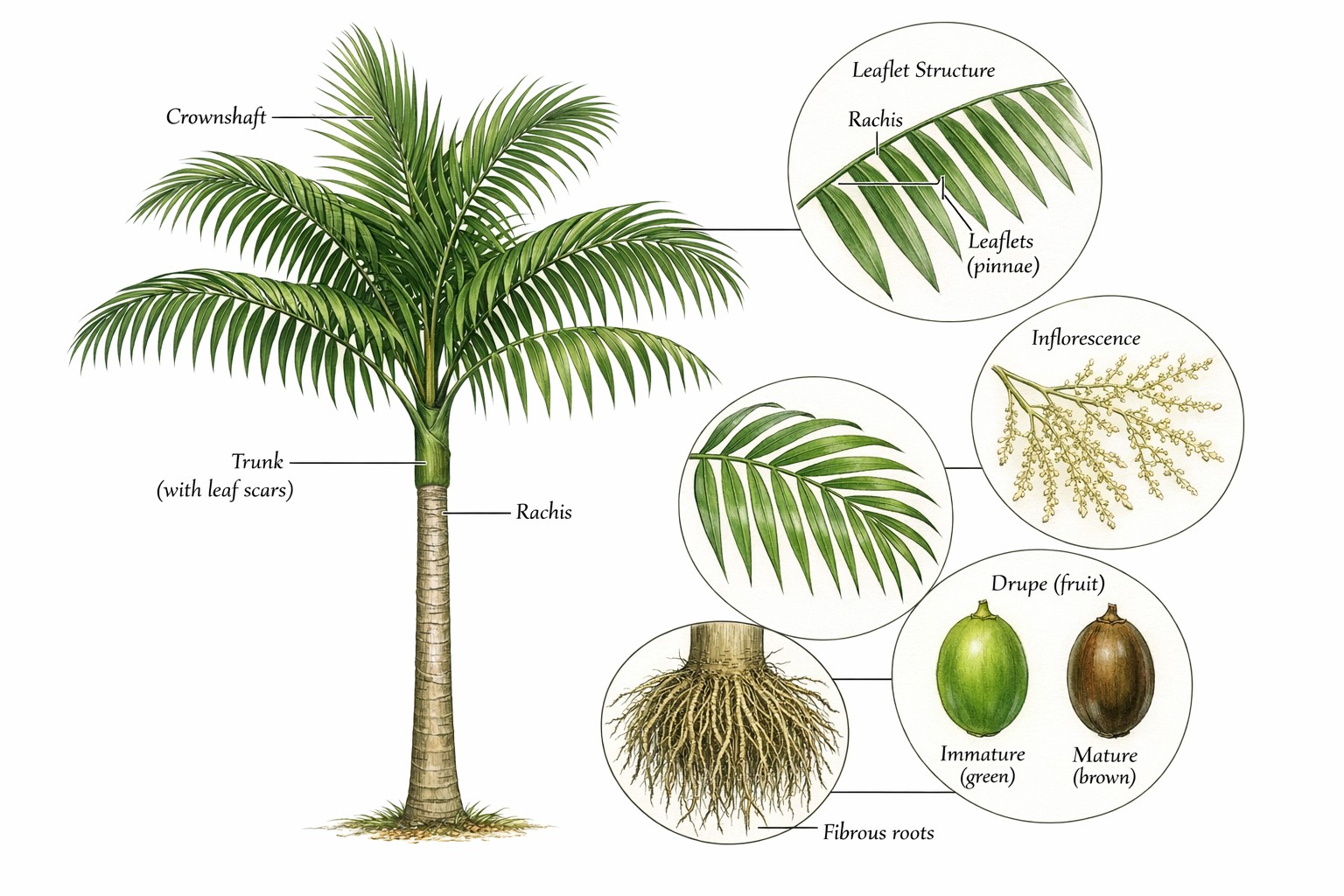
Howea forsteriana is characterized by a solitary, upright trunk that gradually increases in diameter toward the base. The trunk surface is ringed with subtle leaf scars formed as older fronds detach over time. In natural habitats, the trunk can reach considerable heights, while cultivated specimens typically remain more compact.
The leaves are pinnate and arranged in a crown at the apex of the trunk. Each frond is composed of numerous narrow leaflets aligned along a central rachis. The leaflets display a deep green coloration and a gently arching orientation, contributing to the plant’s distinctive silhouette. Mature fronds can reach substantial lengths, creating a broad, spreading canopy.
The inflorescences emerge from among the leaf bases and consist of branching flower stalks bearing small, inconspicuous blossoms. Flowers are typically cream to pale yellow in color. Following pollination, the plant produces oval-shaped drupes that transition in color as they mature.
The root system is fibrous and typical of palms, forming a dense network that supports the upright growth habit. As with most palms, the Kentia Palm lacks a secondary growth process; the trunk does not branch or thicken through traditional woody growth rings.
Plant Classification & Growth Habit
The Kentia Palm belongs to the genus Howea, which comprises only two recognized species native to Lord Howe Island. Within botanical classification, it is categorized as a monocotyledonous flowering plant in the family Arecaceae.
It is a perennial evergreen palm with a solitary trunk growth form. Unlike clustering palms that produce multiple stems from the base, Howea forsteriana develops a single central stem. Its overall growth pattern is upright and vertical, with fronds radiating outward in a balanced, arching arrangement.
The species is considered slow-growing relative to many tropical palms. Its growth form remains consistent throughout maturity, maintaining a narrow trunk topped with a symmetrical crown of foliage.
Common Types / Varieties / General Classifications
The Kentia Palm is not widely divided into ornamental cultivars compared to other palm species. However, it may be categorized broadly based on:
- Juvenile Forms – Smaller plants with shorter fronds and a less developed trunk.
- Mature Specimens – Taller palms with a visible, elongated trunk and expansive fronds.
- Single-Stem vs. Grouped Plantings – Commercially available specimens are sometimes arranged in clusters for visual density, though botanically each stem represents an individual plant.
The genus Howea contains one closely related species:
- Howea belmoreana – Often called the Belmore Sentry Palm, distinguished by more upright leaflets and a slightly different frond structure.
Native Range & Distribution
The Kentia Palm is endemic to Lord Howe Island, a small volcanic island located in the Tasman Sea between Australia and New Zealand. Within this confined native range, it grows in coastal and lowland forest environments.
The island’s subtropical maritime climate, characterized by moderate temperatures and consistent humidity, provides natural conditions for the species. In its native habitat, the palm forms part of the forest understory and can also be found on hillsides and sheltered slopes.
Due to its ornamental appeal, Howea forsteriana has been introduced to numerous regions worldwide. It is now cultivated in subtropical and temperate areas as an interior plant and, in suitable climates, as a landscape palm. Despite its global presence in cultivation, its natural wild distribution remains limited to Lord Howe Island.
Cultural, Culinary, or Traditional Context
The Kentia Palm gained international prominence during the Victorian era, when it became a favored decorative plant in grand homes, hotels, and public buildings in Europe and North America. Its tolerance of interior conditions and refined appearance aligned with architectural and aesthetic trends of the period.
Exportation of Kentia Palm seeds from Lord Howe Island began in the 19th century, forming a significant part of the island’s early economy. Strict management of seed collection historically helped maintain wild populations while supporting international horticultural trade.
While not associated with culinary use, the palm holds cultural importance as one of the defining plant species of Lord Howe Island’s landscape. The island’s flora, including Howea forsteriana, is recognized for its ecological uniqueness and conservation value.
Interesting Facts / Did You Know
- The Kentia Palm is one of only two palm species native to Lord Howe Island.
- It became especially popular in Victorian-era interiors due to its elegant form and longevity.
- The species is slow-growing, contributing to its long lifespan and structural stability.
- Lord Howe Island is a UNESCO World Heritage Site, recognized for its endemic plant species.
- Kentia Palms have been used in formal indoor settings, including historic hotels and conservatories.
FAQs
Is the Kentia Palm the same as the Sentry Palm?
The name “Sentry Palm” may refer to both Howea forsteriana and Howea belmoreana. The two species are closely related but differ slightly in leaflet arrangement and overall frond posture.
Is the Kentia Palm a true tree?
Botanically, palms are monocotyledonous flowering plants rather than true woody trees. The Kentia Palm develops a single trunk but does not form growth rings like hardwood trees.
Does the Kentia Palm produce fruit?
Yes. The plant produces oval drupes following flowering. In its native environment, these fruits mature naturally on the plant.
Is Kentia Palm evergreen?
Yes. Howea forsteriana retains its foliage year-round and is classified as an evergreen perennial.
Recommended Products
Disclosure: As an Amazon Associate, PlantsInfo may earn from qualifying purchases.
🌱 Plant Care Essentials
The following tools can help with pruning, plant health, soil management, and fruit garden maintenance.

Neem Oil for Plant Care
Natural plant protection against aphids, whiteflies, mites, and other common garden pests.

Fungicide for Root Care
Helps suppress soil-borne fungal diseases and supports healthier root systems.

Spray Bottle for Plants
Ideal for applying foliar sprays, neem oil solutions, and liquid plant treatments.

Rubber Hand Gloves
Protects hands during pruning, planting, soil preparation, and garden maintenance.
Conclusion
The Kentia Palm (Howea forsteriana) is a perennial evergreen palm distinguished by its solitary trunk and arching, feather-like fronds. Endemic to Lord Howe Island, it represents a botanically significant species within the Arecaceae family and has achieved worldwide recognition as an ornamental plant.
Its refined growth form, slow development, and historical prominence in interior design have contributed to its lasting appeal. Despite its widespread cultivation, its natural habitat remains limited to a single island ecosystem, underscoring its ecological importance.
The Plants Info platform maintains a structured plant database designed for organized botanical reference and educational learning. Entries such as this provide factual, scalable information intended for long-term study and documentation.