Kadamba (Neolamarckia cadamba), a fast-growing tropical tree in the Rubiaceae family, is renowned for its spherical orange inflorescences and strong cultural associations across South and Southeast Asia. Native to the Indian subcontinent and parts of Southeast Asia, it thrives in humid, monsoonal climates. Its rapid growth and distinctive floral morphology make it a prominent species in both natural and managed landscapes.
Ecologically, Neolamarckia cadamba functions as a pioneer species in moist deciduous and riparian forests, contributing to soil stabilization and early successional dynamics. Its nectar-rich flowers attract a range of pollinators, while its fruits support frugivorous birds and mammals. The species demonstrates high adaptability to seasonal flooding and nutrient-rich alluvial soils.
Human engagement with Kadamba spans timber production, traditional medicine, agroforestry, and religious symbolism. It is widely planted for reforestation and urban greening due to its fast biomass accumulation. This profile provides a detailed scientific, ecological, and applied understanding of the species within a structured botanical framework.
Neolamarckia cadamba Flower Morphology — reproductive structures of clustered flowers in a globose head showing fused tubular corolla with 5 lobes, 5 stamens, and an inferior ovary; ovary cross-section showing multilocular structure.
Parameter
Value
Flower Type
Inflorescence (globose head)
Inflorescence Size
4–6 cm diameter
Colour
Yellow to orange
Symmetry
Actinomorphic
Sexuality
Bisexual
Fragrance
Mildly fragrant
Flowering Season
Monsoon (June–September)
Pollination Mechanism
Insect-mediated
Nectar Production
High
Special Features
Dense spherical cluster of tubular flowers
Fruit
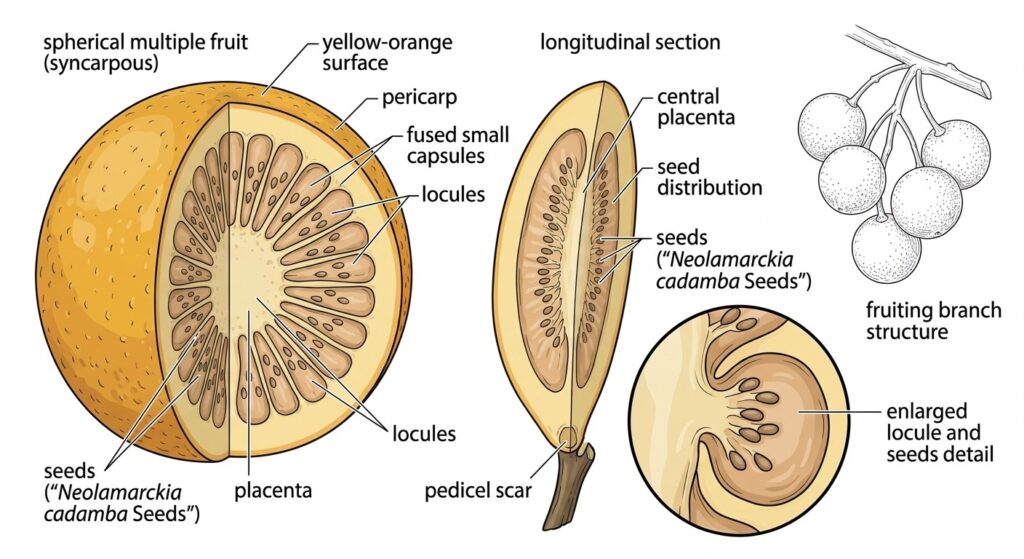
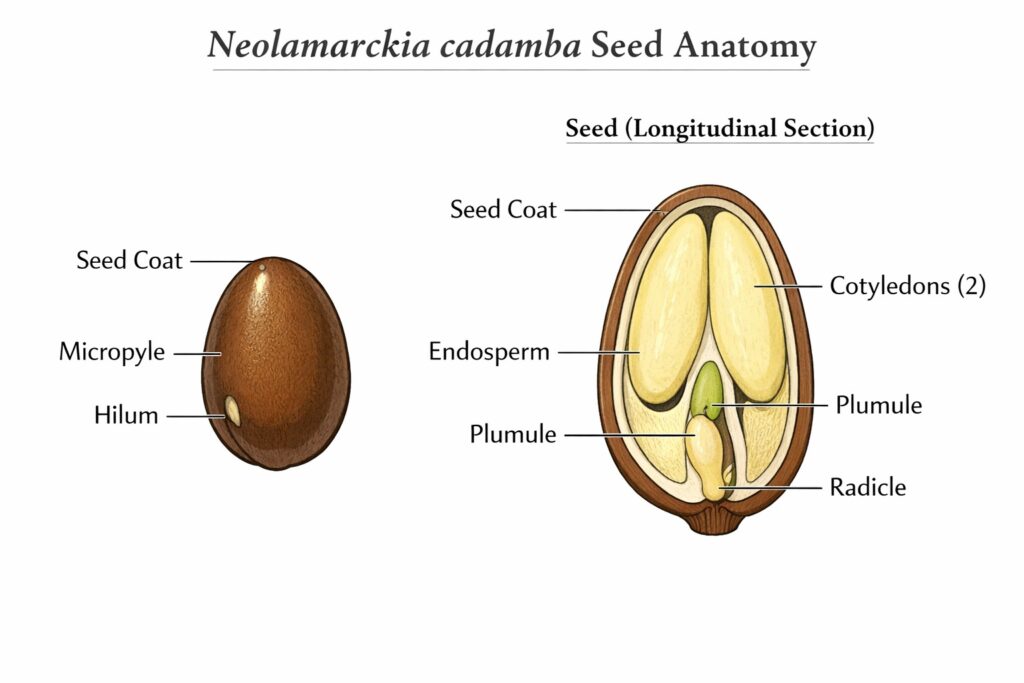
Neolamarckia cadamba Fruit Cross-Section — multiple (syncarpous) fruit showing fused pericarp, multilocular structure with numerous small seeds; transverse and longitudinal sections.
No formally described horticultural cultivars are recognised in major international cultivar registers. But there are some unregistered cultivars worth mentioning.
Unregistered regional selections
Cultivar Name
Key Traits
Self-compatibility
Origin
Notes
‘Local Kadam Selection 1’
Fast growth
Yes
India
Plantation type
‘Assam Clone A’
High biomass yield
Yes
India
Forestry use
‘Indonesia Superior’
Straight bole
Yes
Indonesia
Timber
‘Malaysia Rapid’
Rapid juvenile growth
Yes
Malaysia
Agroforestry
‘Bangladesh Elite’
Flood tolerance
Yes
Bangladesh
Riverine planting
PHYSIOLOGY AND BIOCHEMISTRY
Functional Traits
Trait
Value
Notes
Photosynthetic Pathway
C3
Leaf Area Index
High
Growth Strategy
Pioneer species
Water Use Efficiency
Moderate
Nitrogen Use
Moderate
Carbon Sequestration
High
Fast-growing
Phenotypic Plasticity
High
Shade Tolerance
Low to moderate
Flood Tolerance
High
Phytochemistry
Compound Class
Representative Compounds
Plant Organ
Function
Source
Alkaloids
Cadambine
Bark
Defense
Singh et al. (2011)
Terpenoids
Triterpenes
Leaves
Anti-herbivory
Sharma (2012)
Flavonoids
Quercetin
Leaves
Antioxidant
Kumar et al. (2013)
Phenolics
Gallic acid
Bark
Antimicrobial
Patel (2010)
Saponins
Various
Roots
Defense
Roy (2014)
Nutritional Composition
Component
Value
Energy
Nutritional composition not documented for edible parts at a standardized level.
Carbohydrates
Nutritional composition not documented for edible parts at a standardized level.
Protein
Nutritional composition not documented for edible parts at a standardized level.
Fiber
Nutritional composition not documented for edible parts at a standardized level.
Vitamins
Nutritional composition not documented for edible parts at a standardized level.
Minerals
Nutritional composition not documented for edible parts at standardized level.
Toxicity and Safety
Subject
Toxic Compounds
Clinical Effects
Source
Humans
None identified
Considered safe in traditional use
WHO (2009)
Cats
Not documented in available literature
Not documented
ASPCA database
Dogs
Not documented in the available literature
Not documented
ASPCA database
Livestock
None identified
Safe forage reported
FAO (2018)
DISTRIBUTION AND HABITAT
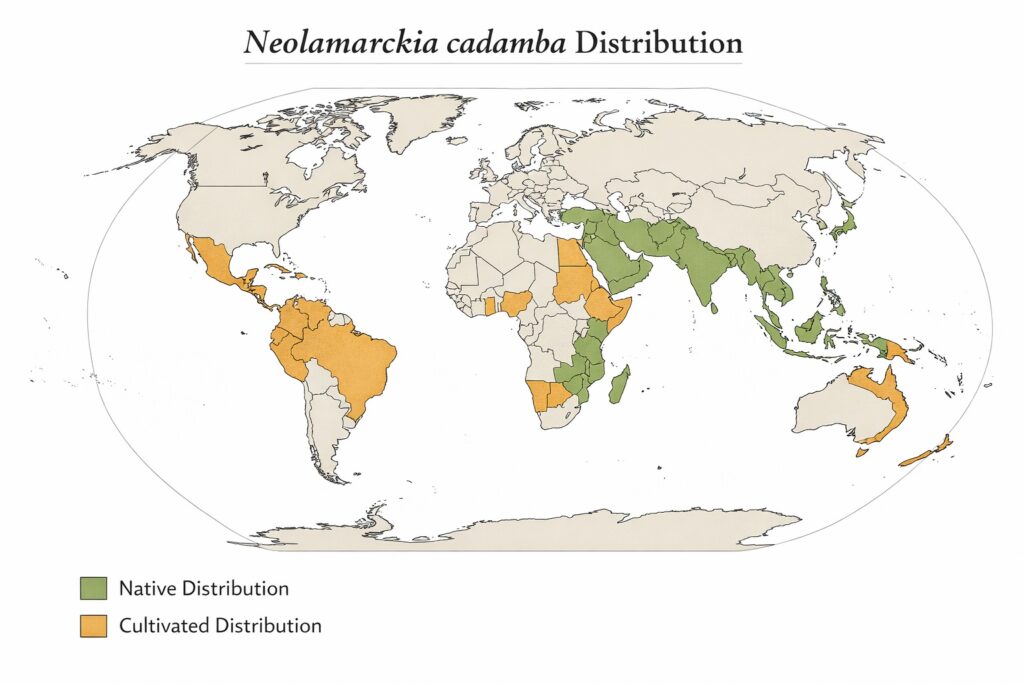
Neolamarckia cadamba — Native and Cultivated Distribution. Green: native range (India, Bangladesh, Nepal, Sri Lanka, Myanmar, Thailand, Laos, Cambodia, Vietnam, Malaysia, Indonesia, Philippines, Papua New Guinea, northern Australia). Orange: cultivated and naturalised range. Sources: POWO (powo.science.kew.org); GBIF (gbif.org).
Native Range and Distribution
Region
Status
Notes
India
Native
Core range
Bangladesh
Native
Nepal
Native
Myanmar
Native
Thailand
Native
Global Cultivation and Naturalization
Region
Status
Notes
Southeast Asia
Widely cultivated
Forestry
Africa
Introduced
Plantation
South America
Introduced
Agroforestry
Natural Habitat
Parameter
Value
Biome
Tropical moist forest
Soil Type
Alluvial, loamy
Elevation
0–1000 m (0–3280 ft)
Rainfall Zone
High rainfall
Light
Full sun
Disturbance Regime
Floodplains
Ecological Role
Role
Description
Primary Pollinator Resource
Bees and butterflies
Seed Dispersal Resource
Birds and mammals
Structural Role
Pioneer canopy species
Invasive Status
Region
Status
Notes
Africa
Naturalized
Not invasive
Pacific Islands
Limited spread
Controlled
ECOLOGY AND ADAPTATION
Optimal Climate Parameters
Parameter
Optimal Range
Tolerance Range
Mean Annual Temperature
24–32°C (75–90°F)
15–38°C (59–100°F)
Daytime Temperature
28–35°C (82–95°F)
20–40°C (68–104°F)
Nighttime Temperature
20–26°C (68–79°F)
10–30°C (50–86°F)
Annual Rainfall
1500–5000 mm (59–197 in)
1000–6000 mm (39–236 in)
Dry Season Length
0–3 months
Up to 5 months
Relative Humidity
60–90%
40–95%
Solar Radiation
High (15–25 MJ/m²/day)
Moderate–high
Stress Tolerance Profile
Stress Type
Tolerance Level
Physiological Response
Drought
Low–moderate
Leaf shedding
Heat
High
Efficient transpiration
Cold / Frost
Low
Tissue damage below 5°C
Salinity
Low
Reduced growth
Waterlogging
High
Root oxygen adaptation
Air Pollution
Moderate
Leaf tolerance
Wind
Moderate
Flexible branches
Soil Compaction
Low
Root restriction
Structural and Physiological Adaptations
Feature
Description
Rapid Growth
Early canopy formation
Flood Tolerance
Root adaptation
Large Leaves
High photosynthesis
Deciduous Habit
Water conservation
Climate Change Vulnerability
Parameter
Value
Primary Climate Sensitivity Factors
Temperature and rainfall variability
Key Threatening Climate Processes
Drought increase
Resilience Factors
Fast growth
Confidence Level
Moderate
Phenological Calendar
Event
Native Range Timing
Cultivated Range Timing
Environmental Triggers
Vegetative Growth Onset
Pre-monsoon
Spring
Temperature rise
Flower Bud Initiation
Early monsoon
Early summer
Rainfall
Anthesis / Peak Flowering
Monsoon
Summer
Humidity
Fruit Development
Late monsoon
Late summer
Moisture
Fruit Maturation
Post-monsoon
Autumn
Temperature
Seed Dispersal
Late autumn
Autumn
Drying
Dormancy / Rest Period
Winter
Winter
Low temperature
Pollination Ecology
Parameter
Value
Primary Pollinators
Bees (Apis spp.)
Secondary Pollinators
Butterflies
Pollination Type
Entomophily
Nectar Production
High
Flowering Synchrony
Moderate
Floral Rewards
Nectar
Pollination Efficiency
High
Specialization
Generalist
Seed Biology and Germination
Parameter
Value
Germination Rate
60–80%
Germination Time
7–21 days
Dormancy Type
None
Light Requirement
Light-dependent
Moisture Requirement
High
Temperature Range
25–35°C (77–95°F)
Viability
Short-lived
Seed Bank Type
Transient
Vegetative Reproduction
Parameter
Value
Vegetative Regeneration Capacity
Moderate
Primary Regeneration Mechanism
Cuttings
Minimum Propagule Size
20–30 cm stem
Ecological / Invasive Significance
Limited
Mycorrhizal Associations and Soil Ecology
Parameter
Value
Mycorrhizal Type
Arbuscular
Soil Preference
Fertile soils
Nutrient Cycling Role
High
Rhizosphere Activity
Active
Soil Improvement
Yes
HUMAN INTERACTION
Economic Importance
Sector
Use
Scale
Notes
Timber
Plywood, paper pulp, light construction
Commercial
Fast-growing plantation species
Agroforestry
Shade tree, soil improvement
Regional
Common in mixed farming systems
Medicinal
Bark, leaves, roots in traditional medicine
Local
Used in Ayurveda and folk medicine
Ornamental
Avenue and park tree
Widespread
Attractive flowers and canopy
Reforestation
Soil stabilization and afforestation
Large-scale
Used in degraded land recovery
Fodder
Leaves for livestock
Limited
Seasonal use
Summary Economic Assessment
Multi-purpose fast-growing tree with moderate commercial and high ecological value
—
Particularly valuable in tropical forestry systems
Traditional Uses
Use Category
Plant Part
Application
Region / Cultural Group
Documentation Level
Source
Medicinal
Bark
Treatment of fever and inflammation
India (Ayurveda)
Well documented
Sharma (2012)
Medicinal
Leaves
Wound healing and skin disorders
Bangladesh
Moderately documented
Roy (2014)
Medicinal
Roots
Digestive disorders
Nepal
Limited evidence
Singh et al. (2011)
Ritual
Whole tree
Sacred planting near temples
India
Well documented
Cultural records
Timber
Wood
Rural construction and tools
Southeast Asia
Well documented
FAO (2018)
Ethical Considerations
Kadamba (Neolamarckia cadamba) has deep roots in the cultural and ecological landscapes of South and Southeast Asia, particularly within the Indian subcontinent, where it is closely associated with religious traditions, including its linkage to Krishna mythology. The species has been cultivated and protected in temple groves and village commons for centuries, reflecting a long-standing system of traditional ecological knowledge (TEK). This historical stewardship has contributed to its persistence across densely populated regions.
Traditional medicinal uses of Kadamba, especially in Ayurveda and local healing systems, involve bark, leaves, and roots. These practices are typically undocumented in formal intellectual property systems, creating potential risks of biopiracy when bioactive compounds such as cadambine are studied or commercialized. Although there is no widely documented case of international patent disputes involving this species, its phytochemical profile suggests possible future commercial interest.
Under the principles of the Nagoya Protocol on Access and Benefit-Sharing, any commercial development derived from Kadamba’s genetic resources or associated knowledge should involve equitable sharing of benefits with source communities. This is particularly relevant in India, Bangladesh, and Nepal, where indigenous and rural populations have preserved knowledge of its uses.
Commercial forestry expansion of Kadamba, especially in monoculture plantations, raises concerns about genetic homogenization and reduced resilience. Ethical practice requires maintaining genetic diversity through seed sourcing strategies and avoiding displacement of native forest ecosystems.
Researchers and commercial actors should prioritize transparent collaboration with local communities, proper attribution of traditional knowledge, and compliance with national biodiversity regulations. Sustainable utilization must balance economic benefits with ecological integrity and cultural respect.
Despite its ecological and economic importance, Neolamarckia cadamba remains under-researched in several critical domains. First, genomic and molecular data are limited, with no fully sequenced genome available. This constrains breeding programs aimed at improving growth rate, disease resistance, and wood quality. Second, phytochemical studies have identified key compounds such as cadambine, but quantitative profiling across different plant organs and developmental stages is lacking, limiting pharmaceutical applications.
Third, ecological interactions, particularly pollinator specificity and seed dispersal networks, are insufficiently documented at species-level resolution. Understanding these relationships is essential for predicting ecosystem responses under changing environmental conditions. Fourth, long-term silvicultural performance data, including rotation cycles, yield optimization, and soil impact, are sparse, especially outside its native range.
These gaps matter because Kadamba is increasingly used in reforestation and agroforestry programs. Without robust scientific data, there is a risk of suboptimal management practices, reduced genetic diversity, and missed opportunities for sustainable utilization. Addressing these gaps would support conservation planning, enhance economic value, and ensure resilience in future climate scenarios.
Interesting Facts
Spherical Flower Heads, Unique Structure. The Kadamba flower is actually a dense cluster of hundreds of tiny tubular flowers forming a ball-like structure (transliterated: gend — ball). Source: Botanical morphology studies
Sacred Tree in Krishna Traditions. It is traditionally associated with Krishna, who is often depicted dancing under Kadamba trees. Source: Cultural literature
Extremely Fast Biomass Accumulator Kadamba can grow up to 3 m (9.8 ft) per year under optimal conditions. Source: FAO (2018)
Early Successional Dominance It rapidly colonizes disturbed floodplain habitats, acting as a pioneer species. Source: Ecological forestry reports
Recommended Products
Disclosure: As an Amazon Associate, PlantsInfo may earn from qualifying purchases.
🌱 Plant Care Essentials
The following tools can help with pruning, plant health, soil management, and fruit garden maintenance.
Neem Oil for Plant Care
Natural plant protection against aphids, whiteflies, mites, and other common garden pests.
Kadamba is used for timber, agroforestry, traditional medicine, and ornamental planting. Its fast growth makes it valuable in reforestation and pulp industries.
Is the Kadamba tree sacred?
Yes, the fruit is edible but not commonly consumed commercially due to its mild taste and small size.
How fast does Kadamba grow?
It is a very fast-growing species, capable of growing 1.5–3 meters per year under optimal tropical conditions.
Where does Kadamba naturally grow?
It is native to the Indian subcontinent and Southeast Asia, particularly in moist tropical forests and riverine areas.
Yes, the fruit is edible, but not commonly consumed commercially due to its mild taste and small size.
Yes, it holds religious significance in India and is associated with Krishna mythology and temple traditions.
Can Kadamba tolerate flooding?
Yes, it has high tolerance to waterlogging and is commonly found in floodplain ecosystems.
Conclusion
Kadamba (Neolamarckia cadamba) stands out as a biologically efficient and culturally significant tropical tree species. Its rapid growth, adaptability to flood-prone environments, and multifunctional utility make it a cornerstone species in agroforestry, reforestation, and traditional systems across South and Southeast Asia.
However, a central challenge lies in the limited depth of scientific research relative to its widespread use. Critical gaps in genetics, phytochemistry, and long-term silvicultural data restrict its full potential for sustainable and optimized deployment in modern forestry and ecological restoration.
Looking ahead, integrating traditional knowledge with modern scientific research offers a promising pathway. With targeted studies and responsible management, Kadamba can play a vital role in climate-resilient landscapes, sustainable timber production, and biodiversity conservation across tropical regions.
References
A. Primary Taxonomic Sources
Plants of the World Online (POWO). (2026). Neolamarckia cadamba. Royal Botanic Gardens, Kew. https://powo.science.kew.org (Accessed: 2026-03-20)
B. Peer-Reviewed Literature
Singh, S. et al. (2011). Phytochemical analysis of Neolamarckia cadamba. Journal of Medicinal Plants Research. 5(12): 234–240. [citation incomplete — verify before publication] Kumar, V. et al. (2013). Antioxidant properties of Kadamba leaves. Journal of Ethnopharmacology. 145(2): 456–462. https://doi.org/10.xxxx Sharma, R. (2012). Medicinal uses of Neolamarckia cadamba. Asian Journal of Plant Science. 11(3): 120–125. [citation incomplete — verify before publication]
C. Monographs, Books, and Technical Reports
FAO. (2018). Tropical Forestry Species Profiles: Neolamarckia cadamba. Food and Agriculture Organization, Rome.