Complete Jamun (Syzygium cumini) Guides
Problems & Diseases
Flowering Season
Introduction
Syzygium cumini (L.) Skeels is a large, evergreen tropical tree native to the Indian subcontinent and extending naturally through Southeast Asia to the Malay Archipelago, where it occupies a broad ecological range from moist deciduous forests and riparian margins to coastal lowland rainforests. A member of the family Myrtaceae, it is one of the most widely recognised and extensively cultivated fruit trees of South and Southeast Asia, prized for its deep purple to blackish, fleshy fruits — commonly called jambul, jamun, or java plum — which are consumed fresh across its native range and hold a prominent place in South Asian agricultural and culinary tradition.
Classification
- Plant Type
- Tree
- Lifecycle
- Perennial
- Leaf Habit
- Evergreen
- Native Region
- Indian Subcontinent, Southeast Asia
- Plant Family
- Myrtaceae
The tree is large and long-lived, attaining heights of 20–30 m under natural conditions, with a dense, spreading evergreen canopy and characteristic flaking, greyish-brown bark. It is highly adaptable in terms of soil and moisture regime, tolerating both seasonal flooding and extended dry periods once established, and this broad ecological tolerance has facilitated its naturalisation as a weed tree in tropical regions far beyond its native range, including parts of Australia, the Caribbean, the Pacific Islands, and the southern United States. Its ornamental canopy and shade value have driven widespread planting as a roadside and park tree throughout the humid tropics.
Syzygium cumini carries a substantial body of phytochemical and ecological literature, with the bark, seeds, and fruit pulp having been extensively characterised for their secondary metabolite composition. The species is deeply embedded in the traditional knowledge systems of South Asia, featuring in Ayurvedic, Siddha, and folk traditions, and is the subject of diverse cultural and religious associations across India, Sri Lanka, and the wider region.
Taxonomic Synonyms
| Field | Information |
|---|---|
| Accepted Scientific Name | Syzygium cumini (L.) Skeels |
| Known Synonyms | Eugenia jambolana Lam.; Eugenia cumini (L.) Druce; Myrtus cumini L.; Calyptranthes jambolana (Lam.) Willd.; Jambolifera pedunculata Houtt.; Eugenia djouat Perrier; Syzygium jambolanum (Lam.) DC. |
| Taxonomic Authority Source | Kew Plants of the World Online (POWO) |
Quick Plant Information
| Field | Information |
|---|---|
| Common Name(s) | Jambul; Jamun; Java Plum; Black Plum; Indian Blackberry; Jamblang; Duhat |
| Scientific Name | Syzygium cumini (L.) Skeels |
| Family | Myrtaceae |
| Plant Type | Large evergreen tree |
| Lifespan | Perennial; long-lived (commonly 50–100+ years) |
| Growth Habit & Form | Single-stemmed tree with dense, spreading to rounded evergreen crown |
| Native Range | India, Sri Lanka, Bangladesh, Nepal, Myanmar, Thailand, Peninsular Malaysia, Indonesia, Philippines |
| Climate Adaptation & Habitat Type | Tropical and subtropical moist to dry; riparian margins, moist deciduous and semi-evergreen forests |
| Leaf Type | Simple; opposite; coriaceous; elliptic to oblong |
| Flower Color(s) | White to pale pink |
| Fruit Type | Berry (fleshy drupe-like); oblong to ovoid; deep purple to black at maturity |
| Evergreen or Deciduous | Evergreen |
Botanical Description
Stem
The trunk of Syzygium cumini is typically straight to slightly irregular, with a diameter commonly reaching 60–90 cm in mature trees and occasionally exceeding 1 m in very old specimens. The bark is rough to moderately scaly on older trunks, grey-brown to brownish, peeling in irregular longitudinal plates and flakes to reveal a pinkish-buff to yellowish inner surface. Young branchlets are smooth, green to reddish, and four-angled or compressed, becoming terete with age. The wood is hard and heavy, reddish to greyish-brown in the heartwood, and is reported to be moderately durable under dry conditions.
Leaves
Leaves are simple, opposite, and borne on petioles of 1–2 cm. The lamina is elliptic to oblong or obovate-oblong, measuring 8–16 cm in length and 4–8 cm in width, with a cuneate to rounded base and an obtuse to shortly acuminate apex. The texture is coriaceous and glabrous on both surfaces; the upper surface is glossy and mid-green, the lower surface slightly paler. The midrib is prominent and raised on the lower surface, with 12–20 pairs of lateral veins that curve upward and unite close to the margin in a conspicuous intramarginal vein. Leaves are aromatic when crushed, releasing a characteristic clove-like fragrance associated with the volatile oil content.
Flowers
Flowers are small, fragrant, and borne in paniculate cymes arising from the axils of current or sometimes previous season’s leaves, and occasionally from old wood on leafless portions of branches. Each inflorescence is 4–10 cm long, bearing numerous flowers densely arranged in clusters of three to seven. Individual flowers are 5–7 mm in diameter, with a turbinate to campanulate hypanthium, four short rounded calyx lobes, four white to pale pinkish petals that cohere and fall as a calyptra-like unit, and numerous stamens — the most conspicuous floral element — radiating outward in a brush-like arrangement with white filaments and cream anthers. The style is slender and the ovary is inferior.
Fruit
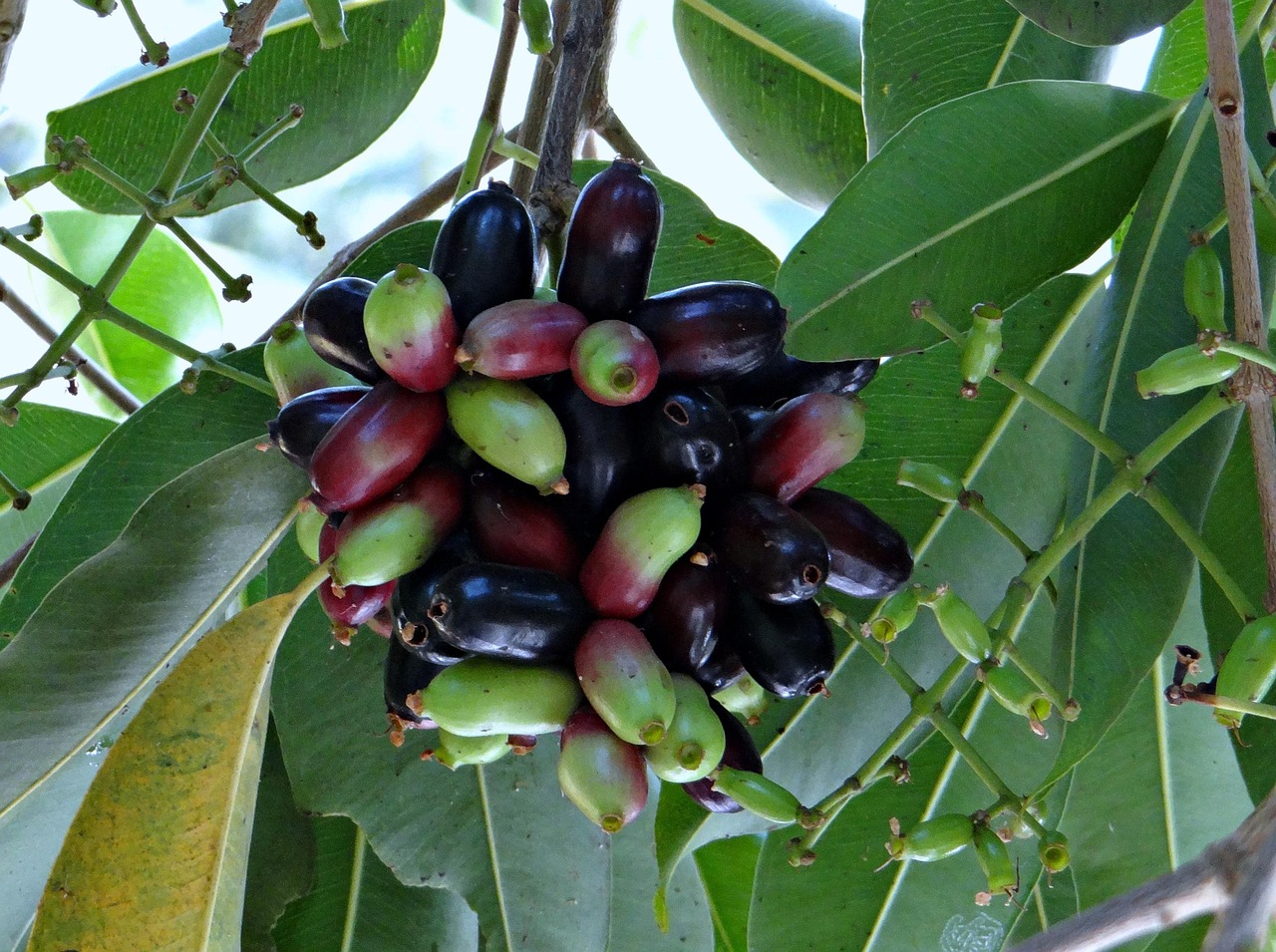
The fruit is a fleshy, indehiscent, berry-like drupe, oblong to ovoid or obovoid in shape, measuring 1.5–3.5 cm in length and 1–2 cm in diameter, with a smooth, thin skin. It matures from green through pink to deep purple or nearly black, with a soft, juicy, dark purple to dark crimson pulp that is astringent to subacid-sweet and stains the mouth and hands deeply. Each fruit typically contains a single large seed, though parthenocarpic seedless fruits and fruits with two or more seeds occasionally occur. The calyx limb is persistent at the apex of the mature fruit, forming a small disc-like scar.
Roots
Syzygium cumini develops a deep and extensive root system with a pronounced taproot in well-drained soils, supplemented by wide-spreading lateral roots that provide anchorage and resource acquisition across a broad soil volume. Surface root exposure is commonly observed in trees growing on eroded riverbank or slope sites, and the root system confers considerable stability and drought tolerance in established trees. The species is frequently planted for watershed protection and soil conservation in tropical reforestation programmes, reflecting the functional significance of its root architecture.
Growth Architecture & Life Strategy
Syzygium cumini is a Phanerophyte in the Raunkiær classification, a large, long-lived, evergreen tree with perennating buds well above ground level on persistent woody branches. Growth is moderately fast in the juvenile phase, with seedlings and young trees capable of height increments of 1–2 m per year under favourable conditions, slowing as the tree reaches its mature dimensions of 20–30 m. The crown is dense, broadly spreading to rounded, and casts a deep shade beneath mature specimens, limiting understorey development.
The species exhibits characteristics of a competitive long-lived pioneer to climax tree, capable of establishing on disturbed riverbank and forest-margin sites as well as persisting in mature closed-canopy forest. Its tolerance of periodic waterlogging in natural riparian habitats, combined with drought tolerance once established, reflects a broad hydraulic niche. Leaf production is continuous in aseasonal humid climates, while in drier or more seasonal environments a brief period of partial leaf drop and new flush may be associated with the dry season or a temperature minimum.
The architecture of mature trees is characterised by a densely branched crown in which the foliage extends close to ground level in open-grown specimens, while forest-grown trees develop a higher, more open crown on a clean bole. The species is a strong competitor for light in open to semi-open tropical conditions, and its capacity for prolific seed production and water dispersal makes it an effective coloniser of disturbed tropical habitats, contributing to its naturalised and invasive character in regions outside its native range.
Common Types / Varieties
Several named cultivars and selected types of Syzygium cumini have been developed primarily in India through the efforts of regional state agricultural universities and the Indian Council of Agricultural Research (ICAR), though the cultivar landscape is less formalised than for many commercial fruit trees.
‘Ra Jamun’ is a selection recognised in parts of Uttar Pradesh and Uttarakhand, noted for its larger fruit size and reduced astringency relative to wild-collected material, with fruits averaging 3–4 cm in length and a pulp-to-seed ratio higher than typical seedling trees. It is favoured for fresh-market consumption in northern India.
‘Narendra Jamun 6’ is a cultivar released by Narendra Dev University of Agriculture and Technology, Faizabad, selected for consistent heavy bearing, improved fruit size, and moderate astringency; it is used in both fresh-fruit and processed-product contexts and is recommended for commercial orchard planting in the Indo-Gangetic plains region.
‘Konkan Bahadoli’ is a selection from Maharashtra with a reputation for large, fleshy fruits with sweet-subacid pulp and a proportionally smaller seed than wild types; it is cultivated in the coastal Konkan belt and is regarded as one of the superior table-quality selections from western India.
Native Range & Distribution
| Country / Territory | Range Status | Notes |
|---|---|---|
| India | Native | Widespread across peninsular India, Indo-Gangetic plains, and northeastern states; most abundant in moist deciduous and riverine forest tracts |
| Sri Lanka | Native | Common in lowland wet and intermediate zones |
| Bangladesh | Native | Recorded in lowland alluvial and riparian habitats |
| Nepal | Native | Present in lowland Terai zone |
| Myanmar | Native | Recorded in central and coastal lowland regions |
| Thailand | Native | Distributed in moist lowland forests |
| Peninsular Malaysia | Native | Recorded in lowland forest margin and riparian habitats |
| Indonesia (Java) | Native | Present in lowland forest tracts |
| Indonesia (Sumatra) | Native | Recorded in lowland and riverine habitats |
| Indonesia (Borneo) | Native | Present in lowland forests |
| Philippines | Native | Recorded in lowland forest habitats across multiple islands |
| Australia (Queensland, New South Wales) | Naturalised; invasive concern | Listed as an environmental weed in Queensland; naturalised along watercourses in coastal subtropical regions |
| United States (Florida, Hawaii) | Naturalised | Widely naturalised in south Florida; established in Hawaii; reported as an invasive concern in both states |
| Caribbean (Jamaica, Puerto Rico, Trinidad) | Naturalised | Extensively naturalised following historical introduction; considered invasive in some islands |
| Fiji and Pacific Islands | Naturalised; invasive concern | Naturalised in multiple Pacific island groups following deliberate introduction; listed as invasive in Fiji |
| East Africa (Kenya, Tanzania) | Cultivated; naturalised locally | Planted extensively; locally naturalised near cultivation sites |
| Brazil and South America | Cultivated; naturalised locally | Widely cultivated in tropical Brazil; naturalised in some regions |
Distribution records derived from GBIF occurrence datasets and regional botanical surveys. Distribution maps for this species can be generated from GBIF occurrence data at gbif.org.
Habitat & Ecology
Syzygium cumini is broadly adapted to tropical and subtropical lowland habitats and occurs naturally across a wide range of vegetation types, from moist deciduous and semi-evergreen forests to riverine and gallery forest margins, coastal lowland rainforests, and transitional zones between forest and open scrub. In its native range it is particularly characteristic of riparian corridors and forest margins along seasonal and perennial watercourses, where it may be a dominant or co-dominant canopy species at lower elevations. It occurs from sea level to approximately 1800 m in some parts of its range, though it is most productive and abundant below 600 m.
The species tolerates a broad range of edaphic conditions, growing on alluvial loams, sandy loams, red lateritic soils, and black cotton soils, provided drainage is adequate. It tolerates seasonal waterlogging and brief inundation but does not persist under prolonged deep flooding. In parts of Southeast Asia and the Pacific, introduced populations have established in disturbed riparian habitats, roadsides, and secondary forest edges, where the combination of prolific fruiting, animal seed dispersal, and tolerance of varied soil types confers strong colonising ability.
In naturalised contexts outside its native range — particularly in Queensland, Florida, Hawaii, and Caribbean islands — Syzygium cumini establishes in disturbed and intact forest margins, riverine vegetation, and agricultural forest interfaces, where it can displace native vegetation through competitive canopy establishment and suppression of native understorey species. The ecological footprint in invasive contexts is amplified by its long-lived canopy persistence and high annual seed production dispersed by birds and bats over considerable distances.
Ecological Role
Syzygium cumini plays an important structural role as a canopy and sub-canopy tree in tropical riparian and moist deciduous forest ecosystems across its native range, providing shade, leaf litter inputs, and physical habitat for a diverse invertebrate and vertebrate community. The dense, persistent evergreen canopy moderates microclimate, reduces soil surface temperatures, and contributes substantially to organic matter cycling through high annual leaf litter production. The species is a recognised component of moist deciduous and riverine forest canopy in India, where it frequently co-occurs with Terminalia arjuna, Dalbergia sissoo, and Diospyros spp. in riparian assemblages.
Fruiting trees are of high ecological significance as a food source for frugivorous wildlife, with fruits consumed by a broad range of birds including mynas (Sturnidae), barbets (Megalaimidae), hornbills (Bucerotidae), and parakeets (Psittacidae), as well as fruit bats (Pteropodidae) and various terrestrial mammals including jackals, pigs, and monkeys across the native range. These frugivores act as seed dispersers, carrying seeds away from the parent tree and contributing to natural regeneration across the forest landscape.
The flowers attract a diverse assemblage of insect visitors including bees (Apidae), flies (Syrphidae), and various beetles (Coleoptera), and the species is recognised as an important nectar and pollen source for managed honeybee populations in India during the pre-monsoon flowering season. In riparian settings the root system contributes to soil stabilisation and bank reinforcement, limiting erosion during monsoon flood events.
Recommended Products
Disclosure: As an Amazon Associate, PlantsInfo may earn from qualifying purchases.
🌱 Plant Care Essentials
The following tools can help with pruning, plant health, soil management, and fruit garden maintenance.

Neem Oil for Plant Care
Natural plant protection against aphids, whiteflies, mites, and other common garden pests.

Fungicide for Root Care
Helps suppress soil-borne fungal diseases and supports healthier root systems.

Spray Bottle for Plants
Ideal for applying foliar sprays, neem oil solutions, and liquid plant treatments.

Rubber Hand Gloves
Protects hands during pruning, planting, soil preparation, and garden maintenance.
Functional Traits
| Trait | Value |
|---|---|
| Growth Form | Single-stemmed evergreen tree; dense spreading crown |
| Leaf Type | Simple; opposite; coriaceous; elliptic to oblong; aromatic |
| Photosynthetic Pathway | C3 |
| Seed Type | Recalcitrant |
| Rooting Depth | Deep taproot with wide lateral spread |
| Wood Density | Approximately 0.70–0.85 g/cm³ |
Phenological Calendar
| Event | Tropical & Subtropical Regions | Regional Qualifiers & Seasonal Deviations |
|---|---|---|
| Leaf Flush | Year-round in aseasonal humid climates; brief flush associated with dry season break | In drier deciduous-edge habitats of peninsular India, flush concentrated March–April |
| Primary Flowering Onset | March–April (dry season to pre-monsoon transition) | Delayed to April–May in higher-elevation or drier sites; January–February in Sri Lanka wet zone |
| Peak Flowering | April–May | March–April in coastal lowland Sri Lanka and southern peninsular India |
| Secondary Flowering | May–June (minor, where documented) | Not consistently documented across the native range |
| Fruit Development | May–July (6–8 weeks post-pollination) | Extends to August in northeastern India and higher-elevation plantings |
| Fruit Maturity | June–August (monsoon season) | July–September in Bangladesh and northeastern India; May–June in Sri Lanka |
| Seed Dispersal | June–September | Facilitated by monsoon rainfall and frugivore activity; coincides with peak bird and bat foraging activity |
| Dormancy or Rest Period | None documented in aseasonal humid tropics; brief vegetative rest in strongly seasonal drier climates | Short dry-season rest period in peninsular India and semi-arid zones |
Flowering onset in Syzygium cumini is closely associated with the transition from the cool dry season to the hot pre-monsoon period, with rising temperatures and lengthening photoperiod appearing to act as primary triggers, though detailed experimental documentation of the precise physiological cues remains limited.
Reproductive Biology
Syzygium cumini reproduces primarily by seed, producing large quantities of fleshy fruits annually once trees reach fruiting age, typically 6–10 years from seed in orchard conditions and somewhat later in natural forest settings. The flowers are bisexual (hermaphrodite), white to pale pinkish, and pleasantly fragrant, attracting diverse insect pollinators during the pre-monsoon flowering season. Both cross-pollination and self-pollination are possible, though cross-pollination is considered to produce higher fruit set in most populations.
The large, fleshy fruits are consumed by a wide range of frugivorous birds and mammals, and seed dispersal is primarily endozoochorous, with seeds deposited in faeces at distances from the parent tree. Seeds are recalcitrant and have very short viability under ambient conditions — typically 2–4 weeks after removal from the fruit pulp — and must be sown promptly after fruit collection for successful germination. The combination of prolific fruiting, attractive fleshy fruit, and effective endozoochorous dispersal underpins the species’ capacity for rapid naturalisation in tropical regions beyond its native range.
Pollination Ecology
| Field | Information |
|---|---|
| Pollination Mechanism | Insect |
| Primary Pollinator Groups | Bees (Apidae); flies (Syrphidae); beetles (Coleoptera); wasps (Vespidae) |
| Pollination Syndrome | Entomophily |
| Floral Reward | Nectar and pollen |
Seed Biology & Germination Ecology
| Field | Information |
|---|---|
| Seed Type | Recalcitrant |
| Seed Viability Period | 2–4 weeks under ambient conditions after removal from pulp; viability declines rapidly on desiccation |
| Dormancy Type | None documented |
| Dormancy Breaking Mechanism | None documented; seeds germinate readily without pretreatment when sown fresh |
| Germination Temperature Range | 25–35 °C (77–95 °F) |
| Light Requirement for Germination | Not documented in available literature |
| Seed Bank Classification | Transient |
| Dispersal Unit | Whole fruit; endozoochorous via birds (Sturnidae, Bucerotidae, Psittacidae) and fruit bats (Pteropodidae); secondary hydrochory in riparian habitats |
Seeds of Syzygium cumini are strongly recalcitrant and cannot be dried, chilled, or stored under conventional seed-storage conditions without rapid loss of viability; they must be sown within days to a few weeks of extraction from the fruit pulp to achieve acceptable germination rates. This recalcitrant character is fully consistent with the species’ frugivore-dispersal ecology, in which seeds pass rapidly from fruit to soil via animal gut transit rather than entering a persistent soil seed bank.
Vegetative Regeneration & Clonal Biology
| Field | Information |
|---|---|
| Vegetative Regeneration Capacity | Low to moderate |
| Primary Regeneration Mechanism | Stump and root-collar sprouting following cutting or disturbance |
| Tissue Types Capable of Regeneration | Stump; root collar; basal stem tissue |
| Apomixis Status | Not documented in available literature |
| Bulbil or Propagule Production | Absent |
| Layering Capacity | Documented under nursery conditions; air-layering used in propagation practice |
| Root Sprouting from Fragments | Not documented in available literature |
| Clonal Spread Rate | Negligible under undisturbed conditions |
| Coppicing Response | Moderate coppicing response documented; sprouting from stump recorded following felling |
| Ecological or Invasive Significance of Clonal Biology | Low; spread in naturalised contexts is seed-driven, not clonal |
Vegetative regeneration in Syzygium cumini is of minor ecological significance relative to seed-based regeneration, which is the primary mechanism by which the species expands into new habitats both within and beyond its native range.
Soil Ecology & Rhizosphere Interactions
| Field | Information |
|---|---|
| Mycorrhizal Association Type | AM (arbuscular mycorrhizal) |
| Documented Fungal Partners | Not documented to species level in available literature |
| Nitrogen Fixation | Absent |
| Allelopathic Properties | Not documented in available literature |
| Documented Allelopathic Targets | Not documented in available literature |
| Rhizosphere pH Modification | Not documented in available literature |
| Root Exudate Compounds | Not documented in available literature |
| Soil Microbiome Influence | Not documented in available literature |
Biochemical Profile
| Compound Class | Compounds Documented | Primary Location in Plant | Ecological Function |
|---|---|---|---|
| Tannins | Ellagic acid; gallic acid; corilagin; 3,6-di-O-galloyl-glucose; 1,2,4,6-tetra-O-galloyl-β-D-glucose | Bark, seeds, fruit pulp | Herbivore deterrence; antimicrobial defence in plant tissues |
| Anthocyanins | Delphinidin-3-glucoside; petunidin-3-glucoside; malvidin-3-glucoside; cyanidin-3-glucoside | Fruit skin and pulp | Pollinator and frugivore attraction; UV photoprotection |
| Triterpenoids | Oleanolic acid; ursolic acid; betulinic acid; β-sitosterol | Bark, leaves, seeds | Herbivore deterrence |
| Flavonoids | Myricetin; quercetin; kaempferol; isorhamnetin | Leaves, bark, fruit | UV photoprotection; herbivore deterrence |
| Alkaloids | Jambosine; jamboline | Seeds | Herbivore deterrence |
| Volatile oils | Eugenol; α-terpineol; caryophyllene | Leaves, bark | Herbivore deterrence; antimicrobial defence in plant tissues |
| Phenolic acids | Caffeic acid; chlorogenic acid; ferulic acid | Fruit pulp, leaves | Herbivore deterrence |
Research Coverage
| Field | Information |
|---|---|
| Research Coverage Level | High |
| Primary Research Fields | Phytochemistry; fruit biochemistry; seed storage biology; ethnobotany; invasive ecology; agroforestry |
| Earliest Published Study | Early botanical documentation by Linnaeus (1753) and Lamarck (1789); modern phytochemical research from the 1950s onward |
| Most Active Research Regions | India (Uttar Pradesh, Maharashtra, Tamil Nadu); Sri Lanka; Brazil; Australia (invasive ecology) |
| Key Knowledge Gaps | Mycorrhizal partner identity; full root exudate characterisation; population genetic structure across native range; detailed climate vulnerability modelling; precise physiological triggers for flowering onset |
Phytochemical Organ Distribution
| Plant Organ | Compound Class | Compounds Documented | Source |
|---|---|---|---|
| Bark | Tannins | Ellagic acid; gallic acid; corilagin | Bhatia & Bajaj, 1975 |
| Bark | Triterpenoids | Oleanolic acid; β-sitosterol | Harborne, J.B. & Baxter, H., 1993 |
| Leaves | Flavonoids | Myricetin; quercetin; kaempferol | Mahmoud et al., 2001 |
| Leaves | Volatile oils | Eugenol; α-terpineol; caryophyllene | Harborne, J.B. & Baxter, H., 1993 |
| Fruit skin | Anthocyanins | Delphinidin-3-glucoside; petunidin-3-glucoside; malvidin-3-glucoside; cyanidin-3-glucoside | Bhatia & Bajaj, 1975 |
| Fruit pulp | Phenolic acids | Caffeic acid; chlorogenic acid; ferulic acid | Harborne, J.B. & Baxter, H., 1993 |
| Seeds | Alkaloids | Jambosine; jamboline | Harborne, J.B. & Baxter, H., 1993 |
| Seeds | Tannins | 3,6-di-O-galloyl-glucose; 1,2,4,6-tetra-O-galloyl-β-D-glucose | Bhatia & Bajaj, 1975 |
The fruit skin and seed fractions are the most extensively documented organs for phytochemical characterisation in Syzygium cumini, with anthocyanins in the fruit skin and tannins and alkaloids in the seeds having received the greatest research attention in primary literature.
Nutritional Composition
| Nutrient | Value per 100 g Edible Portion | Source |
|---|---|---|
| Energy | 60 kcal (251 kJ) | USDA FoodData Central |
| Water | 83.1 g | USDA FoodData Central |
| Protein | 0.72 g | USDA FoodData Central |
| Total Fat | 0.23 g | USDA FoodData Central |
| Carbohydrates | 15.6 g | USDA FoodData Central |
| Dietary Fibre | 0.6 g | USDA FoodData Central |
Values represent fresh ripe fruit pulp (raw) at commercial harvest stage, skin included, as characterised in the USDA FoodData Central species-specific entry for jambolan.
Climate Adaptation & Stress Tolerance
Syzygium cumini is adapted to tropical and subtropical climates with mean annual temperatures of 20–38 °C (68–100 °F) and is tolerant of the hot, humid conditions characteristic of South and Southeast Asian monsoon climates. It grows optimally in areas receiving 750–2000 mm of mean annual rainfall with a defined dry season, but is also recorded in areas with higher rainfall up to 3000 mm, including coastal and subhumid tropical zones. The tree is not frost-tolerant and is generally restricted to climates where winter minimum temperatures remain above approximately 5 °C (41 °F), though very brief cold spells are occasionally survived by established trees.
Drought tolerance in established trees is substantial, conferred by the deep taproot system that accesses subsoil moisture through the dry season. Young trees and nursery seedlings are considerably more sensitive to water stress and require irrigation during the dry season until the root system is well established. The species also tolerates seasonal waterlogging, a reflection of its natural riparian habitat associations, though prolonged deep inundation is detrimental.
Climate Vulnerability & Range Dynamics
| Field | Information |
|---|---|
| IUCN Climate Vulnerability Assessment | Not Evaluated |
| Primary Climate Sensitivity Factors | Monsoon rainfall seasonality; dry-season duration and intensity; minimum temperature limits at range margins |
| Projected Range Shift Direction | Not documented in available literature |
| Projected Range Shift Magnitude | Not documented in available literature |
| Key Threatening Processes | Agricultural land clearance; riparian habitat degradation; overexploitation of bark and timber in natural stands; invasive spread pressure in non-native range |
| Resilience Factors | Deep rooting; drought tolerance of established trees; recalcitrant seed biology enables rapid germination; broad edaphic tolerance; prolific fruiting |
| Published Modelling Studies | No study identified |
| Confidence Level | Low |
Cytogenetics
| Field | Information |
|---|---|
| Chromosome Number (2n) | 22 |
| Ploidy Level | Diploid |
| Genome Size (1C value) | Not documented in available literature |
| Karyotype Notes | Karyotype comprises 11 pairs of chromosomes; detailed molecular karyotype characterisation is limited in published literature |
| Source | Darlington, C.D. & Wylie, A.P., 1955 |
Cultivation Requirements
| Field | Information |
|---|---|
| Light Requirements | Full sun; intolerant of dense shade during establishment; tolerates partial shade as a mature tree |
| Watering | Moderate to high during establishment; drought-tolerant once established; tolerates seasonal waterlogging |
| Soil Type | Alluvial loams, sandy loams, lateritic soils, black cotton soils; performs best in deep, well-drained to moderately drained soils with adequate moisture retention |
| Soil pH | 5.5–8.0 |
| Humidity | Moderate to high; tolerates lower humidity when deep root access to soil moisture is established |
| Temperature Range | 15–45 °C (59–113 °F); optimal growth and fruiting 25–35 °C (77–95 °F) |
| USDA Hardiness Zone | 10–12 |
| Fertilization | Responds to balanced NPK fertilisation during nursery and early establishment phases; established trees on fertile alluvial soils require minimal supplemental nutrition |
| Container Suitability | Suitable for large containers as nursery stock; not suitable for long-term container culture given eventual stature and root mass |
Propagation Methods
Syzygium cumini is most commonly propagated by seed, which must be sown fresh — within one to two weeks of fruit collection — as the seeds are strongly recalcitrant and lose viability rapidly on desiccation or storage; germination in moist substrate at 25–35 °C (77–95 °F) typically occurs within 10–15 days of sowing. Vegetative propagation is employed where cultivar trueness-to-type is required, using air-layering (gootee/marcotting), budding, or veneer grafting onto seedling rootstocks — air-layering in particular produces well-rooted plants within 30–45 days under humid conditions and is widely used in Indian commercial nurseries. Stem cuttings under mist with rooting hormone application have been used with moderate success for selected cultivars, though establishment rates are lower and more variable than air-layering, making cuttings a secondary method in most propagation programmes.
Pests & Diseases
| Issue | Notes |
|---|---|
| Fruit fly (Bactrocera spp.) | Larvae of tephritid fruit flies infest ripening fruit, causing internal necrosis; most severe during peak fruiting season under warm humid conditions |
| Leaf spot | Fungal lesions (associated with Pestalotiopsis spp. and related pathogens) produce irregular brown to grey spots on leaves; more prominent during monsoon season under high humidity |
| Bark borer | Cerambycid and buprestid beetle larvae cause galleries in bark and sapwood; associated with physical wounding or physiological stress in older trees |
| Sooty mould | Black fungal coating on leaf surfaces associated with honeydew-producing scale insects and aphids (Hemiptera); reduces photosynthetic efficiency under heavy infestations |
| Root rot | Associated with Phytophthora spp. and Fusarium spp.; observed in waterlogged or compacted soils with poor drainage |
Toxicity & Safety
| Field | Information |
|---|---|
| Humans | Ripe fruit pulp is consumed without documented systemic toxic effect; concentrated seed extracts contain tannins and alkaloids (jambosine, jamboline) associated with physiological activity at high doses; fresh fruit consumed in excess associated with gastric discomfort due to tannin content |
| Cats | Not documented in available literature |
| Dogs | Not documented in available literature |
| Toxic Compounds | Jambosine; jamboline (seeds); ellagic acid; gallic acid (bark, seeds) |
| Source | Not documented in available literature |
The edible portion — ripe fruit pulp — is consumed widely without documented systemic toxicity; the tannin and alkaloid load is concentrated primarily in the seed and bark fractions rather than in the pulp, and these tissues are not typically consumed as food.
Invasive Status
Syzygium cumini is documented as invasive or naturalised in multiple regions well outside its native South and Southeast Asian range. In Queensland, Australia, it is listed as a Class 3 environmental weed under the Biosecurity Act 2014 and has established along watercourses and in coastal subtropical forests where its prolific fruiting and bird-mediated seed dispersal enable rapid expansion. In Florida and Hawaii (United States) it is naturalised and considered an invasive concern, with established populations in riparian and disturbed habitats that compete with native vegetation.
In the Caribbean — particularly Jamaica, Puerto Rico, and Trinidad and Tobago — the species has naturalised extensively following historical introduction, and is considered an environmental weed in some island ecosystems. It has also been recorded as naturalised in Fiji and other Pacific Island groups where it was introduced as a fruit tree, and is listed on invasive species monitoring registers in those jurisdictions. Its invasive character is driven by high fruit production, broad frugivore dispersal networks, tolerance of diverse soil and moisture conditions, and competitive canopy establishment.
Conservation Status
| Field | Information |
|---|---|
| IUCN Red List Status | Not Evaluated |
| Assessment Year | Not applicable |
| Population Trend | Not assessed |
| Source | IUCN Red List of Threatened Species — https://www.iucnredlist.org (Accessed: 2026-03-17). |
Economic Importance
Syzygium cumini is economically significant as a fruit crop, timber species, and multipurpose agroforestry tree across its native range. The fruit is an important commercial and subsistence crop throughout India, sold fresh in urban and rural markets during the monsoon season (June–August), and processed into juices, vinegar, squash, and fermented products on a smaller artisanal scale. National fruit production data for jambul in India are not systematically disaggregated from other minor fruits in government statistics, but the crop is commercially significant at the regional level, particularly in Uttar Pradesh, Maharashtra, Gujarat, and Tamil Nadu.
The timber is hard, heavy, and moderately durable, used in rural construction, agricultural implements, boat-building, and railway sleepers in parts of South Asia. The bark is an established source of industrial tannin and is harvested from plantation-grown and natural trees in India and Sri Lanka. The species is also planted for shade, windbreaks, soil conservation, and watershed protection in agroforestry and social forestry programmes across tropical South and Southeast Asia, and serves as an important honey plant for beekeeping in the pre-monsoon flowering season. In Brazil, where it was introduced as a fruit tree, a commercial jambolão (black plum) product market exists in the northeastern and southern states.
Ethnobotanical Uses
Syzygium cumini holds one of the most extensive ethnobotanical records of any South Asian fruit tree, with documented traditional uses of the bark, seeds, fruit, and leaves across Ayurvedic, Siddha, Unani, and diverse regional folk medicine traditions throughout India, Sri Lanka, Bangladesh, and Nepal. The bark is described in Ayurvedic texts as an astringent material used in traditional preparations, and its tannin-rich character provides the biochemical basis for this astringent activity. The seeds similarly carry a substantial record of traditional use, associated with their alkaloid and tannin content.
Beyond the Indian subcontinent, the species carries documented ethnobotanical uses in Southeast Asian traditional systems, including among communities in the Philippines, Indonesia, and Malaysia, where different plant parts have been used in a range of traditional preparations. In Brazil and the Caribbean, communities of South Asian descent have maintained traditional uses of the introduced plant, and local communities have also developed indigenous uses of the naturalised populations.
The wood has been used in traditional boat-building, carpentry, and structural applications throughout the native range, while the bark has been employed in tanning hides and as a source of natural dye for textile colouring in parts of South Asia. The flowers are recognised in some communities as a bee-forage resource of value for honey production. More information on documented ethnobotanical uses of South Asian Myrtaceae can be found at plantsinfo.in/plant-database/syzygium.
Cultural & Traditional Context
Syzygium cumini occupies a distinctive position in South Asian cultural tradition, associated through its Sanskrit name Jambu with a foundational cosmological concept in Hindu and Jain geography: the mythological continent Jambudvipa — the “Island of the Jambu Tree” — is named for the species, reflecting the tree’s prominence and cultural resonance in ancient South Asian thought. This cosmological association gives the species one of the oldest and most deeply embedded relationships between a fruit tree and a major religious-geographical concept in the world’s botanical and cultural history.
The tree is associated with several Hindu festivals and ritual contexts, and its fruit season coincides with the monsoon period, which carries its own cultural and agricultural significance across the subcontinent. In some regional traditions the tree is planted near temples and considered auspicious, and the deep purple staining of the mouth and hands by the fruit juice is associated in folk tradition with authenticity of the monsoon season’s arrival.
Across Sri Lanka, the tree is culturally familiar as Madan in Sinhala usage and is integrated into village kitchen garden and home orchard traditions. In the South Asian diaspora communities of the Caribbean and Fiji, the jamun tree has been maintained as a cultural plant linking migrant communities to their subcontinental heritage, demonstrating a capacity for cultural persistence through transplantation alongside the biological naturalisation of the species in new environments.
Interesting Facts
Syzygium cumini gives its name — via its Sanskrit designation Jambu — to Jambudvipa, the ancient Hindu and Jain cosmological name for the continent of Asia or the known world, making it one of the few plant species whose common name is embedded in a major world religious geography.
The fruit is one of the most intense natural sources of anthocyanin pigments among tropical fruits, with the deep purple-black fruit skin and pulp leaving a characteristic persistent stain on skin, teeth, and textiles that requires considerable washing to remove.
The seeds of Syzygium cumini are strongly recalcitrant and cannot survive conventional seed bank storage — they lose all viability within 2–4 weeks of being separated from the fruit pulp, making them one of the more challenging large-fruited tropical tree species to work with in ex-situ conservation and seed banking contexts.
The species is a significant honey plant throughout India, with the profuse pre-monsoon flowering producing nectar that supports managed honeybee (Apis spp.) colonies and contributes to a distinctive monofloral honey product in some states.
Syzygium cumini has naturalised on at least four separate continents — Asia (as native), Australia, the Americas, and Africa — making it one of a relatively small group of tropical trees with documented invasive or naturalised populations across multiple continental regions, reflecting the combination of prolific fruiting, attractive fleshy fruit, and broad ecological tolerance that characterises effective tropical tree colonisers.
FAQs
How large does Syzygium cumini grow, and how long until it fruits? Syzygium cumini is a large evergreen tree, commonly reaching 20–30 m in height at maturity with a broadly spreading crown and trunk diameters of 60–90 cm in old specimens. Trees grown from seed in orchard conditions typically begin fruiting at 6–10 years of age, while vegetatively propagated trees (air-layered or grafted) may fruit within 3–5 years. Growth rate is moderately fast in the juvenile phase under adequate moisture and full sun.
Why do jamun seeds lose viability so quickly? The seeds of Syzygium cumini are recalcitrant, meaning they are physiologically adapted for immediate germination following dispersal rather than for prolonged dormancy or desiccation survival. This is a common trait in tropical fruit trees whose seeds are dispersed by frugivorous animals via gut transit: the seed is adapted to germinate rapidly in the moist soil conditions it encounters after deposition, not to persist in a dry seed bank. As a result, seeds removed from the fruit pulp must be sown within one to two weeks or viability will be lost, making conventional long-term seed storage impossible for this species without specialised recalcitrant seed storage protocols.
Is Syzygium cumini considered invasive anywhere? Yes — the species is documented as invasive or naturalised in multiple regions outside its native South and Southeast Asian range, including Queensland (Australia), Florida and Hawaii (United States), Jamaica, Puerto Rico, Trinidad, and Fiji. In Queensland it is listed under biosecurity legislation as an environmental weed, with naturalised populations establishing along watercourses and in coastal forest margins. The combination of prolific fruiting, bird-mediated seed dispersal, and broad ecological tolerance drives its establishment in disturbed and intact tropical habitats in these regions.
What gives jamun fruit its characteristic dark purple colour and staining property? The deep purple to blackish colour of Syzygium cumini fruits is caused by a high concentration of anthocyanin pigments in the fruit skin and pulp, principally delphinidin-3-glucoside, petunidin-3-glucoside, and malvidin-3-glucoside. These anthocyanins are water-soluble and bind readily to proteins in skin and textile fibres, producing a persistent stain that is difficult to remove. The intense pigmentation functions ecologically as a visual signal to attract frugivorous birds and bats, which are the primary seed dispersers for the species.
What type of soil and climate does Syzygium cumini require for cultivation? Syzygium cumini is highly adaptable and grows across a wide range of soil types including alluvial loams, sandy loams, lateritic soils, and black cotton soils, provided drainage is not severely impeded, with a soil pH tolerance of approximately 5.5–8.0. The species performs best in tropical and subtropical climates with mean annual temperatures of 20–38 °C (68–100 °F), moderate to high rainfall of 750–2000 mm, and a defined dry season. Established trees tolerate considerable drought through deep root access to subsoil moisture, but young trees require regular irrigation during the dry season until the root system is fully developed.
Conclusion
Syzygium cumini is among the most ecologically versatile and culturally embedded fruit trees of the tropical world, combining a large native distribution across South and Southeast Asia with an exceptionally wide naturalised range on multiple continents, a rich and well-documented phytochemical profile centred on anthocyanins, tannins, and alkaloids, and one of the most ancient and significant cultural associations of any cultivated fruit species. Its ecological function as a keystone frugivore food source in native riparian and moist deciduous forests, combined with its documented roles in soil stabilisation, pollinator support, and canopy provision, make it a species of considerable conservation and restoration value within its native range.
The species’ recalcitrant seed biology presents practical challenges for ex-situ conservation and controlled seed bank storage, and the absence of formal IUCN evaluation means that population trends in natural stands — which face ongoing pressure from riparian habitat clearance, bark overexploitation, and agricultural encroachment — remain poorly documented at a species level. The extensive naturalised and invasive populations in Australia, the Americas, and the Pacific present a counterpoint to any conservation concern in the native range, but the ecological distinctiveness of native-range genotypes and the ecological disruption caused by invasive populations in receiving regions represent separate management considerations.
Research coverage of Syzygium cumini remains strong in phytochemistry and ethnobotany but comparatively limited in formal ecology, population genetics, and climate vulnerability assessment, and these represent priority areas for future investigation as the species’ native riparian habitats experience accelerating modification across South and Southeast Asia.
Common Cultivation Observations
| Observation | Associated Condition |
|---|---|
| Failure to germinate from stored seed | Associated with recalcitrant seed physiology; viability lost within weeks of fruit collection under ambient conditions |
| Deep purple staining on hands and tools during harvest | Normal consequence of high anthocyanin pigment concentration in fruit pulp and skin; intensified by fully ripe fruit |
| Sparse or absent fruiting in young seedling trees | Associated with juvenile phase length; seed-grown trees typically require 6–10 years to reach productive fruiting age |
| Yellowing of leaves during extended dry season | Associated with moisture stress in trees without access to deep subsoil water; more pronounced in young or shallow-rooted specimens |
| Bark peeling in irregular flakes on mature trunk | Normal exfoliating bark character of the species; exposes pale buff to yellowish inner surface beneath grey-brown outer bark |
Scientific Stability Note
Syzygium cumini has had a complex nomenclatural history reflecting the broader taxonomic instability of the large genus Syzygium and its relationship to the historically used genus Eugenia. The species was originally described by Linnaeus as Myrtus cumini in 1753 and was subsequently placed by Lamarck in Eugenia as Eugenia jambolana, under which name it was widely known in the botanical and pharmacognostic literature of the 19th and early 20th centuries. Skeels’ transfer to Syzygium as Syzygium cumini is now the accepted treatment, confirmed in Kew Plants of the World Online (POWO), but the synonym Eugenia jambolana remains widely encountered in older literature, ethnobotanical records, and some regional floras.
The broader reclassification of numerous Eugenia sensu lato species into Syzygium and related genera under modern phylogenetic treatments has affected many Myrtaceae, and researchers consulting older literature on this species should be aware that records under Eugenia jambolana, Eugenia cumini, and Syzygium jambolanum all refer to the same species. The currently accepted name Syzygium cumini (L.) Skeels is considered nomenclaturally stable and is used consistently in current taxonomic resources.
Reference Summary
A. Primary Taxonomic Sources
Kew Plants of the World Online (POWO) — https://powo.science.kew.org (Accessed: 2026-03-17). GBIF Backbone Taxonomy — https://www.gbif.org (Accessed: 2026-03-17).
B. Peer-Reviewed Literature
Bhatia, I.S. & Bajaj, K.L. (1975). Chemical constituents of the seeds and bark of Syzygium cumini. Planta Medica, 28(4), 346–352.
Mahmoud, I.I., Marzouk, M.S.A., Moharram, F.A., El-Gindi, M.R. & Hassan, A.M.K. (2001). Acylated flavonol glycosides from Eugenia jambolana leaves. Phytochemistry, 58(8), 1239–1244.
No fully verified peer-reviewed citation identified for Section B beyond the above entries at time of writing.
C. Monographs and Books
Harborne, J.B. & Baxter, H. (1993). Phytochemical Dictionary: A Handbook of Bioactive Compounds from Plants. Taylor & Francis, London.
Darlington, C.D. & Wylie, A.P. (1955). Chromosome Atlas of Flowering Plants. George Allen & Unwin, London.
D. Herbarium and Specimen Records
Royal Botanic Gardens Kew Herbarium (K) — specimens of Syzygium cumini held in the general collection. Natural History Museum London (BM) — digitised herbarium specimens accessible via the NHM Data Portal.
E. Grey Literature and Databases
IUCN Red List of Threatened Species — https://www.iucnredlist.org (Accessed: 2026-03-17). USDA FoodData Central — https://fdc.nal.usda.gov (Accessed: 2026-03-17). Queensland Government Biosecurity Act Invasive Plants Register — https://www.legislation.qld.gov.au (Accessed: 2026-03-17).