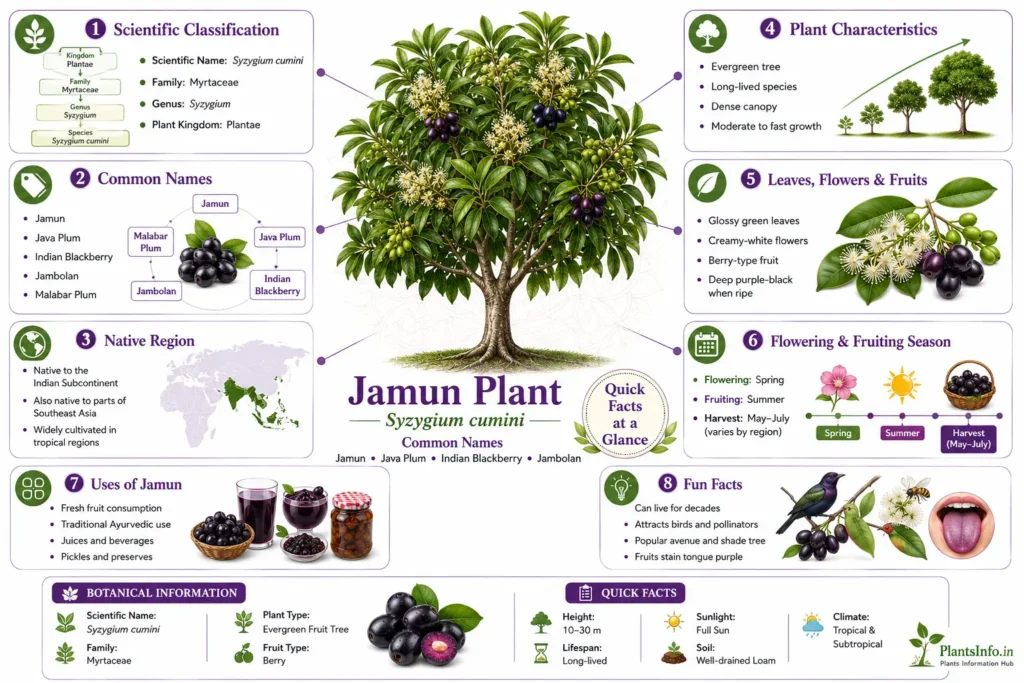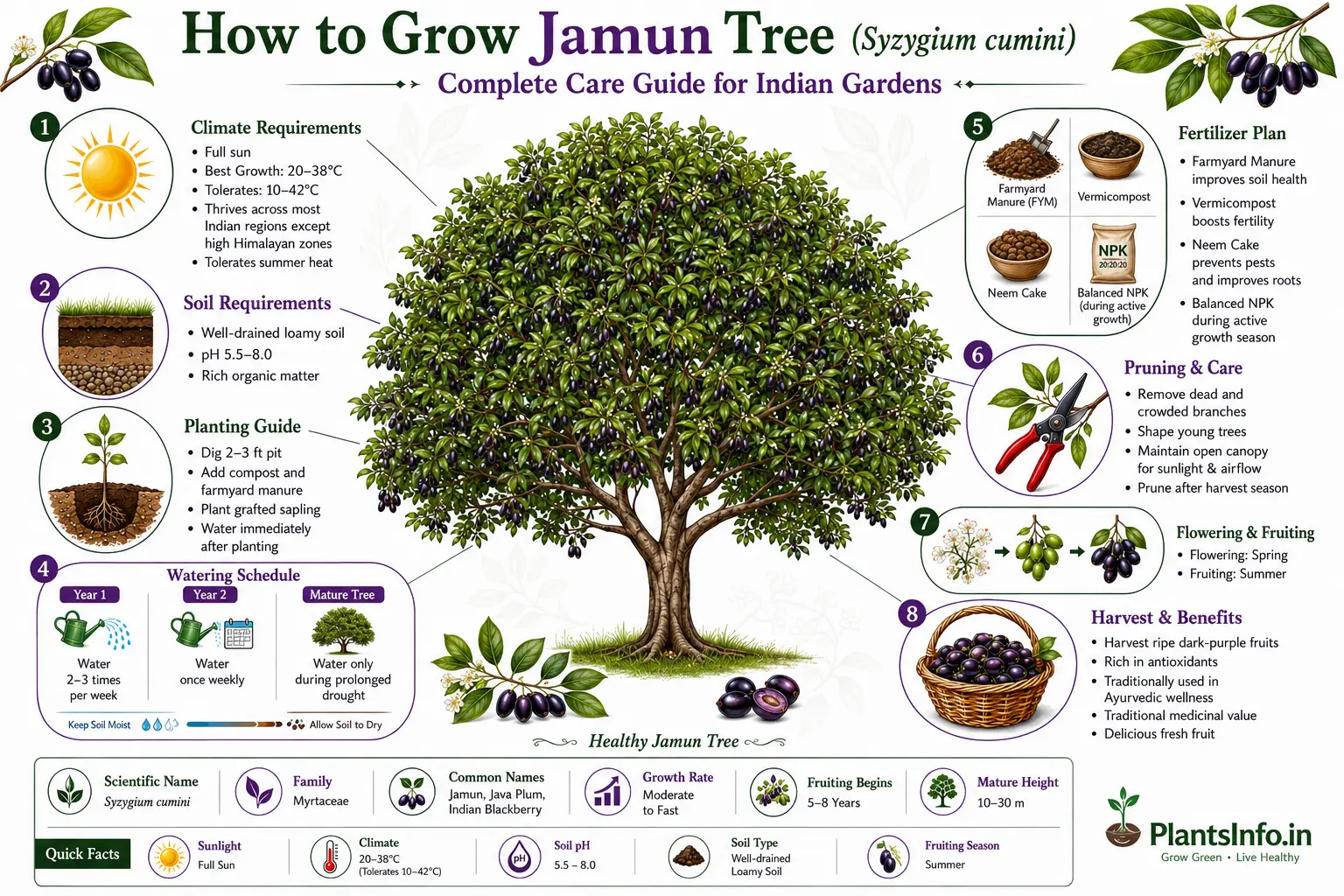
How to Grow Jamun Tree: Complete Care Guide for Indian Gardens
Quick Answer: Jamun (Syzygium cumini) is a hardy, low-maintenance fruit tree that grows well across most of India. It tolerates drought once established, needs full sun, and rewards patience — the first fruits typically arrive 7–8 years from seed, but grafted saplings can fruit in 3–4 years.
See also: Jamun plant profile, common problems, its flowering season, its benefits, and its varieties.
Bite into a ripe jamun, and your tongue turns purple — that stain is not a flaw, it is the plant’s identity. Indian gardeners grow jamun for its fruit, its dense shade, and the sheer reliability of a tree that asks for very little once it finds its footing. The one thing beginners consistently get wrong is expecting quick results from a seed-grown tree, then abandoning it too soon.
Recommended Products
Disclosure: As an Amazon Associate, PlantsInfo may earn from qualifying purchases.
🌱 Growing Essentials
The following products can help with container gardening, potting, root development, soil management, and healthy plant growth.
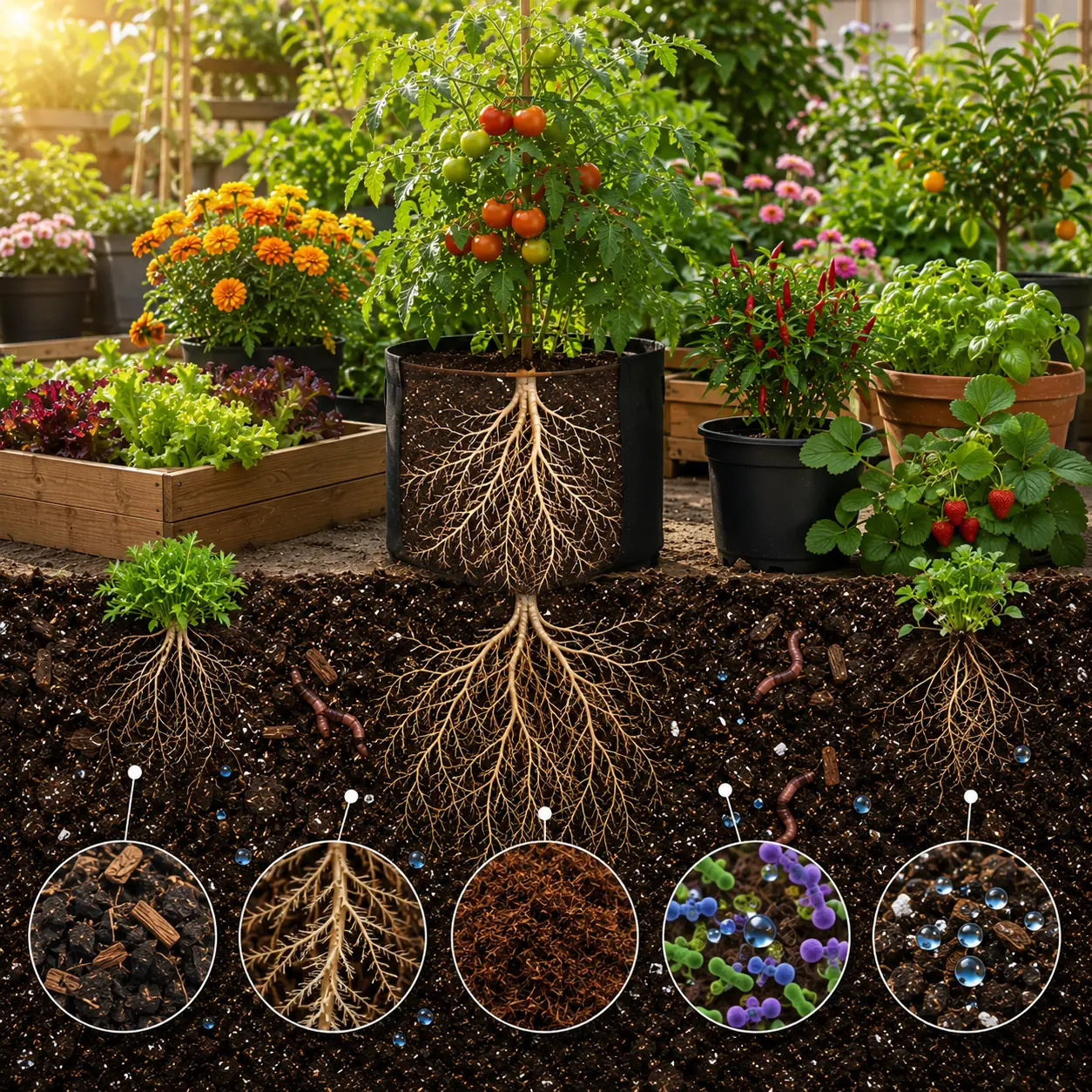
Organic Potting Soil Mix
Provides nutrients, structure, and healthy growing conditions for container plants.
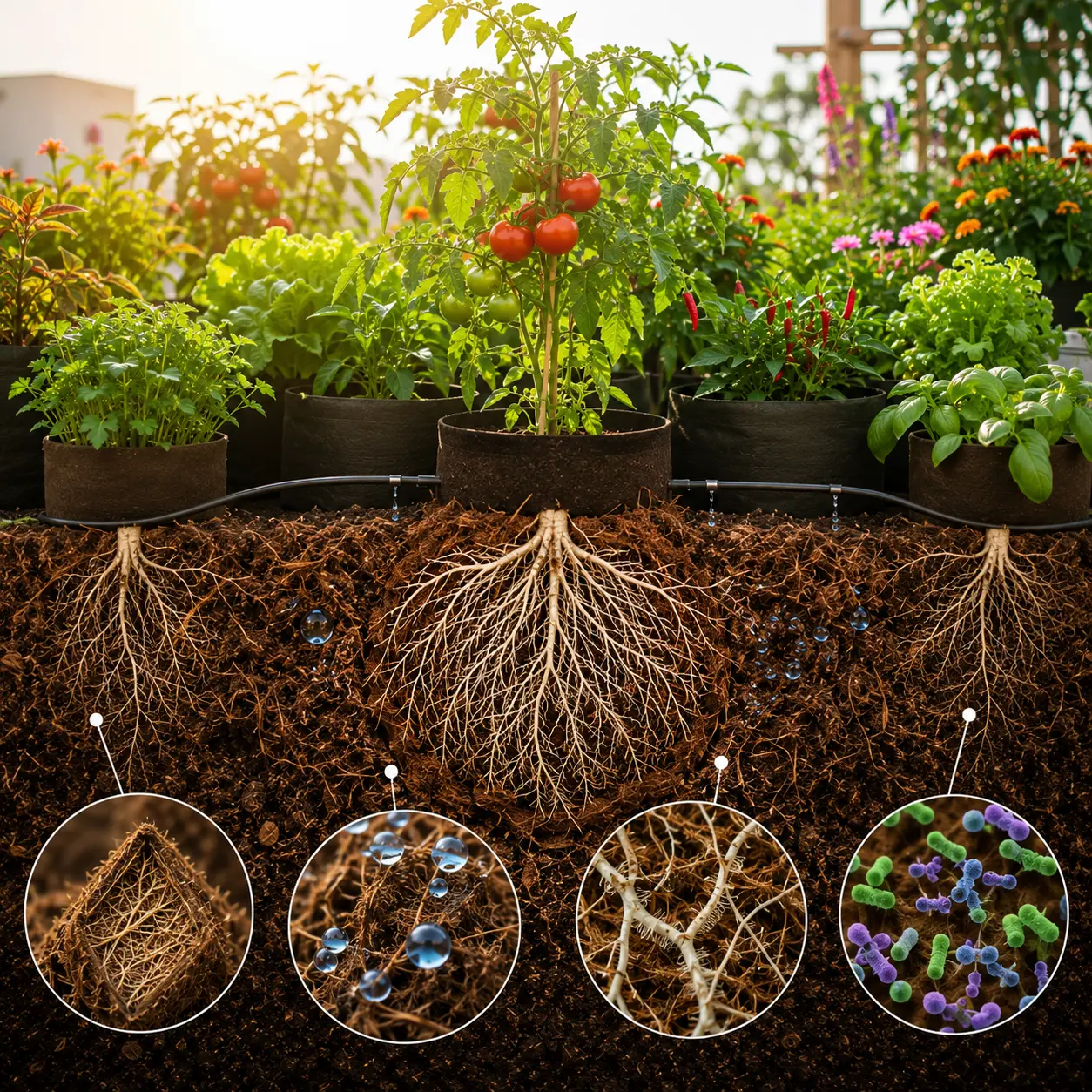
Coco Peat Growing Medium
Enhances moisture retention while maintaining excellent root-zone aeration.

Grow Bags for Plants
Improve drainage, root aeration, and vegetable production in limited spaces.

Plastic Pots for Plants
Ideal containers for seedlings, ornamentals, herbs, and balcony gardens.
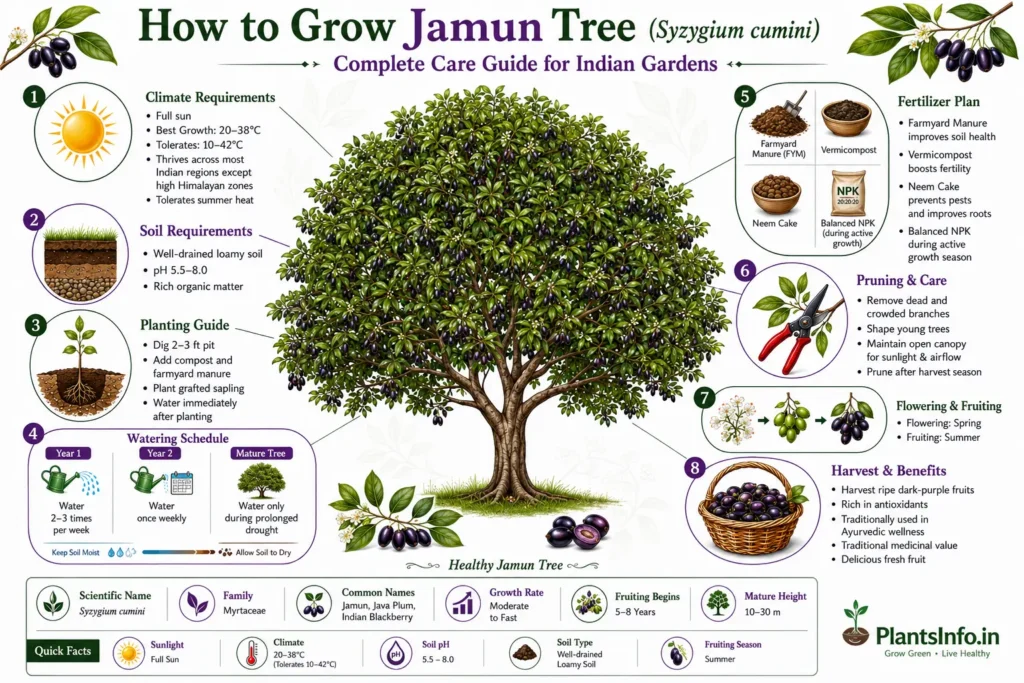
Difficulty level: Easy — once established. The first two years demand attention; after that, jamun largely looks after itself.
Quick Facts
| Attribute | Detail |
|---|---|
| Common names | Jamun, Java plum, Black plum, Jambul |
| Scientific name | Syzygium cumini |
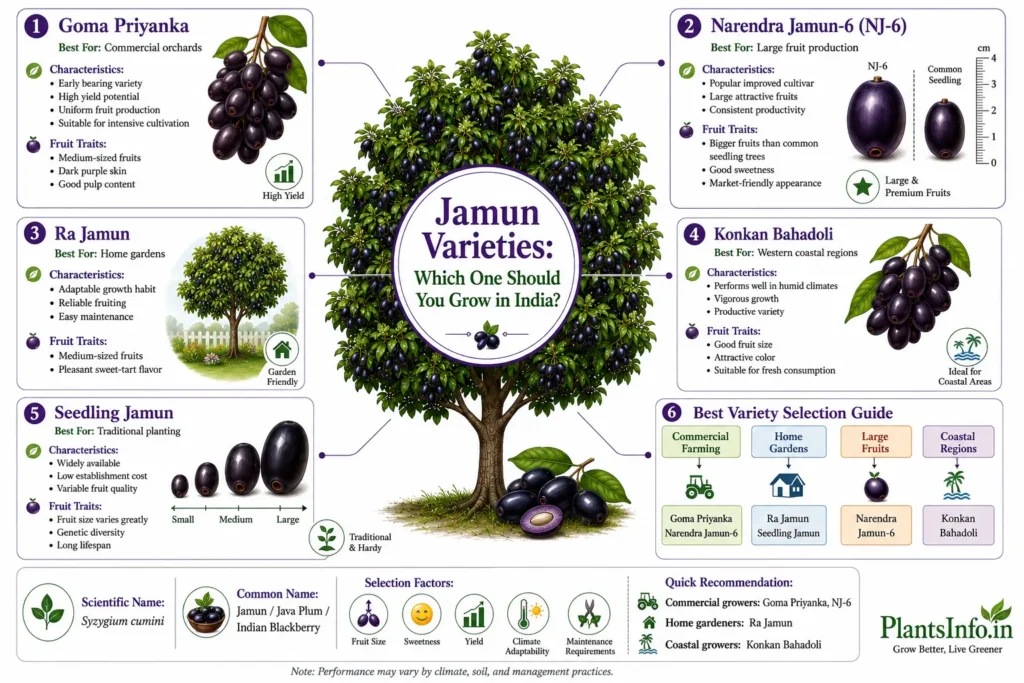
| Varieties | Raja Jamun, CISH Jamun-1, Narendra Jamun-6. See Varieties Guide for full comparison. |
| Plant type | Evergreen fruit tree |
| Mature size | 8–15 m in ground; contained to 2–3 m in large pots with pruning |
| Sunlight | Full sun — 6 hours minimum |
| Water needs | Moderate; drought-tolerant once established |
| Best season to plant | Monsoon onset (June–July) |
| Suitable states | All states; performs best in tropical and subtropical plains |
Choosing the Right Spot
Jamun is a sun-first tree. It needs a minimum of 6 hours of direct sunlight daily, and north-facing spots consistently underperform. In coastal states like Kerala, Karnataka, and Odisha, jamun grows with minimal care; in drier zones like Rajasthan and Gujarat, choose a location that receives afternoon shade in peak summer to protect young saplings.
Plant ground trees at least 8–10 metres from walls, foundations, and boundary walls — the root system is extensive, and the canopy becomes large. For urban plots with limited space, container growing is feasible but requires a pot of at least 24 inches and consistent pruning to manage size.
Container growing works better than most gardeners expect, but the tree will not reach fruiting size quickly in pots. Ground planting remains the more practical choice for anyone who wants fruit, not just foliage.
Soil and Potting Mix
Jamun is forgiving about soil type and performs well in loamy, sandy loam, and even clay-heavy soils. It tolerates slightly acidic to neutral conditions — a pH range of 5.5–7.5 is acceptable, with 6.0–7.0 being optimal. The one non-negotiable is drainage: waterlogged roots during monsoon are the most common cause of decline in young trees.
For garden soil planting, amend heavy clay with coarse river sand and well-rotted compost at a ratio of roughly 2:1:1 (soil:sand:compost) before planting. For containers, use a mix of 60% garden soil, 20% coarse sand, and 20% vermicompost.
The common mistake Indian gardeners make is planting jamun in low-lying spots that collect rainwater. Even one week of standing water at the root zone in the monsoon can set a young sapling back by months.
Planting — Season and Method
The best time to plant jamun is at monsoon onset — June to July. The rains reduce transplant stress, and the tree has the full monsoon season to establish before facing dry-weather conditions. A second window exists in February–March for warmer plains, but post-monsoon planting demands more frequent irrigation.
Grafted saplings are strongly preferred over seed-grown trees for home gardens. Seed-grown jamun can take 7–8 years to bear fruit; grafted trees fruit in 3–4 years. Reputable nurseries in Maharashtra, Uttar Pradesh, and Tamil Nadu commonly stock grafted saplings of improved varieties.
Dig a planting pit of 60 cm × 60 cm × 60 cm. Mix the excavated soil with two handfuls of neem cake and one bucket of well-rotted FYM (farmyard manure). Place the sapling so the graft union sits above soil level. Water thoroughly immediately after planting, then mulch the base with dry leaves or straw to retain moisture.
Watering
For the first 4–6 weeks after planting, water every 2–3 days if the monsoon is inconsistent. Young saplings need consistently moist (not wet) soil while roots are establishing. Once the sapling shows new leaf growth, reduce to once a week or rely on monsoon rains.
Mature jamun trees are drought-tolerant and need watering only from March to May — the driest months in most Indian plains. Two to three deep waterings per week in peak summer are sufficient. Stop supplementary watering once the monsoon arrives.
A specific sign of overwatering in jamun is yellowing that starts at the base of the leaf and moves toward the tip, combined with soft, mushy new growth at branch tips. This is distinct from the crisp brown leaf edges caused by dry heat. Adjust drainage before watering frequency during monsoon — adding more drainage holes to containers is often enough.
Fertiliser
Jamun is not a heavy feeder and responds well to organic inputs. For trees in the first two years, apply vermicompost (1–2 kg per tree) at the start of the monsoon and once more after the monsoon ends in October. Mustard cake (500 g, soaked overnight and applied as liquid) can be given in March to support pre-flowering growth.
For established fruiting trees (4 years and above), a balanced NPK fertiliser of 12:32:16 applied once before flowering (typically February–March) supports fruit set. Keep the application away from the trunk and water it thoroughly. Neem cake applied annually around the drip line serves double duty as a slow-release fertiliser and a mild pest deterrent.
An organic alternative that works well for jamun: decomposed banana peel and wood ash mixed into the soil around the drip line before monsoon onset provides potassium support at a critical growth stage.
Common Problems and Fixes
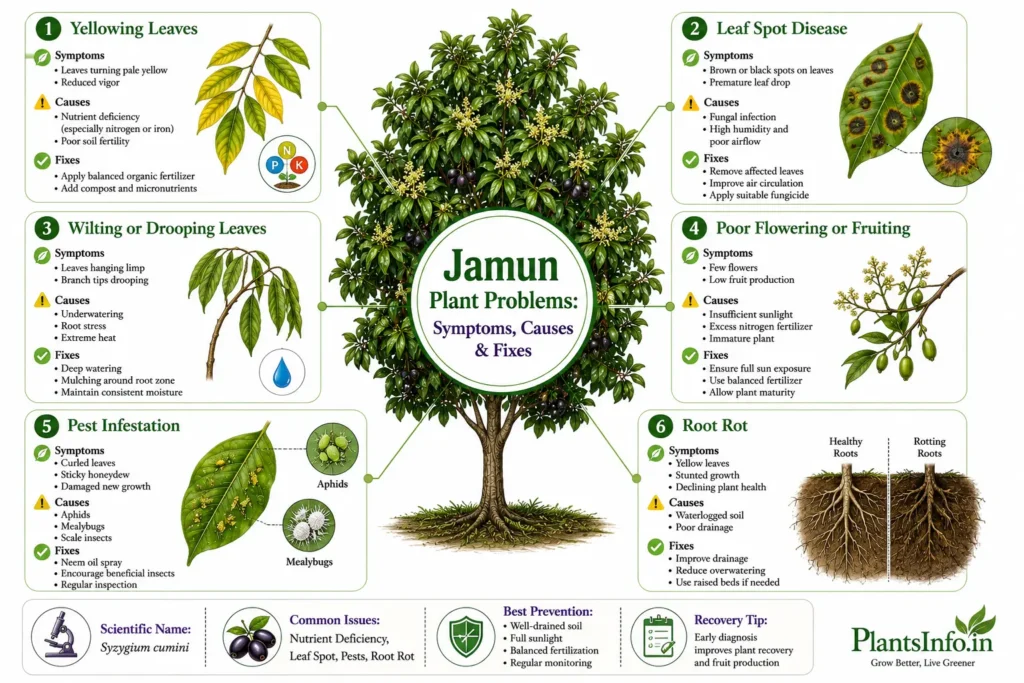
The three most common problems jamun growers encounter in India are:
Anthracnose — brownish-black lesions on leaves and young fruit, caused by the fungus Colletotrichum gloeosporioides. Most severe during humid monsoon months.
Fruit fly infestation — larvae inside ripening fruit, causing premature drop. A seasonal pest that peaks from May to August in most regions.
Leaf-eating caterpillars — skeletonised or partially eaten leaves in summer, most visible on young saplings.
For full diagnosis and treatment, see the Jamun Problems Guide.
When Will You See Results?
In year one, expect only vegetative growth — root establishment and canopy development. A healthy grafted sapling will gain 30–60 cm in height in its first full growing season with adequate monsoon rainfall.
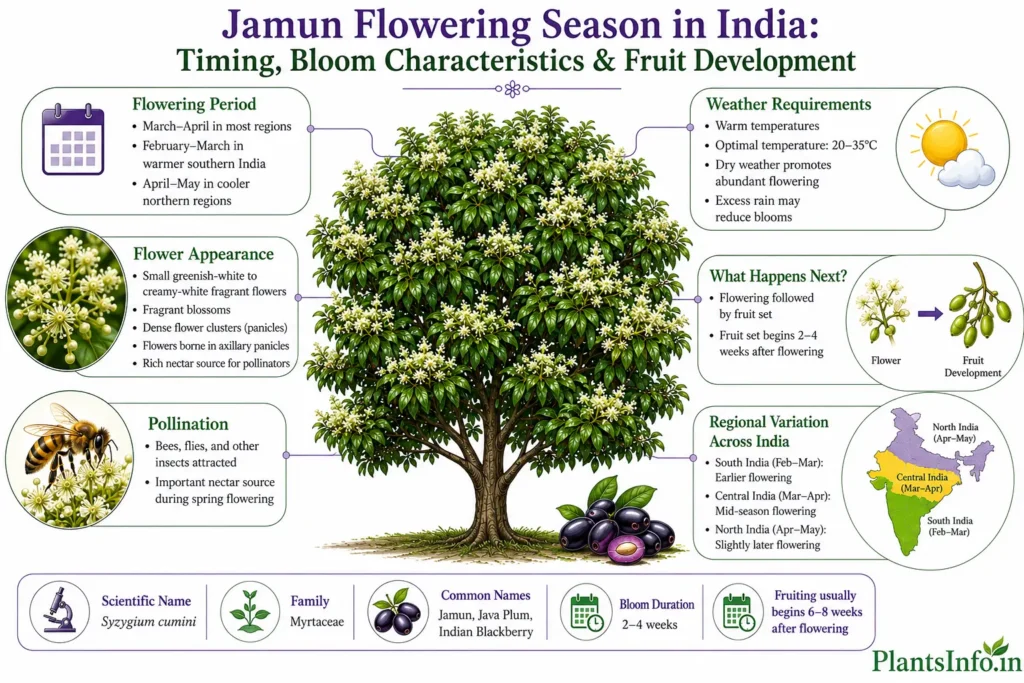
First flowers and fruit on grafted trees typically appear in year 3–4, arriving in spring (March–April as buds) and ripening through June–July. Seed-grown trees take significantly longer — 7–8 years is typical, sometimes more.
The patience note is worth stating plainly: jamun rewards the gardener who treats it as infrastructure, not a seasonal crop. Once it fruits, it fruits reliably for decades with minimal care.
Propagation
Jamun can be propagated by seed, stem cutting, grafting, or air layering. Seed propagation is the least practical option for a home gardener seeking fruit — the long juvenile period and genetic variability make it a poor choice for anything other than rootstock production.
Grafting (specifically tongue grafting or patch budding onto seedling rootstock) is the commercial standard and the most reliable method for home gardeners who want a known variety. Success rates are high when performed in February–March before new growth flushes. Air layering works for jamun but is slower to produce an independent plant than grafting.
The most practical approach for a home gardener in India: purchase a grafted sapling from a reliable nursery or a KVK (Krishi Vigyan Kendra) outlet rather than attempting propagation from scratch.
Pruning and Training
Prune jamun in October–November, after the fruiting season ends and before the winter rest period. Light pruning to remove dead wood, crossing branches, and branches growing toward the centre of the canopy is all that is needed for a healthy tree.
Do not prune heavily in summer — jamun responds to hard pruning in hot weather with stress dieback. For container-grown trees, a light trim in October controls size and encourages a bushier form.
Leave all primary scaffold branches intact. The tree’s natural shape is broadly spreading, and interfering with the main framework slows the return to fruiting.
Container Growing
A minimum pot size of 24 inches (60 cm) diameter with drainage holes is essential. Terracotta or grow bags work better than plastic containers — both regulate root temperature better in Indian summer heat. Repot when roots begin circling the base of the container or emerging from drainage holes, typically every 3–4 years.
Use a slightly richer mix for containers than for ground planting: 50% garden soil, 25% coarse sand, 25% vermicompost. Container trees need more frequent fertilisation than ground-planted trees — apply vermicompost every two months during the growing season.
The key limitation of container-grown jamun is that fruit yield will always be lower than that of a ground-planted tree, and the tree will need root pruning eventually to remain in the same container.
Harvesting
Ripe jamun fruit turns deep purple to almost black and comes away from the cluster with the lightest pull. The window between underripe (sour, astringent, firm) and overripe (very soft, fermenting) is short — typically 3–5 days per cluster. Harvest by hand into shallow trays; jamun bruises easily and should not be piled deep.
Fresh jamun stores at room temperature for 2–3 days and in the refrigerator for up to one week. For longer storage, jamun is commonly dried, made into vinegar, or processed into juice and squash.
The most productive harvest timing: check fruit daily once colour deepens. Birds and fruit bats are efficient competitors — a light net over accessible clusters is the simplest protection.
Seasonal Protection
Summer (April–June) is the most stressful period for young jamun trees in northern and central India. Mulch heavily (8–10 cm of dry straw or leaf litter around the base) to retain moisture and reduce soil temperature. Mature trees handle summer well independently.
Jamun has no meaningful cold sensitivity in Indian plains conditions — it withstands temperatures down to approximately 5°C without damage. At hill station elevations above 1,200–1,400 m, growth slows significantly, and fruiting becomes unreliable.
Monsoon risk for established trees is minimal in well-drained soil. The primary monsoon concern is fungal disease in humid coastal conditions — a preventive copper oxychloride spray before monsoon onset is common practice in Maharashtra and coastal Karnataka.
Key Takeaways
- Buy a grafted sapling, not a seed-grown tree — it cuts the wait to first fruit by 4–5 years.
- Drainage matters more than soil type — jamun tolerates most soils but not waterlogging.
- Plant at monsoon onset for the easiest establishment; the rains do most of the work.
- Fertilise lightly and organically — jamun is not a heavy feeder and responds well to vermicompost and neem cake.
- Once established, jamun is one of the most self-sufficient fruit trees in the Indian garden.
Plant your jamun now, and your grandchildren will still be eating from it.