Introduction
The Pansy Plant, scientifically known as Viola × wittrockiana, is a cultivated hybrid flowering plant widely recognized for its distinctive “face-like” blooms and broad range of colors. It belongs to the violet family, Violaceae, and represents one of the most familiar ornamental bedding plants in temperate regions. Developed through hybridization of several Viola species, the pansy has become a prominent feature in public landscapes, gardens, and horticultural displays.
Classification
- Plant Type
- Herb
- Leaf Habit
- Semi-evergreen
- Native Region
- Europe
- Plant Family
- Violaceae
Pansies are valued for their compact growth habit and extended flowering season in cooler climates. Their large, flat flowers and striking color combinations have made them a staple in seasonal plantings and ornamental horticulture. As a hybrid, Viola × wittrockiana reflects centuries of selective breeding aimed at enhancing flower size, color diversity, and form.
Today, pansies are cultivated globally and are associated with spring and autumn displays in many regions. They are also culturally symbolic in art and literature, where they have represented remembrance and thoughtfulness.
Quick Plant Information
| Field | Information |
|---|---|
| Common Name(s) | Pansy, Garden Pansy |
| Scientific Name | Viola × wittrockiana |
| Family | Violaceae |
| Plant Type | Herbaceous flowering plant |
| Lifespan | Short-lived perennial (often cultivated as annual or biennial) |
| Growth Habit / Growth Form | Low-growing, clump-forming |
| Native Range | Hybrid origin (derived from European Viola species) |
| Climate Adaptation / Habitat Type | Temperate regions; adapted to cool-season conditions |
| Leaf Type | Simple, broad leaves |
| Flower Color(s) | Purple, yellow, white, blue, red, orange, bi-colored, multi-colored |
| Fruit Type | Capsule |
| Evergreen / Deciduous | Semi-evergreen in mild climates |
Botanical Description
Viola × wittrockiana is a compact, herbaceous plant characterized by a basal rosette of leaves and upright flowering stems. The stems are slender, green, and slightly angular, emerging from a short central crown. The plant typically forms a rounded mound.
The leaves are simple, ovate to heart-shaped, and arranged alternately. They may display slight scalloping or crenation along the margins. Leaf surfaces are generally smooth, with visible veins and a soft texture. The foliage is medium to dark green in color.
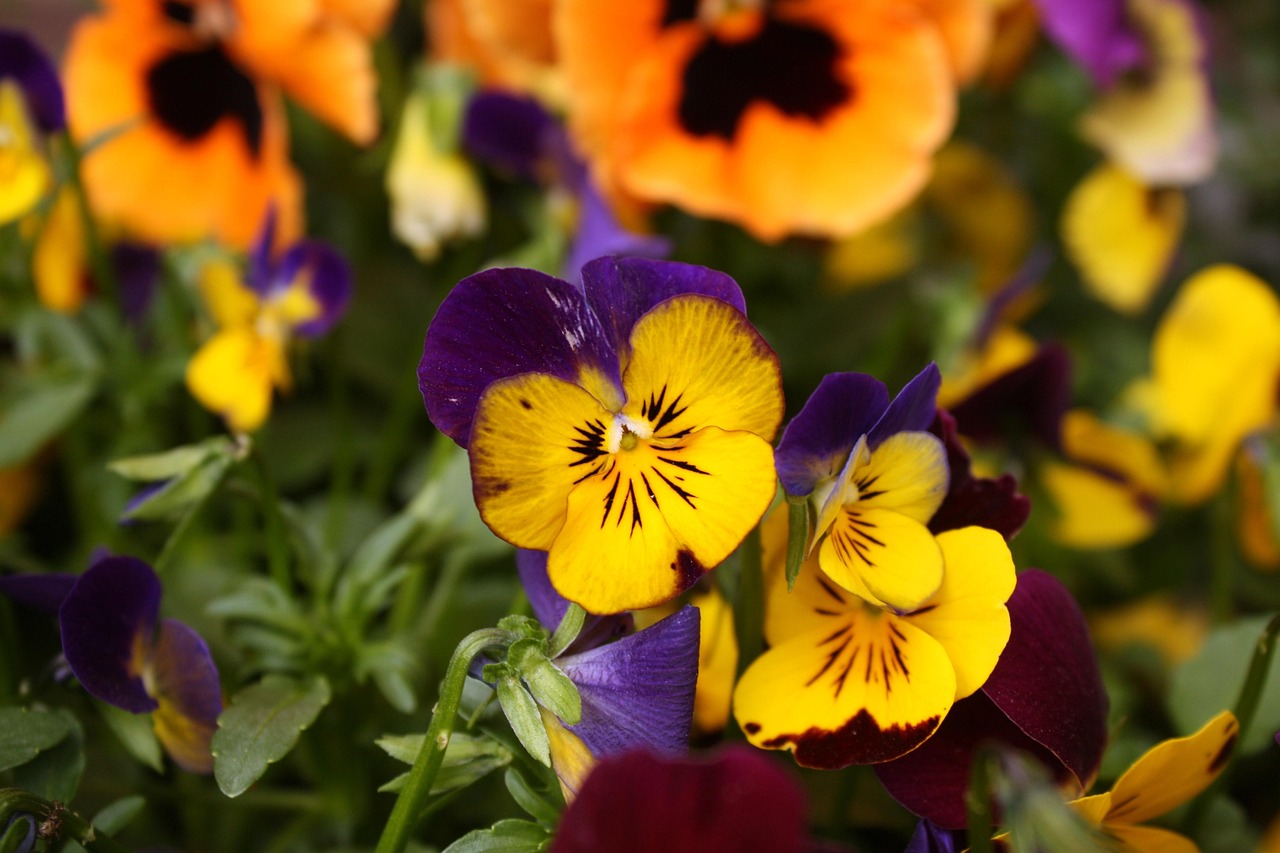
The flowers are the most distinguishing feature of the pansy plant. Each bloom consists of five overlapping petals arranged in a flattened, circular pattern. The petals are often marked with contrasting blotches or lines radiating from the center, creating the appearance of a “face.” The upper petals are typically slightly smaller, while the lower petal may be broader and marked with dark lines that guide pollinators toward the reproductive structures.
Flower coloration is highly variable and includes solid tones as well as intricate patterns. The center typically contains a cluster of yellow stamens surrounding a single pistil. Flower size varies depending on cultivar but is generally larger than that of wild Viola species.
The fruit develops as a small, three-parted capsule that splits open when mature to release numerous tiny seeds. The root system is fibrous and relatively shallow, forming a compact network beneath the soil surface.
Plant Classification & Growth Habit
The pansy plant is classified as a herbaceous flowering hybrid within the genus Viola. The “×” in its scientific name indicates its hybrid origin, resulting from crosses between species such as Viola tricolor, Viola lutea, and Viola altaica.
Botanically, pansies are considered short-lived perennials. However, in horticultural contexts, they are frequently grown as annuals or biennials due to their flowering cycle and climatic performance. Their growth habit is low and spreading, typically forming compact clumps rather than tall vertical structures.
Pansies exhibit a non-woody stem structure and maintain a rounded form throughout their life cycle. In milder climates, foliage may remain present through winter, while in colder regions, the plant completes its cycle within a single growing season.
Common Types / Varieties / General Classifications
Extensive hybridization has resulted in numerous pansy series and classifications. These are generally grouped based on flower size, color pattern, and growth characteristics.
By Flower Size:
- Large-flowered pansies
- Medium-flowered pansies
- Multiflora or small-flowered pansies
By Color Pattern:
- Blotch-type (distinct dark central markings)
- Clear-faced (solid color without central markings)
- Bicolor and tricolor forms
- Picotee types (contrasting petal edges)
By Color Range:
- Purple and violet shades
- Yellow and gold tones
- White and cream varieties
- Red and burgundy forms
- Blue and lavender hues
- Mixed or gradient combinations
These classifications reflect horticultural diversity rather than taxonomic separation, as all are cultivars within Viola × wittrockiana.
Native Range & Distribution
The pansy does not have a true wild native range in its cultivated form, as it is a hybrid developed in Europe during the 19th century. Its parent species originate primarily from Europe and western Asia.
Since its development, the pansy has been distributed worldwide and is cultivated across temperate regions of North America, Europe, Asia, Australia, and parts of South America. It is particularly associated with cooler seasons and is commonly observed in public landscapes, ornamental beds, and container displays.
While cultivated pansies are generally maintained in managed landscapes, related wild Viola species continue to occur naturally in grasslands, meadows, woodland edges, and alpine regions.
Cultural, Culinary, or Traditional Context
Historically, the pansy is linked to the wild heartsease (Viola tricolor), which appears in European folklore and literature. The name “pansy” is derived from the French word pensée, meaning “thought,” reflecting its symbolic association with remembrance and contemplation.
In the Victorian era, pansies were used in the language of flowers to convey sentiments of affection and thoughtful reflection. Their distinctive markings contributed to their symbolic identity.
In culinary contexts, pansy flowers have occasionally been used as decorative edible blossoms in salads and confections. This usage is aesthetic rather than nutritional and reflects the plant’s ornamental qualities.
The pansy also plays a role in ornamental horticulture industries worldwide, contributing to seasonal landscape design and commercial nursery production.
Interesting Facts / Did You Know
- The pansy’s characteristic “face” pattern results from contrasting pigmentation and nectar-guiding lines on the petals.
- Modern pansy cultivars were largely developed in England during the early 1800s.
- The genus Viola contains over 500 species distributed globally.
- Pansies are closely related to violets but generally have larger and flatter blooms.
- The hybrid designation in Viola × wittrockiana indicates its origin from intentional crossbreeding.
FAQs
Is a pansy the same as a violet?
Pansies belong to the genus Viola and are closely related to violets, but they are distinct hybrid cultivars with larger flowers and more pronounced markings.
Is the pansy an annual or a perennial?
Botanically, it is a short-lived perennial. In many horticultural settings, it is cultivated as an annual or biennial due to seasonal flowering cycles.
Why do pansies have “faces”?
The appearance of a face is created by petal coloration patterns and dark central blotches that contrast with surrounding colors.
What does the scientific name Viola × wittrockiana signify?
The “×” indicates that the plant is a hybrid species resulting from crosses between different Viola species.
Recommended Products
Disclosure: As an Amazon Associate, PlantsInfo may earn from qualifying purchases.
🌱 Plant Care Essentials
The following tools can help with pruning, plant health, soil management, and fruit garden maintenance.

Neem Oil for Plant Care
Natural plant protection against aphids, whiteflies, mites, and other common garden pests.

Fungicide for Root Care
Helps suppress soil-borne fungal diseases and supports healthier root systems.

Spray Bottle for Plants
Ideal for applying foliar sprays, neem oil solutions, and liquid plant treatments.

Rubber Hand Gloves
Protects hands during pruning, planting, soil preparation, and garden maintenance.
Conclusion
The pansy plant (Viola × wittrockiana) is a cultivated hybrid within the violet family known for its distinctive, multi-colored blooms and compact growth form. Developed from the European Viola species, it has become one of the most widely recognized ornamental flowering plants in temperate climates.
Its hybrid origin, extensive color diversity, and cultural symbolism contribute to its continued prominence in horticulture and decorative planting. As a representative of the genus Viola, the pansy illustrates the impact of selective breeding on plant form and diversity.
For structured, factual plant profiles covering hundreds of species and cultivated varieties, the Plants Info reference collection provides a standardized plant database designed for educational and informational purposes.