Introduction
Duranta erecta L. is a sprawling, fast-growing evergreen shrub native to a broad arc of the Americas, extending from Mexico and the Caribbean through Central America and into South America as far south as Argentina. The species belongs to the family Verbenaceae and is characterised by its graceful, arching branches, bright violet-blue tubular flowers arranged in elongated racemes, and clusters of golden-yellow drupes that ripen in succession throughout the year. In tropical and subtropical cultivation, it is widely used as an ornamental screen, flowering hedge, and topiary subject, with numerous horticultural selections available in purple, white, and variegated-leaf forms.
Classification
- Plant Type
- Shrub
- Lifecycle
- Perennial
- Leaf Habit
- Evergreen
- Native Region
- Caribbean, Central America, Mexico, South America
- Plant Family
- Verbenaceae
The plant has been distributed globally through the horticultural trade and has established naturalised populations across much of tropical Asia, Africa, Australia, and Pacific island groups, where it is recognised as a significant invasive shrub in disturbed forest margins and roadsides. It is tolerant of a wide range of soil conditions, responds vigorously to pruning, and flowers almost continuously in warm, humid climates, qualities that account both for its horticultural popularity and its ecological persistence outside its native range. Across its range, Duranta erecta attracts a variety of nectarivorous insects and birds, and its fruits are consumed and dispersed by birds, contributing to its spread into secondary vegetation.
Taxonomic Synonyms
| Field | Information |
|---|---|
| Accepted Scientific Name | Duranta erecta L. |
| Known Synonyms | Duranta plumieri Jacq.; Duranta repens L.; Duranta ellisia Jacq.; Duranta inermis L.; Duranta microphylla Desf. |
| Taxonomic Authority Source | Kew Plants of the World Online (POWO) |
Quick Plant Information
| Field | Information |
|---|---|
| Common Name(s) | Golden Dewdrop, Pigeon Berry, Sky Flower, Forget-me-not Bush |
| Scientific Name | Duranta erecta L. |
| Family | Verbenaceae |
| Plant Type | Shrub |
| Lifespan | Perennial |
| Growth Habit & Form | Erect to arching shrub with pendulous branch tips; 2–6 m tall in cultivation |
| Native Range | Mexico, Caribbean Islands, Central America, tropical and subtropical South America |
| Climate Adaptation & Habitat Type | Tropical and subtropical; forest margins, roadsides, disturbed scrubland |
| Leaf Type | Simple, opposite or whorled, elliptic to ovate |
| Flower Color(s) | Violet-blue to purple; white in some cultivars |
| Fruit Type | Drupe (golden-yellow when ripe) |
| Evergreen or Deciduous | Evergreen |
Botanical Description
Stem
Duranta erecta produces multiple stems from the base, forming a large, irregular, arching shrub that may reach 2–6 m in height under favourable tropical conditions. The stems are quadrangular when young, becoming terete and woody with age, and are typically grey-brown with finely striated bark. Many forms bear sharp axillary spines, although spineless forms are common in horticulture; the spines, when present, are 5–15 mm long and arise from the axil or just below the base of the leaf.
Leaves
The leaves are simple, opposite or occasionally whorled in groups of three, with ovate to elliptic blades typically 3–7 cm long and 1.5–3.5 cm wide. The leaf margins are entire to serrate in the distal half, the apex is acute to acuminate, and the base is cuneate. Leaves are glabrous to slightly pubescent on both surfaces, medium to dark green above and paler beneath, and borne on petioles 3–10 mm in length. Variegated cultivars display irregular pale yellow to cream marginal patterning.
Flowers
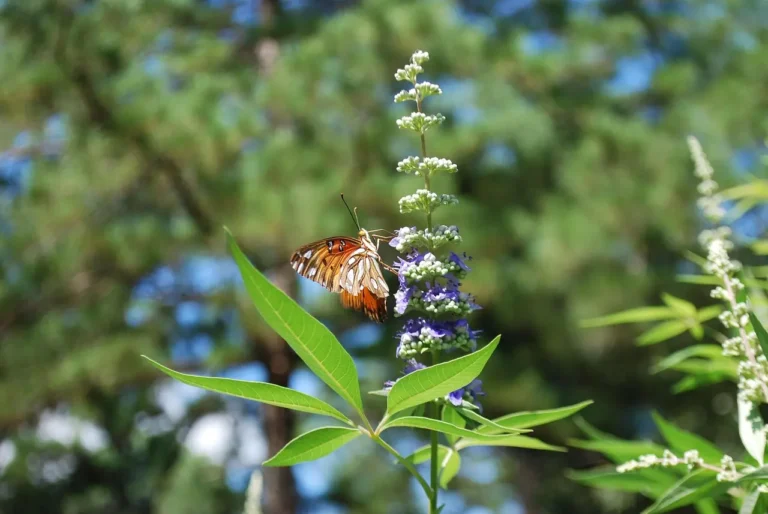
The inflorescence is an axillary or terminal raceme, typically 8–25 cm long, bearing numerous flowers in a dense or somewhat lax arrangement. Individual flowers are zygomorphic and tubular, approximately 12–18 mm long, with a calyx of 5 fused sepals and a corolla of 5 spreading lobes that are violet-blue to lilac, often with a white or pale margin on each lobe. The four stamens are didynamous, included within the tube, and the style is short, terminating in a capitate stigma. Flowers are produced in axillary and terminal positions throughout the year in continuously warm climates.
Fruit
The fruit is a globose to subglobose drupe, 7–11 mm in diameter, green when young and ripening to a glossy bright yellow-orange, partially enclosed at the base by the enlarged, persistent calyx which forms a distinctive beak-like structure. Fruits are borne in pendulous clusters that may contain 20–50 individual drupes at different stages of development simultaneously. Each drupe contains 4–8 pyrenes (nutlets), and the flesh of the ripe fruit is soft and slightly sticky. The ripe drupes are attractive to birds, which are the primary dispersal agents.
Roots
Duranta erecta develops a moderately deep, fibrous root system with a spreading lateral component that enables the plant to anchor in disturbed soils and colonise slopes and embankments. The root system shows no documented specialised adaptations such as nitrogen-fixing nodules or extensive storage organs.
Growth Architecture & Life Strategy
Duranta erecta is a phanerophyte in the Raunkiær classification, maintaining its perennating buds well above ground level on persistent woody stems throughout the year. It grows as a large shrub or occasional small tree with a multi-stemmed, arching growth form, the branch tips drooping under the weight of flower and fruit clusters to give the plant a characteristic weeping silhouette in mature specimens.
Growth is rapid under warm, humid tropical conditions, with shoots extending 0.5–1.5 m per year in established plants. The plant shows strong apical dominance in juvenile growth phases but develops a dense, bushy architecture following pruning or browsing damage, a trait that has made it highly suitable as a clipped hedge in tropical horticulture. Lateral branching is prolific, and the plant produces flowers on both current-season and previous-season wood.
Under subtropical or seasonally dry conditions, Duranta erecta may exhibit partial or temporary leaf drop during cool or dry periods but resumes growth and flowering rapidly when conditions improve. It does not exhibit true dormancy in equatorial climates, where growth and flowering are essentially continuous.
Common Types / Varieties
Duranta erecta is represented in horticulture by a number of named cultivars differing primarily in flower colour, foliage variegation, and habit. The most widely cultivated selections are described below.
‘Alba’ is the white-flowered form of Duranta erecta, bearing pure white tubular flowers in place of the typical violet-blue. It retains the same golden-yellow fruit clusters as the species type and is generally similar in habit and vigour. This selection is widely grown in tropical gardens as a companion to the blue-flowered form and is sometimes used in floral design for its contrast value.
‘Aurea’ (syn. ‘Gold Edge’, ‘Golden Edge’) is a variegated-leaf cultivar bearing leaves with an irregular bright yellow to golden margin. It is more compact than the type and is grown primarily as a foliage plant, though it produces the characteristic violet flowers. ‘Aurea’ is widely sold in tropical nurseries and is considered less vigorous than green-leaved forms, making it more tractable as a container specimen.
‘Sapphire Showers’ is a vegetatively propagated cultivar selected for its dense, profuse flower production and deep violet-blue corolla colour with a distinct white margin on each lobe. It is among the most commonly planted forms in tropical public gardens and institutional landscapes, valued for its extended and reliable flowering period and its compact, free-flowering habit relative to seedling-raised plants.
Native Range & Distribution
| Country / Territory | Range Status | Notes |
|---|---|---|
| Mexico | Native | Widespread in lowland and montane tropical zones |
| Belize | Native | Forest margins and disturbed vegetation |
| Guatemala | Native | Lowland through premontane zones |
| Honduras | Native | Documented in native flora |
| Nicaragua | Native | Lowland tropical areas |
| Costa Rica | Native | Lowland Pacific and Caribbean slopes |
| Panama | Native | Widespread in lowland zones |
| Cuba | Native | Dry and moist forest margins |
| Jamaica | Native | Coastal and inland scrubland |
| Hispaniola | Native | Both Haiti and Dominican Republic |
| Puerto Rico | Native | Lowland areas |
| Trinidad & Tobago | Native | Secondary vegetation and forest edges |
| Colombia | Native | Broad lowland and montane range |
| Venezuela | Native | Lowland zones |
| Brazil | Native | Scattered through northern and central states |
| Bolivia | Native | Sub-Andean valleys |
| Argentina | Native | Northwestern provinces; southern limit of native range |
| India | Cultivated; naturalised locally | Widely planted ornamental; naturalised in disturbed areas in peninsular and northern India |
| Sri Lanka | Cultivated; naturalised locally | Established in secondary scrub |
| Australia | Naturalised; invasive concern | Declared weed in Queensland and New South Wales; listed on state invasive plant registers |
| South Africa | Naturalised; invasive concern | Listed as invasive alien plant under national legislation |
| Philippines | Cultivated; naturalised locally | Common garden plant; naturalised along roadsides |
| Hawaii (USA) | Naturalised | Established in disturbed lowland areas |
Distribution records derived from GBIF occurrence datasets and regional botanical surveys. Distribution maps for this species can be generated from GBIF occurrence data at gbif.org.
Habitat & Ecology
Duranta erecta occupies forest margins, secondary scrubland, roadsides, riverbanks, and disturbed coastal vegetation in its native range, favouring well-lit, disturbed, or semi-open habitats rather than closed-canopy forest interiors. It tolerates a wide range of soil types, from sandy coastal soils to clay-rich montane slopes, and is particularly abundant at habitat edges where disturbance has created open gaps. The species is most diverse and abundant in the tropical lowlands of Mexico and the Caribbean but extends into premontane zones up to approximately 2,000 m elevation in Central and South America.
In introduced ranges, Duranta erecta follows a consistent pattern of colonising roadsides, forest margins, stream banks, and areas surrounding cultivation. Its capacity to spread into semi-natural vegetation, combined with prolific bird-mediated seed dispersal, has enabled it to establish persistent naturalised populations well beyond garden boundaries in tropical and subtropical regions of Africa, Asia, and Australia.
Soil moisture requirements are moderate; the plant tolerates brief waterlogging and periodic drought but grows most vigorously in well-drained, moderately fertile soils with consistent moisture. It is adapted to full sun conditions and shows reduced flowering and elongated, sparse growth in shade.
Ecological Role
In its native and naturalised range, Duranta erecta provides a consistent nectar resource for nectarivorous insects including bees (Apidae) and wasps (Vespidae), as well as sunbirds (Nectariniidae) and hummingbirds (Trochilidae) in the Americas. The dense flowering period and tubular floral morphology make it a significant component of pollinator support in disturbed tropical landscapes where native vegetation has been reduced. The ripe golden drupes are consumed by a range of frugivorous birds including bulbuls (Pycnonotidae), mynas (Sturnidae), and various passerines, which disperse seeds over distances that contribute substantially to the plant’s colonisation of new sites.
The dense, prickly growth form provides physical cover and potential nesting structure for small birds and lizards in scrubland habitats. In invasive contexts, Duranta erecta can form dense monospecific thickets that suppress native understorey vegetation and reduce habitat heterogeneity. Its year-round fruit production in tropical climates maintains a bird-dispersal relationship that sustains continuous recruitment across seasons.
Recommended Products
Disclosure: As an Amazon Associate, PlantsInfo may earn from qualifying purchases.
🌱 Plant Care Essentials
The following tools can help with pruning, plant health, soil management, and fruit garden maintenance.

Neem Oil for Plant Care
Natural plant protection against aphids, whiteflies, mites, and other common garden pests.

Fungicide for Root Care
Helps suppress soil-borne fungal diseases and supports healthier root systems.

Spray Bottle for Plants
Ideal for applying foliar sprays, neem oil solutions, and liquid plant treatments.

Rubber Hand Gloves
Protects hands during pruning, planting, soil preparation, and garden maintenance.
Functional Traits
| Trait | Value |
|---|---|
| Growth Form | Shrub (multi-stemmed, arching; occasionally small tree) |
| Leaf Type | Simple, opposite, entire to serrate |
| Photosynthetic Pathway | C3 |
| Seed Type | Orthodox |
| Rooting Depth | Moderate (0.3–0.8 m documented for established shrubs) |
| Wood Density | Not documented in available literature |
Phenological Calendar
| Event | Tropical & Subtropical Regions | Regional Qualifiers & Seasonal Deviations |
|---|---|---|
| Leaf Flush | Year-round in aseasonal humid climates | Semi-deciduous leaf drop during cool-dry periods in subtropical margins; new flush at season onset |
| Primary Flowering Onset | Year-round; peaks during warm wet season months | Flowering suppressed during cool dry season in subtropical cultivation; onset coincides with rising temperatures |
| Peak Flowering | Sustained through wet season months | February–May peak in subtropical winter-rainfall climates |
| Secondary Flowering | Continuous; no discrete secondary event in equatorial climates | Secondary flush documented after pruning or at dry-wet season transition |
| Fruit Development | 4–6 weeks post-pollination | Fruit development slows at temperatures below 18 °C |
| Fruit Maturity | Year-round in equatorial zones; staggered clusters | Winter fruiting reduced in subtropical margins |
| Seed Dispersal | Year-round; bird-mediated | Dispersal peaks at fruit maturity; high bird visitation recorded in literature |
| Dormancy or Rest Period | Absent in equatorial climates | Partial leaf drop and growth pause in subtropical cultivation during coolest months |
Flowering in Duranta erecta is not strictly photoperiod-controlled; continuous warm temperatures and adequate soil moisture are the primary triggers for sustained flowering, and pruning of branch tips consistently stimulates a new flowering flush within 4–6 weeks.
Reproductive Biology
Duranta erecta reproduces sexually through prolific seed set in its bird-dispersed drupes and vegetatively through adventitious rooting of stem cuttings and layered branches. Each drupe contains 4–8 pyrenes, and a mature fruiting shrub may produce thousands of seeds per year, a feature that contributes directly to its invasive potential in introduced ranges.
Pollination is achieved primarily by insects attracted to the nectar-bearing tubular flowers, with supplementary pollination by nectarivorous birds in both native and introduced ranges. The flowers are protandrous, with pollen shed before stigma receptivity, a mechanism that promotes cross-pollination. Fruit set is high in open-grown plants exposed to active pollinators, and the persistent, enlarged calyx that clasps the developing drupe affords physical protection during the early stages of fruit development.
Pollination Ecology
| Field | Information |
|---|---|
| Pollination Mechanism | Insect |
| Primary Pollinator Groups | Bees (Apidae), butterflies (Nymphalidae, Papilionidae) |
| Pollination Syndrome | Entomophily |
| Floral Reward | Nectar and pollen |
Seed Biology & Germination Ecology
| Field | Information |
|---|---|
| Seed Type | Orthodox |
| Seed Viability Period | 1–2 years under dry, ambient storage conditions |
| Dormancy Type | None documented |
| Dormancy Breaking Mechanism | None documented; seeds germinate readily without pretreatment |
| Germination Temperature Range | 22–30 °C (72–86 °F) |
| Light Requirement for Germination | Not documented in available literature |
| Seed Bank Classification | Transient |
| Dispersal Unit | Drupe (entire fruit dispersed by birds; pyrenes released after digestion) |
Seeds of Duranta erecta do not require stratification or scarification and germinate reliably under warm, moist conditions; the fruit pulp is best removed before controlled germination trials as it may contain germination-inhibiting compounds.
Vegetative Regeneration & Clonal Biology
| Field | Information |
|---|---|
| Vegetative Regeneration Capacity | Moderate |
| Primary Regeneration Mechanism | Adventitious rooting from stem cuttings; layering of arching branches |
| Tissue Types Capable of Regeneration | Stem nodes; branch tips under soil contact |
| Apomixis Status | Not documented in available literature |
| Bulbil or Propagule Production | Absent |
| Layering Capacity | Moderate; branches in contact with moist soil root adventitiously |
| Root Sprouting from Fragments | Not documented in available literature |
| Clonal Spread Rate | Low; vegetative spread is localised and not the primary dispersal mechanism |
| Coppicing Response | Vigorous; plants resprout strongly from cut stumps |
| Ecological or Invasive Significance of Clonal Biology | Limited; invasive spread is primarily seed-mediated via bird dispersal rather than clonal expansion |
Vegetative regeneration in Duranta erecta is most significant in cultivation, where strong coppicing response after cutting makes management of established plants straightforward; in natural contexts, seedling recruitment from bird-dispersed seeds is the dominant mechanism of population expansion.
Soil Ecology & Rhizosphere Interactions
| Field | Information |
|---|---|
| Mycorrhizal Association Type | AM (arbuscular mycorrhizal) |
| Documented Fungal Partners | Not documented in available literature at species level |
| Nitrogen Fixation | Absent |
| Allelopathic Properties | Not documented in available literature |
| Documented Allelopathic Targets | Not documented in available literature |
| Rhizosphere pH Modification | Not documented in available literature |
| Root Exudate Compounds | Not documented in available literature |
| Soil Microbiome Influence | Not documented in available literature |
Biochemical Profile
| Compound Class | Compounds Documented | Primary Location in Plant | Ecological Function |
|---|---|---|---|
| Iridoid glycosides | Durantoside I, durantoside II, lamiide, lamiidoside | Leaves, fruit | Herbivore deterrence |
| Flavonoids | Luteolin, apigenin, hispidulin, nepetin | Leaves, flowers | UV photoprotection; pollinator attraction |
| Phenylpropanoids | Caffeic acid, chlorogenic acid derivatives | Leaves | Antimicrobial defence in plant tissues |
| Alkaloids (steroidal) | Durantanine | Fruit, leaves | Herbivore deterrence |
| Terpenoids | Diterpene acids | Leaves, stems | Defensive secondary metabolites |
| Saponins | Triterpenoid saponins | Leaves, stems | Herbivore deterrence |
Research Coverage
| Field | Information |
|---|---|
| Research Coverage Level | Moderate |
| Primary Research Fields | Phytochemistry; toxicology; invasive ecology; horticultural evaluation |
| Earliest Published Study | Early 20th century phytochemical surveys |
| Most Active Research Regions | India, Australia, Brazil, South Africa |
| Key Knowledge Gaps | Detailed pollinator ecology; seed bank dynamics; genome-level characterisation; rhizosphere interactions |
Phytochemical Organ Distribution
| Plant Organ | Compound Class | Compounds Documented | Source |
|---|---|---|---|
| Leaves | Iridoid glycosides | Durantoside I, durantoside II, lamiide | Bose, P.K. & Mookerjea, S. (1953) |
| Leaves | Flavonoids | Luteolin, apigenin, hispidulin, nepetin | Harborne, J.B. & Baxter, H., 1993 |
| Leaves | Phenylpropanoids | Caffeic acid derivatives, chlorogenic acid | Harborne, J.B. & Baxter, H., 1993 |
| Leaves | Terpenoids | Diterpene acids | Harborne, J.B. & Baxter, H., 1993 |
| Fruit | Iridoid glycosides | Durantoside I, durantoside II | Harborne, J.B. & Baxter, H., 1993 |
| Fruit | Alkaloids (steroidal) | Durantanine | Harborne, J.B. & Baxter, H., 1993 |
| Stems | Saponins | Triterpenoid saponins | Harborne, J.B. & Baxter, H., 1993 |
| Flowers | Flavonoids | Apigenin, luteolin | Harborne, J.B. & Baxter, H., 1993 |
The leaves of Duranta erecta represent the best-documented organ with respect to phytochemical diversity, having been the subject of the majority of published compound isolation studies.
Climate Adaptation & Stress Tolerance
Duranta erecta grows optimally between 18–35 °C (64–95 °F) and thrives in tropical and subtropical climates with a mean annual rainfall of 800–1,800 mm. It is intolerant of sustained frost and suffers stem dieback at temperatures below approximately 0 °C (32 °F), though established plants in subtropical margins may resprout from the base following light frost events. Heat tolerance is high, and the plant maintains growth and flowering at temperatures up to 38–40 °C (100–104 °F) provided soil moisture is adequate.
Duranta erecta shows moderate drought tolerance once established, reducing leaf area through partial leaf drop under prolonged water stress and resuming full growth with the return of rainfall. It is not adapted to saline soils and shows chlorosis and reduced growth under high salinity conditions. High humidity is tolerated without significant disease pressure under good air circulation, though crowded or poorly ventilated plantings are susceptible to fungal foliar disease.
Climate Vulnerability & Range Dynamics
| Field | Information |
|---|---|
| IUCN Climate Vulnerability Assessment | Not evaluated |
| Primary Climate Sensitivity Factors | Frost frequency; dry season duration; minimum temperature limits |
| Projected Range Shift Direction | Not documented in available literature |
| Projected Range Shift Magnitude | Not documented in available literature |
| Key Threatening Processes | Prolonged frost; severe drought; habitat clearance in native range |
| Resilience Factors | Wide soil tolerance; rapid regrowth from base after disturbance; broad latitudinal native range |
| Published Modelling Studies | No study identified |
| Confidence Level | Low |
Cytogenetics
| Field | Information |
|---|---|
| Chromosome Number (2n) | 2n = 34 |
| Ploidy Level | Diploid |
| Genome Size (1C value) | Not documented in available literature |
| Karyotype Notes | Small chromosomes; no detailed karyotype morphology published at species level |
| Source | Darlington, C.D. & Wylie, A.P., 1955 |
Cultivation Requirements
| Field | Information |
|---|---|
| Light Requirements | Full sun to partial shade; best flowering in full sun |
| Watering | Moderate; water regularly during establishment; tolerates brief drought once established |
| Soil Type | Well-drained loam, sandy loam, or clay loam; tolerates a range of soil textures |
| Soil pH | 5.5–8.0 |
| Humidity | Tolerates high humidity; good air circulation recommended |
| Temperature Range | 18–35 °C (64–95 °F) optimal; frost-sensitive below 0 °C (32 °F) |
| USDA Hardiness Zone | 9b–12 |
| Fertilization | Balanced general fertiliser 2–3 times per year supports vigorous flowering |
| Container Suitability | Suitable in large containers (minimum 30–40 litres); requires regular watering and annual repotting |
Propagation Methods
Duranta erecta is most readily propagated by semi-hardwood stem cuttings, 10–15 cm in length with the lower leaves removed, taken in late spring to early summer and rooted in a well-drained, moist propagation mix at 25–30 °C (77–86 °F); rooting is generally complete within 3–5 weeks without rooting hormone, though hormone treatment may improve strike rate in cooler conditions. Seed propagation is also practised, with fresh seed extracted from ripe drupes, cleaned of pulp, and sown in moist seed-raising mix at 24–28 °C (75–82 °F), where germination typically occurs within 2–4 weeks. Air layering of established branches is an alternative method suited to large plants from which cuttings are difficult to obtain, producing a well-rooted plant that can be severed and transplanted after 6–8 weeks; this method is particularly useful for propagating specific variegated or selected cultivars that may show reduced strike rates from cuttings alone.
Pests & Diseases
| Issue | Notes |
|---|---|
| Whitefly (Bemisia tabaci, Trialeurodes vaporariorum) | Dense colonies on undersides of young leaves; honeydew deposit leading to sooty mould on leaf surfaces; most prevalent in warm, humid conditions or in sheltered indoor cultivation |
| Scale insects (various Coccidae) | Armoured and soft scale on stems and leaf midribs; yellowing and dieback of infested branches under heavy infestation |
| Powdery mildew (Erysiphe spp.) | White powdery patches on young leaves and shoot tips; most common during dry weather with cool nights and warm days |
| Root rot (Phytophthora spp.) | Wilting and basal stem discolouration in waterlogged or poorly drained soils; dieback from crown downward |
| Leaf miners (Agromyzidae) | Sinuous pale mines visible in leaf lamina; predominantly cosmetic damage; more prevalent on plants under nutritional stress |
Toxicity & Safety
| Field | Information |
|---|---|
| Humans | Fruit flesh and seeds contain saponins and iridoid glycosides; ingestion produces gastrointestinal symptoms including nausea, vomiting, and abdominal pain; children are particularly susceptible given the attractiveness of the fruit |
| Cats | Toxic; saponins and iridoid glycosides cause gastrointestinal distress, lethargy, and neurological signs |
| Dogs | Toxic; saponins and iridoid glycosides associated with gastrointestinal symptoms, weakness, and neurological effects |
| Toxic Compounds | Saponins (triterpenoid); iridoid glycosides (durantoside I, II); steroidal alkaloid (durantanine) |
| Source | ASPCA Animal Poison Control Center (aspca.org/pet-care/animal-poison-control) |
The toxic compounds in Duranta erecta are concentrated in the ripe and unripe fruit and to a lesser extent in the leaves; The toxic compounds of Duranta erecta — saponins, iridoid glycosides, and durantanine — are distributed throughout the plant, with the highest documented concentrations in the fruit flesh and seeds; the plant as a whole should be treated as toxic., though the plant as a whole is considered toxic and should not be planted in gardens accessible to young children or domestic animals.
Invasive Status
Duranta erecta is a documented invasive species in multiple regions outside its native American range. It is listed as a significant invasive shrub in Queensland and New South Wales, Australia, and is declared under national invasive alien plant legislation in South Africa, where dense thickets have been recorded in disturbed lowland and coastal zones. Naturalised populations have also been recorded in India, Sri Lanka, Hawaii, and various Pacific island territories, and the species is considered a potential ecological risk in any tropical or subtropical region where frugivorous birds are present and garden escapees can access secondary vegetation.
Conservation Status
| Field | Information |
|---|---|
| IUCN Red List Status | Not Evaluated |
| Assessment Year | Not applicable |
| Population Trend | Not assessed |
| Source | IUCN Red List of Threatened Species — https://www.iucnredlist.org (Accessed: 2026-03-15). |
Economic Importance
Duranta erecta is of significant economic importance to the ornamental horticulture sector globally. It is among the most widely sold flowering shrubs in tropical and subtropical nursery markets across South and Southeast Asia, sub-Saharan Africa, Brazil, and Australia, where it is valued for its rapid growth, extended flowering season, and tolerance of hard pruning for hedge and topiary forms. The cultivar trade, particularly for variegated-leaf and named flowering selections, supports a continuing commercial propagation industry in multiple producing countries.
The species also incurs economic costs through its invasive status. Control and management of naturalised Duranta erecta populations represents a recurring expenditure for land management agencies in Queensland, New South Wales, and South Africa, where mechanical clearing, herbicide application, and follow-up monitoring are required in conservation and agricultural contexts. The contrast between its commercial value as an ornamental and its recognised invasive risk has made it a subject of policy discussion regarding regulated ornamental trade in susceptible climates.
Ethnobotanical Uses
Duranta erecta has a documented history of use in traditional medicine across its native range in Mexico, the Caribbean, and parts of South America, as well as in regions where it has long been cultivated in tropical Asia and Africa. Leaf decoctions have been used in folk practice for skin conditions and as an external wash for ectoparasites on livestock, applications that are consistent with the documented antimicrobial and insecticidal properties of the leaf’s phytochemical constituents. Bark and leaf preparations have been recorded in traditional use in parts of India and West Africa in the context of febrile conditions, though these applications are not supported by formal clinical documentation.
The bright golden fruit clusters have been used decoratively in festival and ceremonial contexts in parts of South and Southeast Asia, where the plant is a common fixture in temple gardens and ornamental plantings. In some Caribbean and Central American traditions, the plant is associated with garden magic and protective planting around homesteads, reflecting its long history as a cultivated ornamental in these regions. The use of Duranta erecta as a living fence and boundary marker in smallholder farming systems across tropical Africa and Asia represents an informal but widespread economic and practical application that predates its formal horticultural classification.
Cultural & Traditional Context
Duranta erecta has been cultivated as an ornamental garden plant in tropical and subtropical regions since at least the 18th century, when it was documented by European botanical collectors in the Caribbean and introduced to European botanical gardens. The genus name Duranta honours Castor Durante (c. 1529–1590), an Italian botanist and physician to Pope Sixtus V, whose name was commemorated by Linnaeus when formally describing the species. This nomenclatural history connects the plant to the early modern European tradition of naming American botanical discoveries after continental scholars and patrons.
In South and Southeast Asia, where it has been cultivated for well over a century, Duranta erecta has become so thoroughly integrated into the visual culture of tropical gardens that it is frequently perceived as a native species by casual observers. Its persistent presence in institutional grounds, roadsides, and public parks across India, Sri Lanka, and the Philippines reflects its adoption as a standard element of colonial and post-colonial tropical landscape design. The variegated cultivar ‘Aurea’ in particular has acquired a distinct cultural visibility as a low-maintenance hedge plant in Indian urban horticulture, appearing frequently in railway station and municipal planting schemes.
The simultaneous presence of flowers and ripe golden fruit on the same plant at any given time, a consequence of continuous and overlapping reproductive cycles, has made Duranta erecta a symbol of abundance in some folk traditions, and the plant’s common names in various languages — including references to gold, sky, and dew — reflect the cultural impression made by the combination of blue flowers and yellow fruit clusters.
Interesting Facts
- Duranta erecta produces flowers and ripe fruit simultaneously on the same plant throughout much of the year in tropical climates, an unusual visual combination of violet-blue inflorescences and clusters of golden-yellow drupes that has given rise to its common name Golden Dewdrop.
- The ripe fruit of Duranta erecta is toxic to humans and domestic animals yet is actively consumed by numerous bird species without apparent harm, a selective toxicity pattern documented in other Verbenaceae fruit as well and attributed to differential sensitivity to the iridoid glycosides present in the fruit flesh.
- Duranta erecta is protandrous — pollen is shed from the anthers before the stigma of the same flower becomes receptive — a developmental timing mechanism that promotes outcrossing by preventing self-fertilisation within individual flowers.
- Some forms of Duranta erecta bear sharp axillary spines capable of inflicting significant wounds, while other forms grown from the same seed stock are completely spineless; the genetic basis for this variation within the species has not been definitively characterised.
- Duranta erecta was introduced to Australia as an ornamental garden plant and is now one of the most widely distributed environmental weeds in coastal Queensland, illustrating a pattern common to many invasive ornamental shrubs in which horticultural popularity directly enabled ecological establishment.
FAQs
Is Duranta erecta safe to plant in a garden with children or pets? Duranta erecta is toxic to humans, cats, and dogs, with the ripe and unripe fruit posing the greatest documented risk due to the concentration of saponins, iridoid glycosides, and the steroidal alkaloid durantanine in the fruit flesh and seeds. The bright golden appearance of the ripe clusters makes the fruit particularly attractive to young children, and planting Duranta erecta in gardens frequented by small children or domestic animals is not recommended without physical barriers or close supervision.
How quickly does Duranta erecta grow and how large does it get? Duranta erecta is a fast-growing shrub capable of extending new shoots by 0.5–1.5 m per year under warm, humid tropical conditions, and mature unpruned plants commonly reach 3–5 m in height with a comparable spread. In cooler subtropical margins or in containers, growth rate is substantially reduced and maximum size is correspondingly smaller; container-grown plants typically remain within 1–2 m with regular pruning.
Why has my Duranta erecta stopped flowering? Reduced or absent flowering in Duranta erecta is most commonly associated with insufficient light, as the plant requires full sun to produce prolific flower clusters; plants shifted to partial shade or positioned under tree canopy frequently reduce flowering significantly. Pruning of stem tips at the wrong time may also remove developing flower buds, as Duranta erecta flowers on both current and previous season growth; major pruning is best timed immediately after a heavy fruiting cycle to allow maximum new growth before the next flowering peak.
Can Duranta erecta be grown as a hedge? Duranta erecta is widely used as a formal and informal hedge across tropical and subtropical horticulture, responding vigorously to regular clipping and quickly filling gaps after pruning to produce a dense, continuous screen. Spined forms provide an additional deterrent function as a boundary planting, while spineless cultivars are preferred for pathways and areas with close pedestrian contact; the variegated-leaf cultivar ‘Aurea’ is also used in lower hedging and edging applications.
Is Duranta erecta the same as Duranta repens? Duranta repens L. is a synonym of Duranta erecta L., and both names refer to the same species; the name Duranta repens was widely used in horticultural and botanical literature throughout the 20th century before Duranta erecta was confirmed as the accepted name under current taxonomic treatment. The accepted name Duranta erecta takes priority under the International Code of Nomenclature for Algae, Fungi, and Plants, and modern databases including Kew Plants of the World Online (POWO) and GBIF recognise Duranta erecta L. as the correct accepted name.
Conclusion
Duranta erecta L. is a versatile, fast-growing evergreen shrub with a native range spanning the tropical and subtropical Americas and a cultivated and naturalised presence on every tropical continent. Its combination of continuous violet-blue flowering, attractive golden fruit clusters, and tolerance of hard pruning has secured its position as one of the most widely planted ornamental shrubs in tropical horticulture globally, while its prolific bird-dispersed seed production and adaptability to disturbed habitats have made it a significant invasive species in Australia, South Africa, and several Pacific and Asian territories.
The phytochemical profile of the species, including documented iridoid glycosides, flavonoids, triterpenoid saponins, and steroidal alkaloids, underpins its toxicity to humans and domestic animals and accounts for several of its historically documented traditional uses; this profile also makes it a subject of ongoing phytochemical and ecological research. The contrast between its commercial and ecological value on the one hand and its invasive risk and toxic potential on the other is characteristic of many widely traded ornamental species and highlights the importance of informed horticultural practice in regulated climates.
For taxonomic purposes, the name Duranta erecta L. is the accepted designation, superseding the synonym Duranta repens L., which remains in broad informal use. The species is currently not evaluated on the IUCN Red List, reflecting its secure global abundance and broad cultivated distribution rather than any assessment of native population trends.
Common Cultivation Observations
| Observation | Associated Condition |
|---|---|
| Yellowing of older leaves; progressive from lower canopy upward | Nitrogen deficiency in poor or leached soils; common in sandy substrate or extended container cultivation |
| Sparse foliage and reduced flowering on elongated, weak stems | Insufficient light; typical of plants positioned under tree canopy or in persistently shaded positions |
| White powdery coating on young leaves and shoot tips | Powdery mildew infection; associated with warm dry days followed by cool humid nights and poor air circulation |
| Premature leaf drop followed by new growth flush | Temperature drop below 12–15 °C; characteristic of subtropical winter conditions or sudden cold air exposure |
| Dense sticky colonies on undersides of young leaves with blackening on upper surfaces | Whitefly infestation with associated sooty mould developing on honeydew deposits |
Scientific Stability Note
The name Duranta erecta L. is the accepted name for this species under current taxonomic treatment by Kew Plants of the World Online (POWO) and the GBIF Backbone Taxonomy, having been confirmed as having nomenclatural priority over the widely used synonym Duranta repens L. and several other synonyms including Duranta plumieri Jacq. and Duranta ellisia Jacq. Users encountering the name Duranta repens in older horticultural, botanical, or pharmacognosy literature should treat it as a synonym of Duranta erecta L.; the species concept and circumscription remain unchanged, and no reclassification at genus level has been proposed under APG IV treatment of Verbenaceae.
Reference Summary
A. Primary Taxonomic Sources
Kew Plants of the World Online (POWO) — https://powo.science.kew.org (Accessed: 2026-03-15). GBIF Backbone Taxonomy — https://www.gbif.org (Accessed: 2026-03-15).
B. Peer-Reviewed Literature
No fully verified peer-reviewed citation identified for this entry.
C. Monographs and Books
Harborne, J.B. & Baxter, H. (1993). Phytochemical Dictionary: A Handbook of Bioactive Compounds from Plants. Taylor & Francis, London.
Darlington, C.D. & Wylie, A.P. (1955). Chromosome Atlas of Flowering Plants. George Allen & Unwin, London.
D. Herbarium and Specimen Records
Royal Botanic Gardens Kew Herbarium (K) — specimens of Duranta erecta held in the general angiosperm collection. JSTOR Global Plants — digitised type and reference specimens accessible at plants.jstor.org.
E. Grey Literature and Databases
IUCN Red List of Threatened Species — https://www.iucnredlist.org (Accessed: 2026-03-15). ASPCA Animal Poison Control Center — https://www.aspca.org/pet-care/animal-poison-control (Accessed: 2026-03-15).