
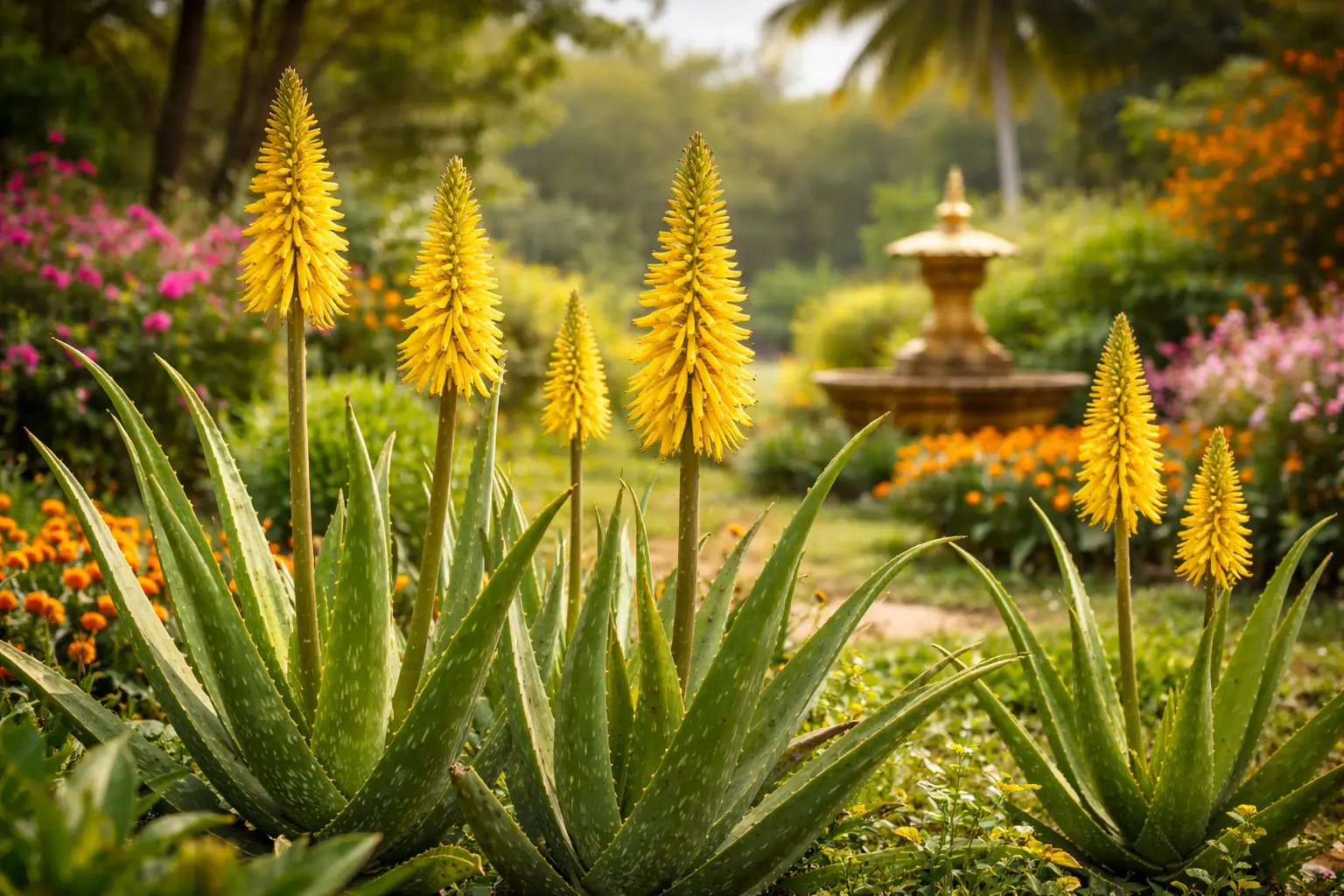
Quick Answer: Aloe vera flowers in India between February and April — at the tail end of winter and into pre-summer. The flower spike is tall, bright yellow-orange, and appears only on mature plants (typically 3–4 years old). Not every plant flowers every year.
See also: Aloe Vera (Ghritkumari) Plant plant profile, how to grow it, common problems, its benefits, and its varieties.
The flower spike arrives quietly. One day in late February, you notice a single upright stem pushing out of the centre of the rosette — within two weeks it towers 60–90 cm tall, topped with a cluster of pendant yellow-orange tubular flowers. In most parts of India, this is one of the first dramatic garden events of the year, arriving just as winter loosens its hold.
Recommended Products
Disclosure: As an Amazon Associate, PlantsInfo may earn from qualifying purchases.
🌱 Growing Essentials
The following products can help with container gardening, potting, root development, soil management, and healthy plant growth.
Organic Potting Soil Mix
Provides nutrients, structure, and healthy growing conditions for container plants.
Coco Peat Growing Medium
Enhances moisture retention while maintaining excellent root-zone aeration.

Grow Bags for Plants
Improve drainage, root aeration, and vegetable production in limited spaces.

Plastic Pots for Plants
Ideal containers for seedlings, ornamentals, herbs, and balcony gardens.
India’s Seasons and This Plant
| Season (months) | What the plant is doing |
|---|---|
| Pre-monsoon (Mar–May) | Flowering peaks in March–April; growth slows as heat intensifies; leaves may lighten in colour |
| Monsoon (Jun–Sep) | Minimal active growth; high rot risk; plant rests; pups may appear at the base |
| Post-monsoon (Oct–Nov) | Best planting window; plant begins slow recovery; best time to separate pups |
| Winter (Dec–Feb) | Slowest growth period; roots consolidate; flower spike emerges late February |
Flowering Season in Detail
Flower buds first appear as a tightly packed spike emerging from the centre of the rosette, usually in late January to February in warmer states (Tamil Nadu, Andhra Pradesh, Gujarat), and February to March in cooler northern states (Delhi, Punjab, Rajasthan).
Peak bloom runs through March and into early April. Each flower is tubular, 2–3 cm long, and hangs downward, attractive to sunbirds and bees. The full spike remains in flower for 3–4 weeks before the flowers drop.
Flowering is triggered by a combination of cooler night temperatures (below 15°C) over several weeks, followed by gradually warming days — the classic Indian winter-to-pre-summer transition. Plants kept indoors year-round with stable temperatures rarely flower because this temperature cue is absent.
A what-nobody-tells-you detail: aloe vera does not flower reliably every year. A plant may skip one or two years between blooms. This is normal and not a sign of poor health.
Best Time to Plant
The ideal planting window for aloe vera in India is post-monsoon — October through November. The soil has drained fully after the rains, temperatures are dropping into the comfortable 20–28°C range, and the plant has a full cool season to establish roots before the stress of summer.
This timing works because aloe vera’s root system develops best in relatively dry, mild conditions — not in heat and not in waterlogged monsoon soil.
The second-best window is early winter — December to mid-January — though in northern India, temperatures can dip low enough by January to slow establishment noticeably.
Container and ground planting follow the same timing. The only exception: if you are planting in a climate-controlled indoor space, timing matters less.
Month-by-Month Care Calendar
| Month | Season | Key Task |
|---|---|---|
| January | Winter | Minimal intervention; check for root rot if the plant looks soft |
| February | Winter / Pre-monsoon | Flower spike emerges; stop fertilising; enjoy the bloom |
| March | Pre-monsoon | Peak flowering; water slightly more as temperatures rise |
| April | Pre-monsoon | Flowering ends; trim spent spike at the base; resume light feeding |
| May | Pre-monsoon / Summer | Move potted plants to partial shade; reduce watering frequency |
| June | Monsoon | Move pots under shelter; stop fertilising; check drainage |
| July | Monsoon | Ease watering restrictions slightly as the rains reduce |
| August | Monsoon | Same as July; watch for mealybugs in humid conditions |
| September | Monsoon | Ease watering restrictions slightly as rains reduce |
| October | Post-monsoon | Best month to repot, separate pups, or plant new saplings |
| November | Post-monsoon | Apply vermicompost; water once every 2 weeks; resume normal care |
| December | Winter | Reduce watering; protect from frost above 1,000 m altitude |
What Can Go Wrong Seasonally?
Monsoon root rot: The single biggest seasonal risk. If a container plant sits in waterlogged soil for more than a few days during June–August, root rot begins. Fix: move pots under shelter, reduce or stop watering, and check drainage holes are clear.
Leaf scorch in May–June: Potted plants on exposed south-facing balconies can develop brown leaf tips and bleached patches during peak summer. This is sometimes misdiagnosed as a nutrient deficiency. The fix is shade, not fertiliser — move the plant to a spot that gets afternoon shade.
Flower spike failure in mature plants: A plant that has not flowered in 3–4 years is likely not receiving the necessary winter temperature cue. If kept indoors, move it to an outdoor or semi-outdoor location from November through February.
Post-Bloom Care
After the flower spike finishes — usually by April — cut it off cleanly at the base with a sharp blade. Do not pull it; tearing the stem base can introduce infection.
The plant will redirect its energy back into leaf and pup production through April and May before slowing again in the monsoon. This is a good time to apply a light dose of vermicompost and resume regular watering.


