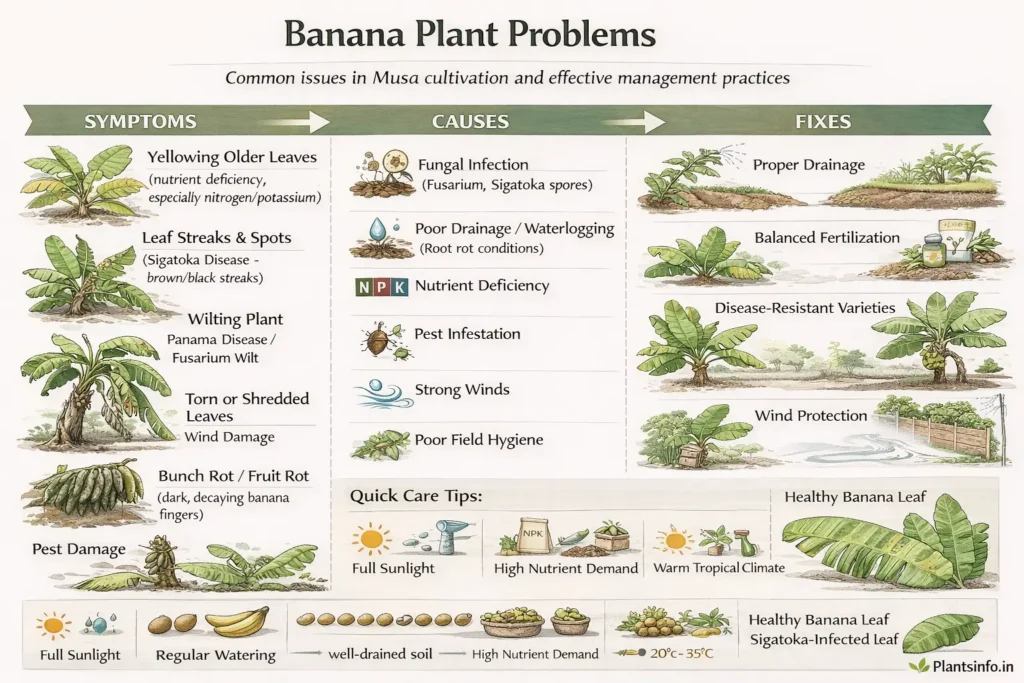
Banana Plant Problems: Symptoms, Causes and Fixes
Banana Plant Problems: Symptoms, Causes, and Fixes
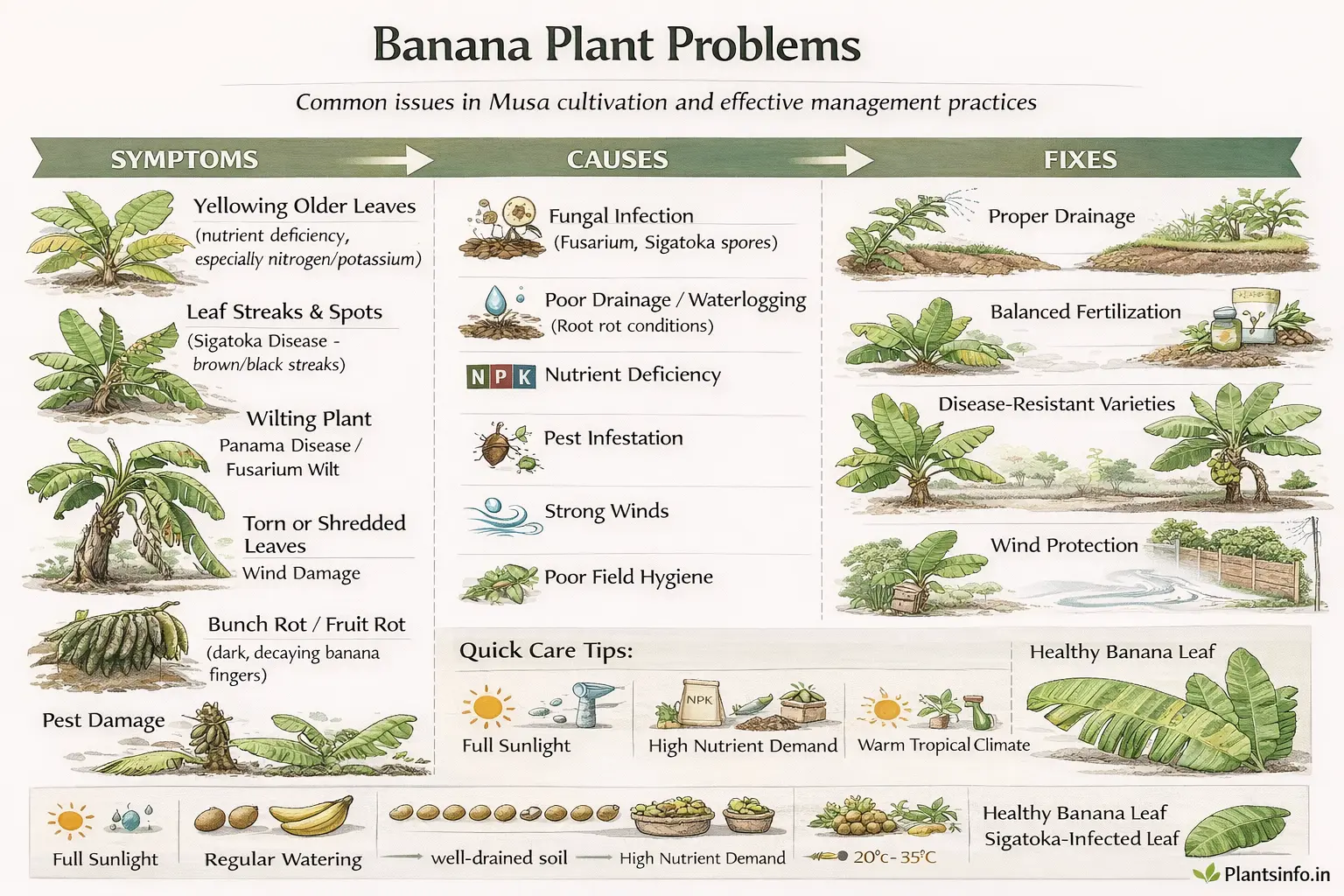
Quick Answer: The most common banana plant problems in India are Panama wilt, Sigatoka leaf spot, bunchy top virus, and weevil damage. Most are preventable with healthy planting material, good drainage, and early observation. Caught early, many problems are manageable — but a few, once established, cannot be reversed.
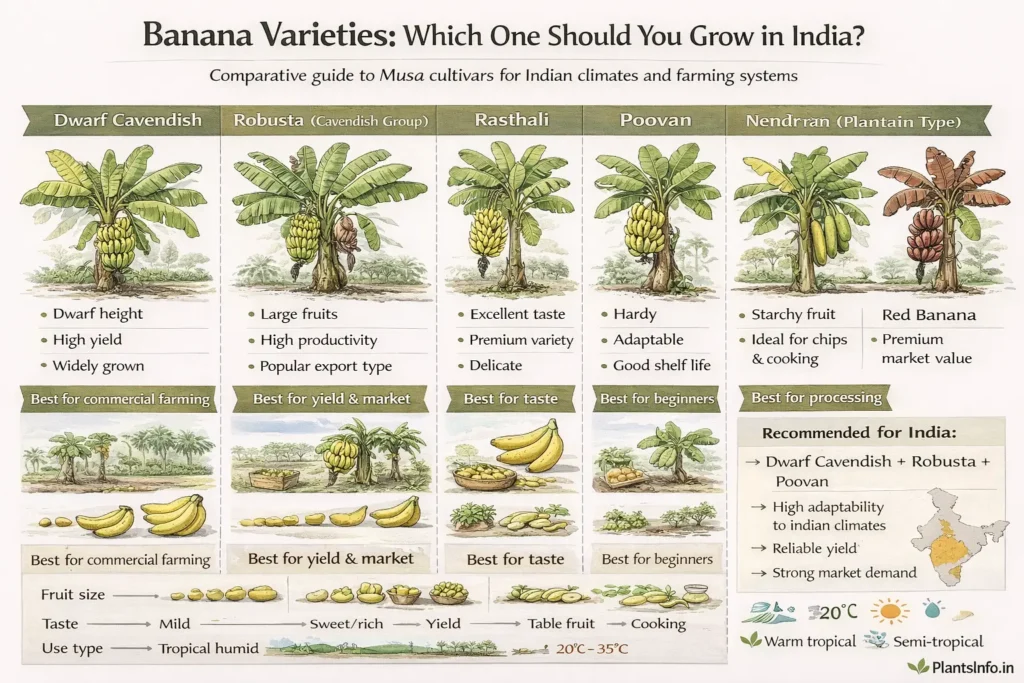
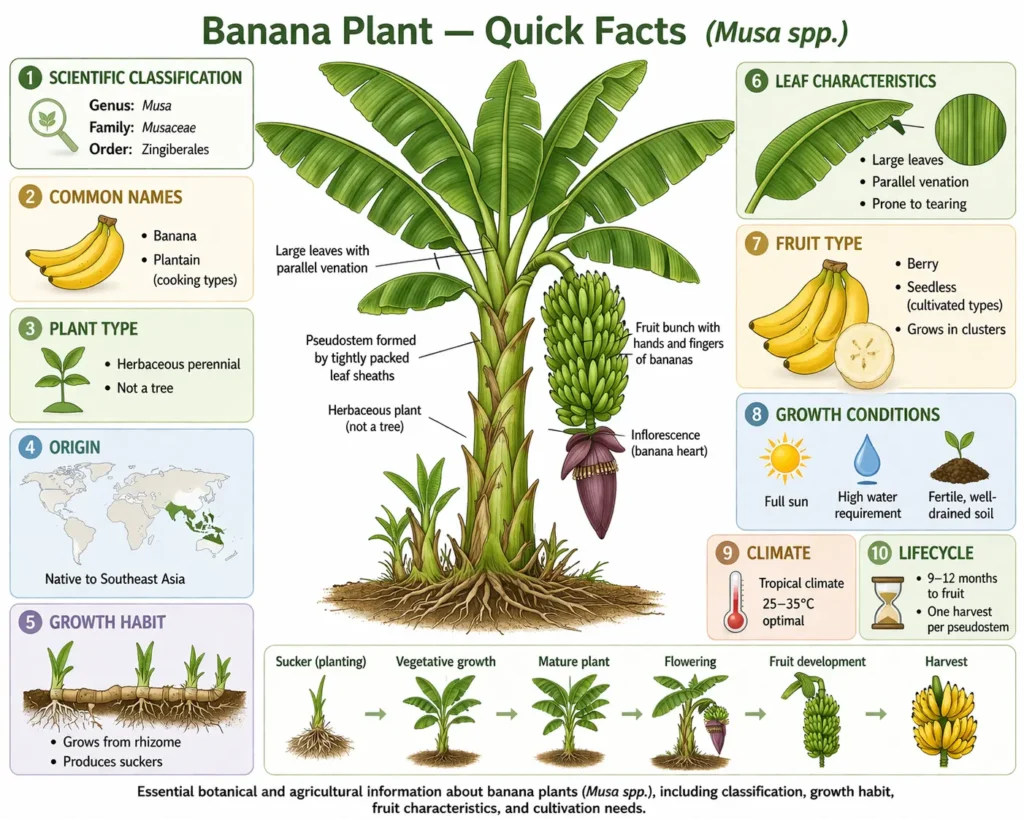
See also: Banana Plant plant profile, how to grow it, its flowering season, its benefits, and its varieties.
A healthy banana plant can turn alarming fast — one week of lush green, the next week of yellowing, wilting, or stunted growth that leaves most gardeners guessing. In Indian conditions, where heat, humidity, and waterlogged soil during monsoon create near-perfect conditions for fungal and bacterial disease, problems tend to escalate quickly if ignored. The good news: the majority of banana plant losses trace back to a handful of well-understood causes, and most of them are preventable.
Recommended Products
Disclosure: As an Amazon Associate, PlantsInfo may earn from qualifying purchases.
🌱 Growing Essentials
The following products can help with container gardening, potting, root development, soil management, and healthy plant growth.
Organic Potting Soil Mix
Provides nutrients, structure, and healthy growing conditions for container plants.
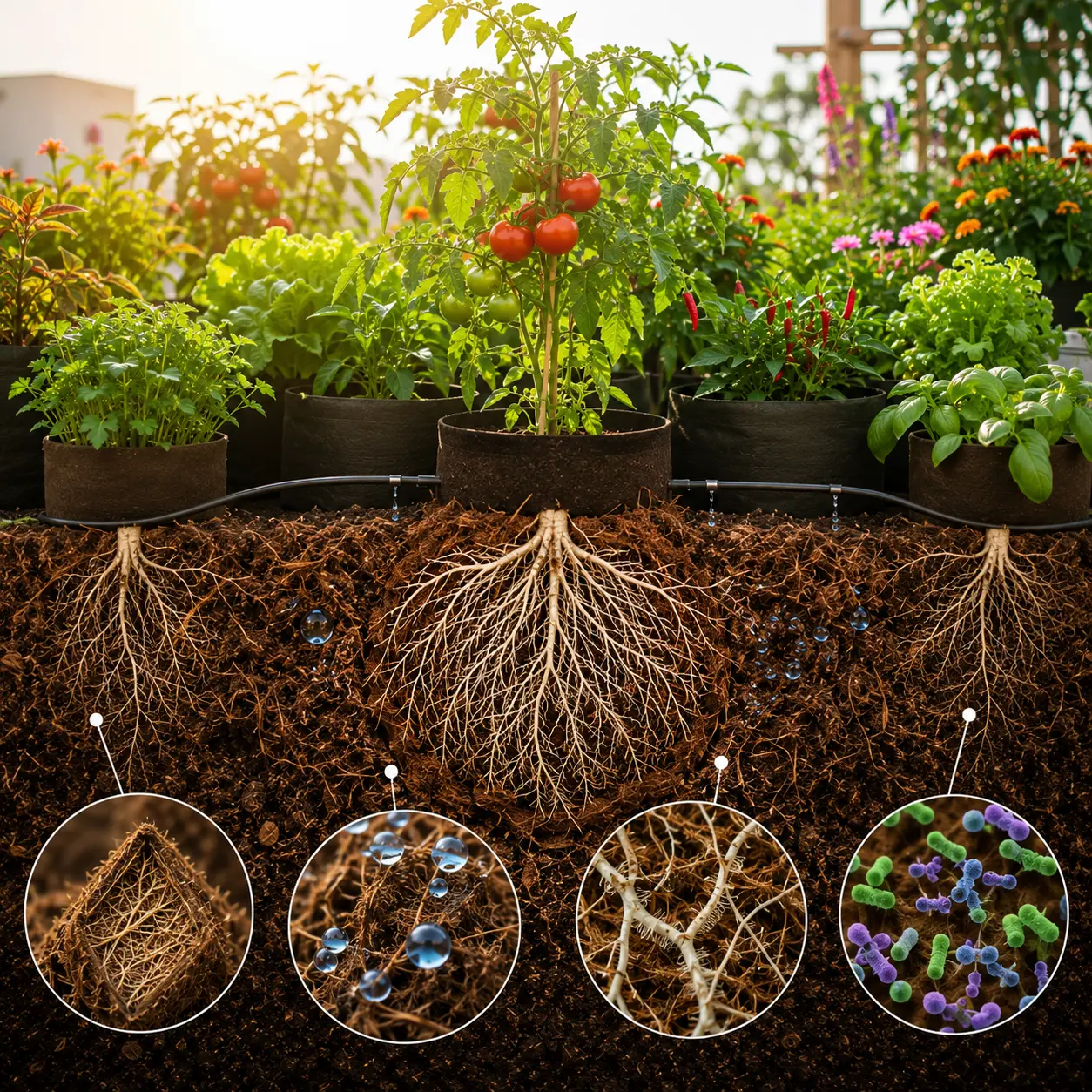
Coco Peat Growing Medium
Enhances moisture retention while maintaining excellent root-zone aeration.

Grow Bags for Plants
Improve drainage, root aeration, and vegetable production in limited spaces.

Plastic Pots for Plants
Ideal containers for seedlings, ornamentals, herbs, and balcony gardens.
Quick Diagnosis
| Symptom | Most Likely Cause | First Action |
|---|---|---|
| Leaves are yellowing from the edges inward | Sigatoka leaf spot (fungal) | Remove affected leaves immediately |
| The entire plant wilts suddenly | Panama wilt (Fusarium) | Check pseudostem — red/brown inside means wilt |
| Leaves are yellowing from edges inward | Bunchy top virus (BBTV) | Isolate plant; do not propagate from it |
| Yellowing of lower leaves only | Overwatering or poor drainage | Check soil moisture; improve drainage |
| New leaves small, bunched, and pale | Panama wilt or bacterial rot | Cut open the stem; note the colour pattern |
| Black streaks inside the pseudostem | Banana weevil (Cosmopolites) | Probe base with a stick; check for larvae |
| Fruit turning black before ripening | Anthracnose or crown rot | Harvest earlier; treat with copper fungicide |
Diseases
Banana plants in India face a short list of diseases that account for the vast majority of losses. Three are fungal, one is bacterial, and one is viral — and the viral one is the most serious.
Panama Wilt (Fusarium oxysporum f. sp. cubense)
Panama wilt is the most feared banana disease in India, and for good reason: there is no cure. The fungus lives in the soil and enters through the roots, blocking the plant’s water transport system from the inside. The first visible sign is yellowing of the oldest, outermost leaves, which droop and collapse one by one while the younger inner leaves look normal for a while.
The definitive test is to cut the pseudostem horizontally at the base — a healthy plant shows white or cream tissue; infected tissue shows red, brown, or purple discolouration in the vascular ring. Once you see that discolouration, the plant cannot be saved. Remove and destroy it immediately — do not compost it.
The fungus persists in soil for decades, so replanting bananas in the same spot without fumigation or a multi-year fallow period guarantees repeat infection. Cavendish varieties (the Robusta and Grand Naine types sold widely in Indian nurseries) show moderate resistance to Race 1 of the fungus but are highly susceptible to Tropical Race 4 (TR4), which has been reported in parts of South India.
Sigatoka Leaf Spot (Mycosphaerella musicola) and Black Sigatoka (M. fijiensis)
Sigatoka is the most common foliar disease of banana in India, and it is manageable if addressed early. Yellow Sigatoka begins as pale yellow streaks on older leaves that expand into brown oval spots with yellow margins.
Black Sigatoka is more aggressive — small dark brown spots appear first, often with a chlorotic halo, and can kill large sections of leaf tissue within weeks in humid conditions. Both diseases are purely fungal and spread by spores in humid, warm weather — exactly the conditions of the Indian monsoon.
The disease reduces photosynthetic area, which in turn reduces bunch weight and can delay ripening. Removing infected leaves as soon as symptoms appear and ensuring adequate spacing between plants for air circulation are the two most effective management steps. Copper-based fungicides or mancozeb sprays, applied during early symptom onset, can slow progression significantly.
Banana Bunchy Top Virus (BBTV)
Bunchy top virus is incurable and highly infectious. It is spread almost entirely by the banana aphid (Pentalonia nigronervosa), which feeds on infected plants and then carries the virus to healthy ones. The symptoms are unmistakable once you know them: new leaves emerge narrow, pale, and bunched together at the top of the plant — hence the name.
Leaf margins may curl upward, and the plant stops growing normally. There is no treatment. The only management strategy is to remove and destroy infected plants as soon as they are identified, treat surviving plants and surrounding plants with aphid control to break the transmission cycle, and never use suckers from infected plants for propagation. BBTV is a major constraint in Kerala, parts of Tamil Nadu, and Andhra Pradesh, where aphid populations are high in the dry season.
Banana Anthracnose (Colletotrichum musae)
Anthracnose primarily affects harvested fruit rather than the growing plant, but it originates in the field. Small, sunken, dark brown to black lesions appear on the fruit skin, typically starting at the tip or near wounds. In highly humid growing conditions, infection can spread rapidly after harvest, making fruit unmarketable within days.
Field sanitation — removing dead flower bracts, which are prime sites for the fungus to establish — is the most effective prevention. Post-harvest treatment with hot water dips or fungicidal dips is standard practice in commercial growing.
Pest Problems
Banana Weevil Borer (Cosmopolites sordidus)
The banana weevil is one of the most destructive pests of banana in India and is easily missed because the damage happens underground. Adult weevils are dark brown to black, about 1 cm long, and are active at night — you will rarely see them during the day.
The larvae tunnel into the rhizome (corm) and pseudostem base, destroying the internal tissue. Above ground, the first signs are yellowing of leaves, reduced plant vigour, and — in severe infestations — the plant tilting or toppling.
To confirm weevil presence, slice the pseudostem at the soil level: larval tunnels and brown-black gallery damage are obvious if they are there. Organic control includes placing cut pseudostem sections near the plant base as trap material (weevils are attracted to the fresh cut surfaces) and removing them with the weevils every few days. Chlorpyrifos-based drenches are effective for chemical control in severe cases, applied to the base of the plant.
Aphids (Pentalonia nigronervosa)
The banana aphid is small, reddish-brown to dark brown, and clusters on the undersides of leaves and at the base of the pseudostem. Direct feeding damage is relatively minor — the real danger is that this aphid is the primary vector for BBTV (see Diseases). If you find aphids on banana plants, treat them immediately with neem oil spray or insecticidal soap. Chemical options include imidacloprid soil drenches, which provide systemic protection. Inspect newly acquired plants and suckers carefully before planting — aphids are the most common way BBTV enters a garden.
This pest is commonly mistaken for a disease when it causes leaf deformation — the curling and puckering of young leaves caused by aphid feeding can look like a viral or nutritional problem. Look closely at the leaf undersides and base before diagnosing.
Thrips (Thrips hawaiiensis and related species)
Thrips cause scarring and silvery streaking on banana fruit skin — the damage is cosmetic for home gardeners but significant for anyone selling or gifting the fruit. They feed between the developing fingers during the early stages of bunch development, and by the time the fruit is visible, the scarring is already done.
The flower bracts, as they open, expose the young fingers briefly — this is the critical window. Blue sticky traps near the bunch can indicate thrip pressure. Spinosad-based sprays are effective for organic control; synthetic pyrethroids are the chemical option.
This information is for general guidance only. Always read product labels before applying any pesticide or fungicide. Follow state agriculture department guidelines for food crops. Keep children and pets away during and after application.
Environmental and Care Mistakes
Waterlogging and Root Rot
The single most common mistake Indian home gardeners make with bananas is planting in soil that holds water. Banana plants are heavy drinkers but cannot tolerate stagnant water around the roots. Waterlogged roots develop rot within days during the monsoon — roots turn brown and mushy, and the plant begins wilting despite apparently wet soil.
The cruel irony is that waterlogging looks exactly like drought from above: a wilting plant with discoloured leaves. Check the soil before watering. If the top 5 cm is still wet, do not water. Before the monsoon, check drainage paths around every banana plant and clear any blockage. For routine drainage improvement, see the Banana Growing Guide.
Pseudostem Damage from Wind
Tall banana varieties — especially Nendran and Robusta, grown in exposed locations — are highly vulnerable to wind damage. The pseudostem does not snap clean; it splits and tears, exposing the inner layers to fungal and bacterial infection. The first sign is a lengthwise crack or a tilted plant after strong winds.
Beyond supporting the plant with bamboo stakes before flowering, once a pseudostem is split open, the primary risk is secondary infection. Apply a copper paste or wood ash to the exposed tissue immediately and monitor for rot. Coastal gardeners in Maharashtra, Odisha, and Andhra Pradesh face this problem severely during the pre-cyclone and monsoon seasons — staking before June is not optional in these regions.
Nutrient Deficiency Misdiagnosed as Disease
Potassium deficiency is widespread in Indian banana gardens and is almost universally mistaken for a disease. The symptom — premature yellowing of older leaves starting from the tip, with brown scorched margins — looks almost identical to Sigatoka in early stages. The difference: Sigatoka shows small oval spots with defined margins; potassium deficiency shows a diffuse, spreading yellowing that begins at the leaf tip and margin with no spots.
Banana is an extremely potassium-hungry plant. Soil that has grown bananas continuously for more than two seasons without potassium supplementation will almost certainly be depleted. Adding wood ash, banana peel compost, or muriate of potash resolves deficiency symptoms within 3–4 weeks. For full fertiliser guidance, see the Banana Growing Guide.
Transplant Shock in Tissue Culture Plants
Tissue culture banana plants — now the standard planting material for Grand Naine and widely improved varieties — are grown in sterile, controlled conditions and experience significant stress when moved to field soil. The first 6–8 weeks after transplanting are the highest-risk period. Symptoms include pale, papery leaves, slow growth, and occasional browning at leaf tips.
These are shock symptoms, not disease. The most common mistake is over-fertilising a shocked plant to “help it recover,” which burns the sensitive young roots and compounds the problem. Water lightly and consistently, provide shade if transplanting in summer, and hold off on fertiliser for the first 3–4 weeks.
Prevention Protocol
Preventing banana plant problems in India is significantly more effective than treating them, because the two most serious threats — Panama wilt and bunchy top virus — have no cure once established.
Always start with certified, disease-free planting material. Suckers from a neighbour’s garden or uncertified nurseries carry the highest risk of introducing Panama wilt fungus and BBTV. State agriculture department nurseries and KVK (Krishi Vigyan Kendra) outlets are the most reliable sources for clean material.
Before monsoon onset, clear all dead plant debris, old pseudostems, and banana bracts from around the plant base — these are primary infection sites for Sigatoka, anthracnose, and weevil harborage. Inspect plants weekly during the active growing season (typically post-monsoon through spring) for the first signs of aphid colonies, and treat immediately — breaking the aphid–BBTV transmission chain is the most effective BBTV prevention available to home gardeners.
Ensure drainage is functional before every monsoon; in flat or low-lying gardens, raise the planting bed by at least 30 cm. Rotate or fallow the planting area after every 2–3 crop cycles to reduce soil pathogen buildup, especially if Panama wilt has been observed in the vicinity.
When to Give Up on a Plant
Some banana plant conditions are unrecoverable, and holding on to a diseased plant actively endangers surrounding plants.
Give up when: the pseudostem cross-section shows red or brown vascular discolouration (Panama wilt confirmed), the plant shows BBTV symptoms (bunched, narrow, pale new leaves), and the virus has been confirmed by the symptom pattern, or the rhizome shows more than 50% gallery damage from weevil infestation with no viable growing point remaining.
When removing a diseased plant, do not compost any part of it — burn or deeply bury all material. For Panama wilt specifically, do not replant any Musa species in the same soil for at least two full seasons.
If replanting is necessary sooner, solarise the soil by covering it with clear plastic sheeting for 6–8 weeks during peak summer (April–May) to raise soil temperature to levels that suppress Fusarium. For BBTV-infected gardens, a two-week gap between removal and replanting is the minimum — use that time to aggressively treat any aphids in the area before introducing new plants.
Frequently Asked Questions
Is it safe to eat bananas from a plant that has Sigatoka leaf spots?
Yes. Sigatoka is a foliar disease that affects the leaves, not the fruit. Fruit from affected plants is safe to eat, though reduced leaf area may mean smaller bunches or slightly delayed ripening.
My banana plant’s outer leaves are yellow, but the inner ones look fine — is this normal?
Some yellowing of the oldest outer leaves is a normal part of the plant’s growth cycle. It becomes a concern when yellowing progresses inward quickly, affects leaves at all stages, or is accompanied by wilting or spots.
Can I save a banana plant with root rot from waterlogging?
If caught early, the plant is wilting, but the pseudostem base is still firm — improving drainage and holding water for 10–14 days can allow recovery. If the corm is soft and mushy at the base, the plant cannot be saved.
Banana problems look dramatic, but most are predictable. Fix the drainage, start with clean planting material, and check your plants once a week — that habit alone prevents the majority of losses Indian gardeners face.