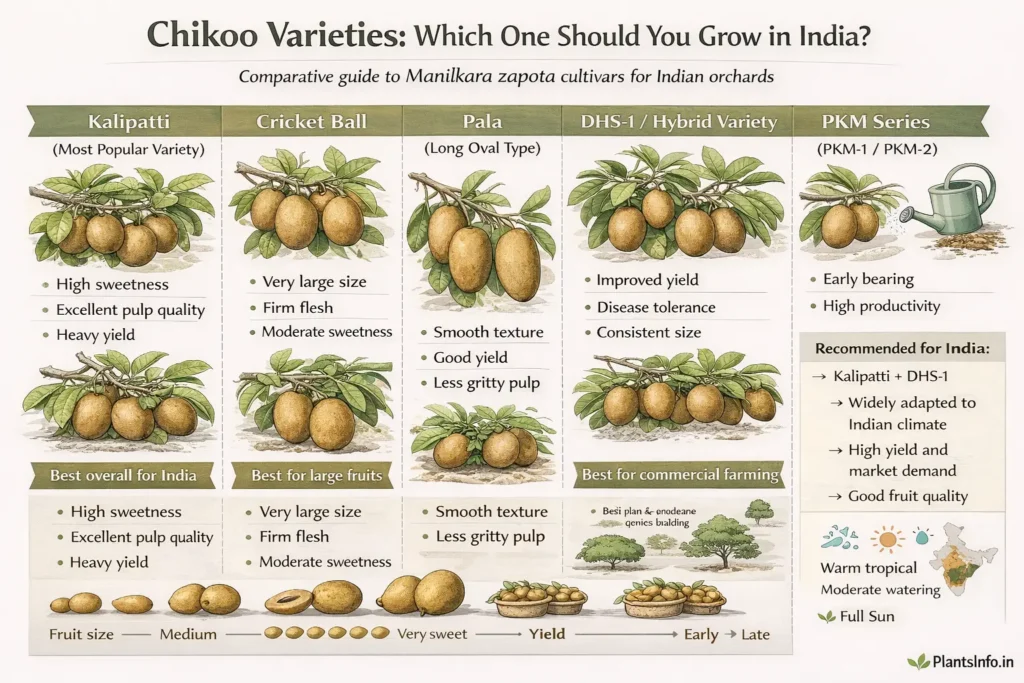
Chikoo Varieties: Which One Should You Grow in India?
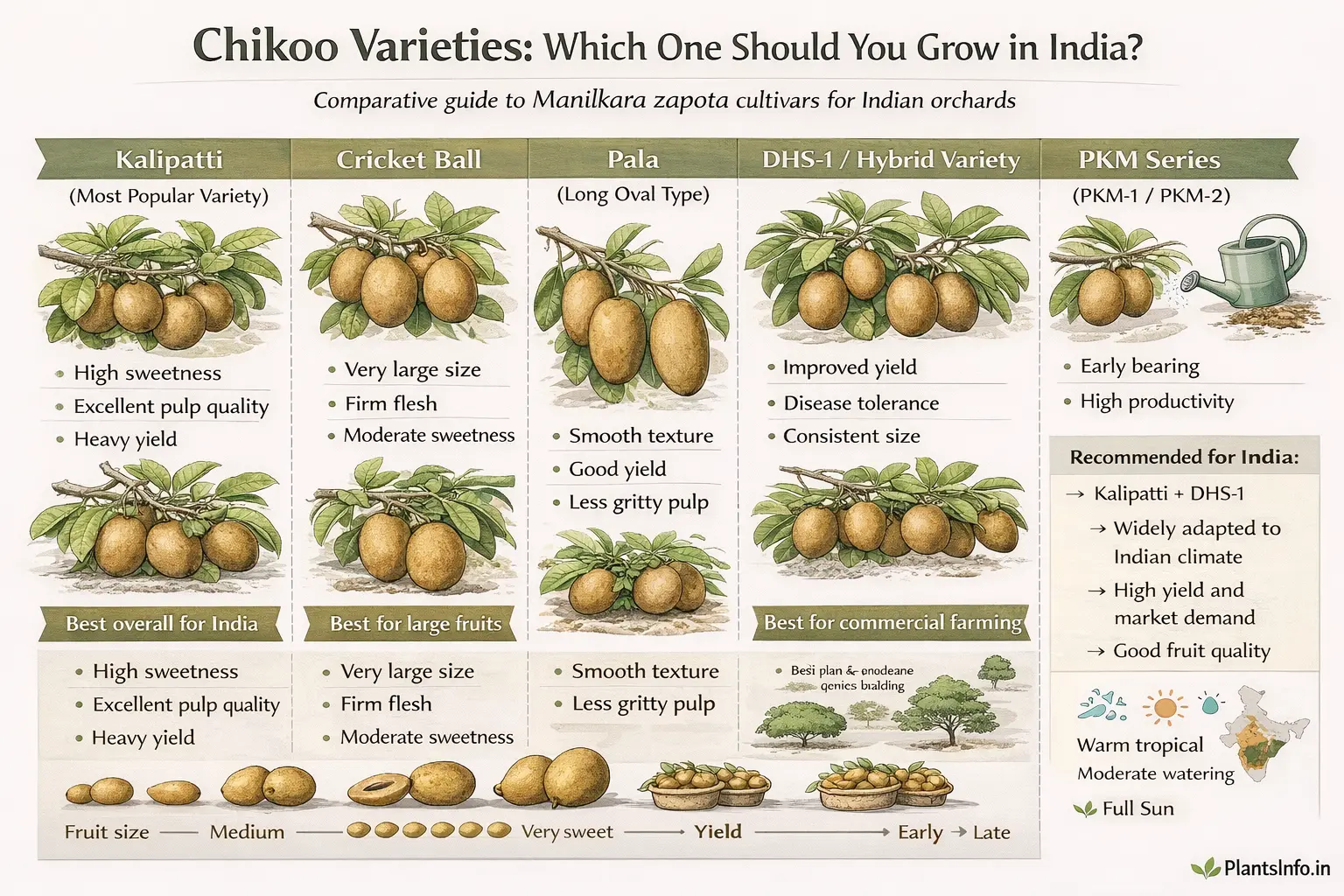
Chikoo Varieties: Which One Should You Grow in India?
Two chikoo trees planted side by side in a Karnataka garden can produce fruit of entirely different size, texture, and sweetness — not because of how they are grown, but because of which variety they are.
See also: Chikoo plant profile, how to grow it, common problems, its flowering season, and its benefits.
Chikoo (Manilkara zapota) has been cultivated in India long enough to develop a strong regional variety culture, and what thrives in coastal Gujarat is not always what performs in Tamil Nadu or Maharashtra. Most Indian home gardeners buy whatever grafted sapling the nursery has in stock. This speech gives you the information to ask for something specific.
Recommended Products
Disclosure: As an Amazon Associate, PlantsInfo may earn from qualifying purchases.
🌱 Growing Essentials
The following products can help with container gardening, potting, root development, soil management, and healthy plant growth.
Organic Potting Soil Mix
Provides nutrients, structure, and healthy growing conditions for container plants.
Coco Peat Growing Medium
Enhances moisture retention while maintaining excellent root-zone aeration.

Grow Bags for Plants
Improve drainage, root aeration, and vegetable production in limited spaces.

Plastic Pots for Plants
Ideal containers for seedlings, ornamentals, herbs, and balcony gardens.
Quick Answer: Kalipatti is the most widely grown and commercially successful Indian chikoo variety, valued for its sweet flavour and long shelf life. For a home garden, it remains the safest choice across most of India. Cricket Ball suits those who want large, impressive fruit. Baramasi is the best option for near-continuous fruiting through the year.
Quick Variety Selector
| Variety | Type | Plant Size | Best For | Suited To |
|---|---|---|---|---|
| Kalipatti | Improved selection | Large | Home and commercial, reliable yield | Maharashtra, Gujarat, Karnataka, AP |
| Cricket Ball | Improved selection | Large | Large fruit, home display, gifting | Maharashtra, Gujarat, South India |
| Baramasi | Desi / open-pollinated selection | Medium–Large | Year-round fruiting, home gardens | Most of India; performs well in humid climates |
| CO-1 | Improved (Tamil Nadu) | Medium | Most of India performs well in humid climates | Tamil Nadu, Andhra Pradesh, Karnataka |
| PKM-1 | Improved (Tamil Nadu) | Medium | High yield, early bearing | Tamil Nadu, parts of South India |
| Pilipatti | Desi selection | Large | Traditional flavour, low-input growing | Gujarat, Maharashtra |
| Dwarapudi | Regional selection | Large | Coastal and humid conditions | Coastal Andhra Pradesh |
| DHS-1 | Improved (Karnataka) | Medium | Compact planting, moderate yield | Karnataka, South India |
Varieties in Detail
Kalipatti originated as a selection from Maharashtra and remains the dominant commercial variety in India’s largest chikoo-producing belt — Dahanu and Palghar in Maharashtra, and parts of Gujarat. The name refers to the blackish-brown calyx remnant at the fruit’s base. Fruit is oval to elongated, medium to large, with a smooth texture and high sugar content.
Shelf life after harvest is notably longer than most other varieties, which is why it dominates commercial trade. The tree is vigorous and large; in a home garden, it requires adequate space and is not suitable for containers. Its chief weakness is susceptibility to fruit borer in humid coastal conditions.
Cricket Ball Named for its large, round fruit resembling a cricket ball. One of the most visually impressive chikoo varieties, producing fruit that can weigh 150–200 grams, with a coarse-grained, granular texture that some consumers prefer and others do not. Flavour is sweet but less refined than Kalipatti.
The tree is large and spreading and requires significant space. Cricket Ball is better suited to a home garden where fruit size and visual impact matter more than commercial shelf life. Less widely available as grafted nursery stock than Kalipatti; may need to be sourced from specialist nurseries.
Baramasi Baramasi means “twelve months” in Hindi — an accurate description of its most valuable characteristic. Unlike most chikoo varieties that produce in one or two distinct seasonal flushes, Baramasi bears fruit across most of the year with overlapping flowering and fruiting cycles.
Fruit is medium-sized, round to oval, with good sweetness but a lower shelf life than Kalipatti. For a home gardener who wants a continuous supply rather than a single large harvest, Baramasi is the most practical choice available. The tree is medium to large and adapts well across India’s humid regions.
CO-1 Developed by Tamil Nadu Agricultural University, CO-1 was bred for higher yield and earlier bearing than traditional selections. It typically begins fruiting at three to four years from grafting — faster than most desi varieties.
Fruit is medium-sized, oval, with good flavour. It is well-suited to Tamil Nadu’s climate and performs reliably in Karnataka and coastal Andhra Pradesh. CO-1 trees tend to be slightly more compact than Kalipatti, which makes them marginally more manageable in a home garden setting. Widely available through Tamil Nadu government nurseries and KVK outlets in the region.
PKM-1 Also from Tamil Nadu Agricultural University, PKM-1 is valued primarily for its precocity — it begins bearing earlier than most varieties, sometimes within two to three years of grafting.
Fruit is medium-sized with good sugar content. It is a practical choice for gardeners in South India who want to see results quickly. Its long-term yield and tree longevity are generally considered slightly below CO-1 in Tamil Nadu conditions, but for a home gardener seeking early fruiting, the trade-off is often acceptable.
Pilipatti, an older desi selection from Gujarat and Maharashtra, Pilipatti produces large, elongated fruit with a distinct flavour that long-term chikoo consumers often describe as richer and more complex than improved hybrid selections.
The tree is large and slow-maturing by modern standards — it may take five to six years from grafting before reliable fruiting. For a home gardener with space, patience, and a preference for traditional flavour over commercial consistency, Pilipatti is worth seeking out. It is more tolerant of low-input growing conditions than improved selections. Less commonly available in nurseries outside its home regions.
Dwarapudi, a regional selection from coastal Andhra Pradesh, Dwarapudi is adapted to the high humidity and warm temperatures of the eastern coastal belt. The fruit is large and oval with good sweetness. It is not widely cultivated outside its home region but is available through nurseries in Andhra Pradesh and Telangana. For gardeners in coastal AP and Odisha, it is worth considering as a locally adapted alternative to Kalipatti.
DHS-1 Developed by the University of Horticultural Sciences, Bagalkot (Karnataka), DHS-1 is a relatively compact variety suited to South Indian conditions. It is grown primarily in Karnataka and is not widely distributed beyond the state. For Bangalore and Mysore region home gardeners who find Kalipatti trees growing too large for their available space, DHS-1 is a practical alternative worth inquiring about at local KVK outlets.
Head-to-Head Comparison
Kalipatti vs. Cricket Ball: The most common decision for Indian home gardeners choosing a single chikoo tree. Kalipatti wins on fruit quality for eating, shelf life after harvest, and consistent annual yield — it is a lower-risk choice across a wider range of conditions.
Cricket Ball wins on fruit size and visual drama; if you grow chikoo partly for the impression large fruit makes, it delivers something Kalipatti does not. For most gardeners choosing one tree for a kitchen garden or terrace, Kalipatti is the correct recommendation. Cricket Ball makes sense where space is generous, and novelty is part of the goal.
Baramasi vs. Kalipatti: These are not competing on the same criteria. Kalipatti produces heavier, higher-quality fruit in concentrated seasonal flushes. Baramasi produces moderate-quality fruit spread across most of the year.
The choice comes down to how you want to use the tree: if you want a periodic, large harvest for the household, Kalipatti. If you want a few fruits available continuously through the year with minimal effort in timing, Baramasi. In practice, many home gardeners with space for two trees plant one of each.
How to Choose for Your Space
Container or terrace garden Chikoo is a large tree by nature, and no variety is genuinely well-suited to long-term container growing in the way that dwarf citrus or certain guava varieties are.
In practice, a grafted chikoo in a large container (100+ litres) can be maintained for several years before the root restriction becomes limiting, but long-term productivity will be lower than in-ground. If container growing is the only option, CO-1 or DHS-1 are the most compact of the commonly available varieties. Expect reduced yield and plan for eventual ground planting or replacement.
Small ground plot (under 200 sq ft) Baramasi or CO-1. Both are slightly more manageable in size than Kalipatti or Cricket Ball, and their bearing characteristics — year-round for Baramasi, early for CO-1 — suit a gardener who wants returns from a limited investment. Plant at least 6 metres from walls or structures to accommodate mature spread.
Larger garden or backyard Kalipatti is the default recommendation for quality and reliability. Where space allows two trees, pair Kalipatti with Baramasi for both a seasonal peak harvest and a year-round background supply.
Commercial or semi-commercial home orchard, Kalipatti for Maharashtra and Gujarat. CO-1 or PKM-1 for Tamil Nadu and South India. Both regional selections have been developed with yield and marketability in mind, and post-harvest shelf life — critical for any selling situation — is better in these improved varieties than in desi selections.
Regional Suitability
Maharashtra and Gujarat: Kalipatti is the historic and commercial standard in the Konkan belt and Gujarat’s Surat-Navsari region. Cricket Ball and Pilipatti are traditional regional alternatives. All three perform well in the warm, humid-to-semi-arid climate of these states.
Tamil Nadu and Andhra Pradesh: CO-1 and PKM-1 are the recommended choices, developed specifically for these conditions. Dwarapudi for coastal AP. Kalipatti can be grown here, but it is not the optimum selection — regional varieties outperform it in local trials.
Karnataka: DHS-1 for Bangalore and Mysore region. Kalipatti also performs well. CO-1 grows successfully in South Karnataka. Avoid Cricket Ball in high-humidity zones of coastal Karnataka — fruit borer incidence is higher with this variety in humid conditions.
North India (UP, Bihar, MP, Rajasthan): Chikoo grows in these states but is not a primary fruit crop. Baramasi is the most adaptable choice in borderline climates. Avoid planting in areas with sustained frost; chikoo is frost-sensitive, and young trees are particularly vulnerable.
Coastal regions (Kerala, Goa, coastal Maharashtra, coastal Odisha, and Bengal): Kalipatti and Baramasi. High humidity demands attention to mealybug and sooty mould management regardless of variety. Dwarapudi for eastern coastal zones.
Desi vs. Hybrid — What Nobody Tells You
“Hybrid” is not the right frame for chikoo — virtually all commercially grown Indian varieties, including the so-called improved selections like CO-1 and PKM-1, are clonally propagated through grafting from selected superior mother trees, not from crossing programmes in the way vegetable hybrids are produced. The distinction that actually matters for a home gardener is grafted vs. seed-grown.
A grafted chikoo tree — whether Kalipatti, Cricket Ball, or any named variety — will begin fruiting in three to five years and produce fruit true to its parent. A seed-grown chikoo will take eight to twelve years to fruit, and the fruit characteristics will be unpredictable.
The overwhelming majority of quality nurseries in India sell grafted stock. If you are offered a chikoo seedling at a very low price with no variety name, assume it is seed-grown and factor the long bearing lag into your decision.
Seed cannot be saved from grafted trees with any expectation of reproducing the parent variety. Buy grafted, buy named.
Watch Out for Mislabelling
Mislabelling is a genuine and documented problem in the Indian chikoo nursery trade, particularly with Kalipatti. Because Kalipatti commands the highest retail price among common varieties, seedlings of inferior, unnamed selections or seed-grown trees are frequently sold under the Kalipatti label. A genuinely grafted Kalipatti sapling will show a visible graft union near the base of the stem — a slight swelling or angled join point where the scion meets the rootstock. If no graft union is visible on a “Kalipatti” sapling, it is almost certainly not grafted and may not be the stated variety.
Cricket Ball is similarly subject to substitution with any large-fruited local selection. The only reliable check is the graft union and purchasing from a source with verifiable stock — government nurseries, KVK outlets, or established horticultural suppliers with a reputation to protect.
When purchasing from a private nursery, ask specifically: “Is this grafted or seed-grown?” and “From which mother tree or certified source was the scion taken?” A reputable seller will answer both questions directly.
Where to Source These Varieties in India
State government horticulture department nurseries and KVK (Krishi Vigyan Kendra) outlets are the most reliable sources for certified grafted chikoo stock, particularly for regional varieties like CO-1, PKM-1, and DHS-1 that may not be stocked by general nurseries. Tamil Nadu Horticulture Department outlets and the nurseries attached to state agricultural universities are particularly well-regarded for South Indian varieties.
For Maharashtra and Gujarat, the Dahanu-Palghar belt has established commercial nurseries with verifiable Kalipatti grafted stock; these are accessible through local horticulture networks and some online plant sellers.
When purchasing online, verify that the seller states the variety name, confirms grafted propagation, and provides a graft union visible in product photographs. Reject any listing that describes a chikoo sapling only as “chikoo plant” with no variety information — this is almost always seed-grown stock.
Freshness of the grafted sapling matters: a healthy grafted chikoo for planting should have 30–50 cm of active growth above the graft union, firm non-mushy roots, and no sign of leaf yellowing or stem softening. Do not accept planting stock that shows any of these stress signs, regardless of the variety named.
The single most consequential decision in growing chikoo at home is choosing grafted named-variety stock from a reliable source — everything else, including care and climate, matters less than starting with the right plant.