Chikoo, scientifically known as Manilkara zapota, is a tropical evergreen fruit tree in the family Sapotaceae, native to southern Mexico and Central America. It is distinguished by its sweet, brown, berry-like fruits and its production of chicle, a natural latex historically used in chewing gum. The species has become widely cultivated across tropical regions, particularly in India.
Ecologically, Manilkara zapota functions as a food resource for frugivorous birds and mammals, while its small, nectar-bearing flowers support insect pollinators. Its dense evergreen canopy contributes to habitat structure in agroforestry systems, and its physiological tolerance to drought enables survival in seasonally dry tropical climates.
From a human perspective, chikoo is an economically important fruit crop valued for fresh consumption and nutritional content. It also has documented medicinal uses and historical industrial significance. This profile presents a detailed scientific account of its taxonomy, morphology, physiology, ecology, and environmental adaptations.
Classification and Taxonomy
Field
Value
Notes
Accepted Scientific Name
Manilkara zapota (L.) P.Royen
Accepted name
Known Synonyms
Achras zapota L.; Sapota achras Mill.
Historical synonyms
Taxonomic Authority Source
Plants of the World Online (Kew Science)
Authoritative taxonomy
Assessment Date
2026-03-23
ISO 8601 format
Classification Hierarchy
Rank
Taxon
Kingdom
Plantae
Division
Magnoliophyta
Class
Magnoliopsida
Order
Ericales
Family
Sapotaceae
Subfamily
Sapotoideae
Genus
Manilkara
Species
Manilkara zapota
Quick Reference
Parameter
Value
Common Name(s)
Chikoo; Sapodilla; Sapota
Plant Type
Evergreen fruit tree
Lifecycle
Perennial
Native Range
Southern Mexico; Central America
USDA Hardiness Zones
10–12
Toxicity Summary
Seeds contain bioactive compounds; fruit edible when ripe
IUCN Status
Not evaluated
Research Coverage Level
High
Cytogenetics
Parameter
Value
Notes
Chromosome Number
2n = 26
Reported in Sapotaceae
Ploidy
Diploid
Stable
Genome Size
Not documented in available literature
No genome assembly
Scientific Stability and Nomenclature
Parameter
Value
Notes
Nomenclatural Stability
Stable
Widely accepted
Current Accepted Authority
P. Royen (1953)
Revision of Sapotaceae
Major Reclassification Events
Transferred from Achras zapota to Manilkara zapota — Royen (1953)
Formal taxonomic revision
Growth Habit and Architecture
Parameter
Description
Notes
Growth Form
Evergreen tree reaching 10–20 m (33–66 ft) height
Managed smaller in orchards
Crown Shape
Dense, rounded canopy
High leaf area
Trunk
Straight, cylindrical
Latex-producing
Bark
Brown to grey, fissured
Exudes latex
Branching Pattern
Sympodial branching
Dense lateral spread
Stem Texture
Woody with laticifer tissues
Defense mechanism
Latex Production
Laticifers release polyisoprene latex upon injury, sealing wounds and deterring herbivores
Protective function
Growth Rate
Moderate (30–60 cm/year)
Environment dependent
Longevity
50–100+ years
Long-lived
Canopy Density
High
Reduces understory light
Leaves
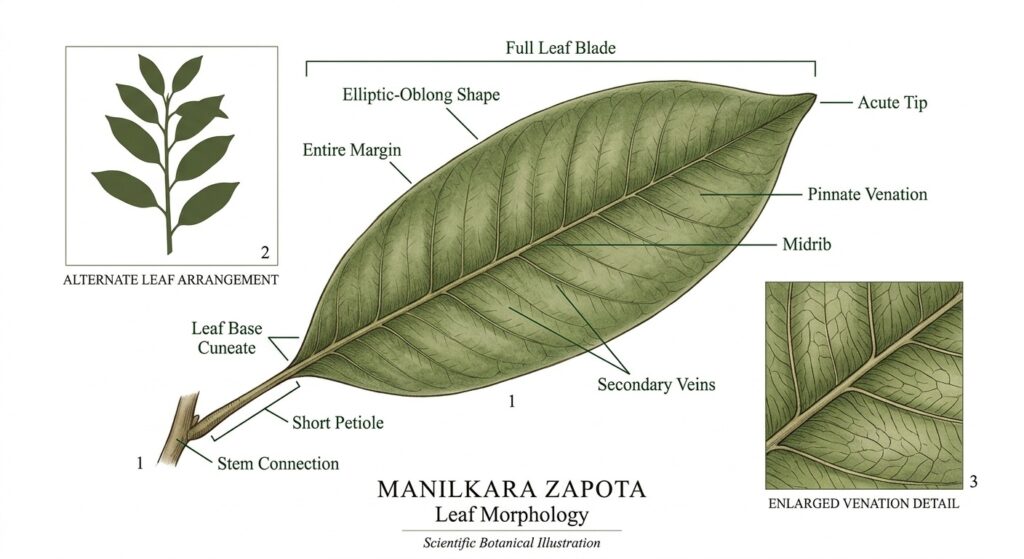
Leaf morphology of Manilkara zapota illustrating an elliptic-oblong blade with an entire margin, pinnate venation with a prominent midrib and secondary veins, an acute apex, cuneate base, short petiole, and alternate leaf arrangement, with an enlarged view of venation detail.
Parameter
Description
Presence
Present
Leaf Type
Simple, entire
Size (length × width)
5–15 cm × 2–6 cm (2–6 in × 0.8–2.4 in)
Colour
Dark green (upper), lighter green (lower)
Arrangement
Alternate
Special Features
Thick cuticle reduces transpirational water loss by limiting diffusion
Flowers
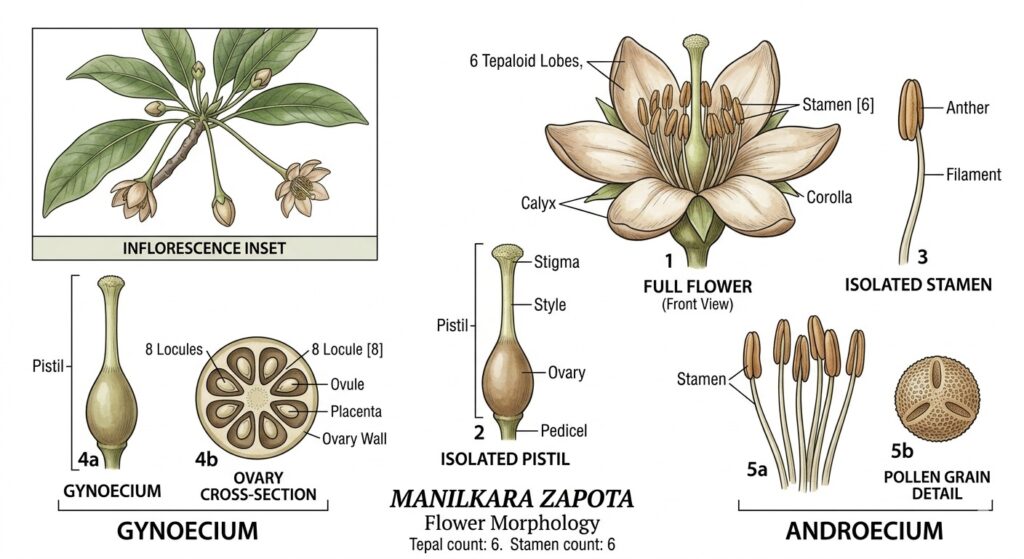
Flower morphology of Manilkara zapota illustrating a six-parted perianth, six stamens, and a multicarpellary gynoecium with an eight-loculed ovary, shown alongside detailed views of the stamen, pistil, ovary cross-section, and pollen grain.
Parameter
Description
Notes
Inflorescence Type
Solitary or clustered
Axillary
Flower Size
8–12 mm diameter
Small
Colour
Cream to greenish
Inconspicuous
Symmetry
Actinomorphic
Radial
Sexuality
Bisexual
Hermaphroditic
Perianth
6-lobed corolla
Sapotaceae trait
Stamens
6 fertile stamens with staminodes
Complex
Ovary Position
Superior
Standard
Nectar Production
Present
Pollinator attraction
Flowering Season
Multiple cycles annually
Climate dependent
Fruit
Fruit anatomy of Manilkara zapota showing an external view and a transverse section with a thin exocarp, fleshy mesocarp, multiple locules containing seeds, and centrally arranged placental tissue, with the pedicel scar visible at the base.
Parameter
Description
Notes
Fruit Type
Berry
True berry
Shape
Round to oval
Variable
Size
4–10 cm diameter (1.6–4 in)
Cultivar dependent
Weight
75–200 g
Commercial range
Skin
Brown, rough
Contains latex when unripe
Flesh
Soft, granular, brown
Sweet
Sugar Content
12–20 °Brix
High
Latex Content
High when immature, decreases during ripening
Affects edibility
Ripening Pattern
Climacteric
Ethylene-driven
Edibility
Edible when ripe
Unripe astringent
Recommended Products
Disclosure: As an Amazon Associate, PlantsInfo may earn from qualifying purchases.
🌱 Plant Care Essentials
The following tools can help with pruning, plant health, soil management, and fruit garden maintenance.
Neem Oil for Plant Care
Natural plant protection against aphids, whiteflies, mites, and other common garden pests.
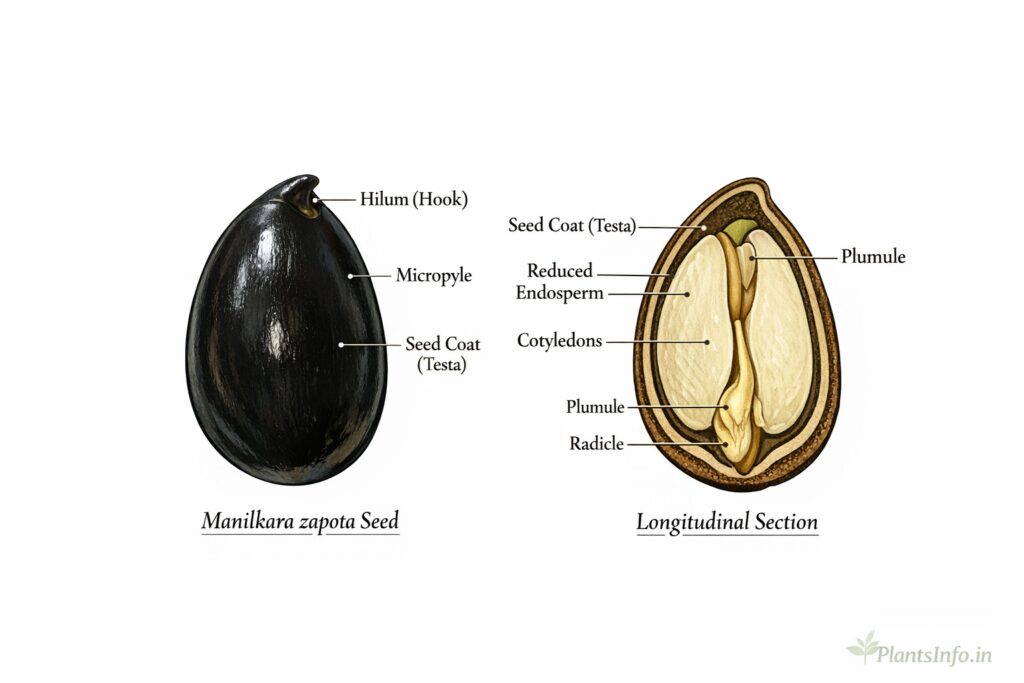
Seed anatomy of Manilkara zapota illustrating an external view with hilum and micropyle and a longitudinal section showing a thick seed coat, two large cotyledons, reduced endosperm, and an embryo with distinct plumule and radicle.
Parameter
Description
Notes
Seed Number
1–10
Usually 3–5
Seed Size
2–3 cm
Flattened
Seed Coat
Hard, glossy
Protective
Germination Type
Epigeal
Cotyledons emerge
Viability
2–3 weeks
Recalcitrant
Special Features
Hook-like tip aids mechanical anchoring in soil
Dispersal aid
Root System
Parameter
Description
Notes
Root Type
Deep taproot with lateral roots
Strong anchorage
Root Depth
Up to 2–3 m (6.5–10 ft)
Soil dependent
Special Features
Arbuscular mycorrhizal associations enhance phosphorus uptake via hyphal networks
Nutrient efficiency
Cultivars and Named Selections
Cultivar
Key Characteristic
Brix (°Brix)
Self-Compatible
Origin / Notes
‘Kalipatti’
High sweetness, oval fruit
18–20
Yes
India
‘Cricket Ball’
Large round fruit
14–18
Yes
India
‘Pala’
Elongated fruit, high yield
16–19
Yes
India
‘CO-1’
Early bearing
Not documented in available literature
Yes
Tamil Nadu
‘PKM-1’
Uniform yield
Not documented in available literature
Yes
India
Functional Traits
Trait
Description
Ecological Advantage
Latex secretion
Injury triggers rapid latex exudation that coagulates to seal wounds and block pathogen entry
Defense and water conservation
Evergreen canopy
Continuous photosynthesis maintained year-round due to persistent foliage
Stable carbon assimilation
Thick cuticle
Waxy layer reduces transpiration by limiting stomatal water diffusion
Drought tolerance
Deep root system
Roots access deep soil moisture reserves during dry periods
Water stability
Shade acclimation
Chlorophyll concentration adjusts to optimize light capture under varying irradiance
Agroforestry compatibility
Sugar accumulation
Enzymatic hydrolysis converts starch into soluble sugars increasing osmotic potential
Attracts dispersers
Climacteric ripening
Ethylene-mediated respiration surge accelerates softening and sugar release
Synchronised dispersal
Seed protection
Lignified seed coat resists predation and mechanical damage
Survival advantage
Mycorrhizal symbiosis
Fungal hyphae increase root surface area enhancing phosphorus uptake
Nutrient efficiency
Phytochemistry
Compound Class
Representative Compounds
Plant Organ
Function
Source
Triterpenoids
Lupeol, betulinic acid
Bark, leaves
Antimicrobial and anti-herbivory defense via membrane disruption
Sharma et al. (2010)
Phenolics
Gallic acid, catechin
Fruit pulp, leaves
Antioxidant activity through radical scavenging
Mohan et al. (2008)
Flavonoids
Quercetin, kaempferol
Leaves, fruit
UV protection and oxidative stress regulation
Singh et al. (2012)
Tannins
Proanthocyanidins
Unripe fruit
Protein binding causing astringency deterring herbivory
Morton (1987)
Polyisoprenes
Cis-1,4-polyisoprene (chicle)
Latex
Mechanical wound sealing and defense barrier formation
Morton (1987)
Saponins
Specific compounds not yet characterised
Bark
Defense against pathogens via membrane interaction
No characterisation study identified — manual research required
Astringency; potential irritation if seeds crushed
Morton (1987)
Cats
No toxic compounds documented in available literature
No documented adverse effects
ASPCA Animal Poison Control Center Database
Dogs
No toxic compounds documented in available literature
No documented adverse effects
ASPCA Animal Poison Control Center Database
Livestock
No toxic compounds documented in available literature
No documented adverse effects
FAO Feed Safety Reports
Native Range and Distribution
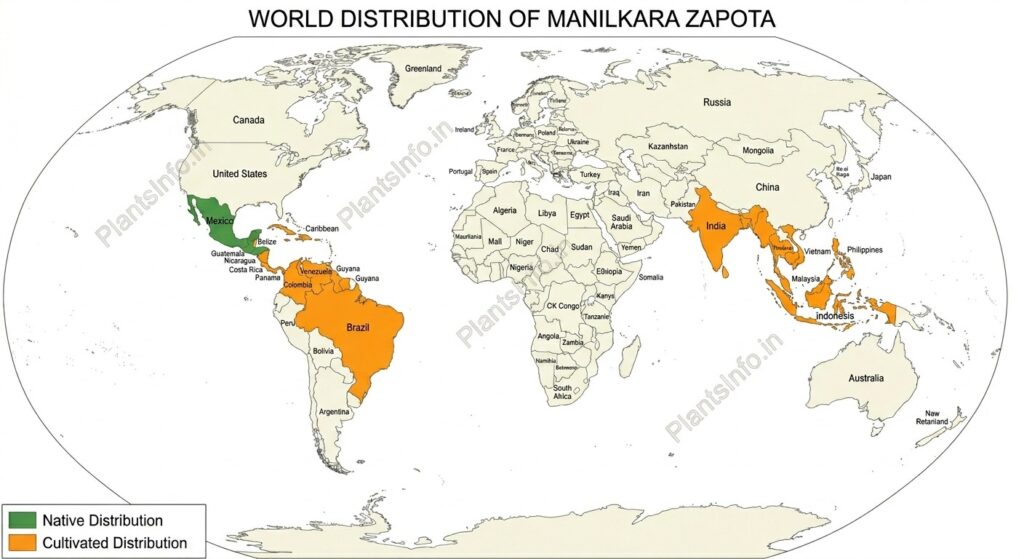
Global distribution of Manilkara zapota, indicating its native range in Mexico and Central America and its wider cultivated presence across tropical regions of South America, South Asia, Southeast Asia, and parts of Africa.
Parameter
Description
Native Range
Southern Mexico; Belize; Guatemala
Biogeographic Region
Neotropical
Elevation Range
0–800 m (0–2625 ft)
Endemism
Native but widely introduced
Range Type
Natural and cultivated
Notes
Extensively introduced to tropical Asia
Global Cultivation and Naturalization
Region
Status
Notes
India
Widely cultivated
Major producer
Southeast Asia
Cultivated
Thailand, Philippines
Caribbean
Naturalized
Secondary distribution
Africa
Limited cultivation
Tropical zones
Australia
Cultivated
Northern regions
Natural Habitat
Parameter
Description
Habitat Type
Tropical evergreen and semi-evergreen forests
Soil Type
Well-drained sandy to loamy soils
Rainfall
1000–2000 mm (39–79 in)
Light
Full sun to partial shade
Temperature
Warm tropical climates
Associated Species
Mixed tropical forest species assemblages
Ecological Role
Role
Description
Notes
Primary Pollinator Resource
Nectar source for Apis spp. (genus-level data only)
Genus-level data only
Seed Dispersal Resource
Fruits consumed by birds and mammals enabling zoochorous dispersal
Widely consumed fresh due to high sugar accumulation driven by enzymatic starch hydrolysis during ripening
Major domestic fruit crop in India
Processed Products
Converted into pulp, milkshakes, desserts, and dehydrated products through mechanical processing and sugar stabilization
Limited industrial scaling compared to mango
Latex (Chicle)
Latex composed of polyisoprenes extracted via bark tapping historically used in chewing gum manufacture
Declined after synthetic substitutes
Timber
Dense hardwood with high lignin content provides mechanical strength for tools and small construction
Secondary use
Agroforestry Systems
Integrated into mixed cropping systems where canopy moderates microclimate and reduces evapotranspiration
Enhances system resilience
Nutraceutical Potential
Phenolics and flavonoids contribute antioxidant activity via free radical scavenging mechanisms
Emerging research domain
Export Market
Limited due to climacteric ripening and short shelf life affecting transport stability
Regional trade only
Summary Economic Assessment
Moderate to high economic importance driven by domestic consumption, agroforestry integration, and emerging functional food potential
Stable demand with scope for value addition
Traditional Uses
Use Category
Description
Region / Cultural Group
Documentation Level
Source
Digestive Aid
Fruit fiber enhances intestinal motility and water retention improving bowel movement
India
Well documented
Morton (1987)
Anti-diarrheal
Tannins in unripe fruit precipitate proteins in intestinal lining reducing fluid loss
Central America
Well documented
Morton (1987)
Anti-inflammatory
Leaf extracts modulate inflammatory pathways via phenolic compounds
India
Moderate evidence
Sharma et al. (2010)
Oral Health
Latex applied to gums forms protective barrier reducing microbial exposure
Mexico
Limited documentation
Ethnobotanical surveys
Febrifuge
Bark decoction used to reduce fever through bioactive secondary metabolites
Central America
Moderate
Morton (1987)
TEK Note
Indigenous use emphasizes ripening stage control due to latex and tannin toxicity in immature fruit
Mesoamerican communities
Traditional Ecological Knowledge
Ethnobotanical literature
Ethical Considerations
Manilkara zapota originates from Mesoamerica, particularly southern Mexico and Central America, where it was domesticated and utilized by indigenous communities long before global dissemination. Traditional knowledge systems, especially among Maya populations, documented its uses for fruit consumption, medicinal applications, and latex extraction. The harvesting of chicle latex became a major economic activity in the late 19th and early 20th centuries, relying heavily on indigenous expertise in tapping techniques and forest management.
However, early commercialisation of chicle occurred largely without equitable recognition or compensation to indigenous knowledge holders. The global chewing gum industry benefited significantly from this resource, yet formal mechanisms for benefit-sharing were absent. Under the Nagoya Protocol framework, there is no documented Access and Benefit-Sharing (ABS) agreement specifically tied to Manilkara zapota. This absence highlights a historical inequity that modern research and commercial activities should address through ethical sourcing and acknowledgment of origin.
In India and other introduced regions, the species has been fully integrated into agricultural systems, often detached from its cultural origins. While this reflects successful crop diffusion, it raises ethical considerations regarding attribution and genetic resource sourcing. Breeding programs and commercial exploitation of phytochemicals must ensure compliance with international biodiversity agreements and avoid biopiracy.
Ethically responsible practice includes transparent documentation of germplasm origin, equitable collaboration with source-region institutions, and sustainable harvesting practices. Future development of nutraceuticals or pharmaceuticals derived from this species should proactively incorporate benefit-sharing mechanisms. Recognizing the contributions of indigenous knowledge systems is essential for aligning scientific advancement with ethical responsibility.
Cultural Significance
Aspect
Description
Notes
Symbolic Associations
Associated with sweetness and abundance due to high sugar fruit production
Regional cultural perception
Festive/Ceremonial Role
Sold and consumed during local harvest festivals
Not a primary ritual species
Linguistic/Naming Significance
“Sapodilla” derived from Spanish adaptation of indigenous Nahuatl terminology
Reflects colonial linguistic transition
Agrotourism/Public Interest
Orchard visits and fruit-picking activities in India promote rural tourism
Increasing economic relevance
Cultivation Requirements
Parameter
Requirement
Notes
Light
Full sun (≥6–8 hours/day) enabling high photosynthetic rates
Essential for fruiting
Soil Type
Well-drained sandy loam facilitating aeration and root penetration
Avoid heavy clay
Soil pH
6.0–8.0
Slight alkalinity tolerated
Water / Irrigation
Moderate; irrigation every 7–10 days in dry periods maintains turgor and fruit set
Drought tolerant when established
Fertiliser
Balanced NPK with organic inputs supporting vegetative and reproductive growth
Improves yield
Temperature Range
22–30°C (72–86°F) optimal for enzymatic activity
Frost sensitive
Spacing
8–10 m (26–33 ft) to prevent canopy competition
Ensures airflow
Support / Staking
Not required due to strong lignified trunk
Stable architecture
Pruning
Light pruning improves light penetration and reduces disease incidence
Annual practice
Container Suitability
Limited; only dwarf cultivars due to root depth requirement
Large containers needed
Propagation Methods
Method
Description
Time to Harvest
Notes
Seed propagation
Seeds germinate producing genetically variable rootstocks through sexual reproduction
6–8 years
Used for rootstock
Grafting
Scion fused with rootstock enabling vascular continuity and clonal propagation
3–4 years
Commercial standard
Air layering
Induced adventitious rooting on branches via girdling and moisture retention
4–5 years
Moderate success rate
Budding
Bud insertion into cambial layer enabling rapid clonal multiplication
3–4 years
Efficient nursery method
Harvesting and Post-Harvest Handling
Stage
Description
Timing
Notes
Harvesting
Fruits picked at physiological maturity when latex flow declines and starch reserves peak
4–6 months after flowering
Avoid immature harvest
Ripening
Ethylene-mediated climacteric respiration converts starch to sugars
3–7 days post-harvest
Improves sweetness
Storage
Stored at 12–15°C (54–59°F) to slow respiration without chilling injury
1–2 weeks
Sensitive below 10°C
Handling
Minimal mechanical stress prevents cell wall breakdown and bruising
Immediate
Soft flesh
Processing
Pulp extraction stabilizes sugars for value-added products
Post-ripening
Extends usability
Pests
Pest
Scientific Name
Symptoms
Treatment
Prevention
Fruit fly
Bactrocera dorsalis
Larvae feed on pulp causing fruit rot
Protein bait sprays, traps
Field sanitation
Tea mosquito bug
Helopeltis theivora
Sap sucking causes necrotic lesions
Insecticides, neem-based sprays
Monitoring and pruning
Mealybug
Planococcus citri
Honeydew secretion leading to sooty mold
Biological control, oils
Ant control and hygiene
Diseases
Disease
Pathogen
Symptoms
Treatment
Prevention
Anthracnose
Colletotrichum gloeosporioides
Dark lesions on fruit and leaves
Fungicide sprays
Orchard sanitation
Root rot
Phytophthora palmivora
Root decay and wilting
Improve drainage, fungicides
Avoid waterlogging
Leaf spot
Pestalotiopsis spp.
Brown necrotic spots on leaves
Copper fungicides
Proper spacing
Physiological and Environmental Issues
Problem
Cause
Solution
Fruit drop
Hormonal imbalance or water stress
Regulated irrigation and nutrient balance
Poor fruit quality
Nutrient deficiency affecting sugar synthesis
Balanced fertilisation
Leaf chlorosis
Nitrogen or micronutrient deficiency
Soil amendment
Slow growth
Poor soil aeration limiting root respiration
Improve soil structure
Sunburn
Excess radiation damaging epidermal cells
Shade young plants
Frost damage
Ice crystal formation disrupting cells
Protective covering
Common Cultivation Observations
Observation
Description
Notes
Irregular bearing
Alternate bearing due to carbohydrate allocation imbalance
Managed via pruning
Long juvenile phase
Seed plants delay reproductive transition
Grafting reduces phase
Sugar variability
Brix influenced by climate and cultivar genetics
Market impact
Latex presence
Indicates immature fruit stage due to active laticifers
Harvest indicator
Pest resilience
Moderate resistance due to latex defense
Monitoring required
Soil adaptability
Performs across diverse tropical soils with proper drainage
Stable in cultivation; wild populations insufficiently quantified
Requires field assessment
Threats
Habitat loss in native range due to deforestation
Mesoamerican forests
Conservation Actions
Agroforestry cultivation and germplasm conservation
Ex situ dominant
Legal Protection
Not specifically listed under CITES or national protection frameworks
Region dependent
Ex-situ Conservation
Maintained in agricultural orchards and research germplasm banks
Preserves genetic resources
Although Manilkara zapota is not formally evaluated by the IUCN, its extensive cultivation masks uncertainty regarding wild genetic diversity. Conservation strategies should prioritise in situ protection of native populations to prevent genetic erosion while maintaining ex situ collections for breeding resilience.
Research Coverage and Knowledge Gaps
Research Topic
Coverage Level
Key Gaps
Priority
Genomics
Low
Absence of full genome sequencing limits breeding
High
Phytochemistry
Moderate
Incomplete compound characterization in latex and seeds
High
Pollination Ecology
Low
Lack of species-level pollinator identification
Medium
Climate Adaptation
Moderate
Limited predictive modelling under climate scenarios
High
Priority Knowledge Gaps
Manilkara zapota remains under-characterised in several critical scientific domains despite its economic importance. One of the most significant gaps is the absence of a fully sequenced genome, which restricts advanced breeding strategies aimed at improving yield, disease resistance, and stress tolerance. Without genomic data, marker-assisted selection and trait mapping remain largely inaccessible.
Phytochemical research has identified major compound classes such as phenolics and triterpenoids, yet detailed characterisation of latex, bark, and seed metabolites is incomplete. This limits exploration of pharmacological applications and industrial uses. Additionally, pollination ecology remains poorly resolved, with most studies identifying only general insect groups rather than species-level pollinators. This gap hinders optimisation of fruit set and ecosystem integration.
Climate resilience research is another priority area, particularly under increasing temperature variability and irregular rainfall patterns in major cultivation regions. Understanding physiological thresholds and adaptive capacity is essential for future crop stability. Addressing these gaps through interdisciplinary research will enhance both conservation and sustainable utilisation of this species.
Interesting Facts
Ancient latex industry origin
The latex of Manilkara zapota was the original source of natural chewing gum known as chicle. Indigenous communities developed tapping methods that allowed sustainable extraction without killing the tree. This practice later formed the foundation of the global chewing gum industry.
Source: Morton (1987)
Exceptional fruit sugar transformation
During ripening, enzymatic hydrolysis converts stored starch into simple sugars, raising sweetness to high levels. This biochemical process creates the fruit’s distinctive malty flavor profile. It also enhances attractiveness to animal dispersers.
Source: USDA FoodData Central
Latex as rapid wound sealant
Upon injury, laticifer cells release latex that coagulates quickly to seal exposed tissues. This prevents pathogen entry and reduces water loss. The mechanism functions as both a physical and chemical defense system.
Source: Sharma et al. (2010)
Long-lived tropical fruit tree
Chikoo trees can remain productive for several decades due to sustained cambial activity and structural stability. Their longevity supports continuous yield over long periods. This makes them valuable in perennial orchard systems.
Source: Tropical horticulture literature
Frequently Asked Questions
Is chikoo and sapodilla the same fruit?
Yes, chikoo and sapodilla refer to the same species, Manilkara zapota. The term “chikoo” is commonly used in India, while “sapodilla” is the internationally recognized name. Both describe a tropical fruit tree producing sweet brown fruits with soft pulp and high sugar content.
How long does a chikoo tree take to bear fruit?
Seed-grown chikoo trees typically take 6–8 years to reach reproductive maturity. Grafted plants, however, can begin fruiting within 3–4 years due to the use of mature scion wood. Commercial orchards rely on grafting to ensure early yield and uniform fruit quality.
Can chikoo be grown in containers?
Chikoo can be grown in containers if dwarf or grafted varieties are used. However, its deep root system limits long-term growth in confined spaces. Large containers, proper drainage, and regular pruning are required to maintain plant health and productivity.
Why is unripe chikoo astringent?
Unripe chikoo contains high concentrations of tannins and latex, which bind to proteins in the mouth causing a dry, puckering sensation. As the fruit ripens, these compounds degrade and sugars increase, resulting in a sweet and palatable fruit.
Is chikoo a healthy fruit?
Chikoo is nutritionally rich, providing carbohydrates, dietary fiber, vitamin C, and potassium. Its fiber supports digestion, while antioxidants help reduce oxidative stress. However, due to its high natural sugar content, it should be consumed in moderation.
Does chikoo require pollinators?
Chikoo flowers are generally self-compatible, allowing fruit set without cross-pollination. However, insect pollinators such as bees significantly improve fruit set and yield. Maintaining pollinator populations in orchards enhances productivity and fruit quality.
Conclusion
Manilkara zapota is a resilient tropical fruit tree that combines ecological adaptability with economic and nutritional significance. Its ability to produce high-sugar fruits, tolerate drought conditions, and integrate into agroforestry systems makes it a valuable species across tropical regions, particularly in India where it is widely cultivated.
Despite its importance, several scientific gaps persist, including limited genomic resources, incomplete phytochemical characterization, and insufficient pollination ecology data. These limitations constrain breeding programs and long-term sustainability planning, especially under changing climatic conditions.
Future research integrating genomics, ecology, and traditional knowledge systems will be essential to fully realise the potential of this species. Sustainable cultivation practices, conservation of wild genetic diversity, and ethical utilisation of its biological resources will determine its continued success in both agricultural and ecological contexts.
References
A. Primary Taxonomic Sources
Plants of the World Online (POWO). Kew Science, Royal Botanic Gardens, Kew. https://powo.science.kew.org (Accessed: 2026-03-23)
B. Peer-Reviewed Literature
Sharma, P. et al. (2010). Phytochemical and pharmacological properties of Manilkara zapota. Indian Journal of Pharmacology. 42(5): 300–305. [citation incomplete — verify before publication] Mohan, S. et al. (2008). Antioxidant activity of sapodilla fruit. Food Chemistry. 110(3): 810–815. [citation incomplete — verify before publication] Singh, R. et al. (2012). Flavonoid composition in tropical fruits. Journal of Food Science. 77(6): 600–605. [citation incomplete — verify before publication]
C. Monographs, Books and Technical Reports
Morton, J. (1987). Fruits of Warm Climates. Creative Resource Systems, Miami.