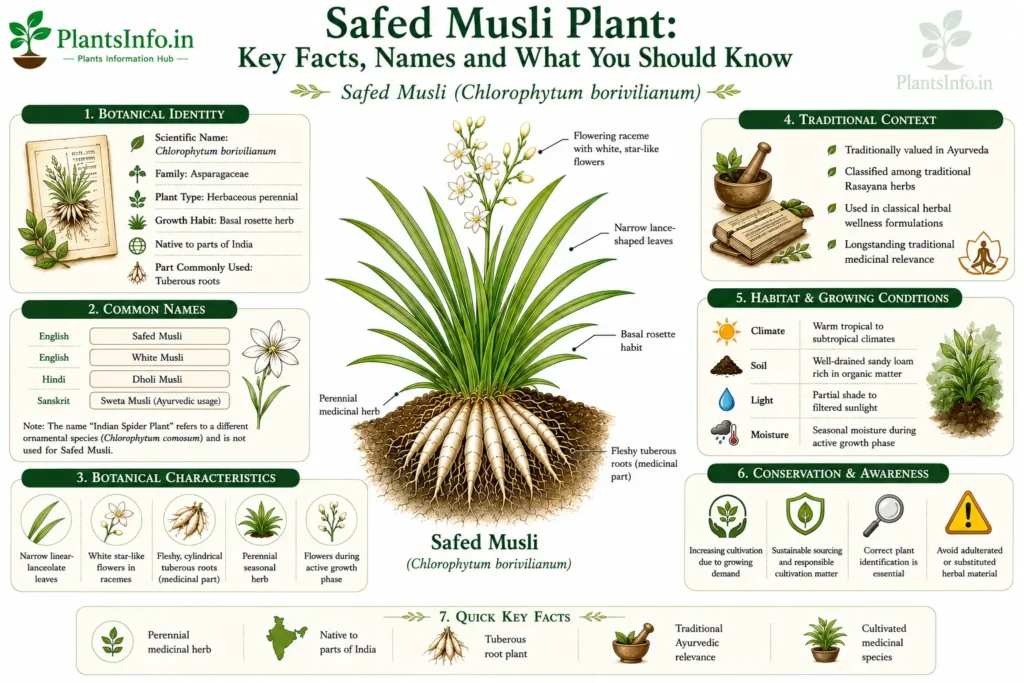
Safed Musli Flowering Season: When and What to Expect in India
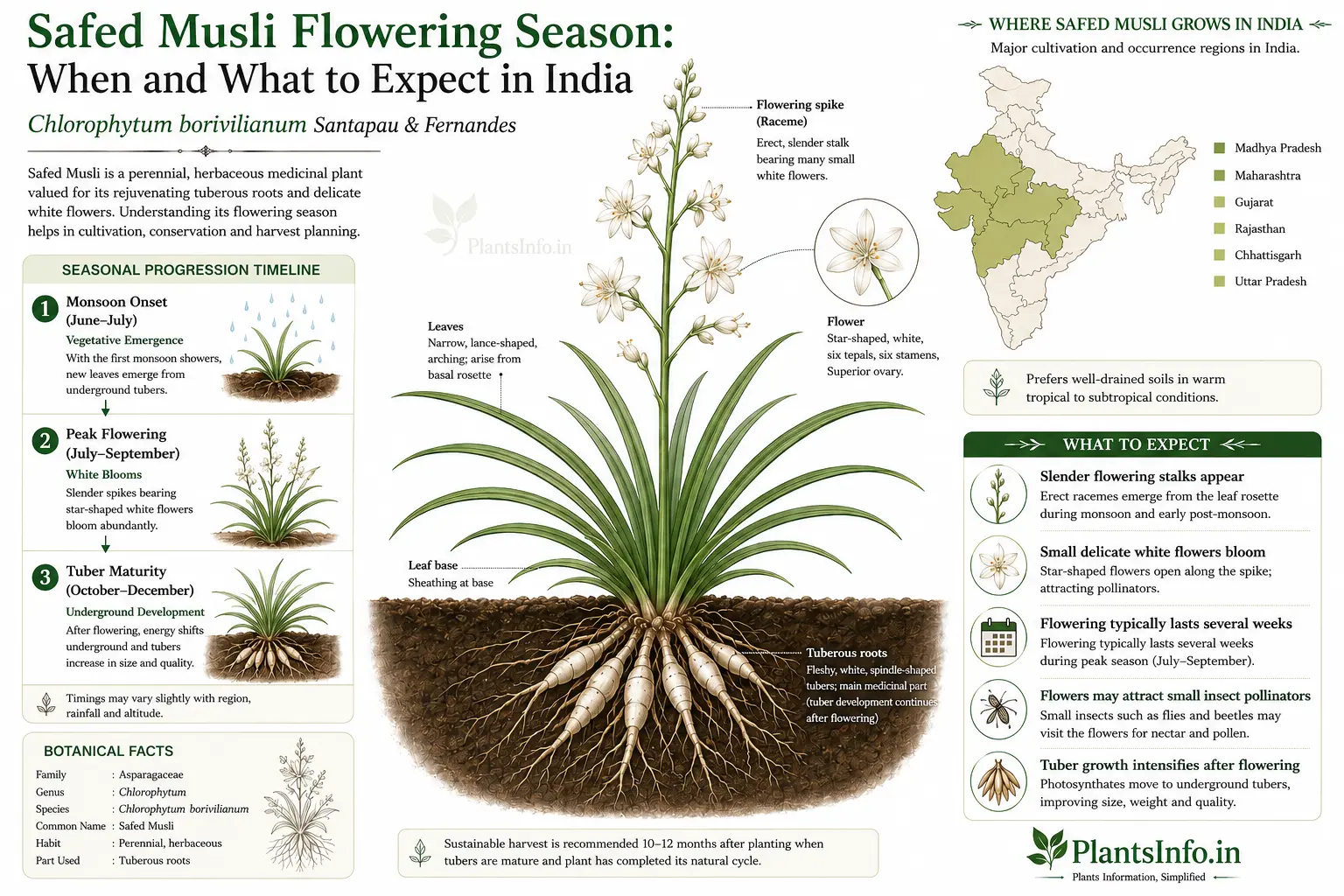
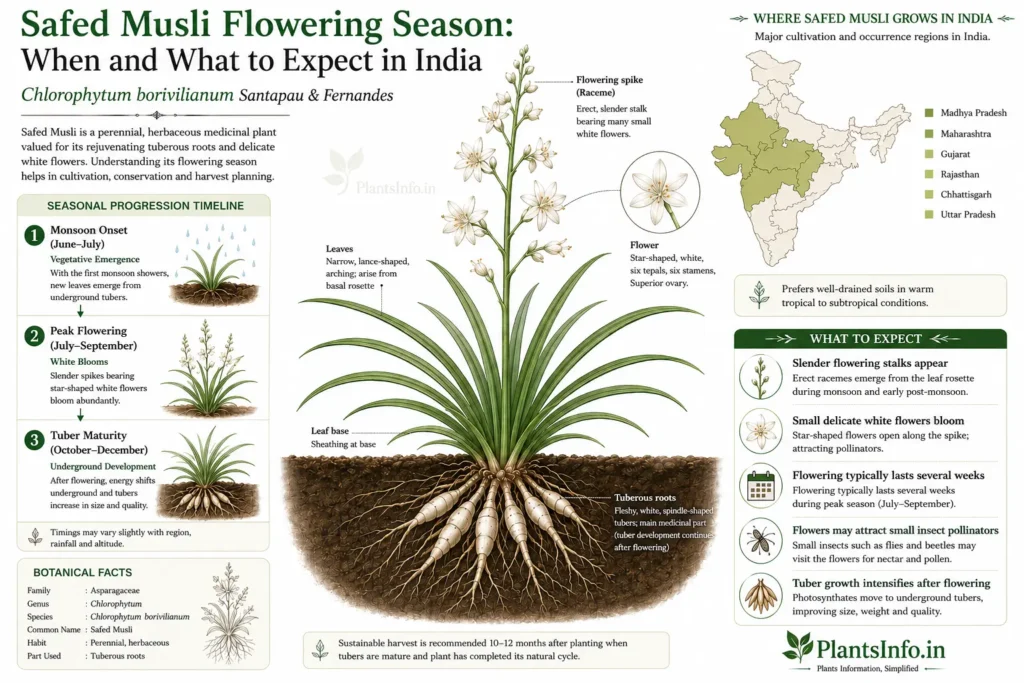
Quick Answer: Safed Musli flowers from July through December, with peak bloom during the monsoon months of August and September. The plant sprouts at monsoon onset, grows and flowers through the rainy season, sets fruit between July and December, then dies back completely in winter when tubers are harvested. The entire above-ground life cycle runs June to December.
See also: Safed Musli plant profile, how to grow it, common problems, its benefits, and its varieties.
One of the stranger pleasures of growing Safed Musli is watching those tall, slender flower panicles rise far above the modest leaf rosette — sometimes reaching 120 cm when the rest of the plant is less than 45 cm high. The flowers appear almost extravagant for such an unassuming plant. They arrive in the peak of the monsoon, and they tell you, more reliably than any calendar, that the tubers below are at maximum development.
Recommended Products
Disclosure: As an Amazon Associate, PlantsInfo may earn from qualifying purchases.
🌱 Growing Essentials
The following products can help with container gardening, potting, root development, soil management, and healthy plant growth.
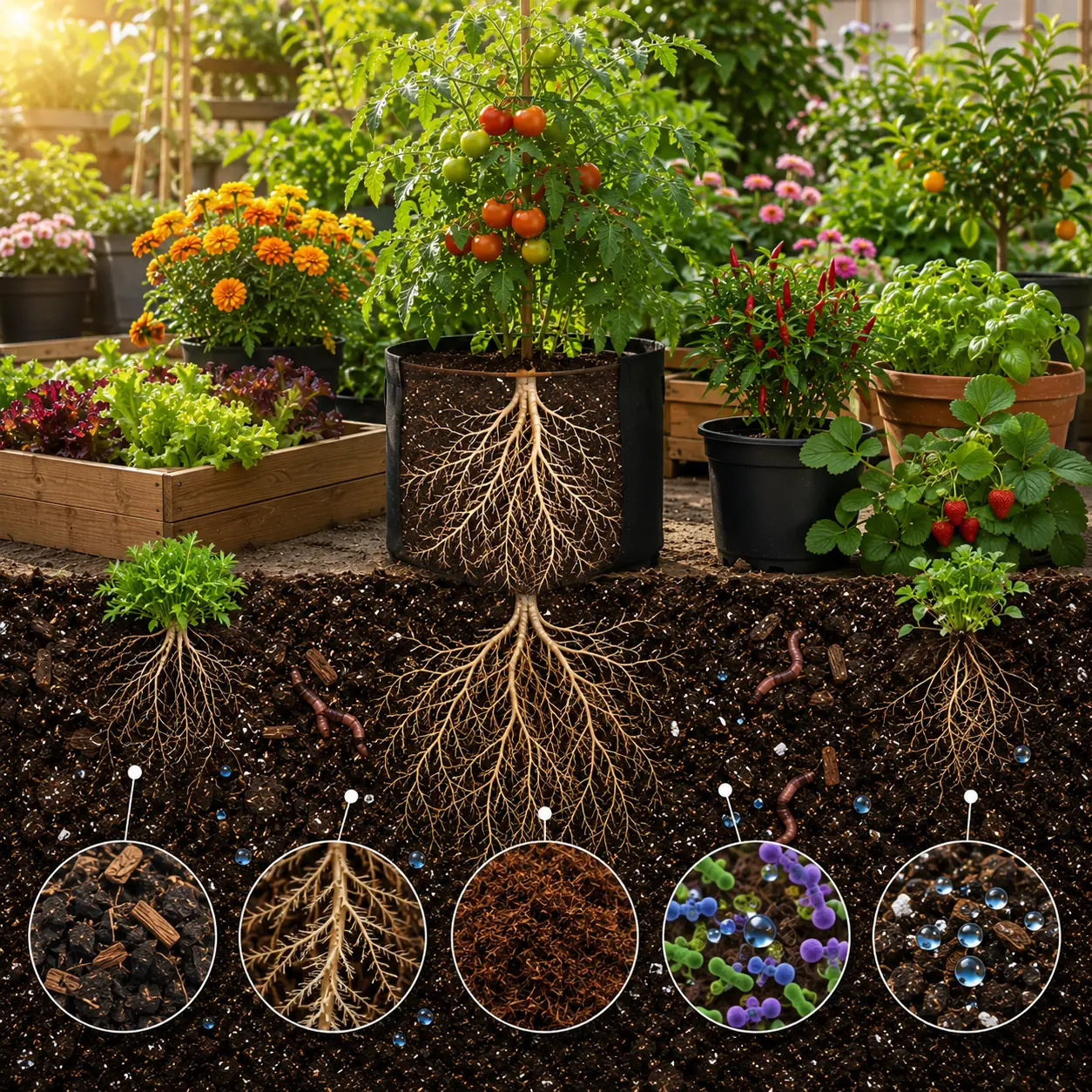
Organic Potting Soil Mix
Provides nutrients, structure, and healthy growing conditions for container plants.
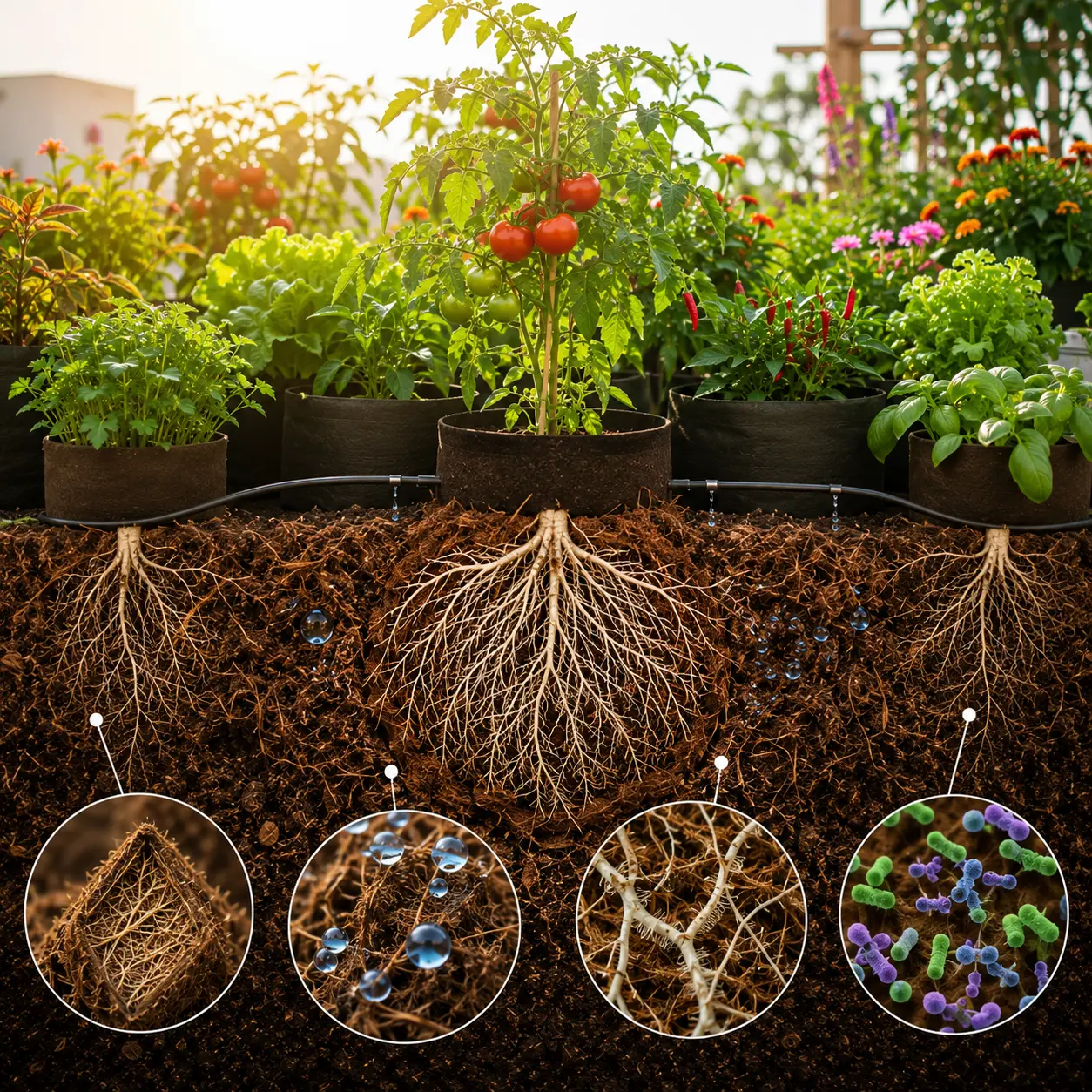
Coco Peat Growing Medium
Enhances moisture retention while maintaining excellent root-zone aeration.

Grow Bags for Plants
Improve drainage, root aeration, and vegetable production in limited spaces.

Plastic Pots for Plants
Ideal containers for seedlings, ornamentals, herbs, and balcony gardens.
India’s Seasons and This Plant
| Season (months) | What the plant is doing |
|---|---|
| Pre-monsoon (Mar–May) | Dormant underground; tubers in storage; no above-ground growth |
| Monsoon (Jun–Sep) | Sprouting and rapid vegetative growth (June–July); peak leaf growth and flowering (Aug–Sep) |
| Post-monsoon (Oct–Nov) | Flowering continues; fruiting; leaves beginning to yellow; tubers at maximum size |
| Winter (Dec–Feb) | Above-ground parts die back completely; tubers harvested; replanting material stored |
Flowering Season in Detail
Flower panicles emerge from the base of the plant — not from leaf axils — beginning in July in South India and early August in North and Central India. The panicles are slender, branching, and can reach 60–120 cm in height. Individual flowers are small, white, star-shaped, with six petals, approximately 2 cm across. Each flower lasts a few days; the panicle carries successive flowers for weeks, extending the visual interest considerably.
Peak flowering is August–September across most of central India, corresponding with the height of the monsoon. The combination of warm temperatures, high humidity, and long days is the primary flowering trigger. Flowering continues into October and November at a reduced intensity as the season changes.
The flowers are insect-pollinated, attracting bees and small pollinators. Male and female parts are present in each flower (the plant is not dioecious like Guduchi), so a single plant can set seed without a companion.
In North India (UP, Rajasthan, MP), the flowering season runs from July to November. In South India and coastal areas with earlier, longer monsoons, it can begin in June and extend to December.
Fruiting Season
Fruits are small, greenish to yellow capsules containing black seeds. They set from August onward, becoming visible from September on the lower portions of the panicle while upper flowers are still open. Ripe fruits are yellow to straw-coloured and split to release black, angular seeds.
The fruiting season runs broadly from July through December — an unusually extended window that reflects the panicle’s long flowering period. Seeds disperse naturally when capsules split. Collecting seed for propagation is less relevant for this plant because crown-tuber division is always faster and more productive.
Best Time to Plant
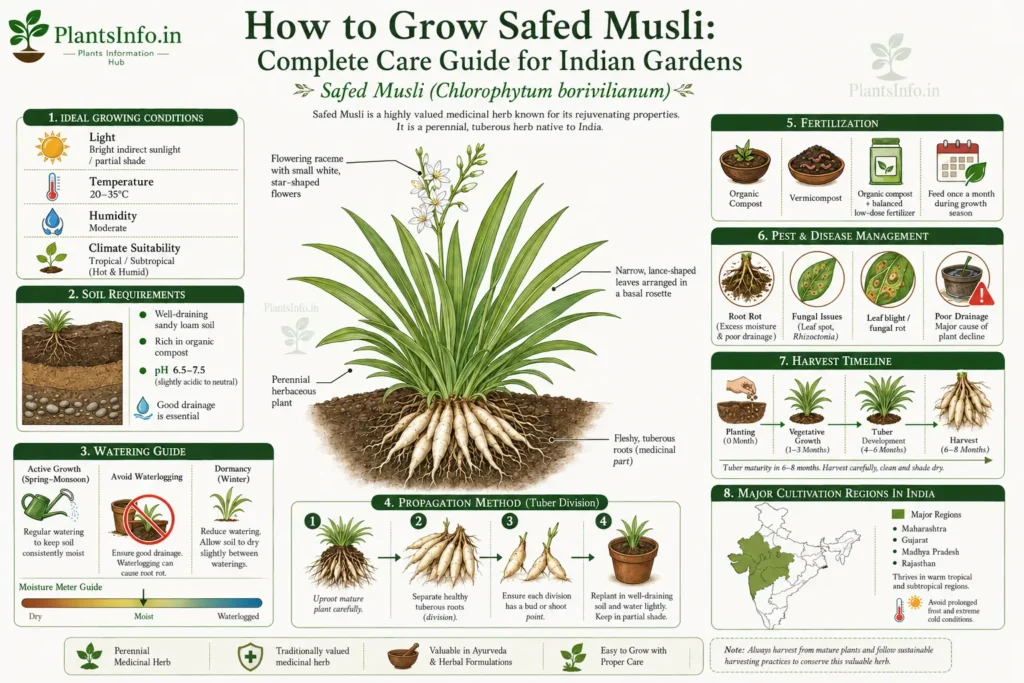
The ideal planting window is monsoon onset — late June to mid-July. Research from CIMAP Lucknow across two growing seasons confirmed that planting at monsoon onset on raised beds or ridges maximises both leaf growth and final dry root yield. Warm soil, consistent moisture, and the natural rainfall rhythm give tubers optimal sprouting conditions.
A partial second window exists in early June in areas of South India where the monsoon arrives earlier — Karnataka, Kerala, coastal Andhra Pradesh, and Assam. In these states, planting by the second week of June takes advantage of the full monsoon season.
Avoid planting in late July or August. Cuttings planted in this window lose weeks of the active growing season and produce noticeably lower tuber yields at harvest.
Month-by-Month Calendar
| Month | Season | What to Do |
|---|---|---|
| January | Winter | Tubers dormant in storage; no field activity; check stored crowns for rot |
| February | Late winter | Continue crown storage; prepare beds; add compost and sand |
| March | Pre-monsoon | Complete bed preparation; no planting yet |
| April | Pre-monsoon | Final bed or container preparation; source planting material |
| May | Pre-monsoon | Last checks on bed structure and drainage; planting window opens in South India |
| June | Monsoon onset | Plant tubers (South India now; North India from late June); water lightly at planting |
| July | Monsoon | Main planting window (North and Central India); first sprouting visible by late July |
| August | Monsoon | Rapid vegetative growth; first flower panicles appearing; ensure drainage is clear |
| September | Monsoon | Peak leaf growth and peak flowering; monitor for leaf blight |
| October | Post-monsoon | Flowering continues; fruiting; leaves beginning to yellow; do not disturb roots |
| November | Post-monsoon | Leaves yellowing rapidly; fruit ripening; reduce watering |
| December | Early winter | Above-ground parts dying back; begin harvest when fully dried down |
What Can Go Wrong Seasonally?
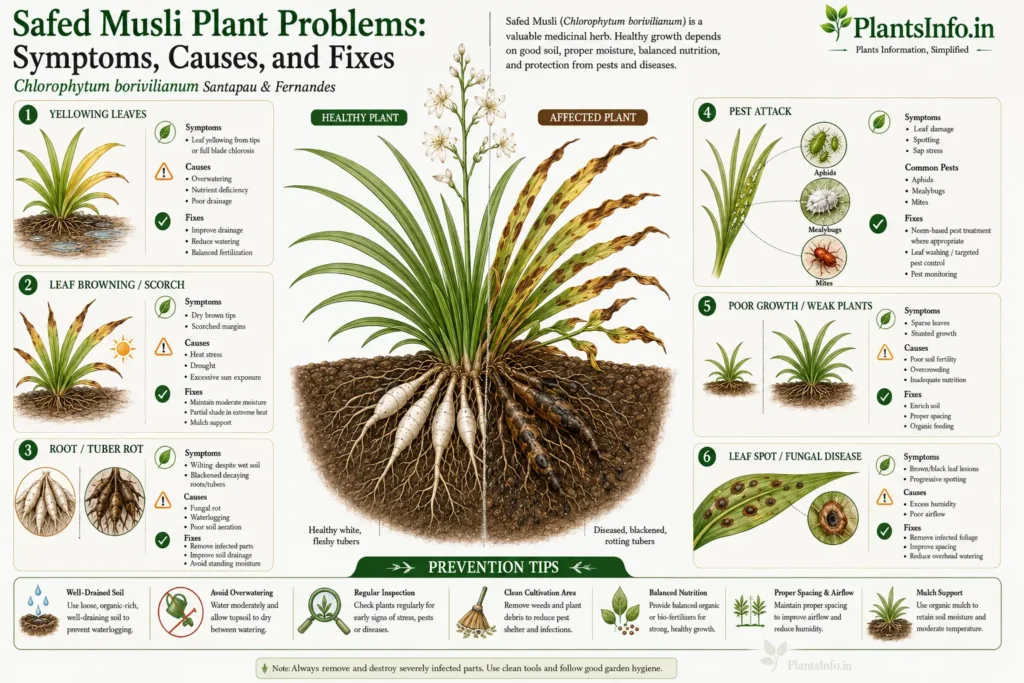
Monsoon waterlogging: The highest-risk event for Safed Musli is prolonged waterlogging at the crown zone during July–August heavy rainfall. Even two to three days of standing water is sufficient to trigger crown rot. Raised beds and ridge planting are the only reliable preventive measures.
Premature harvest: Novice growers sometimes dig up tubers in September or October when the plants look mature, before the aerial parts have died back. Premature harvest yields smaller, lighter tubers with lower saponin content. The signal to harvest is the complete death of above-ground parts — not just yellowing.
Poor post-harvest storage: Crowns harvested in December and stored for the following June planting need careful, dry, shaded storage. Crowns stored in humid conditions develop rot at the bud point, destroying the following season’s planting material. This is the most common cause of poor second-season results.
Post-Harvest Care
Once harvested tubers have been separated and the planting crowns set aside for storage, the bed or container is empty. This is the ideal time to replenish soil organic matter — work in a generous dressing of well-rotted compost and allow the bed to rest until the following June. In containers, empty the old mix entirely, refresh with a new vermicompost-enriched mix, and store the container in a dry position until replanting.
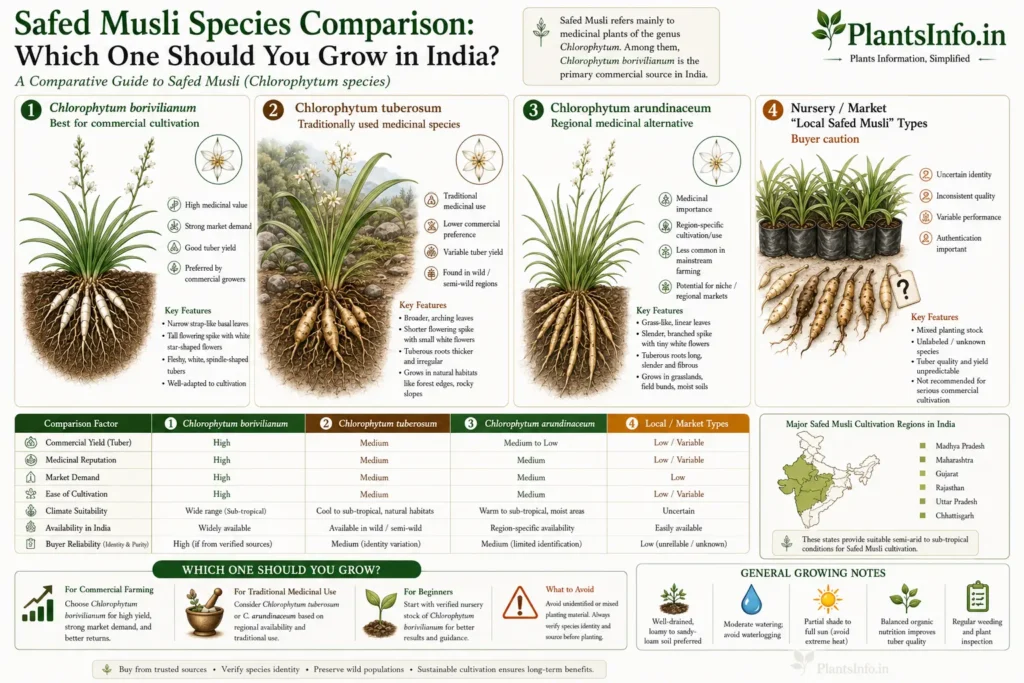
The off-season period of January–May is the time to source additional planting material from neighbours, nurseries, KVK outlets, or agriculture departments — good-quality crown-bearing tubers of authenticated C. borivilianum variety.
Dormancy and Off-Season
Safed Musli’s dormancy is absolute and complete. Between December and June, no above-ground part is visible — only stored tubers and crowns remain. This is not a problem; it is the plant’s natural rhythm. Do not water the empty bed or container during this period.
The dormant crowns store their energy underground. Any watering or fertilising during dormancy is wasted and may encourage fungal rot at the crown bud. Leave the bed alone, let it dry fully, and begin preparation activities in February–March ahead of the June planting window.