Safed Musli Varieties: Which One Should You Grow in India?
Quick Answer: For home gardeners in central and North India, RC-2 (RAU Udaipur) or Jawahar Safed Musli 405 (Mandsaur, MP) are the most accessible, well-documented choices with proven yield and high saponin content. MDB-13 and MDB-14 offer disease-resistant advantages. The most important factor separating varieties for a home grower is not yield alone, but saponin content and disease resistance — two traits that determine both the medicinal value and the likelihood of actually getting a successful harvest.
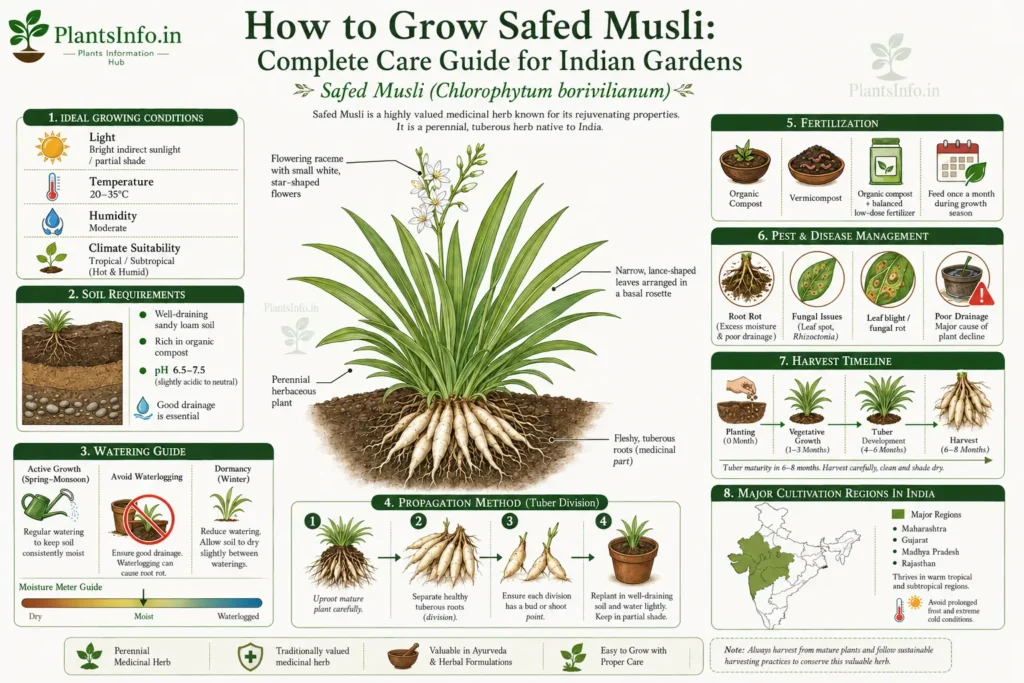
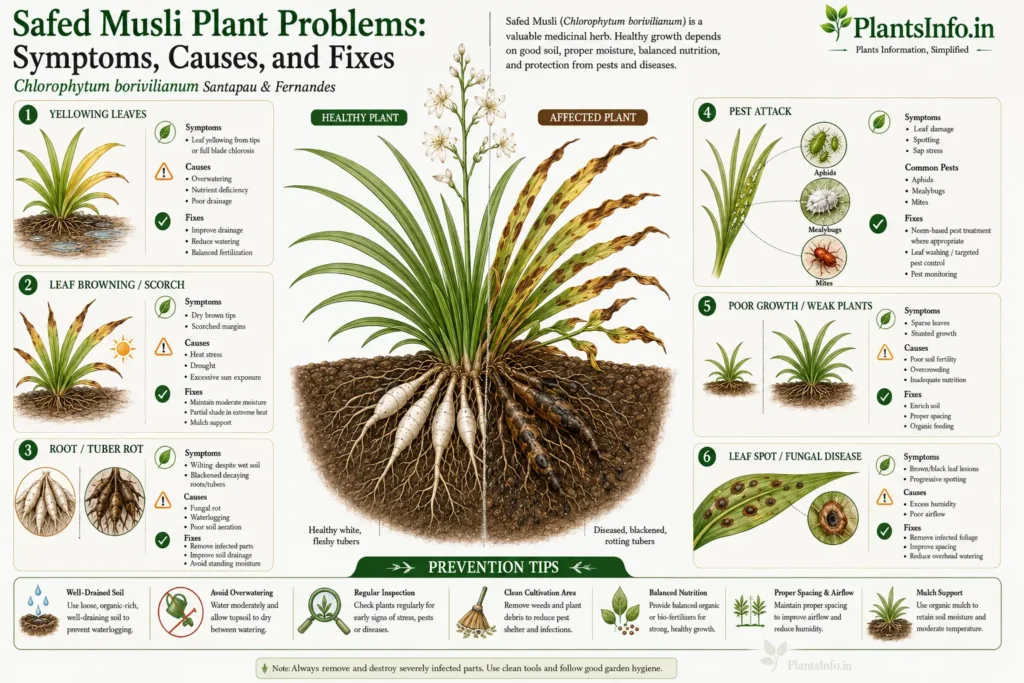
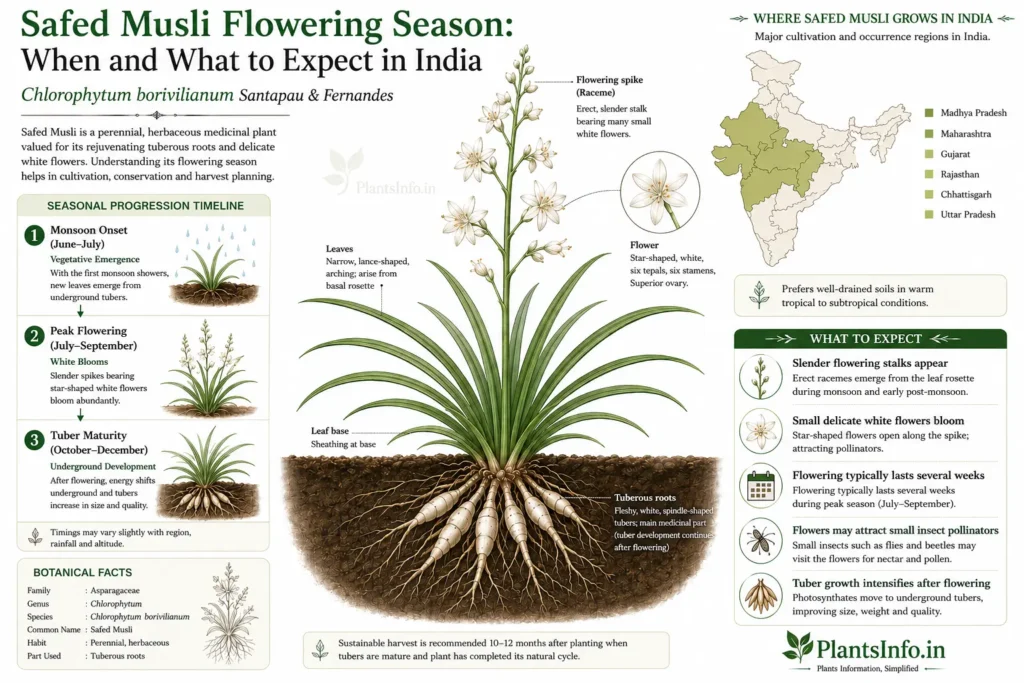
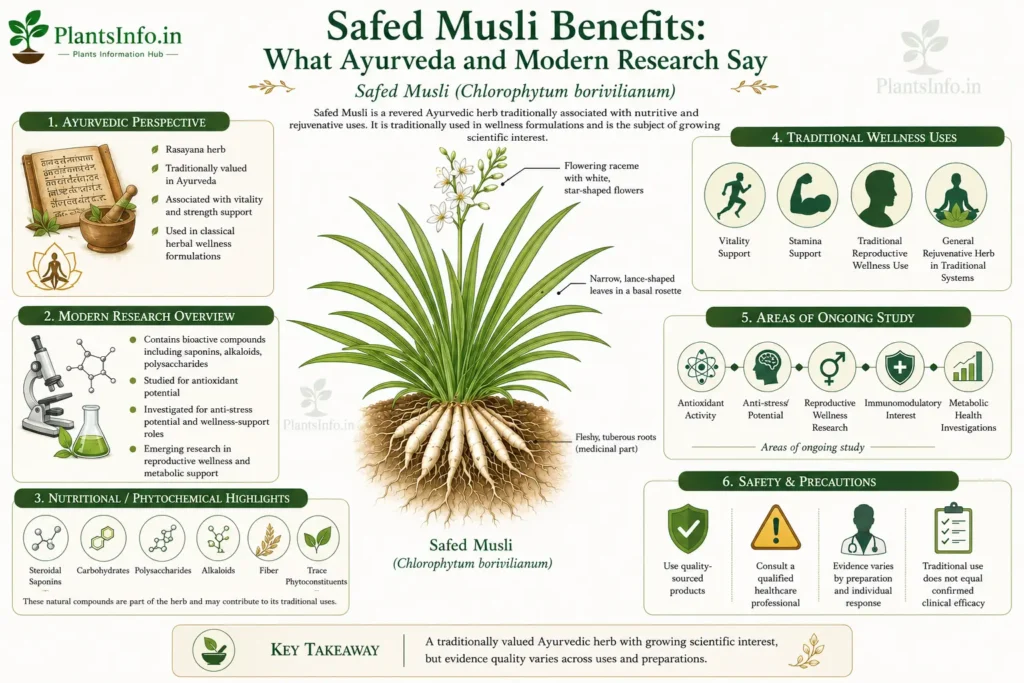
See also: Safed Musli plant profile, how to grow it, common problems, its flowering season, and its benefits.
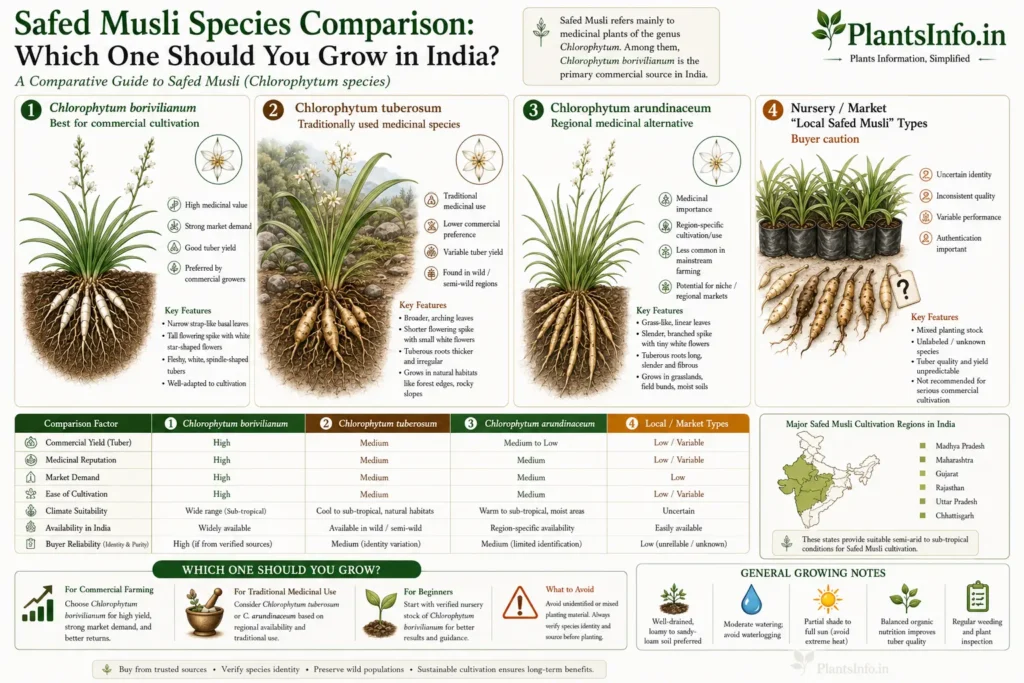
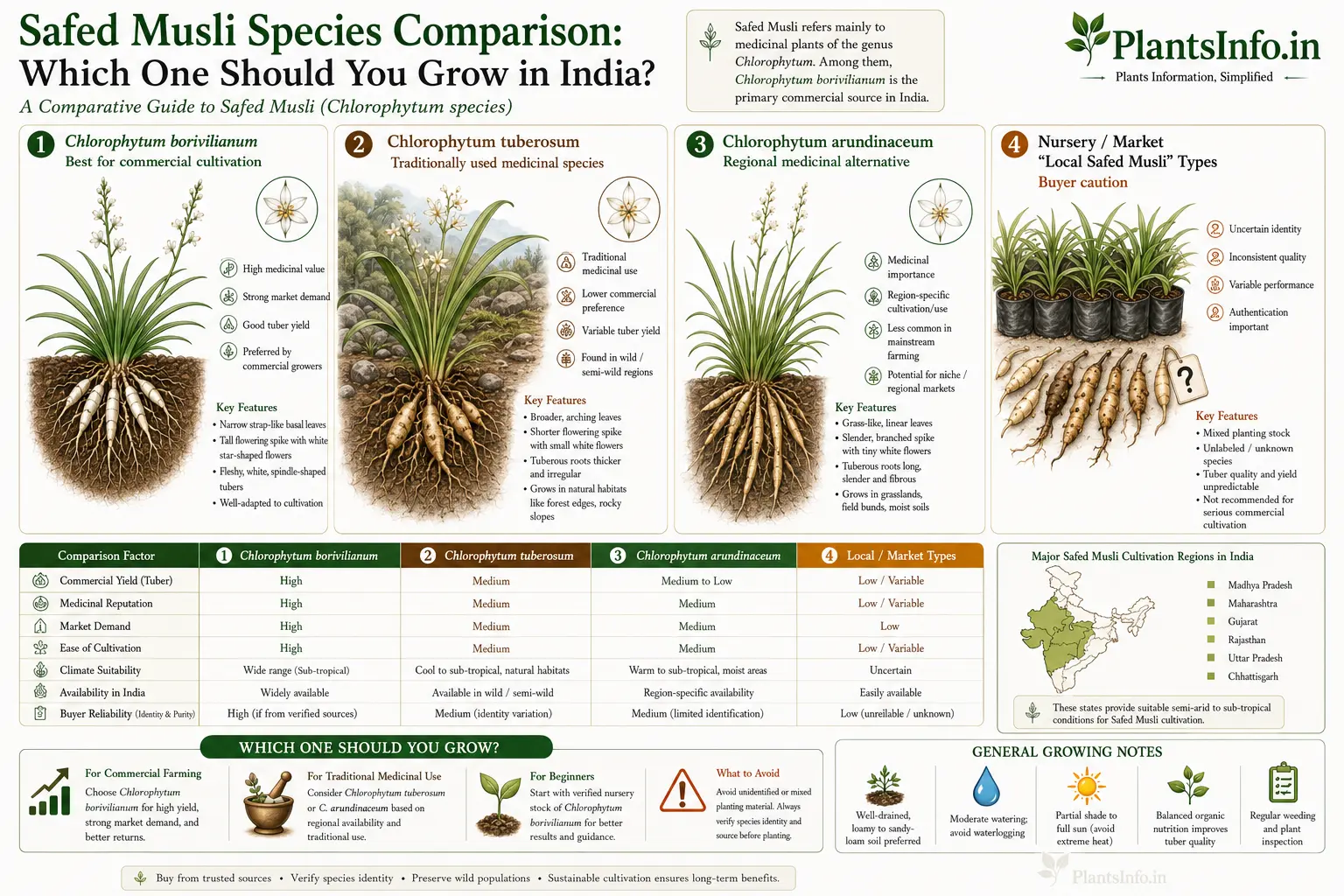
Most home growers who attempt Safed Musli buy whatever tubers are available from a local nursery or online supplier without knowing the variety name. This is a more consequential choice than with most plants, because the commercial Safed Musli market has a documented adulteration problem — tubers of inferior Chlorophytum species are routinely mixed with or substituted for authentic C. borivilianum. Knowing the named varieties and insisting on authenticated planting material is the first line of quality defence.
Recommended Products
Disclosure: As an Amazon Associate, PlantsInfo may earn from qualifying purchases.
🌱 Growing Essentials
The following products can help with container gardening, potting, root development, soil management, and healthy plant growth.
Organic Potting Soil Mix
Provides nutrients, structure, and healthy growing conditions for container plants.
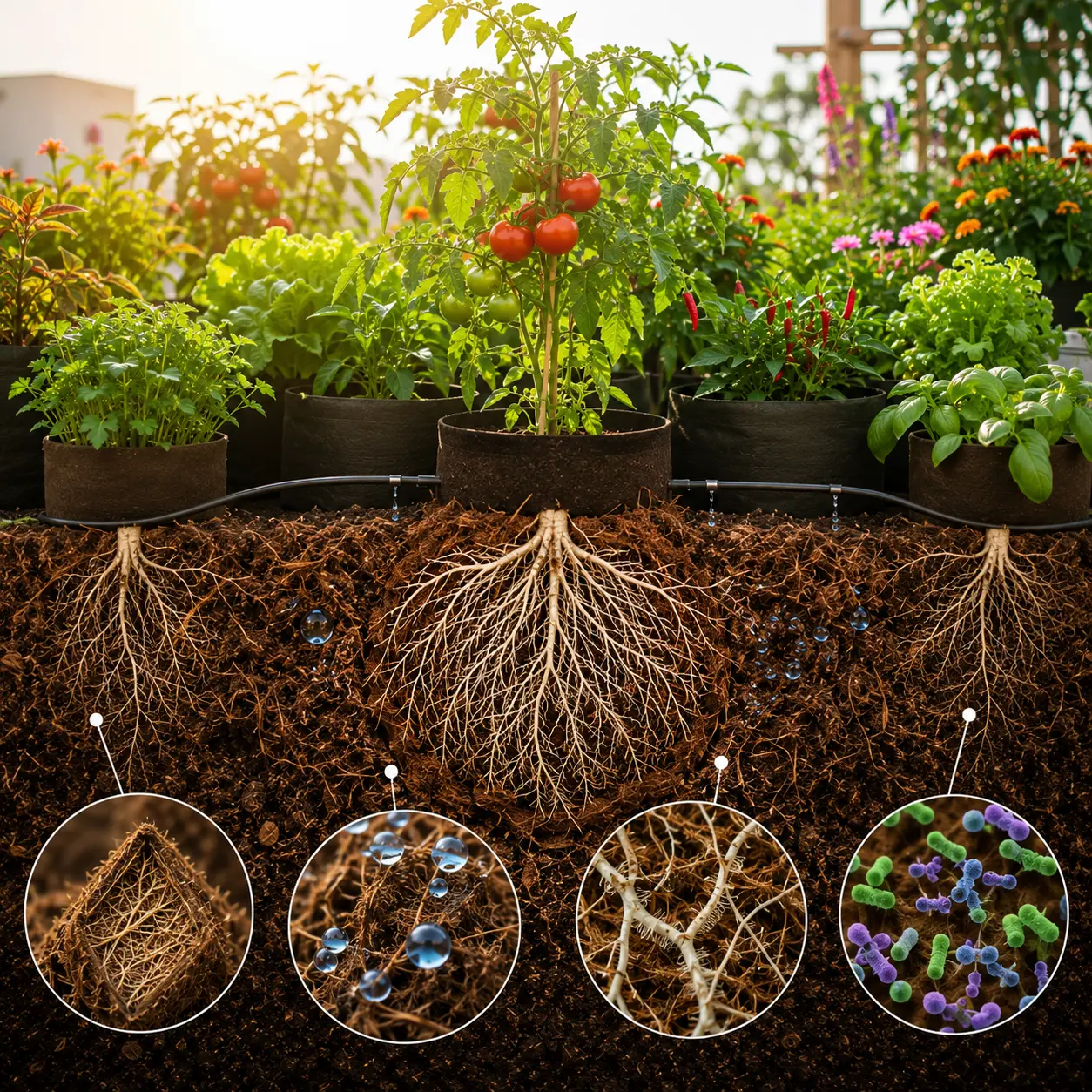
Coco Peat Growing Medium
Enhances moisture retention while maintaining excellent root-zone aeration.

Grow Bags for Plants
Improve drainage, root aeration, and vegetable production in limited spaces.

Plastic Pots for Plants
Ideal containers for seedlings, ornamentals, herbs, and balcony gardens.
Quick Variety Selector
| Variety | Type | Plant Size | Best For | Suited To |
|---|---|---|---|---|
| RC-2 | Collected/improved (RAU Udaipur) | Medium | High saponin, home and commercial | MP, Rajasthan, Gujarat, Maharashtra |
| RC-16 | Collected/improved (RAU Udaipur) | Medium | Consistent yield, good saponin | MP, Rajasthan |
| RC-36 | Collected/improved (RAU Udaipur) | Medium | High yield | MP, Rajasthan, Gujarat |
| Jawahar Safed Musli 405 | Released variety (JNKVV Mandsaur) | Medium | Home garden; high saponin; widely available | MP, UP, Maharashtra |
| Rajvijay Safed Musli 414 | Released variety (JNKVV Mandsaur) | Medium | Commercial; good yield | MP, Rajasthan |
| MDB-13 / MDB-14 | Improved (Maa Danteshwari HRC) | Medium | Disease/fungal resistance; maximum saponin | MP, Chhattisgarh |
| C. tuberosum (landrace) | Unimproved related species | Small | Not recommended for medicinal use | Widely available but medicinally inferior |
Varieties in Detail
RC-2 (RAU Udaipur)
RC-2 is among the most widely cited and tested selections in Indian Safed Musli cultivation research. It was collected and maintained at Rajasthan Agricultural University (RAU), Udaipur, as part of a germplasm evaluation programme that produced several improved selections (RC-2, RC-16, RC-20, RC-23, RC-36, RC-37, CT-1). RC-2 is specifically noted for high saponin content and consistent yield performance under the subtropical and semi-arid conditions of Rajasthan and MP.
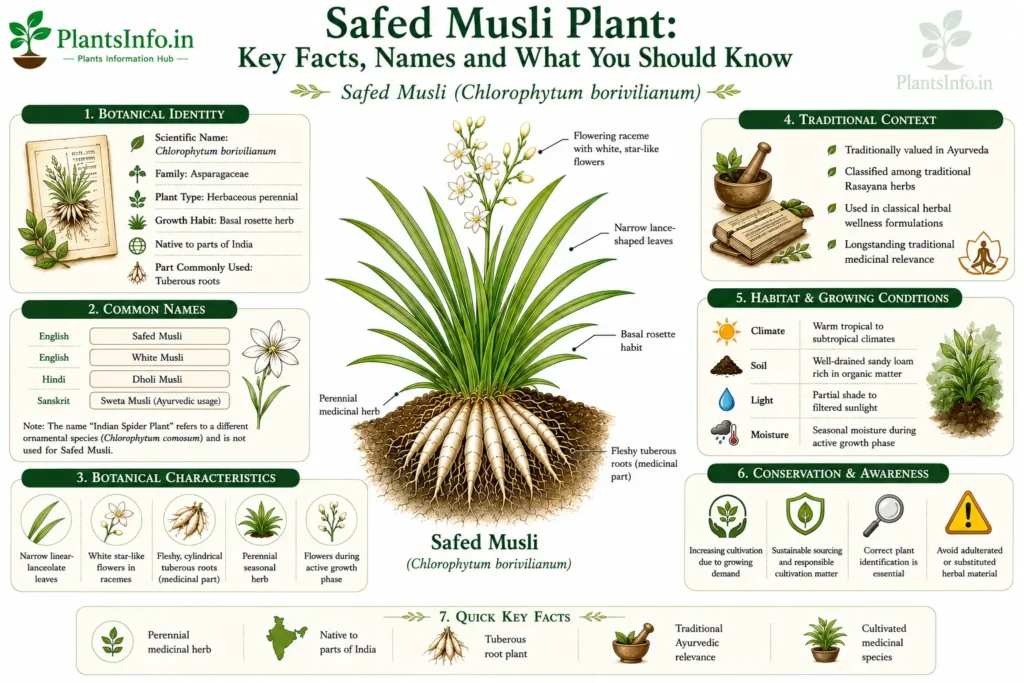
The plant is medium in above-ground size — the typical rosette height of 30–40 cm with panicles reaching 80–100 cm. Tuber clusters from RC-2 plants in well-prepared beds with correct spacing yield fingers that are firm, white, and commercially acceptable.
Its notable strength is its documentation — more cultivation trial data exists for RC-series varieties than for most others, making it the most defensible choice for a grower who wants evidence-backed planting material. Its notable weakness is availability: RC-series materials are primarily distributed through RAU Udaipur and affiliated agricultural institutions, and may not be accessible through general nurseries. Sourcing from a KVK or RAU nursery is the reliable path.
Jawahar Safed Musli 405
Released by Rajmata Vijayaraje Scindia Krishi Vishwa Vidyalaya (JNKVV), Mandsaur, Madhya Pradesh, Jawahar Safed Musli 405 is among the most commercially available named varieties in central India. It was developed for conditions in MP and has been adopted across UP, Maharashtra, and Rajasthan. The released variety status means it comes with documented trial performance across multiple seasons and locations.
This variety is particularly well-suited to the home garden context: its medium plant size fits container growing and small raised beds, its saponin content is confirmed to be high, and its planting material is more widely available through state agriculture department channels and KVK outlets than the RAU RC-series.
A propagation constraint worth knowing: as a released variety, the seed of Jawahar Safed Musli 405 is maintained by JNKVV and state seed corporations. Home growers can replant from their own harvested crowns season after season — this is the standard propagation method and does not require repurchasing seed each year.
Rajvijay Safed Musli 414
Also released by JNKVV Mandsaur, Rajvijay Safed Musli 414 is oriented toward commercial cultivation priorities — yield per unit area and uniformity of tuber size. It performs well under the MP and Rajasthan agroclimatic conditions for which it was developed.
For a home gardener whose primary goal is medicinal quality rather than commercial yield, Jawahar Safed Musli 405 is often recommended ahead of Rajvijay 414 — the latter’s commercial yield focus does not necessarily translate to superior saponin content per unit weight. Both are legitimate choices; the distinction is the grower’s priority.
MDB-13 and MDB-14
MDB-13 and MDB-14 were developed by the Maa Danteshwari Herbal Research Centre, Chikalputi, Chhattisgarh — a research institution with a specific focus on medicinal plant production in tribal farming contexts. These varieties are notable for combining high saponin and alkaloid content with documented disease and fungal resistance.
The disease resistance trait is significant given that leaf blight and collar rot are Safed Musli’s primary production constraints. A variety with inherent resistance to the fungal pathogens that cause these diseases reduces the grower’s dependence on chemical fungicide applications — an advantage for home growers seeking organic production.
MDB-13 and MDB-14 are primarily distributed through the developing network of tribal farming cooperatives and agriculture institutions in Chhattisgarh and eastern MP. Availability outside this region is limited but growing as commercial interest in the varieties increases.
Head-to-Head Comparison
RC-2 vs. Jawahar Safed Musli 405 — For the Home Grower
Both are well-documented, high-saponin varieties with consistent performance records in central Indian conditions. The practical difference for a home grower is availability and support. RC-2 is best accessed through RAU Udaipur or its regional contacts — appropriate for growers in Rajasthan and Gujarat who have direct access. Jawahar Safed Musli 405 is available through a wider network of KVK outlets and state seed corporations, making it the more accessible choice for growers in MP, UP, and Maharashtra. Both win for medicinal quality. Jawahar 405 wins for availability across the widest geography.
Named Varieties vs. Chlorophytum tuberosum (unlabelled nursery material)
This comparison matters enormously. Chlorophytum tuberosum — a related species with a similar above-ground appearance — is widely sold as “Safed Musli” at general nurseries, online plant sellers, and informal markets. It is medicinally inferior, with significantly lower saponin content and a different phytochemical profile. Research explicitly identifies it as one of the primary adulterants in the Safed Musli market.
The visual distinction between the two species is difficult for a non-specialist: both produce similar rosette leaves. The surest confirmation is the tuber — authentic C. borivilianum tubers are thick, white, clustered, and finger-shaped; C. tuberosum roots are thinner, more numerous, and lack the characteristic milky-white interior. For planting material, always insist on authenticated C. borivilianum from a named source. The quality difference in the final medicinal product is substantial.
How to Choose for Your Space
Container or terrace garden: Jawahar Safed Musli 405 or RC-2 in a container of minimum 20–25 litre capacity and 25–30 cm depth. One plant per large container. Place in morning sun with afternoon shade. The compact above-ground size fits well on terraces.
Small ground plot (under 100 sq ft): Raised bed planted with RC-2, Jawahar 405, or RC-36. Spacing of 15 × 15 cm allows approximately 4 plants per square metre. A 2 square metre raised bed planted with good-quality authenticated tubers produces a meaningful household supply at first harvest.
Larger garden or backyard: MDB-13 or MDB-14 for organic growing contexts, given their documented disease resistance, reducing the need for fungicide inputs across a larger planting area. Rajvijay 414 for growers with a secondary commercial interest.
Disease-prone areas or organic growing: MDB-13 or MDB-14 — the fungal resistance trait is worth seeking out in regions with high monsoon humidity (Chhattisgarh, Vidarbha, coastal Karnataka, Assam) where leaf blight pressure is consistently high.
Regional Suitability
MP, Rajasthan, Gujarat: All named varieties perform well. RC-series and JNKVV releases are the most locally documented choices.
Maharashtra (Vidarbha, Marathwada): Jawahar 405, RC-2, RC-36. Monitor closely for fungal disease pressure given the region’s monsoon intensity. MDB-13 is worth seeking if available.
Chhattisgarh: MDB-13 and MDB-14 are the recommended regional choice — developed in this agro-climatic context and distributed through local channels.
UP, Bihar: Jawahar 405 and RC-2 are both documented performers in the subtropical UP conditions. CIMAP Lucknow maintains authenticated germplasm.
Karnataka, Assam, and Andhra Pradesh: Standard C. borivilianum cultivation is possible — the subtropical climate suits the crop. Source authenticated planting material from CIMAP or ICAR-DMAPR, Anand. Regional variety trial data for these states is limited.
North India above 1,000 m altitude (hill zones): Safed Musli becomes unreliable. Below this altitude, subtropical conditions suit the crop.
Watch Out for Mislabelling
Mislabelling and species substitution are endemic problems in the Safed Musli market and apply as much to planting material as to dried root products. Three substitution patterns are documented in the literature:
Chlorophytum tuberosum — the most common substitute — produces thinner, less white tubers with lower saponin content. It is frequently sold as Safed Musli at general nurseries without clear species identification.
Chlorophytum arundinaceum and other wild Chlorophytum species are harvested from forests and mixed into dried root consignments at the wholesale level.
Unnamed local landrace material — with no varietal identity, unknown saponin content, and potentially mixed-species origin — is the default product at most informal plant markets.
The protection for a home grower: buy planting material from KVK outlets, state agriculture universities (JNKVV Mandsaur, RAU Udaipur), CIMAP, or ICAR-DMAPR. Request confirmation of the variety name. The authentic tuber should be thick (1–2 cm diameter), white-skinned, and milky white inside when broken.
Where to Source These Varieties in India
JNKVV Mandsaur (Madhya Pradesh) is the releasing institution for Jawahar Safed Musli 405 and Rajvijay 414 and distributes certified seed and planting material through its outlets.
RAU Udaipur (Rajasthan) maintains the RC-series germplasm and distributes planting material through its affiliated networks and KVK channels in Rajasthan and Gujarat.
CIMAP Lucknow maintains authenticated C. borivilianum germplasm and is a reference institution for UP and northern India growers seeking confirmed species material.
ICAR-DMAPR (Directorate of Medicinal and Aromatic Plants Research), Anand, Gujarat, conducts ongoing research on Safed Musli disease and cultivation and distributes authenticated material regionally.
Krishi Vigyan Kendras across MP, Rajasthan, and Maharashtra often carry seasonal planting material of named varieties during June–July. Contact your district KVK in May to check availability before the planting window opens.
Grow from authenticated material, plant on raised beds at monsoon onset, and the variety you choose will perform reliably. The variety decision matters — but only when the planting material is genuinely what it claims to be.