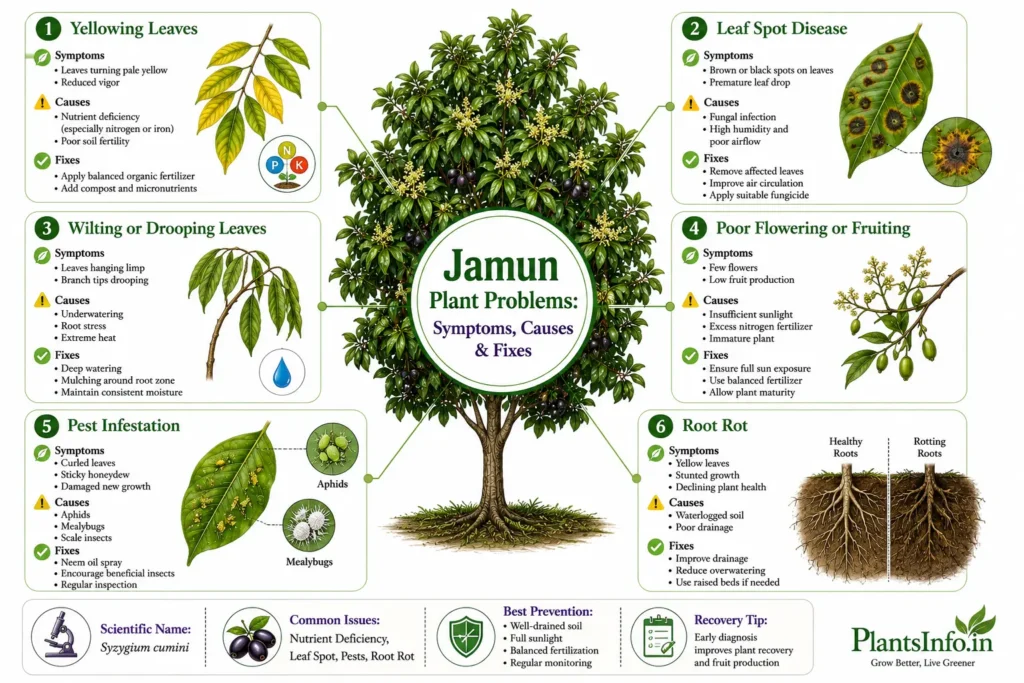
Jamun Plant Problems: Symptoms, Causes, and Fixes

Quick Answer: The most common jamun problem in Indian gardens is anthracnose — a fungal disease that damages leaves and fruit during the monsoon. Most jamun problems are either fungal (triggered by humidity) or environmental (triggered by poor drainage or transplant stress), and most are preventable with basic seasonal care.
See also: Jamun plant profile, how to grow it, its flowering season, its benefits, and its varieties.
Bite into a jamun and find a hollow, larvae-filled cavity — that is fruit fly damage, and it is the single complaint that drives most jamun growers to an internet search. The reassuring truth is that jamun is genuinely tough. Problems that would kill a mango or a guava in the same season often leave jamun standing. Most issues arrive in a predictable seasonal pattern, which means they can be anticipated rather than chased.
Recommended Products
Disclosure: As an Amazon Associate, PlantsInfo may earn from qualifying purchases.
🌱 Growing Essentials
The following products can help with container gardening, potting, root development, soil management, and healthy plant growth.
Organic Potting Soil Mix
Provides nutrients, structure, and healthy growing conditions for container plants.
Coco Peat Growing Medium
Enhances moisture retention while maintaining excellent root-zone aeration.

Grow Bags for Plants
Improve drainage, root aeration, and vegetable production in limited spaces.

Plastic Pots for Plants
Ideal containers for seedlings, ornamentals, herbs, and balcony gardens.
Quick Diagnosis
| Symptom | Most Likely Cause | First Action |
|---|---|---|
| Brown-black lesions on leaves and fruit | Anthracnose fungus | Apply copper oxychloride spray |
| Larvae inside ripening fruit | Fruit fly infestation | Set up fruit fly traps immediately |
| Yellowing leaves, soft new growth | Overwatering / poor drainage | Check drainage; reduce watering |
| Skeletonised or partially eaten leaves | Caterpillar feeding | Hand-pick larvae; apply neem oil |
| Sooty black coating on leaves | Sooty mould following scale insects | Treat scale first; wipe leaves |
| White cottony masses on stems | Mealybug infestation | Apply neem oil or rubbing alcohol |
| Premature fruit drop, no larvae | Heat stress or irregular watering | Mulch root zone; water deeply |
Diseases
Anthracnose
Anthracnose, caused by Colletotrichum gloeosporioides, is among the most important fungal diseases affecting jamun in humid tropical regions. It presents as dark brown to black irregular lesions on leaves, young shoots, and developing fruit. On leaves, the spots begin at the margins or tip and expand inward; on fruit, the lesions are sunken and may cover a large portion of the surface before harvest.
The disease is most severe from June to August — exactly when jamun is fruiting — because the fungus thrives in warm, humid, monsoon conditions. Infected fruit is unsaleable and largely inedible; infected leaves drop prematurely, weakening the tree over successive seasons.
Anthracnose infections cannot be reversed once symptoms develop on the current season’s leaves or fruit, but further spread and disease severity can be reduced through timely management. Preventive fungicide applications are most effective when applied before periods of prolonged warm, humid weather that favour fungal development. Copper-based fungicides, such as copper oxychloride, may be used according to product label directions and local agricultural recommendations.
Good sanitation is equally important: promptly remove and dispose of fallen infected leaves and fruit to reduce sources of reinfection. While some individual trees may show varying levels of tolerance, anthracnose-resistant jamun cultivars are not widely available commercially. As a result, prevention, sanitation, and early intervention remain the most effective long-term management strategies.
Powdery Mildew
Powdery mildew appears as a white to grey powdery coating on young leaves and tender shoot tips. Unlike anthracnose, it is most active during dry periods with cool nights — typically February to March, which coincides with the pre-flowering and early flowering stage.
Severe mildew on young shoots at flowering time can reduce fruit set by limiting the development of healthy flower clusters. The disease rarely kills mature wood but can set back young saplings significantly.
Wettable sulphur (0.2–0.3%) applied as a spray at the first sign of infection is the standard treatment. Repeat applications at 10-day intervals control the spread. Avoid applying sulphur-based products when temperatures exceed 35°C — heat combined with sulphur causes leaf burn. Improving air circulation through light pruning in November reduces mildew incidence the following spring.
Leaf Spot (Pestalotiopsis)
Pestalotiopsis leaf spot produces circular to irregular brown spots with a darker border and a pale centre, sometimes with a yellow halo. It is distinct from anthracnose in that the lesions are more sharply defined and tend to appear mid-leaf rather than at the margins.
This disease is secondary and opportunistic — it is rarely severe on healthy, well-maintained trees. It typically follows physical damage from insects, hail, or mechanical injury that creates entry points for the fungus. Severely affected leaves turn yellow and drop.
Management involves removing heavily infected leaves and applying a broad-spectrum fungicide such as mancozeb (0.25%) at 2-week intervals during active infection. Keeping the canopy open and avoiding overhead irrigation reduces recurrence.
Sooty Mould
Sooty mould is not a primary pathogen — it is a secondary fungal growth that colonises the honeydew secreted by sucking insects, particularly scale insects and mealybugs. The mould itself presents as a black, powdery coating on leaf surfaces that blocks photosynthesis and causes generalised decline when severe.
Treating sooty mould without treating the underlying insect infestation is ineffective. Once the insect population is controlled, the mould can be wiped from leaves with a damp cloth or washed off with a mild soap solution. The mould does not penetrate leaf tissue and causes no permanent damage once the honeydew source is removed.
This information is for general guidance only. Always read product labels before applying any pesticide or fungicide. Follow state agriculture department guidelines for food crops. Keep children and pets away during and after application.
Pest Problems
Fruit Fly (Bactrocera spp.)
The single most damaging pest of jamun at harvest time. Female fruit flies puncture ripening fruit to lay eggs beneath the skin; the larvae feed inside, rendering the fruit inedible. The entry point is a tiny puncture mark, often invisible until the fruit is cut open and larvae or a hollow, rotted cavity is found.
Damage peaks from June to August, precisely when the jamun ripens. The pest is present across all fruit-growing regions of India and is particularly severe in humid conditions.
Organic management: methyl eugenol bait traps (commercially available at agricultural supply shops) attract and trap male fruit flies, reducing the breeding population. Wrapping individual fruit clusters in paper bags or mesh at the green stage physically excludes the fly.
Chemical option: protein hydrolysate bait mixed with malathion, applied to a small board or bait station near the tree rather than sprayed on the fruit directly, is the recommended approach. Spraying insecticide directly on ripening fruit is not appropriate for an edible crop.
Note: Premature fruit drop without visible puncture marks or larvae is heat stress, not fruit fly damage — this is the most common misidentification in jamun diagnosis.
Mealybugs
Mealybugs appear as white, cottony masses at leaf axils, on young stems, and along the undersides of leaves. They feed by piercing plant tissue and extracting sap, causing yellowing, leaf curl, and stunted new growth. Their honeydew secretion leads directly to sooty mould colonisation.
Mealybug populations build rapidly in dry, warm conditions — February to May is the highest-risk period in most of India. Heavy infestations on young saplings cause more damage than on established trees.
Organic fix
A spray of neem oil (5 ml per litre of water with a drop of liquid soap as emulsifier) is applied in the early morning to all affected surfaces, repeated at weekly intervals. Direct application of rubbing alcohol to individual colonies using a cotton swab is effective for small infestations.
Chemical option
Severe infestations may require the use of a registered systemic insecticide applied according to product label directions and local agricultural recommendations. Systemic products are absorbed by the plant and can help control sap-feeding insects by targeting pests as they feed. Always follow label instructions, observe any pre-harvest intervals, and avoid applications during flowering to minimise risks to pollinators and other beneficial insects.
Bark-Eating Caterpillar (Indarbela spp.)
Bark-eating caterpillars are occasional but potentially serious pests of mature jamun trees. The larvae bore beneath the bark and into woody tissues, creating tunnels that disrupt the movement of water and nutrients within affected branches. Infestations often go unnoticed until damage becomes extensive.
The most characteristic sign is the presence of frass (insect excreta), chewed wood particles, and silken webbing protruding from small openings on the trunk or major branches. These accumulations often resemble clumps of sawdust adhered to the bark. In severe cases, affected branches may show reduced vigour, progressive dieback, and thinning of the upper canopy.
Management is most effective when infestations are detected early. Small infestations can often be controlled by carefully removing frass and webbing, locating the tunnel opening, and mechanically destroying the larva with a flexible wire or similar probe. Maintaining tree health through proper watering, mulching, and pruning helps reduce susceptibility to attack.
Where infestations are severe, treatment should follow current local agricultural recommendations and approved pesticide labels. Targeted applications directed into active galleries may be recommended by agricultural authorities in some regions. Avoid using unapproved substances or outdated control methods that may injure the tree or pose environmental and safety risks.
Regular inspection of trunks and major branches, particularly after the fruiting season, allows early detection and greatly improves control success.
Pest is commonly mistaken for a disease
The sooty mould that follows mealybug infestation is frequently diagnosed as a fungal disease and treated with fungicide, which does not affect the mould and has no effect on the underlying mealybug population. Identify the insect first; the mould resolves once the insect is controlled.
Environmental and Care Mistakes
Overwatering and Poor Drainage
The most universally made mistake by first-time jamun growers is planting in a low-lying spot or in a container without adequate drainage, then continuing to water on a fixed schedule through the monsoon. The symptom is yellowing that begins at leaf bases, combined with soft, limp new growth and a smell of soil sourness near the root zone.
Jamun roots are surprisingly sensitive to sustained waterlogging despite the tree’s general toughness. The fix for container plants is straightforward: add drainage holes and reduce watering immediately. For ground-planted trees, the solution is a raised planting mound (20–30 cm above the surrounding soil level) at the next planting attempt — the existing tree must be managed by improving drainage channels around it rather than replanting.
For routine watering guidance, see the Growing Guide.
Wrong Sun Exposure
Young jamun saplings planted in partial shade produce elongated, weak stems, pale leaves, and virtually no flowering when they reach maturity. This mistake is common in urban gardens where a sapling is planted beneath an existing tree canopy to benefit from the shade and moisture — only to find, years later, that the jamun has grown tall and spindly toward the light and never flowered.
Jamun requires a minimum of 6 hours of direct sun. A sapling placed in the wrong spot should be relocated in its first year, before the root system makes moving impractical.
Transplant Shock
Transplant shock in jamun presents as sudden, complete leaf drop 1–2 weeks after planting — the entire sapling may appear dead. This alarms new growers into overwatering, which compounds the problem. The cause is root disturbance during planting, particularly if the root ball was disturbed or the sapling was left unwatered in its nursery bag for too long before planting.
The fix: do not remove the leaf litter mulch, do not fertilise, and do not increase watering. Water once every 3 days and wait. Jamun almost always recovers from transplant shock within 4–6 weeks, pushing new buds from the remaining stem tissue. Patience here is the treatment.
Over-Fertilising Young Trees
Applying high-nitrogen fertiliser to jamun saplings in their first two years produces a burst of lush, dark green leafy growth that appears healthy but attracts aphids and mealybugs, delays the transition to flowering maturity, and makes young stems soft and susceptible to physical damage. This mistake is particularly common when gardeners apply DAP or urea at the same rate as they would for a vegetable crop.
Jamun’s fertiliser needs in the establishment phase are light. Vermicompost and neem cake, at moderate quantities, are sufficient for the first two years. Reduce or eliminate nitrogen-heavy fertiliser until the tree shows signs of pre-flowering maturity.
Iron Deficiency
Iron deficiency is an occasional nutritional disorder of jamun, most commonly seen in alkaline, calcareous, or poorly drained soils where iron is present but unavailable for root uptake. Young leaves are affected first, developing a distinctive pattern of yellowing between the veins while the veins themselves remain green. In severe cases, newly emerging leaves may become almost entirely pale yellow or cream-coloured, and shoot growth slows noticeably.
Unlike fungal diseases, iron deficiency does not produce spots, lesions, or tissue death. The condition is often mistaken for a disease because the yellowing can appear suddenly across large sections of the canopy.
Correction involves identifying and addressing the underlying cause. Improving soil drainage, increasing organic matter content, and avoiding excessive lime applications can improve iron availability. In alkaline soils, chelated iron products may be applied according to label directions to correct severe deficiencies. Maintaining good soil structure, adequate drainage, and a moderately acidic to neutral soil pH can improve long-term iron availability and nutrient uptake.
Quick Diagnosis
| Symptom | Most Likely Cause | First Action |
|---|---|---|
| Young leaves yellow with green veins | Iron deficiency | Check soil pH and improve iron availability |
Zinc Deficiency
Zinc deficiency is occasionally observed in jamun grown on nutrient-poor, alkaline, or heavily cultivated soils. The disorder typically affects young growth first, producing smaller-than-normal leaves, shortened internodes, and a clustered appearance known as rosetting. Affected trees often appear stunted and less vigorous than healthy specimens.
Because zinc deficiency reduces overall growth and can distort new foliage, it is frequently mistaken for insect damage, disease, or poor plant genetics. Fruit production may decline if the deficiency persists over multiple seasons.
Management focuses on correcting soil or foliar zinc levels. Zinc-containing fertilisers or foliar sprays may be applied according to local agricultural recommendations. Incorporating organic matter and maintaining balanced nutrition helps prevent recurrence.
Quick Diagnosis
| Symptom | Most Likely Cause | First Action |
|---|---|---|
| Small leaves, rosetted shoots, weak growth | Zinc deficiency | Apply zinc supplementation if deficiency is confirmed |
Dieback
Dieback is a symptom rather than a specific disease. It refers to the progressive death of shoot tips, twigs, or branches, beginning at the outer parts of the canopy and moving inward. Early symptoms include browning and drying of branch tips, sparse foliage, and reduced production of new growth. If the underlying cause is not addressed, larger branches may eventually become affected.
Several factors can contribute to dieback in jamun. Fungal pathogens may invade damaged or stressed tissues, while mechanical injuries from pruning, storms, or lawn equipment create entry points for infection. Prolonged drought, root damage, poor drainage, and other forms of environmental stress can also trigger branch decline.
Management depends on identifying the underlying cause. Dead branches should be pruned back to healthy wood using clean tools, and all removed material should be discarded. Improving tree health through proper watering, mulching, and balanced nutrition often prevents further spread. Where fungal infection is suspected, appropriate fungicide treatments may be recommended according to local agricultural guidance.
Quick Diagnosis
| Symptom | Most Likely Cause | First Action |
|---|---|---|
| Branch tips dying back and twigs drying progressively | Dieback associated with stress, injury, or fungal infection | Prune affected wood and investigate underlying cause |
Prevention Protocol
The following habits prevent the majority of jamun problems before they occur:
Apply a preventive copper oxychloride spray (0.3%) at two points annually: once in late February before flowering, and once at monsoon onset in June. These two applications address the highest-risk windows for both powdery mildew and anthracnose.
Set up methyl eugenol fruit fly traps in May — before fruit begins to develop — rather than waiting until damage is visible. Early trap deployment reduces the breeding population before the harvest season begins.
Inspect the trunk base and main branches for bark-eating caterpillar frass in October and November when the harvest season is over, and the canopy is accessible. Early detection means a simple wire probe; late detection means significant structural damage.
Clear fallen fruit and leaves from beneath the tree immediately after each harvest pick. Fallen fruit is the primary breeding site for fruit flies and a major reservoir for anthracnose inoculum.
Keep the root zone mulched year-round — an 8–10 cm layer of dry organic material reduces soil temperature fluctuation, retains moisture through summer, and prevents the root stress that makes trees susceptible to secondary infections.
When to Give Up on a Plant
Jamun is rarely unrecoverable, but two conditions warrant removal rather than treatment.
A tree with extensive heartwood tunnelling from bark-eating caterpillars across multiple main branches — visible as large galleries when a branch is cut — has compromised structural integrity. Such a tree is a safety hazard in a garden setting and should be felled rather than treated.
A young sapling that has shown no new growth for more than three months after transplanting, with bark that has begun to shrivel and no green tissue visible when a small section of bark is scratched near the base, is dead. The error at this stage is waiting indefinitely — replanting a healthy grafted sapling is more productive than nursing a dead one.
After removing a tree that showed serious fungal disease, wait one monsoon season before replanting jamun in the same spot. Work compost and neem cake into the soil and allow the site to rest; most fungal inocula in the soil do not persist beyond one full dry season.
Frequently Asked Questions
Is it safe to eat jamun fruit from a tree that was sprayed with fungicide?
Wait a minimum of 10–14 days after the last fungicide application before consuming fruit, and wash all harvested fruit thoroughly. Copper oxychloride has a pre-harvest interval — check the product label for the specific interval, as it varies by formulation. When in doubt, skip the fruit from treated clusters in the immediate post-spray period.
My jamun has purple spots on the leaves — is this a disease?
Purple or reddish-purple discolouration on jamun leaves is almost always a normal anthocyanin response to temperature stress, strong sunlight, or the natural ageing of older leaves — not a disease. True fungal leaf spots are brown to black, often with a defined border, and are associated with tissue death. If the purple areas remain firm and the leaf is otherwise healthy, no treatment is needed.
Can I use neem oil spray on jamun during flowering?
Avoid applying neem oil sprays directly to open flowers during peak bloom — neem compounds can deter or harm the bee pollinators that jamun depends on. Apply neem oil treatments in the evening after bee activity has stopped, or wait until after the flowering period ends and fruit has set.
Jamun problems are almost always seasonal, predictable, and manageable — a tree that has stood for twenty years is not going to give up over one bad monsoon.