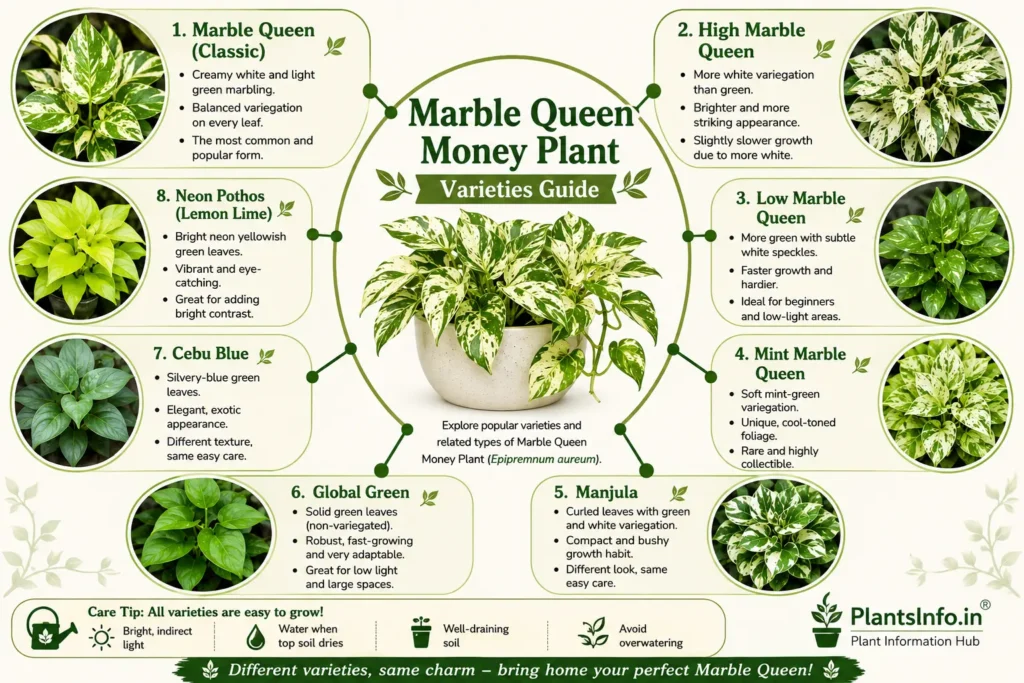
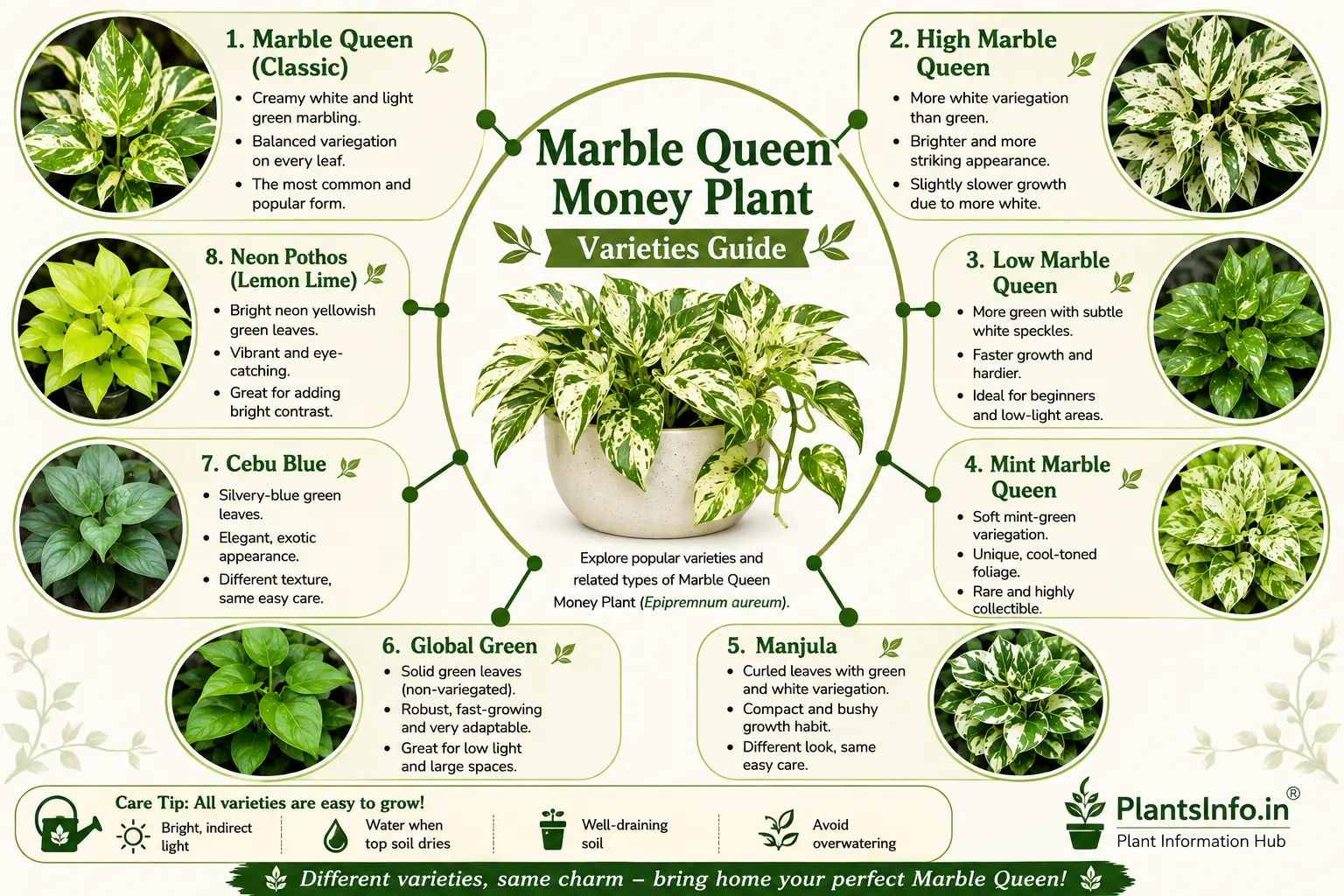
Marble Queen Money Plant Varieties Guide
Quick Answer
Epipremnum aureum ‘Marble Queen’ is a variegated cultivar of Epipremnum aureum, best recognised for its irregular cream-to-white and green marbled leaves. It is a strong choice when decorative, high-contrast foliage is more important than maximum growth speed.
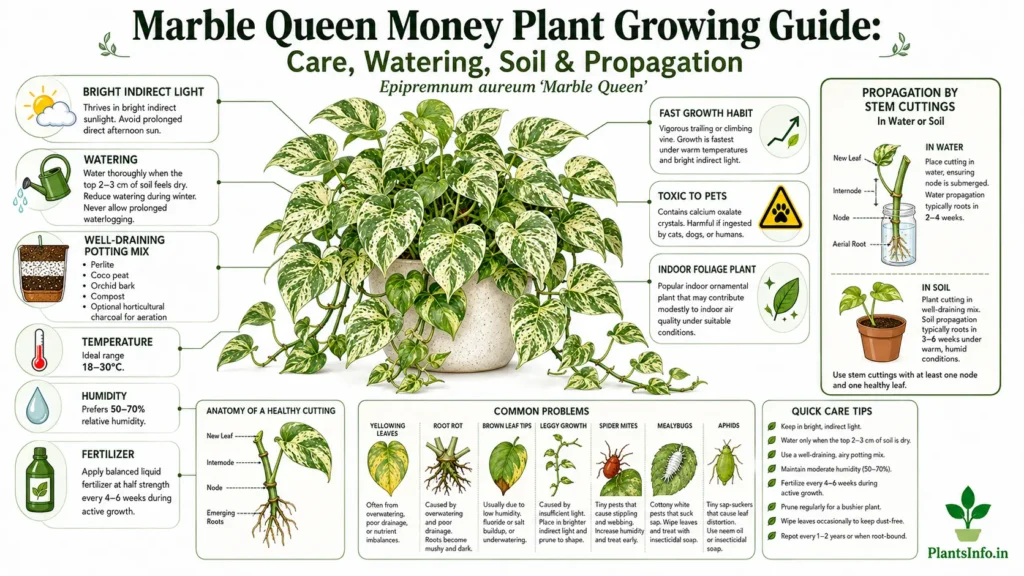
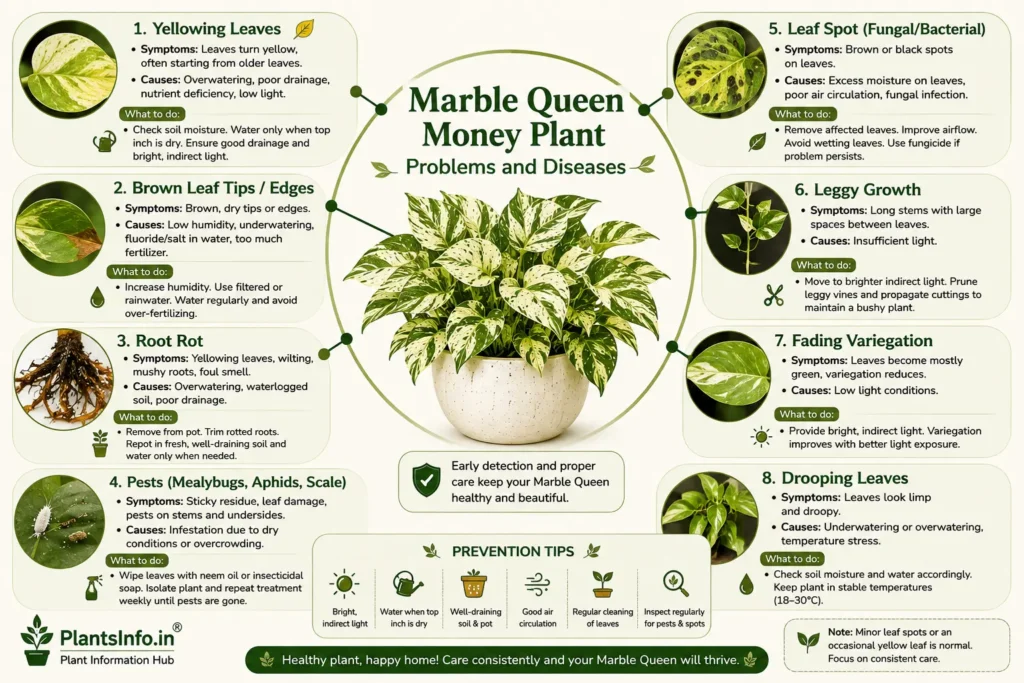
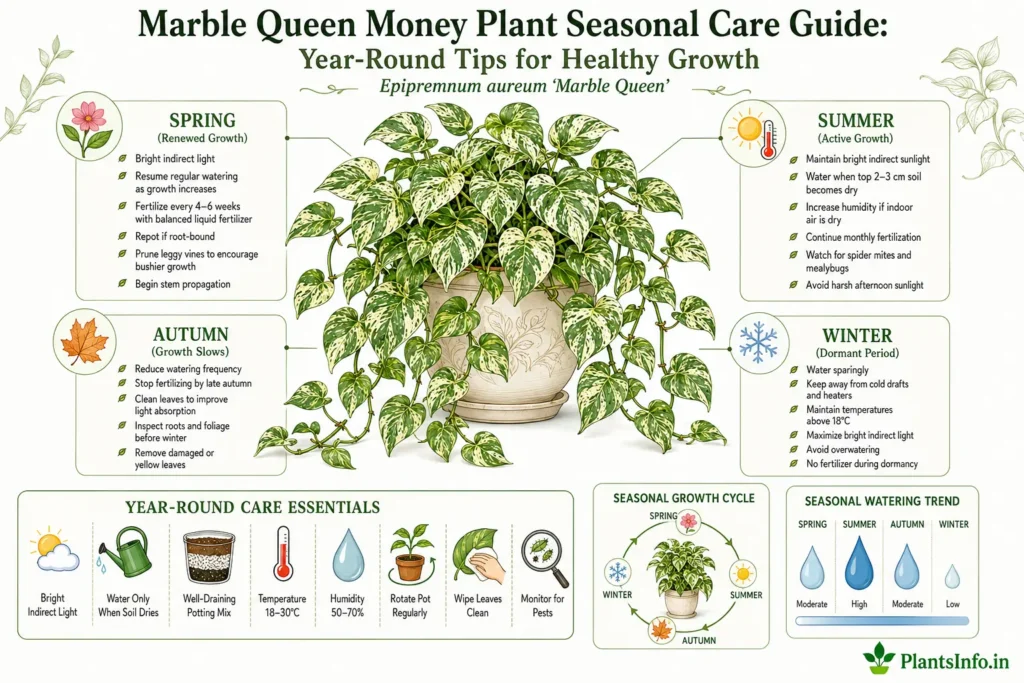
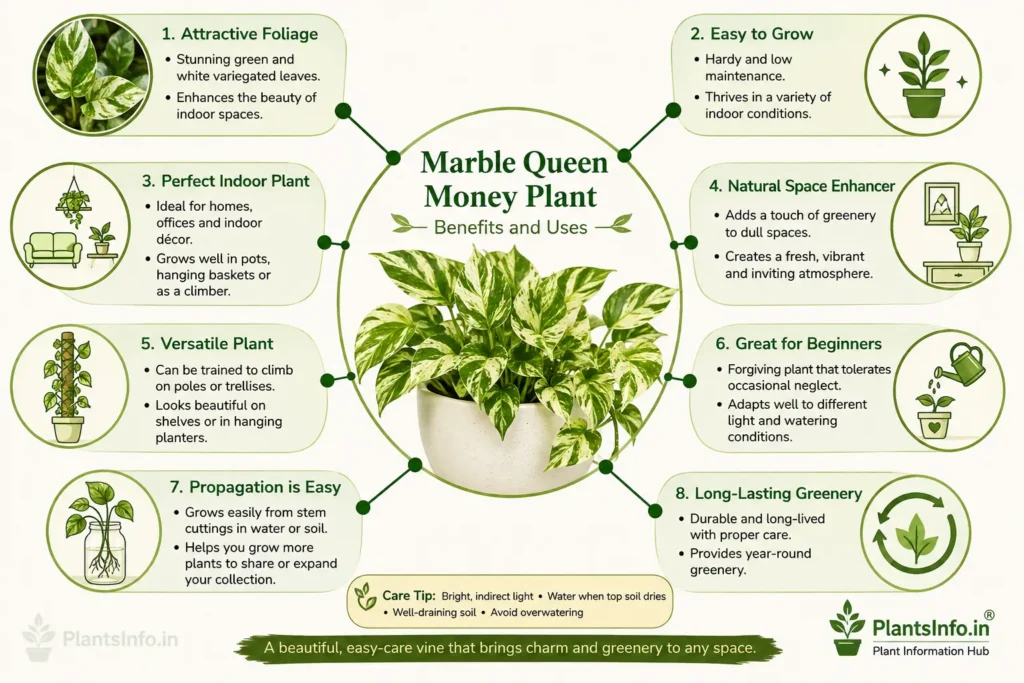
See also: Marble Queen Money Plant plant profile, how to grow it, common problems, seasonal care, and its benefits.
For variety selection, the main trade-off is variegation versus vegetative growth. Greener selections such as Jade generally carry more chlorophyll and can produce vigorous growth, while more heavily variegated selections tend to have less green tissue and may grow more slowly. Marble Queen occupies a middle position, combining conspicuous variegation with relatively dependable growth.
Recommended Products
Disclosure: As an Amazon Associate, PlantsInfo may earn from qualifying purchases.
🌱 Growing Essentials
The following products can help with container gardening, potting, root development, soil management, and healthy plant growth.
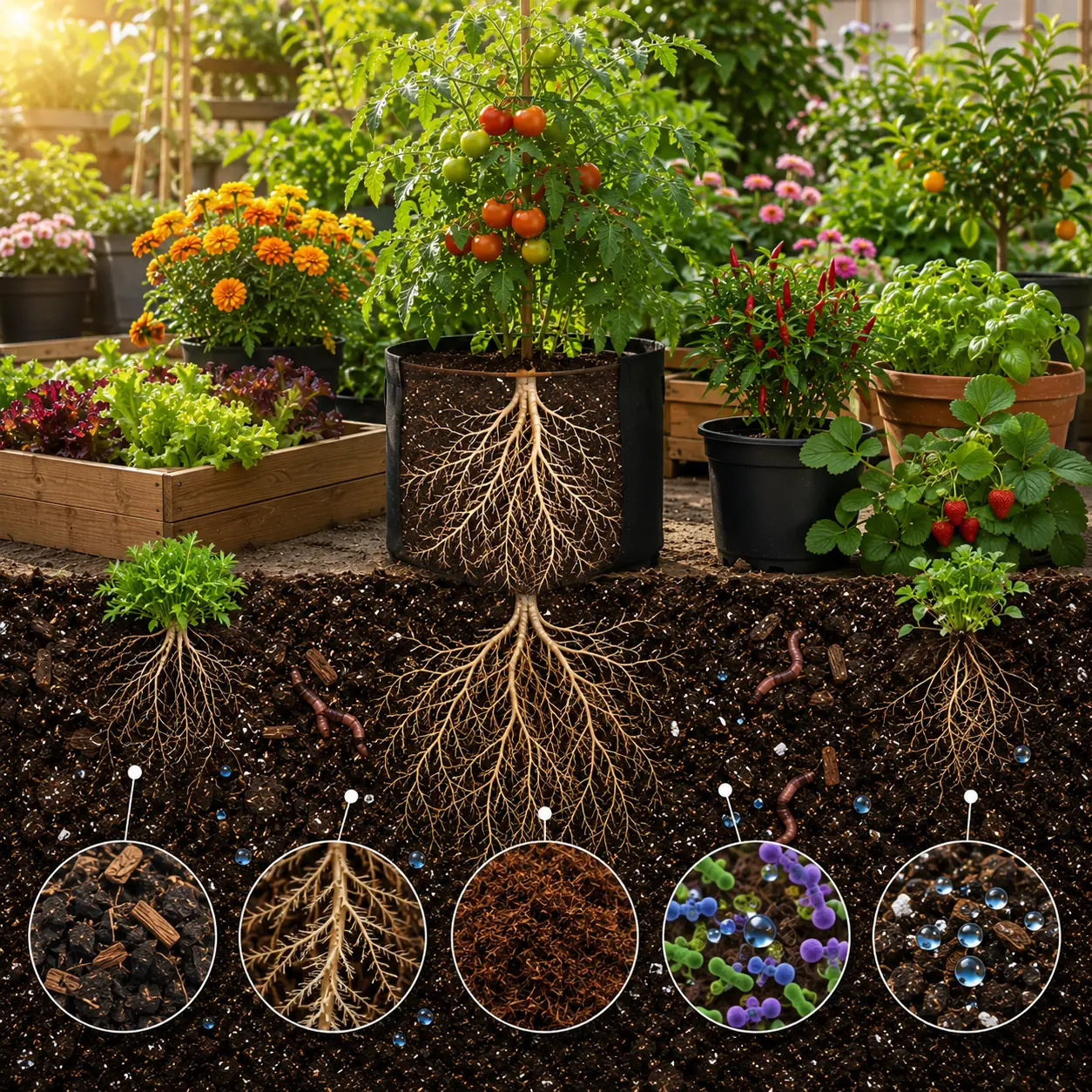
Organic Potting Soil Mix
Provides nutrients, structure, and healthy growing conditions for container plants.
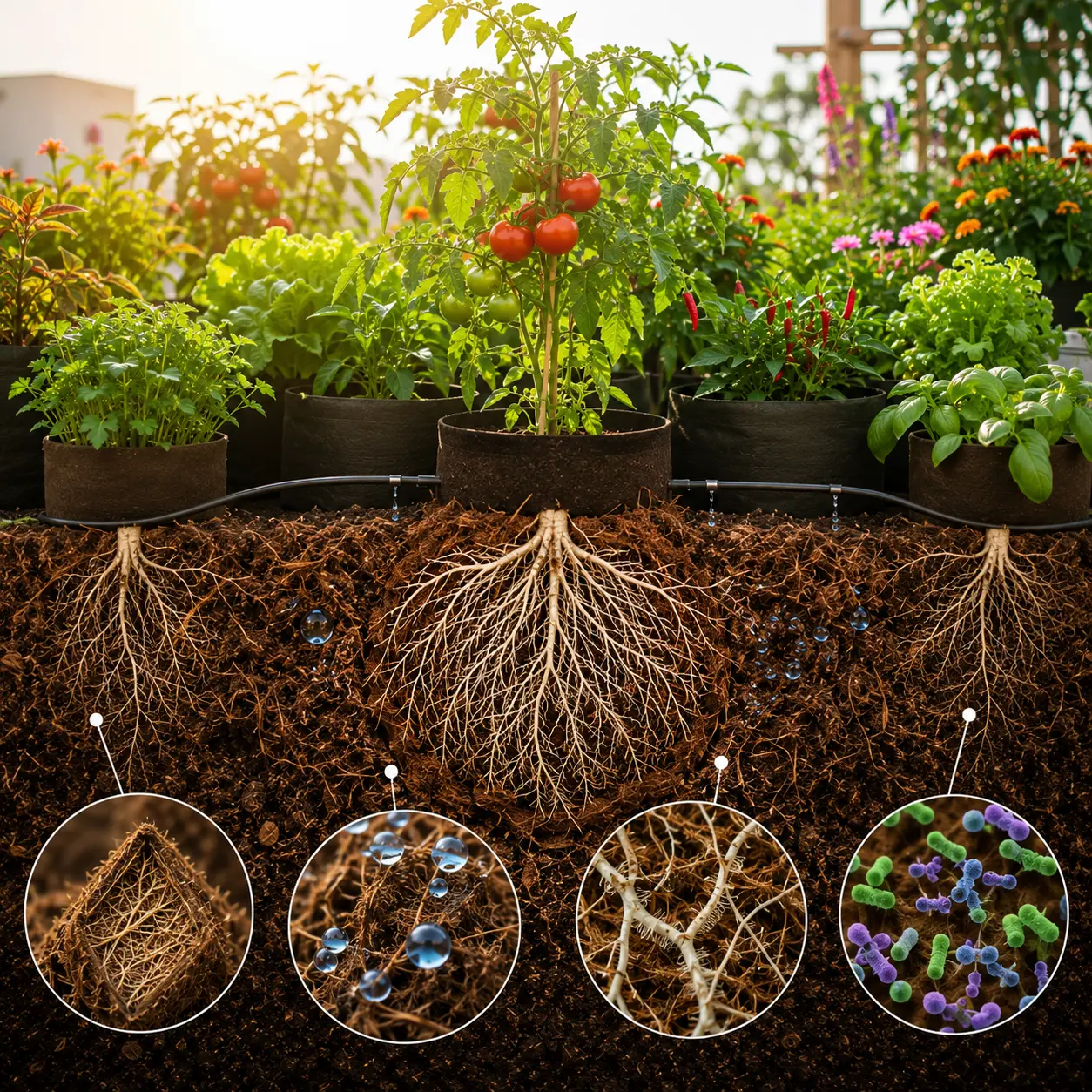
Coco Peat Growing Medium
Enhances moisture retention while maintaining excellent root-zone aeration.

Grow Bags for Plants
Improve drainage, root aeration, and vegetable production in limited spaces.

Plastic Pots for Plants
Ideal containers for seedlings, ornamentals, herbs, and balcony gardens.
PlantsInfo uses Epipremnum aureum ‘Marble Queen’ as the botanical designation. There is some taxonomic inconsistency in horticultural databases: Kew accepts E. aureum as the species, while the current RHS profile files Marble Queen under E. pinnatum and lists E. aureum ‘Marble Queen’ as a synonym.
| Feature | Marble Queen |
|---|---|
| Botanical name used here | Epipremnum aureum ‘Marble Queen’ |
| Family | Araceae |
| Plant type | Evergreen climbing or trailing vine |
| Main identifying feature | Irregular cream-and-green marbling |
| Growth character | Generally slower than greener selections |
| Main ornamental value | Variegated foliage |
| Best suited to | Gardeners wanting decorative foliage rather than maximum growth speed |
Introduction
Money plant is a widely used Indian common name for several ornamental vines, and Marble Queen is one of the most recognisable variegated forms sold as a money plant or pothos.
The cultivar is distinguished primarily by foliage. Its leaves combine green tissue with irregular cream or white areas, producing a marbled effect rather than the predominantly yellow variegation associated with Golden Pothos. Commercial and horticultural references commonly include Marble Queen among cultivated forms of Epipremnum aureum.
For a buyer, the important question is not whether Marble Queen is simply “better” than other pothos cultivars. The useful question is which foliage pattern and growth character best fit the intended use. A fast-growing green cultivar, a bright chartreuse cultivar, and a highly variegated white cultivar can all be appropriate choices for different situations.
Quick Variety Selector
| If you want… | A suitable choice |
|---|---|
| Balanced cream-and-green marbling | Marble Queen |
| Vigorous solid-green foliage | Jade Pothos |
| Green foliage with yellow variegation | Golden Pothos |
| Bright chartreuse-green foliage | Neon Pothos |
| Green-and-cream foliage with defined variegation | N’Joy |
| Small, patterned green-and-cream foliage | Pearls and Jade |
| Broad leaves with complex variegation | Manjula |
| Very heavily white-variegated foliage | Snow Queen, where correctly identified |
These are selection guides rather than absolute performance rankings. Light, temperature, nutrition, rooting conditions, plant age and individual plant variation can all influence growth and appearance. NCSU Extension lists Golden, Jade, Marble Queen, Neon, Pearls and Jade, N’Joy and Snow Queen among E. aureum cultivars or varieties, while RHS separately documents N’Joy and Marble Queen in its Epipremnum collection.
Most Important Variety Decision
Variegation or growth speed?
For most buyers, this is the most useful first decision.
Greener foliage generally provides more photosynthetic tissue, while extensive white or cream variegation reduces the proportion of green tissue in a leaf. Commercial production guidance also shows clear visual differences between solid-green Jade, yellow-variegated Golden Pothos, and white-variegated Marble Queen.
This does not mean Marble Queen is difficult to grow. Rather, a gardener choosing Marble Queen should expect its growth to be less vigorous than a strongly green selection under comparable conditions.
If the priority is:
- Maximum foliage growth: consider a greener cultivar such as Jade.
- Classic yellow-green variegation: Golden Pothos is the more appropriate choice.
- Strong cream-and-green marbling: Marble Queen is the better match.
- Very high white variegation: consider a highly variegated selection, but expect greater dependence on favourable growing conditions.
Marble Queen Variety Profile
Botanical identity
| Characteristic | Description |
|---|---|
| Species | Epipremnum aureum |
| Cultivar | ‘Marble Queen’ |
| Family | Araceae |
| Habit | Climbing or trailing |
| Foliage | Evergreen |
| Primary selection trait | Variegated foliage |
| Main colour combination | Green with cream to white areas |
Kew currently accepts Epipremnum aureum as a species in Araceae and records its native range as the Society Islands, with the species now cultivated and naturalised in numerous tropical and subtropical regions.
What makes Marble Queen distinctive?
The defining feature is the irregular distribution of cream and green across the leaf. Unlike Golden Pothos, whose classic variegation is yellow to golden, Marble Queen is principally associated with white or cream variegation. University of Florida commercial-production guidance describes Marble Queen as having leaves marbled with white variegation.
Individual leaves do not need to look identical. Variation in the amount and distribution of variegation is normal, so identification should be based on the plant’s overall foliage pattern rather than one unusually green or unusually pale leaf.
How much variegation should Marble Queen have?
There is no single percentage of white or green that defines every commercially sold Marble Queen plant. Leaves can differ considerably.
A useful identification rule is:
Look for repeated cream-and-green marbling across the plant rather than judging the cultivar from one leaf.
This is especially important when comparing Marble Queen with highly variegated plants sold under names such as Snow Queen.
Marble Queen Compared With Other Pothos Cultivars
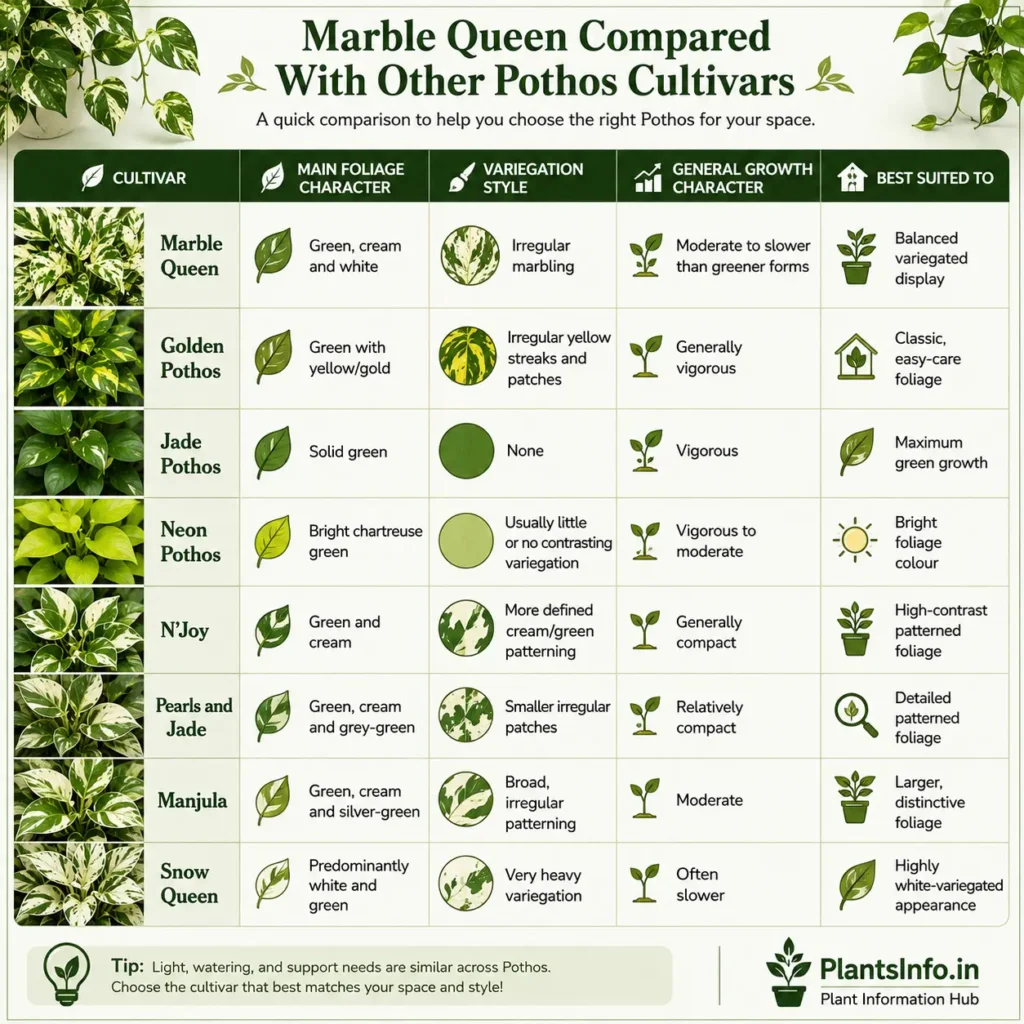
| Cultivar | Main foliage character | Variegation style | General growth character | Best suited to |
|---|---|---|---|---|
| Marble Queen | Green, cream and white | Irregular marbling | Moderate to slower than greener forms | Balanced variegated display |
| Golden Pothos | Green with yellow/gold | Irregular yellow streaks and patches | Generally vigorous | Classic, easy-care foliage |
| Jade Pothos | Solid green | None | Vigorous | Maximum green growth |
| Neon Pothos | Bright chartreuse green | Usually little or no contrasting variegation | Vigorous to moderate | Bright foliage colour |
| N’Joy | Green and cream | More defined cream/green patterning | Generally compact | High-contrast patterned foliage |
| Pearls and Jade | Green, cream and grey-green | Smaller irregular patches | Relatively compact | Detailed patterned foliage |
| Manjula | Green, cream and silver-green | Broad, irregular patterning | Moderate | Larger, distinctive foliage |
| Snow Queen | Predominantly white and green | Very heavy variegation | Often slower | Highly white-variegated appearance |
The comparison is intended to describe broad cultivar tendencies, not fixed performance ratings. The UF/IFAS commercial guide documents the classic distinctions among Golden Pothos, Jade, Marble Queen, and Neon, while NCSU and RHS provide additional cultivar identification information.
Individual Variety Profiles
Golden Pothos
Golden Pothos is a useful comparison because it is one of the best-known Epipremnum selections. Its foliage is green with yellow or golden variegation rather than Marble Queen’s cream-white marbling. UF/IFAS describes its leaves as dark green with irregular yellow and creamy-white streaks, stripes, and splashes.
Choose Golden Pothos if you prefer warmer yellow-green foliage and a classic pothos appearance.
Jade Pothos
Jade Pothos has solid green leaves without the contrasting variegation found in Marble Queen. UF/IFAS identifies it specifically as a non-variegated form.
Choose Jade if: vigorous green foliage is more important to you than leaf pattern.
Neon Pothos
Neon Pothos is recognised for bright chartreuse-green foliage rather than cream-white variegation. It provides strong colour contrast without relying on the marbled pattern characteristic of Marble Queen.
Choose Neon if: you want unusually bright green foliage rather than a cream-variegated plant.
N’Joy
N’Joy is a green-and-cream variegated cultivar with somewhat puckered foliage. The RHS lists Epipremnum N’joy under the cultivar name ‘Hansoti12’ and notes that its variegation becomes less pronounced in shadier conditions.
Choose N’Joy if: you prefer more clearly defined green-and-cream patterning rather than Marble Queen’s fine marbling.
Pearls and Jade
Pearls and Jade is another variegated E. aureum selection. UF/IFAS documentation identifies it as a cultivar developed for the foliage market, while the supplied PlantsInfo research describes its smaller, more patch-like patterning as a useful distinction from Marble Queen.
Choose Pearls and Jade if: you prefer smaller, more detailed patches and a more intricate foliage pattern.
Manjula
Manjula is commonly selected for broad leaves and complex cream-and-green variegation. Its foliage character is sufficiently different from Marble Queen that it is useful as a collector-oriented alternative.
Choose Manjula if: broader leaves and complex variegation are more important than the fine marbling of Marble Queen.
Because cultivar names and commercial descriptions are not always used consistently across the ornamental plant trade, identification should rely on documented cultivar characteristics rather than seller descriptions alone.
Snow Queen
Snow Queen deserves particular caution when buying.
The name is used in horticultural commerce for highly white-variegated plants, and the supplied research notes that commercial treatment of Snow Queen can vary. NCSU Extension also lists Snow Queen among E. aureum cultivars.
Choose Snow Queen if: the objective is a substantially whiter foliage appearance.
For a buyer, however, it is sensible to inspect the actual plant rather than assuming that a “Snow Queen” label guarantees a particular degree of variegation.
Marble Queen vs. the Parent Species
Marble Queen should not be treated as a separate botanical species.
| Characteristic | Epipremnum aureum | ‘Marble Queen’ |
|---|---|---|
| Taxonomic level | Species | Cultivar |
| Foliage | Variable among cultivated forms | Characteristically cream-and-green variegated |
| Climbing habit | Yes | Yes |
| Trailing use | Yes | Yes |
| Aerial roots | Present | Present |
| Main ornamental distinction | Species-level diversity | Selected foliage pattern |
Kew accepts E. aureum as the species, while horticultural sources document Marble Queen as a cultivated form within the Epipremnum trade.
The term cultivar is important here. A cultivar is a cultivated plant selection maintained for particular characteristics. For Marble Queen, those characteristics are primarily ornamental foliage traits.
Taxonomic Naming Note
Botanical naming of pothos can be confusing because older and current horticultural sources do not always use the same combination.
Kew currently accepts:
Epipremnum aureum (Linden & André) G.S.Bunting
as the species name.
The RHS currently presents its Marble Queen profile as:
Epipremnum pinnatum ‘Marble Queen’
while listing:
Epipremnum aureum ‘Marble Queen’
as a synonym.
For this PlantsInfo guide, ‘Epipremnum aureum ‘Marble Queen” is retained because it aligns with the requested plant identity and with Kew’s currently accepted treatment of E. aureum.
Older names such as Scindapsus aureus also occur in horticultural literature and commerce.
Choosing the Right Variety
The best cultivar depends on the visual effect and growth character wanted from the plant.
| Priority | Recommended direction |
|---|---|
| Cream-and-green marbling | Marble Queen |
| Solid green foliage | Jade |
| Yellow-green variegation | Golden Pothos |
| Bright chartreuse foliage | Neon |
| Defined cream-and-green pattern | N’Joy |
| Small, intricate variegated pattern | Pearls and Jade |
| Broad, complex variegated leaves | Manjula |
| Very white appearance | Snow Queen, subject to accurate identification |
When Marble Queen is the better choice
Marble Queen is particularly suitable when the goal is balanced variegation. It offers substantially more visual contrast than a solid-green cultivar without requiring the buyer to select an extremely white-variegated plant.
It is also a useful choice for gardeners who want a cultivar that is visually distinctive but still widely represented in horticultural production. Commercial cultivation guidance confirms its long-standing presence among foliage-plant cultivars.
When another cultivar may be better
Choose a greener cultivar when maximum vegetative vigour is the main priority.
Choose Golden Pothos when yellow or golden variegation is preferred.
Choose Neon when bright chartreuse foliage is the desired feature.
Choose N’Joy, Pearls and Jade or Manjula when the preferred appearance is more sharply patterned or structurally distinctive.
Choose a heavily white-variegated selection when foliage whiteness is the primary collecting objective, while recognising that high variegation can reduce the amount of green photosynthetic tissue.
Regional Suitability in India
Marble Queen is primarily a warm-climate foliage plant. Its suitability in India therefore depends more on the local indoor or sheltered growing environment than on a simple state-by-state ranking.
| Indian situation | Relative suitability |
|---|---|
| Warm, bright indoor environment | Excellent |
| Warm, humid tropical conditions | Excellent |
| Warm subtropical conditions with suitable indoor protection | Good |
| Cool winter conditions | Requires protection from cold |
| Very dark indoor location | Poor for maintaining strong variegation |
The broader Epipremnum group prefers bright indirect or filtered light and can tolerate some shade, but deep shade can reduce growth and visible variegation.
For Indian homes, the practical selection issue is therefore not simply whether Marble Queen can survive. It is whether the available light is sufficient to maintain the visual character for which the cultivar was purchased.
Container Suitability
Marble Queen is well suited to container culture because Epipremnum is widely grown as an indoor foliage plant and can be maintained either as a trailing plant or trained as a climber. RHS lists Marble Queen as a foliage houseplant with climbing and trailing habits.
From a variety-selection perspective, the important point is that container suitability does not make Marble Queen identical to every other pothos cultivar.
Its relatively slower growth compared with greener selections can be an advantage where a gardener wants a decorative plant without rapid extension of long green shoots. Conversely, gardeners seeking rapid coverage may prefer a greener cultivar.
Detailed potting, watering, pruning and propagation instructions belong in the PlantsInfo Growing Guide rather than this variety-selection article.
Buying Advice
Check the foliage, not only the label.
A nursery label is useful but should not be the sole basis for identification. Look for repeated cream-and-green marbling across several leaves.
Inspect several leaves
One unusually green or unusually white leaf does not necessarily indicate a different cultivar. Individual leaves can vary.
Compare plants at the same nursery.
When possible, compare several labelled plants. This makes it easier to judge whether the foliage matches the expected cultivar character.
Be cautious with highly variegated names.
Names such as Snow Queen can be used inconsistently in commercial horticulture. If the distinction matters to you, buy from a seller able to identify the cultivar clearly and show representative foliage.
Avoid buying on rarity claims alone.
A higher price does not automatically indicate a superior cultivar. Variety selection should be based on foliage character, growth expectations, availability, and the intended use of the plant.
Common Mistakes
Choosing by colour alone
A plant with the whitest leaf is not automatically the best Marble Queen. Look at the overall pattern across the plant.
Expecting Marble Queen to grow like a solid-green cultivar
Its variegated foliage can result in slower growth than greener selections. This is an important expectation to set before purchase.
Treating all white-variegated pothos as the same cultivar
Marble Queen, N’Joy, Pearls and Jade, Manjula, and highly variegated plants sold as Snow Queen can look related but are not interchangeable labels.
Assuming a trade name is a botanical name
Pothos has a long history of older synonyms and changing commercial terminology. When accuracy matters, check the botanical name and cultivar designation rather than relying only on a common name.
Frequently Asked Questions
Is Marble Queen a separate species?
No. Marble Queen is treated horticulturally as a cultivar associated with Epipremnum aureum. Kew accepts E. aureum as the species, while RHS currently lists E. aureum ‘Marble Queen’ as a synonym under its E. pinnatum profile.
What is Marble Queen best known for?
It is best known for irregular cream-to-white and green marbled foliage.
Is Marble Queen faster growing than Jade Pothos?
Generally, no. Jade is a solid-green cultivar, while Marble Queen has substantially more variegated tissue. In comparable conditions, greener plants can have an advantage in vegetative growth. UF/IFAS identifies Jade as unvariegated and Marble Queen as white-variegated.
Is Marble Queen the same as Golden Pothos?
No. Both are associated with Epipremnum aureum, but Golden Pothos is characterised by yellow or golden variegation, whereas Marble Queen is principally recognised for white or cream variegation.
Is Marble Queen the same as Snow Queen?
Not necessarily. Snow Queen is used as a cultivar name in horticultural sources, but commercial naming can overlap with highly white-variegated Marble Queen plants. Buyers should evaluate the actual foliage and the reliability of the seller’s identification.
Why can Marble Queen leaves become greener?
Lower light can reduce visible variegation in Epipremnum. NCSU Extension specifically notes that low light can cause loss of variegation.
Is Marble Queen suitable for Indian homes?
Yes, provided it receives an appropriate warm environment and sufficient bright, indirect or filtered light. Deep shade can reduce growth and visible variegation.
Which pothos cultivar should I choose for the fastest growth?
If rapid green growth is the priority, a greener selection such as Jade is a more logical choice than a strongly variegated Marble Queen. Exact growth speed remains dependent on growing conditions.
Is Marble Queen a good choice for a foliage collection?
Yes, if cream-and-green marbling is the desired characteristic. It also provides useful visual contrast when displayed alongside solid-green, yellow-variegated, chartreuse, or more heavily white-variegated cultivars.
Conclusion
Marble Queen is best understood as a variegated cultivar selected primarily for its cream-and-green marbled foliage, rather than as a separate species. Its main advantage is balance: it provides a distinctive variegated appearance while avoiding the predominantly green look of Jade and the strongly yellow appearance of Golden Pothos.
The most important buying decision is therefore the balance between ornamental variegation and growth character. Choose Marble Queen when marbled cream-and-green foliage is the priority; choose greener cultivars when vigorous green growth matters more; and consider more heavily variegated selections when a predominantly white appearance is the objective.
For Indian gardeners, the best Marble Queen plant is not necessarily the one with the whitest individual leaf. A better choice is a healthy, accurately labelled plant showing the cultivar’s characteristic marbling across multiple leaves and placed where sufficient light can preserve that appearance.