Introduction
Punica granatum L., commonly known as pomegranate, is a fruit-bearing woody plant belonging to the family Lythraceae. It is generally described as a deciduous shrub or small tree and is recognised by its branching growth habit, conspicuous flowers, persistent floral structures, and characteristic many-seeded fruit.
Classification
- Plant Type
- Shrub
- Lifecycle
- Perennial
- Leaf Habit
- Deciduous
- Native Region
- Central Asia, Indian Subcontinent, West Asia
- Plant Family
- Lythraceae
The species is native to a region extending from northeastern Türkiye through western and northern Pakistan, including parts of western and central Asia. Its natural distribution is associated with temperate and seasonally dry environments.
Pomegranate has a long history of cultivation for its edible fruit, ornamental flowers, and cultural significance. Its extensive cultivation across different regions should be distinguished from its native geographical range.
The species is assessed globally as Least Concern (LC). This conservation assessment refers to its global status and should not be interpreted as evidence that every wild population or local habitat is secure.
This profile examines the species’ taxonomy, morphology, biological characteristics, cultivation, uses, ecological relationships, and conservation context.
Quick Plant Information
| Field | Value |
|---|---|
| Accepted name | Punica granatum L. |
| Common names | Pomegranate; anar |
| Family | Lythraceae |
| Genus | Punica |
| Life form | Deciduous shrub or small tree |
| Growth habit | Woody, branched perennial |
| Native range | Northeastern Türkiye to western and northern Pakistan, including parts of western and central Asia |
| Conservation status | Least Concern (LC), global assessment |
| Principal uses | Food, ornamental, cultural, traditional-use, and other documented economic uses |
Classification and Taxonomy
| Rank | Taxon |
|---|---|
| Kingdom | Plantae |
| Phylum | Streptophyta |
| Class | Equisetopsida |
| Subclass | Magnoliidae |
| Order | Myrtales |
| Family | Lythraceae |
| Genus | Punica |
| Species | Punica granatum L. |
The classification presented here follows the taxonomic backbone consulted in the source draft, Plants of the World Online. Higher-rank terminology may differ among taxonomic classification systems.
Related Species of Significance
| Species | Relationship | Distinguishing note |
|---|---|---|
| Punica protopunica Balf.f. | Congeneric species | The other accepted species of Punica, native to Socotra. Its inclusion provides context for the genus and its geographical distribution. |
Taxonomic Context
The consulted taxonomic treatment recognises two accepted species in the genus Punica: P. granatum and P. protopunica.
Historical names associated with pomegranate include Punica nana L. and Punica granatum var. nana (L.) Pers. These names are treated within the synonymy of the accepted species in the consulted taxonomic treatment rather than as separate accepted species.
When searching historical botanical, horticultural, or taxonomic literature, these synonyms may be useful for retrieving older records. The accepted name, Punica granatum L., is retained throughout this profile.
Cytogenetics
| Parameter | Value |
|---|---|
| Chromosome number | Not reported in the verified source set; species-specific verification pending |
| Ploidy level | Not reported in the verified source set; species-specific verification pending |
| Genome size | Not reported in the verified source set; species-specific verification pending |
Numerical cytogenetic values have not been included because traceable, species-specific records have not yet been established for this profile.
This is a limitation of the present source verification, not evidence that cytogenetic information is absent from the scientific literature.
Scientific Stability and Nomenclature
Punica granatum L. is recognised as an accepted species under the consulted Kew taxonomic treatment. The name was published by Carl Linnaeus in 1753.
Historical synonymy reflects earlier taxonomic treatments and horticultural classifications. The appearance of an older name in a publication does not, by itself, indicate a change in the currently accepted identity of the species.
For bibliographic research, relevant synonyms and historical infraspecific combinations should be considered alongside the accepted name. This profile consistently uses Punica granatum L. as its principal taxonomic designation.
Growth Habit and Architecture
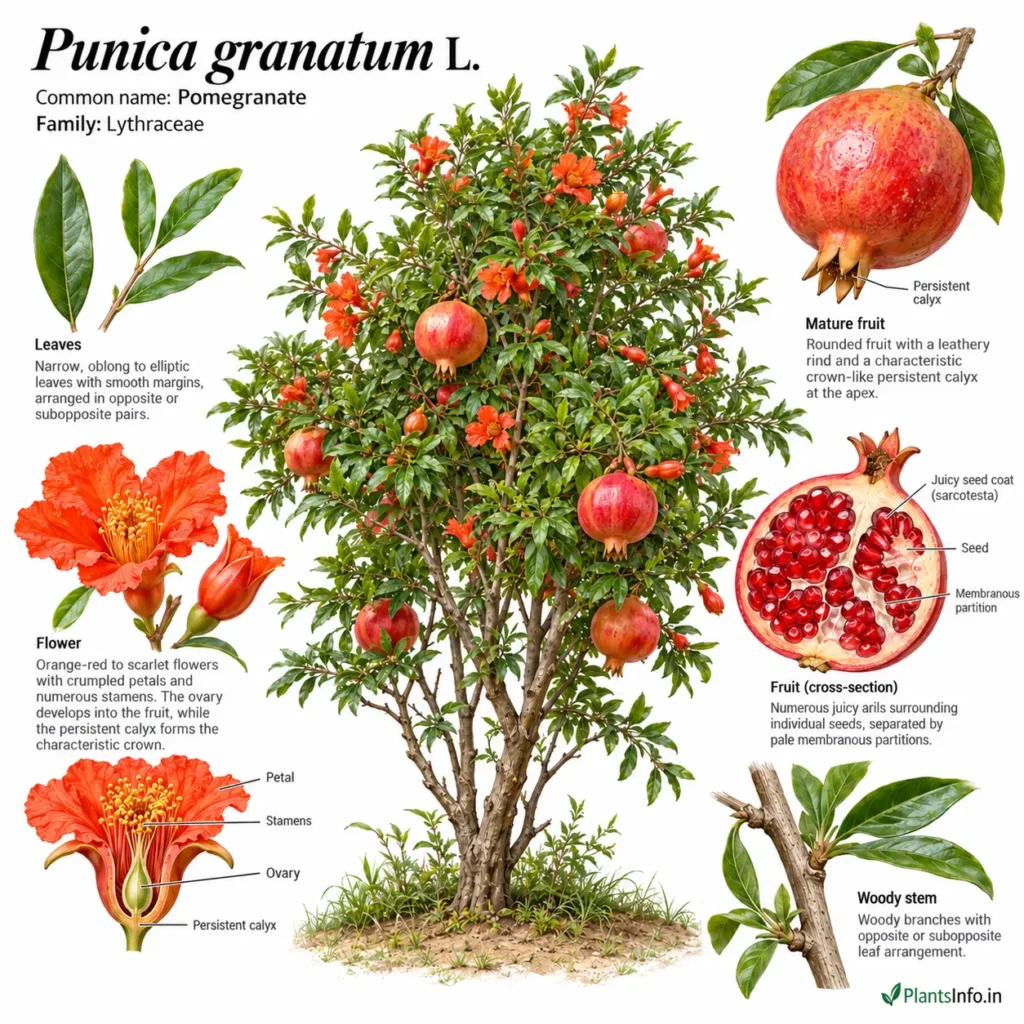
Punica granatum is a woody, deciduous shrub or small tree with a branching growth habit. Plants are frequently multi-stemmed, although pruning and cultivation can produce a more clearly defined trunk.
The crown is generally dense and spreading, with an irregular branching pattern. Short lateral shoots may bear rigid, spine-like structures. Their occurrence and prominence vary among plants and cultivars.
| Characteristic | Description |
|---|---|
| Life form | Deciduous shrub or small tree |
| Mature height | Commonly approximately 3–6 m; larger individuals may occur |
| Canopy spread | Variable; may be comparable to or greater than height in untrained plants |
| Stem type | Woody and branched |
| Bark | Relatively smooth when young; may become rough or fissured with age |
| Branching pattern | Dense, irregular to spreading |
| Root system | Woody, with a principal root axis and lateral roots |
| Growth rate | Moderate under favourable growing conditions |
| Longevity | Long-lived perennial; mature specimens may persist for several decades |
| Distinguishing feature | Shrubby branching with short lateral shoots that may bear spines |
Stem
The woody stem system supports the crown and bears vegetative and reproductive shoots. Stems may develop an erect to spreading form, depending on plant age, growing conditions, and management.
Short, rigid, spine-like structures commonly occur on branches or short shoots, although their prominence varies.
| Characteristic | Description |
|---|---|
| Stem type | Woody, erect to spreading |
| Cross-section | Approximately circular |
| Mature diameter | Variable with age and growth form |
| Surface | Young stems relatively smooth; older stems may become rougher |
| Young stem colour | Greenish to reddish-brown, depending on developmental stage |
| Mature stem colour | Greyish-brown |
| Internode length | Variable between vigorous shoots and short lateral growth |
| Spine status | Spines commonly present on branches or short shoots |
| Internal structure | Woody, with secondary growth |
Leaves
Pomegranate leaves are simple, relatively narrow, and entire-margined, with short petioles. Their arrangement and compact form contribute to the plant’s characteristic vegetative appearance.
| Characteristic | Description |
|---|---|
| Foliage habit | Deciduous |
| Leaf type | Simple |
| Leaf arrangement | Opposite to subopposite; sometimes appearing clustered on short shoots |
| Leaf shape | Oblanceolate to elliptic or narrowly oblong |
| Leaf length | Commonly approximately 2–8 cm |
| Leaf width | Commonly approximately 0.5–2 cm |
| Leaf margin | Entire |
| Leaf apex | Obtuse to acute |
| Leaf base | Cuneate to attenuate |
| Leaf colour | Green, becoming glossy dark green at maturity |
| Leaf surface | Generally smooth |
| Petiole | Short |
| Additional features | Young foliage may be reddish or bronze; autumn coloration may precede leaf fall |
Flowers
Pomegranate flowers are characterised by a thick, persistent calyx and numerous stamens. Flower colour commonly ranges from orange-red to scarlet, with additional variation among ornamental forms and cultivars.
| Characteristic | Description |
|---|---|
| Flower arrangement | Solitary or in small clusters |
| Symmetry | Generally actinomorphic |
| Diameter | Commonly approximately 3–5 cm |
| Calyx | Thick, persistent, tubular to bell-shaped, with 5–8 lobes |
| Petals | Usually 5–7; often delicate or crumpled in appearance |
| Petal colour | Orange-red to scarlet; cultivar variation occurs |
| Stamens | Numerous |
| Pistil | Compound, with an inferior ovary |
| Fragrance | Variable; not consistently diagnostic |
| Pollination | Insects, including bees, are involved |
The persistent calyx remains attached to the developing fruit and forms the characteristic crown-like structure at its distal end.
Recommended Products
Disclosure: As an Amazon Associate, PlantsInfo may earn from qualifying purchases.
🌱 Plant Care Essentials
The following tools can help with pruning, plant health, soil management, and fruit garden maintenance.

Neem Oil for Plant Care
Natural plant protection against aphids, whiteflies, mites, and other common garden pests.

Fungicide for Root Care
Helps suppress soil-borne fungal diseases and supports healthier root systems.

Spray Bottle for Plants
Ideal for applying foliar sprays, neem oil solutions, and liquid plant treatments.

Rubber Hand Gloves
Protects hands during pruning, planting, soil preparation, and garden maintenance.
Fruit
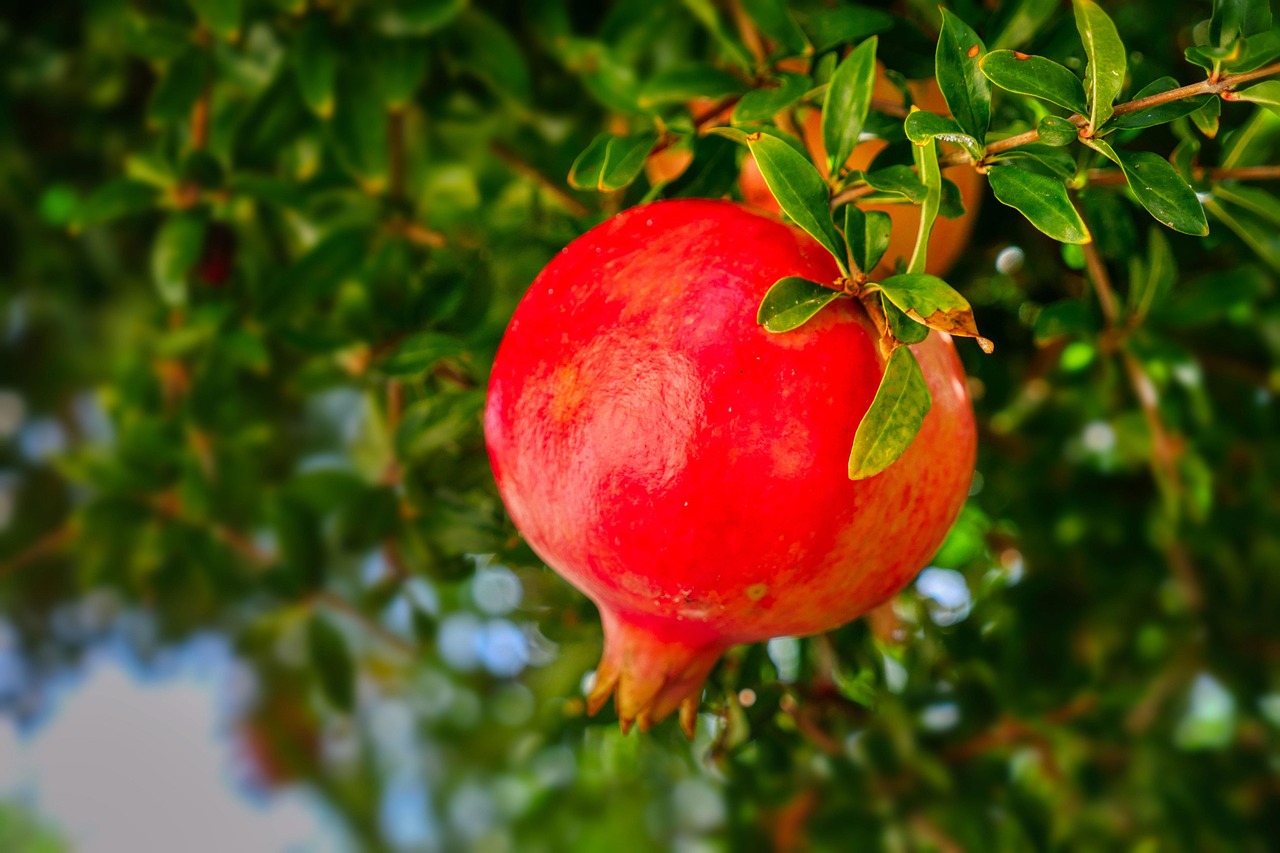
The fruit of Punica granatum is botanically described as a balausta, a specialised type of berry. Its leathery rind encloses numerous juicy arils arranged within chambers separated by membranous partitions.
| Characteristic | Description |
|---|---|
| Fruit type | Balausta; a specialised berry |
| Shape | Globose to subglobose |
| Diameter | Commonly approximately 5–12 cm |
| Rind colour | Yellowish, pink, red, or reddish-brown, depending on cultivar and maturity |
| Surface | Leathery |
| Distal structure | Persistent calyx forming a crown |
| Internal organisation | Chambers separated by membranous partitions |
| Edible portion | Juicy arils surrounding the seeds |
| Aril colour | Clear, pale pink, deep red, or other cultivar-dependent shades |
| Aril texture | Juicy; firmness varies |
| Seed number | Numerous; varies substantially among fruits and cultivars |
| Maturation period | Variable with cultivar and climate; commonly several months after flowering |
Seeds
The seeds are enclosed within fleshy arils. Their shape, colour, and firmness vary with maturity and cultivar characteristics.
| Characteristic | Description |
|---|---|
| Shape | Angular to irregularly rounded |
| Colour | Cream to pale brown, depending on maturity and seed characteristics |
| Seed coat | Relatively firm; hardness varies among cultivars |
| Structure | Seed enclosed within a fleshy aril |
| Texture | Variable among cultivars |
The edible portion of the fruit is commonly consumed with the seed, although perceived seed hardness differs among cultivars and individual fruits.
Root System
The root system is woody and includes a principal root axis with lateral roots. Its architecture is influenced by plant age, soil conditions, water availability, propagation method, and cultivation practices.
The available source description does not establish a universal rooting depth or a fixed root-spread measurement. Such values should therefore not be presented as species-wide constants.
Morphological Summary
Pomegranate can be recognised by the combination of a deciduous, often multi-stemmed woody habit; narrow, simple leaves; conspicuous flowers with a persistent calyx; and globose fruits containing numerous arils.
Individual dimensions, colour, branching form, spine development, and fruit characteristics vary with cultivar, developmental stage, environment, and management. These variations should be considered when using morphology for identification.
Field Identification
A mature pomegranate (Punica granatum L.) can generally be identified by a combination of vegetative and reproductive characteristics. No single vegetative feature should be treated as universally diagnostic, particularly when examining young plants or cultivated forms.
Key Identification Characteristics
| Characteristic | Field observation |
|---|---|
| Growth form | Woody, deciduous shrub or small tree, often multi-stemmed |
| Leaves | Simple, narrow, entire-margined leaves |
| Leaf arrangement | Opposite to subopposite, sometimes appearing clustered on short shoots |
| Branches | Rigid, sometimes bearing short spines |
| Flowers | Conspicuous orange-red to scarlet flowers |
| Calyx | Thick, persistent, and characteristically crown-forming |
| Fruit | Globose to subglobose, with a leathery rind |
| Internal fruit structure | Numerous juicy arils arranged within chambers separated by membranous partitions |
Principal Diagnostic Feature
The combination of a persistent crown-like calyx and numerous juicy arils enclosed within a leathery, chambered fruit is particularly useful for recognizing mature pomegranate.
Vegetative identification should be interpreted alongside plant age, seasonal condition, and cultivar variation.
Normal vs. Concerning Observations
Pomegranate exhibits natural seasonal and horticultural variation. Leaf shedding, differences in spine development, and variation in fruit characteristics should not automatically be interpreted as signs of poor plant health.
The following distinctions provide a preliminary observational framework rather than a diagnostic assessment of specific diseases.
| Observation | Interpretation | Notes |
|---|---|---|
| Seasonal leaf fall | Normal | Expected during seasonal dormancy in this deciduous species |
| Reddish or bronze young leaves | Normal | Young foliage may differ in colour from mature leaves |
| Variable spine prominence | Normal | Spine development varies among shoots and cultivated forms |
| Differences in fruit rind and aril colour | Normal | These characteristics vary among cultivars |
| Differences in seed hardness | Normal | Hard-seeded and relatively soft-seeded cultivated forms occur |
| Localized bark fissuring on older stems | Monitor | Interpret surface changes in relation to stem age and their extent |
| Persistent, irregular stem dieback | Investigate | Ordinary seasonal leaf loss alone does not adequately explain persistent dieback |
| Unusual deformation of leaves or reproductive structures | Investigate | Persistent or widespread abnormalities require further examination |
These observations are intended to distinguish expected biological variation from conditions that warrant closer investigation. They do not establish a specific causal diagnosis.
Cultivar Summary
Pomegranate includes numerous named cultivars and regionally recognized selections. Cultivated diversity is expressed through differences in fruit appearance, aril characteristics, seed hardness, and commercial importance.
The following examples illustrate selected horticultural forms and do not constitute a complete cultivar catalogue.
| Cultivar | Key characteristics reported in the source | Commercial or regional significance | Reported origin |
|---|---|---|---|
| Wonderful | Large fruit with red rind and arils | Widely recognized commercial cultivar | United States selection |
| Bhagwa | Red fruit and arils | Commercially important in India | Indian selection |
| Ganesh | Commonly associated with softer seeds and pinkish arils | Regionally significant | India |
| Kandhari | Large fruit, commonly associated with deep red arils | Regionally significant | Indian subcontinent; cultivar history requires verification |
| Dholka | Recognized Indian cultivar with comparatively light-coloured fruit characteristics | Regionally significant | Gujarat, India |
Interpretation of Cultivar Variation
Cultivar characteristics should be understood as horticultural descriptions rather than universal species-level traits.
Fruit colour, aril appearance, and seed hardness may vary among cultivars. Consequently, these characteristics should not be used individually to define the botanical identity of P. granatum.
The reported origins and historical associations of individual cultivars require appropriate cultivar-specific documentation before being treated as fully established provenance records.
Functional Traits
The functional profile of Punica granatum reflects its deciduous growth habit, persistent woody structure, and production of fleshy, seed-bearing fruits.
Seasonal leaf shedding separates periods of active foliage from dormancy. Fruit development combines seed protection with a structure that may participate in animal-mediated dispersal.
Functional Trait Summary
| Functional trait | Mechanism | Biological significance | Ecological context |
|---|---|---|---|
| Deciduous seasonal strategy | Seasonal leaf shedding followed by renewed foliage production | Separates active foliage development from the dormant period | Consistent with environments where temperature and water availability vary seasonally |
| Woody perennial growth | Persistent woody tissues support repeated seasonal growth and reproductive cycles | Allows long-term structural growth across successive seasons | Supports establishment over multiple growing seasons |
| Fleshy fruit development | Seeds develop within a fleshy, aril-bearing fruit enclosed by a protective rind | Represents reproductive investment in a seed-containing structure | May provide an animal-consumed dispersal unit; effectiveness depends on the animal and habitat |
| Phenotypic variation in cultivated populations | Fruit and vegetative characteristics vary among cultivated selections | Produces variation in morphological and horticultural characteristics | Reflects human selection; cultivated variation should not automatically be interpreted as wild adaptive differentiation |
Functional Interpretation
The combination of deciduous foliage and persistent woody growth allows pomegranate individuals to maintain a perennial structure while undergoing seasonal changes in vegetative activity.
Its fleshy fruit contains numerous seeds surrounded by arils. This fruit structure may contribute to animal-mediated dispersal, although the effectiveness of that process depends on the dispersing animal and the surrounding habitat.
Cultivated variation is also an important component of the species’ functional and horticultural profile. Differences among selected plants may reflect human selection and should not automatically be interpreted as evidence of adaptive differentiation in wild populations.
The available evidence assembled for this profile does not establish a single quantitative water-use strategy, photosynthetic performance value, or nutrient-acquisition mechanism for the species as a whole. These characteristics depend on genotype, developmental stage, and experimental conditions.
Physiological Integration
Seasonal leaf activity, perennial woody growth, and fruit development form the principal components of the annual growth and reproductive cycle of Punica granatum.
The species combines:
- Seasonal foliage production and dormancy.
- Persistent woody growth across successive seasons.
- Reproductive development involving flowers, fruits, and seeds.
- Cultivar-dependent variation in fruit and vegetative characteristics.
The relative physiological costs of vegetative growth and fruit production cannot be quantified from the evidence assembled for this profile.
Similarly, no specific species-level trade-off among drought response, photosynthetic efficiency, nutrient acquisition, and reproductive output is established here.
Occurrence in seasonally dry environments should not, by itself, be treated as proof of a particular physiological mechanism or quantitative drought-tolerance threshold.
Phytochemistry
Punica granatum has a diverse documented chemical composition, including hydrolysable tannins, phenolic acids, flavonoids, anthocyanins, and seed lipids.
The following compounds represent reported constituents of P. granatum. Their presence and distribution may vary with plant organ, cultivar, maturity, extraction method, and analytical technique.
Major Phytochemical Groups
| Compound class | Representative compounds | Principal reported locations | Biological or ecological interpretation |
|---|---|---|---|
| Hydrolysable tannins | Punicalagin (α and β forms), punicalin, pedunculagin | Particularly peel and other non-edible tissues; distribution varies by organ | Phenolic defence-related activity is plausible, but the ecological contribution of individual compounds requires species-specific functional evidence |
| Phenolic acids and related compounds | Ellagic acid, gallic acid | Peel, juice, and other investigated tissues | Contribute to the phenolic profile; individual ecological functions are not fully established |
| Anthocyanins | Cyanidin-3-glucoside, cyanidin-3,5-diglucoside, delphinidin glycosides, pelargonidin glycosides | Coloured arils and juice | Associated with fruit pigmentation; a specific contribution to animal attraction has not been quantified here |
| Flavonoids | Quercetin, kaempferol, and reported derivatives | Leaves, peel, and other examined tissues | Potential roles in plant chemical interactions are documented broadly, but species-specific ecological functions remain incompletely resolved |
| Seed fatty acids | Punicic acid, linoleic acid, oleic acid | Seed oil | Characteristic seed-oil composition; ecological function is not assigned from composition alone |
The table is representative rather than a complete metabolomic characterization. Chemical composition should not be treated as invariant across all plant materials or analytical conditions.
Phytochemical Organ Distribution
Organ-level studies support several broad associations between pomegranate tissues and their reported chemical constituents.
Concentrations are not supplied where a directly comparable quantitative dataset has not been established for this profile.
| Plant organ | Compound class | Representative compounds | Concentration information | Source information in supplied draft |
|---|---|---|---|---|
| Fruit peel | Hydrolysable tannins | Punicalagin, punicalin | No harmonized quantitative dataset established for this profile | Seeram et al. (2005); Fischer et al. (2011) |
| Fruit peel | Phenolic acids | Ellagic acid, gallic acid | No harmonized quantitative dataset established for this profile | Seeram et al. (2005) |
| Arils and juice | Anthocyanins | Cyanidin, delphinidin, and pelargonidin glycosides | Cultivar- and method-dependent; no single representative value assigned | Mena et al. (2012) |
| Seeds | Fatty acids | Punicic acid, linoleic acid, oleic acid | Variable by sample and analytical method | Górnaś et al. (2014) |
| Leaves | Flavonoids | Quercetin and kaempferol derivatives | No harmonized quantitative dataset established for this profile | Species-specific leaf phytochemical studies; complete reference required |
The distribution described above is not exclusive. Detection of a compound in one organ does not establish its absence from other organs.
Phytochemical Significance
Punicalagin is a prominent ellagitannin associated with pomegranate peel and has received substantial attention in analytical and biological research.
Ellagic acid and anthocyanins are recurring components of the species’ chemical characterization, while punicic acid is a characteristic fatty acid of pomegranate seed oil.
Principal Organ Associations
| Organ | Principal reported chemical characteristics |
|---|---|
| Peel | Hydrolysable tannins and related phenolics |
| Arils and juice | Anthocyanins and other soluble phenolics |
| Seeds | Characteristic fatty-acid composition |
| Leaves | Reported flavonoids and other phenolic constituents |
These associations establish chemical significance but do not independently demonstrate therapeutic effects, clinical benefits, or specific ecological functions.
The co-occurrence of phenolic compounds also does not, by itself, establish synergistic or antagonistic interactions. No specific interaction is presented here as a confirmed species-level mechanism.
Research coverage is comparatively concentrated on fruit-derived materials, particularly peel, juice, arils, and seed oil. This does not establish complete characterization of every organ, cultivar, developmental stage, or growing environment.
The relative research coverage of leaves, roots, stems, wild populations, and geographically distinct genetic material has not been quantified. Consequently, no numerical or geographic research-bias estimate is assigned.
Medicinal Evidence
Punica granatum is a food-use species with a documented history of traditional medicinal use and substantial preclinical research.
Its medicinal significance is relevant to botanical and nutritional assessment. However, traditional use and laboratory findings do not independently establish clinical efficacy.
Evidence Hierarchy
| Evidence layer | Status | Assessment |
|---|---|---|
| Traditional use | Documented | Fruit, peel, flowers, and other preparations have documented uses in traditional medical systems. These establish historical context, not clinical efficacy |
| Nutritional evidence | Documented | Edible arils have characterized macronutrients, minerals, vitamins, and dietary fibre |
| In vitro studies | Documented | Extracts and isolated constituents have been investigated for antioxidant, antimicrobial, and other biological activities. Results depend on preparation, concentration, and assay conditions |
| Animal studies | Documented | Experimental studies report biological effects in several animal models. These findings do not establish equivalent effects in humans or veterinary patients |
| Human clinical studies | Partial | Human studies exist, but outcomes, preparations, study designs, and indications vary. Broad therapeutic efficacy is not established |
| Regulatory recognition | Partial | Pomegranate is recognized as a food. Food recognition does not constitute regulatory approval for disease treatment |
| Unsupported commercial claims | Documented | Claims of disease treatment, prevention, or cure cannot be justified solely by traditional use, chemical composition, or preclinical findings |
Evidence Assessment
Nutritional composition and major phytochemical groups are better characterized than clinical outcomes for specific disease indications.
Traditional use and laboratory research provide a basis for scientific investigation, but they do not establish that consuming pomegranate fruit or taking a concentrated extract prevents or treats a particular disease.
Commercial claims should be evaluated against:
- The exact preparation or product.
- The administered dose and duration.
- The study population.
- The measured clinical outcome.
- The design and quality of the supporting evidence.
Findings involving peel extracts, seed oil, juice, and isolated compounds are not interchangeable.
Nutritional Composition
Reference basis: 100 g raw edible pomegranate arils, excluding peel and internal membranes.
The values below represent a standard food-composition reference and do not describe every cultivar.
Nutritional Values
| Nutrient | Value per 100 g | Notes |
|---|---|---|
| Energy | 83 kcal (346 kJ) | Raw edible portion |
| Water | 77.93 g | — |
| Protein | 1.67 g | — |
| Total lipid | 1.17 g | — |
| Carbohydrate | 18.70 g | Total carbohydrate |
| Dietary fibre | 4.0 g | Total dietary fibre |
| Total sugars | 13.67 g | Naturally occurring sugars |
| Calcium | 10 mg | — |
| Iron | 0.30 mg | — |
| Magnesium | 12 mg | — |
| Phosphorus | 36 mg | — |
| Potassium | 236 mg | — |
| Sodium | 3 mg | — |
| Vitamin C | 10.2 mg | Ascorbic acid |
| Folate | 38 µg | Total folate |
| Vitamin K | 16.4 µg | Phylloquinone |
Source attribution in the supplied draft: USDA food-composition data for raw pomegranate edible portions.
Nutritional Significance
Pomegranate arils provide carbohydrates, dietary fibre, and potassium, together with smaller quantities of several vitamins and minerals.
Their nutritional contribution depends on serving size and the broader dietary context.
These values apply to raw edible arils and should not be transferred directly to juice, dried arils, peel preparations, or extracts. Processing changes water content and nutrient concentration per unit mass.
Cultivar, maturity, growing conditions, and analytical methods contribute to compositional variation.
Specific bioavailability differences and quantitative comparisons between wild and cultivated ecotypes are not established in the evidence assembled for this profile.
Soil Ecology and Mycorrhizal Associations
The available evidence is insufficient to establish a detailed, species-specific soil microbial profile for Punica granatum.
General occurrence across different soil conditions does not establish a particular mycorrhizal dependency, bacterial interaction, or allelopathic mechanism.
Research Evidence
| Research component | Evidence assessment |
|---|---|
| Mycorrhizal type | Species-specific associations require further verification |
| Fungal genera | A verified genus-level inventory has not been established in the current source assessment |
| Rhizosphere bacteria | A sufficiently verified species-specific community profile is unavailable |
| Bacterial functional roles | Specific functional relationships remain unverified |
| Allelopathy | No specific mechanism is asserted without direct experimental evidence |
| Ecological implications | Detailed soil-community implications remain unresolved |
These limitations reflect the current source assessment and do not establish that pomegranate lacks mycorrhizal or microbial associations.
Toxicity and Safety
Pomegranate safety depends on the exposed species, plant part, preparation, exposure amount, and route.
Evidence concerning ordinary consumption of edible arils cannot automatically be applied to whole fruit, rind, concentrated extracts, seed oil, or experimental preparations.
Toxicological Overview
| Subject | Exposure or toxicological concern | Clinical effects and evidence |
|---|---|---|
| Humans | No specific constituent is established in the current assessment as causing poisoning from ordinary consumption of edible arils. Concentrated preparations require separate assessment | Preparation- and exposure-dependent adverse effects and interactions require consideration. Lack of a verified poisoning record does not guarantee safety |
Safety Interpretation
The available source assessment does not support treating all pomegranate-derived materials as toxicologically equivalent.
Food use, traditional preparations, concentrated extracts, and experimental exposures should be evaluated separately. The absence of a verified poisoning record in the supplied material should not be interpreted as proof of universal safety.
Specific adverse-effect frequencies, dose thresholds, contraindications, and interaction claims should not be added without traceable evidence appropriate to the preparation and exposure route.
Geographic Distribution
Punica granatum L. has a geographically restricted native range but is cultivated widely across temperate, Mediterranean, arid, semi-arid, and selected tropical environments.
Its present distribution reflects both natural occurrence and extensive human cultivation. These categories should be distinguished when interpreting geographic records.
Native Distribution
The native range extends from northeastern Türkiye through western and northern Pakistan, including parts of western and central Asia.
Global Cultivation Distribution
| Geographic region | Representative locations | Distribution status | Context |
|---|---|---|---|
| South Asia | India, Pakistan, and neighbouring regions | Widely cultivated | Important fruit-growing region |
| East Asia | China and other regional production areas | Cultivated | Established horticultural production |
| Mediterranean region | Southern Europe and adjoining areas | Established cultivation | Associated with Mediterranean horticultural environments |
| Middle East | Syria, Saudi Arabia, Oman, and neighbouring areas | Commercially established | Cultivation in warm and relatively dry environments |
| North America | California, Arizona, and parts of the southeastern United States | Commercially established or regional | Cultivation varies with local climate |
| Latin America and Caribbean | Mexico, Cuba, and other tropical or subtropical areas | Established or regional cultivation | Extent varies geographically |
| Tropical Africa | Selected countries and regions | Cultivated | Distribution and production intensity require regional confirmation |
| Southeast Asia | Selected tropical and subtropical areas | Cultivated | Production occurs under conditions differing from the classical Mediterranean climate |
Cultivation Range
Pomegranate is cultivated across temperate, Mediterranean, arid, semi-arid, and selected tropical environments.
Major production regions include South and West Asia, the Mediterranean basin, and parts of East Asia.
Cultivation outside the native range does not automatically indicate naturalisation. The available distribution records establish widespread introduction and cultivation but do not provide a sufficiently consistent basis for classifying every introduced population as self-sustaining.
Natural Habitat
The available habitat information reflects both natural occurrence and long-term cultivation. It does not justify assigning a single uniform natural vegetation community to the species.
Habitat Characteristics
| Habitat feature | Documented context |
|---|---|
| Biome | Primarily temperate, with occurrence and cultivation extending into subtropical environments |
| Elevation | From lowland environments to montane cultivation areas; published records include elevations approaching 2,000 m or more |
| Soil | Associated with gravelly, calcareous, alkaline, and loamy substrates |
| Drainage | Well-drained settings are commonly represented in habitat and horticultural descriptions |
| Moisture regime | Particularly associated with relatively dry environments, although occurrence and cultivation are not restricted to regions with a pronounced dry season |
| Vegetation association | Cultivated landscapes, gardens, orchards, and regional terrestrial vegetation settings |
| Disturbance response | Long-term human cultivation is a major influence on its present distribution |
| Habitat specialization | Broad ecological and horticultural occurrence; a narrowly specialized habitat requirement is not established by the reviewed sources |
Extensive cultivation complicates the interpretation of occurrence records. Geographic presence should therefore not automatically be treated as evidence of an undisturbed natural population.
Ecological Role
The ecological role of P. granatum is documented more clearly through reproductive biology and fruit production than through comprehensive ecosystem-level studies.
Ecological Relationships
| Ecological role | Species or agent involved | Ecological context |
|---|---|---|
| Floral resource | Insects, including bees | Flowers provide floral resources; the relative contribution of individual pollinator species requires locality-specific evidence |
| Fruit consumption | Vertebrate fruit consumers | Fleshy arils provide an edible resource, but a globally representative list of wild consumers is not established here |
| Seed dispersal | Vertebrate-mediated dispersal | Reported or plausible in ecological contexts; disperser identities and quantitative contributions require further verification |
| Human-mediated dispersal | Humans | Cultivation, fruit production, ornamental planting, and movement of planting material have substantially expanded the species’ distribution |
No keystone-species or ecosystem-indicator designation is assigned because the reviewed material does not establish such a role across the species’ geographic range.
Invasive Status
Pomegranate is widely introduced and cultivated outside its native range. However, the evidence assembled for this assessment does not establish a consistently documented invasive ecological impact or a species-wide invasive classification.
The following categories should remain distinct:
- Introduced: Present outside the native range through human activity or other dispersal pathways.
- Cultivated: Maintained or propagated for agricultural, ornamental, or other purposes.
- Naturalised: Established as a self-sustaining population outside cultivation.
- Invasive: Demonstrates ecological spread or impact meeting the relevant regional definition.
Introduced occurrence or vegetative regeneration alone does not establish ecological invasiveness.
Climate Requirements
The climate values below represent a preliminary synthesis of horticultural and agroecological literature. They are not universal physiological thresholds.
Available sources do not provide a fully harmonised global dataset separating cultivar, developmental stage, exposure duration, and measurement method.
Climate Parameters
| Parameter | Reported optimal range | Tolerance range | Notes |
|---|---|---|---|
| Mean annual temperature | Approximately 20–24 °C (68–75.2 °F) | No defensible universal species-wide range established | The reported optimum comes from an agroecological reference and should not be treated as a universal limit |
| Annual rainfall | Approximately 500–1,000 mm (19.7–39.4 in) | Cultivation is documented beyond this range, but a universal quantitative tolerance envelope is not established | Rainfall alone does not represent effective water availability, seasonal distribution, or soil moisture |
A quantitative global tolerance range remains unresolved because the available sources do not support defensible universal limits.
Inferred values should not be substituted for experimentally established thresholds.
Climate Interpretation
Pomegranate is associated with climates providing substantial seasonal warmth and, in many major production areas, relatively dry summers and cooler seasonal conditions.
Its geographic and horticultural distribution indicates considerable climatic adaptability. However, conditions supporting plant survival are not necessarily equivalent to those supporting consistent flowering, fruit development, or commercial fruit quality.
Three environmental envelopes should be distinguished:
| Environmental envelope | Meaning |
|---|---|
| Native occurrence | Geographic and climatic settings represented in the accepted native distribution |
| Cultivation envelope | Conditions under which the species is maintained or produced in different agricultural regions |
| Physiological tolerance | Experimentally established responses to particular environmental stresses |
The available sources do not support a single global threshold applicable to all three. Regional climate and cultivar differences are particularly important when interpreting temperature and water requirements.
Stress Tolerance
Tolerance labels indicate the strength and scope of available evidence rather than a universal numerical hardiness ranking.
Stress Response Summary
| Stress type | Evidence status | Physiological response | Qualification |
|---|---|---|---|
| Water deficit | Supported | Responses include regulation of water loss and physiological adjustment under reduced water availability | Drought tolerance is repeatedly reported in crop literature, but its degree depends on exposure, developmental stage, and cultivar |
| High temperature | Supported | Heat exposure can alter photosynthetic performance, oxidative balance, and other physiological processes | Heat adaptation is reported, but survival under heat does not establish unrestricted fruit productivity |
| Salinity | Conditional | Salt exposure can affect ionic balance, water relations, growth, and photosynthetic function | Responses depend on salinity level, exposure duration, genotype, and experimental conditions. A universal threshold is not established |
| Low temperature and frost | Supported | Cold exposure can cause tissue injury and restrict growth or survival | Published temperature limits differ by source and context. A single species-wide lethal temperature is not assigned |
Stress Evidence Qualification
The drought, heat, salinity, and cold-response categories are supported by species-specific horticultural or experimental literature, but the strength of evidence is not identical across them.
Published frost thresholds are not interchangeable. An injury temperature, a survival limit, and a threshold for commercial production describe different outcomes.
These distinctions must be preserved when quantitative values are introduced.
Combined-Stress Responses
The available evidence does not establish a sufficiently consistent basis for generalising combined-stress responses across P. granatum.
Drought and heat may occur together in cultivation environments, while salinity may coincide with restricted water availability in some production settings. Such co-occurrence does not independently demonstrate a particular combined physiological response.
Cultivar-specific, exposure-controlled studies are required to establish how simultaneous drought, heat, salinity, and other environmental stresses interact, including whether tolerance observed under individual stresses is maintained during combined exposure.
Structural and Physiological Adaptations
Pomegranate exhibits structural and physiological traits relevant to seasonal growth, fruit development, and potential seed dispersal.
Their ecological functions should be distinguished from evolutionary explanations that have not been directly established.
| Trait | Mechanism | Ecological relevance |
|---|---|---|
| Persistent, leathery fruit wall | A relatively firm outer pericarp encloses the seed-bearing arils | Provides physical enclosure for developing seeds. A specific protective advantage against particular predators has not been established here |
| Fleshy, edible arils | Seeds are surrounded by fleshy tissue that may be consumed with them | Provides a potential vertebrate-mediated dispersal pathway, although the contribution of particular wild dispersers remains insufficiently quantified |
| Seasonal leaf shedding | Leaves are shed during the seasonal resting period | Consistent with seasonal growth in temperate and seasonally dry environments. Its adaptive contribution requires interpretation alongside broader physiological evidence |
The presence of thorns or short spines should not, by itself, be treated as proof of an anti-herbivory adaptation without direct evidence establishing that function.
Climate Change Vulnerability
Pomegranate has a broad cultivation range and documented responses to environmental stress. However, these characteristics do not establish uniform resilience to future climate conditions.
Climate Vulnerability Assessment
| Factor | Assessment | Interpretation |
|---|---|---|
| Primary climate sensitivities | Conditional | Temperature extremes, water availability, and seasonal conditions affecting flowering and fruit development are potential sensitivities. Their relative importance varies among cultivars and growing regions |
| Potentially threatening climate processes | Conditional | Increased heat extremes, prolonged drought, altered seasonal rainfall, and insufficient winter chilling may affect reproductive performance. Species-wide impact magnitudes are not established |
| Resilience factors | Supported | Broad cultivation across climatic regions and documented environmental stress responses indicate some environmental flexibility. This does not establish resilience under every future climate scenario |
| Confidence level | Low to moderate; qualitative | The assessment is based on cultivation breadth and known environmental sensitivities, not a verified species-wide climate vulnerability model. Regional and cultivar-specific projections remain necessary |
No numerical vulnerability score is assigned.
Cultivation breadth should not be equated with demonstrated long-term population resilience.
Phenological Calendar
The following calendar describes broad seasonal patterns, principally for Northern Hemisphere populations. Actual timing varies with latitude, elevation, cultivar, and local climate.
Seasonal Phenology
| Event | Native-range timing | Cultivated-range timing | Environmental context |
|---|---|---|---|
| Vegetative growth onset | Spring | Spring; timing may vary in warm subtropical regions | Seasonal temperature and the end of the resting period are associated with renewed growth. A universal temperature threshold is not established |
| Flower bud initiation | Spring, before or during flowering | Spring to early summer in many temperate and subtropical production regions | A universal photoperiod or temperature threshold has not been established |
| Anthesis or peak flowering | Generally late spring to summer | Commonly spring to summer; multiple flowering flushes may occur | Seasonal warmth is associated with flowering. A universal minimum temperature or photoperiod threshold is not established |
| Fruit development | Summer into autumn | Commonly summer through autumn, depending on flowering date and cultivar | Follows successful flower development and fruit set. A universal quantitative environmental trigger is not established |
| Fruit maturation | Late summer to autumn, with regional variation | Commonly late summer to autumn; harvest periods vary by cultivar and region | Developmental duration and seasonal conditions influence maturation. No single global maturity threshold is assigned |
| Seed dispersal | Associated with fruit maturation and availability | Associated with mature fruit; human harvest is a major pathway in cultivated settings | Dispersal timing depends on fruit availability and the relevant dispersal pathway |
Phenological Interpretation
Pomegranate follows a broadly seasonal growth and reproductive cycle in many temperate and subtropical environments.
Flowering and fruit development are not restricted to identical calendar dates across all regions. Multiple flowering flushes may occur, and harvest timing varies with cultivar and local growing conditions.
The calendar should therefore be interpreted as a general seasonal framework rather than a fixed month-by-month schedule applicable worldwide.
Pollination Ecology
Pomegranate flowers vary in reproductive form and function. Flowers may be functionally male or bisexual, and fruit production depends on successful reproductive development rather than flower presence alone.
Insect visitation, particularly by bees, is documented. However, the presence of floral visitors does not automatically establish their pollination effectiveness or demonstrate dependence on a single pollinator species.
Pollination Parameters
| Parameter | Description | Evidence qualification |
|---|---|---|
| Primary pollinators | Bees, including Apis species | Bees are documented floral visitors and pollination agents; relative effectiveness varies with local conditions |
| Secondary pollinators | Other flower-visiting insects | Their species-level contribution remains unresolved, and a consistent ranking is not established |
| Pollination syndrome | Insect pollination (entomophily) | Supported by floral traits and insect visitation; this does not identify a single exclusive pollinator |
| Floral mechanism | Insects contact reproductive structures while accessing floral resources | The precise contribution of floral geometry to pollen transfer requires species- and visitor-specific evidence |
| Reproductive system | Flowers may be bisexual or functionally male; self-compatibility is reported | Fruit set and reproductive performance may vary among cultivars and pollination conditions |
| Seed dispersal agents | Vertebrates and humans | The contribution of particular wild vertebrate dispersers is insufficiently resolved for a named-agent claim |
| Reproductive evidence status | Documented, with quantitative limitations | Floral sexual forms, insect visitation, and fruit production are described in horticultural literature. Universal pollinator-dependence estimates are not established |
| Human intervention | Controlled pollen transfer and breeding research are biologically feasible | This describes biological feasibility only; no operational procedure is included |
Pollination Context
Self-compatibility and cross-pollination are not mutually exclusive. A plant may be capable of self-fertilisation while also exhibiting improved reproductive performance following pollen transfer between different plants or cultivars.
The available evidence does not justify assigning a universal pollinator-dependency percentage to P. granatum.
Pollinator decline may affect reproductive opportunities in particular settings, but the magnitude of that effect requires local evidence.
Seed Biology and Germination
Seed Characteristics
| Parameter | Current assessment | Notes |
|---|---|---|
| Seed type | True botanical seeds associated with fleshy arils — Verified | Seeds are enclosed within the fruit’s locular structures |
| Dormancy class | No obligatory dormancy class established — Conditional | Germination is reported without a universal mandatory dormancy-breaking treatment. Cultivar and seed-lot variation remain relevant |
| Dormancy-breaking requirement | No universal requirement established — Conditional | A species-wide requirement for scarification, stratification, or another treatment has not been verified |
| Optimal germination temperature | Universal optimum not established — Conditional | Published germination conditions vary. A single optimum should not be assigned without a source-specific experiment |
| Germination rate | No universal percentage established — Conditional | Results depend on seed maturity, viability, storage, and experimental conditions |
| Germination period | Germination reported over several weeks under suitable conditions — Supported | A defensible species-wide minimum and maximum interval is not established in this assessment |
| Storage behaviour | Classification requires source-level verification — Conditional | Orthodox, intermediate, or recalcitrant behaviour should not be assigned without a validated storage study |
| Seed longevity | No universal duration established — Conditional | Longevity depends on storage conditions and seed quality; a species-wide period has not been verified |
Germination Notes
Seed germination should be interpreted in relation to seed maturity, viability, and storage history.
The presence of fleshy arils does not, by itself, establish a dormancy mechanism.
The current evidence record does not support definitive global values for optimal germination temperature, germination percentage, storage category, or seed longevity. These parameters remain research and verification gaps rather than grounds for generalized horticultural estimates.
Vegetative Reproduction
| Parameter | Description | Evidence qualification |
|---|---|---|
| Vegetative regeneration capacity | Documented | Pomegranate can regenerate vegetatively through established horticultural and natural growth mechanisms |
| Primary regeneration mechanisms | Root suckering and regeneration from vegetative tissues; horticultural propagation also uses stem material | The relative importance of each mechanism in unmanaged populations is not quantified here |
| Minimum propagule size | Not established | A species-wide minimum viable propagule size is not documented in the sources assembled for this assessment |
| Ecological or invasive significance | Limited evidence for a general invasive consequence | Vegetative regeneration supports persistence and multiplication but does not independently demonstrate ecological invasion |
Vegetative regeneration contributes to the persistence of established plants and the maintenance of cultivated material.
Its ecological importance outside cultivation requires evidence of successful establishment, spread, and population-level consequences.
Economic Importance
Pomegranate (Punica granatum L.) is an established fruit crop cultivated across South Asia, West Asia, the Mediterranean region, and parts of East Asia.
Its economic importance derives primarily from fresh-fruit production, processing, and products obtained from different fruit tissues.
Economic Uses
| Use category | Description | Economic significance |
|---|---|---|
| Fresh fruit | Commercial production and sale of whole pomegranates | Principal direct agricultural use, supporting growers, traders, and fruit-distribution networks |
| Juice and processed products | Juice, concentrates, syrups, and other fruit-derived products | Extends markets beyond fresh-fruit consumption and creates processing demand |
| Food ingredients | Arils and fruit-derived ingredients used in culinary products | Supports value addition and differentiated food markets |
| Peel-derived products | Peel materials used in selected food, extract, and ingredient applications | Provides a potential secondary value stream, although commercial scale varies by market |
| Seed and seed oil | Seed-derived oil and related specialty products | Supports niche value-added applications; global commercial significance is not quantified here |
| Ornamental cultivation | Selected forms grown for flowers, fruit, and landscape use | Represents a secondary horticultural market distinct from commercial fruit production |
Commercial Supply Chain
The commercial supply chain includes cultivation, harvesting, grading, storage, transport, fresh-fruit distribution, and processing.
Production is concentrated in established growing regions, while international trade is influenced by fruit quality, seasonality, storage characteristics, and market access.
Cultivated fruit is the principal commercial supply source. The contribution of wild-harvested fruit to global trade has not been established in the evidence available for this account.
Peel, seed, and extract markets should not be assumed to have the same scale as fresh-fruit production. Their economic importance requires product-specific market data.
Pomegranate’s economic significance as a cultivated fruit crop is established, but current production, export, trade, and market-value figures are not presented here because a harmonised statistical dataset has not been verified.
Traditional Uses
Traditional uses are presented in relation to identifiable cultural or medical knowledge systems. Generalised claims without sufficiently specific ethnobotanical documentation are excluded.
Documented Use Categories
| Use category | Knowledge system or tradition | Region | Practice | Documentation status |
|---|---|---|---|---|
| Food and dietary use | South Asian food traditions | Indian subcontinent | Consumption of the fruit and use of arils in food preparations | Documented at a broad regional level |
| Food and dietary use | West Asian and Mediterranean food traditions | West Asia and the Mediterranean region | Fresh-fruit consumption and use of fruit-derived preparations | Documented at a broad regional level |
| Traditional medicinal use | Ayurveda | South Asia | Pomegranate is recorded in Ayurvedic materia medica and traditional formulations | Partial; specific indications and edition-level sources require verification |
| Traditional medicinal use | Unani | South Asia and West Asia | Pomegranate appears in Unani materia medica; plant parts and preparations vary by source | Partial; specific practices and regional attributions require verification |
The medicinal entries represent associations with established knowledge systems, not evidence of clinical efficacy.
Specific therapeutic indications are not listed because their attribution and primary-source support have not been sufficiently verified.
Traditional Use Summary
The documented human relationship with P. granatum includes long-standing food use and incorporation into named South Asian medical knowledge systems.
Food use is geographically broad, whereas medicinal applications require more precise attribution by formulation, plant part, and textual source.
Contemporary commercial processing has expanded the range of products derived from pomegranate. These applications should not automatically be represented as direct continuations of particular traditional practices.
Regional Ethnobotanical Context
Pomegranate has a long history of cultivation and movement across western and southern Asia and the Mediterranean region.
Its presence in food systems and horticultural landscapes reflects sustained human selection, cultivation, exchange, and regional adaptation.
The species’ cultural history is closely connected with fruit agriculture and the movement of cultivated plant material.
However, a detailed chronology of individual medicinal practices, their textual transmission, and their continuity within specific communities is not established in the evidence considered here.
Traditional Ecological Knowledge
Pomegranate is integrated into orchards, gardens, and mixed agricultural landscapes in regions where it is cultivated.
Specific community-attributed traditional ecological knowledge concerning landscape management, ecological indicators, or resource-management systems has not been sufficiently documented in the available source material.
No additional traditional ecological knowledge inventory is assigned.
Ethical Considerations
No species-specific biopiracy dispute or documented intellectual-property conflict has been established in the evidence considered here.
Relevant ethical considerations include:
- Accurate attribution of traditional knowledge to its originating communities and knowledge systems.
- Clear separation of traditional use from demonstrated clinical efficacy.
- Appropriate documentation when commercial products draw upon community-origin knowledge.
- Transparent handling of agricultural by-products and supply-chain traceability.
The latter considerations are general concerns relevant to agricultural and processing sectors; they are not allegations of documented species-specific misconduct.
Cultivation Summary
Punica granatum is a woody perennial fruit crop cultivated in temperate, Mediterranean, subtropical, and selected semi-arid environments. Its cultivation across varied regions reflects its broad environmental range, seasonal growth pattern, and capacity for vegetative multiplication.
Fruit production depends on interactions among genotype, environmental conditions, flowering, reproductive development, and fruit maturation. Cultivar differences are important, and the performance of one cultivar or production region should not be generalised to the entire species.
Pomegranate is cultivated for both fruit and ornamental purposes. Detailed planting, propagation, irrigation, fertilisation, pruning, and production guidance belongs in a dedicated cultivation guide.
Pest, Disease, and Physiological Burden
Pomegranate production is affected by insect pests, fungal and bacterial diseases, fruit disorders, and environmental stresses. Their importance varies by region, cultivar, production system, and seasonal conditions.
| Burden category | Representative examples | General significance |
|---|---|---|
| Insect pests | Pomegranate butterfly (Deudorix isocrates); pomegranate aphid (Aphis punicae) | May affect reproductive structures, fruit, and plant growth |
| Fruit diseases and fungal decay | Fruit rot and postharvest decay associated with fungi, including Aspergillus and Alternaria species in reported contexts | May reduce marketable yield and storage quality |
| Bacterial disease | Bacterial blight associated with Xanthomonas species | Can affect leaves, shoots, and fruit and cause production losses in affected regions |
| Physiological disorders | Fruit cracking, sunburn, and internal fruit disorders | Reduce fruit quality and marketability; occurrence depends on cultivar and environmental conditions |
This is a representative summary rather than a complete regional pest or disease inventory. Pathogen identity and relative importance require local diagnostic context.
Failure Points and Commercial Risks
| Risk category | Documented vulnerability | Potential commercial consequence |
|---|---|---|
| Climate and water availability | Heat extremes, water limitation, and seasonal variability can affect crop performance | Production variability and inconsistent fruit quality |
| Fruit cracking | Recognised production disorder | Loss of marketable fruit and reduced pack-out |
| Disease pressure | Fruit and bacterial diseases can affect production and postharvest quality | Yield loss, rejection, and storage or transport limitations |
| Cultivar variation | Fruit size, colour, flavour, maturity, and other commercial traits vary among cultivars | Differences in market suitability and buyer acceptance |
| Postharvest handling | Fruit quality and storage performance affect distribution | Losses during storage and transport |
| Supply-chain concentration | Production and trade are concentrated in established growing regions | Exposure to regional production disruptions and seasonal supply variation |
| By-product market uncertainty | Peel, seed, and extract markets are not directly comparable with fresh-fruit markets | Secondary product revenue cannot be assumed to offset fresh-fruit losses |
These commercial risks are distinct from general biological stress responses. They are included because they can affect production, quality, marketability, or supply continuity.
Conservation Analysis
Punica granatum L. is widely cultivated, but its commercial and horticultural abundance cannot independently establish the security of wild populations. The consulted taxonomic and conservation resources report the species as Least Concern (LC).
The conservation interpretation distinguishes three aspects:
- Species-level conservation status: A published global LC classification is available.
- Wild genetic resources: The distribution, representation, and long-term security of wild and locally adapted genetic material require more specific documentation.
- Cultivation and conservation: Cultivated diversity can support germplasm maintenance, but it cannot substitute for documenting wild-population condition and habitat status.
The available material does not establish a quantified global decline, a specific species-wide extinction mechanism, or a documented global conservation programme for P. granatum. These remain evidence gaps rather than demonstrated threats.
Conservation Status
| Parameter | Assessment | Interpretation |
|---|---|---|
| IUCN Red List category | Least Concern (LC) | Reported for the species in the consulted resources |
| Population trend | Unknown for this profile | No verified global trend estimate was established in the assembled material |
| Primary conservation concern | Wild genetic-resource and habitat documentation | A research and monitoring concern, not evidence of demonstrated global decline |
| Conservation direction | Maintain wild-resource documentation and germplasm representation | Requires locality-level evidence and appropriate monitoring |
Potential concerns include changes in wild habitat and narrowing of cultivated genetic diversity through cultivar replacement. Neither has a quantified global impact estimate in the assembled evidence.
These are research and management concerns, not evidence that the species is globally threatened. Commercial cultivation and the reported LC category should not be interpreted as proof that every wild occurrence or genetic resource is secure.
Conservation Assessment
The available classification indicates that P. granatum is not currently placed in a globally threatened IUCN category. However, the assembled evidence does not support a detailed assessment of wild population size, trend, fragmentation, or genetic representation.
The conservation assessment is therefore status-informed but population-limited. A more complete assessment would require the underlying IUCN assessment details, regional population information, and evidence distinguishing wild, feral, and cultivated occurrences.
The conservation status of the related species Punica protopunica must not be transferred to P. granatum. The two are distinct species with separate assessment histories.
Research Coverage and Knowledge Gaps
| Research domain | Coverage in this profile | Principal knowledge gaps | Priority |
|---|---|---|---|
| Taxonomy and nomenclature | Established | Regional treatment of native versus cultivated occurrence | Moderate |
| Morphology and reproductive biology | Moderate–high | Population-level variation and standardised comparative datasets | Moderate |
| Phytochemistry and food composition | Moderate–high | Harmonised cultivar, organ, maturity, and analytical comparisons | Moderate |
| Human health evidence | Partial | Robust clinical evidence, preparation-specific effects, and safety | High |
| Distribution and habitat | Moderate | Wild versus cultivated occurrence and locality-level verification | High |
| Climate and stress response | Partial | Comparable thresholds, interacting stressors, and field validation | High |
| Seed biology and propagation | Partial | Storage longevity, germination variability, and provenance effects | Moderate |
| Conservation and population monitoring | Limited in this profile | Wild population estimates, trends, genetic structure, and monitoring coverage | High |
| Cultivation and plant-health management | Moderate | Regional validation and comparative cultivar performance | Moderate |
| Traditional uses and cultural history | Partial | Primary-source attribution and regional specificity | Moderate |
Research Landscape
The research topics represented in this profile are unevenly documented. Botanical description, cultivation, fruit composition, and phytochemical characterisation have an established literature, whereas the assembled material provides less direct support for global wild-population monitoring and conservation genetics.
This assessment concerns the evidence available within the profile. It does not quantify research funding, publication growth, or geographic concentration.
A defensible analysis of research distribution would require a systematic literature dataset containing publication dates, study locations, funding acknowledgements, and research themes.
Priority Knowledge Gaps
- Establish a traceable distinction among wild, naturalised, and cultivated populations in regional distribution records.
- Improve documentation of wild-population condition and genetic representation.
- Validate climate and stress-response parameters across provenances and growing environments.
- Resolve seed-storage and germination parameters using reproducible protocols and provenance-specific data.
- Strengthen clinical evidence appraisal for health-related applications, keeping food composition, traditional use, and therapeutic efficacy distinct.
- Verify regional ethnobotanical and cultural claims against identifiable primary or authoritative sources.
Interesting Facts
- The edible portion is not the seed alone: the juicy outer seed covering is the aril.
- The persistent floral calyx forms the crown-like structure commonly visible at the fruit apex.
- The fruit is botanically classified as a specialised berry, often termed a balausta.
- The species belongs to Lythraceae rather than the historically recognised separate family Punicaceae.
- The genus includes Punica protopunica, a distinct species with its own conservation assessment.
Frequently Asked Questions
Is pomegranate endangered?
The consulted resources report Punica granatum as Least Concern (LC). This global category does not establish the condition of every regional population or wild genetic resource.
Does widespread cultivation mean wild populations are secure?
No. Cultivated abundance and wild-population conservation are different measures. Wild occurrence, population trends, and genetic representation require their own evidence.
Are pomegranate’s traditional medicinal uses clinically established?
Traditional use, chemical characterisation, laboratory findings, and clinical efficacy are separate evidence categories. The assembled profile does not establish that traditional therapeutic indications are clinically effective.
Is Punica protopunica the same species as pomegranate?
No. Punica protopunica is a distinct species within the same genus and has a separate conservation record.
Conclusion
Punica granatum is a long-cultivated fruit species with established botanical, horticultural, nutritional, and phytochemical importance. Its morphology, fruit structure, and broad cultivation context are addressed across the preceding profile sections, while several regional and quantitative details remain subject to source-level verification.
The consulted conservation resources report the species as Least Concern. This classification should not be conflated with a complete understanding of wild-population condition, genetic diversity, or regional conservation needs. Several research domains remain unevenly documented in the assembled profile.
References
Taxonomy and Conservation
- Royal Botanic Gardens, Kew. (n.d.). Punica granatum L. Plants of the World Online. https://powo.science.kew.org/taxon/554129-1. Accessed October 3, 2026.
- Royal Botanic Gardens, Kew. (n.d.). Punica L. Plants of the World Online. https://powo.science.kew.org/taxon/25518-1. Accessed October 3, 2026.
- World Flora Online. (n.d.). Punica granatum L. WFO-0000468843. https://www.worldfloraonline.org/taxon/wfo-0000468843. Accessed October 3, 2026.
- International Union for Conservation of Nature. (n.d.). Punica granatum species assessment. The IUCN Red List of Threatened Species. https://www.iucnredlist.org/species/63531/173543609. Accessed October 3, 2026.
Peer-Reviewed Literature
- Hawes, M. H., & Gill, I. J. (2018). Hepatotoxicosis in cattle associated with consumption of Punica granatum (pomegranate). Australian Veterinary Journal, 96(10), 408–410. https://doi.org/10.1111/avj.12745
- Holland, D., Hatib, K., & Bar-Ya’akov, I. (2009). Pomegranate: Botany, horticulture, breeding. In J. Janick (Ed.), Horticultural Reviews (Vol. 35, pp. 127–191). John Wiley & Sons. https://doi.org/10.1002/9780470593776.ch2
- Stover, E., & Mercure, E. W. (2007). The pomegranate: A new look at the fruit of paradise. HortScience, 42(5), 1088–1092. https://doi.org/10.21273/HORTSCI.42.5.1088
- Teixeira da Silva, J. A., Rana, T. S., Narzary, D., Verma, N., Mersha, D. T., & Ranade, S. A. (2013). Pomegranate biology and biotechnology: A review. Scientia Horticulturae, 160, 85–107. https://doi.org/10.1016/j.scienta.2013.05.017
Monographs and Technical Resources
- Morton, J. F. (1987). Pomegranate. In Fruits of Warm Climates (pp. 352–355). Julia F. Morton. Purdue University, Center for New Crops & Plant Products. https://hort.purdue.edu/newcrop/morton/pomegranate.html
Botanical and Scientific Databases
- National Center for Biotechnology Information. (n.d.). Punica granatum (Taxonomy ID: 22663). NCBI Taxonomy Browser. https://www.ncbi.nlm.nih.gov/Taxonomy/Browser/wwwtax.cgi?id=22663. Accessed October 3, 2026.
- Centre for Ecological Sciences, Indian Institute of Science. (n.d.). Punica granatum. India Flora Online. https://indiaflora-ces.iisc.ac.in/plants.php?name=Punica%20granatum. Accessed October 3, 2026.