Vasaka Plant: Key Facts, Names, and What You Should Know
Crush a single fresh Vasaka leaf between your fingers, and the smell hits immediately — strong, green, and deeply bitter, somewhere between strong tea and fresh hay. It is a smell that anyone who grew up in rural Bengal, Maharashtra, or UP will recognise instantly, usually connected with a grandmother’s cough remedy.
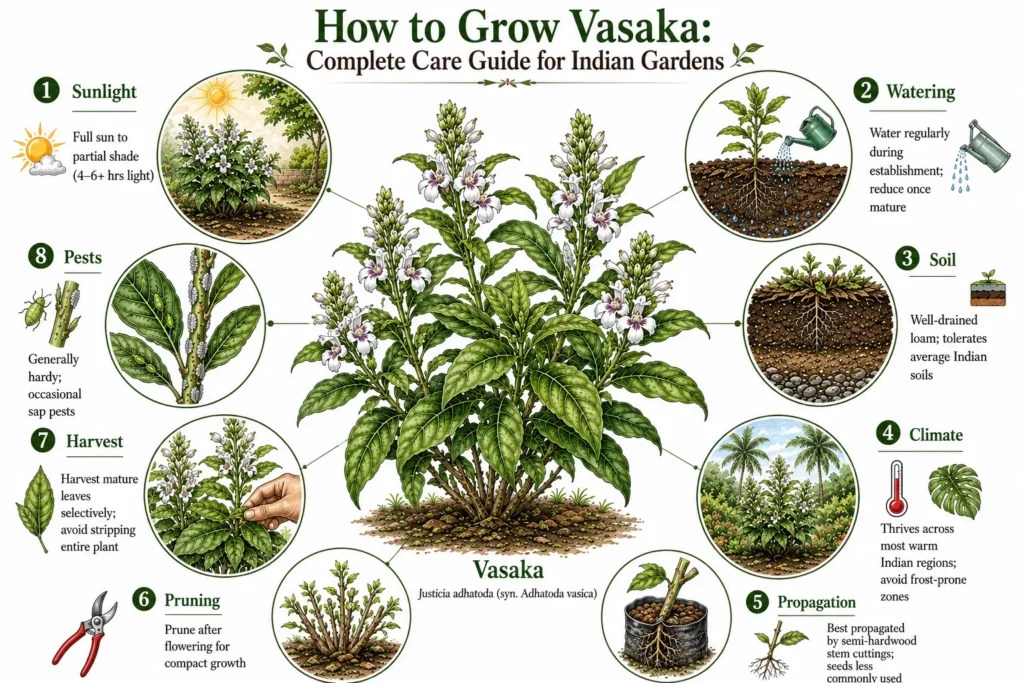
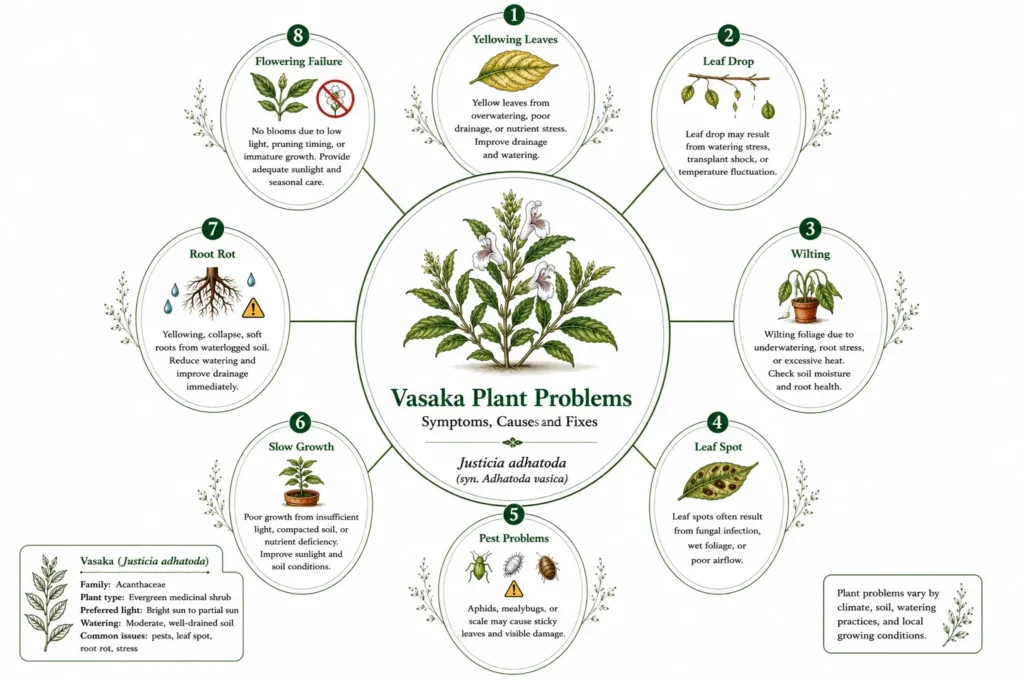
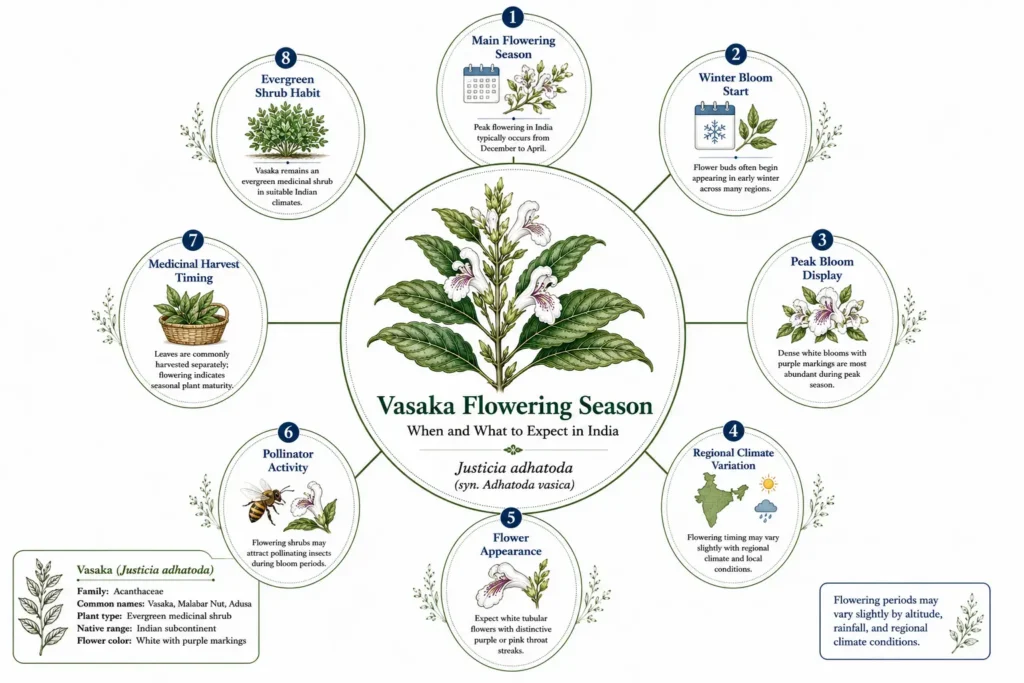
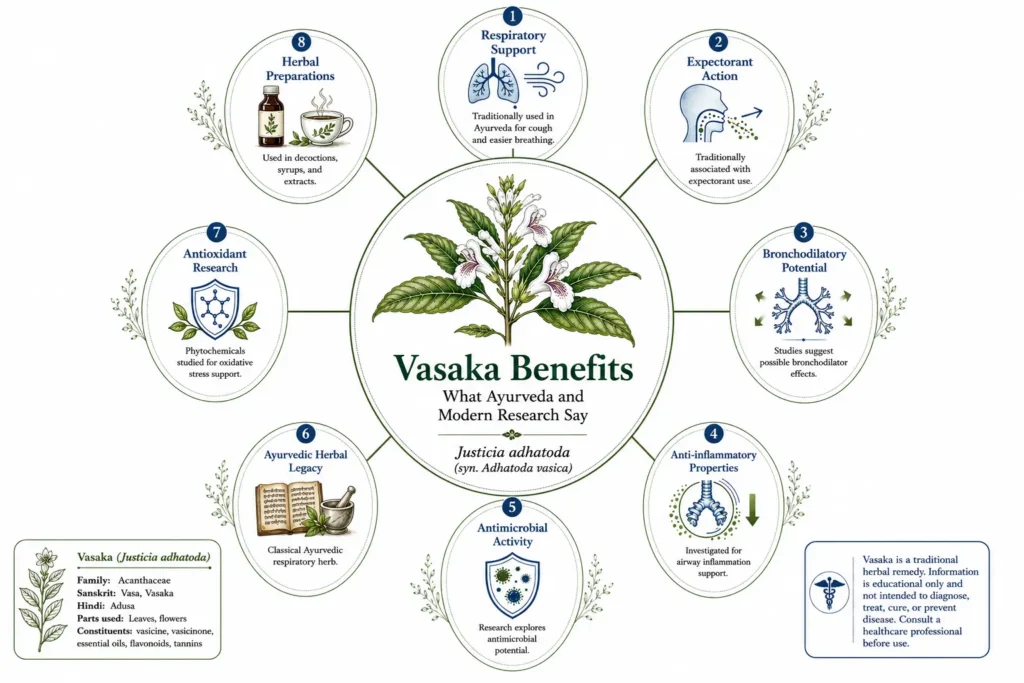
See also: Vasaka plant profile, how to grow it, common problems, its flowering season, and its benefits.
Names in Different Languages
| Language | Name |
|---|---|
| English | Malabar Nut, Malabar Nut Tree, Adulsa |
| Hindi | Adusa, Arusha, Arusa, Rus, Bansa |
| Bengali | Basak, Bakas, Vasok |
| Tamil | Adathodai, Adadodai |
| Telugu | Addasaramu, Adamkabu |
| Marathi | Adulsa, Adusa |
| Kannada | Adusoge, Aadumuttada gida |
| Malayalam | Atalotakam, Adolakam |
| Gujarati | Aradusi, Alduso |
| Punjabi | Vamsa, Bhekkar |
| Assamese | Titabahak, Bahak |
| Odia | Basanga, Arusa |
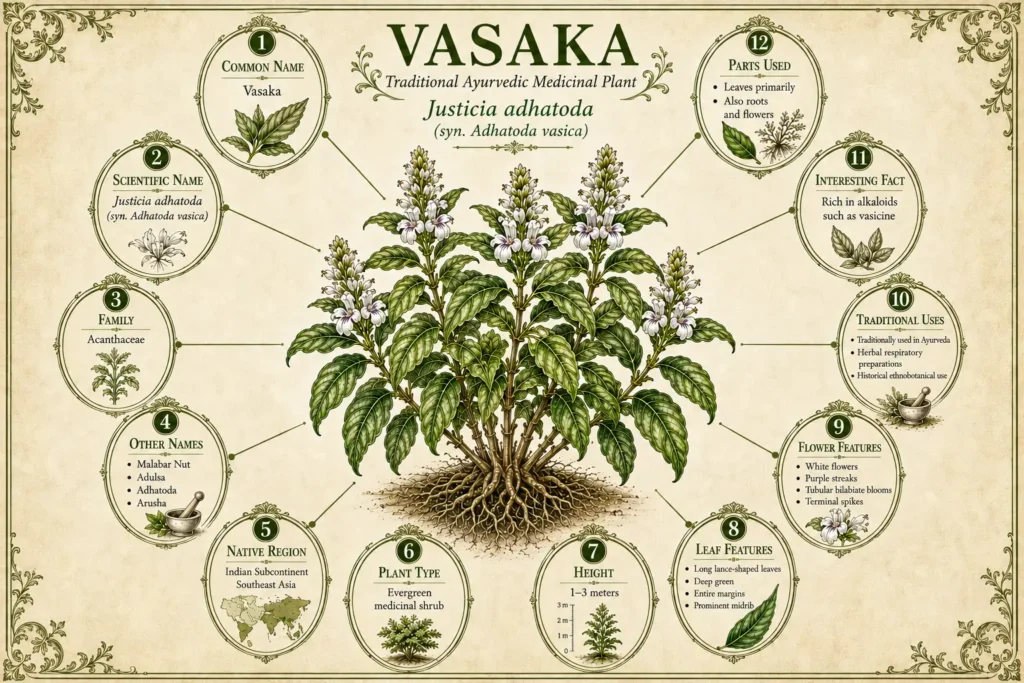
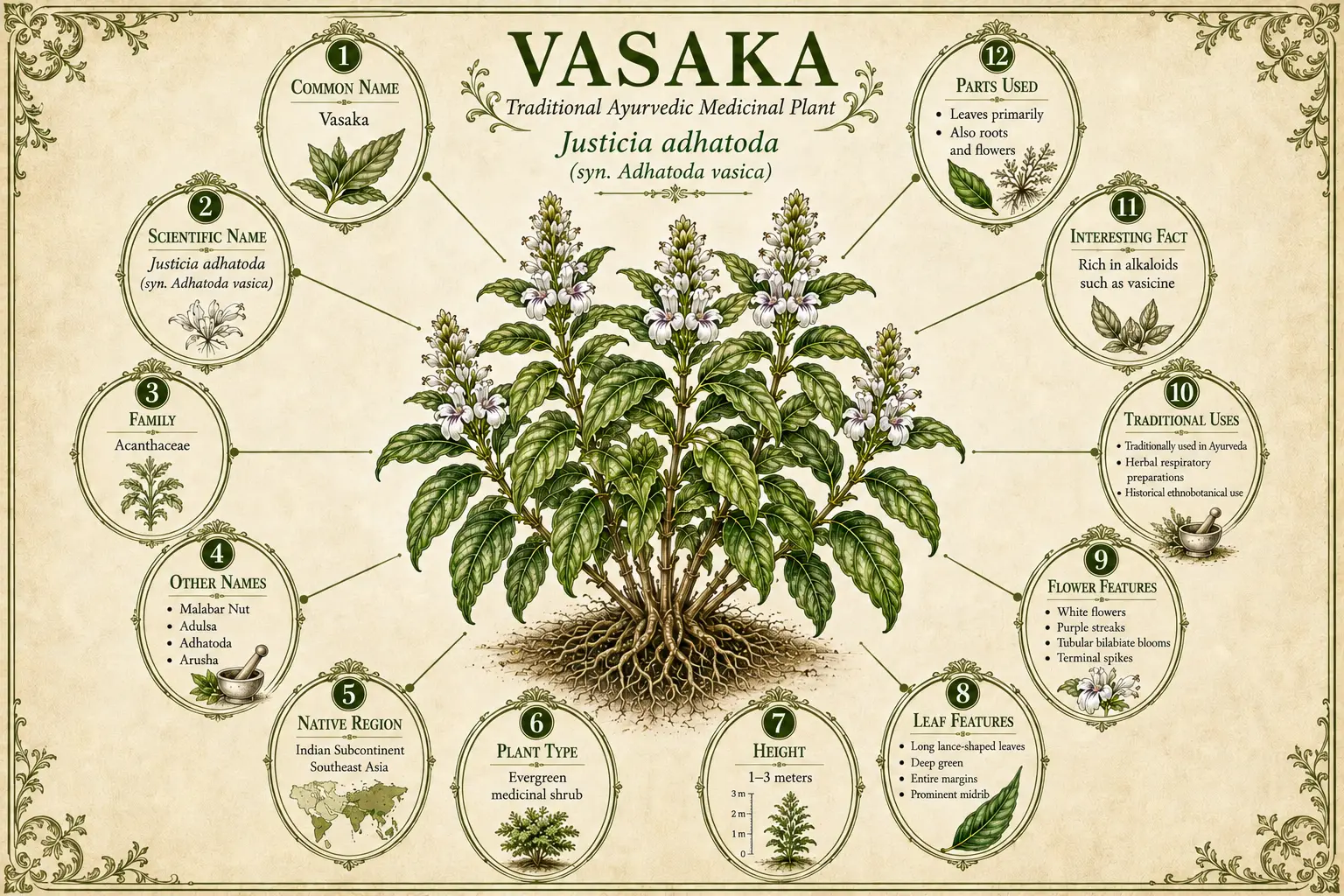
| Scientific name | Justicia adhatoda L. (syn. Adhatoda vasica Nees) |
| Family | Acanthaceae |
The most-searched name in India is Adulsa (Marathi/Hindi) and Basak (Bengali). In South India, Adathodai (Tamil) is the most recognised regional name. Note that the scientific name appears in two forms in the literature — Adhatoda vasica Nees is the older, widely-used name; Justicia adhatoda L. is now botanically accepted. Both refer to the same plant.
Recommended Products
Disclosure: As an Amazon Associate, PlantsInfo may earn from qualifying purchases.
🌱 Growing Essentials
The following products can help with container gardening, potting, root development, soil management, and healthy plant growth.
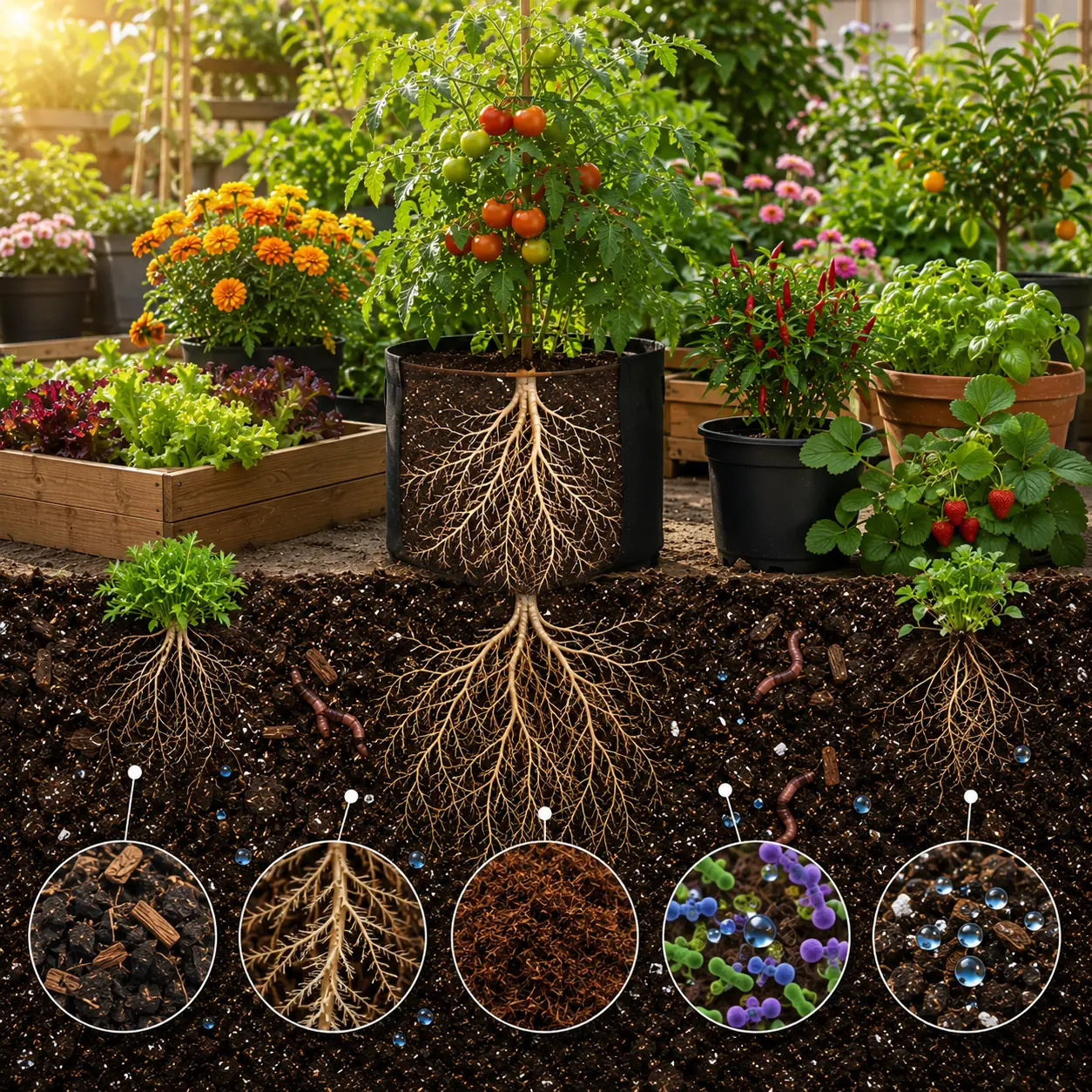
Organic Potting Soil Mix
Provides nutrients, structure, and healthy growing conditions for container plants.
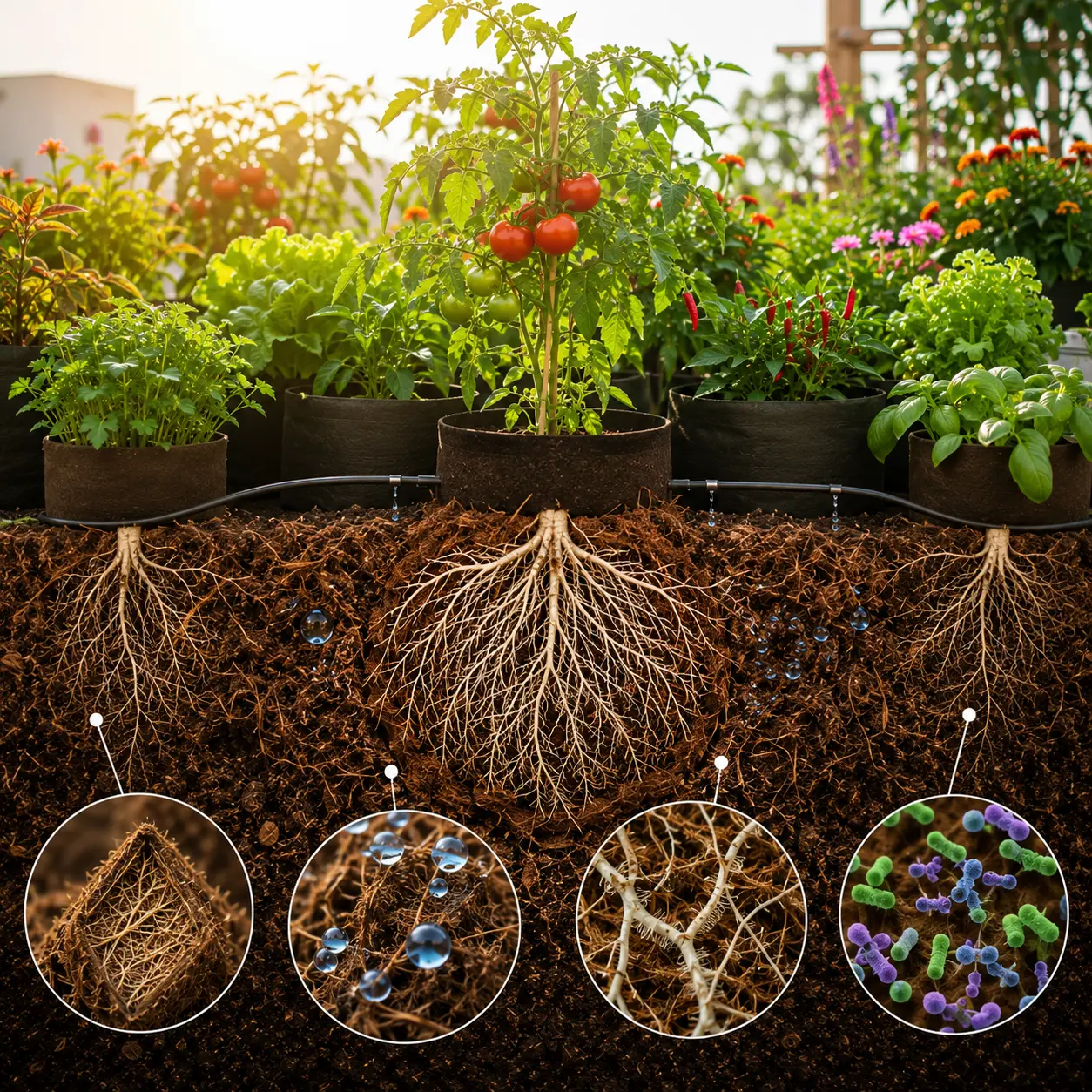
Coco Peat Growing Medium
Enhances moisture retention while maintaining excellent root-zone aeration.

Grow Bags for Plants
Improve drainage, root aeration, and vegetable production in limited spaces.

Plastic Pots for Plants
Ideal containers for seedlings, ornamentals, herbs, and balcony gardens.
What Does It Look Like?
Vasaka is a dense, multi-stemmed evergreen shrub reaching 1.5–3 m in height with a spread of 1–2 m. The bark on older stems is pale yellowish-grey with prominent leaf-node scars.
The leaves are the plant’s most distinctive feature: broadly lance-shaped, 10–20 cm long, 4–7 cm wide, arranged in opposite pairs along the stem. They are a deep, glossy green on top with a slightly paler underside, and carry prominent veins. The texture is smooth above and finely hairy below. Crushed, they release an intense, bitter, tea-like smell — the most reliable identification tool for this plant.
Flowers are the plant’s ornamental high point: dense, upright spikes 4–8 cm long, each carrying white, tubular flowers with a distinctive purple or pink streaking on the lower lip. The flower shape — slightly open at the front with a flared lower petal — bears a resemblance to a lion’s mouth, which is precisely what the Sanskrit synonym Simhasya (lion-faced) records. Flowers appear from February to April.
Fruits are small, club-shaped capsules that split explosively when ripe to scatter the 4–6 seeds inside. This explosive seed dispersal is characteristic of the Acanthaceae family.
Where Does It Grow in India?
Vasaka is native to the Indian subcontinent and grows throughout the country up to 1,300 m altitude. It is found across the entire Indo-Gangetic plain — Uttar Pradesh, Bihar, and West Bengal have some of the densest natural populations. It is equally common across Maharashtra, Karnataka, and Andhra Pradesh.
The plant naturalises aggressively on roadsides, railway embankments, degraded forest edges, and scrubland. It is one of the first colonisers of disturbed ground in tropical and subtropical India. In Rajasthan’s Sariska Tiger Reserve, research has recorded it as one of the dominant shrub species in some forest patches, where its toxicity to ungulates gives it a competitive advantage.
Urban cultivation has expanded with growing interest in home Ayurvedic gardens. In cities like Pune, Kolkata, Hyderabad, and Bengaluru, it is readily available from nurseries and frequently grown in large pots on terraces and in garden beds.
What Is It Used For?
Vasaka is used primarily as a respiratory medicine — its leaves, roots, flowers, and bark all find application in formulations for cough, bronchitis, asthma, and tuberculosis. Full medicinal details belong in the Benefits Guide.
The plant is one of the most important commercial medicinal herbs in India — Vasaka syrup and liquid extract are listed in the Indian Pharmacopoeia, and it is a key ingredient in several widely marketed Ayurvedic formulations, including Vasavaleha and Vasarishta.
The leaf juice is used externally in some regional traditions for skin diseases and wound care. The whole plant has a documented insecticidal property: a decoction of the bark, leaves, and flowers kills red spider mites and their eggs, which is why the plant is occasionally used as a natural pesticide in organic farms.
It is widely planted as a livestock-proof boundary hedge across India — its bitterness is the hedge’s entire defence mechanism, and it requires no maintenance.
In Mythology and Ancient Texts
Vasaka holds a prominent and specific place in classical Ayurvedic literature. The Charaka Samhita lists it in the kasahara (cough-relieving) and shwasahara (breathlessness-relieving) pharmacological groups, and specifically names it as the pre-eminent herb for kasa (cough) conditions. The Sushruta Samhita references it in the context of bleeding disorders and respiratory management.
In the Ashtanga Hridayam — the third major classical Ayurvedic text — Vasaka is cited in formulations for kshaya (chronic wasting respiratory conditions, broadly encompassing tuberculosis-like presentations) and rakta pitta (bleeding disorders involving the Pitta dosha).
The name Adhatoda has its root in Tamil — ada (goat), combined with thoda (not touch). The fact that a Sanskrit-dominant medicinal tradition adopted a Tamil name for this plant’s primary common identity suggests it was already well-established in South Indian folk knowledge before formal textual codification. The Sanskrit synonyms Simhi, Simhasya (lion-mouth), Vajidanta (horse’s teeth, referring to the white flowers), and Vrisha (one whose flowers attract bees) all encode direct botanical observations, not mythological connections.
Vasaka does not appear in the major Sanskrit epics (Ramayana, Mahabharata) or the Puranas in a narrative role, but its presence across all three major Ayurvedic classical texts over more than fifteen hundred years of recorded use places it firmly among the most important and consistently documented medicinal plants in Indian botanical history.
Is It Easy to Grow?
Yes — Vasaka is among the easiest shrubs to establish in Indian home gardens. It grows from a stem cutting, tolerates poor and rocky soils, survives drought once established, and requires no special care or attention. The difficulty rating is Easy across all Indian states below 1,300 m altitude.
The plant’s only non-negotiable requirement is drainage. It is not suited to low-lying waterlogged spots or heavy clay soils without amendment. In containers, a 15–20 litre pot with a free-draining mix and adequate sunlight is all it needs.
⚠ Special Flags
Uterotonic and abortifacient: Vasaka leaf contains vasicine, which stimulates uterine contractions. Pregnant women must not use this plant in any medicinal form. This is not a precaution — it is an absolute contraindication with documented historical and pharmacological evidence.
Invasive tendency in degraded landscapes: Research in Rajasthan has noted that Vasaka can displace other shrub and tree regeneration where it colonises in high density. In a managed home garden, this is not a concern, but in rural properties adjacent to forest land, unmanaged spread should be monitored.
Frequently Asked Questions
Is Adhatoda vasica the same as Justicia adhatoda?
Yes. Both names refer to the same plant. Adhatoda vasica Nees is the older name used in most Ayurvedic and Indian pharmaceutical texts. Justicia adhatoda L. is the currently accepted botanical name. When buying plants or products, either name refers to the same species.
Can Vasaka leaves be used on the skin?
Traditional practice in several Indian states applies a paste of fresh Vasaka leaves to skin infections, minor wounds, and insect bites. The leaves have documented antimicrobial activity. A patch test on a small skin area first is sensible, as some individuals experience mild irritation from the bitter alkaloids.
Is Vasaka the same as Adusa?
Yes. Adusa (or Adulsa) is simply the Hindi and Marathi common name for the same plant. Vasaka is the Sanskrit name most used in Ayurvedic literature. In everyday markets and nurseries across Maharashtra and UP, you will almost always hear it called Adulsa or Adusa rather than Vasaka.
Every winter, the bundle of fresh Basak leaves at the local sabzi market in Bengal tells the same story it has for generations — one of India’s most practical and historically documented medicines, available fresh, in season, for almost nothing.
Disclaimer: This information is based on traditional Ayurvedic knowledge and published scientific research. It is not a substitute for professional medical advice, diagnosis, or treatment. Always consult a qualified healthcare professional or certified Ayurvedic practitioner before using any plant-based remedy for health conditions.