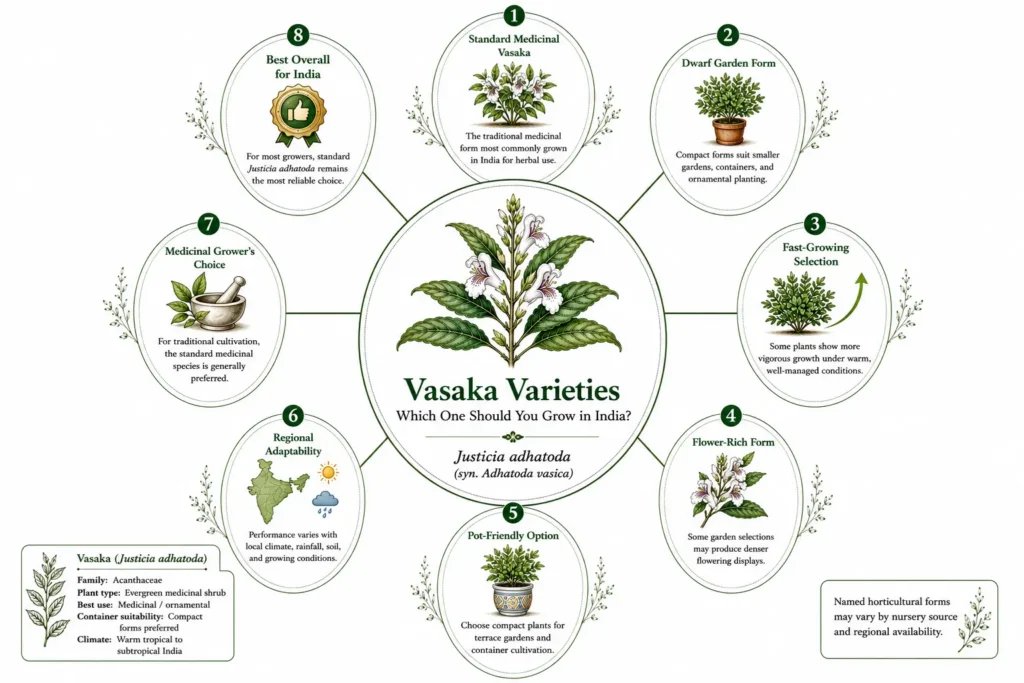
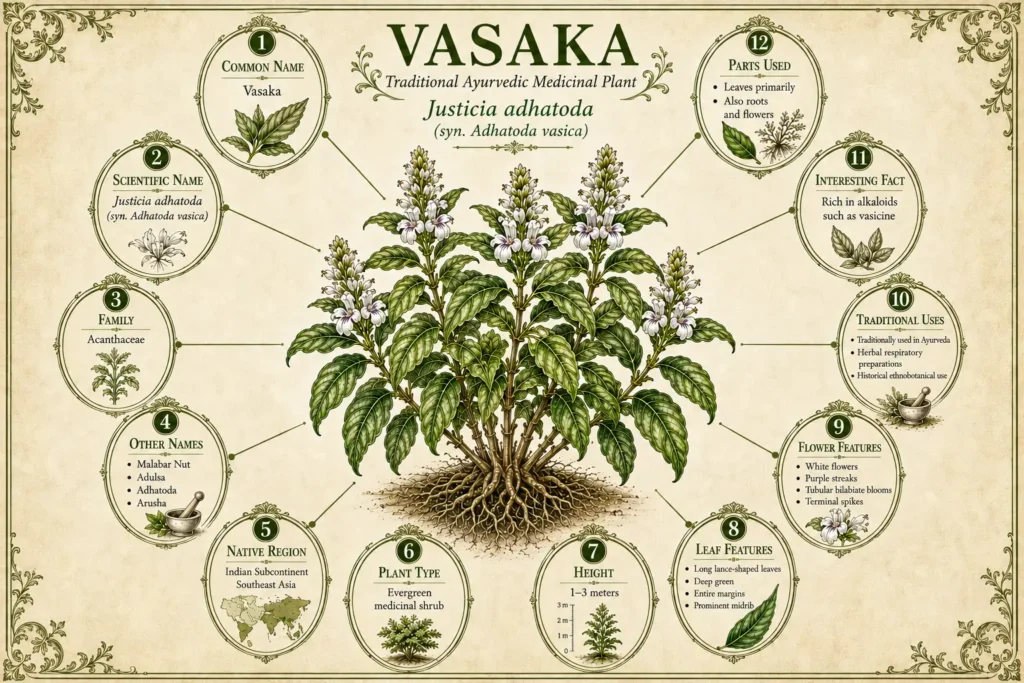
Vasaka Varieties: Which One Should You Grow in India?
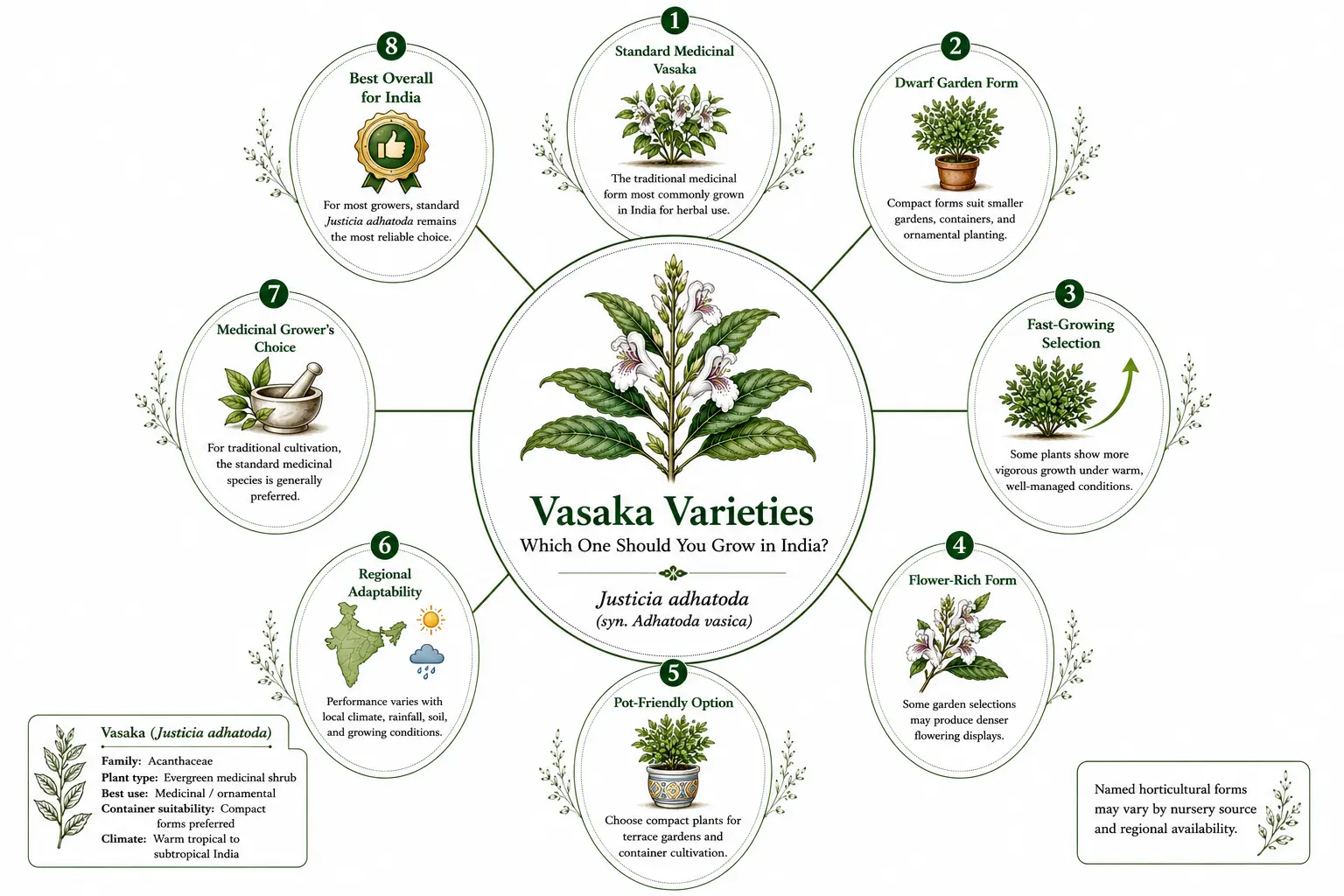
Quick Answer: For home gardeners across most of India, standard Justicia adhatoda — the locally available common form — is the right and only choice. Botanical research recognises two morphological varieties: var. vasica (predominant in northern India) and var. zeylanica (common in South India and Sri Lanka). Both are medicinally equivalent for household use.
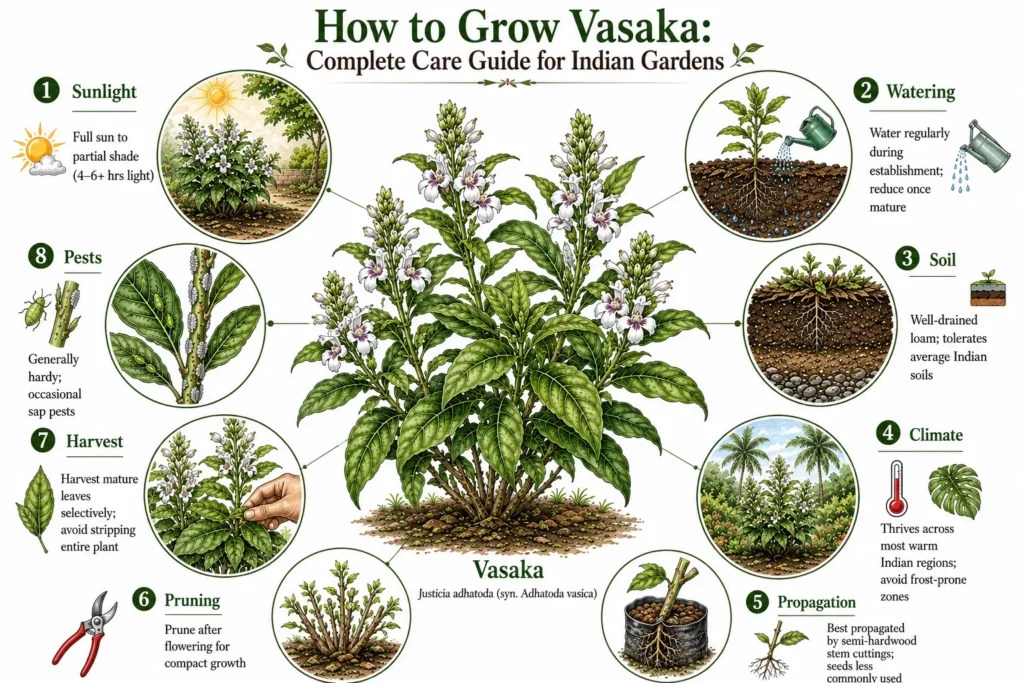
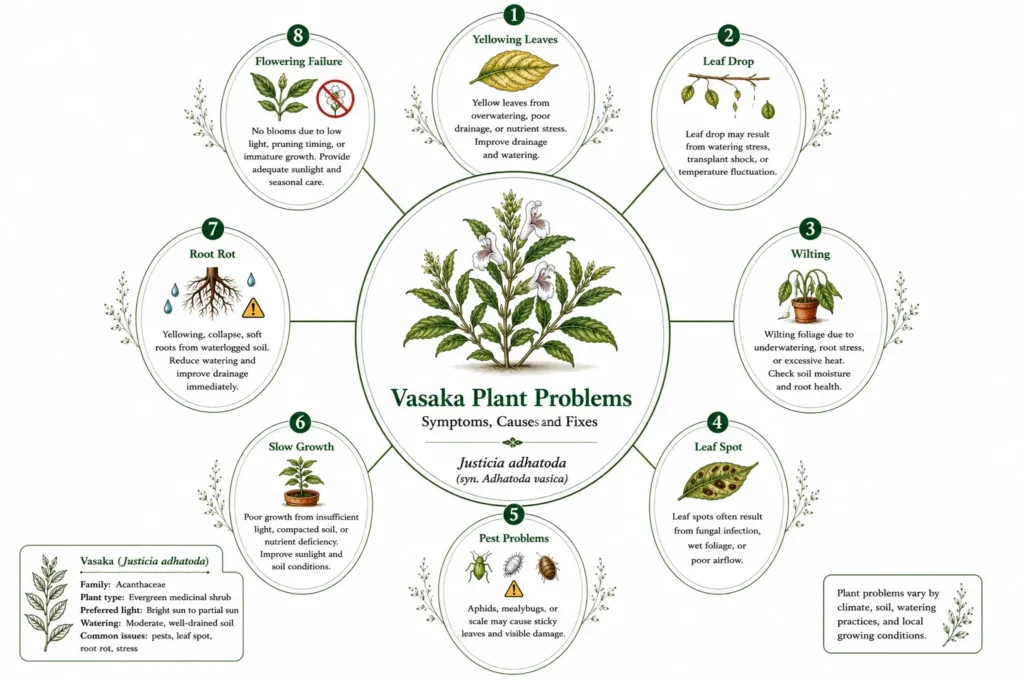
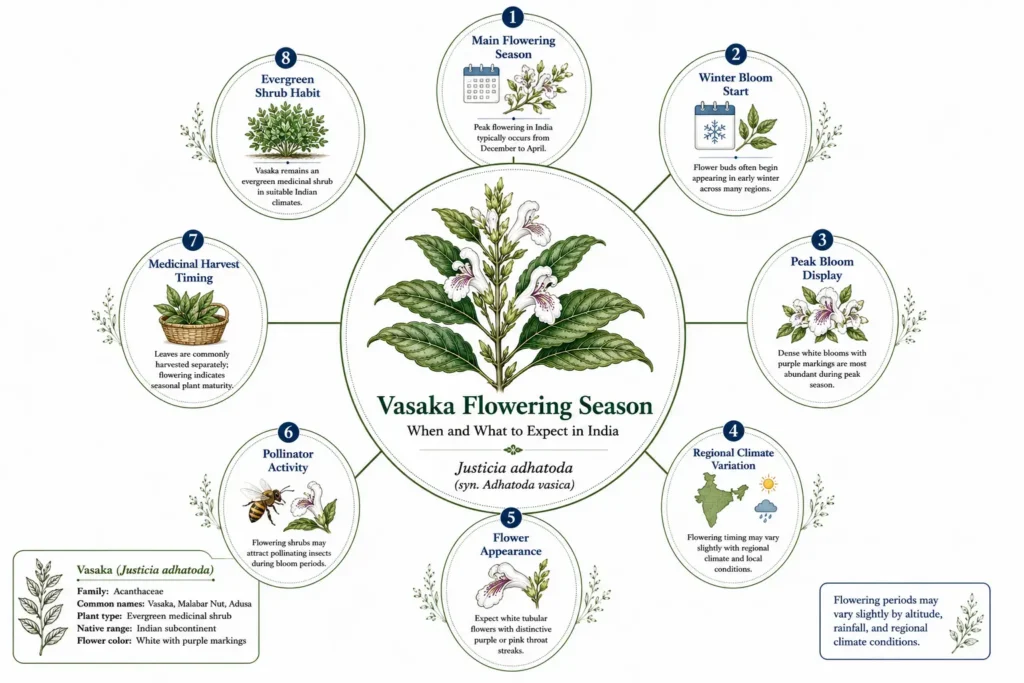
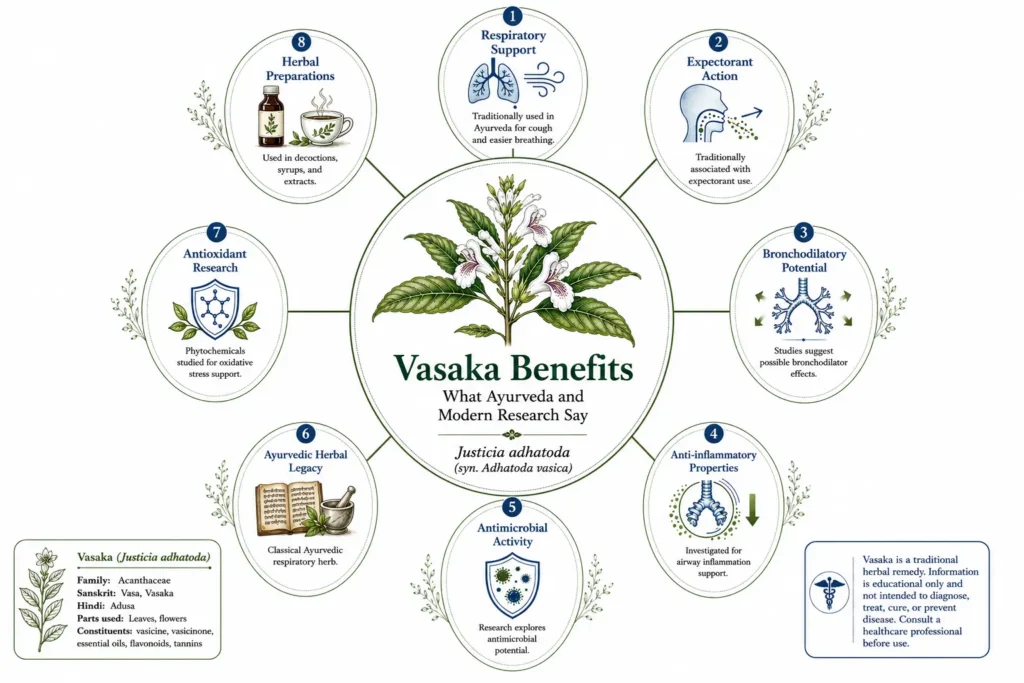
See also: Vasaka plant profile, how to grow it, common problems, its flowering season, and its benefits.
Most people who grow Vasaka have never been told there are different forms. They buy a cutting from a local nursery or obtain it from a neighbour’s hedge, and that is what they grow. For medicinal use, this pragmatic approach is mostly fine — but understanding the varieties matters when you are sourcing deliberately, comparing plants in different regions, or selecting for a specific growing condition. This guide makes those distinctions clear.
Recommended Products
Disclosure: As an Amazon Associate, PlantsInfo may earn from qualifying purchases.
🌱 Growing Essentials
The following products can help with container gardening, potting, root development, soil management, and healthy plant growth.
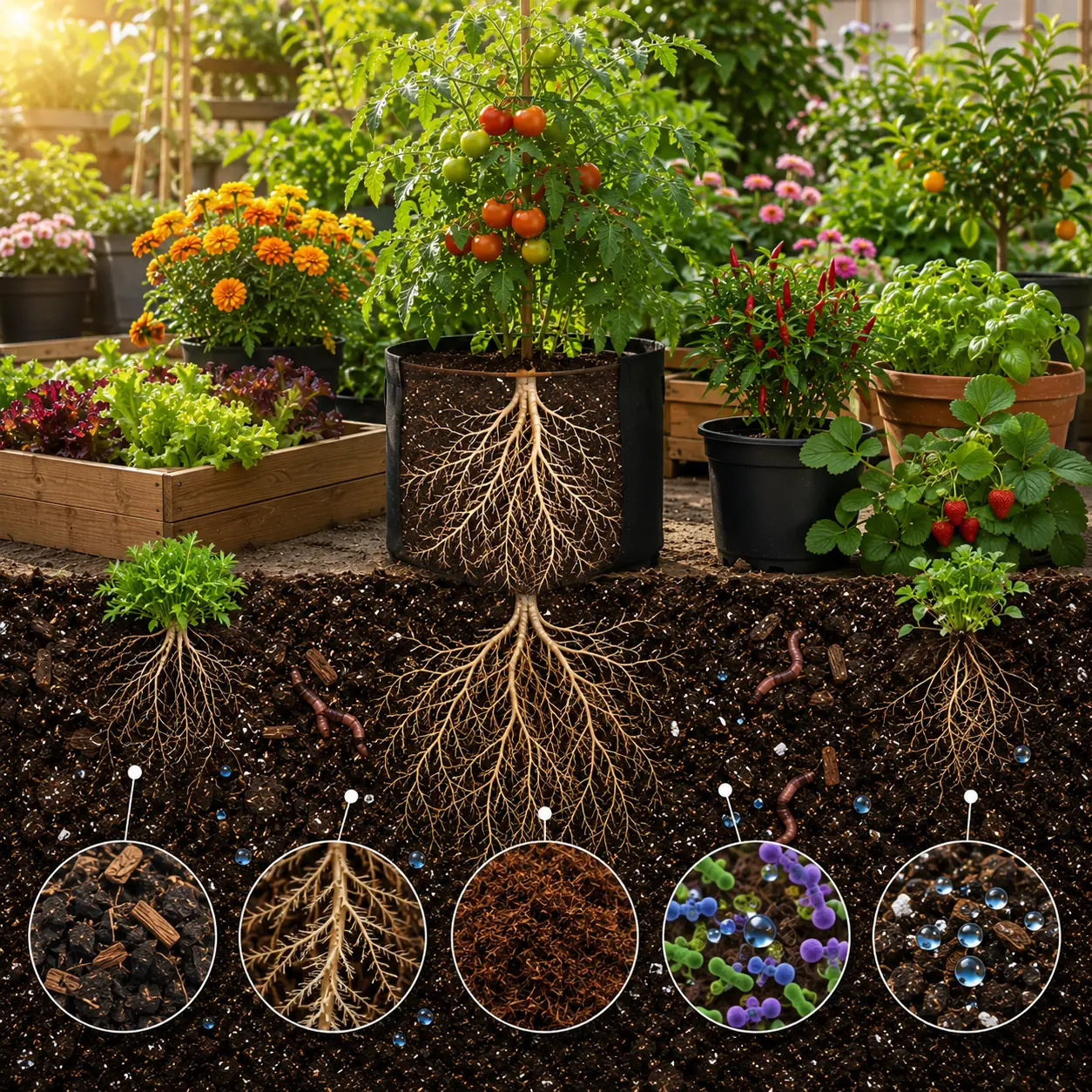
Organic Potting Soil Mix
Provides nutrients, structure, and healthy growing conditions for container plants.
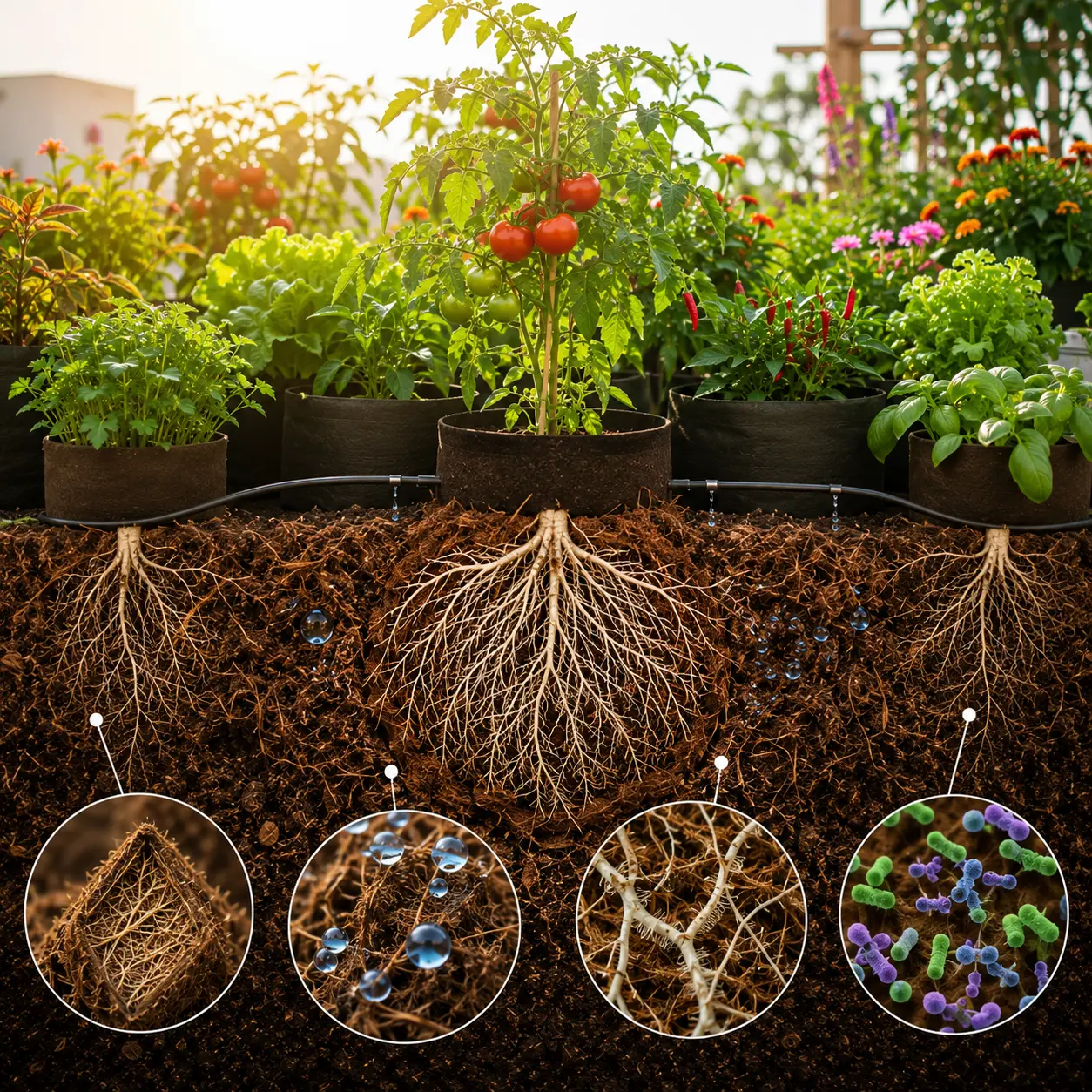
Coco Peat Growing Medium
Enhances moisture retention while maintaining excellent root-zone aeration.

Grow Bags for Plants
Improve drainage, root aeration, and vegetable production in limited spaces.

Plastic Pots for Plants
Ideal containers for seedlings, ornamentals, herbs, and balcony gardens.
Quick Variety Selector
| Variety / Form | Type | Plant Size | Best For | Suited To |
|---|---|---|---|---|
| J. adhatoda var. vasica | Wild-type, northern morphotype | Medium–Large (2–3 m) | All medicinal uses; hedgerows | North and Central India, eastern states |
| J. adhatoda var. zeylanica | Wild-type, southern morphotype | Medium (1.5–2.5 m) | Medicinal; containers; South Indian gardens | South India, Sri Lanka, coastal regions |
| Adhatoda beddomei | Related Kerala species | Medium | Regional Kerala use only | Kerala (specific areas) |
| Ornamental white-flower selection | Unimproved, selected | Compact–Medium | Terrace gardens; ornamental planting | Pan-India in containers |
Varieties in Detail
Justicia adhatoda var. vasica — Northern Morphotype
This is the form predominant across North India, the Indo-Gangetic plain, Bihar, West Bengal, Uttar Pradesh, Madhya Pradesh, Rajasthan, and the lower Himalayan foothills up to 1,300 m. It is the primary botanical source of the drug Vasaka, referenced in virtually all classical Ayurvedic texts and the form listed in the Indian Pharmacopoeia.
Plants of this variety tend toward the taller end of the species range — typically 2–3 m in open conditions — with leaves running 12–20 cm in length. The flowers are white with prominent purple streaking on the lower lip. Alkaloid content (primarily vasicine) has been measured at 0.54–1.1% of dry leaf weight across the literature, with variation depending on season of harvest, altitude, and growing conditions.
Its notable strength is cold tolerance relative to the southern form — it handles the North Indian winter without significant leaf drop and maintains good foliage through December–January. Its notable weakness for container gardeners is its ultimate size; without regular pruning, it quickly outgrows a terrace pot and becomes an unwieldy ground plant.
Propagation is entirely by stem cutting or root division; seed propagation is possible but rarely practical. The leaf alkaloid content is highest when harvested just before the February–March flowering flush.
Justicia adhatoda var. zeylanica — Southern Morphotype
This form is common in South India (Tamil Nadu, Kerala, coastal Karnataka, Andhra Pradesh) and Sri Lanka. Botanical research published in the Journal of Plant Research (2020) formally proposed the two morphotypes as var. vasica and var. zeylanica to reflect the “vague north–south divide” that earlier botanists had informally noted.
The southern form tends to be slightly more compact — 1.5–2.5 m — with leaves that may be marginally narrower and a flower that some observers describe as more densely pigmented on the lower lip. It is functionally equivalent to the northern form for medicinal use. The primary practical distinction for a home gardener in South India is that this is simply the form available at local nurseries, and it is entirely appropriate.
The adathodai of Tamil Siddha medicine and the atalotakam of Kerala’s traditional medicine both reference this southern form. In Kerala specifically, Adhatoda beddomei is also recognised as a botanical source for Vasa in some regional Ayurvedic traditions — this is a separate species discussed below.
Adhatoda beddomei — Kerala Regional Species
Adhatoda beddomei (C.B.Cl.) is a related species found in Kerala, recognised by some authorities in the state as an additional or alternative botanical source for the Ayurvedic drug Vasa. It is not the standard pan-India Vasaka and is not listed in the Indian Pharmacopoeia as an accepted source outside of its regional tradition.
For home gardeners outside Kerala, this species is largely irrelevant. For Kerala-based gardeners, Adhatoda beddomei may be available alongside standard J. adhatoda at local nurseries. The standard J. adhatoda (var. zeylanica in South India) remains the recommended choice for medicinal cultivation unless you are specifically working within a Kerala regional Ayurvedic tradition.
This species does not earn a full H3 section by the data floor rule — too little distinct agronomic information is available to meaningfully differentiate its home garden care from standard J. adhatoda.
Ornamental White-Flower Selection
Some nurseries in urban centres (Bangalore, Pune, Delhi, Hyderabad) offer Vasaka as an ornamental container plant specifically for its flower display. These are not formally cultivated varieties with registered names — they are simply individuals selected for compact habit or particularly dense flowering, propagated by cutting and sold as ornamental shrubs.
For a home gardener interested in both ornamental value and medicinal use, these compact selections work well on terraces. Their medicinally relevant alkaloid content is assumed equivalent to wild-type plants of the same species, though no formal comparative study has been conducted.
Head-to-Head Comparison
var. vasica vs. var. zeylanica — Does It Matter for Home Use?
The practical difference for a home gardener is minimal. Both varieties contain the same primary alkaloids (vasicine, vasicinone), respond to the same cultivation inputs, and are used identically in household Ayurvedic preparations. The north–south morphological distinction is real but agronomically insignificant for a home grower who is simply asking: which one do I plant?
The answer is determined by geography, not preference: if you are in North or Central India, you will plant var. vasica because that is what is locally available. If you are in South India or coastal regions, var. zeylanica is your plant. Importing the other form from a distant source provides no meaningful medicinal advantage.
Where the distinction matters is in research and pharmaceutical contexts, where documentation of which morphotype was used affects the interpretability of results. For household use, grow whatever form is locally available with confidence.
Standard J. adhatoda vs. Adhatoda beddomei — For Kerala Gardeners
Standard J. adhatoda (var. zeylanica in Kerala) is the universally accepted, pharmacopoeia-listed, research-supported form. Adhatoda beddomei is regionally recognised in Kerala Ayurvedic practice but carries no additional advantage for a home gardener and is less documented. For any Kerala-based gardener choosing between the two, standard J. adhatoda remains the default recommendation. Grow A. beddomei only if you are working specifically with a Kerala Ayurvedic practitioner who recommends it.
How to Choose for Your Space
Container or terrace garden: A compact ornamental selection of J. adhatoda in a 15–20 litre container, potted in a gritty, well-drained mix. Prune annually in March to maintain size. Choose var. zeylanica in South India, var. vasica in North India.
Small ground plot (under 100 sq ft): Single J. adhatoda specimen against a compound wall or as a focal planting in a medicinal herb bed. Annual post-bloom pruning keeps it within 1.5 m height. One plant provides ample leaves for a household.
Larger garden or backyard: Multiple J. adhatoda plants as a boundary hedge — plant at 60–90 cm spacing for a dense, livestock-proof, self-managing hedge that also provides a generous medicinal leaf supply. No other hedge plant in India requires less maintenance.
Medicinal harvest priority: Either morphotype of standard J. adhatoda, sourced from a known healthy parent plant or KVK nursery. Harvest leaves just before the February–March flowering flush for the highest vasicine concentration.
Regional Suitability
North India (UP, Bihar, MP, Rajasthan, Delhi): var. vasica — thrives year-round; full sun; tolerates North Indian winter without leaf drop.
Eastern India (West Bengal, Odisha, Jharkhand): var. vasica — in its natural habitat; abundant wild material; nursery availability excellent.
South India (Karnataka, Tamil Nadu, AP, Telangana): var. zeylanica — grows year-round without any winter slowdown; full sun or partial shade.
Kerala: var. zeylanica; Adhatoda beddomei is also present in some areas.
Coastal regions (Goa, Konkan, coastal Andhra): var. zeylanica; high humidity and warmth suit the plant year-round; monitor for powdery mildew during post-monsoon months.
Hill stations (below 1,300 m): Either form grows reliably. Above 1,300 m, the plant becomes unreliable and is not recommended.
Watch Out for Mislabelling
Vasaka mislabelling is less common and less dangerous than in some other medicinal plants (Guduchi, for instance, has a documented species-substitution safety problem). However, a few issues are worth knowing:
Some nurseries sell small ornamental Justicia species — particularly Justicia brandegeeana (the shrimp plant, with its distinctive curved orange bracts) — in pots alongside Vasaka. Both belong to Acanthaceae, and an unlabelled plant could conceivably be confused at the seedling stage. The adult plants look nothing alike — Vasaka’s large lance leaves and white flower spikes are unmistakable. Buy plants at a size where the leaf character is clearly visible.
The surest verification: crush a leaf. Authentic J. adhatoda leaves have an intensely bitter smell and taste that is unmistakable. No ornamental Justicia species has this character.
Where to Source These Varieties in India
State-level medicinal plant nurseries run by forest departments and Krishi Vigyan Kendras are the most reliable sources for authenticated Justicia adhatoda planting material. These outlets typically carry locally-appropriate forms at minimal or no cost.
CSIR-CIMAP (Lucknow) and its regional centres maintain documented Vasaka germplasm. Several state Ayurvedic universities and research institutes also propagate and distribute authenticated material.
For urban gardeners, most established online plant nurseries that carry medicinal herb collections stock J. adhatoda reliably. Verify that the plant is being sold under the correct name (Justicia adhatoda or Adhatoda vasica) and that it shows the characteristic large, lance-shaped, deeply-veined leaves.
Both forms of Vasaka serve Indian home gardens equally well: easy to grow, self-defending, medicinally valuable, and practically maintenance-free once established. Grow whichever form is local to you and grow it with confidence.