Nirgundi Benefits: What Ayurveda and Modern Research Say
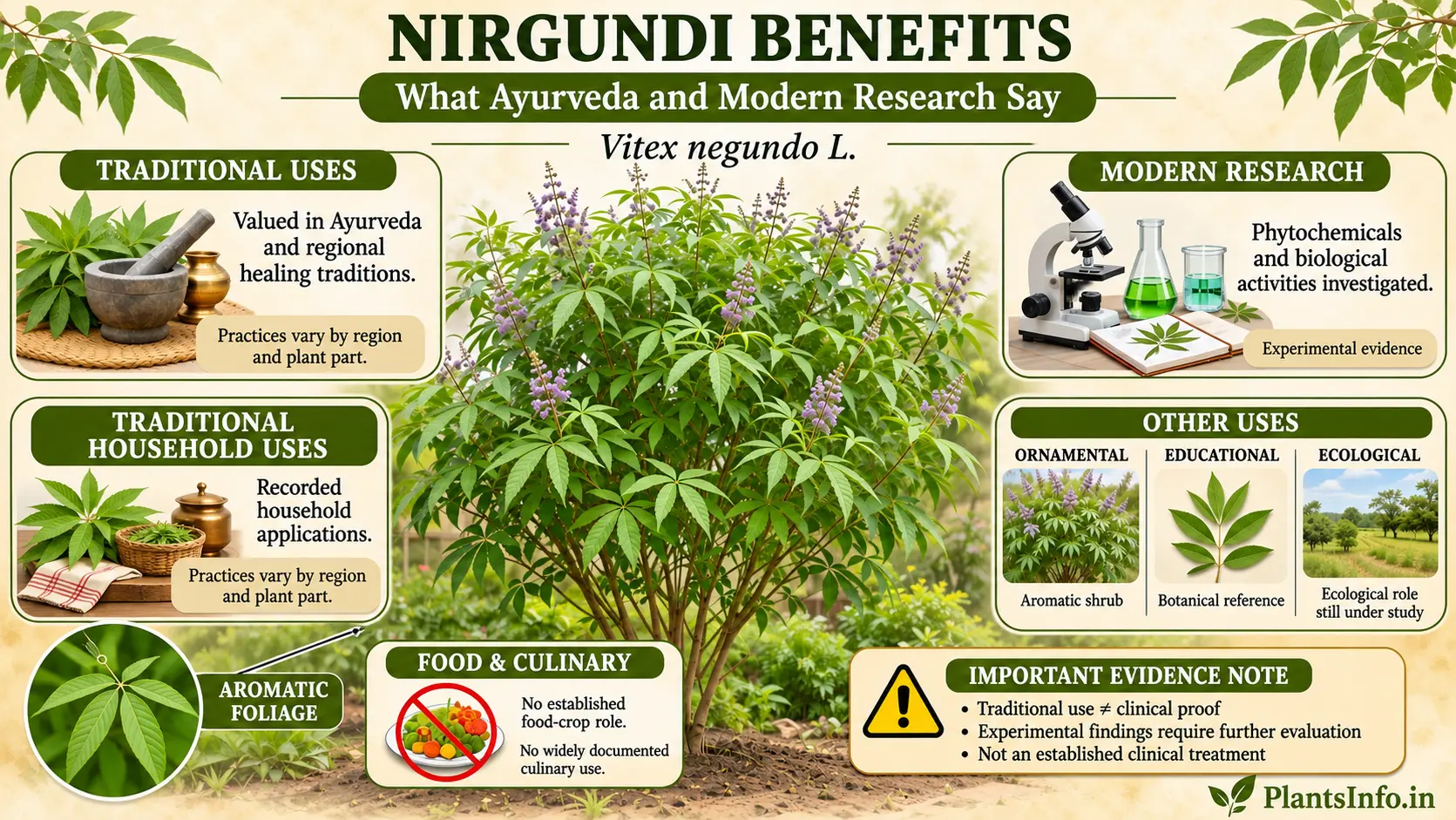
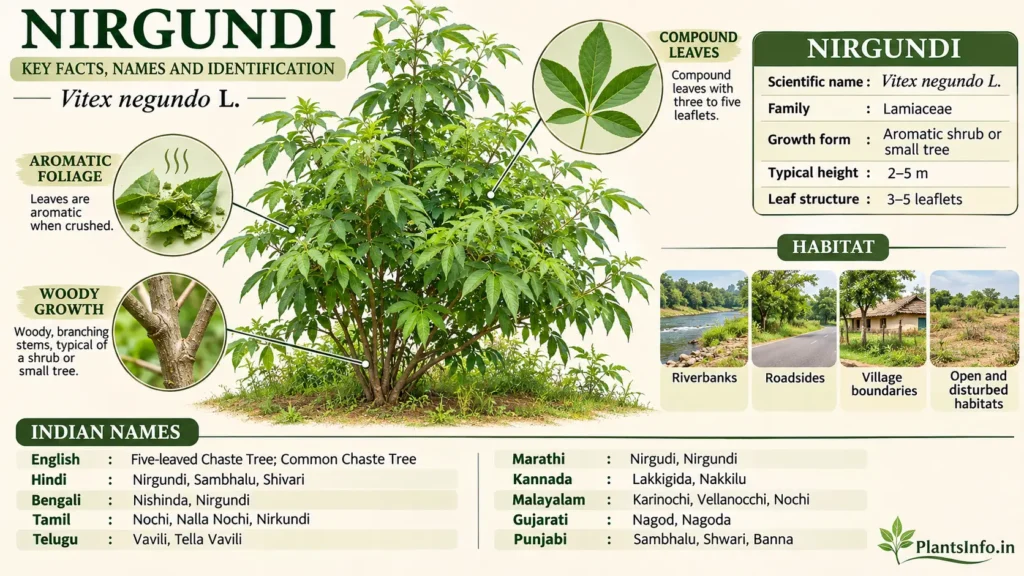
Nirgundi (Vitex negundo) is valued primarily as a traditional medicinal plant in Ayurveda and other South Asian healing systems. Traditional uses involve several plant parts, and laboratory and animal studies have investigated its reported biological activities. These findings do not establish it as a clinically proven treatment.
See also: Nirgundi plant profile, how to grow it, common problems, seasonal care, and its flowering season.
Uses at a Glance
| Domain | Main use or role | Context |
|---|---|---|
| Food | No established role as a food crop | Not generally recognised as an edible vegetable or fruit |
| Culinary | No widely documented culinary use | Primarily associated with non-culinary applications |
| Traditional | Medicinal and household applications | Practices vary by region and plant part |
| Ornamental | Aromatic shrub or small tree | Also suitable for educational plant collections |
| Ecological | Ecological effects remain insufficiently documented | Some rural land-management uses are recorded |
Introduction
A single species can appear in very different kinds of records: traditional medical literature, rural household practices and modern natural-products research. Nirgundi is one such example, with documented uses extending beyond medicinal traditions into agricultural applications. Its reported chemical diversity has also made it a subject of pharmacognosy research.
Recommended Products
Disclosure: As an Amazon Associate, PlantsInfo may earn from qualifying purchases.
🌱 Growing Essentials
The following products can help with container gardening, potting, root development, soil management, and healthy plant growth.
Organic Potting Soil Mix
Provides nutrients, structure, and healthy growing conditions for container plants.
Coco Peat Growing Medium
Enhances moisture retention while maintaining excellent root-zone aeration.

Grow Bags for Plants
Improve drainage, root aeration, and vegetable production in limited spaces.

Plastic Pots for Plants
Ideal containers for seedlings, ornamentals, herbs, and balcony gardens.
Traditional Medicinal Uses and Modern Research
Nirgundi’s most prominent documented significance lies in traditional healthcare systems. Different plant parts appear in regional medicinal records, and their traditional applications are not interchangeable.
Traditional Ayurvedic and Folk Uses
Traditional Ayurvedic, Siddha, and Unani records associate Nirgundi with several health complaints. The plant part and preparation vary between regional practices.
- Leaves: Traditionally used in preparations associated with pain, swelling, skin complaints, and wound-related care.
- Roots: Recorded in traditional materia medica for digestive complaints, rheumatic conditions, and other ailments.
- Seeds: Mentioned in traditional preparations associated with swelling and reproductive health.
- Stem bark: Also recorded in traditional medicinal literature.
These records describe customary practices and historical indications. They do not establish that Nirgundi treats the conditions listed.
Phytochemical Constituents
Phytochemical investigations have reported several groups of naturally occurring compounds in V. negundo. Their distribution varies between plant parts and extracts.
| Compound group | Examples reported |
|---|---|
| Flavonoids | Casticin, luteolin derivatives and artemetin |
| Iridoid glycosides | Negundoside and related glycosides |
| Phenolic compounds | Phenolic acids and other polyphenols |
| Terpenoids | Diterpenes and other terpenoid constituents |
| Phytosterols | β-sitosterol |
These compounds are of interest to pharmacognosy and natural-products research. Their presence alone does not establish a clinical benefit. Extract composition can also vary with the plant material and extraction method.
What Modern Research Shows
Experimental research has investigated several biological activities of Nirgundi extracts and isolated compounds:
- Anti-inflammatory activity: Leaf extracts have shown effects in experimental models of inflammation.
- Analgesic activity: Research has examined potential pain-related effects in laboratory and animal models.
- Antioxidant activity: Extracts and isolated constituents have demonstrated free-radical-scavenging activity in experimental tests.
- Antimicrobial activity: Laboratory studies have investigated activity against selected bacteria and other microorganisms.
- Other experimental activities: Research has explored possible effects involving liver protection, metabolic processes, and other biological pathways.
Much of the available evidence comes from laboratory experiments or animal studies. Research reviews identify the need for better standardisation, toxicological assessment, and well-designed clinical trials in humans. Nirgundi should therefore not be presented as a clinically proven treatment for these conditions.
This information is based on traditional Ayurvedic knowledge and general research. It is not a substitute for medical advice. Consult a qualified healthcare professional before using any plant-based remedy for health conditions.
Traditional Insect-Repellent and Agricultural Uses
Nirgundi also has a documented history of non-medicinal use in rural settings.
Traditional accounts describe dried leaves being stored with clothing to deter insects. Other practices include burning leaf material to repel mosquitoes and using leaf preparations in traditional crop-protection activities.
Research has investigated insecticidal effects of certain extracts against agricultural pests. These findings support further investigation of plant-derived pest-management materials, but they do not establish that household leaf preparations provide reliable or safe pest control. Burning plant material indoors also produces smoke and should not be treated as a risk-free household practice.
Ecological Role
The ecological significance of Nirgundi is less thoroughly documented than its medicinal and ethnobotanical uses.
Indian records describe the species being used as a field-boundary hedge in some rural settings. However, the available material does not establish measurable benefits for pollinator populations, bird communities, soil conservation, or wider ecosystem health.
Its documented presence in rural land management should therefore be distinguished from demonstrated ecological benefits.
Practical Value for Home Gardeners
For home gardeners, Nirgundi can serve as an aromatic ornamental shrub and as a subject for educational or botanical collections. Its documented place in Indian medicinal and agricultural traditions also gives it ethnobotanical interest.
Growing the species does not make its leaves, roots or seeds automatically suitable for home remedies. Ornamental use and medicinal use should be treated as separate decisions, particularly because generally safe human doses and standardised household preparations have not been established by the available evidence.
What to Avoid
Nirgundi should not be treated as a harmless household herb simply because it has a long history of traditional use.
- Avoid self-prescribing: Do not use the plant to replace prescribed treatment or delay medical assessment.
- Exercise particular caution during pregnancy and breastfeeding: Adequate human safety information is lacking. Experimental research has also reported reproductive effects from certain seed-derived fractions in animals.
- Do not assume all plant parts are interchangeable: Leaves, roots, seeds and bark have different chemical profiles and traditional applications.
- Do not assume a laboratory extract is equivalent to a household preparation: Concentration, extraction method, and plant material can substantially affect exposure.
The available research does not establish a generally safe human dosage or a complete profile of possible medication interactions.
Conclusion
Nirgundi’s place in Indian medicinal and agricultural traditions makes it an important ethnobotanical species, while its reported phytochemicals continue to attract scientific interest. Stronger clinical evidence is still needed to establish its therapeutic potential.
🌿 About Nirgundi (Vitex negundo)
🌿 View Complete Nirgundi (Vitex negundo) Plant Profile →🌱 Growing Guide
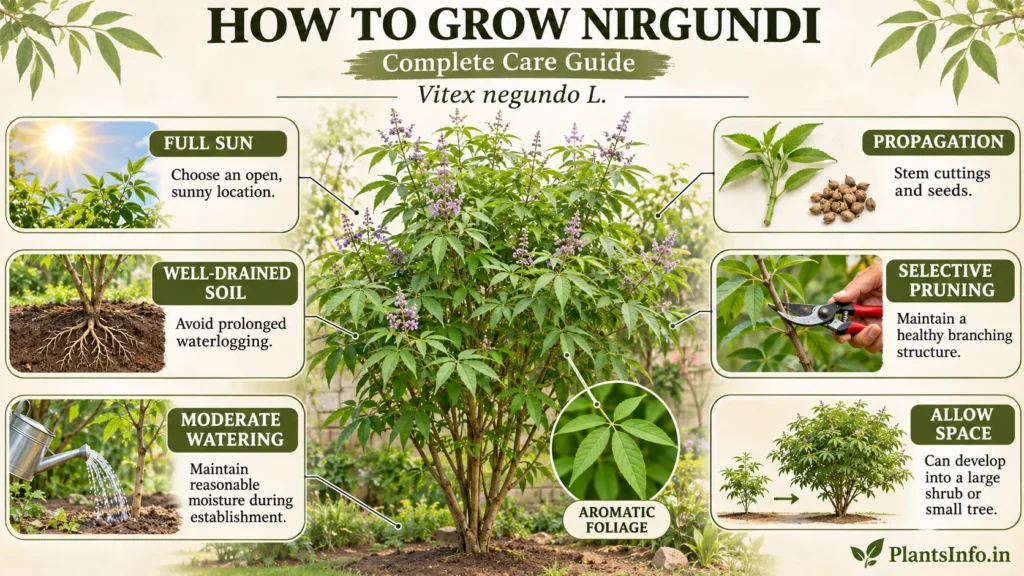
Practical guidance on planting, growing conditions, and routine plant care.
⚠️ Problems & Diseases
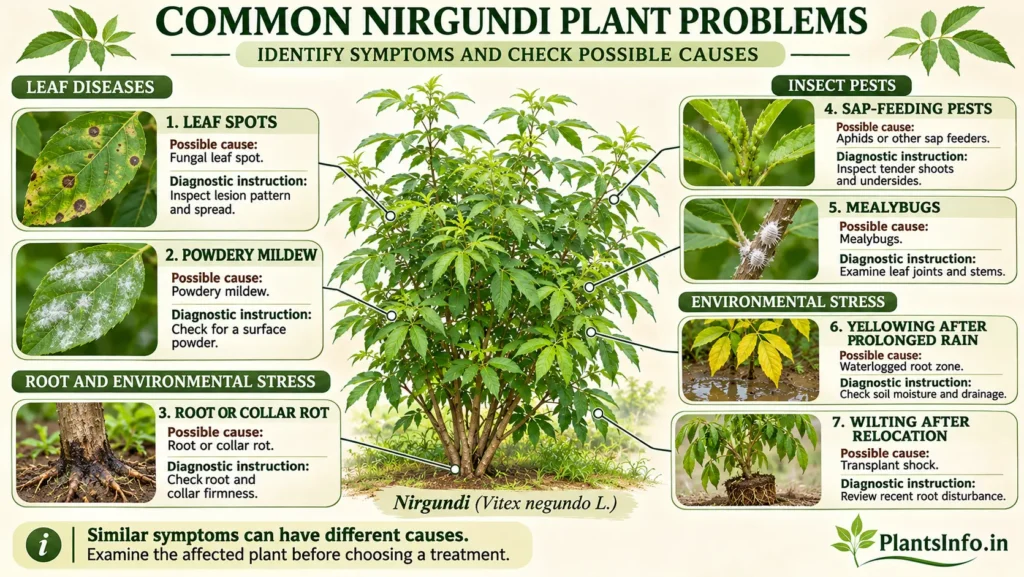
Information on common plant problems, diseases, and their identification.
🍂 Seasonal Care
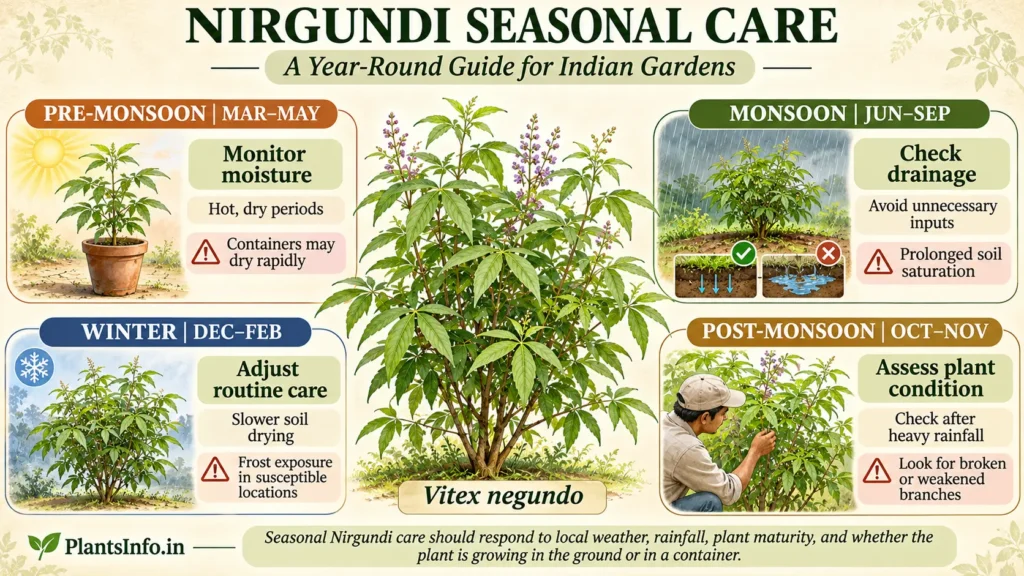
Season-specific guidance for maintaining plant health and growth.
🌸 Flowering Season
Information about flowering periods, seasonal patterns, and bloom development.

🍃 Benefits
An overview of documented uses, benefits, and relevant plant characteristics.

🧬 Varieties
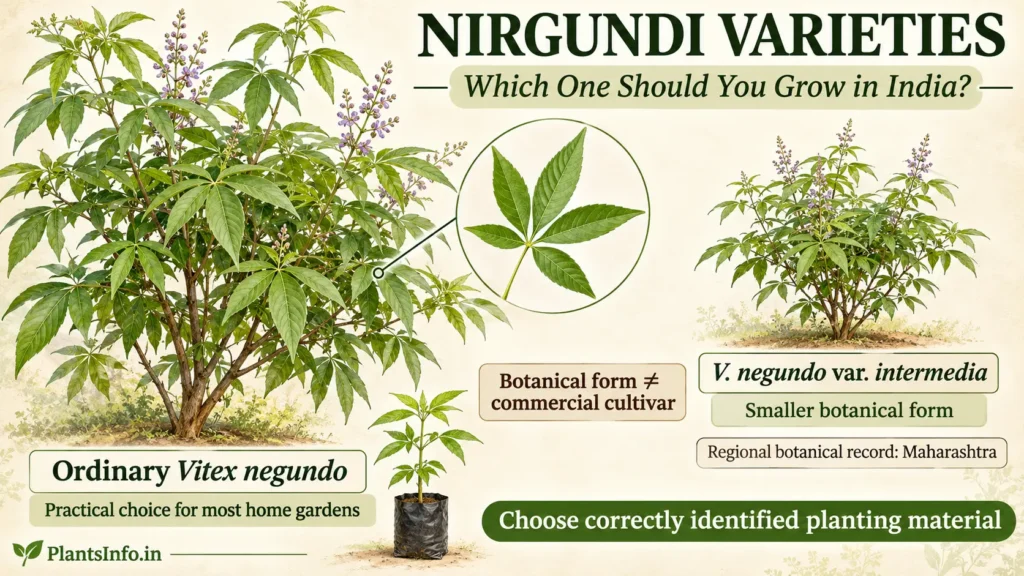
Explore recognised varieties, cultivars, and related forms of this plant.
📊 Quick Facts
A concise reference to important botanical and cultivation facts.