Nirgundi Varieties: Which One Should You Grow in India?
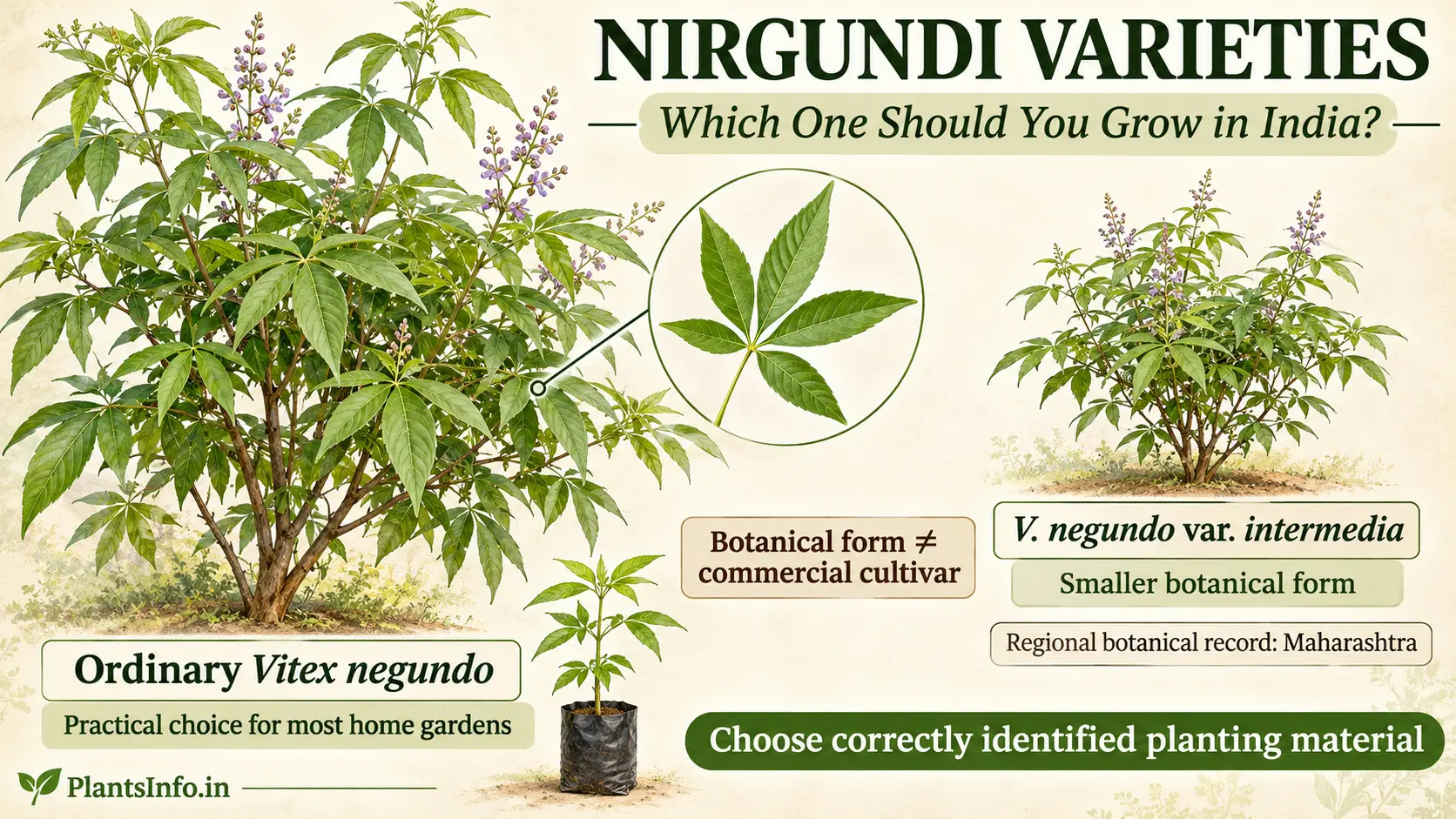
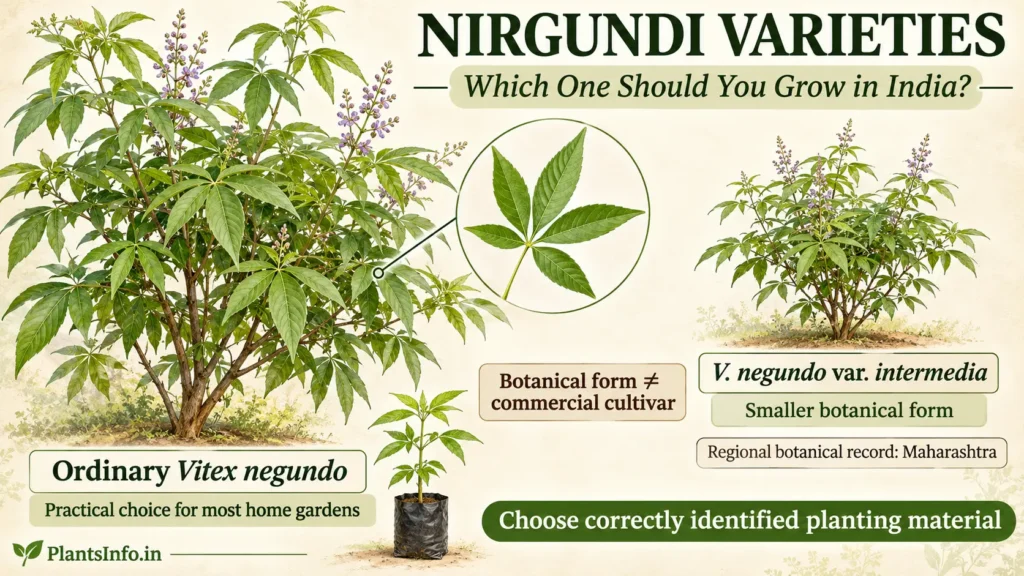
For most Indian home gardeners, ordinary, correctly identified Vitex negundo is the most practical choice because established commercial garden cultivars have not been verified. A smaller form called V. negundo var. intermedia is described in a Maharashtra regional flora, but its taxonomic treatment differs between botanical authorities and it is not an established compact nursery cultivar.
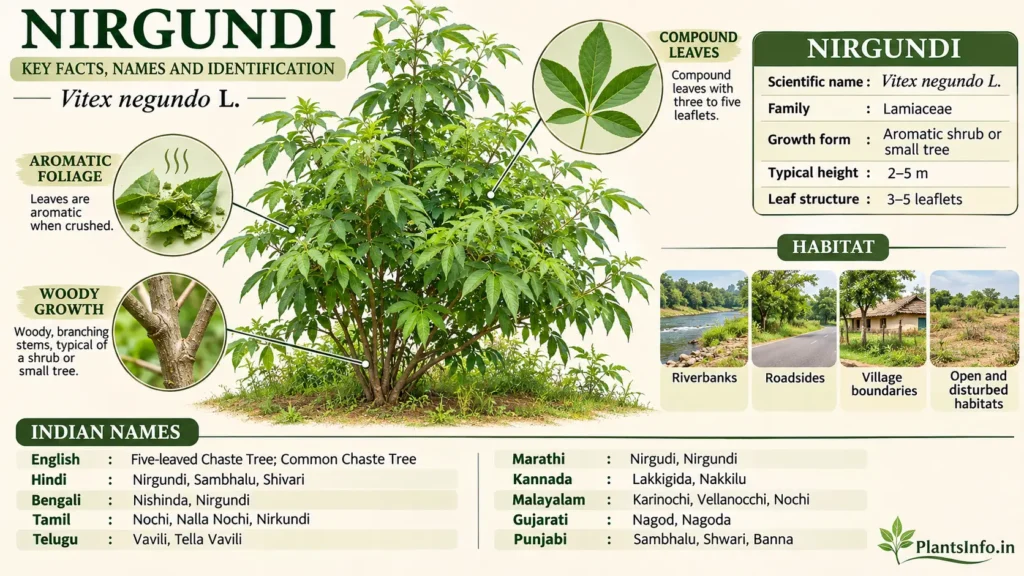
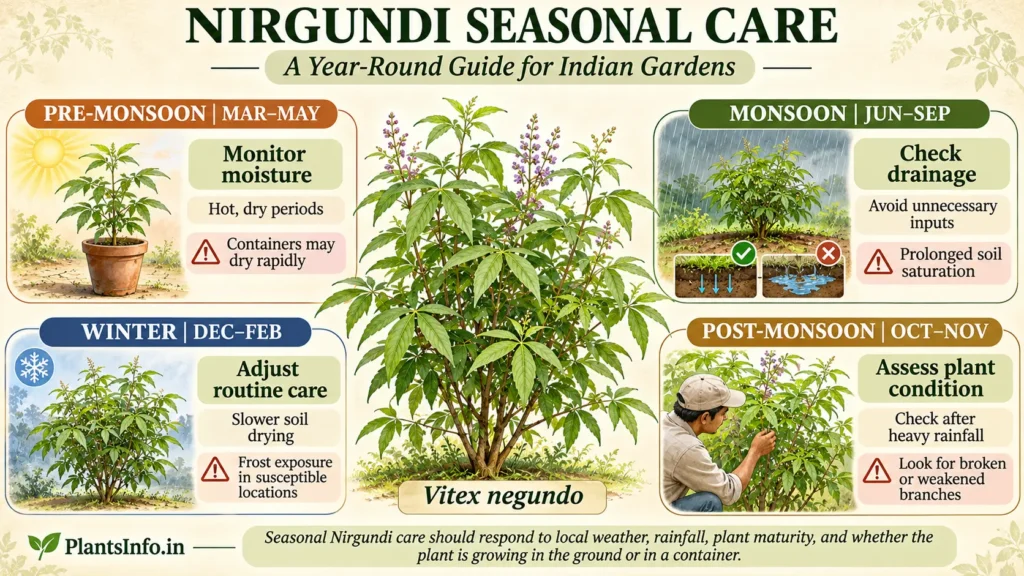
See also: Nirgundi plant profile, how to grow it, common problems, seasonal care, and its flowering season.
Nirgundi is more often encountered as a wild or locally grown shrub than as a plant sold in a standard range of named horticultural varieties. Gardeners may therefore receive ordinary seedlings or locally propagated plants without knowing whether a nursery label refers to a recognised botanical name or a genuine garden selection.
Recommended Products
Disclosure: As an Amazon Associate, PlantsInfo may earn from qualifying purchases.
🌱 Growing Essentials
The following products can help with container gardening, potting, root development, soil management, and healthy plant growth.

Organic Potting Soil Mix
Provides nutrients, structure, and healthy growing conditions for container plants.

Coco Peat Growing Medium
Enhances moisture retention while maintaining excellent root-zone aeration.

Grow Bags for Plants
Improve drainage, root aeration, and vegetable production in limited spaces.

Plastic Pots for Plants
Ideal containers for seedlings, ornamentals, herbs, and balcony gardens.
Quick Variety Selector
| Variety or planting material | Type | Plant Size | Best For | Suited To |
|---|---|---|---|---|
| Unimproved local material | Ordinary species material | Large | Home gardens, boundaries | Regions where V. negundo is locally grown |
No established Indian commercial cultivar range has been verified for this species. The selector therefore uses ordinary local material as its comparison baseline rather than adding unsupported cultivar names or treating botanical synonyms as separate garden varieties.
Varieties in Detail
Ordinary Vitex negundo material
Ordinary V. negundo is the familiar species material encountered in Indian landscapes, village boundaries, roadsides, and cultivation. It is a woody shrub or small tree with aromatic compound leaves, typically bearing three to five leaflets and clusters of bluish-purple flowers.
Its main advantage for gardeners is that the species is widely recorded in India, making correctly identified local planting material a practical option. Its limitation is natural variation: plants raised from seed may differ in growth habit and mature size, so a seedling should not be expected to reproduce every characteristic of its parent plant.
Vitex negundo var. intermedia: a Maharashtra-recorded form
A regional flora of Raigad District, Maharashtra, describes V. negundo var. intermedia as a shrub approximately 90–120 cm tall. It distinguishes the form by its smaller, elliptic-lanceolate leaflets with irregularly serrated margins and violet flowers, and records it in hilly forest localities.
Its reported stature is smaller than that of ordinary V. negundo, making the botanical description interesting for comparison. However, the measurement comes from a regional botanical account and should not be treated as a guaranteed mature size in cultivation.
Its taxonomic status also requires qualification. Kew’s Plants of the World Online treats the name as a synonym of V. negundo, whereas the Maharashtra regional flora records it at varietal rank. It is therefore best regarded here as a regionally documented botanical form, not a verified compact horticultural cultivar.
Other recorded botanical names.
Names such as Vitex negundo var. incisa and V. negundo var. purpurascens occur in botanical literature and taxonomic synonym lists. They should not automatically be interpreted as separate, currently recognised garden varieties.
Kew’s taxonomic resources list these names among the synonyms associated with V. negundo. A nursery label using one of these names is not, by itself, evidence that the plant represents a distinct horticultural selection.
Head-to-Head Comparison
Ordinary V. negundo vs. the Maharashtra-recorded var. intermedia
Ordinary V. negundo is the more dependable choice for general home planting because it is widely recorded in India and ordinary species material is the relevant sourcing option. The regional description of var. intermedia reports a smaller shrub with distinct leaflet characteristics, but it does not establish predictable compact growth under garden conditions or reliable nursery availability. Choose ordinary species material for general planting; consider the botanical form only when its identity and provenance can be substantiated.
How to Choose for Your Space
Container or terrace garden
Nirgundi is naturally a woody shrub or small tree, so it is not a dependable choice where a permanently small container plant is required. Choose a young, correctly identified local plant only if you can accommodate its eventual growth; do not pay a premium for an unverified “dwarf Nirgundi” label.
Small ground plot (under 100 sq ft)
Consider one ordinary local plant only if sufficient space can be reserved for its mature growth. The smaller stature reported for var. intermedia may appear attractive, but the regional botanical record does not establish it as a reliably compact garden selection.
Larger garden or backyard
Ordinary local V. negundo is the straightforward choice for a boundary or open garden area. A named botanical form is unnecessary unless you have a specific identification or collection interest and can verify the planting material.
Regional Suitability
- North India: Ordinary V. negundo is the practical species-level choice; no distinct regional garden cultivar is established by the available information.
- South India: Ordinary V. negundo is widely recorded; no separately verified regional garden cultivar is identified here.
- Coastal regions: Use correctly identified local species material where the plant is grown; no superior coastal cultivar has been established.
- Maharashtra hill regions: The regional flora records var. intermedia in hilly localities, but this does not establish its commercial availability or garden performance.
- Other hill stations and high-altitude zones: The available information does not support recommending a distinct variety for these conditions.
Where to Source Nirgundi in India
For ordinary Nirgundi, look for correctly identified plants at established local nurseries, forest-nursery outlets, or agricultural and horticultural nursery networks. Locally sourced material is generally more practical than purchasing a plant advertised under an unfamiliar variety name.
When buying, check that the botanical name is Vitex negundo L. If a seller offers a named botanical form or cultivar, ask for its botanical identity and documented source. Treat claims such as “dwarf Nirgundi”, “high-yield variety” or “improved medicinal variety” cautiously unless the seller can provide credible supporting information.
Conclusion
For most Indian gardeners, correctly identified local Vitex negundo remains the practical choice; select a botanical form only when its identity and horticultural characteristics are substantiated.
🌿 About Nirgundi (Vitex negundo)
🌿 View Complete Nirgundi (Vitex negundo) Plant Profile →🌱 Growing Guide
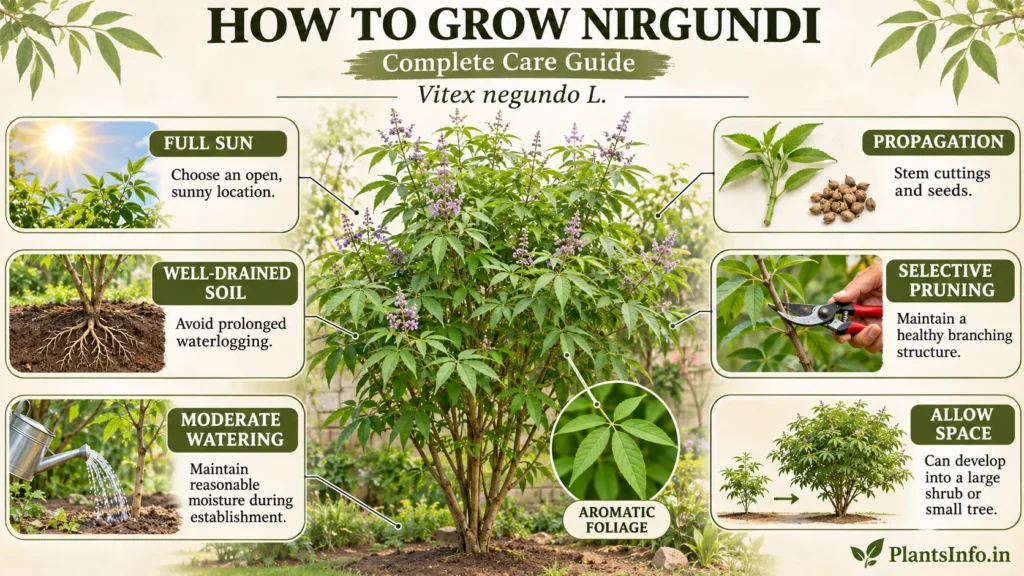
Practical guidance on planting, growing conditions, and routine plant care.
⚠️ Problems & Diseases
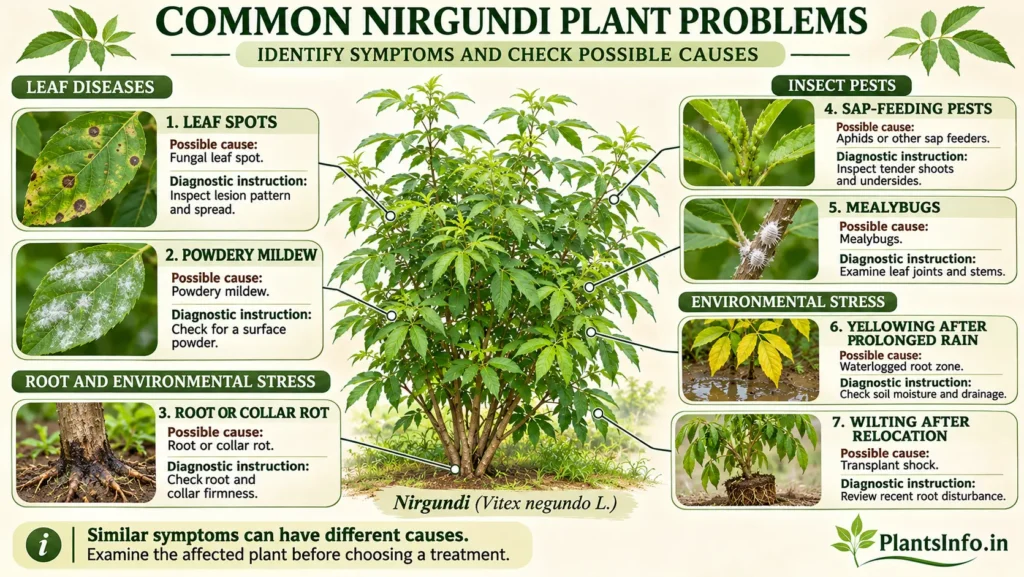
Information on common plant problems, diseases, and their identification.
🍂 Seasonal Care
Season-specific guidance for maintaining plant health and growth.
🌸 Flowering Season
Information about flowering periods, seasonal patterns, and bloom development.

🍃 Benefits
An overview of documented uses, benefits, and relevant plant characteristics.

🧬 Varieties
Explore recognised varieties, cultivars, and related forms of this plant.
📊 Quick Facts
A concise reference to important botanical and cultivation facts.