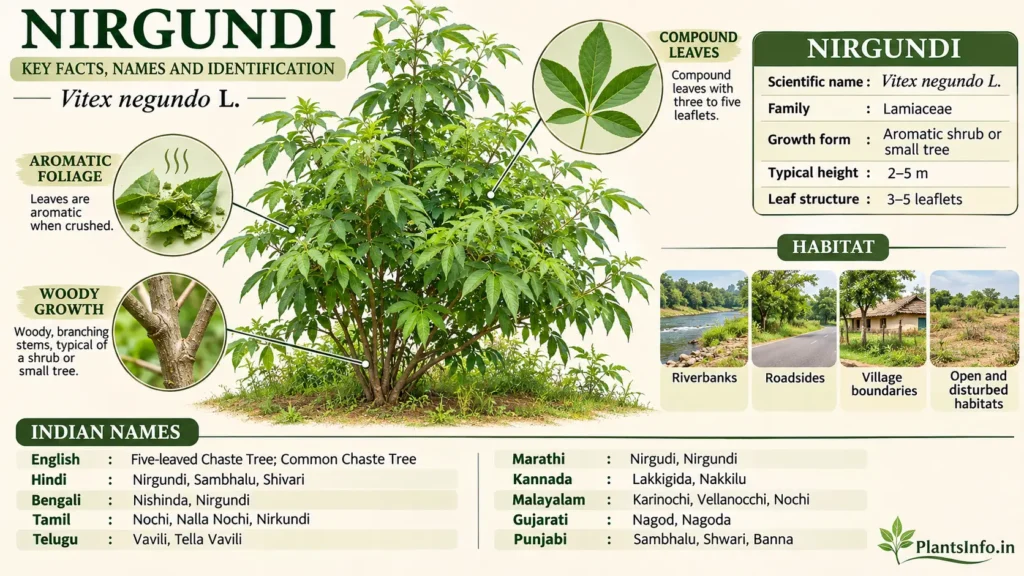
Nirgundi Plant: Key Facts, Names and What You Should Know
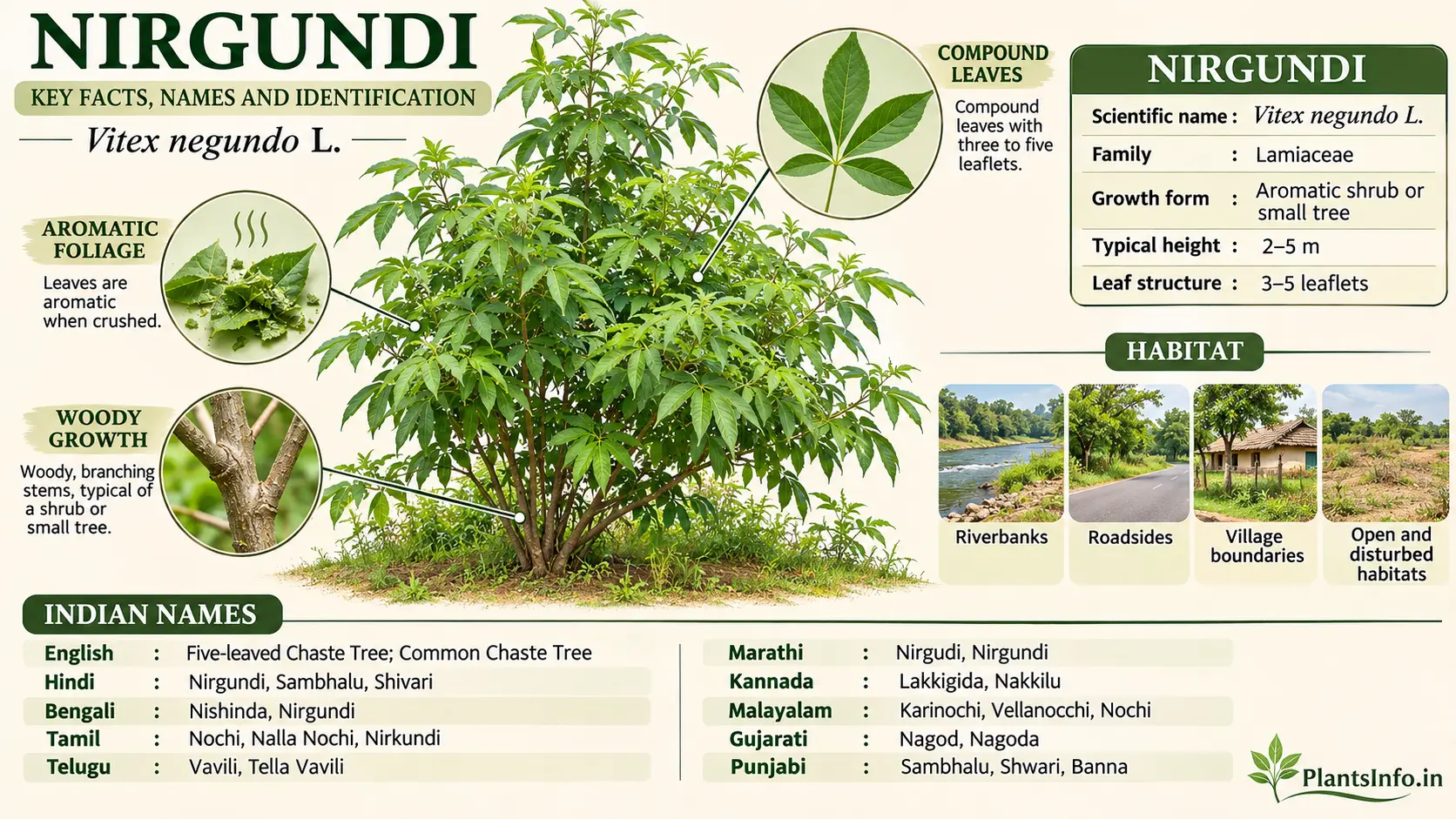
Nirgundi (Vitex negundo L.), also known as the Five-leaved Chaste Tree, is an aromatic shrub or small tree in the mint family, Lamiaceae. It is recorded widely across India, particularly along riverbanks, roadsides, village boundaries and other open or disturbed habitats.
See also: Nirgundi plant profile, how to grow it, common problems, seasonal care, and its flowering season.
Introduction
Crush one of its leaves, and a distinct aromatic smell becomes noticeable. This characteristic makes Nirgundi familiar in many rural and semi-urban landscapes.
Recommended Products
Disclosure: As an Amazon Associate, PlantsInfo may earn from qualifying purchases.
🌱 Growing Essentials
The following products can help with container gardening, potting, root development, soil management, and healthy plant growth.

Organic Potting Soil Mix
Provides nutrients, structure, and healthy growing conditions for container plants.

Coco Peat Growing Medium
Enhances moisture retention while maintaining excellent root-zone aeration.

Grow Bags for Plants
Improve drainage, root aeration, and vegetable production in limited spaces.

Plastic Pots for Plants
Ideal containers for seedlings, ornamentals, herbs, and balcony gardens.
Quick Facts
| Feature | Typical characteristic |
|---|---|
| Growth form | Woody, aromatic shrub or small tree |
| Leaf arrangement | Compound leaves with three to five leaflets |
| Mature height | Commonly reported around 2–5 m, with variation |
| Scientific name | Vitex negundo L. |
| Family | Lamiaceae |
Names in Different Languages
| Language | Common names |
|---|---|
| English | Five-leaved Chaste Tree; Common Chaste Tree |
| Hindi | Nirgundi, Sambhalu, Shivari |
| Bengali | Nishinda, Nirgundi |
| Tamil | Nochi, Nalla Nochi, Nirkundi |
| Telugu | Vavili, Tella Vavili |
| Marathi | Nirgudi, Nirgundi |
| Kannada | Lakkigida, Nakkilu |
| Malayalam | Karinochi, Vellanocchi, Nochi |
| Gujarati | Nagod, Nagoda |
| Punjabi | Sambhalu, Shwari, Banna |
Nirgundi is a widely recorded Indian common name. Five-leaved Chaste Tree is a corresponding English name.
What Does It Look Like?
Nirgundi generally develops as a much-branched shrub or small tree. Botanical descriptions commonly report mature heights of around 2–5 metres, although size varies with growing conditions and growth form.
Leaves: The leaves are compound, usually bearing three to five elongated, pointed leaflets. The central leaflet is generally larger than the lateral ones. The upper surface is relatively smooth, while the lower surface often has fine, pale hairs that can give it a greyish or silvery appearance.
Flowers: The individual flowers have a distinctive two-lipped structure. They occur in branched clusters, usually toward the ends of branches, and are bluish-purple to violet.
Fruit: The fruit is a small, rounded, fleshy drupe that becomes dark purple or black when mature.
Key identification feature: The combination of a larger central leaflet, paler hairy leaf undersides, and aromatic foliage helps distinguish Nirgundi from many other common shrubs.
Where Does It Grow in India?
Nirgundi is widely recorded across India, from the plains and lower hills to parts of the Himalayan region and coastal areas. Indian botanical records document its occurrence in several regions, including the Eastern Ghats, Western Ghats and numerous districts of southern and eastern India.
Regional Distribution
- Northern India: Recorded in states and regions including Uttar Pradesh, Punjab, Haryana, Rajasthan and the Himalayan foothills.
- Eastern India: Recorded in West Bengal, Odisha, Assam and neighbouring regions.
- Central India: Recorded in Madhya Pradesh and adjoining areas.
- Western India: Recorded in Gujarat and Maharashtra.
- Southern India: Recorded widely in Karnataka, Kerala, Tamil Nadu and Andhra Pradesh.
- Islands: Botanical records also document the species in the Andaman and Nicobar Islands.
The species is associated with riverbanks, moist localities, village margins, roadsides, wastelands, and deciduous forest environments. It occurs in rural and semi-urban landscapes, including areas where natural vegetation has been disturbed.
Distribution and Native-Range Classification
Indian botanical sources record Nirgundi extensively across the country. However, its native-range classification is not consistent across botanical references.
Kew’s accepted-species record lists its native range from Nepal to China, northern Vietnam and Taiwan, while Indian regional botanical sources document its widespread occurrence in India. These records reflect different treatments of its geographical status; widespread occurrence alone does not resolve whether all Indian populations are native or introduced.
What Is It Used For?
Nirgundi has several documented traditional and practical associations in India:
- Traditional medicine: Different parts of the plant are recorded in Ayurvedic and regional medicinal preparations. Detailed medicinal uses are covered separately.
- Mosquito-repellent practices: Its aromatic leaves have traditionally been used in practices intended to deter mosquitoes and other insects.
- Agricultural applications: Leaf materials and extracts have been investigated or used in traditional plant-protection practices.
- Hedge planting: Its branching growth makes it suitable for field boundaries and informal hedges.
- Ornamental planting: Its foliage and bluish-purple flowers give it value as an ornamental shrub.
These uses vary by region and practice. Their traditional use should not be taken as proof of clinical effectiveness or reliable pest-control performance.
Conclusion
Nirgundi is a distinctive Indian shrub or small tree, recognised by its aromatic foliage, compound leaves and broad occurrence in rural and semi-urban habitats. Its botanical identity and regional names make it a familiar species in India’s plant landscape.
🌿 About Nirgundi (Vitex negundo)
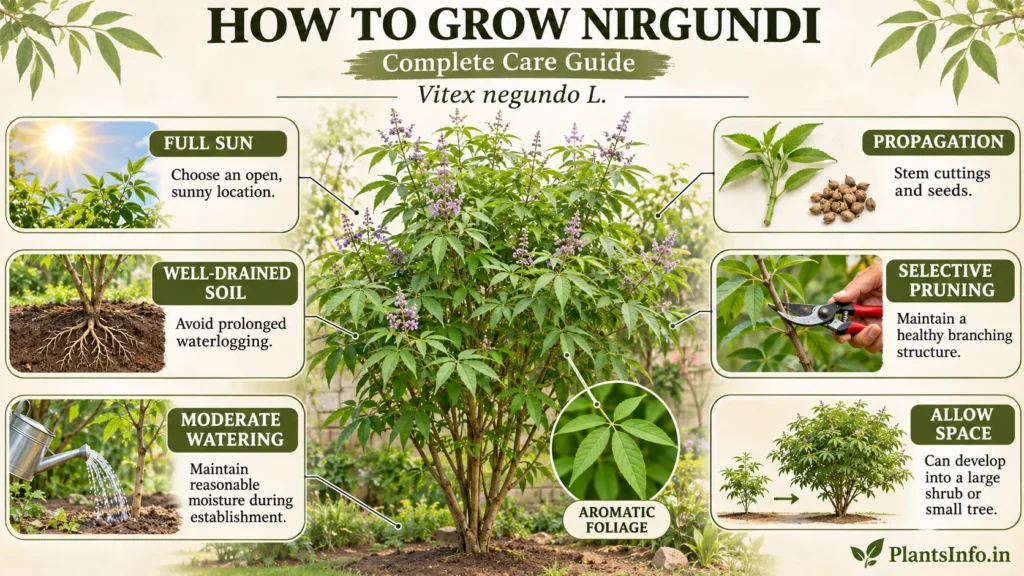
🌿 View Complete Nirgundi (Vitex negundo) Plant Profile →🌱 Growing Guide
Practical guidance on planting, growing conditions, and routine plant care.
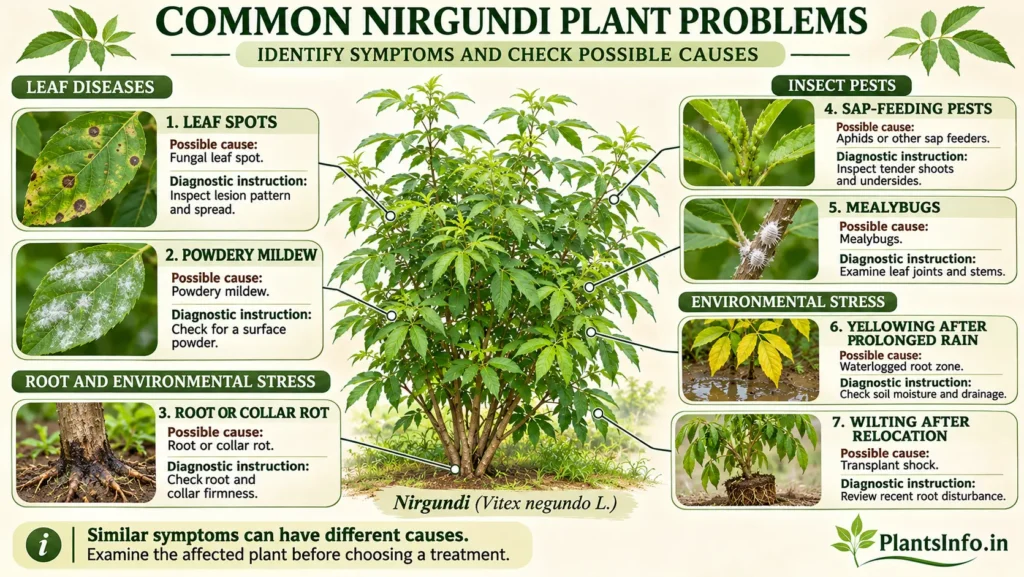
⚠️ Problems & Diseases
Information on common plant problems, diseases, and their identification.
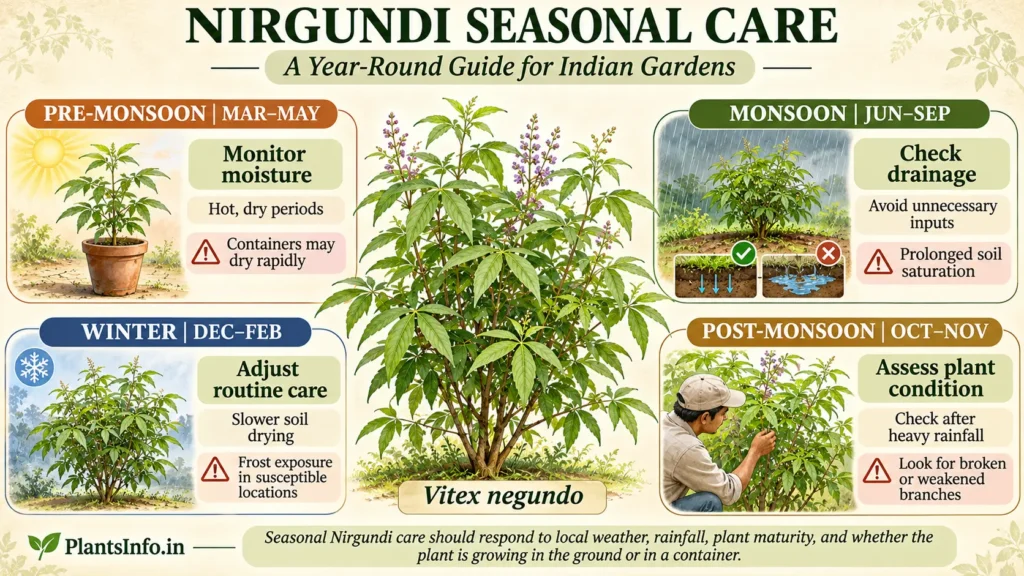
🍂 Seasonal Care
Season-specific guidance for maintaining plant health and growth.
🌸 Flowering Season
Information about flowering periods, seasonal patterns, and bloom development.

🍃 Benefits
An overview of documented uses, benefits, and relevant plant characteristics.

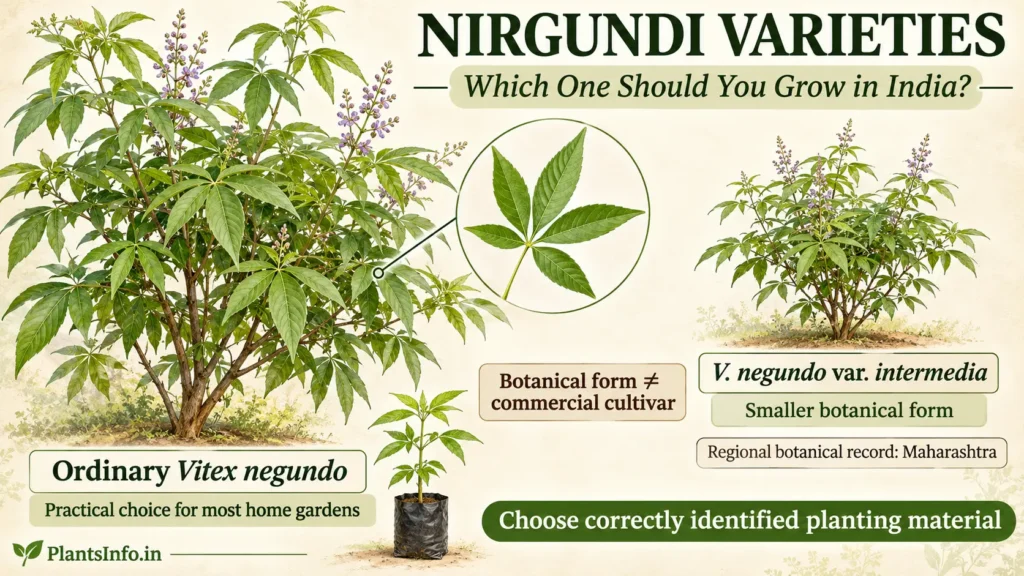
🧬 Varieties
Explore recognised varieties, cultivars, and related forms of this plant.
📊 Quick Facts
A concise reference to important botanical and cultivation facts.