Bougainvillea Flowering Season in India
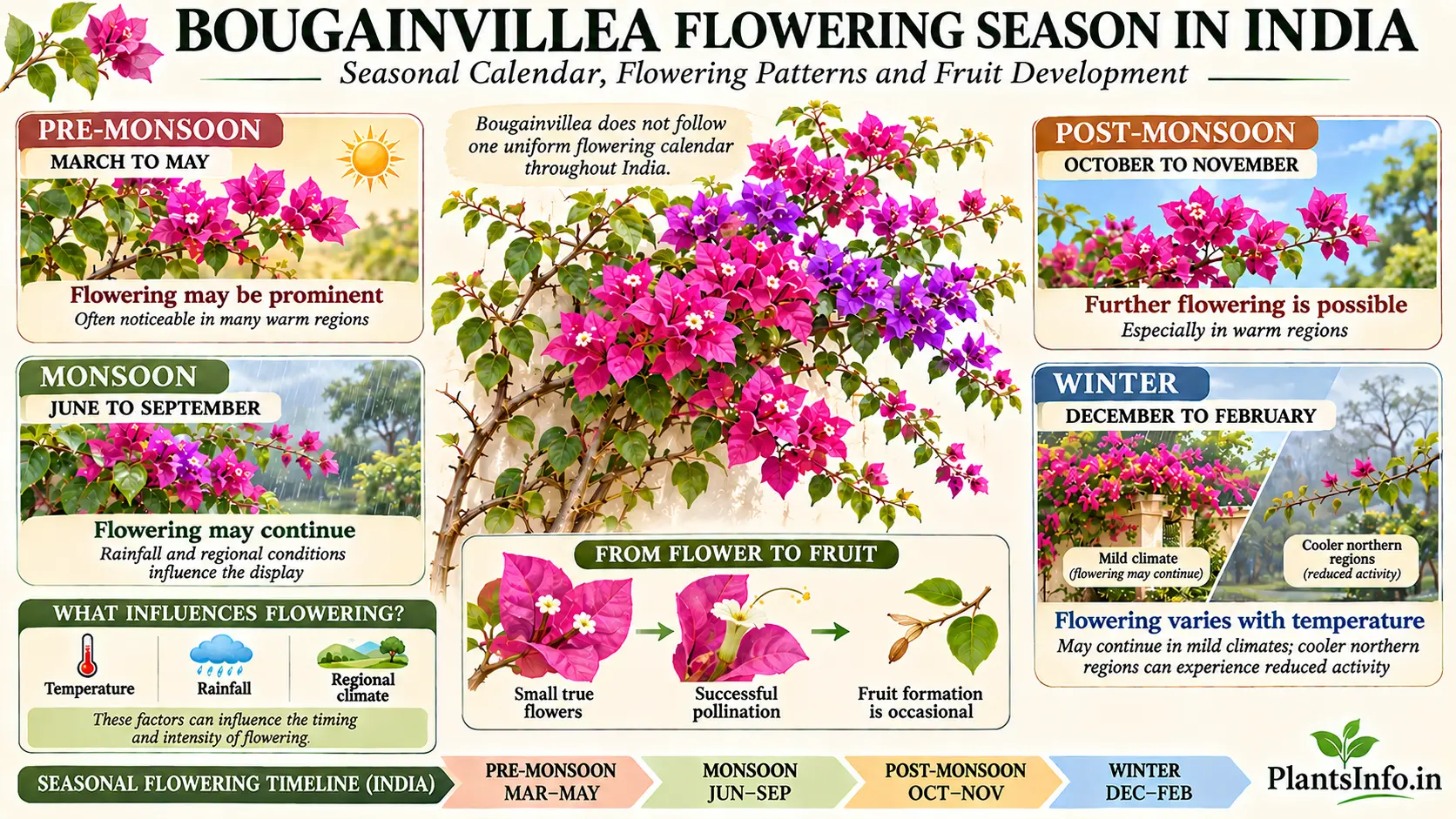
Bougainvillea can produce repeated flowering displays in warm parts of India, although the timing and intensity vary with regional climate, temperature, rainfall and the cultivated species or selection. Its colourful bracts often remain conspicuous longer than the small true flowers. Fruit formation is occasional and considerably less predictable than the ornamental display.
See also: Bougainvillea Comm. ex Juss. plant profile, how to grow it, common problems, seasonal care, and its benefits.
Introduction
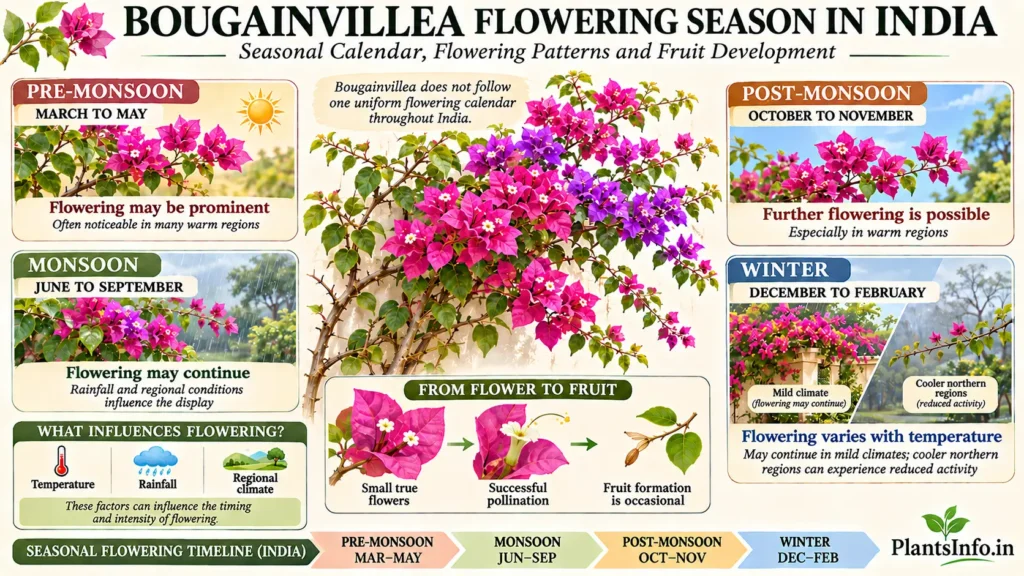
Bougainvillea does not follow one uniform flowering calendar across India. Temperature and rainfall influence when flowering becomes most noticeable, while the colourful bracts can extend the apparent duration of the display beyond the lifespan of individual flowers.
Recommended Products
Disclosure: As an Amazon Associate, PlantsInfo may earn from qualifying purchases.
🌱 Growing Essentials
The following products can help with container gardening, potting, root development, soil management, and healthy plant growth.

Organic Potting Soil Mix
Provides nutrients, structure, and healthy growing conditions for container plants.

Coco Peat Growing Medium
Enhances moisture retention while maintaining excellent root-zone aeration.

Grow Bags for Plants
Improve drainage, root aeration, and vegetable production in limited spaces.

Plastic Pots for Plants
Ideal containers for seedlings, ornamentals, herbs, and balcony gardens.
Biological Timing at a Glance
| Biological stage | Typical period |
|---|---|
| Flower initiation | Variable; depends on climate and plant condition |
| Flowering displays | May recur under favourable conditions |
| Prominent bract display | Often associated with favourable warm and relatively dry periods |
| Fruit set | Occasional, following successful pollination |
| Fruit development | After pollination and fertilisation; duration varies |
| Fruit maturity | No widely recognised commercial harvest period |
India’s Seasons and This Plant
| Season (months) | What the plant is doing |
|---|---|
| Pre-monsoon (Mar–May) | Flowering may be prominent in many warm regions, although intensity varies |
| Monsoon (Jun–Sep) | Flowering may continue, but rainfall and regional conditions influence the display |
| Post-monsoon (Oct–Nov) | Further flowering is possible in warm regions |
| Winter (Dec–Feb) | Flowering may continue in mild climates; cooler northern regions can experience reduced activity |
Flowering Season in Detail
When Does Bougainvillea Flower?
Unlike plants with a relatively fixed annual flowering season, bougainvillea can produce repeated flowering displays. In warm tropical and subtropical parts of India, flowering may occur during several parts of the year.
Prominent displays are often observed during favourable warm periods, including periods with comparatively dry weather. However, the exact flowering pattern differs among cultivated plants and geographical regions. Repeated flowering does not necessarily mean that flowers remain continuously present throughout the year.
Regional Variation in India
| Indian region | General flowering pattern |
|---|---|
| Southern India | Flowering can occur over extended periods because of generally warm conditions |
| Western India | Prominent displays commonly occur during favourable warm and relatively dry periods |
| Eastern India | Flowering may continue through multiple parts of the year, with rainfall influencing display intensity |
| Northern plains | Flowering is generally more seasonal, with cooler winter conditions influencing activity |
| Himalayan and colder regions | Flowering is more restricted by lower temperatures and the length of the favourable growing period |
These are broad regional patterns rather than fixed flowering dates. Local climate, elevation and the particular cultivated plant can alter the observed period.
How Long Do the Flowers Last?
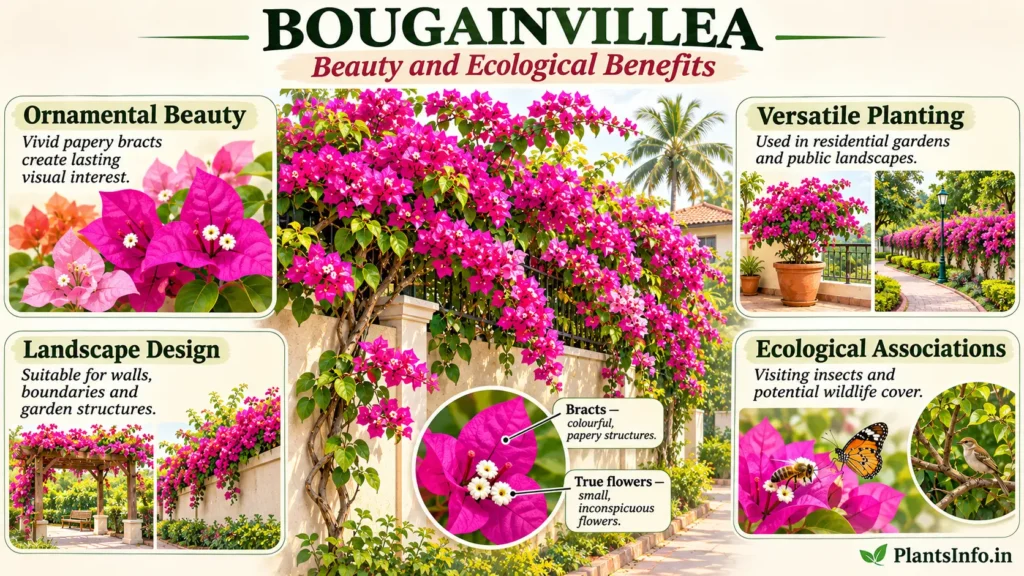
The small true flowers are short-lived compared with the colourful bracts surrounding them. The bracts often remain attractive for considerably longer, which is why a bougainvillea display can appear to last for weeks even though individual flowers do not.
What Influences Flowering?
Several environmental and plant-related factors influence flowering intensity:
- Temperature: Warm conditions generally support active growth and flowering, while cold conditions can reduce activity.
- Rainfall: Prolonged wet conditions may coincide with less prominent displays in some plants.
- Light exposure: Adequate sunlight is associated with stronger flowering performance.
- Plant characteristics: Species, cultivated selections, and plant maturity contribute to differences in flowering behaviour.
The relative importance of these factors varies, so no single flowering trigger applies uniformly across the genus.
Fruiting Season
Bougainvillea produces fruit, although fruit formation is much less conspicuous than its ornamental flowering display.
When Does Fruit Develop?
Fruit development follows successful pollination and fertilisation. The fruit is a small, dry structure, commonly described as an achene. Its formation is occasional in many cultivated settings and should not be expected after every flowering display.
What Does the Fruit Look Like?
The mature fruit is small, dry, and inconspicuous. Unlike the colourful bracts, it does not provide a prominent visual feature and is not normally associated with a household or commercial harvest.
There is no broadly established fruit-ripening or harvesting season for ornamental bougainvillea in India.
Best Time to Plant
The monsoon (Jun–Sep) is generally a suitable planting window for bougainvillea in many Indian regions because seasonal rainfall can support establishment. The precise timing depends on local rainfall, temperature, and drainage conditions.
The post-monsoon (Oct–Nov) can be another suitable period in warmer parts of India. In colder northern locations, the planting window may need to avoid the coldest part of winter.
There is no universal planting date for the entire genus, and local climatic conditions are more useful than a single nationwide calendar.
Month-by-Month Calendar
The following calendar describes broad biological patterns for cultivated bougainvillea in India. It is indicative rather than a fixed schedule; regional climates and cultivated selections can shift the observed activity.
| Month | Season | What the Plant Is Doing |
|---|---|---|
| January | Winter | Flowering may continue in warmer regions; activity can be reduced in colder areas |
| February | Winter | Flowering activity may increase as temperatures become milder |
| March | Pre-monsoon | Flowering may become prominent in many warm regions |
| April | Pre-monsoon | Active growth and flowering are commonly observed |
| May | Pre-monsoon | Flowering may continue before the onset of monsoon rainfall |
| June | Monsoon | Flowering patterns vary with rainfall and regional conditions |
| July | Monsoon | Flowering may continue, although displays can be less consistent |
| August | Monsoon | Flowering activity remains variable |
| September | Monsoon | Flowering may continue as regional rainfall patterns change |
| October | Post-monsoon | Further flowering is possible in warm regions |
| November | Post-monsoon | Flowering may remain prominent in favourable climates |
| December | Winter | Flowering may continue in mild climates; activity can decline in colder regions |
What Can Go Wrong Seasonally?
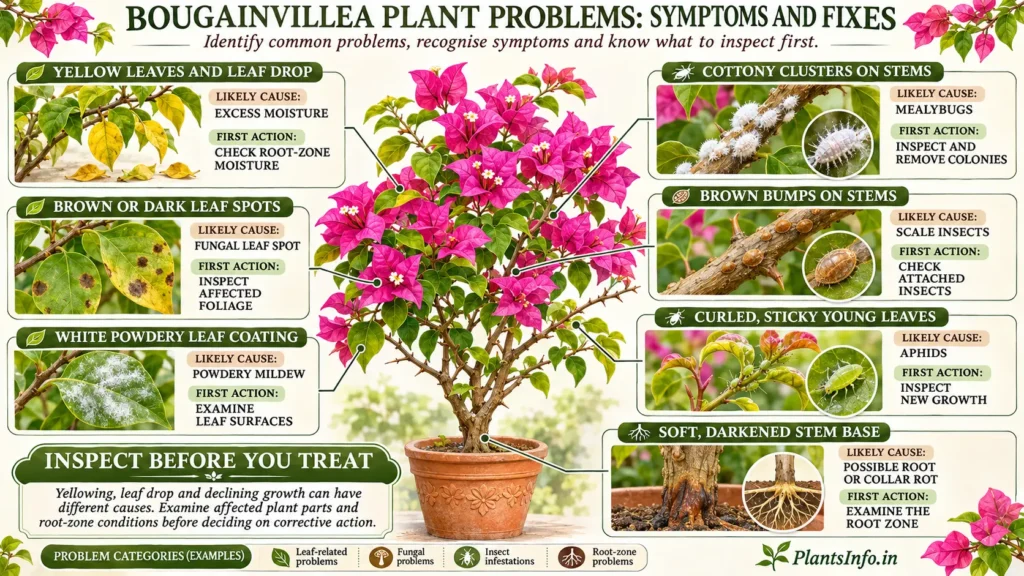
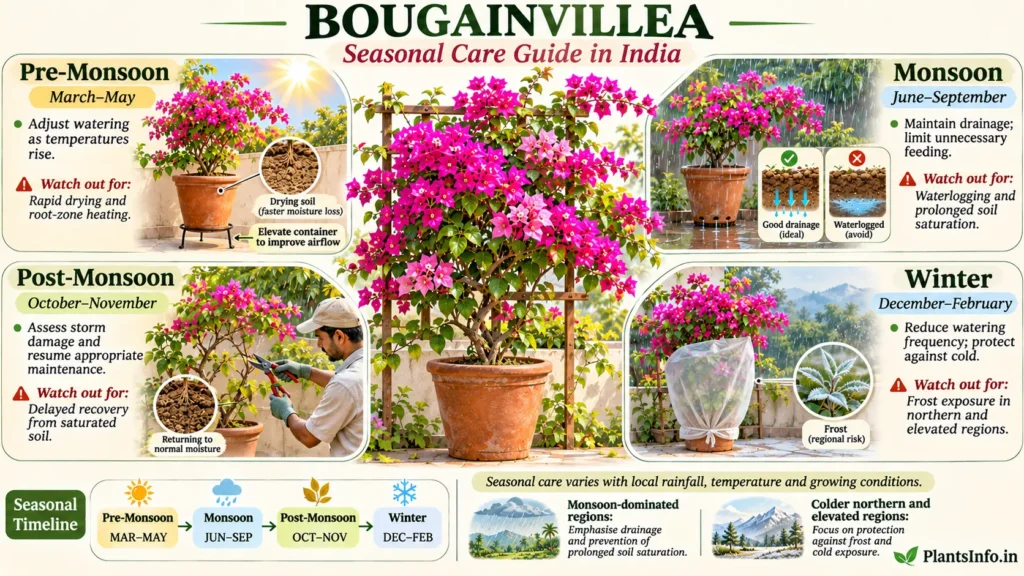
- Winter cold: Low temperatures and frost in colder regions can suppress flowering and damage exposed plant growth.
- Prolonged monsoon rainfall: Extended wet weather may coincide with reduced flowering displays or shorter-lasting bract displays.
- Regional timing differences: A plant flowering prominently in one part of India may show a different pattern elsewhere because of local climatic conditions.
Reduced flowering during a particular season does not necessarily indicate that the plant has entered dormancy or is unhealthy.
Conclusion
Bougainvillea’s capacity for repeated flowering displays makes it a distinctive ornamental genus, but its seasonal performance is best understood through local climate rather than a fixed nationwide flowering calendar.